Every successful interview starts with knowing what to expect. In this blog, we’ll take you through the top Tile Tool Proficiency interview questions, breaking them down with expert tips to help you deliver impactful answers. Step into your next interview fully prepared and ready to succeed.
Questions Asked in Tile Tool Proficiency Interview
Q 1. What types of tile saws are you proficient with?
My tile saw proficiency spans several types, each suited for different tasks. I’m highly skilled with wet saws, which are essential for precise cuts in ceramic and porcelain tiles. These saws use water to cool the blade and reduce dust, resulting in cleaner cuts and a longer blade life. I’m also proficient with dry saws, ideal for quick cuts on softer materials like mosaic tiles, though they generate more dust and require more frequent blade changes. Finally, I’m experienced with angle grinders fitted with diamond blades; these are versatile tools useful for intricate cuts and shaping, especially in renovation projects where precise adjustments are needed. For example, when working with intricate mosaic designs, the angle grinder’s maneuverability becomes invaluable.
Q 2. Explain the process of selecting the appropriate grout for different tile types.
Grout selection is crucial for tile longevity and aesthetics. It depends heavily on the tile type and the intended environment. For example, highly absorbent tiles, like natural stone, require a grout with a higher water absorption capacity to prevent cracking. Conversely, less porous tiles, such as porcelain, can handle a standard grout. The intended use also factors in; for high-moisture areas like showers, an epoxy grout is preferred due to its superior water resistance and mildew resistance. Cement-based grouts are suitable for most other applications and are more readily available and cost-effective. I always carefully review the tile manufacturer’s recommendations and the grout manufacturer’s specifications to ensure a perfect match. Failing to do so could lead to issues like efflorescence (salt deposits) or grout cracking.
Q 3. How do you ensure proper tile spacing and alignment?
Maintaining consistent tile spacing and alignment is critical for a professional finish. I use spacers of uniform thickness, typically plastic or tile clips, to ensure even gaps between tiles. Accurate spacing is especially important with larger format tiles. For alignment, I rely on a combination of tools and techniques. A laser level is invaluable for checking levelness and plumbness, particularly across larger areas. I use a straight edge and level constantly to check alignment. The first few tiles laid act as a guide for the rest of the installation. Any deviation early on is amplified as the installation progresses. I always double-check my work frequently to catch any misalignment early, rectifying it before it becomes a larger problem. Imagine laying bricks – you wouldn’t start without a line to ensure a straight wall; tiling is no different.
Q 4. Describe your experience with different tile laying patterns (e.g., running bond, herringbone).
I have extensive experience with various tile laying patterns. Running bond, the most common, involves laying tiles in a staggered brick-like pattern. Herringbone is a more intricate pattern where tiles are laid at 45-degree angles, creating a zig-zag effect. I’ve also worked with basketweave, diagonal, and even more complex custom designs. Each pattern presents unique challenges. For instance, herringbone requires more precise cutting and careful planning to maintain consistent angles and spacing. The complexity of the pattern determines the time and skill level required and is often reflected in the cost. Understanding the nuances of different patterns and their implications for material usage and cutting is crucial for accurate quoting and efficient execution.
Q 5. What are the different methods for cutting tiles for intricate designs?
Intricate designs necessitate precise tile cutting. Wet saws are excellent for straight cuts, but for curves and complex shapes, I employ several methods. A tile nipper is ideal for small, precise cuts and shaping. Angle grinders with diamond blades provide versatility for creating curves and shaping tiles. For very intricate designs, I may use a combination of these tools with a template. For instance, when creating a circular design, I’d use a template and carefully score the tile before breaking it along the line. In other scenarios, I use a template and then use the angle grinder to fine-tune the curves and perfect the shape. It’s like sculpting with tile; it requires a level of artistic sensibility along with technical skill.
Q 6. How do you handle uneven subfloors before tile installation?
Uneven subfloors are a common challenge that can lead to tile cracking and uneven surfaces. Before installation, I thoroughly assess the subfloor’s levelness. If minor imperfections exist, self-leveling compound is my go-to solution. It creates a smooth, level surface ready for tiling. For more significant unevenness, I might recommend a full subfloor repair involving plywood or concrete patching. This is an important preparatory stage that can prevent costly future problems. Ignoring subfloor preparation is like building a house on a shaky foundation – the end result will inevitably suffer.
Q 7. What safety precautions do you take when using power tools for tile installation?
Safety is paramount. When using power tools like wet saws and angle grinders, I always wear safety glasses, hearing protection, and a dust mask. Long sleeves and closed-toe shoes are essential to protect against flying debris and accidental cuts. I ensure the work area is well-ventilated, especially when using a dry saw. I regularly check the power tools for damage before each use and follow the manufacturer’s instructions carefully. A secure grip on the tools is crucial to prevent accidents. It’s not just about my own safety; it also protects those around me. Proper safety measures translate into a smooth, accident-free project.
Q 8. Describe your experience with waterproofing techniques for tile installations.
Waterproofing is crucial in tile installations, especially in wet areas like bathrooms and showers. It prevents water damage to the substrate and underlying structures. My experience encompasses various waterproofing methods, including the use of waterproof membranes like Schluter-KERDI or RedGard. These are applied to the substrate before tiling, creating a completely sealed barrier. I also have extensive experience with pre-sloped shower pans, ensuring proper drainage to prevent water pooling. For less critical areas, I utilize a high-quality waterproof thin-set mortar, ensuring proper application to avoid any potential leaks. The choice of waterproofing method depends greatly on the application and local building codes. For instance, a simple backsplash might only require a waterproof thin-set, whereas a shower will demand a full membrane system.
For example, in a recent project involving a walk-in shower, I used a Schluter-KERDI membrane. After preparing the substrate, I carefully applied the membrane, overlapping seams and ensuring a watertight seal around all penetrations. This meticulous approach guarantees long-lasting protection against water damage.
Q 9. Explain the process of mixing and applying thin-set mortar.
Mixing thin-set mortar requires precision to achieve the right consistency. I typically use a clean bucket and add the recommended amount of water to the dry mix, following the manufacturer’s instructions precisely. Using a drill with a paddle mixer, I mix at low speed, gradually increasing it to ensure proper blending and prevent air pockets. The ideal consistency is like peanut butter – smooth and spreadable, not runny or too thick. Too much water leads to weak bonding, while too little results in difficult application. I always test the mix on a small area before applying it to the whole surface.
Applying the thin-set involves using a notched trowel to create even ridges. The size of the notch depends on the tile size and material. Larger tiles usually require larger notches to provide sufficient mortar coverage. I apply the thin-set to the substrate in manageable sections, ensuring full coverage before placing the tile. This ensures strong adhesion and prevents hollow tiles.
Q 10. How do you prevent cracking or chipping of tiles during installation?
Preventing cracking and chipping during tile installation involves careful planning and execution. Firstly, ensuring the substrate is perfectly level and smooth is paramount. Any unevenness can put stress on the tiles, leading to cracking. I use a self-leveling compound where necessary to ensure a flat surface. Secondly, the proper selection and application of thin-set mortar is crucial. Using the right notch size on the trowel ensures the proper amount of mortar is used for each tile. Thirdly, I avoid dropping or forcefully placing tiles. I carefully place each tile, pressing it firmly but gently into the mortar bed to ensure full contact. Finally, using backer board instead of drywall for substrates helps prevent cracking from substrate movement.
For example, in a recent project involving delicate porcelain tiles, I meticulously prepared the substrate with a self-leveling compound and applied a thin layer of thin-set using a smaller notch trowel to minimize stress on the tiles. This ensured their integrity.
Q 11. How do you troubleshoot common problems like lippage or hollow tiles?
Lippage, or uneven tile heights, is often caused by inconsistent mortar application or an uneven substrate. Troubleshooting involves tapping down high tiles with a rubber mallet to level them. If the substrate is uneven, that needs to be addressed before tiling. For hollow tiles, I use a tapping method to identify them and carefully remove and re-set them with fresh mortar. Sometimes, a simple tap will reveal hollowness. If that happens, removal and reapplication is needed. This is why I emphasize thorough checking and preparation before beginning the tiling process.
In one instance, I discovered lippage after several tiles were set. I carefully used a rubber mallet to tap down the higher tiles, making sure not to crack them in the process. This meticulous approach ensured a smooth and level surface.
Q 12. What are the different types of tile and their suitability for various applications?
Tile comes in many types, each suited to different applications. Ceramic tiles are durable, affordable, and widely available, suitable for floors, walls, and backsplashes. Porcelain tiles are denser and more water-resistant than ceramic, ideal for high-traffic areas and wet environments. Natural stone tiles, like marble or granite, offer elegance and durability but require more care and maintenance. Glass tiles add a stylish touch to backsplashes and accent walls, while mosaic tiles allow for intricate designs. The choice of tile depends on factors such as budget, durability requirements, aesthetic preferences, and the specific application.
For example, in a kitchen renovation, I chose durable porcelain tiles for the floor, resisting wear and tear. However, for the backsplash, I selected glass tiles to add a modern design element.
Q 13. How do you calculate the amount of tile and grout needed for a project?
Calculating tile and grout quantities requires accurate measurements and accounting for waste. First, measure the area to be tiled in square feet. Next, determine the tile’s square footage per piece, factoring in tile size and shape. Divide the total area by the tile’s square footage to get the approximate number of tiles needed. Add 10-15% extra to account for cuts, breakage, and mistakes. For grout, I typically estimate the amount based on the grout joint width and total tile area. Many manufacturers provide online calculators to assist with this process. I always verify the quantity with the tile supplier before starting the project to ensure sufficient material is available.
For instance, if a room measures 100 sq ft and tiles are 1 sq ft each, I’d calculate 100 tiles, plus 10-15 extra for a total of 110-115 tiles.
Q 14. Describe your experience with different types of tile adhesives.
My experience includes various tile adhesives, from traditional thin-set mortars to modified mortars and specialized adhesives. Thin-set mortars are versatile and suitable for most applications. Modified thin-set mortars contain additives that improve bonding, water resistance, and flexibility. These are crucial for installations in wet areas or where substrate movement is expected. Specialized adhesives, such as those designed for large-format tiles or natural stone, provide superior adhesion and prevent issues like cracking or slippage. The choice of adhesive depends on factors like tile type, substrate, and intended application.
For instance, when installing large-format porcelain tiles, I’d use a high-performance modified thin-set mortar designed for superior bonding and crack prevention. Conversely, a standard thin-set is often sufficient for smaller ceramic tiles on a stable substrate.
Q 15. What is the proper procedure for cleaning and sealing grout?
Cleaning and sealing grout is crucial for maintaining the longevity and aesthetic appeal of tile installations. It involves a multi-step process focusing on thorough cleaning followed by effective sealing.
Cleaning: Begin by sweeping or vacuuming the grout lines to remove loose dirt and debris. Then, use a grout cleaner specifically designed for the type of grout you’re working with (cement-based, epoxy, etc.). Apply the cleaner according to the manufacturer’s instructions, often using a stiff brush or grout brush to scrub the lines. Rinse thoroughly with clean water and allow to dry completely. For stubborn stains, a solution of oxygen bleach and water can be effective, but always test in an inconspicuous area first.
Sealing: Once the grout is completely dry (at least 24-48 hours), apply a grout sealant. Choose a sealant appropriate for your grout type and the area’s exposure to moisture. Apply the sealant evenly using a brush or sponge, ensuring complete saturation. Allow the sealant to dry according to the manufacturer’s instructions, often 2-4 hours. A second coat may be necessary, especially in high-traffic areas or wet environments. This prevents staining and makes future cleaning much easier.
Example: On a recent bathroom remodel, I used a pH-neutral cleaner on the cement-based grout before applying a penetrating, water-based sealer. The client was thrilled with the result; the grout remained clean and stain-free even after months of use.
Career Expert Tips:
- Ace those interviews! Prepare effectively by reviewing the Top 50 Most Common Interview Questions on ResumeGemini.
- Navigate your job search with confidence! Explore a wide range of Career Tips on ResumeGemini. Learn about common challenges and recommendations to overcome them.
- Craft the perfect resume! Master the Art of Resume Writing with ResumeGemini’s guide. Showcase your unique qualifications and achievements effectively.
- Don’t miss out on holiday savings! Build your dream resume with ResumeGemini’s ATS optimized templates.
Q 16. How do you handle challenging cuts, such as curved or angled cuts?
Handling challenging cuts, like curves or angles, requires precision and the right tools. Simply using a standard tile cutter won’t suffice; you’ll need to employ a combination of techniques.
Curved Cuts: For curves, a wet saw with a diamond blade is essential. You’ll need to make multiple, closely spaced cuts to gradually shape the tile. A tile nipper can be used for refining the shape and removing small sections for a smooth finish. For very tight curves, a tile file can help to achieve ultimate precision.
Angled Cuts: Angled cuts are often achieved using a wet saw, adjusting the blade angle to match the desired angle. A miter saw can also be effective for sharper angles, ensuring a precise and clean cut. Accurate measuring and marking are critical for both curved and angled cuts. Always practice on scrap tiles before attempting the cut on the final piece.
Example: In a recent project involving a curved shower wall, I meticulously used a wet saw to make numerous small cuts, then refined the shape with a nipper and file. The final result was a seamless and beautiful curve.
Q 17. Describe your experience with installing large-format tiles.
Installing large-format tiles presents unique challenges, primarily concerning weight, handling, and ensuring level installation. My experience includes working with tiles up to 48” x 48”.
Support and Preparation: Proper substrate preparation is paramount. The surface needs to be perfectly flat and level to prevent cracking or unevenness. Using a self-leveling compound can be critical for achieving this. Sufficient support is also key; using additional support structures such as backer boards can be critical for very large format tiles.
Handling and Cutting: Large tiles are heavy and require careful handling to prevent breakage. Using specialized lifting tools and employing multiple installers for handling can improve efficiency and safety. Cutting these tiles requires industrial-grade wet saws with powerful motors and diamond blades designed for large-format applications.
Installation: Using modified thin-set mortar is essential to ensure proper adhesion and minimize the risk of cracking. It’s vital to ensure consistent coverage and correct spacing. It is important to also plan your layout and ensure you work with a sufficient number of helpers to ensure the tile is properly set.
Example: During a recent kitchen backsplash project, I installed 24” x 48” porcelain tiles. Careful planning, proper substrate preparation, and using a large-format wet saw were crucial for a successful installation.
Q 18. What are the best practices for maintaining a clean and organized workspace?
Maintaining a clean and organized workspace is essential for efficiency, safety, and the overall quality of the finished product. My approach involves a system of organization and ongoing cleanup.
Designated Areas: I establish separate zones for tools, materials, and waste. Tools are kept neatly arranged, allowing for easy access. Materials are stored in a way that prevents damage or mixing.
Regular Cleanup: I regularly clear debris and excess materials throughout the day, preventing clutter and tripping hazards. This includes regular sweeping and wiping, particularly in areas where mortar and other wet materials are present.
Waste Disposal: Proper waste disposal practices are critical. Waste materials are disposed of in a responsible and environmentally friendly manner according to local regulations.
Example: On a recent large-scale project, maintaining a clean workspace was particularly important. By organizing tools and materials effectively, and by performing regular cleanup throughout the day, I was able to complete the project quickly and safely.
Q 19. How do you ensure proper ventilation during tile installation?
Proper ventilation is crucial during tile installation, especially when using thin-set mortar, sealants, or adhesives that release volatile organic compounds (VOCs). These compounds can be harmful if inhaled in poorly ventilated spaces.
Open Windows and Doors: The simplest solution is to open windows and doors to maximize natural ventilation. This is often sufficient for smaller projects.
Exhaust Fans: For larger projects or areas with limited natural ventilation, using exhaust fans is necessary. Position fans to draw air away from the work area and expel it outdoors.
Ventilation Systems: In some cases, a dedicated ventilation system, like those used in construction sites, may be necessary to ensure adequate air exchange.
Respiratory Protection: Regardless of the ventilation level, respiratory protection such as a dust mask is always recommended to filter out dust and particles.
Example: During a recent bathroom renovation, I used an exhaust fan and kept windows slightly ajar to ensure sufficient ventilation when applying thin-set mortar and grout.
Q 20. Describe your experience with different types of tile trim and molding.
My experience encompasses various tile trim and molding options, each offering unique aesthetic and functional properties. The choice depends on factors like tile type, design style, and location.
Metal Trim: Aluminum, stainless steel, and brass trims are durable and offer a modern look. They are ideal for transitions between different materials or for creating accents.
Plastic Trim: PVC and other plastic trims are budget-friendly and offer a variety of colors and finishes. However, they may not be as durable as metal.
Ceramic and Porcelain Trim: Matching ceramic or porcelain trim pieces offer a seamless and cohesive look. They require precise cutting and installation for a clean finish.
Bullnose Tiles: Bullnose tiles are rounded edge tiles that are often used to finish edges and corners, providing a smooth, finished look.
Example: In a recent project, I used matching ceramic trim pieces to create a clean transition between the wall tiles and the shower pan. In another project, I employed metal trim to accentuate the transition between tile and wood flooring.
Q 21. How do you handle customer requests or changes during a project?
Handling customer requests or changes during a project requires clear communication, professionalism, and adaptability. My approach is centered around collaboration and transparency.
Open Communication: I encourage open communication with clients throughout the project, addressing any concerns or questions promptly.
Assessing Feasibility: When a change request arises, I carefully assess its feasibility, considering factors like timeline, budget, and material availability.
Providing Options: I present the client with options, explaining the implications of each choice, including any potential cost or schedule adjustments.
Documentation: Any agreed-upon changes are documented in writing to avoid misunderstandings and ensure clarity.
Example: A client recently requested a change in tile color midway through a project. I carefully assessed the implications, discussed the alternatives, and provided a revised timeline and cost estimate. The client appreciated the transparency and the collaborative approach, leading to a successful project completion.
Q 22. What is your experience with different types of backer boards?
Choosing the right backer board is crucial for a successful tile installation. It provides a stable, even surface and prevents cracking or damage. I’ve worked extensively with several types, each with its own strengths and weaknesses.
- Cement backer board (CBU): This is a common choice, offering good strength and moisture resistance. I’ve used it in countless bathroom and kitchen projects. It’s relatively easy to cut and install, making it ideal for DIYers and professionals alike. However, it can be heavy and prone to cracking if not handled carefully.
- Water-resistant gypsum backer board: Lighter than CBU, this is a good option for areas with moderate moisture. I prefer it for projects where weight is a concern, or for areas like laundry rooms where the moisture levels aren’t as extreme as in a shower. It’s important to use a waterproof membrane beneath it in wet areas.
- Waterproof backer board: This offers the best moisture protection and is essential for shower walls and other high-moisture environments. I often specify this for high-end projects or in situations where water damage is a serious concern. It’s generally more expensive than CBU but offers superior long-term protection.
- Plywood (with proper waterproofing): While less common as a primary backer board, I’ve used exterior-grade plywood with a waterproof membrane in certain situations, especially when working with existing structures where replacing the entire substrate wasn’t feasible. It’s crucial to ensure proper sealing to prevent moisture penetration.
My selection process always considers the specific project requirements – the type of tile, the location, the expected moisture levels, and the budget. For example, I wouldn’t use standard CBU in a steam shower; waterproof backer board is essential there.
Q 23. How do you manage a project timeline and budget effectively?
Managing project timelines and budgets requires a meticulous approach. I start by creating a detailed scope of work, breaking the project down into manageable tasks. Each task gets a realistic time estimate and associated cost. I use project management software (I’m proficient in both Asana and Trello) to track progress, identify potential delays, and manage resources effectively.
For example, if a particular type of tile is backordered, I immediately communicate that delay to the client and explore alternative solutions. Regular communication is key to keeping the client informed and ensuring their expectations are aligned with the project’s progress.
Budget management involves careful material sourcing, negotiating with suppliers, and tracking expenses diligently. I maintain detailed records of all purchases and labor costs, comparing them to the initial budget regularly. If I anticipate cost overruns, I communicate them proactively to the client and propose solutions. This proactive approach prevents surprises and maintains trust.
Q 24. Describe your experience with repairing damaged tiles.
Repairing damaged tiles depends heavily on the extent and nature of the damage. Minor chips or cracks can often be repaired using epoxy resin matched to the tile color. I meticulously clean the area, apply the resin, and carefully shape it to match the surrounding tile. For larger cracks or broken tiles, replacement is usually necessary.
The process involves carefully removing the damaged tile without causing further damage to the surrounding area. Then, I prepare the area, apply fresh thinset mortar, and install the replacement tile. For particularly delicate or expensive tiles, I might use a specialized adhesive to ensure a secure bond.
In one instance, I had to repair a cracked porcelain tile in a high-traffic area of a commercial kitchen. Using a specialized epoxy resin and carefully matching the color, the repair was practically invisible. Success in tile repair requires patience, attention to detail, and a good understanding of different materials and their properties.
Q 25. What are some common mistakes to avoid when installing tiles?
Several common mistakes can derail a tile installation. Avoiding these pitfalls is key to a successful project:
- Improper substrate preparation: Failing to ensure a clean, level, and stable substrate is a recipe for disaster. Cracks and unevenness will show through the tile.
- Incorrect thinset application: Too little thinset leads to poor adhesion; too much results in messy grout lines. I always follow the manufacturer’s recommendations for thinset usage.
- Uneven grout lines: Consistent grout lines are crucial for a professional look. Using spacers consistently is vital.
- Failing to seal grout and natural stone: This leaves the grout and stone susceptible to staining and damage. Sealing protects the investment.
- Ignoring expansion joints: Ignoring the need for expansion joints in large areas can lead to cracking as the substrate expands and contracts.
- Cutting tiles incorrectly: Using the wrong tools or techniques can chip or crack tiles, leading to replacement and delays.
I always emphasize careful planning and meticulous execution to avoid these common mistakes. A little extra care at each stage goes a long way in achieving a flawless finished product.
Q 26. What software or tools do you use to create tile layouts or designs?
For creating tile layouts and designs, I utilize a combination of software and tools.
- SketchUp: This 3D modeling software allows me to create detailed visualizations of tile layouts, experimenting with different patterns and orientations before installation. I can even integrate the exact tile dimensions and textures for a highly realistic preview.
- AutoCAD: This software is invaluable for precise measurements and detailed drawings, especially for complex commercial projects requiring exact tile placement and calculations.
- Adobe Photoshop: I often use Photoshop to create detailed mockups and presentations for clients, showcasing various tile options and designs.
- Hand sketches and physical mockups: For smaller or simpler projects, hand sketches and small-scale physical mockups are still important for initial ideation and client review.
The choice of software depends on the project’s complexity and client requirements. For a small bathroom remodel, hand sketches might suffice. For a large-scale commercial project, AutoCAD and SketchUp provide the precision and detail needed.
Q 27. Explain the importance of using proper personal protective equipment (PPE).
Using proper Personal Protective Equipment (PPE) is non-negotiable on every project, regardless of size. It’s not just about following regulations; it’s about protecting myself and my team from potential hazards.
- Safety glasses or goggles: Protect eyes from flying debris during cutting and grinding.
- Dust mask or respirator: Essential to prevent inhalation of silica dust, especially when working with natural stone or certain types of tile.
- Gloves: Protect hands from chemicals, cuts, and abrasions.
- Hearing protection: Power tools can be extremely loud; hearing protection is vital to prevent long-term damage.
- Knee pads: Make long periods of kneeling more comfortable and reduce risk of injury.
- Steel-toed boots: Protect feet from dropped objects and heavy materials.
I always ensure that I and my team have the appropriate PPE for the task at hand. Neglecting PPE can lead to serious injuries, impacting both personal health and project timelines. Safety is always my top priority.
Q 28. Describe your experience with working with different types of natural stone.
Working with natural stone is a rewarding but challenging experience, requiring specialized knowledge and techniques. I have extensive experience with various types:
- Marble: A beautiful but relatively soft stone, prone to scratching and etching. Requires careful handling and sealing to maintain its luster.
- Granite: A very hard and durable stone, resistant to scratching and staining. Popular for kitchen countertops and flooring.
- Travertine: A porous limestone with a distinctive pitted texture. Requires careful sealing to prevent staining.
- Slate: A naturally cleft stone with a distinct layered structure. Can be quite durable but needs proper support during installation.
- Limestone: A softer stone than granite, but still relatively durable. More susceptible to etching than granite.
Each stone has unique properties, requiring specific tools, adhesives, and sealing techniques. For example, I use a wet saw with diamond blades for cutting granite and a different blade for softer stones like marble to prevent chipping. Understanding these nuances ensures a successful and aesthetically pleasing installation.
Key Topics to Learn for Tile Tool Proficiency Interview
- Understanding Tile Tool Fundamentals: Grasp the core functionalities and capabilities of the Tile Tool. This includes different modes of operation and their respective strengths and limitations.
- Practical Application in Various Projects: Demonstrate your ability to apply the Tile Tool effectively in diverse scenarios, such as creating intricate patterns, managing large datasets, and optimizing workflow efficiency.
- Advanced Techniques and Optimization: Explore advanced features and techniques to showcase a deeper understanding, including shortcuts, automation capabilities, and troubleshooting common issues.
- Data Manipulation and Analysis using Tile Tool: Understand how to effectively import, export, manipulate, and analyze data within the Tile Tool environment. Demonstrate proficiency in data cleaning, transformation, and visualization.
- Troubleshooting and Problem-Solving: Be prepared to discuss how you approach and solve problems encountered while using the Tile Tool. Highlight your analytical and problem-solving skills.
- Integration with Other Software: Showcase your understanding of how the Tile Tool integrates with other software and workflows within your potential work environment. This demonstrates a broader understanding of the tool’s role in a larger system.
- Best Practices and Efficiency: Discuss best practices for using the Tile Tool to achieve optimal results. This could include efficient data handling, minimizing processing time, and maximizing accuracy.
Next Steps
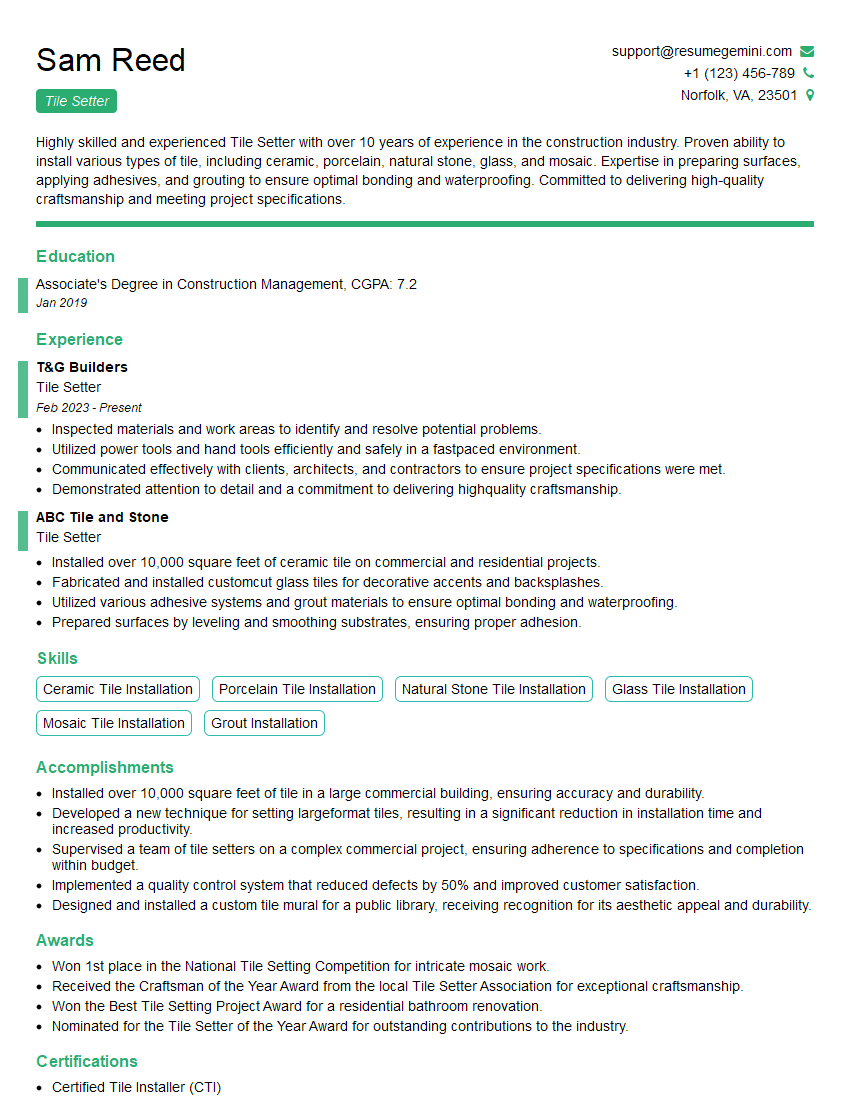
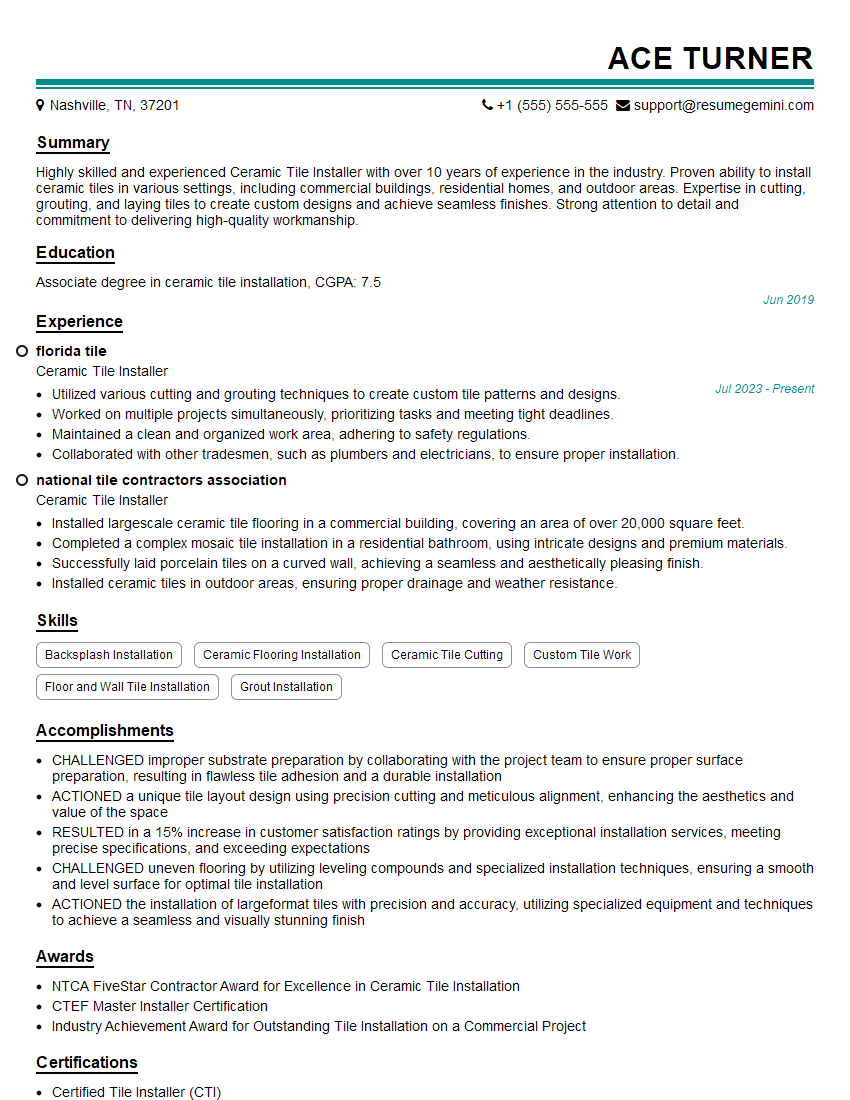
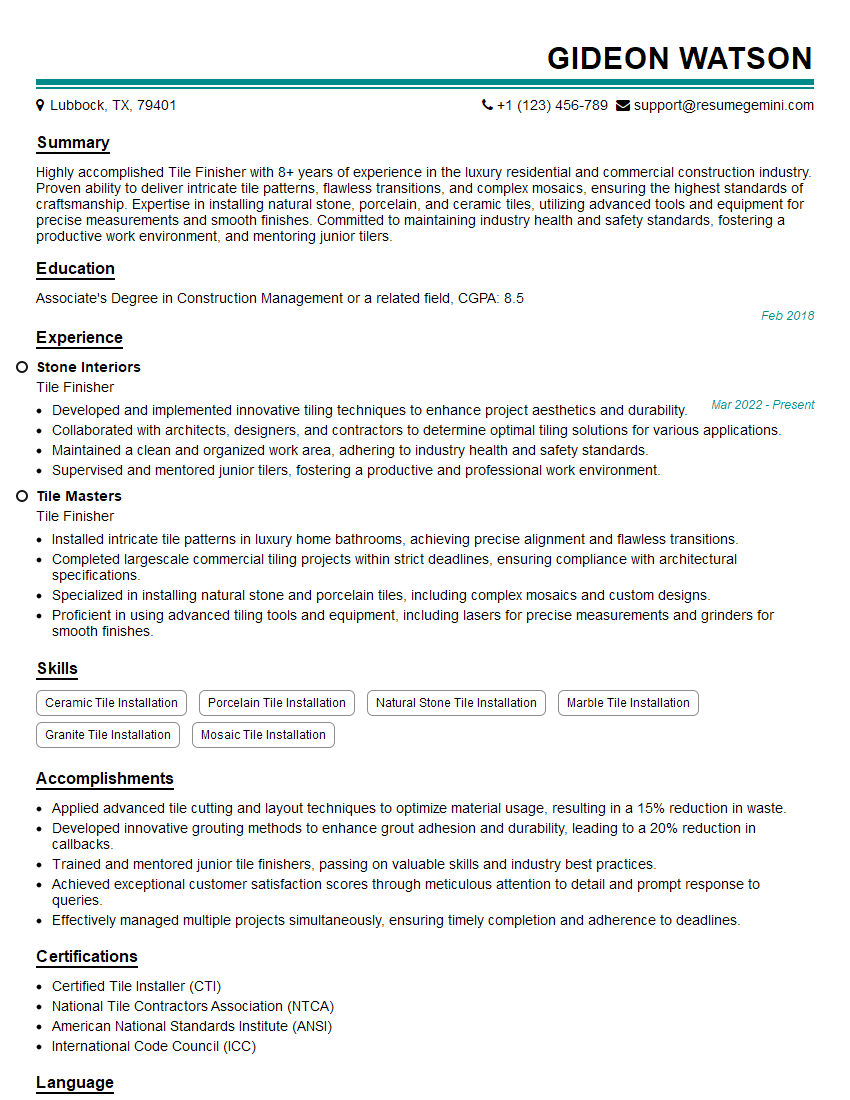
Mastering Tile Tool Proficiency is crucial for career advancement in many fields, opening doors to exciting opportunities and higher earning potential. A strong understanding of this tool significantly boosts your value to potential employers. To maximize your chances of landing your dream job, creating an ATS-friendly resume is essential. This ensures your qualifications are accurately captured by applicant tracking systems. We highly recommend using ResumeGemini to build a professional and impactful resume that highlights your Tile Tool skills effectively. ResumeGemini provides examples of resumes tailored to Tile Tool Proficiency, helping you present your abilities in the best possible light.
Explore more articles
Users Rating of Our Blogs
Share Your Experience
We value your feedback! Please rate our content and share your thoughts (optional).
What Readers Say About Our Blog
To the interviewgemini.com Webmaster.
Very helpful and content specific questions to help prepare me for my interview!
Thank you
To the interviewgemini.com Webmaster.
This was kind of a unique content I found around the specialized skills. Very helpful questions and good detailed answers.
Very Helpful blog, thank you Interviewgemini team.