The thought of an interview can be nerve-wracking, but the right preparation can make all the difference. Explore this comprehensive guide to Advanced Control Systems interview questions and gain the confidence you need to showcase your abilities and secure the role.
Questions Asked in Advanced Control Systems Interview
Q 1. Explain the difference between PID and Model Predictive Control (MPC).
PID (Proportional-Integral-Derivative) and Model Predictive Control (MPC) are both feedback control strategies, but they differ significantly in their approach. PID is a simpler, single-loop controller that reacts to the error between the desired setpoint and the actual process variable. It uses three terms: proportional (immediate response to error), integral (corrects cumulative error), and derivative (anticipates future error). MPC, on the other hand, is a more advanced multivariable control strategy that uses a process model to predict the future behavior of the system. It optimizes control actions over a prediction horizon to achieve the desired setpoint while satisfying constraints.
Think of it like this: PID is like driving a car using only the gas pedal and brake. You react to deviations from your desired speed. MPC is like using a navigation system; you have a plan for your entire journey, and you adjust your driving based on predictions of traffic and road conditions. MPC handles multiple inputs and outputs, constraints, and changing operating conditions more effectively than PID.
In summary: PID is reactive and simpler, while MPC is proactive and more complex, capable of handling more sophisticated systems.
Q 2. Describe your experience with different control strategies (e.g., cascade, feedforward, ratio).
I have extensive experience designing and implementing various advanced control strategies, including cascade, feedforward, and ratio control.
- Cascade Control: I’ve used cascade control in numerous industrial applications, such as controlling temperature in a chemical reactor. In this setup, a primary controller manipulates a secondary controller, creating a hierarchical control structure for tighter regulation. For instance, a master controller regulates the reactor temperature by manipulating the flow rate of a cooling jacket, which is itself controlled by a secondary controller managing the coolant pump. This improves performance and robustness.
- Feedforward Control: Feedforward control anticipates disturbances before they impact the process. I’ve applied this strategy successfully in process flow control, where changes in feedstock flow rate are anticipated, and adjustments are made to maintain stable output flow even before deviation is detected. For example, if we know the feedstock flow is about to increase, we preemptively adjust the outlet valve to prevent a surge in pressure.
- Ratio Control: This method maintains a constant ratio between two or more process variables. I implemented ratio control in blending operations where maintaining a specific ratio of ingredients is vital. For example, in a fuel blending plant, maintaining a precise ratio between gasoline components is critical for optimal engine performance. The controller continuously monitors and adjusts the flow rates to achieve and maintain this ratio.
Selecting the appropriate strategy depends critically on the process characteristics and control objectives.
Q 3. How do you tune a PID controller? Explain different tuning methods.
PID controller tuning is crucial for optimal performance. The goal is to find the values of the proportional gain (Kp), integral gain (Ki), and derivative gain (Kd) that minimize error, prevent oscillations, and ensure stability. Several tuning methods exist, each with its advantages and disadvantages:
- Ziegler-Nichols Method (discussed in the next question): A simple, empirical method.
- Cohen-Coon Method: Another empirical method, offering slightly improved performance over Ziegler-Nichols in some cases.
- Relay Feedback Method: This method uses a relay to induce oscillations and extract system parameters for tuning.
- Auto-tuning Methods: Many modern controllers offer automatic tuning capabilities. These algorithms analyze the system response and automatically adjust PID gains.
- Trial and Error: While less systematic, this iterative approach allows for fine-tuning based on observation and adjustments.
The chosen method depends on factors such as the process complexity, available instrumentation, and time constraints. Often, a combination of methods is used for optimal results. For example, I might use the Ziegler-Nichols method as a starting point and then refine the gains using trial and error or more advanced optimization techniques.
Q 4. What is the Ziegler-Nichols method, and when is it appropriate to use it?
The Ziegler-Nichols method is a simple, empirical tuning method for PID controllers. It involves two steps:
- Ultimate Gain Determination: Set the controller to P-only (Ki=Kd=0). Increase the proportional gain (Kp) until sustained oscillations occur. Note the ultimate gain (Ku) and the period of oscillations (Pu).
- Gain Calculation: Using the values of Ku and Pu, calculate the PID gains using specific formulas provided by Ziegler-Nichols. Different formulas exist depending on the desired response characteristics (e.g., less oscillatory, faster response).
This method is suitable for systems with relatively simple dynamics and where a quick, approximate tuning is acceptable. It’s relatively easy to implement, but the resulting controller may not be optimal and might exhibit overshoot or sluggish response. It’s best suited for initial tuning; further refinement is often needed.
I often use this as a starting point, especially when faced with a process where I have limited information, to quickly get a functioning control loop. From there I will usually refine the tuning using more advanced methods.
Q 5. Explain the concept of stability in control systems. How do you analyze stability?
Stability in a control system refers to the system’s ability to maintain equilibrium or return to it after a disturbance. An unstable system will exhibit unbounded oscillations or diverge from the setpoint. Stability analysis is crucial to ensure the safety and reliable operation of the controlled system.
Several methods exist for analyzing stability:
- Routh-Hurwitz Criterion: This algebraic method uses the coefficients of the characteristic equation to determine stability without explicitly solving for the roots. It’s particularly useful for higher-order systems.
- Bode Plots and Nyquist Plots: These frequency-domain methods use graphical representations of the system’s transfer function to assess stability margins (gain margin and phase margin). They provide insights into the system’s response to sinusoidal inputs.
- Root Locus Method: This graphical method shows the locations of the closed-loop poles as a function of a gain parameter. It’s helpful in understanding how gain affects stability and response time.
For example, if the Routh-Hurwitz criterion shows that all the coefficients in the first column of the Routh array are positive, we can conclude that the system is stable. Conversely, a negative coefficient indicates instability.
Q 6. What are the limitations of PID control?
While PID controllers are widely used and effective for many applications, they have limitations:
- Difficulty Handling Non-Linear Systems: PID controllers are fundamentally linear and might struggle with systems exhibiting significant non-linear behavior. Performance can degrade significantly under such conditions.
- Sensitivity to Parameter Changes: PID gains that work well under one set of conditions might need retuning if the system parameters change (e.g., due to aging or environmental variations).
- Limited Ability to Handle Constraints: PID controllers generally don’t explicitly handle constraints on manipulated variables or process variables. They might violate these constraints, leading to unsafe or inefficient operation.
- Inherent Interaction Challenges (Multivariable Systems): In multivariable systems, controlling multiple outputs independently can be challenging with simple PID control; interaction between loops can lead to undesirable behavior.
These limitations often necessitate the use of more sophisticated control strategies, like Model Predictive Control (MPC), especially for complex or high-performance applications.
Q 7. Describe your experience with different types of sensors and actuators used in control systems.
My experience encompasses a wide range of sensors and actuators used in various control systems. I’ve worked with:
- Sensors: Temperature sensors (thermocouples, RTDs, thermistors), pressure sensors (strain gauge, piezoresistive), flow sensors (Coriolis, ultrasonic, orifice plate), level sensors (ultrasonic, radar), pH sensors, position sensors (encoders, potentiometers), and various optical sensors.
- Actuators: Control valves (pneumatic, electric), electric motors (DC, AC servo, stepper), hydraulic actuators, pumps, and heaters.
The selection of sensors and actuators depends on factors such as accuracy requirements, operating conditions, cost, and compatibility with the control system. For example, in high-temperature applications, thermocouples might be preferred over RTDs due to their higher temperature range. Similarly, the choice between pneumatic and electric actuators often depends on factors such as the required speed, precision, and the available power supply.
I have hands-on experience selecting, calibrating, and integrating these components into complete control systems, ensuring accurate data acquisition and precise actuation for optimal performance.
Q 8. How do you handle sensor noise and uncertainty in a control system?
Sensor noise and uncertainty are inevitable in any control system. Think of it like trying to navigate using a slightly inaccurate GPS – you’ll still get to your destination, but with some deviations. To mitigate these issues, we employ several techniques. One common approach is filtering. This involves using algorithms, like Kalman filters or moving averages, to smooth out the noisy sensor readings and estimate the true value. Kalman filters, for example, are particularly powerful because they incorporate knowledge about the system’s dynamics and the noise characteristics to provide optimal estimates.
Another strategy involves redundancy. Using multiple sensors to measure the same variable allows us to compare readings and identify outliers, improving the overall accuracy. We can then apply techniques like majority voting or weighted averaging to combine sensor data.
Finally, the control system design itself plays a crucial role. A robust control system should be designed to be less sensitive to small variations in sensor readings. Techniques like feedforward control can help compensate for known disturbances, while feedback control constantly adjusts the system based on the measured output, helping to counteract noise effects. For instance, a PID controller with carefully tuned gains can be remarkably effective in compensating for noise. The choice of filter and controller parameters depends heavily on the specific application and the characteristics of the noise.
Q 9. Explain the concept of controllability and observability.
Controllability refers to the ability to steer a system to a desired state within a finite time using allowable control inputs. Imagine driving a car; if the steering wheel doesn’t work (uncontrollable), you can’t change direction. Mathematically, we use the controllability matrix to determine if a system is controllable. If the rank of this matrix equals the number of states, the system is controllable.
Observability, on the other hand, is the ability to determine the system’s internal state by observing its output. Think of a black box – you can only infer what’s inside by observing its external behavior. If we can’t deduce the internal state from the output, the system is unobservable. Similar to controllability, we use the observability matrix to check for observability; if its rank equals the number of states, the system is observable. Both controllability and observability are crucial for designing effective control systems. Uncontrollable or unobservable systems are inherently problematic and may lead to instability or poor performance.
Q 10. What is a state-space representation of a control system?
The state-space representation provides a mathematical model for a dynamic system. It describes the system’s behavior using a set of first-order differential equations. It’s represented by a set of equations:
ẋ = Ax + Buwhere:
ẋrepresents the rate of change of the system’s state variables.xrepresents the state vector (a collection of variables that fully describe the system’s state).Ais the system matrix, describing the system’s internal dynamics.Bis the input matrix, showing how the control inputs affect the system.uis the input vector (the control signals).
The output equation is:
y = Cx + Duwhere:
yis the output vector (the measured variables).Cis the output matrix, relating the states to the outputs.Dis the direct transmission matrix (sometimes zero).
This representation is extremely powerful because it allows us to analyze system stability, controllability, and observability using linear algebra techniques. It is the foundation for many advanced control design methods, such as LQR (Linear Quadratic Regulator) and Kalman filtering.
Q 11. What are your experiences with designing and implementing control systems using PLC’s or DCS?
I have extensive experience designing and implementing control systems using both PLCs (Programmable Logic Controllers) and DCSs (Distributed Control Systems). In one project, I used a PLC to control a packaging line in a food processing plant. The PLC managed the sequence of operations, including conveyor belt speeds, robotic arm movements, and product labeling. I programmed the PLC in ladder logic, ensuring the system met strict safety and sanitation standards. The challenge was in coordinating the various components to maintain optimal throughput while preventing jams or other malfunctions. We implemented robust error-handling routines and diagnostic features to address these issues.
In another project involving a chemical process, we used a DCS due to the need for advanced control algorithms and distributed sensor/actuator network. The DCS allowed for centralized monitoring and control of multiple process units, including temperature, pressure, and flow rate. We implemented a model predictive control (MPC) strategy to optimize the process and ensure safe operation within predefined constraints. This required careful modeling of the chemical process and extensive testing to validate the control algorithm. The experience highlighted the importance of understanding the process dynamics for effective control system design.
Q 12. Explain your experience with SCADA systems.
My SCADA (Supervisory Control and Data Acquisition) system experience primarily involves integrating various control systems (PLCs, DCSs, etc.) into a unified monitoring and control platform. This includes designing the human-machine interface (HMI), configuring data acquisition and communication protocols, and establishing alarm management strategies. In one project, we developed a SCADA system for a large water treatment facility, integrating data from numerous sensors, pumps, and valves. The HMI provided operators with a real-time overview of the entire plant, facilitating efficient monitoring and control. A key challenge was ensuring data integrity and reliability, which involved implementing redundancy and robust communication protocols. We also integrated historical data archiving capabilities for trend analysis and troubleshooting purposes. The success of this project hinged on clear communication and collaboration with operators to ensure the system met their needs and workflow.
Q 13. How do you design a control system for a specific application?
Designing a control system is an iterative process. It begins with a thorough understanding of the application’s requirements, including performance specifications, safety constraints, and cost considerations. The first step involves defining the control objectives—what do we want the system to achieve? This is followed by a careful analysis of the system’s dynamics—how does the system respond to inputs and disturbances? This might involve developing a mathematical model, either through first-principles modeling or system identification techniques.
Next, we choose an appropriate control strategy. The selection depends heavily on the system’s characteristics and the control objectives. Simple systems might only need a PID controller, while more complex systems may require advanced techniques like MPC, LQR, or adaptive control. After choosing a strategy, parameters are tuned using simulation and/or experimental methods to optimize the controller’s performance. Finally, the system is implemented, rigorously tested, and commissioned to ensure that it meets all requirements. Throughout the process, safety is a paramount consideration, from the selection of components to the development of robust safety mechanisms.
Q 14. Explain the importance of safety in the design and implementation of control systems.
Safety is paramount in control system design and implementation. A malfunctioning control system can have catastrophic consequences, ranging from minor disruptions to severe accidents. Therefore, safety must be considered at every stage of development, from initial concept to final commissioning. This involves adhering to relevant safety standards and regulations (e.g., IEC 61508, ISA 84.01), employing redundant components and fail-safe mechanisms to prevent catastrophic failures, and developing thorough testing and verification procedures.
Implementing safety instrumented systems (SIS) is often crucial for high-risk applications. These are independent systems designed to shut down the process in case of hazardous events. Robust alarm management is also essential, providing timely alerts to operators about potential problems. Finally, rigorous training for operators is crucial. They need to understand the system’s capabilities and limitations and how to respond to various emergency situations. A layered safety approach, combining hardware, software, and procedural safety measures, is crucial for achieving a high level of safety.
Q 15. How do you perform system testing and validation?
System testing and validation in advanced control systems is a crucial process ensuring the designed controller meets the specified performance and safety requirements. It’s not just about verifying functionality; it’s about validating that the system behaves as intended under various operating conditions and disturbances.
My approach involves a multi-stage process:
- Requirements Verification: I begin by meticulously reviewing the control system’s requirements, ensuring a clear understanding of performance metrics (e.g., settling time, overshoot, steady-state error), safety constraints, and environmental factors.
- Simulation and Modeling: Extensive simulations are performed using tools like MATLAB/Simulink to test the controller’s response to various scenarios, including nominal operation, disturbances, and sensor noise. This allows for early identification of design flaws and optimization before physical implementation. For example, I might simulate a sudden change in load on a robotic arm to ensure stability.
- Hardware-in-the-Loop (HIL) Testing: For complex systems, I utilize HIL testing, where a real-time controller interacts with a simulated plant model. This provides a realistic test environment, bridging the gap between simulation and real-world implementation. For instance, in testing an autonomous vehicle controller, HIL would allow us to simulate various road conditions and obstacles without risking damage to physical equipment.
- Physical System Testing: After successful simulation and HIL testing, I proceed to physical testing on the actual hardware. This usually involves a carefully designed test plan with gradual increase in complexity. Data acquisition systems are used to collect real-time data for performance analysis and comparison against the requirements.
- Validation and Reporting: The collected data is rigorously analyzed to verify whether the system meets its performance requirements. A detailed report is then prepared documenting the test procedures, results, and any deviations from the specifications. This report often includes recommendations for improvements or modifications if needed.
Career Expert Tips:
- Ace those interviews! Prepare effectively by reviewing the Top 50 Most Common Interview Questions on ResumeGemini.
- Navigate your job search with confidence! Explore a wide range of Career Tips on ResumeGemini. Learn about common challenges and recommendations to overcome them.
- Craft the perfect resume! Master the Art of Resume Writing with ResumeGemini’s guide. Showcase your unique qualifications and achievements effectively.
- Don’t miss out on holiday savings! Build your dream resume with ResumeGemini’s ATS optimized templates.
Q 16. How do you troubleshoot control system problems?
Troubleshooting control system problems requires a systematic and methodical approach. I typically follow these steps:
- Gather Information: Start by collecting data from various sources: error messages, sensor readings, process logs, and operator observations. This helps pinpoint the area of the problem.
- Analyze the Data: Using data analysis techniques, identify patterns or trends that may indicate the root cause. For instance, plotting sensor data might reveal unexpected oscillations or drifts.
- Isolate the Problem: Based on the data analysis, attempt to isolate the source of the problem. This might involve temporarily disconnecting components or isolating subsystems to observe the impact on the overall system.
- Verify Hypotheses: Once a potential cause is identified, verify the hypothesis through targeted testing or simulation. This may involve changing controller parameters, replacing suspect hardware, or checking software logic.
- Implement Solutions: Once the root cause is confirmed and a solution is developed, implement it carefully and monitor its effectiveness. Thorough documentation of the troubleshooting process is vital for future reference.
- Preventive Maintenance: A significant aspect of troubleshooting is preventing future occurrences. This involves regular maintenance checks, system monitoring, and proactive updates to reduce system vulnerabilities.
For example, if a robotic arm is exhibiting erratic movements, I would first check for sensor faults, then examine the communication between the controller and the actuators, and lastly, review the controller’s algorithm for any potential issues.
Q 17. Describe your experience with different communication protocols used in industrial control systems (e.g., Profibus, Ethernet/IP).
My experience encompasses several industrial communication protocols, each with its strengths and weaknesses. I’ve worked extensively with:
- Profibus: A fieldbus widely used in process automation, known for its robust nature and reliability in harsh industrial environments. I’ve used it in projects involving distributed control systems (DCS) where multiple devices communicate efficiently across a network. Its deterministic nature is crucial for real-time applications.
- Ethernet/IP: An industrial Ethernet protocol based on standard Ethernet technology, offering high bandwidth and flexibility. I have implemented Ethernet/IP in projects requiring high-speed data transmission, such as those involving robotics and vision systems. The open architecture and ease of integration with other systems are its major benefits.
- Modbus: A widely adopted serial communication protocol, particularly prevalent in simpler systems. While less sophisticated than Profibus or Ethernet/IP, its simplicity and widespread adoption make it suitable for certain applications. I have used it in projects where integration with legacy systems is required.
My experience includes configuring, troubleshooting, and optimizing communication networks using these protocols. I understand the importance of selecting the appropriate protocol based on factors such as data rate requirements, network topology, and environmental considerations.
Q 18. What is your experience with digital signal processing (DSP) techniques in control systems?
Digital Signal Processing (DSP) techniques are essential in advanced control systems for tasks such as filtering, signal conditioning, and spectral analysis. My experience includes applying DSP algorithms to enhance the performance of control systems.
I have used DSP techniques to:
- Reduce noise in sensor signals: Using filters like Kalman filters or moving average filters to remove unwanted noise from sensor data, improving the accuracy of control decisions. For example, I have used a Kalman filter to estimate the position and velocity of a robot arm based on noisy sensor measurements.
- Implement advanced control algorithms: Incorporating DSP techniques within algorithms like model predictive control (MPC) to improve performance and reduce computational burden. Implementing FFTs for frequency analysis of system responses.
- Develop real-time signal processing applications: Implementing efficient algorithms for fast data processing, particularly crucial in time-critical control systems. This might involve optimizing code for embedded processors.
I am proficient in using tools like MATLAB and specialized DSP processors for the efficient implementation of these algorithms.
Q 19. Explain your experience with nonlinear control techniques.
Nonlinear control techniques are critical when dealing with systems that do not exhibit linear behavior. Many real-world processes, such as chemical reactors or robotic manipulators, inherently possess nonlinear characteristics that cannot be accurately modeled using linear methods. My experience involves the design and implementation of controllers that address these nonlinearities.
I have worked with various nonlinear control techniques, including:
- Feedback linearization: Transforming a nonlinear system into a linear equivalent system, allowing the application of linear control techniques. I have used this to control a robotic manipulator by transforming its complex nonlinear dynamics into a simpler linear form.
- Sliding mode control: A robust control technique that ensures the system’s state converges to a desired trajectory, even in the presence of uncertainties. This has been applied in projects involving systems with significant disturbances.
- Backstepping: A recursive design method for nonlinear systems. This technique is used in systems with complex interactions between variables.
My understanding of these techniques includes selecting the appropriate method based on the specific system dynamics and performance requirements. I am experienced in using simulation and experimental validation to verify the effectiveness of the chosen nonlinear control strategy.
Q 20. What is your experience with adaptive control?
Adaptive control systems possess the ability to adjust their parameters automatically in response to changing operating conditions or uncertainties. This is crucial in situations where the system’s dynamics are not precisely known or vary over time.
My experience with adaptive control includes:
- Model reference adaptive control (MRAC): Designing controllers that force the system’s output to track a reference model, even when the system’s parameters are unknown. I have applied MRAC in situations where the system’s dynamics change slowly over time.
- Self-tuning regulators: Employing online parameter estimation techniques to adjust the controller’s parameters continuously. This is valuable for systems with significant uncertainties or time-varying characteristics.
- Reinforcement learning-based adaptive control: Using reinforcement learning algorithms to find optimal control policies, particularly for systems with complex and unpredictable dynamics. This is a more advanced technique, and I’ve explored its application in robotic control and autonomous systems.
The selection of an appropriate adaptive control technique requires careful consideration of factors such as the system’s complexity, the nature of uncertainties, and the computational resources available. I have extensive experience in evaluating the performance and stability of adaptive controllers through simulations and experiments.
Q 21. Describe your experience with robust control techniques.
Robust control techniques are designed to maintain stability and performance in the face of uncertainties, disturbances, and model imperfections. These techniques are essential for real-world applications where perfect models are often unattainable.
My experience includes the design and implementation of controllers using various robust control techniques, including:
- H∞ control: Minimizing the impact of disturbances and uncertainties on the system’s output. I’ve used H∞ control to design controllers that are robust to model uncertainties and external disturbances.
- μ-synthesis: A technique for designing robust controllers in the presence of structured uncertainties. This allows for more accurate modelling of uncertainties in the system.
- Linear Matrix Inequalities (LMIs): Using LMIs to formulate and solve robust control problems. LMIs provide a powerful mathematical framework for designing robust controllers.
The choice of a robust control technique depends on the nature and structure of the uncertainties. My expertise includes analyzing system robustness, selecting the appropriate design method, and verifying the controller’s performance through simulations and experimental validation. For example, I’ve designed a robust controller for a flight control system that maintains stability even with significant aerodynamic uncertainties.
Q 22. Explain your familiarity with MATLAB/Simulink or other control system design software.
MATLAB/Simulink is my primary tool for control system design. My proficiency spans the entire design process, from modeling and simulation to analysis and code generation. I’m comfortable using Simulink’s block diagrams to represent complex systems, incorporating various control algorithms like PID, state-space, and model predictive control (MPC). I’ve extensively used the Control System Toolbox for tasks such as root locus analysis, Bode plots, Nyquist plots, and pole placement. Beyond Simulink, I have experience with other tools like Python with control libraries such as Control Systems Library (control) for more advanced algorithm development and data analysis. This allows me to leverage the strengths of each platform for different aspects of a project. For instance, Simulink’s visual nature is perfect for initial design and simulation, while Python provides more flexibility for customized algorithms and data processing.
For example, in a recent project involving a robotic arm, I used Simulink to model the arm’s dynamics, design a PID controller to regulate its position, and then generated C code for deployment on the embedded system controlling the robot. I also utilized Python to analyze the collected data from the robot’s operation, identifying areas for improved controller performance.
Q 23. How do you handle process disturbances in a control system?
Handling process disturbances is crucial in robust control system design. My approach involves a combination of techniques depending on the nature and characteristics of the disturbance. Firstly, I thoroughly analyze the system to identify the sources and types of disturbances. Are they random noise, step changes, or periodic variations? This analysis informs the choice of control strategy.
For predictable disturbances, feedforward control is effective. This involves measuring or estimating the disturbance and incorporating that information into the control algorithm to counteract its effect before it affects the output. For example, in a temperature control system, anticipating changes in ambient temperature and adjusting the heating accordingly prevents large output deviations.
For unpredictable disturbances, feedback control is essential. This involves using sensors to measure the output, comparing it to the desired setpoint, and adjusting the control signal to minimize the error. Robust control techniques, such as H-infinity control or LQG control, are particularly useful for systems with significant uncertainty or disturbances. These methods are designed to provide stability and performance guarantees even in the presence of unmodeled dynamics or external perturbations.
Further, techniques like integral action in a PID controller effectively eliminate persistent steady-state errors caused by constant disturbances. Adaptive control can dynamically adjust the controller parameters based on the observed disturbance characteristics, leading to optimized performance in changing conditions.
Q 24. Explain your experience with control system design for complex systems.
My experience extends to designing control systems for complex systems, which often involve multiple interacting subsystems and high dimensionality. These projects require a systematic approach, frequently leveraging techniques like model decomposition and hierarchical control. Model decomposition breaks down the complex system into smaller, more manageable subsystems, allowing for individual controller design. Hierarchical control then coordinates these individual controllers to achieve the overall system objectives.
For instance, in a project involving the control of a multi-agent robotic system, I used a hierarchical control architecture. Lower-level controllers managed the individual robot’s motion, while a higher-level controller coordinated the robots’ actions to achieve a common goal, such as collaborative transportation of an object. This approach simplifies the design and improves scalability. Furthermore, I’ve effectively employed state-space methods and optimal control techniques to design controllers for these complex systems, often utilizing advanced tools like LMI (Linear Matrix Inequality) optimization to achieve desired performance specifications.
Q 25. What is your experience with predictive maintenance strategies using control system data?
Predictive maintenance using control system data is a powerful tool for improving system reliability and reducing downtime. My experience involves analyzing sensor data from control systems to identify patterns and anomalies that indicate potential equipment failures. This analysis typically involves techniques like time-series analysis, machine learning (ML), and statistical process control (SPC).
For instance, I worked on a project where we used vibration sensor data from industrial machinery to predict bearing failures. By applying machine learning algorithms such as Support Vector Machines (SVMs) or Recurrent Neural Networks (RNNs) to the vibration data, we were able to accurately predict impending failures weeks in advance, allowing for scheduled maintenance to prevent unexpected shutdowns. This reduced maintenance costs and improved production efficiency. The key here is feature engineering – extracting meaningful information (e.g., frequency components, amplitude changes) from raw sensor data to improve the predictive model’s accuracy.
Q 26. Describe your experience with implementing and managing control system projects.
I have extensive experience in implementing and managing control system projects, from initial concept to final deployment and maintenance. My approach is highly structured and follows a well-defined lifecycle. This typically starts with a thorough requirements analysis to understand the system objectives and constraints. Following this, I develop a detailed design specification, including hardware and software selection, algorithm design, and testing procedures.
Implementation involves close collaboration with engineering teams, ensuring seamless integration with existing systems. Rigorous testing and validation are essential throughout the process, using both simulation and real-world testing to verify performance and robustness. Project management involves coordinating resources, setting milestones, and tracking progress. Documentation is crucial, both for maintaining the system and for facilitating future upgrades or modifications. I am proficient in using project management tools to ensure efficient workflow and timely project delivery.
A key aspect is post-implementation monitoring and support. This often involves regular system reviews to identify areas for optimization or potential issues. My experience encompasses various methodologies, including agile development and waterfall approaches, adapted to the specific needs of each project.
Q 27. How do you ensure the cybersecurity of a control system?
Cybersecurity is paramount in modern control systems, especially in critical infrastructure. My approach to ensuring cybersecurity involves a multi-layered strategy that addresses both hardware and software vulnerabilities. This begins with the selection of secure hardware components, including industrial PLCs and sensors with robust security features, such as strong authentication mechanisms and encryption capabilities.
Software security is equally important. This includes secure coding practices to prevent vulnerabilities like buffer overflows and SQL injections. Regular software updates are crucial to patch known security flaws. Network security measures, such as firewalls, intrusion detection systems (IDS), and virtual private networks (VPNs), are essential to protect the control system from unauthorized access. Access control mechanisms, based on role-based access control (RBAC), ensure that only authorized personnel have access to sensitive areas of the control system.
Furthermore, implementing robust logging and monitoring systems allows for the detection of suspicious activity and potential intrusions. Regular security audits and penetration testing are essential to identify and mitigate vulnerabilities before they can be exploited. Compliance with relevant industry standards and regulations, such as IEC 62443, is crucial for ensuring a high level of cybersecurity.
Q 28. Describe a challenging control system problem you solved and the approach you took.
One challenging project involved controlling the temperature of a large industrial furnace with significant thermal inertia and unpredictable heat losses. Standard PID controllers struggled to maintain accurate temperature control due to the substantial time delays and variations in heat transfer.
My approach involved a two-pronged strategy: First, I developed a more accurate model of the furnace dynamics, incorporating factors like ambient temperature variations and heat losses through radiation and convection. This involved extensive data collection and analysis using advanced system identification techniques. Second, I implemented a model predictive control (MPC) algorithm. MPC utilizes a predictive model of the system to optimize the control actions over a future time horizon, leading to superior performance compared to conventional PID controllers, especially in systems with delays and disturbances.
The MPC controller, coupled with the improved furnace model, significantly reduced temperature fluctuations and improved the accuracy of temperature control. The key to success was combining advanced modeling techniques with a suitable advanced control algorithm. This project showcased the importance of a thorough understanding of the process dynamics and the strategic selection of control techniques to overcome challenging control problems.
Key Topics to Learn for Advanced Control Systems Interview
- Nonlinear Control Systems: Understand concepts like Lyapunov stability, feedback linearization, and sliding mode control. Consider practical applications in robotics and aerospace.
- Adaptive Control: Explore techniques for handling uncertainties and variations in system parameters. Think about applications in process control and self-driving vehicles.
- Optimal Control: Grasp the principles of dynamic programming and Pontryagin’s maximum principle. Consider applications in resource management and trajectory optimization.
- Robust Control: Learn about H-infinity control and its application in designing controllers that are insensitive to model uncertainties and disturbances. Consider applications in power systems and aircraft control.
- Model Predictive Control (MPC): Understand the formulation and implementation of MPC algorithms. Explore its applications in chemical process control and building automation.
- State Estimation and Filtering (Kalman Filtering): Master the fundamentals of Kalman filtering and its variants for state estimation in noisy environments. Consider applications in navigation systems and sensor fusion.
- Discrete-Time Control Systems: Understand the differences and challenges compared to continuous-time systems, including Z-transforms and digital controller design.
- Control System Design and Implementation: Familiarize yourself with various design methodologies and practical considerations like controller tuning, stability analysis, and implementation on embedded systems.
Next Steps
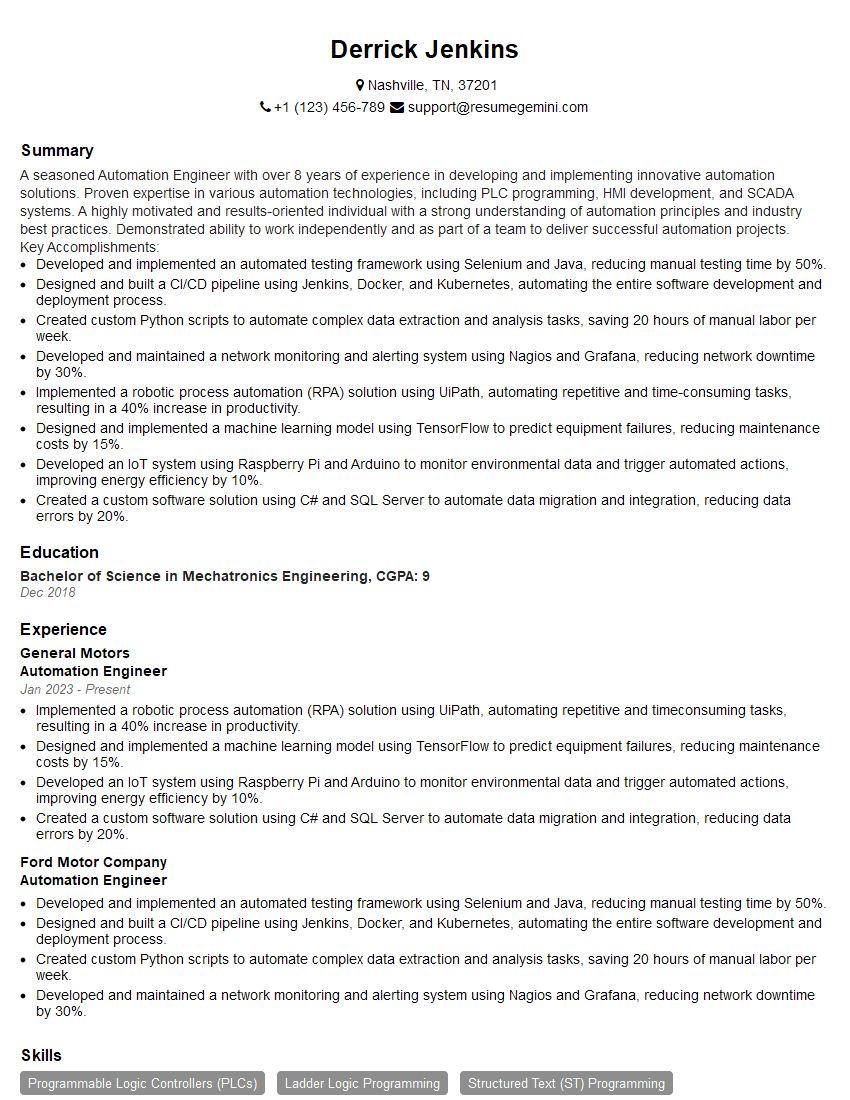
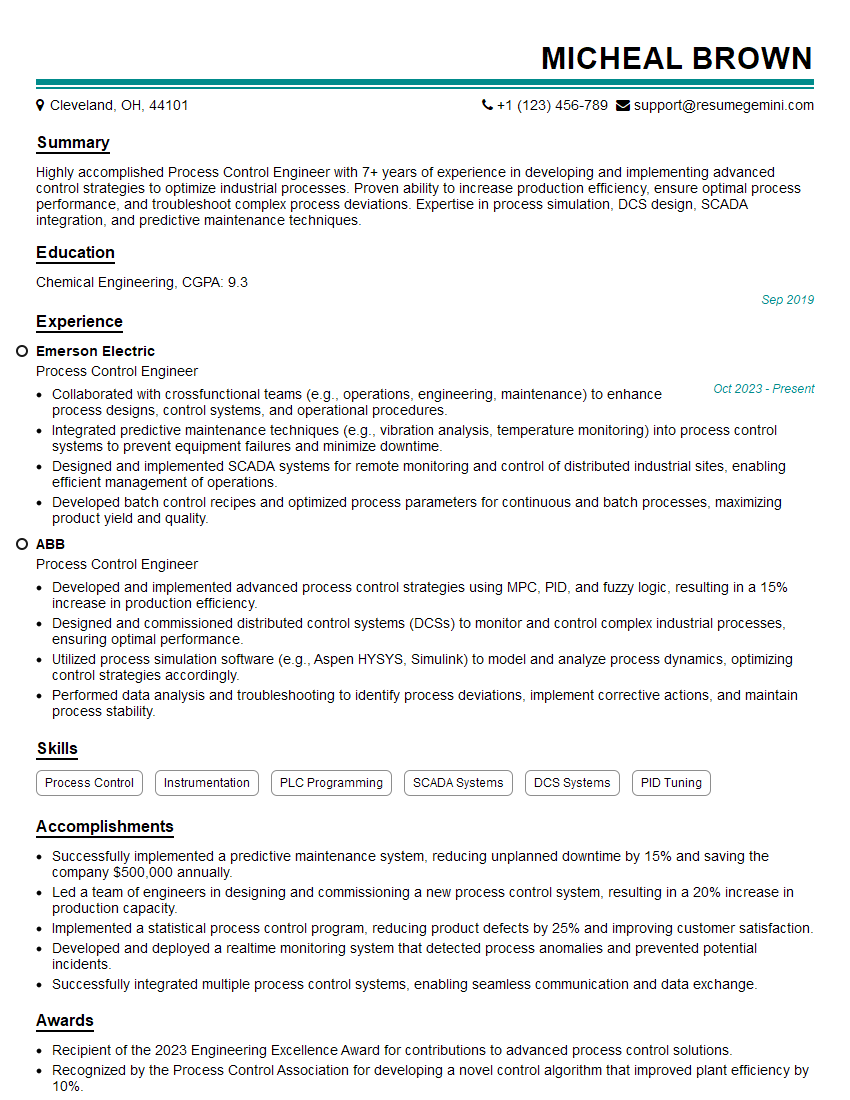
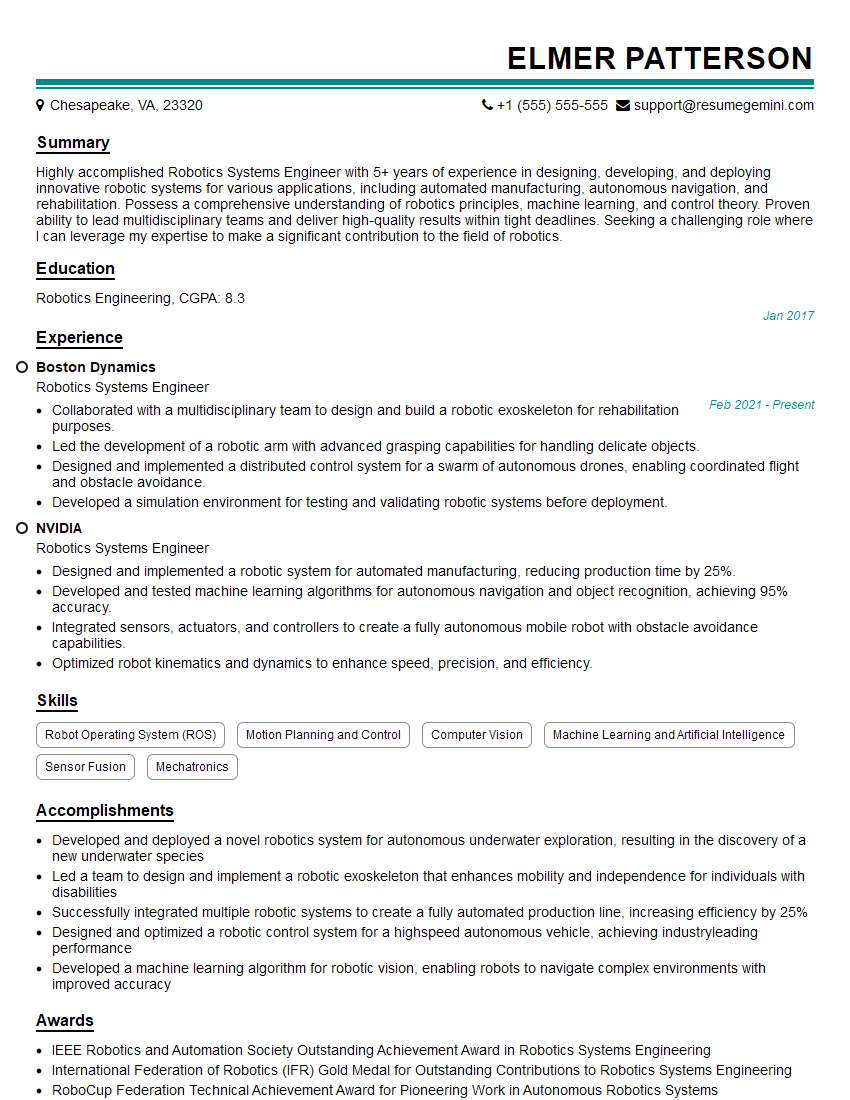
Mastering advanced control systems opens doors to exciting and impactful careers in diverse fields like automation, robotics, aerospace, and energy. To maximize your job prospects, crafting a compelling and ATS-friendly resume is crucial. ResumeGemini is a trusted resource that can help you build a professional resume tailored to highlight your expertise in advanced control systems. We provide examples of resumes specifically designed for this field to help you showcase your skills and experience effectively. Invest in your future – build a resume that gets noticed.
Explore more articles
Users Rating of Our Blogs
Share Your Experience
We value your feedback! Please rate our content and share your thoughts (optional).
What Readers Say About Our Blog
To the interviewgemini.com Webmaster.
Very helpful and content specific questions to help prepare me for my interview!
Thank you
To the interviewgemini.com Webmaster.
This was kind of a unique content I found around the specialized skills. Very helpful questions and good detailed answers.
Very Helpful blog, thank you Interviewgemini team.