Are you ready to stand out in your next interview? Understanding and preparing for Age-Sex Analysis interview questions is a game-changer. In this blog, we’ve compiled key questions and expert advice to help you showcase your skills with confidence and precision. Let’s get started on your journey to acing the interview.
Questions Asked in Age-Sex Analysis Interview
Q 1. Explain the importance of age and sex standardization in data analysis.
Age and sex standardization is crucial in data analysis because it allows for fair comparisons between different populations or time periods. Without standardization, differences in age and sex distributions can obscure or distort the true patterns in the data. Imagine comparing the average income of two cities – one with a predominantly older population and another with a younger population. Without standardization, the city with the older population might appear wealthier simply because older individuals tend to have higher lifetime earnings. Standardization removes this confounding effect, allowing for a more accurate comparison.
Standardization ensures that observed differences aren’t simply due to variations in age and sex composition. It allows researchers to isolate the effects of other variables of interest, leading to more robust and reliable conclusions. This is particularly important in epidemiology (studying disease patterns), public health, and social sciences.
Q 2. Describe different methods for age-sex stratification in a dataset.
Age-sex stratification involves dividing a dataset into subgroups based on age and sex categories. The methods vary depending on the data and research question.
- Direct Standardization: This involves applying a standard age-sex distribution to the data of different populations. You essentially adjust each population’s observed rates to what they would be if they had the same age-sex distribution as the standard population. This allows direct comparison of rates between populations.
- Indirect Standardization: This method is useful when you have limited data on the specific age-sex distribution within a population. You apply the age-sex-specific rates from a standard population to the study population’s age-sex distribution to get expected rates. The difference between observed and expected rates can reveal the relative risk.
- Age-Sex Specific Analysis: Instead of adjusting for age and sex, you can analyze each age-sex stratum separately. This reveals how the variable of interest behaves within each subgroup. This provides more granular insights.
Choosing the right method depends on the research question and the available data. For example, if comparing mortality rates across regions, direct standardization might be preferred. If studying a rare disease with limited data, indirect standardization might be more appropriate. Analyzing each age-sex stratum individually helps to explore differences within those groups.
Q 3. How do you handle missing data related to age and sex in your analyses?
Missing age and sex data is a common problem. Ignoring missing data can introduce bias. Several strategies can be employed:
- Deletion: Complete case analysis, where observations with missing data are excluded. This is simple but can lead to significant loss of information and bias if the missing data is not Missing Completely at Random (MCAR).
- Imputation: This involves replacing missing values with plausible estimates. Methods include mean/mode imputation (simple but can reduce variance), regression imputation (uses a regression model to predict missing values), multiple imputation (creates multiple plausible datasets with imputed values to account for uncertainty), and k-nearest neighbor imputation (uses similar cases to estimate missing values).
- Sensitivity Analysis: Examining how different missing data handling methods impact the results. This helps assess the robustness of the findings.
The best approach depends on the pattern of missing data and the research question. It’s crucial to document the chosen method and justify it based on its impact on the overall analysis. Imputation techniques generally provide better results than simple deletion, but each has limitations that need to be evaluated.
Q 4. What are some common biases associated with age and sex data, and how can they be mitigated?
Age and sex data can be subject to several biases:
- Sampling Bias: If the sample doesn’t accurately represent the population, the results will be biased. For example, oversampling a particular age group could skew the findings.
- Measurement Error: Inaccurate or inconsistent recording of age and sex can lead to biases in analysis. This is common in historical datasets.
- Reporting Bias: Individuals may not accurately report their age or sex, particularly in sensitive contexts.
- Selection Bias: This occurs when participation in a study is not random and related to age or sex, influencing the data.
Mitigation strategies involve careful study design, rigorous data collection protocols, quality control checks, using multiple data sources, and employing appropriate statistical techniques to account for bias (e.g., weighting adjustments for sampling bias). Awareness of potential biases is crucial for interpreting results accurately.
Q 5. Explain the concept of age-sex pyramids and their interpretation.
An age-sex pyramid is a graphical representation of the population’s age and sex distribution. It’s a powerful tool for visualizing population structure and understanding demographic trends. The horizontal axis represents the number of individuals within specific age groups (often 5-year intervals), while the vertical axis shows age. Males are typically represented on one side and females on the other.
Interpretation: The shape of the pyramid reveals much about a population. A wide base indicates high birth rates and a growing population. A narrow base suggests declining birth rates. A pyramid with a bulge in the middle shows a cohort that is relatively large (a baby boomer generation, for example). A pyramid that tapers quickly indicates a high mortality rate. By comparing pyramids across different time periods or locations, you can visually track significant demographic shifts and make predictions.
Q 6. How do you use age-sex data to project future population trends?
Age-sex data is fundamental for projecting future population trends. This involves using demographic models that incorporate fertility rates (births), mortality rates (deaths), and migration rates (movement of people into and out of a population). These models use current age-sex data as a baseline and project future changes based on assumptions about these rates.
Methods: Common methods include cohort-component models, which track cohorts (groups born around the same time) through time, and Leslie matrices, a mathematical approach to model population growth. These models account for age-specific fertility and mortality rates, allowing projections of future age-sex distributions. The accuracy of these projections depends heavily on the quality of input data and the validity of assumptions about future demographic rates. Uncertainty analysis is crucial to understand the range of possible future scenarios.
Q 7. Describe different statistical methods used to analyze age-sex data (e.g., regression, survival analysis).
Numerous statistical methods are used to analyze age-sex data. The choice depends on the research question.
- Regression Analysis: Useful for examining the relationship between age, sex, and other variables. Linear regression can model continuous outcomes, logistic regression can model binary outcomes (e.g., disease presence/absence), and other types of regression (e.g., Poisson, multinomial) are tailored to specific data types.
- Survival Analysis: This is appropriate when studying time-to-event data, such as age at death, duration of disease, or time until a certain event. Methods like Kaplan-Meier curves and Cox proportional hazards models are frequently used to analyze survival differences between age and sex groups.
- Time Series Analysis: This is important when analyzing population trends over time. Methods like ARIMA (Autoregressive Integrated Moving Average) models can help understand patterns and make forecasts.
- Spatial Analysis: This helps understand the geographic distribution of age and sex across a region, potentially identifying clusters or disparities.
Sophisticated techniques, such as multilevel models, are used when dealing with hierarchical data (individuals nested within families, neighborhoods, etc.). The selection of the appropriate statistical method requires careful consideration of the research question, data structure, and underlying assumptions.
Q 8. What are the ethical considerations when working with age-sex data?
Ethical considerations in age-sex analysis are paramount, especially given the potential for bias and misuse. We must prioritize the responsible handling of sensitive personal information. This involves obtaining informed consent, ensuring data anonymity and aggregation to prevent re-identification, and avoiding discriminatory practices. For instance, analyzing age-sex data to understand healthcare disparities requires careful consideration to avoid perpetuating harmful stereotypes or justifying unequal access to care. We must also be transparent about our methods and findings, acknowledging any limitations and potential biases in the data or analysis. Finally, adhering to relevant privacy regulations like GDPR or HIPAA is crucial.
- Informed Consent: Individuals must understand how their data will be used before participating.
- Data Anonymization: Techniques like data masking or generalization should be employed to protect individual identities.
- Bias Mitigation: We must be aware of and address potential biases in the data collection process and analysis.
- Transparency and Accountability: Clearly communicate our methods and findings, acknowledging limitations.
Q 9. How do you ensure the confidentiality and security of age-sex data?
Confidentiality and security are cornerstones of responsible age-sex data handling. We employ a multi-layered approach. First, data is anonymized or pseudonymized wherever possible, replacing direct identifiers with codes. Secondly, access to the data is strictly controlled through role-based access controls, limiting access to only authorized personnel. Thirdly, the data is stored securely using encryption both in transit and at rest, preventing unauthorized access. Finally, we regularly audit our security measures to ensure they remain effective and up-to-date. This includes penetration testing and vulnerability scans to identify and address any potential weaknesses.
Imagine a healthcare database: We wouldn’t store names and addresses directly alongside age and sex; instead, we’d use unique identifiers that only authorized personnel can map back to individuals – and only when absolutely necessary and with appropriate oversight.
Q 10. Explain your experience with different data visualization techniques for age-sex data.
I have extensive experience with various data visualization techniques for age-sex data. For presenting age-sex distributions, population pyramids are invaluable. These clearly illustrate the proportion of males and females across different age groups. For exploring trends over time, line charts are excellent for showing changes in population structure. For comparing age-sex distributions across different groups, grouped bar charts are effective. Heatmaps are useful for visualizing complex interactions between age, sex, and another variable, like disease prevalence. Finally, interactive dashboards allow for dynamic exploration of the data, enabling users to filter and drill down into specific subsets.
For example, I once used population pyramids to demonstrate the aging population in a specific region, and a line chart to show the changing sex ratios over several decades. The ability to choose the right visualization is crucial to effectively communicate the findings.
Q 11. How do you interpret and present your findings from age-sex analysis to a non-technical audience?
Communicating complex findings from age-sex analysis to a non-technical audience requires clear and concise language, avoiding jargon. I typically start with a compelling narrative, setting the context and highlighting the key question the analysis addresses. Then, I use visually appealing charts and graphs, focusing on a few key insights rather than overwhelming them with details. I explain each chart in simple terms, using analogies or real-world examples to illustrate the findings. Finally, I summarize the key takeaways, emphasizing the implications of the analysis and potential actions based on the findings. For instance, instead of saying ‘the age-standardized mortality rate shows a statistically significant increase,’ I might say ‘older people in this area are dying at a faster rate than expected.’
Q 12. Describe your experience with specific software or tools used for age-sex analysis (e.g., R, SAS, SPSS).
My experience spans multiple software packages. R is my primary tool, providing immense flexibility for data manipulation, statistical analysis, and visualization. I’m proficient in packages like ggplot2 for creating publication-quality graphics and dplyr for efficient data wrangling. I’ve also worked extensively with SAS, particularly for its robust statistical procedures and its capabilities for handling large datasets. SPSS offers a user-friendly interface, which is beneficial for collaborations involving less technical users. Each tool has its strengths and I select the most appropriate one based on the specific needs of the project.
Q 13. How do you identify and address outliers in age-sex data?
Identifying and addressing outliers in age-sex data requires careful consideration. Outliers can arise from data entry errors, measurement errors, or genuine, albeit unusual, events. I use a combination of visual inspection (scatter plots, box plots) and statistical methods. For example, I might use the Interquartile Range (IQR) method to identify potential outliers, flagging data points that fall outside 1.5 times the IQR above the third quartile or below the first quartile. However, simply removing outliers is not always appropriate. I carefully investigate the reason for the outlier. If it’s a data entry error, I correct it. If it’s a measurement error, I might exclude it or use robust statistical methods less sensitive to outliers. If it’s a genuine data point representing a unique situation, I’ll retain it but might comment on its impact in my analysis.
Q 14. How do you validate the accuracy and reliability of age-sex data?
Validating the accuracy and reliability of age-sex data is critical. I start by examining the data source, assessing its credibility and methodology. This includes understanding how the data was collected, the sample size, and any limitations. I then check for internal consistency, looking for discrepancies or inconsistencies within the data itself. For example, I might compare age-sex data from different sources to check for agreement. I also consider the plausibility of the data, ensuring it aligns with known demographic trends and expectations. Finally, when possible, I might conduct sensitivity analyses to assess how changes in data assumptions influence the overall findings.
Q 15. Describe your experience with data cleaning and preprocessing for age-sex data.
Data cleaning and preprocessing are crucial for reliable age-sex analysis. My experience involves a multi-step process. First, I identify and handle missing data, often using imputation techniques like mean/median imputation for smaller datasets or more sophisticated methods like k-Nearest Neighbors (k-NN) for larger, more complex datasets. This choice depends on the nature of the missing data and the overall dataset characteristics. Second, I address inconsistencies in age reporting (e.g., discrepancies in age units or ranges). This might involve standardizing age to a single unit (years) and defining clear age brackets. Third, I check for outliers – unusually high or low ages – which could indicate data entry errors. These outliers need careful investigation; sometimes they’re genuine, but often require correction or removal. Finally, I ensure data types are correct (age as numeric, sex as categorical) and perform consistency checks across different variables. For example, I might cross-reference age with birthdate information if available.
For instance, in a study analyzing healthcare utilization, I encountered a significant number of missing ages. Instead of simply discarding these records, I employed k-NN imputation, leveraging information from individuals with similar demographic and health characteristics to estimate missing ages. This allowed me to retain a larger sample size and improve the accuracy of the analysis.
Career Expert Tips:
- Ace those interviews! Prepare effectively by reviewing the Top 50 Most Common Interview Questions on ResumeGemini.
- Navigate your job search with confidence! Explore a wide range of Career Tips on ResumeGemini. Learn about common challenges and recommendations to overcome them.
- Craft the perfect resume! Master the Art of Resume Writing with ResumeGemini’s guide. Showcase your unique qualifications and achievements effectively.
- Don’t miss out on holiday savings! Build your dream resume with ResumeGemini’s ATS optimized templates.
Q 16. What are the limitations of using age and sex as the sole variables in your analysis?
Using only age and sex significantly limits the scope and depth of analysis. Many other factors influence outcomes. For example, analyzing health outcomes solely based on age and sex ignores the impact of lifestyle, socioeconomic status, genetics, access to healthcare, and environmental factors. Consider comparing heart disease rates between 60-year-old men and women. While age and sex are relevant, the difference could be largely explained by differences in smoking habits, diet, or access to preventative care rather than solely biological differences. Similarly, analyzing educational attainment solely based on age and sex overlooks the impact of parental education, geographic location, and economic opportunities. In short, using only age and sex provides a very incomplete picture and may lead to inaccurate or misleading conclusions.
Q 17. How do you incorporate other demographic variables (e.g., race, ethnicity, socioeconomic status) into your age-sex analysis?
Incorporating other demographic variables is essential for a comprehensive age-sex analysis. I often include race, ethnicity, socioeconomic status (often measured by income, education, or occupation), geographic location, and marital status. The inclusion of these variables allows for a more nuanced understanding of how age and sex interact with other factors to influence the outcome. For example, in a study examining income disparities, I would control for race and ethnicity to isolate the impact of age and sex on income while accounting for potential biases. I utilize statistical techniques like regression analysis (linear, logistic, or multinomial depending on the outcome variable) to model the relationships between the outcome and these variables simultaneously, allowing us to understand the independent effect of each variable.
Consider a study on mortality rates. Simple age-sex analysis might show higher mortality rates in older males. However, incorporating socioeconomic status might reveal that this disparity is partly due to differences in access to healthcare or healthy lifestyles associated with lower socioeconomic groups within the older male population.
Q 18. Explain how you would design a study to investigate the impact of age and sex on a specific outcome.
Designing a study to investigate the impact of age and sex on a specific outcome requires a rigorous approach. First, I’d clearly define the research question and the specific outcome variable. For example, ‘What is the impact of age and sex on the risk of developing type 2 diabetes?’ Next, I’d choose an appropriate study design – a prospective cohort study is often ideal for examining long-term effects, while a cross-sectional study is suitable for assessing prevalence at a single point in time. The sample size needs to be adequately powered to detect statistically significant differences. I’d then carefully select participants, ensuring representative sampling across age and sex groups. Data collection instruments must be validated and reliable. Finally, the analysis plan should be pre-specified to avoid bias and ensure the study’s findings are robust and replicable. Ethical considerations, including informed consent and data privacy, are paramount.
Q 19. How do you evaluate the significance of your findings in age-sex analysis?
Evaluating the significance of findings involves several steps. First, I use statistical tests appropriate to the data and research question. For continuous outcomes, t-tests or ANOVA might be used to compare means across age-sex groups. For categorical outcomes, chi-squared tests or logistic regression are often employed. P-values indicate the probability of observing the results if there were no true effect; a p-value below a pre-determined significance level (e.g., 0.05) indicates statistical significance. However, statistical significance doesn’t automatically imply clinical or practical significance. Therefore, I calculate effect sizes (e.g., odds ratios, risk ratios, Cohen’s d) to quantify the magnitude of the effect. Confidence intervals provide a range of plausible values for the effect size, providing a measure of uncertainty. Finally, I consider the context of the findings, including the limitations of the study and potential confounding variables, to interpret the results meaningfully.
Q 20. Describe your experience with longitudinal age-sex data analysis.
Longitudinal age-sex data analysis involves analyzing data collected over time from the same individuals. This allows us to study changes in outcomes over the lifespan and track individual trajectories. My experience includes using statistical methods such as mixed-effects models, growth curve models, and survival analysis. Mixed-effects models are particularly useful for handling repeated measures data, accounting for individual variability and temporal correlation. Growth curve models are well-suited to analyze changes in outcomes over time, such as cognitive function or physical performance. Survival analysis is useful for studying time-to-event data, such as mortality or the onset of a disease. These techniques are powerful as they can reveal age-specific trends and patterns in outcomes, along with their interplay with sex.
For example, in a study on the trajectory of cognitive decline, using longitudinal data allowed me to identify different patterns of decline in men and women, revealing nuances that cross-sectional studies would miss.
Q 21. How do you handle age-sex data from different sources with varying levels of detail?
Handling age-sex data from different sources with varying levels of detail requires careful consideration. First, I assess the quality and reliability of each data source. I look for consistency in data definitions, measurement methods, and data completeness. Then, I standardize the data to ensure compatibility. This might involve creating consistent age categories, recoding sex variables to match, and dealing with different units of measurement. Data harmonization techniques, such as creating common coding schemes and resolving inconsistencies, are vital. If sources offer different levels of detail, I might aggregate the data to a common level to facilitate comparison. For example, if one dataset has detailed age information while another uses broad age bands, I might group the detailed data into the same age bands to maintain consistency. It is important to carefully document all these steps to maintain transparency and reproducibility.
Q 22. What are the key differences between cohort and period analysis in age-sex studies?
Cohort and period analyses are two fundamental approaches in age-sex studies, differing primarily in their focus: cohort analysis tracks a specific group of individuals (a cohort) born within a particular time frame throughout their lives, while period analysis examines the population at a specific point in time, irrespective of birth cohort.
Imagine two groups: Group A, all born in 1990 (a cohort), and Group B, the entire population in 2023 (a period). Cohort analysis would follow Group A’s experiences—their marriage rates, mortality rates, etc.—as they age. Period analysis would snapshot Group B’s characteristics at that single moment in 2023.
- Cohort Analysis Advantages: Reveals life course patterns, identifies cohort effects (experiences unique to a generation).
- Cohort Analysis Disadvantages: Longitudinal data is needed; cohort effects can be difficult to separate from period effects.
- Period Analysis Advantages: Provides a snapshot of current conditions, easier to obtain data, ideal for short-term forecasting.
- Period Analysis Disadvantages: Doesn’t reveal life course patterns, can obscure cohort effects.
In practice, combining both approaches often yields a more comprehensive understanding. For example, studying fertility rates using both methods might reveal generational differences (cohort) and short-term fluctuations (period) in birth rates.
Q 23. Describe your experience with spatial analysis techniques for age-sex data.
My experience with spatial analysis techniques for age-sex data is extensive. I’ve used various methods to visualize and analyze population distributions and their change over time, including:
- Geographic Information Systems (GIS): I routinely use GIS software (ArcGIS, QGIS) to map age and sex distributions, identify spatial clusters (e.g., areas with high proportions of elderly people), and analyze spatial relationships between demographic patterns and other geographic features like proximity to healthcare facilities or environmental hazards.
- Spatial Regression Models: These techniques, such as Geographically Weighted Regression (GWR), allow us to explore how age-sex compositions vary across space while accounting for spatial autocorrelation. For example, we can investigate if the effect of income on life expectancy differs geographically.
- Spatial Interpolation: Methods like kriging are used to estimate age-sex data in areas with missing or sparse data, crucial for generating more complete population maps.
For instance, in one project analyzing the impact of a new highway on population distribution, GIS and spatial regression helped us identify areas experiencing significant population growth or decline due to improved accessibility, showing distinct patterns correlated with age and sex.
Q 24. How do you communicate the uncertainty associated with your age-sex analysis projections?
Communicating uncertainty is crucial for responsible age-sex analysis. I employ several strategies:
- Confidence Intervals: For projections, I always present confidence intervals around estimates. This illustrates the range of plausible outcomes, acknowledging inherent variability in future scenarios.
- Scenario Planning: Instead of providing a single projection, I often develop multiple scenarios reflecting different assumptions about future trends (e.g., high, medium, low fertility rates). This highlights the sensitivity of projections to key variables.
- Sensitivity Analysis: I assess how changes in input parameters affect projections. This helps quantify the impact of uncertainties in data or model assumptions.
- Clear and Concise Communication: I avoid technical jargon when communicating with non-experts. Graphics like charts and maps are essential for conveying both the findings and associated uncertainties effectively. Explanations clearly highlight the limitations and assumptions underpinning the analysis.
For example, when projecting population aging, I might present projections with 95% confidence intervals, highlighting how the uncertainty increases further into the future. I might also present alternative scenarios based on different assumptions about future migration patterns.
Q 25. Explain how you stay current with the latest developments and methodologies in age-sex analysis.
Staying current in the rapidly evolving field of age-sex analysis involves a multifaceted approach:
- Academic Journals and Conferences: I regularly read journals like Demography, Population Studies, and Mathematical Population Studies. Attending international conferences allows me to interact with leading researchers and learn about the latest methodologies.
- Online Resources and Databases: I utilize online databases like the UN Population Division website for data and methodological updates. Online courses and webinars offer training on advanced techniques.
- Professional Networks: Membership in professional organizations (e.g., the Population Association of America) allows me to stay connected with other researchers and participate in discussions.
- Software and Tool Development: I keep abreast of improvements in statistical software and GIS technology, constantly exploring and incorporating new tools for data analysis and visualization.
This continuous learning ensures that my work utilizes the most up-to-date data, techniques, and theoretical frameworks.
Q 26. Describe a challenging age-sex data analysis project you worked on and how you overcame the challenges.
One challenging project involved projecting population growth in a region experiencing significant internal migration and data inconsistencies. The challenge was twofold: incomplete data and substantial migration flows making precise predictions difficult.
To overcome these challenges, I employed a multi-pronged strategy:
- Data Imputation: I used statistical techniques (e.g., multiple imputation) to address missing data, carefully documenting the assumptions and potential biases introduced.
- Migration Modelling: I built a migration model incorporating factors like economic opportunities, access to services, and previous migration patterns. This helped estimate future migration flows more accurately.
- Bayesian Methods: Incorporating prior knowledge through Bayesian approaches helped to regularize our estimates and account for uncertainties in the data and model parameters. This approach significantly improved our forecasting accuracy.
- Robustness Checks: I performed various robustness checks—for example, varying migration assumptions and imputation techniques—to assess the sensitivity of the projections to the methods used.
This project highlighted the importance of integrating diverse data sources, employing appropriate statistical techniques, and thoroughly evaluating the robustness of the results when dealing with complex demographic phenomena.
Q 27. What are your strengths and weaknesses related to age-sex analysis?
My strengths in age-sex analysis include:
- Strong analytical and statistical skills: I am proficient in various statistical techniques relevant to demographic analysis, including time series analysis, regression modeling, and spatial statistics.
- Data management and manipulation expertise: I can handle large datasets and perform complex data cleaning and preparation tasks.
- Experience with GIS and spatial analysis: I can effectively map and visualize demographic data, identifying spatial patterns and correlations.
- Excellent communication skills: I can translate complex analytical results into clear and concise reports and presentations for both technical and non-technical audiences.
Areas for improvement include deepening my knowledge of advanced causal inference techniques and further developing my skills in agent-based modeling, which allows for more complex simulations of population dynamics.
Key Topics to Learn for Age-Sex Analysis Interview
- Data Collection and Preparation: Understanding various data sources (census data, surveys, administrative records), data cleaning techniques, and handling missing data in age-sex datasets.
- Descriptive Statistics: Calculating and interpreting key descriptive statistics like age-sex ratios, proportions, and rates. Visualizing data effectively using histograms, bar charts, and other relevant graphs.
- Population Pyramids and their Interpretation: Understanding the structure and implications of different population pyramid shapes (e.g., expansive, constrictive, stationary) and their relation to societal trends.
- Age-Specific Rates and Standardized Rates: Calculating and interpreting age-specific rates (e.g., mortality, fertility, morbidity) and applying standardization techniques to compare rates across different populations.
- Life Tables and their Applications: Understanding life table construction and using them to analyze mortality patterns and life expectancy.
- Cohort Analysis: Tracking and analyzing a specific group (cohort) over time to understand changes in age-sex composition and related trends.
- Applications in Public Health and Policy: Understanding how age-sex analysis informs public health initiatives, resource allocation, and policy decisions (e.g., healthcare planning, social security systems).
- Ethical Considerations: Recognizing potential biases in data and ensuring responsible interpretation and application of age-sex analysis results.
- Advanced Techniques (for technical roles): Regression analysis, time series analysis, demographic modeling, and statistical software proficiency (e.g., R, SPSS, SAS).
Next Steps
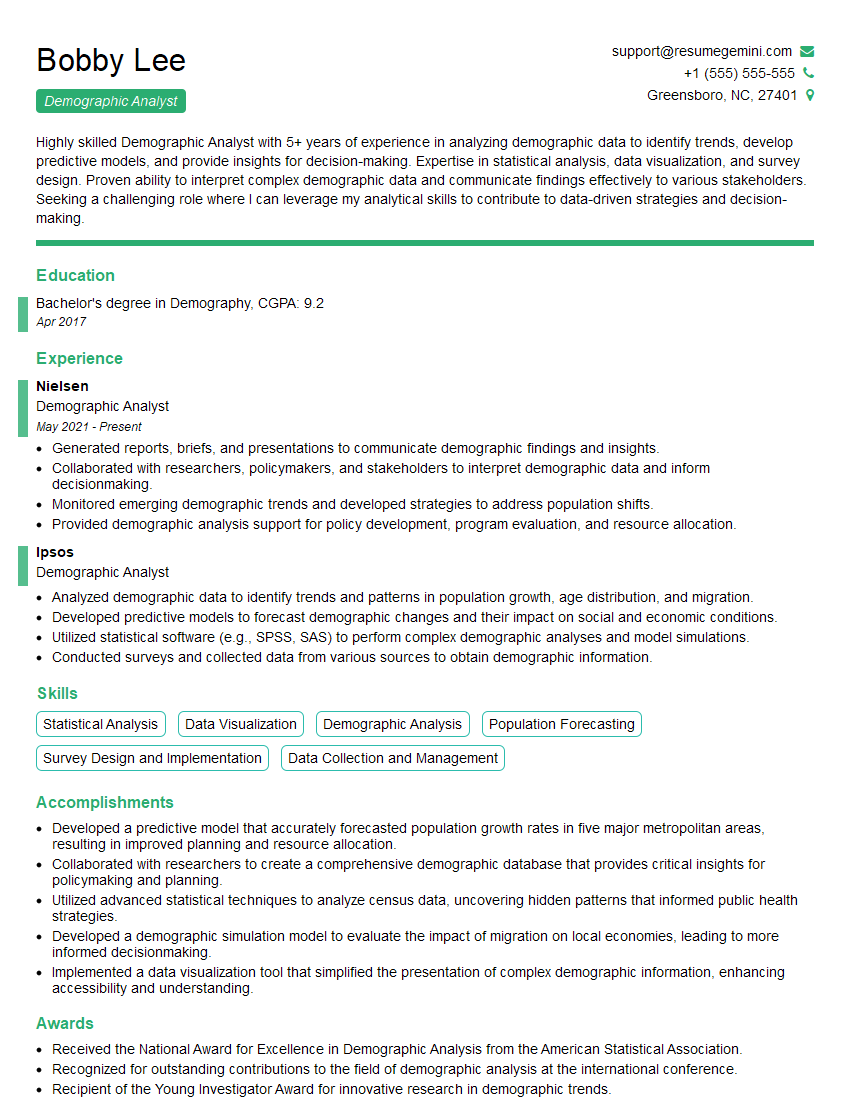
Mastering Age-Sex Analysis is crucial for career advancement in various fields, including demography, public health, social sciences, and market research. A strong understanding of this area showcases valuable analytical and problem-solving skills highly sought after by employers. To maximize your job prospects, it’s essential to craft a compelling and ATS-friendly resume that highlights your relevant skills and experience. We strongly recommend using ResumeGemini, a trusted resource for building professional resumes. ResumeGemini provides examples of resumes tailored to Age-Sex Analysis to help you create a document that effectively showcases your qualifications. This will significantly improve your chances of landing your dream job.
Explore more articles
Users Rating of Our Blogs
Share Your Experience
We value your feedback! Please rate our content and share your thoughts (optional).
What Readers Say About Our Blog
To the interviewgemini.com Webmaster.
Very helpful and content specific questions to help prepare me for my interview!
Thank you
To the interviewgemini.com Webmaster.
This was kind of a unique content I found around the specialized skills. Very helpful questions and good detailed answers.
Very Helpful blog, thank you Interviewgemini team.