Every successful interview starts with knowing what to expect. In this blog, we’ll take you through the top Wallpaper Steaming and Scoring interview questions, breaking them down with expert tips to help you deliver impactful answers. Step into your next interview fully prepared and ready to succeed.
Questions Asked in Wallpaper Steaming and Scoring Interview
Q 1. Describe the process of steaming wallpaper for removal.
Steaming wallpaper is a crucial step in its removal, softening the adhesive bond between the wallpaper and the wall. Think of it like softening a stubborn sticker with warm water – the steam does the same for the wallpaper paste. The process involves saturating the wallpaper with steam to loosen the adhesive, making it easier to peel off without damaging the underlying wall.
- Prepare the area: Protect the floor with drop cloths and remove any electrical outlet or switch plates.
- Fill the steamer: Fill the steamer with distilled water to avoid mineral deposits that can clog the unit.
- Apply the steam: Hold the steamer head a few inches from the wall, moving it slowly and evenly over the wallpaper in overlapping strokes. Allow the steam to penetrate for a few minutes. You’ll see the wallpaper begin to bubble or loosen.
- Peel away the wallpaper: Gently insert a scraper or putty knife at a corner or seam to start peeling the softened wallpaper. Work in sections. If resistance is met, re-steam the area.
- Remove remaining adhesive: After removing the bulk of the wallpaper, use a scraper or a damp sponge to remove any remaining adhesive. A wallpaper stripping solution can be helpful for stubborn residue.
Q 2. What are the different types of wallpaper steamers available, and what are their advantages and disadvantages?
Wallpaper steamers come in various types, each with its own set of pros and cons:
- Handheld Steamers: These are compact and affordable, ideal for smaller projects or spot treatments. However, they can be slower for large areas and may require frequent refills.
- Professional-Grade Steamers: These larger units offer higher steam output and larger water tanks, making them faster and more efficient for larger areas. They tend to be more expensive and less portable.
- Steamers with attachments: Some steamers come with attachments, such as brushes or scrapers, that can assist in the wallpaper removal process. These provide additional versatility but are more expensive.
The choice depends largely on the project size and budget. For a small room, a handheld steamer may suffice. For a larger project or professional use, a professional-grade steamer is recommended.
Q 3. How do you determine the appropriate steaming technique for various wallpaper types (e.g., vinyl, fabric, etc.)?
Different wallpaper types react differently to steaming. Understanding this is key to effective removal. Imagine trying to soften a leather jacket the same way you’d soften a cotton shirt – you’d need different approaches.
- Vinyl Wallpaper: Vinyl is generally more resistant to steam, requiring longer steaming times and potentially multiple passes. The steam needs to penetrate the vinyl layer to reach the adhesive underneath.
- Fabric-backed Wallpaper: This type is usually more susceptible to damage from excessive heat, so gentler steaming is necessary to avoid tearing. Shorter bursts of steam and careful monitoring are key.
- Paper Wallpaper: Paper wallpaper is generally the easiest to remove with steaming, as it absorbs the moisture readily. However, it can tear easily if not handled carefully.
Always test a small, inconspicuous area before proceeding with the entire wall. This will give you an understanding of how the wallpaper reacts to steam and the best approach for complete removal.
Q 4. Explain the process of scoring wallpaper for removal.
Scoring wallpaper involves making small cuts or perforations in the wallpaper surface to weaken its structure and facilitate removal. Think of it like creating small cracks in a hard shell to make it easier to break apart. This is particularly helpful for stubborn wallpaper that doesn’t readily respond to steaming alone.
- Use a scoring tool: Use a scoring tool (see next answer) to make numerous small, shallow cuts or perforations across the surface of the wallpaper. Aim for even spacing to maximize effectiveness.
- Apply steam: After scoring, apply steam to the wall to penetrate the weakened areas, further loosening the adhesive bond.
- Remove wallpaper: After steaming, attempt to peel away the wallpaper. The scoring process will significantly aid this process, allowing for easier removal of the paper.
Q 5. What tools are essential for scoring wallpaper effectively?
Several tools can effectively score wallpaper:
- Utility knife or razor blade: These offer precise scoring but require careful handling to avoid cutting too deeply into the wall surface. Use a fresh blade for cleaner cuts.
- Wallpaper scoring tool: Specialized tools are available with multiple scoring wheels that make the process faster and more efficient. They often have depth-control mechanisms, minimizing the risk of wall damage.
- Drywall perforator: A heavy-duty perforator can be utilized for scoring heavier or more stubborn wallpaper, but it’s imperative to use it cautiously to avoid damage to the wall itself.
Regardless of the tool used, practice the process on a small inconspicuous area first to ensure you’re using the correct technique and avoid damaging the wall.
Q 6. How do you safely handle a wallpaper steamer to prevent burns or damage?
Safety is paramount when using a wallpaper steamer. Steam burns are severe, and the hot water within the steamer can cause significant injury. Remember, safety is not just about preventing accidents, but also about preventing damage to your project and the surrounding areas.
- Always use distilled water: Mineral deposits can clog the steamer and reduce its effectiveness. Tap water might also leave residue on the wall.
- Keep children and pets away: The hot steam and water pose a serious hazard to children and animals. Maintain a safe distance.
- Avoid touching the steam head: The steam head gets extremely hot; always use caution when operating and handling the steamer. Allow it to cool down before handling.
- Use appropriate protective gear: Wear heat-resistant gloves to prevent burns. Eye protection is also recommended to prevent accidental splashes.
- Turn off the steamer before refilling: Unplug the steamer and allow it to cool down before refilling the water tank to avoid burns.
Q 7. What safety precautions do you take when removing wallpaper?
Removing wallpaper involves several safety considerations beyond just the steamer:
- Wear appropriate clothing: Long sleeves and pants are recommended to avoid skin irritation or damage from sharp tools or chemicals. Always protect your eyes.
- Proper ventilation: Ensure adequate ventilation in the room to avoid inhaling dust or fumes from wallpaper stripping solutions. Open windows and use fans if possible.
- Careful handling of tools: Sharp tools like utility knives and scrapers can cause injury if handled carelessly. Always use caution and point the blade away from your body.
- Proper disposal of waste: Dispose of removed wallpaper and adhesive according to local regulations. Some materials may require special disposal methods.
- Protective eyewear: Always wear safety glasses to protect your eyes from flying debris, especially when using sharp tools or harsh chemical solutions.
Remember, careful preparation and a cautious approach are crucial for ensuring a safe and successful wallpaper removal project.
Q 8. How do you identify and address common issues during wallpaper removal, such as stubborn adhesive?
Stubborn adhesive is the bane of any wallpaper removal project! The key is patience and the right tools. Identifying the problem often starts with observation. Is the adhesive a thin, almost invisible layer, or is it thick and gooey? Is the wallpaper itself heavily textured or vinyl-backed, making it more resistant?
For stubborn adhesive, I usually start with a combination of steaming and scoring. A thorough steaming softens the adhesive, making it easier to remove. Then, scoring creates micro-perforations, allowing the steam to penetrate deeper and weakening the bond further. If simple steaming and scoring aren’t effective, I’ll use a wallpaper scraper, working slowly and carefully to avoid damaging the wall. In extreme cases, a chemical adhesive remover might be necessary – always test a small, inconspicuous area first to ensure compatibility with your wall surface and the wallpaper type. Remember safety! Always wear gloves and eye protection when using chemical removers and ensure proper ventilation.
For example, I once encountered a vintage wallpaper with incredibly tenacious adhesive. Steaming alone wasn’t sufficient. I had to employ a combination of deep scoring with a sharp utility knife, followed by generous steaming, and finally, a careful application of a specialized adhesive remover to fully dissolve the residue. The result? A pristine wall, ready for the next project!
Q 9. How do you prepare a wall surface for new wallpaper after removal?
Preparing the wall after wallpaper removal is crucial for the success of your new wallpaper installation. A poorly prepared surface can lead to bubbling, peeling, or an uneven finish. The process involves several steps:
- Thorough Cleaning: Once all the wallpaper and adhesive are removed, wash the walls with warm water and a mild detergent to remove any remaining residue. A sponge or soft cloth works best. Allow the walls to dry completely.
- Repairing Imperfections: Inspect the wall for any holes, cracks, or uneven areas. Fill any imperfections with spackle or patching compound, allow it to dry, and then sand smooth. This ensures a flat, even surface for your new wallpaper.
- Priming: Applying a primer is vital, especially on porous surfaces or if you’re switching from dark to light wallpaper. Primer creates a uniform surface for better adhesion of the new wallpaper, preventing the color of the old wall from bleeding through.
- Final Cleaning: After the primer has dried, give the wall a final wipe-down to remove any dust or debris before applying the new wallpaper.
Imagine trying to apply wallpaper to a bumpy, dirty surface – the result would be disastrous! Proper wall preparation guarantees a smooth, professional-looking finish and extends the life of your new wallpaper.
Q 10. What are the signs of improper wallpaper steaming or scoring?
Improper wallpaper steaming or scoring often results in tearing the wallpaper, leaving large sections intact, or damaging the wall underneath. Signs of improper steaming include:
- Uneven removal: Some areas peel off easily, while others are stubbornly stuck.
- Wallpaper tearing: The wallpaper rips instead of cleanly separating from the wall.
- Wall damage: The wall’s surface is scratched, gouged, or otherwise damaged.
Signs of improper scoring include:
- Incomplete perforation: The scores aren’t deep enough to effectively weaken the adhesive bond.
- Irregular scoring: The scores are unevenly spaced, leading to inconsistent removal.
- Scoring the wall: The scoring tool has damaged the wall’s surface.
For instance, if you score too lightly, the steam won’t penetrate effectively, and you’ll be left with a frustratingly difficult removal process. Conversely, aggressive scoring can damage the wall itself, requiring costly repairs.
Q 11. How do you determine the correct amount of steam needed to loosen wallpaper?
Determining the correct amount of steam is crucial for effective wallpaper removal without damaging the wall. It’s a balance! Too little steam and the wallpaper remains stubbornly attached. Too much, and you risk water damage or damaging the wall’s surface.
I typically start with a moderate amount of steam, applying it in short bursts to a small section (about 2 feet square). I then observe the wallpaper’s reaction. If it softens readily and begins to peel, I continue. If not, I apply more steam, gradually increasing the exposure time. Always monitor the wall’s surface for signs of excessive moisture. If the wall starts to absorb too much steam, reduce the amount and allow it to dry slightly. The goal is to saturate the adhesive without saturating the wall itself. Different types of wallpaper and adhesive will require varying amounts of steam. Experience plays a significant role in judging this. It’s best to practice on a less visible area first.
Q 12. Explain the difference between scoring and perforating wallpaper.
Scoring and perforating are both techniques used to weaken the bond between wallpaper and the wall, but they differ in their approach. Scoring involves creating shallow, parallel lines in the wallpaper using a scoring tool, like a utility knife or a special wallpaper scoring tool. This creates micro-perforations that allow steam to penetrate and break down the adhesive. Think of it like creating tiny channels for the steam to travel through.
Perforating, on the other hand, involves creating much deeper and more significant punctures, usually with a needle-like tool or a specialized perforating roller. This method is less common and usually reserved for particularly stubborn wallpaper. It’s a more aggressive approach, and there’s a greater risk of damaging the wall if not done carefully.
The choice between scoring and perforating depends on the type of wallpaper, the adhesive, and your comfort level. Scoring is generally sufficient for most wallpaper types, while perforating is a last resort for extremely difficult cases.
Q 13. How do you handle delicate or antique wallpaper during removal?
Handling delicate or antique wallpaper requires extra care and patience. The goal is to remove it intact, if possible, for preservation or restoration. This often means foregoing aggressive steaming and scoring techniques.
I usually start by carefully assessing the wallpaper’s condition. Is it brittle? Does it have any weak points? I might use a very gentle steaming approach, applying minimal heat and moisture. Instead of a sharp scoring tool, I’ll use a duller implement or even a soft brush to carefully loosen the edges. If possible, I’ll work in small sections, carefully peeling the wallpaper away with my hands or a soft spatula. In some cases, it might be necessary to carefully remove it in strips or even smaller fragments to preserve as much of it as possible. Remember that preservation is paramount. If a piece is stuck particularly firmly, I might opt to leave it rather than risk damaging it further. Professional conservators might be consulted for extremely valuable or fragile wallpaper.
Q 14. What are the different types of scoring tools and their applications?
Several scoring tools are available, each suited to specific applications. The choice depends on the wallpaper type and the level of stubbornness of the adhesive.
- Utility knife: A versatile tool for scoring, but it requires a steady hand to prevent gouging the wall. I usually use a sharp blade, but avoid excessive pressure.
- Wallpaper scoring tool: These tools are specifically designed for scoring wallpaper and often feature multiple blades for faster and more efficient work. They generally have a wheel-like design that creates consistent scoring lines.
- Perforating roller: This tool has a series of small needles that create numerous perforations in the wallpaper. Useful for particularly tough cases but requires more precision and control to prevent wall damage.
- Seam roller: Although primarily used for smoothing wallpaper seams, it can be effective in gently lifting edges of wallpaper when removing more delicate papers.
For example, I use a wallpaper scoring tool for most jobs due to its efficiency and consistency. However, for delicate antique wallpapers, a seam roller is a much gentler option. The utility knife remains handy for intricate areas that require targeted scoring.
Q 15. What are the common causes of wallpaper bubbling or peeling after installation?
Wallpaper bubbling or peeling after installation is usually due to issues with preparation, application, or the environment. Improperly prepared walls are a major culprit. Uneven surfaces, old wallpaper residue, or insufficient cleaning can prevent the new wallpaper from adhering properly. Think of it like trying to glue something to a dirty, uneven surface – it won’t stick well! Another common cause is insufficient adhesive. Not applying enough paste or using the wrong type for the wallpaper material can lead to poor adhesion and subsequent bubbling. Finally, environmental factors like excessive humidity or temperature fluctuations can affect the adhesive’s bonding power, causing the wallpaper to lift. Poor application technique, such as not smoothing out air bubbles during installation, also contributes to this problem.
- Insufficient wall preparation: This includes not removing old wallpaper residue, filling holes and cracks, and priming porous surfaces.
- Inadequate adhesive: Using the wrong type of adhesive or not applying enough can lead to poor adhesion.
- Environmental factors: High humidity or rapid temperature changes can weaken the adhesive bond.
- Poor application technique: Failing to smooth out air bubbles during installation.
Career Expert Tips:
- Ace those interviews! Prepare effectively by reviewing the Top 50 Most Common Interview Questions on ResumeGemini.
- Navigate your job search with confidence! Explore a wide range of Career Tips on ResumeGemini. Learn about common challenges and recommendations to overcome them.
- Craft the perfect resume! Master the Art of Resume Writing with ResumeGemini’s guide. Showcase your unique qualifications and achievements effectively.
- Don’t miss out on holiday savings! Build your dream resume with ResumeGemini’s ATS optimized templates.
Q 16. Describe your experience working with different wallpaper materials.
My experience spans a wide range of wallpaper materials, from delicate silks and vinyls to heavy-duty textured papers and grass cloths. Each material presents unique challenges and requires a specific approach. For example, delicate silks require extra care during steaming and scoring to prevent tearing, demanding a gentle touch and precise control of the steamer. Heavier wallpapers, like those with embossed textures or grass cloth, often necessitate more aggressive scoring to ensure complete separation from the wall. Vinyls, being more resilient, can often tolerate a more vigorous steaming process. Understanding the properties of each material is crucial for successful removal. I’ve worked with hundreds of different wallpapers over the years, and this experience has equipped me to handle any material with confidence.
- Silk Wallpaper: Requires a gentle approach to prevent tearing.
- Vinyl Wallpaper: More resilient and can withstand more aggressive steaming.
- Textured Wallpaper: Often requires more aggressive scoring to ensure complete removal.
- Grass Cloth: Requires careful handling due to its delicate and fibrous nature.
Q 17. What is your experience with various wall textures and how does this impact your technique?
Wall texture significantly impacts my technique. Smooth walls are the easiest to work with, requiring minimal adjustments to steaming and scoring. However, textured walls, such as those with stucco or drywall with heavy texture, present more complex challenges. The texture can trap steam and make scoring more difficult, requiring a more methodical approach. In heavily textured walls, I might use a combination of steaming, scoring, and sometimes even a scraper to carefully lift the wallpaper from the deeper recesses of the texture. I always assess the wall texture before commencing, selecting the appropriate tools and adapting my technique accordingly. For instance, on heavily textured walls, I’ll employ a wider scoring tool for better surface contact. On delicate plaster walls, I’ll use a softer touch and a gentler scoring tool to prevent surface damage.
Q 18. How do you handle difficult areas like corners and edges during steaming and scoring?
Corners and edges always require extra attention. In corners, I often use a smaller, more precise scoring tool to carefully score the wallpaper along the seam, ensuring clean separation without damaging the adjacent wall surface. I’ll steam the corner thoroughly, taking extra care not to burn myself or damage the adjoining surfaces, then carefully peel the wallpaper back from the corner. Edges can be tricky due to the potential for tearing. I often use a putty knife or a flexible scraper to carefully lift the edges, working slowly and methodically to prevent rips. A keen eye and a steady hand are crucial in these situations. Sometimes, on stubborn corners, I might have to employ a combination of steaming, scoring, and applying a wallpaper-removal solution to soften the adhesive and aid in removal.
Q 19. How do you manage large-scale wallpaper removal projects?
Large-scale wallpaper removal projects require meticulous planning and a systematic approach. I begin by assessing the scope of the project, determining the type of wallpaper, the wall textures, and any potential challenges. This assessment helps me determine the necessary tools, materials, and the required team size. I then develop a detailed work plan, dividing the project into smaller, manageable sections to ensure efficiency and consistency. This approach helps maintain a high level of quality and efficiency, preventing burnout and minimizing the risk of errors. Furthermore, I prioritize proper safety measures and maintain open communication with the client throughout the process.
Q 20. Explain your process for cleaning up after wallpaper removal.
Thorough cleanup is paramount. After removing the wallpaper, I carefully inspect the walls for any remaining adhesive or wallpaper residue. I use a scraper or appropriate solvent to remove any stubborn residue. I then sweep or vacuum the floor, ensuring that all debris is removed. Depending on the situation, I might wash the walls to remove any remaining adhesive or dust. Finally, I thoroughly clean my tools and equipment. It’s essential to maintain a clean workspace. You’d be surprised how much easier the next task is when you start with a clean surface.
Q 21. What are the environmental considerations when removing and disposing of wallpaper?
Environmental considerations are crucial. Wallpaper and its adhesive often contain chemicals that can be harmful if improperly disposed of. I always prioritize environmentally friendly practices. I try to salvage and reuse wallpaper where possible for smaller projects. I separate recyclable materials like cardboard tubes and paper from non-recyclable adhesive and wallpaper remnants. I ensure proper disposal of non-recyclable materials in accordance with local regulations. In addition, I use low-VOC (Volatile Organic Compounds) cleaning solutions and water-based removal solutions to minimize my environmental footprint. Informing clients about proper disposal and recycling options for their removed wallpaper is a significant part of my job.
Q 22. Describe your experience with different adhesive types.
My experience with various adhesive types is extensive, encompassing the full spectrum used in wallpaper installation. This ranges from the traditional pastes – including pre-mixed and powder mixes that require on-site preparation – to the newer, more specialized adhesives designed for specific wallpaper types like vinyl, textured, or heavier fabrics. Understanding adhesive properties is crucial. For example, a paste designed for heavy vinyl won’t necessarily work well with delicate papers. The strength of the bond, drying time, and clean-up are all significant factors. I consider the type of wallpaper and the substrate (wall material) when selecting an adhesive for optimal results and to minimize potential issues during removal. For example, a stronger adhesive might be required for textured wallpaper to ensure a secure bond, while a weaker adhesive might be preferred for delicate papers to prevent damage during removal. I also carefully consider the environmental conditions and the age of the wallpaper in adhesive selection; older pastes may be brittle and harder to remove.
- Pre-mixed Pastes: Convenient and ready to use, but offer less control over consistency.
- Powder Pastes: More cost-effective and allow for precise consistency adjustments, but require mixing.
- Specialty Adhesives: Designed for specific wallpaper types (vinyl, fabric, etc.), providing optimized adhesion and removal characteristics.
Q 23. How do you estimate the time required for wallpaper removal?
Estimating wallpaper removal time isn’t a simple formula; it’s an art honed by experience. Several key factors influence the time estimate: the square footage of wallpaper, the number of layers (multiple layers significantly increase time), the type of adhesive (some adhesives are far more stubborn than others), the condition of the wallpaper (is it loose, peeling, or firmly adhered?), and the wall condition itself. For example, a single layer of lightly adhered paper on a smooth wall will take considerably less time than three layers of heavily glued vinyl on textured plaster.
My process involves a thorough assessment. I physically inspect the area, noting the factors above. I then use a standardized estimation based on my experience – I’ve built a database of completed jobs which helps me accurately gauge the time commitment based on similar projects. This allows me to provide clients with realistic timelines and avoid under- or overestimating the task. I always build in a buffer for unexpected issues, like stubborn adhesive or delicate wallpaper requiring extra care.
Q 24. How do you determine the cost of materials and labor for wallpaper removal?
Determining the cost of wallpaper removal involves calculating both materials and labor costs. Material costs are relatively straightforward – they include the cost of wallpaper stripper (if needed), water, cleaning solutions, protective coverings for furniture and floors, and any specialized tools. Labor costs depend on several factors: the square footage, the complexity (number of layers, adhesive type), and my hourly rate. I typically provide clients with a detailed breakdown, transparently outlining each cost component.
For example, a small room with one layer of easily removable paper will have a much lower material and labor cost than a large room with multiple layers of textured vinyl on textured walls. I believe in upfront transparency, allowing clients to make informed decisions. I factor in the potential for unforeseen complications (like discovering water damage behind the wallpaper) to ensure accurate budgeting and prevent unexpected charges.
Q 25. Describe a time you had to troubleshoot a problem during wallpaper removal.
I once encountered a particularly challenging situation involving a historically significant building with multiple layers of wallpaper, some dating back to the 1920s. The adhesive used was exceptionally tenacious, and the multiple layers were incredibly brittle. Standard steaming was ineffective. The initial approach of aggressive scraping risked damaging the underlying plaster.
My solution involved a multi-pronged approach. First, I carefully applied a combination of wallpaper stripper and prolonged steaming, allowing the adhesive to soften gradually. Then, I utilized a combination of specialized tools – including a scraper designed for delicate surfaces and a putty knife – to lift the layers gently. Throughout the process, I frequently monitored the condition of the plaster to prevent any damage. The successful removal was a testament to the importance of adapting techniques based on the specific circumstances. It highlighted the necessity of a flexible and resourceful problem-solving approach within the craft.
Q 26. How do you ensure the quality of your work meets client expectations?
Ensuring the quality of my work and meeting client expectations is paramount. This begins with clear communication and a detailed initial assessment. I thoroughly discuss the project scope with clients, answering their questions and setting realistic expectations about timelines and potential challenges. Before starting, we confirm the plan, ensuring everyone is on the same page.
During the process, I maintain meticulous attention to detail, ensuring thorough removal of wallpaper and adhesive residue, and careful cleaning of the walls. I regularly check my work, correcting imperfections as I proceed. At completion, I conduct a final walkthrough with the client, addressing any concerns or questions they may have. This approach ensures a positive experience and fosters client satisfaction. Positive client feedback is my ultimate quality indicator.
Q 27. Describe your experience with different types of wallpaper seams.
Wallpaper seams are crucial, impacting both the aesthetic and structural integrity of the wall covering. My experience includes encountering a variety of seam types: butted seams, which are simply butted up against each other and require careful alignment and potentially extra care during steaming to prevent tearing; overlapped seams, where one strip of wallpaper overlaps the other which generally are more forgiving during removal; and edge-matched seams which require precise alignment.
The handling of seams during removal depends entirely on the seam type. For overlapped seams, I usually start at the edges to loosen the overlap. Butted seams need careful attention to prevent tearing. Edge-matched seams are the most challenging. I often use smaller tools for more delicate work to avoid damaging the wallpaper during separation. Knowing which seam style is being addressed is vital to efficient and safe removal.
Q 28. How do you maintain your tools and equipment?
Maintaining my tools and equipment is critical to ensuring their longevity, performance, and safety. After each job, I thoroughly clean all tools, removing any adhesive residue or debris. Steaming equipment is carefully cleaned to prevent mineral buildup and damage. Sharpening blades are frequently maintained to ensure efficient and safe operation. Regular inspection is done to detect wear, and damaged parts are promptly replaced. I also store my equipment properly, protecting them from damage and ensuring they are ready for use on my next project. A well-maintained tool kit reduces costly repairs, ensures smooth operations, and protects my long-term investments.
Key Topics to Learn for Wallpaper Steaming and Scoring Interview
- Understanding Wallpaper Types and Their Suitability for Steaming: Learn to identify different wallpaper materials (vinyl, non-woven, paper) and understand how each reacts to steaming. This includes recognizing potential damage risks based on material and age.
- Safe and Effective Steaming Techniques: Master the proper use of steaming equipment, including temperature control, distance from the wall, and preventing water damage. Practice different steaming approaches for various wallpaper types and conditions.
- Scoring Methods and Their Applications: Explore various scoring tools and techniques, understanding when to use scoring (e.g., for stubborn wallpaper, textured surfaces). Learn to adjust scoring pressure and depth for optimal results.
- Identifying and Addressing Common Challenges: Prepare to discuss common problems encountered during steaming and scoring, such as peeling, tearing, and adhesive residue. Understand different solutions and preventative measures.
- Health and Safety Procedures: Demonstrate knowledge of relevant safety protocols, including proper ventilation, personal protective equipment (PPE) use, and waste disposal.
- Tools and Equipment Maintenance: Discuss the importance of maintaining steaming equipment and scoring tools to ensure longevity and safe operation. This includes cleaning and storage procedures.
- Time Management and Efficiency: Discuss strategies for efficient wallpaper removal, balancing speed with precision to minimize damage and maximize productivity.
Next Steps
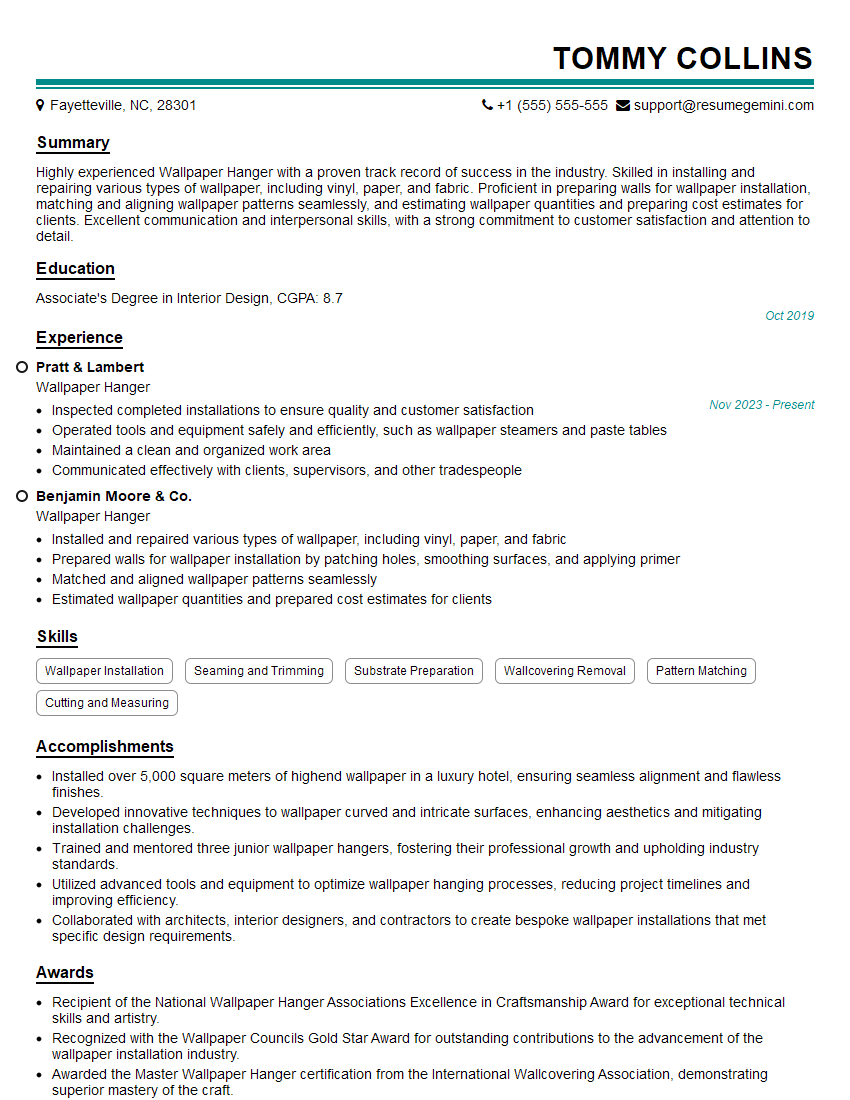
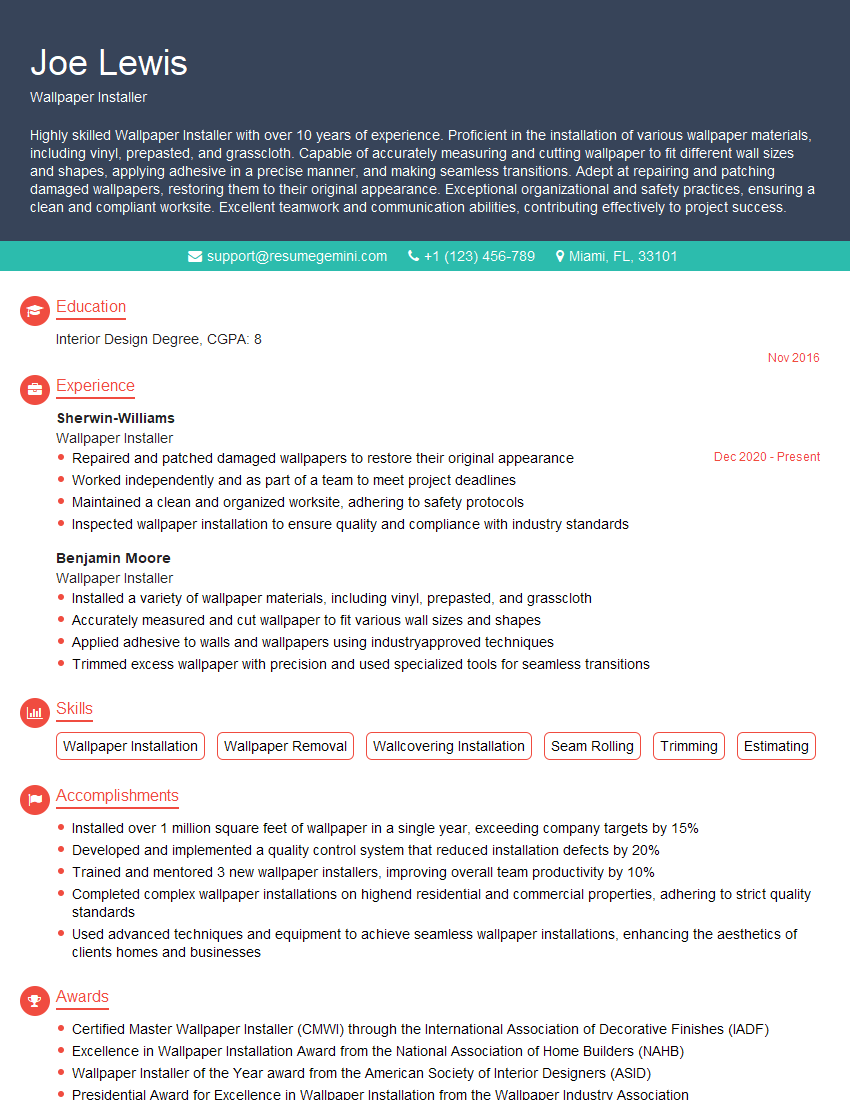
Mastering wallpaper steaming and scoring opens doors to exciting career opportunities in the home renovation and construction industries. A strong understanding of these techniques showcases your practical skills and attention to detail, making you a valuable asset to any team. To maximize your job prospects, creating an ATS-friendly resume is crucial. ResumeGemini is a trusted resource to help you build a professional and impactful resume that highlights your skills and experience effectively. Examples of resumes tailored to Wallpaper Steaming and Scoring are available to help guide you. Take the next step towards your dream job today!
Explore more articles
Users Rating of Our Blogs
Share Your Experience
We value your feedback! Please rate our content and share your thoughts (optional).
What Readers Say About Our Blog
To the interviewgemini.com Webmaster.
Very helpful and content specific questions to help prepare me for my interview!
Thank you
To the interviewgemini.com Webmaster.
This was kind of a unique content I found around the specialized skills. Very helpful questions and good detailed answers.
Very Helpful blog, thank you Interviewgemini team.