Interviews are opportunities to demonstrate your expertise, and this guide is here to help you shine. Explore the essential Alpha Spectrometry interview questions that employers frequently ask, paired with strategies for crafting responses that set you apart from the competition.
Questions Asked in Alpha Spectrometry Interview
Q 1. Explain the principle of alpha spectrometry.
Alpha spectrometry is a technique used to measure the energy spectrum of alpha particles emitted by radioactive isotopes. It’s based on the principle that alpha particles, being relatively heavy and charged, lose energy as they pass through matter. This energy loss is quantifiable and directly related to the initial energy of the alpha particle. The technique essentially counts and measures the energy of these particles, providing a fingerprint of the radioactive sources present.
Imagine throwing a bowling ball (alpha particle) across a room filled with obstacles (matter). The further it travels before stopping, the more energy it initially had. Alpha spectrometry measures how far these ‘bowling balls’ travel, revealing their original energy.
Q 2. Describe different types of alpha detectors used in spectrometry.
Several types of detectors are used in alpha spectrometry, each with its strengths and weaknesses:
- Surface Barrier Detectors (SBDs): These are the most common. They consist of a thin silicon wafer with a gold layer on the surface. The alpha particle penetrates the silicon, creating electron-hole pairs, which are collected and measured as a current pulse. SBDs offer excellent energy resolution and are relatively inexpensive.
- Gas-filled Proportional Counters: These detectors use a gas-filled chamber where the alpha particle ionizes the gas, creating an avalanche of ions that generates a measurable signal. They are robust but generally offer lower energy resolution than SBDs.
- ZnS Scintillation Detectors: Zinc sulfide scintillators emit light when struck by an alpha particle. This light is detected by a photomultiplier tube (PMT), converting it into an electrical signal. They are often used for simple alpha counting, not high-resolution spectrometry.
The choice of detector depends on the specific application and the required energy resolution and sensitivity.
Q 3. What are the advantages and limitations of alpha spectrometry compared to other spectroscopic techniques?
Alpha spectrometry has several advantages:
- High energy resolution: It can precisely distinguish between alpha particles of slightly different energies, allowing identification of different isotopes.
- Isotopic identification: The energy of alpha particles emitted is characteristic to a specific radionuclide, enabling precise identification.
- Relatively simple instrumentation: Compared to other techniques, the equipment is relatively straightforward to operate.
However, limitations exist:
- Low penetrating power of alpha particles: Alpha particles are easily stopped by even thin materials, requiring specialized sample preparation and vacuum conditions in the detector.
- Limited applicability: It’s primarily used for alpha-emitting radionuclides, not applicable to beta or gamma emitters.
- Background interference: Background radiation can sometimes interfere with measurements, necessitating careful shielding.
Compared to techniques like gamma spectrometry, which can analyze samples without extensive preparation, alpha spectrometry is more sensitive but requires greater care in sample handling.
Q 4. How is energy calibration performed in alpha spectrometry?
Energy calibration in alpha spectrometry involves determining the relationship between the measured pulse height (representing the energy deposited by the alpha particle) and the actual energy of the alpha particle. This is typically done using a source with known alpha energies (e.g., 239Pu, 241Am). The spectrum of the calibration source is measured, and the channel number corresponding to the peak of each known energy is plotted against the known energy. A linear fit is usually sufficient to determine the calibration function.
For example, if the 241Am peak is found at channel 4000 and its energy is 5.486 MeV, and the peak for another known source is at channel 6000, then the slope of calibration can be derived, which is used to assign energy to any peak.
Q 5. Explain the concept of resolution in alpha spectrometry and its importance.
Resolution in alpha spectrometry refers to the ability of the system to distinguish between alpha particles with slightly different energies. It’s usually expressed as the full width at half maximum (FWHM) of a peak in the energy spectrum, in keV. Higher resolution means sharper peaks and better separation between isotopes with similar alpha energies.
Think of it like distinguishing between two closely spaced musical notes. High resolution allows clear separation, whereas low resolution causes the notes to blend together. High resolution is crucial for accurate identification and quantification of different alpha-emitting isotopes in a sample, especially when dealing with complex mixtures.
Q 6. How do you handle background radiation in alpha spectrometry measurements?
Background radiation is a significant concern in alpha spectrometry because even small amounts can interfere with the measurement, especially at low activity levels. Mitigation strategies include:
- Shielding: Surrounding the detector with lead or other materials to reduce external gamma and cosmic ray backgrounds.
- Background subtraction: Measuring the background radiation without the sample and subtracting it from the sample measurement.
- Careful sample preparation: Minimizing contamination in the sample and ensuring a clean measurement environment to reduce spurious counts.
- Selecting a low-background detector: using detectors made of materials with low natural radioactivity is helpful.
Careful attention to these steps is necessary to achieve accurate and reliable results, particularly in environmental monitoring where low levels of alpha emitters need to be quantified.
Q 7. Describe the process of sample preparation for alpha spectrometry.
Sample preparation for alpha spectrometry is crucial because alpha particles have low penetration power. The process typically involves:
- Dissolution: Dissolving the sample in an appropriate solvent.
- Electrodeposition: Depositing the radioactive isotopes onto a planchet (thin metal disk) using an electrolytic method. This ensures a uniform and thin sample layer for optimal detection.
- Evaporation: Carefully evaporating a solution containing the radioactive material onto a planchet. This must be done meticulously to prevent loss of material.
- Fusion: Melting the sample and mixing with a suitable matrix. This method is often used for very small samples.
The choice of preparation method depends on the sample matrix and the nature of the radioactive isotopes of interest. After preparation, the sample needs to be handled cautiously to prevent any contamination or alteration of its radioactivity.
Q 8. What are common sources of error in alpha spectrometry?
Alpha spectrometry, while a powerful technique, is susceptible to several sources of error. These errors can broadly be categorized into those affecting the detector, the sample preparation, and the data analysis itself.
- Detector-related errors: These include issues like detector resolution (poor energy resolution leading to peak overlap), background radiation (interfering with the alpha peaks), and detector dead time (leading to pulse pile-up and inaccurate counts). For example, a poorly calibrated detector might consistently underestimate the energy of emitted alpha particles.
- Sample preparation errors: Inaccurate weighing of the sample, uneven sample deposition on the planchet, or the presence of contaminants can significantly affect the results. Imagine trying to measure the height of a building with a ruler that’s not straight – the result will be inaccurate. Similarly, an uneven sample distribution will result in inconsistent alpha emission rates across the sample.
- Data analysis errors: Incorrect peak fitting, improper background subtraction, and the failure to account for self-absorption within the sample are common analysis errors. A misplaced peak in the spectrum can entirely misrepresent the isotopic composition of the sample.
Minimizing these errors requires meticulous attention to detail in all stages, from sample preparation and detector calibration to data acquisition and analysis. Regular quality control checks and the use of certified reference materials are crucial for accurate and reliable results.
Q 9. How is the efficiency of an alpha spectrometer determined?
Determining the efficiency of an alpha spectrometer is crucial for accurate quantification of alpha-emitting nuclides. Efficiency refers to the probability that an alpha particle emitted by the sample will be detected by the spectrometer. It’s typically expressed as a percentage.
The efficiency is determined using a calibrated alpha source of a known activity (Bq or dps). This source is measured under identical conditions as the unknown sample. The activity of the standard is typically traceable to national or international standards. The efficiency (ε) is calculated as:
ε = (Counts detected from standard) / (Activity of standard * measurement time)Several factors affect the efficiency, including:
- Geometry: The distance and angle between the sample and the detector.
- Detector type: Different detectors (e.g., silicon surface barrier detectors, scintillation detectors) have different efficiencies.
- Sample self-absorption: Alpha particles can be absorbed within the sample itself, especially in thicker samples.
- Window thickness (for detectors with windows): Thicker windows will absorb more alpha particles.
Often, a ‘standard’ or ‘reference’ sample is prepared similarly to the sample of interest, and the efficiency calculated from the standard is used to calculate the activity of the unknown sample. Proper calibration procedures and traceable standards are essential for accurate efficiency determination.
Q 10. Explain the concept of alpha decay and its relevance to alpha spectrometry.
Alpha decay is a type of radioactive decay where an atomic nucleus emits an alpha particle, which is essentially a helium nucleus (2 protons and 2 neutrons). This emission transforms the parent nucleus into a daughter nucleus with a mass number reduced by four and an atomic number reduced by two.
The relevance to alpha spectrometry is straightforward: alpha spectrometry is specifically designed to detect and measure these emitted alpha particles. By analyzing the energy of the emitted alpha particles, we can identify the specific alpha-emitting radionuclide present in a sample. Each radionuclide emits alpha particles with characteristic energies, creating a unique “fingerprint” in the spectrum.
For example, 238Pu emits alpha particles with distinct energies, allowing us to identify its presence and quantify its activity in a sample. The process of identifying nuclides based on their specific alpha energies is central to alpha spectrometry’s application in various fields.
Q 11. What are some common applications of alpha spectrometry in environmental monitoring?
Alpha spectrometry finds crucial applications in environmental monitoring, particularly in assessing the presence and levels of naturally occurring and anthropogenic alpha-emitting radionuclides. This is vital for human health and environmental protection.
- Assessing radon levels: Radon, a radioactive gas, decays into alpha-emitting polonium isotopes. Alpha spectrometry of dust samples or air filters can help determine radon concentrations in homes and workplaces.
- Monitoring uranium and thorium contamination: These naturally occurring radioactive elements and their decay products can contaminate soil and water. Alpha spectrometry helps assess the extent of contamination and evaluate potential health risks.
- Nuclear accident monitoring: In the event of a nuclear accident, alpha spectrometry can be used to identify and quantify the release of alpha-emitting fission products into the environment.
- Detecting alpha-emitting contaminants in food and water: This is important for ensuring the safety of the food supply and drinking water.
The ability of alpha spectrometry to identify specific radionuclides at very low concentrations makes it an invaluable tool in these environmental monitoring efforts.
Q 12. How is alpha spectrometry used in nuclear forensics?
Nuclear forensics utilizes alpha spectrometry to analyze nuclear materials, helping investigators understand the origin, production methods, and history of nuclear materials involved in illicit activities, accidents, or incidents. Alpha spectrometry is invaluable because of its ability to uniquely identify and quantify specific isotopes.
- Identifying the origin of nuclear materials: The isotopic ratios of uranium and plutonium in a sample can provide clues about its origin (e.g., reactor-grade or weapons-grade plutonium).
- Determining the age of nuclear materials: Analyzing the decay products of certain isotopes can help estimate the age of the material.
- Analyzing nuclear debris from explosions or accidents: The isotopic composition of the debris can provide information about the type of device or accident that occurred.
- Analyzing environmental samples for illicit nuclear activities: Alpha spectrometry can detect traces of nuclear materials in soil, water, or air, indicating clandestine activities.
The high specificity and sensitivity of alpha spectrometry make it a critical tool for investigations related to nuclear proliferation, terrorism, and accidents.
Q 13. Describe the use of alpha spectrometry in the nuclear fuel cycle.
Alpha spectrometry plays a significant role throughout the nuclear fuel cycle, from uranium enrichment to spent fuel reprocessing and waste management. It provides essential data for process control, safety assessment, and material accountability.
- Uranium enrichment: Alpha spectrometry can measure the isotopic composition of uranium, which is critical for monitoring enrichment levels.
- Spent fuel analysis: It can quantify the buildup of alpha-emitting fission products in spent nuclear fuel.
- Reprocessing control: Alpha spectrometry helps monitor the separation and purification processes during spent fuel reprocessing.
- Waste characterization: It is used to determine the isotopic composition and activity of alpha-emitting radionuclides in nuclear waste, which is crucial for safe disposal.
Accurate and reliable alpha spectrometry data is essential for maintaining safety, efficiency, and security throughout the entire nuclear fuel cycle.
Q 14. What are some safety precautions when working with alpha-emitting isotopes?
Working with alpha-emitting isotopes requires stringent safety precautions due to their potential health hazards. Alpha particles, while easily shielded, pose a significant risk if ingested or inhaled because their high ionizing power can damage cells and tissues.
- Containment: Alpha emitters should be handled in glove boxes or other enclosed systems to prevent the release of airborne particles. All work surfaces should be covered to prevent contamination.
- Personal Protective Equipment (PPE): This includes gloves, lab coats, and respirators to minimize the risk of skin contact and inhalation.
- Monitoring: Regular monitoring of work areas and personnel is essential to detect any contamination. Air monitoring is particularly important for airborne alpha emitters.
- Waste management: Alpha-emitting waste must be properly handled and disposed of according to regulations. This typically involves packaging the waste securely and disposing of it in designated facilities.
- Training: Adequate training on safe handling procedures and emergency response is crucial for all personnel working with alpha emitters.
Strict adherence to these safety procedures is paramount to protect the health and safety of personnel and the environment.
Q 15. How do you interpret an alpha spectrum?
Interpreting an alpha spectrum involves analyzing the energy distribution of detected alpha particles. Think of it like a fingerprint for a radioactive sample. Each peak in the spectrum represents a specific alpha-emitting isotope, and its position along the energy axis corresponds to the energy of the emitted alpha particles. The height of the peak reflects the abundance of that isotope in the sample. We look for the characteristic energy peaks for known isotopes to identify the constituents of the sample. For example, a peak at around 5.486 MeV would strongly suggest the presence of 241Am.
Beyond peak identification, we also assess the resolution of the spectrum, the peak-to-background ratio, and the overall shape of the peaks. These factors provide valuable information about the sample preparation, the detector performance, and the presence of any potential interferences.
Career Expert Tips:
- Ace those interviews! Prepare effectively by reviewing the Top 50 Most Common Interview Questions on ResumeGemini.
- Navigate your job search with confidence! Explore a wide range of Career Tips on ResumeGemini. Learn about common challenges and recommendations to overcome them.
- Craft the perfect resume! Master the Art of Resume Writing with ResumeGemini’s guide. Showcase your unique qualifications and achievements effectively.
- Don’t miss out on holiday savings! Build your dream resume with ResumeGemini’s ATS optimized templates.
Q 16. What is the role of pulse height analysis in alpha spectrometry?
Pulse height analysis is the heart of alpha spectrometry. Alpha particles, upon striking the detector, deposit their energy. This energy is converted into an electrical pulse whose amplitude (height) is directly proportional to the energy of the alpha particle. Pulse height analysis then sorts these pulses according to their amplitude, creating the energy spectrum. This process is analogous to sorting colored marbles based on their size. Each marble represents an alpha particle; the bigger the marble (higher pulse height), the higher the alpha particle’s energy.
The sophisticated electronics in an alpha spectrometer use analog-to-digital converters (ADCs) to precisely measure these pulse heights and bin them into channels. A histogram of these channels creates the final spectrum, which we then interpret. The better the ADC’s resolution, the sharper and more distinct the peaks in the resulting spectrum. This is crucial for resolving closely spaced alpha peaks originating from different isotopes.
Q 17. Explain the difference between alpha and beta spectrometry.
Alpha and beta spectrometry differ fundamentally in the type of radiation they detect and the techniques used. Alpha spectrometry focuses on detecting alpha particles, which are relatively heavy and highly ionizing. They have short ranges in matter, hence requiring thin samples and detectors that are close to the sample. Beta spectrometry, on the other hand, detects beta particles, which are much lighter, less ionizing, and have longer ranges. This necessitates different sample preparation and detector configurations.
The energy range of alpha particles is typically much higher than that of beta particles (MeV vs. keV). Alpha spectrometry detectors are therefore optimized for high-energy resolution at these higher energies. Beta spectrometry detectors may handle a wider energy range but at the cost of lower resolution at high energies, The techniques used for background reduction are also different, since alpha particles have different interactions with materials compared to beta particles.
Q 18. How do you identify different alpha-emitting isotopes using alpha spectrometry?
Identifying different alpha-emitting isotopes is based on their characteristic alpha-particle energies. Each isotope emits alpha particles with specific, well-defined energies. This creates distinct peaks in the alpha spectrum. By comparing the energies of the observed peaks with known values in a nuclide database, we can identify the isotopes present. This process is similar to using a spectral library to identify compounds in a chemical analysis.
For example, if we observe a strong peak at 5.486 MeV, we can confidently attribute it to 241Am. Similarly, peaks at other known energies, such as 5.157 MeV for 239Pu and 5.766 MeV for 244Cm, will help us identify the remaining isotopes in our sample. Sophisticated spectral fitting software also assists in analyzing complex spectra with overlapping peaks.
Q 19. What is the significance of the alpha particle energy in identifying isotopes?
The alpha particle energy is paramount in isotope identification because it’s a unique fingerprint for each radioactive nucleus. Different isotopes have different nuclear structures, leading to distinct alpha decay energies. This energy difference is precisely what allows us to distinguish between them. High-resolution alpha spectrometry is crucial because some isotopes emit alpha particles with very close energies. A high-resolution spectrometer can resolve these close peaks, improving the accuracy of the analysis and allowing for identification of multiple isotopes even in complex mixtures.
Imagine trying to identify coins based only on their diameter. A small difference in diameters could easily lead to misidentification. However, if we include their weight, composition, and other unique characteristics as additional identifying factors, the likelihood of correct identification greatly increases. Alpha energy is analogous to these additional characteristics in isotope identification.
Q 20. How does the type of detector impact the resolution and efficiency of alpha spectrometry?
The detector choice significantly impacts both the resolution and efficiency of alpha spectrometry. Resolution refers to the spectrometer’s ability to distinguish between alpha particles of slightly different energies (the sharpness of the peaks). Efficiency refers to its ability to detect alpha particles. Common detectors include silicon surface barrier detectors (SSBDs) and gas-filled proportional counters.
SSBDs generally offer excellent energy resolution because of their relatively thin depletion region and good charge collection efficiency. However, they are sensitive to damage from heavy alpha particle irradiation. Proportional counters are less sensitive to damage, but their energy resolution is typically lower. The choice between these detectors and others (e.g., scintillators) depends on the specific application; high-resolution applications might favor SSBDs, while applications with high radiation levels might favor proportional counters or other robust detectors.
Q 21. Describe your experience with different types of alpha spectrometers.
Throughout my career, I’ve had extensive experience with various alpha spectrometers, from simple systems used for routine analyses to sophisticated, high-resolution systems employed in research. I’ve worked with instruments utilizing silicon surface barrier detectors (SSBDs), as well as gas-filled proportional counters. My experience spans different manufacturers and instrument configurations.
One particular project involved using a high-resolution SSBD-based spectrometer to analyze extremely low-level alpha-emitting contaminants in environmental samples. Another involved the deployment of a more rugged, less sensitive proportional counter system in a field environment to monitor high radiation levels around nuclear facilities. This experience helped to show me the tradeoffs between high-resolution spectroscopy and robustness against high radiation levels, crucial for selecting the right tool for the specific application.
Q 22. How do you ensure the quality control of alpha spectrometry measurements?
Ensuring quality control in alpha spectrometry is crucial for reliable results. It’s a multi-faceted process that begins even before the sample is analyzed. We must meticulously control the entire process to minimize errors.
- Sample Preparation: This is paramount. Careful weighing and homogeneous sample preparation are essential to avoid inconsistencies. We use certified reference materials (CRMs) to validate our sample preparation techniques. Any contamination introduced during this stage directly impacts the final result.
- Detector Calibration: Regular calibration using certified alpha sources with known activities is non-negotiable. This ensures the detector’s energy response is accurate and traceable. We perform this at least weekly, and often more frequently, depending on usage.
- Background Measurement: Measuring the background radiation is critical to subtract its contribution from the sample measurement, which helps isolate the alpha particles from the sample itself. We typically take prolonged background measurements to achieve good statistical accuracy. A significant increase in background radiation could indicate a problem.
- Data Acquisition: Appropriate acquisition parameters, such as live time and dead time corrections, are important. The software we use automatically applies these corrections, but we always review the results to ensure data validity.
- Quality Assurance Checks: We regularly perform checks using certified reference materials to verify the accuracy and precision of our measurements. Discrepancies trigger an immediate investigation of the entire measurement process. A control chart is maintained to track the performance of the system and allow prompt intervention.
Think of it like baking a cake: If you don’t measure the ingredients accurately, use a faulty oven (detector), or forget to account for the bowl’s weight (background), the final product won’t be what you expect. Alpha spectrometry demands similar rigor.
Q 23. What software packages are you familiar with for alpha spectrometry data analysis?
I’m proficient in several software packages for alpha spectrometry data analysis. The choice often depends on the specific instrument and the type of analysis needed.
- Genie 2000 (Canberra): A widely used software for spectrum acquisition and analysis, offering peak fitting, energy calibration, and isotope identification capabilities.
- AlphaVision (ORTEC): Another popular software package, known for its user-friendly interface and advanced features for analyzing complex alpha spectra.
- MATLAB: I use MATLAB extensively for advanced data processing, statistical analysis, and custom algorithm development. It allows greater flexibility and can be especially helpful when dealing with large datasets or complex spectral features.
Each of these packages has its strengths. For example, Genie 2000 provides a more straightforward interface for routine analysis, while MATLAB gives more control for advanced users tackling challenging spectral deconvolution problems. The most suitable software depends on the complexity of the project.
Q 24. Describe a challenging problem you faced during alpha spectrometry analysis and how you solved it.
One challenging problem involved analyzing a sample with extremely low activity levels of a specific alpha-emitting isotope embedded in a complex matrix. This resulted in a weak peak, making it difficult to distinguish from background noise. Standard peak fitting techniques produced unreliable results.
My solution involved a combination of techniques:
- Increased Measurement Time: Extending the measurement time significantly improved the signal-to-noise ratio, allowing a clearer peak to emerge.
- Background Subtraction: Careful background subtraction using a well-characterized background spectrum was critical for accuracy.
- Advanced Peak Fitting: I used advanced peak fitting algorithms within MATLAB, incorporating information about the expected peak shape and energy based on literature data, to resolve overlapping peaks and obtain a more precise quantification.
- Monte Carlo Simulations: To validate our findings, I performed Monte Carlo simulations to model the expected spectrum based on the known isotopic composition and the detector’s properties.
This multi-pronged approach allowed us to accurately quantify the low-activity isotope, demonstrating the importance of combining various techniques for tackling challenging analytical problems in alpha spectrometry.
Q 25. How would you troubleshoot a low-efficiency alpha spectrometer?
Troubleshooting a low-efficiency alpha spectrometer requires a systematic approach. We need to investigate several potential causes one-by-one.
- Vacuum Integrity: Alpha particles have a short range, and a good vacuum is crucial. Leaks in the vacuum system can scatter particles and reduce efficiency. A leak test is the first step.
- Detector Degradation: The detector itself might be degraded due to age or radiation damage. A comparison of current performance with past calibration records helps reveal whether a degradation has occurred. In some cases, replacing the detector might be necessary.
- Sample Preparation: Issues during sample preparation, like uneven deposition or the presence of a thick sample layer, can significantly reduce efficiency. Careful re-examination of the preparation techniques is necessary.
- Electronics Malfunction: Problems with the amplification system, high voltage supply, or data acquisition electronics could affect the detector’s response and signal detection. A careful review of the instrument’s electronics is needed. Thorough checks of the connections are also needed.
- Calibration Errors: If the detector is improperly calibrated, its efficiency might be misrepresented. This calls for recalibration with a well-characterized alpha source.
Remember, it’s essential to document each step of the troubleshooting process. Systematic investigation using a checklist approach is efficient and minimizes the risk of overlooking crucial details.
Q 26. How do you ensure the accuracy and precision of your alpha spectrometry results?
Accuracy and precision in alpha spectrometry are ensured through a combination of careful experimental design, rigorous quality control, and proper data analysis.
- Certified Reference Materials (CRMs): Regular analysis of CRMs allows us to validate the accuracy of our measurements by comparing our results to known values. Any significant deviation prompts a thorough investigation.
- Multiple Measurements: Repeating measurements on the same sample multiple times improves precision by reducing the impact of random errors. Statistical analysis of the results provides a measure of precision (e.g., standard deviation).
- Blank Samples: Analyzing blank samples helps assess the level of background contamination and enables more accurate subtraction of the background contribution from the sample measurement.
- Proper Data Analysis: Accurate peak fitting and background subtraction methods are critical. Using validated software and algorithms is important. We ensure the correct method is being used in each case.
- Traceability: Maintaining a complete record of every step in the process, from sample preparation to data analysis, ensures traceability and helps identify the source of any errors.
Think of it like shooting an arrow at a target. Accuracy means hitting close to the bullseye (true value), while precision means consistently hitting the same spot, even if not the bullseye. We aim for both in alpha spectrometry.
Q 27. Explain your understanding of radiation safety regulations related to alpha spectrometry.
Radiation safety is paramount when working with alpha-emitting isotopes. My understanding of the relevant regulations is comprehensive.
- Regulatory Compliance: I am fully aware of and adhere to all relevant national and international regulations for handling radioactive materials, including licensing, waste disposal, and personnel safety. This includes following strict guidelines, and recording all materials used.
- Personal Protective Equipment (PPE): We always use appropriate PPE, including gloves, lab coats, and sometimes respirators depending on the material. In some cases, specialized suits may also be used, depending on the isotope.
- Containment: Radioactive samples are handled in designated areas with appropriate shielding and containment to minimize the risk of exposure. All work is done under a fume hood to prevent any airborne contamination.
- Monitoring: Radiation monitoring is done regularly to ensure personnel safety. Survey meters are used to check for radiation levels.
- Waste Management: Radioactive waste is handled and disposed of according to strict protocols. This includes appropriate labelling and storage of the waste, and following specific disposal guidelines.
Radiation safety is not just a set of rules; it’s a mindset. It requires constant vigilance and meticulous adherence to protocols to protect both myself and others.
Q 28. Describe your experience working with radioactive materials.
My experience with radioactive materials spans several years and includes work with various alpha emitters, such as 238Pu, 241Am, and 239Pu. I’ve been involved in diverse applications, such as:
- Environmental Monitoring: Analyzing environmental samples (soil, water, air) for the presence of alpha-emitting radionuclides.
- Nuclear Forensics: Analyzing materials for the purposes of identifying the origin and characteristics of nuclear materials.
- Material Characterization: Determining the isotopic composition of materials containing alpha emitters.
In each application, I’ve adhered to strict radiation safety protocols and used appropriate techniques to handle radioactive materials safely and accurately. This includes record-keeping of all materials, including the amount, concentration, and location. Safety is always the primary consideration in any work I undertake with radioactive materials.
Key Topics to Learn for Alpha Spectrometry Interview
- Alpha Decay and its Characteristics: Understand the fundamental principles of alpha decay, including energy levels, decay constants, and half-lives. Be prepared to discuss different alpha decay models.
- Alpha Spectrometry Instrumentation: Familiarize yourself with various alpha spectrometry techniques, such as silicon surface barrier detectors, gas ionization chambers, and scintillation detectors. Understand their operating principles, advantages, and limitations.
- Data Acquisition and Analysis: Master the process of acquiring and analyzing alpha spectrometry data, including spectrum interpretation, peak identification, and background subtraction. Practice with different software packages if possible.
- Sample Preparation Techniques: Understand the importance of proper sample preparation for accurate alpha spectrometry measurements. Know different techniques for preparing solid, liquid, and gaseous samples.
- Applications of Alpha Spectrometry: Be ready to discuss various applications in fields such as environmental monitoring (e.g., radon measurement), nuclear safety, material science, and geological dating.
- Radiation Safety and Regulations: Demonstrate understanding of relevant safety protocols and regulations associated with handling alpha-emitting materials.
- Calibration and Quality Control: Explain the importance of calibration procedures and quality control measures in ensuring the accuracy and reliability of alpha spectrometry results.
- Troubleshooting and Problem Solving: Be prepared to discuss common issues encountered in alpha spectrometry and your approach to resolving them. This showcases analytical skills.
Next Steps
Mastering alpha spectrometry opens doors to exciting career opportunities in diverse fields, offering excellent prospects for growth and specialization. To significantly enhance your job prospects, create a compelling and ATS-friendly resume that highlights your skills and experience. ResumeGemini is a trusted resource to help you build a professional resume that stands out. We offer examples of resumes tailored to Alpha Spectrometry professionals to guide you – take advantage of these resources to present yourself effectively to potential employers.

Laboratory Manager Resume Sample

Environmental Scientist Resume Sample

Waste Management Specialist Resume Sample

Quality Control Specialist Resume Sample

Nuclear Engineer Resume Sample

Spectroscopist Resume Sample

Health Physicist Resume Sample

Analytical Chemist Resume Sample

Geochemist Resume Sample
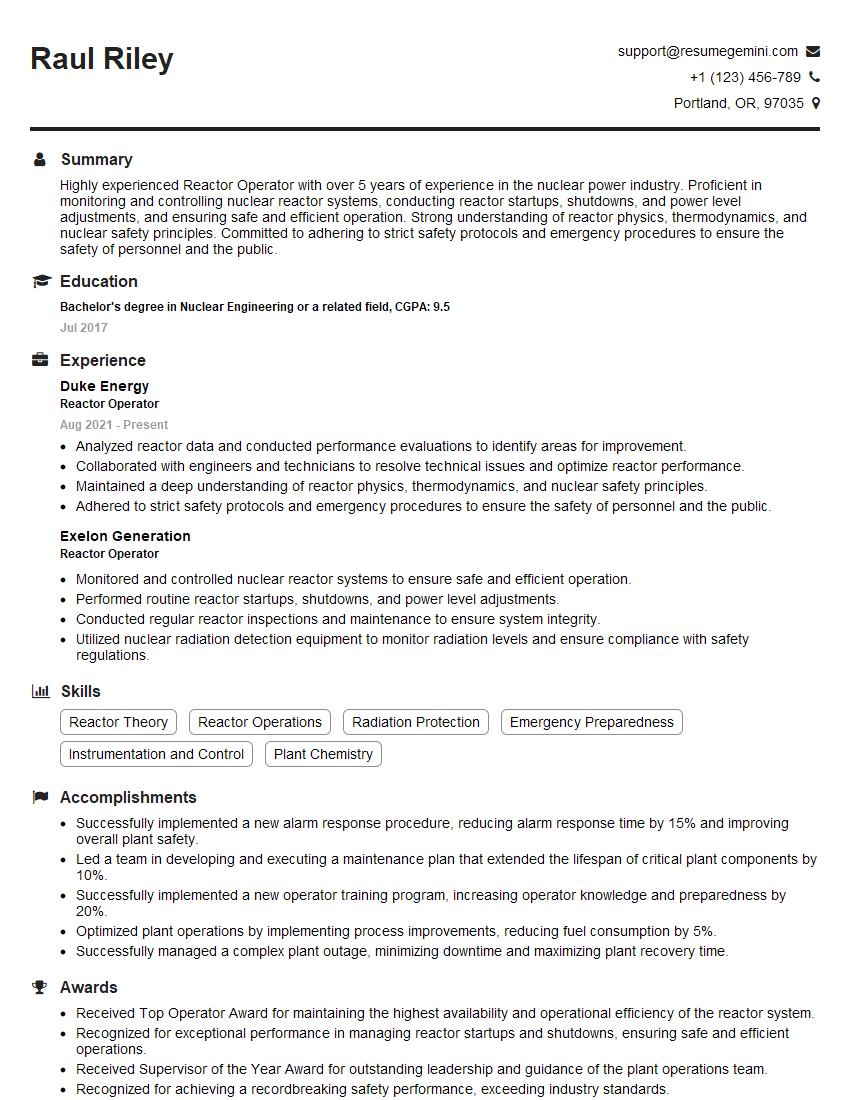
Reactor Operator Resume Sample

Nuclear Medicine Technologist Resume Sample

Radiation Safety Officer Resume Sample
Explore more articles
Users Rating of Our Blogs
Share Your Experience
We value your feedback! Please rate our content and share your thoughts (optional).
What Readers Say About Our Blog
To the interviewgemini.com Webmaster.
Very helpful and content specific questions to help prepare me for my interview!
Thank you
To the interviewgemini.com Webmaster.
This was kind of a unique content I found around the specialized skills. Very helpful questions and good detailed answers.
Very Helpful blog, thank you Interviewgemini team.