Are you ready to stand out in your next interview? Understanding and preparing for Astronomy Interpretation interview questions is a game-changer. In this blog, we’ve compiled key questions and expert advice to help you showcase your skills with confidence and precision. Let’s get started on your journey to acing the interview.
Questions Asked in Astronomy Interpretation Interview
Q 1. Explain the process of calibrating astronomical data.
Calibrating astronomical data is crucial for obtaining accurate and reliable results. It’s like zeroing a scale before weighing groceries; without it, your measurements are meaningless. The process involves removing instrumental biases and correcting for known systematic effects to transform raw detector readings into scientifically usable measurements. This often involves multiple steps:
Bias Subtraction: Removing the inherent electronic noise present in the detector even when no light is detected. This is analogous to subtracting the background hum from an audio recording.
Dark Subtraction: Removing the signal generated by the detector’s internal thermal activity. This is like removing stray light in a photograph.
Flat Fielding: Correcting for variations in the detector’s sensitivity across its surface. This ensures consistent response to light across the detector, like adjusting for uneven ink distribution in a printer.
Photometric Calibration: Converting the instrument’s readings to physical units (e.g., magnitudes or flux) using standard stars with known properties. Think of it as comparing your scale readings to a set of known weights.
These steps are often performed using specialized software packages and require a deep understanding of the instrument and its characteristics. For example, the process for calibrating data from a ground-based optical telescope will differ significantly from that of a space-based X-ray telescope due to the differing instrumental effects.
Q 2. Describe different types of astronomical telescopes and their applications.
Astronomical telescopes come in various types, each optimized for different wavelengths of light and observing goals:
Refracting Telescopes: Use lenses to gather and focus light. They’re excellent for visual observations and producing sharp images, but large refractors are expensive and difficult to manufacture.
Reflecting Telescopes: Use mirrors to gather and focus light. These are more commonly used for large-scale observations because mirrors are easier and cheaper to produce than large lenses. They come in various designs like Newtonian, Cassegrain, and Ritchey-Chrétien, each with different optical properties.
Radio Telescopes: Detect radio waves emitted by celestial objects. They’re used to study phenomena like pulsars, quasars, and the cosmic microwave background radiation. They are often large and consist of multiple dish antennas working together (interferometry) to achieve high resolution.
X-ray and Gamma-ray Telescopes: Detect high-energy radiation, requiring specialized technologies like grazing incidence mirrors because these wavelengths are not easily reflected or refracted by normal means. These are often space-based to avoid atmospheric absorption.
The choice of telescope depends on the research question. For instance, studying distant galaxies might require a large reflecting telescope in space to avoid atmospheric interference, while observing the Sun might utilize a specialized solar telescope that filters out harmful radiation.
Q 3. How do you identify and correct for systematic errors in astronomical observations?
Systematic errors in astronomy are consistent, repeatable mistakes that aren’t random fluctuations. Identifying and correcting them is crucial for accurate results. Methods include:
Careful Instrument Calibration: As discussed earlier, thorough calibration minimizes instrumental biases.
Atmospheric Correction: Using models and observations to correct for atmospheric distortion, scattering, and absorption, especially important for ground-based telescopes.
Data Filtering and Smoothing: Applying techniques to remove known artifacts or spurious signals.
Comparison with Standard Stars: Comparing observations to well-characterized stars helps identify systematic deviations.
Independent Data Sets: Comparing results from different instruments or observatories can help identify systematic issues specific to a single telescope or method.
For example, a systematic error might be a constant offset in a telescope’s pointing, causing all measurements to be slightly off. By carefully monitoring the telescope’s pointing and correcting for the offset, we can eliminate this error. Another example would be a gradual degradation of the telescope’s optics over time, leading to increasingly blurred images. Regular maintenance and calibration can mitigate this.
Q 4. Explain the concept of photometry and its importance in astronomy.
Photometry is the measurement of the intensity of light from celestial objects. It’s fundamental in astronomy because it allows us to determine the brightness of stars and galaxies, providing insights into their properties like luminosity, distance, and temperature. Imagine comparing the brightness of two light bulbs – photometry does the same for celestial objects.
The importance of photometry is vast:
Distance Determination: By comparing the apparent brightness (how bright it appears to us) with the intrinsic brightness (the actual light output), we can estimate the distance.
Stellar Classification: Photometry in different wavelength bands (e.g., ultraviolet, visible, infrared) helps classify stars based on their temperature and composition.
Exoplanet Detection: The transit method detects exoplanets by measuring the slight dimming of a star’s brightness as a planet passes in front of it.
Variable Star Studies: Monitoring brightness changes over time helps understand the physical processes within stars.
Photometric data is often presented as magnitude values, where smaller magnitudes indicate brighter objects. Different photometric systems (e.g., UBVRI) use different filters to isolate specific wavelength ranges.
Q 5. What are the different coordinate systems used in astronomy and how are they related?
Astronomy uses several coordinate systems to pinpoint the location of celestial objects. The most common are:
Horizontal Coordinate System: Uses altitude (height above the horizon) and azimuth (direction along the horizon) to locate an object. It’s observer-centric and changes with time and location.
Equatorial Coordinate System: Uses right ascension (analogous to longitude) and declination (analogous to latitude) to locate an object. It’s Earth-centric but remains relatively fixed over time. The celestial equator is the projection of the Earth’s equator onto the celestial sphere.
Galactic Coordinate System: Uses galactic longitude and galactic latitude to locate an object relative to the Milky Way’s galactic plane. This system is useful for studying the structure and dynamics of our galaxy.
These coordinate systems are interrelated through mathematical transformations. For example, you can convert horizontal coordinates to equatorial coordinates using the observer’s latitude, longitude, and the time of observation. This is essential for astronomers to share and compare observations made from different locations and times.
Q 6. Describe the methods used for determining the distance to celestial objects.
Determining the distance to celestial objects is a fundamental challenge in astronomy. The methods used vary depending on the distance scale:
Parallax: For nearby stars, this geometric method uses the apparent shift in the star’s position as observed from different points in Earth’s orbit. It’s like holding your finger out and looking at it with one eye closed, then the other – the finger seems to shift relative to the background.
Standard Candles: For more distant objects, astronomers use objects with known luminosity (e.g., Cepheid variable stars, Type Ia supernovae). By comparing their apparent brightness to their intrinsic brightness, we can estimate their distance.
Redshift: For extremely distant objects, redshift, the stretching of light’s wavelength due to the expansion of the universe, provides a measure of distance.
Each method has its limitations and uncertainties. For instance, parallax measurements are only accurate for relatively nearby stars, while the accuracy of standard candle methods depends on the accuracy of the luminosity calibration. Combining multiple methods and techniques helps astronomers refine distance estimates and build a consistent cosmic distance ladder.
Q 7. Explain the concept of redshift and its significance in cosmology.
Redshift is the phenomenon where the wavelength of light from a celestial object is stretched, causing it to shift towards the red end of the electromagnetic spectrum. This happens when the object is moving away from us. Imagine the sound of a siren changing pitch as an ambulance speeds past – the Doppler effect. Redshift is the equivalent for light.
In cosmology, redshift has profound significance:
Expanding Universe: The observation that most galaxies show redshift, and that the redshift increases with distance, is strong evidence for the expansion of the universe. This is the foundation of the Big Bang theory.
Distance Measurement: For very distant objects, redshift is a primary indicator of distance. The further away an object is, the faster it recedes and the larger its redshift.
Cosmic Evolution: By studying the redshift of galaxies, astronomers can learn about the evolution of galaxies and the universe itself over cosmic time.
Redshift is often quantified using the dimensionless parameter z, where a higher z value indicates a greater redshift and a larger distance. The relationship between redshift and distance is not linear due to the complex nature of the universe’s expansion.
Q 8. How do you analyze spectroscopic data to determine the composition of stars?
Analyzing stellar spectra to determine composition is akin to reading a star’s unique fingerprint. Each element absorbs specific wavelengths of light, leaving dark lines in its spectrum – its absorption spectrum. These dark lines, called absorption lines or Fraunhofer lines, are unique to each element, similar to how fingerprints are unique to each person. We analyze these absorption lines to determine which elements are present in the star and in what abundance.
The process involves several steps:
- Data Acquisition: We obtain the star’s spectrum using a spectrograph, which disperses the starlight into its constituent wavelengths.
- Calibration: We calibrate the spectrum to account for instrumental effects and to accurately determine wavelengths.
- Line Identification: We compare the observed absorption lines with known spectral lines of different elements from laboratory databases. A stellar spectrum might show hundreds or thousands of these lines.
- Line Measurement: We precisely measure the wavelengths and intensities of the absorption lines.
- Abundance Determination: Using sophisticated models and computer programs, we determine the relative abundance of each element by comparing the strengths of its absorption lines to theoretical models. The depth of an absorption line is directly related to the abundance of the element causing it.
Example: If we observe strong absorption lines corresponding to Hydrogen and Helium, and weaker lines corresponding to heavier elements like Calcium, we infer a star rich in Hydrogen and Helium, typical of a main-sequence star. The relative strengths of these lines will even give clues to the star’s temperature and other physical properties.
Q 9. Describe the different types of astronomical detectors and their advantages and disadvantages.
Astronomical detectors are the eyes of our telescopes, converting light into a measurable signal. Several types exist, each with its strengths and weaknesses:
- Charge-Coupled Devices (CCDs): These are the workhorses of modern astronomy. They’re essentially highly sensitive light buckets. Each photon hitting the CCD creates an electron, which is then read out. Advantages: High quantum efficiency (converting photons to electrons efficiently), excellent linearity (signal is proportional to light intensity), low noise. Disadvantages: Can be susceptible to cosmic rays (high-energy particles leaving spurious signals).
- Complementary Metal-Oxide-Semiconductor (CMOS) Sensors: Similar to CCDs, but with a different architecture. They’re becoming increasingly popular due to their faster readout speeds and lower cost. Advantages: Fast readout, lower cost, often integrated with on-chip processing. Disadvantages: Can have higher noise levels than CCDs at low light levels.
- Photomultiplier Tubes (PMTs): These are extremely sensitive detectors for detecting faint light, especially at single photon levels. Advantages: Extremely high sensitivity. Disadvantages: Limited dynamic range (they saturate at higher light levels) and susceptibility to noise.
- Bolometers: These detectors measure the heat generated by incoming radiation, useful for detecting far-infrared and submillimeter radiation that CCDs aren’t very sensitive to. Advantages: sensitive at long wavelengths. Disadvantages: Relatively less sensitive than CCDs in the visible and near infrared.
The choice of detector depends on the specific astronomical application and the type of light being detected. For example, deep surveys of faint galaxies might favor CCDs, while observing rapidly changing objects might prefer CMOS sensors.
Q 10. How do you deal with data gaps or missing values in astronomical datasets?
Dealing with missing data is a common challenge in astronomy. Data gaps can be caused by various factors, such as instrument malfunctions, cloud cover, or simply the limitations of observation time. We handle this using several strategies:
- Interpolation: This involves estimating the missing values based on the surrounding data points. Simple linear interpolation is often insufficient for astronomical data, and more sophisticated methods like spline interpolation or kriging are often used. The choice depends on the nature of the data and the expected smoothness of the underlying phenomenon.
- Inpainting: Advanced techniques based on image processing borrow concepts like image inpainting, where sophisticated algorithms attempt to ‘fill in’ the missing data using patterns found in the surrounding data.
- Model-based imputation: Instead of directly filling in the gaps, a physical or statistical model of the phenomenon is built, then the model is used to predict values in the missing regions. This requires strong assumptions on the underlying behavior of the data.
- Exclusion: Sometimes, if the number of missing data points is very high, or they cluster in a way that compromises analysis, we might have to simply exclude the affected sections or data points from analysis.
The choice of method depends on the specifics of the data set and the nature of the missing values. It’s crucial to document the methods used to handle missing data, as it can significantly impact the results of the analysis.
Q 11. Explain the concept of astronomical seeing and its impact on observations.
Astronomical seeing refers to the blurring and twinkling of stars caused by turbulence in the Earth’s atmosphere. Imagine looking at a star through a shimmering heat haze rising from a hot road – that’s essentially what atmospheric seeing is. This turbulence distorts the wavefronts of starlight, resulting in a blurry image at the telescope.
The impact on observations is significant. Seeing limits the resolution of ground-based telescopes. A good seeing condition might be around 1 arcsecond, meaning details smaller than about 1 arcsecond in angular size will be blurred out. Poor seeing can be several arcseconds, severely degrading image quality. This affects almost all astronomical observations, from imaging galaxies to measuring the positions of stars.
Mitigating seeing effects: Astronomers employ several strategies to minimize the effects of seeing:
- Adaptive optics: This technology uses deformable mirrors to correct for atmospheric distortions in real time, providing significantly sharper images.
- Speckle interferometry: This technique uses sophisticated image processing to remove the effects of seeing from short-exposure images.
- Space-based telescopes: Placing telescopes in space avoids the Earth’s atmosphere entirely, eliminating seeing limitations.
The quality of seeing significantly influences the types of observations possible and the precision of measurements that can be obtained.
Q 12. Describe the different types of astronomical surveys and their scientific goals.
Astronomical surveys systematically observe large portions of the sky to achieve specific scientific goals. Different surveys employ different strategies and instruments.
- Photometric Surveys: These surveys measure the brightness of celestial objects at various wavelengths. Examples include the Sloan Digital Sky Survey (SDSS), which mapped millions of galaxies, and the Pan-STARRS survey, which is known for its asteroid discovery contributions. Their goals are to characterize the distribution of galaxies, stars, and other objects.
- Spectroscopic Surveys: These surveys obtain spectra of many celestial objects, providing information on their chemical composition, velocities, and other physical properties. The Gaia mission, with its large spectroscopic dataset, provides information on the velocities and properties of billions of stars.
- Time-domain Surveys: These surveys monitor the sky repeatedly over time to detect changes in brightness or position of objects, useful in discovering supernovae, variable stars, and exoplanets (transit method). The Kepler mission, for instance, discovered thousands of exoplanets using its continuous monitoring of stellar brightness.
- Radio Surveys: These surveys use radio telescopes to detect radio waves emitted by celestial objects, uncovering information about things invisible in the optical range (e.g., pulsars, active galactic nuclei). The Very Large Array (VLA) has conducted numerous large-scale radio surveys.
The scientific goals of surveys vary widely, but they generally aim to create large, comprehensive datasets to address fundamental questions in astrophysics, cosmology, and planetary science. These datasets often become invaluable resources for the wider astronomical community.
Q 13. How do you use statistical methods to analyze astronomical data?
Statistical methods are fundamental to analyzing the massive datasets produced by modern astronomical surveys. We use various techniques to extract meaningful information, identify patterns, and draw inferences from noisy data.
- Descriptive Statistics: We begin by computing basic statistics like mean, median, standard deviation, and distributions to characterize the data. For example, we might look at the distribution of galaxy luminosities or the distribution of stellar velocities.
- Hypothesis Testing: We use statistical tests like t-tests and chi-squared tests to assess whether observed differences between groups of objects or measurements are statistically significant or due to chance. For instance, testing whether the mean luminosity of two different types of galaxies is different.
- Regression Analysis: We can use regression techniques to model relationships between different variables. For instance, fitting a relationship between the mass and luminosity of a galaxy population.
- Classification Techniques: Methods like Support Vector Machines (SVMs) and Random Forests are used to classify objects based on their properties. For example, classifying galaxies into different morphological types.
- Clustering Analysis: Techniques like k-means clustering or hierarchical clustering are used to group similar objects together. This is often useful in discovering new classes of astronomical objects.
Example (Python with SciPy):from scipy import stats
t_statistic, p_value = stats.ttest_ind(group1_data, group2_data)
This code snippet demonstrates a simple t-test to compare the means of two groups of data. More complex analyses require dedicated statistical software packages and careful consideration of the assumptions underlying the statistical tests.
Q 14. Explain the concept of light curves and their applications in astronomy.
A light curve is a plot of an object’s brightness as a function of time. Think of it as a graph showing how an object’s light changes over time. It’s a powerful tool in astronomy because it reveals temporal variations in an object’s luminosity, providing vital clues about its nature and behavior.
Applications of light curves are widespread:
- Exoplanet Detection: The transit method detects exoplanets by observing the slight dip in a star’s brightness as a planet passes in front of it. The shape and depth of the dip in the light curve provides information about the planet’s size and orbital period.
- Supernovae Studies: Light curves of supernovae reveal information about their explosion mechanism, energy output, and evolution. The shape of the light curve can distinguish between different types of supernovae.
- Variable Star Studies: Many stars exhibit variations in their brightness over time. Light curves of these variable stars provide insights into their physical processes, such as pulsations or eclipses by companion stars.
- Asteroid Characterization: Light curves of asteroids, produced by their rotation and changes in their orientation with respect to Earth, can be used to determine their shape and rotation period.
- Active Galactic Nuclei (AGN) Studies: AGN light curves reveal variations in the emission from the supermassive black hole at the center of a galaxy, helping to understand the accretion processes and jet formation.
Analyzing light curves often involves sophisticated techniques like Fourier analysis to identify periodic signals or model fitting to determine physical parameters of the objects. They are an invaluable tool for understanding the dynamics and physical processes of diverse celestial objects.
Q 15. Describe the different types of astronomical software and their capabilities.
Astronomical software encompasses a wide range of tools, each designed for specific tasks in data acquisition, analysis, and visualization. They range from simple planetarium programs to complex packages for simulating galactic evolution. Here are some key types:
- Planetarium Software: Stellarium and Celestia are popular examples. These visually represent the night sky, showing the positions of stars, planets, and constellations at any given time and location. They are excellent for educational purposes and amateur astronomy.
- Image Processing Software: Programs like IRAF (Image Reduction and Analysis Facility), AstroImageJ, and PixInsight are crucial for enhancing and analyzing astronomical images. These handle tasks such as noise reduction, background subtraction, and cosmic ray removal, significantly improving the quality and information extracted from images.
- Data Analysis Packages: Python with libraries like Astropy and SciPy are widely used for complex data analysis. They enable statistical analysis, data reduction, modeling, and simulation of astronomical phenomena.
import astropy.io.fits as fits(This line shows a simple example of using the Astropy library in Python to read FITS files, a common astronomical data format.) - Simulation Software: Codes like GADGET and RAMSES are employed to model the formation and evolution of galaxies, star clusters, and other cosmic structures. These powerful tools help astronomers test theories and understand large-scale processes in the universe.
The choice of software depends heavily on the research question and the available data. For instance, a researcher studying galaxy morphology might primarily use image processing and data analysis software, while one modeling the evolution of a binary star system would utilize simulation software.
Career Expert Tips:
- Ace those interviews! Prepare effectively by reviewing the Top 50 Most Common Interview Questions on ResumeGemini.
- Navigate your job search with confidence! Explore a wide range of Career Tips on ResumeGemini. Learn about common challenges and recommendations to overcome them.
- Craft the perfect resume! Master the Art of Resume Writing with ResumeGemini’s guide. Showcase your unique qualifications and achievements effectively.
- Don’t miss out on holiday savings! Build your dream resume with ResumeGemini’s ATS optimized templates.
Q 16. How do you use image processing techniques to enhance astronomical images?
Image processing is vital for improving the quality and extracting information from astronomical images, often marred by noise, artifacts, and low signal-to-noise ratios. Techniques involve several steps:
- Bias Subtraction: Removing the electronic bias signal inherent in the detector.
- Dark Subtraction: Subtracting the dark current (thermal noise) signal from the image.
- Flat Fielding: Correcting for uneven illumination across the detector.
- Cosmic Ray Removal: Identifying and removing cosmic ray hits which appear as bright spots.
- Noise Reduction: Employing techniques such as median filtering or wavelet filtering to reduce random noise while preserving fine details.
- Image Alignment and Stacking: Combining multiple images of the same object to increase the signal-to-noise ratio and reduce noise further. This is crucial for deep sky imaging.
- Contrast Enhancement: Stretching the histogram to reveal faint details or using techniques like unsharp masking to sharpen features.
For example, a faint nebula might be nearly invisible in a raw image, but after bias subtraction, dark subtraction, flat fielding, noise reduction, and contrast enhancement, intricate details become clearly visible. Each step is carefully considered to minimize the introduction of artifacts while maximizing the information content of the final image. Software packages like PixInsight provide sophisticated tools to automate and fine-tune these procedures.
Q 17. Explain the concept of interstellar extinction and its effect on observations.
Interstellar extinction refers to the dimming and reddening of light from stars and other celestial objects as it passes through interstellar dust and gas. This dust and gas absorb and scatter light, particularly at shorter wavelengths (blue light).
Think of it like looking through a smoky room: distant objects appear dimmer and redder because the blue light is scattered away more effectively than red light. This is why stars observed through denser interstellar clouds appear fainter and more red than they intrinsically are.
The effect of interstellar extinction significantly impacts astronomical observations. It can lead to underestimation of distances, misclassification of stellar types, and incorrect estimations of intrinsic luminosity. Astronomers must account for interstellar extinction by making corrections based on observations at various wavelengths and models of interstellar dust distribution. This requires careful calibrations and modeling to derive accurate measurements of the physical properties of distant objects.
Q 18. Describe the different types of astronomical catalogs and their uses.
Astronomical catalogs are comprehensive lists of celestial objects, their positions, and other measured properties. These catalogs are fundamental tools for astronomers.
- Star Catalogs: These list stars with their coordinates, brightness (magnitude), spectral types, and other properties. Examples include the Hipparcos catalog and the Gaia catalog, which provide highly precise positions and proper motions of stars.
- Galaxy Catalogs: These catalog galaxies, including their positions, redshifts (indicating distance), morphology (shape), and luminosity. The Sloan Digital Sky Survey (SDSS) catalog is a well-known example.
- Nebula Catalogs: These list nebulae (clouds of gas and dust), often with detailed descriptions of their physical characteristics. The Messier catalog is a familiar example, mostly consisting of bright nebulae and star clusters.
- Quasar Catalogs: These catalogs list quasars (extremely luminous and distant active galactic nuclei), along with their redshifts and other properties.
The uses of astronomical catalogs are numerous. They provide a basis for selecting targets for follow-up observations, comparing observed properties with theoretical models, and conducting statistical studies of large celestial populations. For instance, a researcher studying galaxy evolution might use a galaxy catalog to select a sample of galaxies with specific properties for detailed spectroscopic analysis.
Q 19. How do you assess the reliability and validity of astronomical data?
Assessing the reliability and validity of astronomical data requires a multi-faceted approach.
- Data Quality Assessment: This involves checking for systematic errors (biases) and random errors (noise). Techniques include examining histograms of data, looking for outliers, and analyzing error bars associated with measurements.
- Calibration and Correction: Applying calibration procedures to correct for instrumental effects and atmospheric influences. This often involves comparing observations with standard stars or other well-calibrated sources.
- Comparison with Independent Data: Comparing results with independent observations or data from different instruments. Consistency across multiple sources strengthens the reliability of the findings.
- Peer Review: Submitting findings for peer review within the scientific community is a critical step, ensuring rigorous scrutiny by experts in the field.
- Error Propagation: Carefully accounting for uncertainties in measurements and propagating these uncertainties throughout the analysis to assess the overall uncertainty in the final results.
For instance, measuring the distance to a galaxy involves several steps, each with associated uncertainties. A reliable distance measurement would carefully quantify and propagate these uncertainties, leading to an accurate estimation of the overall uncertainty of the distance.
Q 20. Explain the concept of astrometry and its applications in space navigation.
Astrometry is the precise measurement of the positions and movements of celestial objects. It’s crucial for creating highly accurate celestial maps and understanding the motion of objects within our solar system and beyond.
In space navigation, astrometry plays a critical role. Spacecraft rely on precise positional data of stars and planets to determine their location and orientation in space. This information is essential for navigation, trajectory correction, and pointing of scientific instruments. For example, the navigation systems of spacecraft like Voyager or the Mars rovers use astrometry to guide them to their destinations. Accurate star catalogs are fundamental inputs to onboard navigation systems.
Techniques like Very Long Baseline Interferometry (VLBI) provide extremely precise astrometry by measuring the arrival times of radio waves from distant quasars at different radio telescopes around the world. The high precision of these measurements allows for extremely accurate determination of spacecraft positions and velocities.
Q 21. Describe the limitations of current astronomical observation techniques.
Current astronomical observation techniques, while incredibly advanced, face several limitations:
- Atmospheric Effects: The Earth’s atmosphere distorts and absorbs light, limiting the quality of ground-based observations. Adaptive optics helps mitigate this, but it’s not a perfect solution.
- Light Pollution: Artificial light from cities significantly hinders astronomical observations, making it difficult to detect faint objects. This is driving the trend of building observatories in remote locations.
- Telescope Aperture Limits: The size of a telescope’s aperture (the diameter of the primary lens or mirror) limits its resolution and light-gathering power. Larger telescopes are needed to observe fainter and more distant objects.
- Observational Bias: Our observations are inherently limited by the type of light we can detect. Much of the universe is invisible to us in the visible light spectrum, necessitating observations in other wavelengths (radio, infrared, X-ray, gamma-ray).
- Data Volume: Modern telescopes generate enormous amounts of data, posing challenges for storage, processing, and analysis.
These limitations drive the development of new technologies, such as space-based telescopes (like Hubble and James Webb), advanced adaptive optics systems, and innovative data analysis techniques. Overcoming these limitations will continue to be a central goal in advancing our understanding of the universe.
Q 22. How do you interpret the results of an astronomical simulation?
Interpreting astronomical simulations involves a multi-step process that goes beyond simply looking at the output. It requires a deep understanding of the underlying physics, the limitations of the model, and the ability to critically evaluate the results in the context of existing observational data.
First, we must thoroughly understand the assumptions and limitations of the simulation. For example, a simulation modeling galaxy formation might simplify the complex processes of star formation or neglect certain feedback mechanisms. This understanding allows us to interpret the results with appropriate caveats.
Next, we compare the simulation outputs to real-world observations. Do the simulated galaxy morphologies match observed galaxies? Do the simulated stellar populations agree with spectroscopic data? Discrepancies may highlight areas where the simulation needs improvement or point to unexpected physical phenomena.
Finally, we use statistical methods to analyze the simulation data. This may involve calculating averages, standard deviations, correlation coefficients, or performing more advanced analyses like power spectrum analysis. This step helps us identify significant trends and draw robust conclusions, quantifying uncertainties and assessing the significance of the results.
For instance, in a simulation of planetary system formation, we might compare the distribution of planetary masses and orbital parameters to exoplanet catalogs. Significant deviations could point to flaws in the model or the discovery of new physical processes.
Q 23. Explain the process of developing an astronomical research proposal.
Developing a strong astronomical research proposal requires careful planning and a clear understanding of the scientific landscape. It’s like building a house – you need a solid foundation and a well-defined blueprint.
The process typically begins with identifying a compelling scientific question. This question should be original, address a significant gap in our current knowledge, and be feasible to investigate given available resources and technologies.
Next, we conduct a thorough literature review to understand existing work and identify potential pitfalls. This review helps to refine the research question and identify the most suitable observational or theoretical approaches.
The proposal itself should clearly articulate the research question, the proposed methodology (observational techniques, simulations, data analysis methods), the expected outcomes, and a realistic timeline. A detailed budget, outlining resource requirements, is also essential.
Finally, a strong proposal will include a clear plan for data analysis and interpretation, outlining the statistical methods that will be employed to analyze the data and draw robust conclusions. It should anticipate potential challenges and offer solutions for mitigating them.
For example, a proposal to study the evolution of a specific type of star might involve proposing observations with a space-based telescope, developing a stellar evolution model, and using statistical methods to compare the model’s predictions to the observational data.
Q 24. Describe the different types of astronomical publications and their roles in disseminating research.
Astronomical research is disseminated through various publication channels, each with a distinct role:
- Peer-reviewed Journals: These are the cornerstone of astronomical communication. Articles undergo rigorous scrutiny by experts in the field before publication, ensuring quality and accuracy. Examples include the Astrophysical Journal, Monthly Notices of the Royal Astronomical Society, and Astronomy & Astrophysics. These are ideal for detailed presentations of new research.
- Conference Proceedings: Often containing shorter papers, these publications provide timely updates on ongoing research presented at conferences. They serve as a platform for rapid dissemination of preliminary results.
- Pre-print Servers (e.g., arXiv): These servers allow researchers to share their work publicly before formal peer review. This allows for immediate dissemination and community feedback, but it’s crucial to remember that the work has not yet undergone peer review.
- Books and Monographs: These provide comprehensive reviews of a specific area of astronomy. They are useful for gaining a deeper understanding of a subject but are not usually the first place to find cutting-edge research.
- Review Articles: These synthesize existing research on a specific topic, offering a valuable overview for both experts and newcomers to the field. They are incredibly useful for summarizing the state-of-the-art in a particular field.
The choice of publication depends on the nature and stage of the research. A groundbreaking discovery would typically warrant publication in a high-impact peer-reviewed journal, while a preliminary result might be presented at a conference first.
Q 25. How do you communicate complex astronomical concepts to a non-expert audience?
Communicating complex astronomical concepts to a non-expert audience requires careful planning and a strategic approach. It’s about translating the technical language of astronomy into terms that everyone can understand. Think of it like teaching a child about the solar system: you wouldn’t start with equations!
Analogies and metaphors are extremely powerful tools. For example, explaining the vastness of space using the analogy of grains of sand on a beach, or comparing the size of stars to everyday objects.
Visual aids like images, videos, and interactive simulations can greatly enhance understanding. A picture of a galaxy is far more impactful than a lengthy description of its properties.
Storytelling can make astronomy more engaging. Rather than presenting facts in a dry manner, weaving them into a narrative can help the audience connect with the subject matter on an emotional level.
Active learning techniques such as questions and discussions can ensure the audience is actively participating and understanding the material. This makes the learning process far more engaging than simply lecturing.
For instance, to explain the concept of redshift, you could use the analogy of a siren moving away from you – the pitch changes, just as the light from distant galaxies appears redder due to their movement away from us.
Q 26. What are some of the current challenges and opportunities in astronomy interpretation?
Astronomy interpretation is currently experiencing both significant challenges and exciting opportunities.
Challenges include the sheer volume of data generated by modern telescopes. Analyzing and interpreting this data requires sophisticated computational techniques and skilled data scientists. Another challenge lies in the inherent complexity of astronomical phenomena. Many processes are governed by intricate physical mechanisms that require advanced modeling and simulation. Furthermore, the interpretation of observational data can be ambiguous, requiring careful consideration of systematic errors and biases.
Opportunities abound with advancements in technology. New telescopes and observational techniques, like adaptive optics and interferometry, provide unprecedented resolution and sensitivity. The development of powerful machine learning algorithms facilitates the automated analysis of vast datasets and the identification of subtle patterns that might be missed by human eyes. The interdisciplinary nature of astronomy allows for collaboration with other fields like computer science, statistics, and artificial intelligence, leading to novel solutions for tackling complex problems.
For instance, machine learning is increasingly being used to identify exoplanets in transit surveys and to classify galaxies based on their morphology and spectral properties.
Q 27. Explain the implications of recent discoveries in exoplanet research.
Recent discoveries in exoplanet research have profound implications for our understanding of planetary systems and the potential for life beyond Earth.
The discovery of thousands of exoplanets, including many in the habitable zones of their stars, has shown that planetary systems are far more diverse than our own solar system. We are finding planets with a wide range of masses, sizes, and orbital configurations. This challenges previous assumptions about planet formation and evolution.
The detection of biosignatures (indicators of life) in exoplanet atmospheres, though still in its early stages, holds the potential to revolutionize our understanding of life in the universe. The presence of water vapor, methane, or other molecules in the atmosphere of an exoplanet could be indicative of life.
Furthermore, the study of exoplanets offers valuable insights into the processes of planetary formation and evolution. By studying the properties of exoplanets, we can test and refine our models of how planetary systems form and evolve. This knowledge can improve our understanding of our own solar system’s history.
For example, the discovery of many ‘hot Jupiters’ (large gas giants orbiting very close to their stars) challenged initial theories of planet formation and led to the development of new models that account for migration of planets.
Q 28. Discuss the future of astronomical data analysis and interpretation.
The future of astronomical data analysis and interpretation is inextricably linked to advancements in computing and artificial intelligence.
The sheer volume of data from upcoming telescopes like the Extremely Large Telescope (ELT) and the James Webb Space Telescope (JWST) will require innovative data analysis techniques. This will include developing more efficient algorithms for data processing, storage, and retrieval, as well as leveraging the power of machine learning to automate the analysis of large datasets.
Advanced machine learning techniques, such as deep learning, will play a crucial role in identifying subtle patterns and features in astronomical data that might be missed by human eyes. This will enhance our ability to detect exoplanets, study the evolution of galaxies, and explore the early universe.
Furthermore, the development of more sophisticated theoretical models and simulations will be crucial for interpreting the data generated by these telescopes. This involves incorporating more complex physical processes into our models, improving our understanding of the uncertainties involved, and developing methods for comparing models to data more rigorously.
The increasing interdisciplinary nature of astronomy will continue to be a driving force in the field. Collaboration between astronomers, computer scientists, statisticians, and other experts will be essential for tackling the challenges and harnessing the opportunities presented by the wealth of data coming from future astronomical surveys.
Key Topics to Learn for Astronomy Interpretation Interview
- Celestial Mechanics: Understanding orbital dynamics, Kepler’s laws, and gravitational interactions. Practical application: Analyzing satellite trajectories or predicting planetary movements.
- Astrophysics Concepts: Stellar evolution, spectral analysis, and the life cycles of stars. Practical application: Interpreting spectroscopic data to determine stellar properties.
- Data Analysis & Visualization: Proficiency in statistical methods and data visualization tools for astronomical data. Practical application: Identifying patterns and trends in large datasets from telescopes.
- Instrumentation & Telescopes: Familiarity with various telescope types, their limitations, and data acquisition techniques. Practical application: Understanding the strengths and weaknesses of different observational methods.
- Cosmological Models: Understanding the Big Bang theory, dark matter, dark energy, and the expansion of the universe. Practical application: Interpreting cosmological observations and simulations.
- Astrometry & Photometry: Accurate measurement of celestial object positions and brightness. Practical application: Contributing to precise mapping of the sky or identifying variable stars.
- Problem-Solving & Critical Thinking: Ability to analyze complex datasets, identify potential errors, and draw meaningful conclusions. Practical application: Debugging observational data or resolving discrepancies in theoretical models.
Next Steps
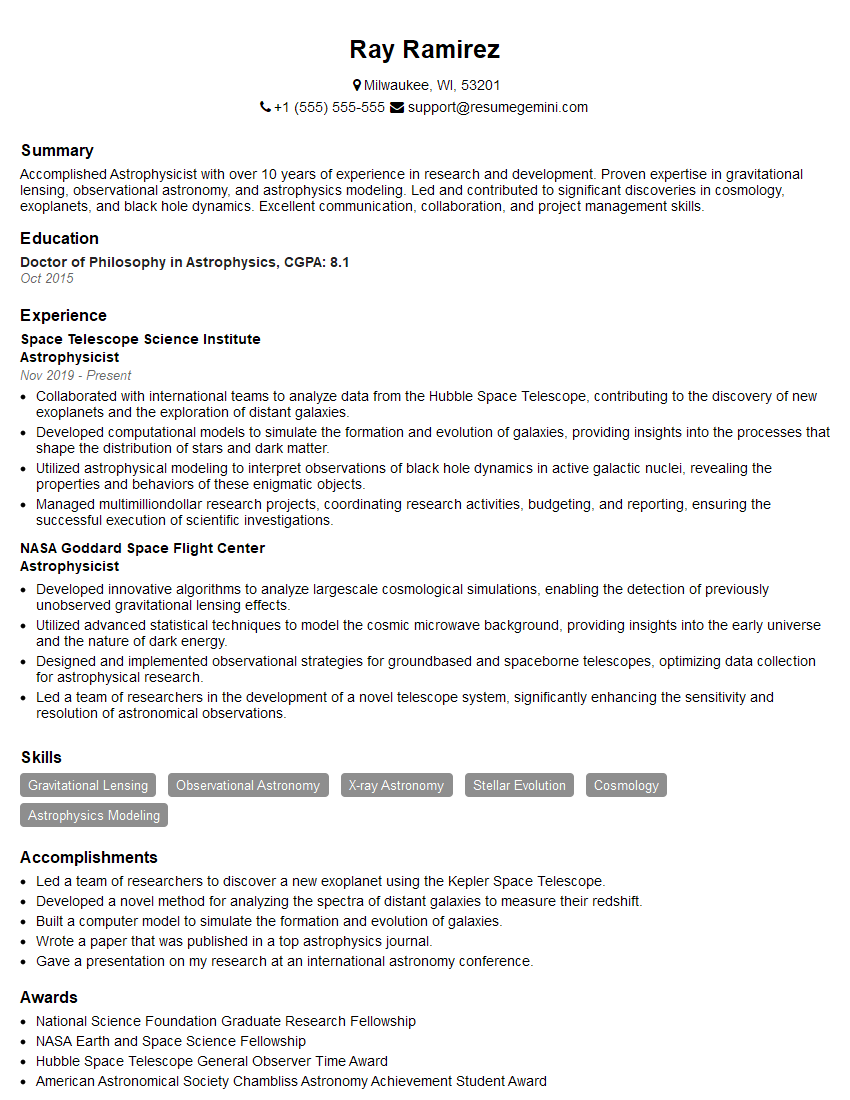
Mastering Astronomy Interpretation opens doors to exciting careers in research, education, and data analysis within the astronomical community. A strong resume is crucial for showcasing your skills and experience to potential employers. Creating an ATS-friendly resume is key to maximizing your job prospects. We highly recommend using ResumeGemini to build a professional and impactful resume that highlights your unique qualifications in Astronomy Interpretation. Examples of resumes tailored to this field are available to guide you.
Explore more articles
Users Rating of Our Blogs
Share Your Experience
We value your feedback! Please rate our content and share your thoughts (optional).
What Readers Say About Our Blog
To the interviewgemini.com Webmaster.
Very helpful and content specific questions to help prepare me for my interview!
Thank you
To the interviewgemini.com Webmaster.
This was kind of a unique content I found around the specialized skills. Very helpful questions and good detailed answers.
Very Helpful blog, thank you Interviewgemini team.