Are you ready to stand out in your next interview? Understanding and preparing for Carbon Steel Piping interview questions is a game-changer. In this blog, we’ve compiled key questions and expert advice to help you showcase your skills with confidence and precision. Let’s get started on your journey to acing the interview.
Questions Asked in Carbon Steel Piping Interview
Q 1. Explain the different types of carbon steel used in piping systems and their applications.
Carbon steel used in piping systems is categorized by its chemical composition and mechanical properties, primarily its carbon content. Higher carbon content generally increases strength but reduces ductility and weldability. Here are some common types:
- ASTM A53: This is a standard for black and galvanized steel pipe, commonly used for low-pressure applications like water supply lines. Think of the pipes bringing water to your house – A53 is often used there.
- ASTM A106: This grade is specifically designed for high-temperature, high-pressure service and is widely employed in power plants and refineries. Its superior strength and creep resistance make it suitable for demanding environments.
- ASTM A333: This standard covers various grades of carbon steel pipe suitable for low-temperature service (cryogenic applications), such as in liquefied natural gas (LNG) plants. These pipes must withstand extreme cold without becoming brittle.
- ASTM A53 Grade B: This type often finds applications where higher strength is needed compared to Grade A, without pushing into the alloy steels. It’s a good compromise between cost and performance.
The selection of the appropriate carbon steel grade depends heavily on the operating conditions, including pressure, temperature, and the nature of the fluid being transported. For example, A106 would be unsuitable for a simple garden irrigation system, while A53 might fail under the high pressures of a steam pipe.
Q 2. Describe the various pipe fitting types and their suitability for different applications.
Pipe fittings are components used to connect, branch, or change the direction of pipes. They are crucial for the proper functioning and safety of any piping system. Common types include:
- Elbows: Used to change the direction of the pipe run. They come in various angles, such as 45° and 90°.
- Tees: Create a branch connection, allowing for splitting the flow of fluid in two directions.
- Reducers: Connect pipes of different diameters, smoothly transitioning the flow.
- Couplings: Connect two pipes of the same diameter. This is essentially a connector.
- Caps: Seal the end of a pipe.
- Flanges: Used with gaskets to create a detachable and easily maintainable connection, particularly useful in high-pressure applications. They allow for convenient disassembly for inspection or repair.
The suitability of a fitting depends on factors like pressure, temperature, fluid properties, and space constraints. For instance, a welded fitting is stronger and preferred for high-pressure situations, while a threaded fitting might be preferred in applications requiring easier disassembly for maintenance. The material compatibility is also a consideration; the fitting’s material needs to be compatible with the fluid and the pipe material to prevent corrosion.
Q 3. What are the common standards and codes used in carbon steel piping design (e.g., ASME B31.1, ASME B31.3)?
Several standards and codes govern the design, fabrication, and installation of carbon steel piping systems. The most prevalent are:
- ASME B31.1: Power Piping – Covers piping systems used in power generation plants, including steam, water, and other high-pressure systems. It details stress calculations, materials selection, and fabrication requirements.
- ASME B31.3: Process Piping – Addresses piping systems in chemical, petroleum, and gas processing plants. This code considers the particular challenges presented by chemical processes.
- ASME B16.5: Pipe Flanges and Flanged Fittings – Specifies dimensions and tolerances for flanges and their associated components. This ensures compatibility between different manufacturers’ products.
- ASME B16.9: Factory-Made Welded Butt Welding Fittings – Covers the specifications for various types of welded fittings, ensuring quality and consistency.
Adhering to these codes is crucial for ensuring the safety and reliability of piping systems. Non-compliance can lead to catastrophic failures with significant safety and economic consequences. Engineers must be thoroughly familiar with the relevant standards applicable to their projects.
Q 4. How do you calculate pipe wall thickness according to relevant codes?
Pipe wall thickness calculation is crucial for ensuring that the pipe can withstand the internal pressure without failure. The codes (like ASME B31.1 and ASME B31.3) provide formulas for this calculation, often based on the Barlow’s formula which is a simplified version for thin walled pipes. However, modern codes incorporate more complex factors.
The basic formula considers factors like:
- Internal pressure (P)
- Nominal pipe diameter (D)
- Allowable stress (S) of the pipe material
- Weld joint efficiency (E)
A simplified representation (not for actual engineering use without considering code limitations) might look like this:
t = (P * D) / (2 * S * E)where ‘t’ is the minimum required wall thickness. However, actual calculations using ASME codes involve more detailed considerations, such as temperature effects, corrosion allowance, and specific material properties. Software tools and code-specific calculation methods are typically employed for accurate and reliable results. Ignoring these factors can lead to pipe failure. Always consult the relevant code for precise calculation procedures.
Q 5. Explain the concept of pipe stress analysis and its importance.
Pipe stress analysis is the process of determining the stresses and strains within a piping system under various operating conditions (e.g., pressure, temperature, and weight). It’s essential for ensuring the structural integrity and preventing failures. Imagine a long pipe carrying hot fluid – expansion and contraction due to temperature changes will create stress. Stress analysis helps us understand and manage these stresses.
The importance of pipe stress analysis lies in:
- Safety: Preventing failures that could lead to leaks, explosions, or other hazardous situations.
- Reliability: Ensuring the long-term performance and operational life of the piping system.
- Cost-effectiveness: Optimizing the design to minimize material usage and reduce installation costs without compromising safety.
Stress analysis is usually performed using specialized software that incorporates finite element analysis (FEA) techniques. This allows engineers to model the piping system and simulate its behavior under various loading conditions.
Q 6. Describe different methods for supporting carbon steel piping systems.
Supporting carbon steel piping systems involves providing sufficient restraint to counteract stresses caused by pressure, weight, thermal expansion, and other forces. Inappropriate support can lead to excessive stress and potential failure.
Common methods include:
- Hangers: Provide vertical support, allowing for thermal expansion. Think of them as adjustable straps that hold up the pipes. They are commonly used in applications where piping runs horizontally.
- Supports: Provide both vertical and lateral support, usually more rigid than hangers. These supports often provide additional stability.
- Guides: Restrict lateral movement of the pipe, preventing excessive vibration and stress. They can help manage the movement of the pipes due to temperature.
- Anchors: Provide fixed points that prevent movement due to thermal expansion or other loads. These are critical in managing stress accumulation.
The selection and placement of supports is crucial and needs careful consideration of the operating conditions and potential loads. Incorrect support design can lead to excessive stresses and premature failures, thus proper support spacing and type are critical. Specialized software is often used to optimize support design and placement.
Q 7. What are the common types of pipe joints and their advantages/disadvantages?
Pipe joints are crucial for connecting pipes and ensuring a leak-proof system. Several types exist, each with advantages and disadvantages:
- Threaded Joints: Relatively simple and inexpensive, suitable for low-pressure applications. However, they can leak under higher pressures.
- Welded Joints: Provide strong, leak-proof connections suitable for high-pressure applications. They require skilled welders and specialized equipment.
- Flanged Joints: Easily disassembled for maintenance and inspection. They’re suitable for a wide range of pressures but can be more expensive and bulky than other joint types.
- Couplings: Offer a quick and easy way to connect pipes of the same size but usually not suitable for high-pressure scenarios.
The choice of joint type depends on factors like pressure, temperature, fluid type, accessibility for maintenance, and cost considerations. High-pressure steam lines, for example, would almost certainly use welded joints for safety and reliability. Conversely, a low-pressure water line might use threaded joints for cost-effectiveness and ease of installation.
Q 8. Explain the process of welding carbon steel pipes and the necessary quality control measures.
Welding carbon steel pipes is a critical process requiring precision and adherence to strict codes. The process typically involves several steps: preparation (cleaning, beveling pipe ends), fitting (aligning and securing pipe sections), welding (using appropriate techniques like SMAW, GMAW, or FCAW depending on the application and joint type), and post-weld inspection. Different welding methods have various strengths and weaknesses regarding speed, cost, and weld quality. For instance, SMAW (Shielded Metal Arc Welding) is a versatile but slower process, while GMAW (Gas Metal Arc Welding) is faster but requires more specialized equipment.
Quality control is paramount. It begins with pre-weld inspection of the materials and the preparation of the pipe ends. This includes verifying the chemical composition of the steel, checking for any surface imperfections or damage, and ensuring proper beveling angles for good weld penetration. During welding, skilled welders follow strict procedures, including maintaining consistent arc length and travel speed, and using appropriate shielding gases. Finally, post-weld inspection is crucial and uses a combination of visual inspections and Non-Destructive Testing (NDT) methods (detailed in the next question) to detect any flaws like porosity, cracks, or incomplete fusion.
Think of it like baking a cake: proper preparation of the ingredients (pipe preparation), following the recipe precisely (welding procedure), and then checking if it’s cooked through (NDT inspection) are all essential for a perfect result (a sound weld).
Q 9. What are the different types of non-destructive testing (NDT) methods used in carbon steel piping inspection?
Non-destructive testing (NDT) is vital for ensuring the integrity of carbon steel piping. Several methods are commonly employed:
- Visual Inspection (VT): The simplest method, involves visually examining welds and pipe surfaces for obvious defects like cracks, porosity, or incomplete penetration. It’s often the first step in any NDT process.
- Radiographic Testing (RT): Uses X-rays or gamma rays to penetrate the weld and reveal internal flaws. This is particularly effective in detecting cracks, porosity, and inclusions hidden within the weld metal.
- Ultrasonic Testing (UT): Employs high-frequency sound waves to detect internal defects. It’s very sensitive and can detect smaller flaws than RT, but requires skilled technicians to interpret the results.
- Magnetic Particle Testing (MT): Used to detect surface and near-surface flaws in ferromagnetic materials like carbon steel. A magnetic field is induced in the pipe, and magnetic particles are applied to the surface. Flaws disrupt the magnetic field, causing particles to accumulate, indicating the presence of a defect. This is great for detecting surface cracks.
- Liquid Penetrant Testing (PT): Similar to MT, but used to detect surface-breaking flaws in any material, regardless of its magnetic properties. A penetrant is applied, excess is removed, and a developer is used to draw the penetrant out of any cracks, making them visible.
The choice of NDT method depends on factors like the type of weld, accessibility, and the required sensitivity. Often, a combination of methods is used for comprehensive inspection. For example, a pipeline might utilize RT for initial inspection, then follow up with UT to check specific welds identified as potential problem areas.
Q 10. How do you identify and address common piping corrosion issues?
Corrosion in carbon steel piping is a significant concern, leading to leaks, failures, and potential safety hazards. Identification and remediation strategies depend on the type of corrosion:
- Uniform Corrosion: Even corrosion across the entire surface, typically caused by environmental factors. It’s relatively predictable and can be mitigated by using corrosion-resistant coatings or selecting more corrosion-resistant materials.
- Pitting Corrosion: Localized corrosion resulting in small pits or holes. This is often caused by impurities in the metal or localized differences in the environment. It can be challenging to detect but can be mitigated with proper material selection and inhibitors.
- Crevice Corrosion: Corrosion in confined spaces like crevices or gaps. Stagnant water or other fluids can accumulate in these areas, leading to accelerated corrosion. Regular cleaning and proper design can prevent crevice corrosion.
- Stress Corrosion Cracking (SCC): Cracks forming due to a combination of tensile stress and a corrosive environment. This requires careful material selection and stress management to avoid.
Addressing corrosion often involves a combination of strategies: material selection (choosing appropriate steel grades with enhanced corrosion resistance), protective coatings (applying paints, linings, or wraps), corrosion inhibitors (adding chemicals to the fluid to slow down corrosion), and cathodic protection (using sacrificial anodes or impressed current to protect the pipe from corrosion).
Imagine a rusty car: uniform corrosion would be a general surface rust, pitting corrosion would be small holes, crevice corrosion could be rust buildup under the bumper, and stress corrosion cracking might be a crack appearing where the car body is stressed.
Q 11. Explain the importance of proper insulation and its impact on piping systems.
Proper insulation is crucial for maintaining the temperature of fluids within piping systems. This impacts several aspects:
- Energy Efficiency: Insulation minimizes heat loss (in hot systems) or heat gain (in cold systems), reducing energy consumption and operating costs. Think of a thermos – it keeps your drink hot or cold by preventing heat transfer.
- Process Optimization: Maintaining the desired temperature is essential for many industrial processes. Inadequate insulation can lead to temperature fluctuations, affecting product quality or even causing process upsets.
- Safety: Insulation can protect personnel from burns or frostbite by reducing surface temperatures of pipes. It can also prevent condensation, reducing the risk of leaks or corrosion.
- Environmental Protection: Reducing energy consumption directly contributes to environmental sustainability by lowering greenhouse gas emissions.
The type of insulation used depends on several factors including the operating temperature, environmental conditions, and the specific application. Different materials have different thermal properties and must be selected appropriately. For instance, fiberglass insulation is commonly used for moderate temperatures, while calcium silicate insulation is suitable for high-temperature applications.
Q 12. What are the considerations for designing piping systems for different operating pressures and temperatures?
Designing piping systems for different operating pressures and temperatures requires careful consideration of several factors:
- Pipe Material: The selection of carbon steel grade depends on the pressure and temperature. Higher pressures and temperatures require stronger and more corrosion-resistant materials. Each grade has specific allowable stress limits defined by relevant codes, such as ASME B31.1.
- Pipe Schedule/Wall Thickness: Thicker pipe walls are needed for higher pressures to withstand the internal stress. The pipe schedule, which is a standardized system that defines wall thickness, is crucial in pressure vessel and piping design.
- Pipe Fittings and Valves: These components must be rated for the design pressure and temperature. They need to be compatible with the pipe material and the fluids being transported.
- Expansion and Contraction: Temperature changes can cause significant expansion and contraction of pipes. This necessitates the use of expansion loops or bellows to accommodate these movements and prevent stress on the system.
- Stress Analysis: For complex piping systems, stress analysis is essential to ensure the system can withstand the expected loads and pressures without failure. Finite Element Analysis (FEA) software is frequently utilized.
A simple analogy: imagine a water balloon. A small balloon can only handle low pressure. For higher pressure, you need a thicker, stronger balloon. Similarly, the pipe’s design must be appropriate for the expected pressure and temperature to avoid ruptures.
Q 13. Describe the process of hydraulic testing of carbon steel piping systems.
Hydraulic testing is a crucial step in verifying the integrity of carbon steel piping systems. It involves pressurizing the system with water to a pressure exceeding the design pressure to detect any leaks or weaknesses. Here’s the process:
- System Preparation: Ensure all valves and connections are properly sealed and inspected. Blind flanges or caps are installed at the ends of the piping section to be tested.
- Pressurization: The system is slowly filled with water and pressurized using a hydraulic pump. The pressure is monitored using pressure gauges at various points. The pressure should be held for a specified duration (typically several hours).
- Leak Detection: During the holding period, the system is closely observed for any signs of leaks. Leak detection methods range from visual inspection to the use of specialized leak detection equipment.
- Pressure Relief: After the holding period, the pressure is slowly released. This is important to avoid damage to the system caused by rapid pressure changes.
- Inspection: A final inspection is conducted to check for any visible signs of leaks or damage.
The test pressure is usually calculated based on the design pressure, typically at 1.5 times the design pressure or other specified pressure according to relevant codes like ASME B31.3. Hydraulic testing is a non-destructive test that helps ensure the pipe system can reliably withstand its intended operating pressure without failure.
Q 14. What are the safety precautions necessary during the installation and maintenance of carbon steel piping?
Safety is paramount during the installation and maintenance of carbon steel piping. Precautions include:
- Lockout/Tagout Procedures: Before any work is performed on a piping system, it’s crucial to isolate the system and lock out all energy sources to prevent accidental activation.
- Personal Protective Equipment (PPE): Appropriate PPE, including safety glasses, gloves, and safety shoes, is essential for all personnel involved. Hard hats and respirators may also be required depending on the specific task.
- Confined Space Entry Procedures: If work is being performed in confined spaces, strict procedures for confined space entry must be followed to ensure worker safety.
- Hot Work Permits: For any work involving welding, cutting, or other hot work, a hot work permit is required to ensure proper safety measures are in place, including fire prevention and emergency response planning.
- Hazard Communication: All personnel need to be aware of potential hazards associated with the fluids in the piping system (flammability, toxicity, etc.). Proper labeling and signage are important.
- Safe Lifting Techniques: Using proper lifting equipment and techniques to avoid injuries during handling of heavy pipe sections.
Remember, safety is not just a set of rules – it’s a culture. A proactive approach to safety is paramount. Every task, from planning to execution and post-installation checks, should be approached with a strong safety-first mentality.
Q 15. How do you handle piping system modifications or retrofits?
Modifying or retrofitting a carbon steel piping system requires a meticulous approach, prioritizing safety and compliance. It begins with a thorough assessment of the existing system, including material specifications, operating conditions, and existing documentation. We need to understand the reason for the modification – is it for increased capacity, improved efficiency, or addressing a safety concern?
The process typically involves:
- Detailed Engineering: This includes generating new isometrics, stress analysis, and updating P&IDs (Piping and Instrumentation Diagrams). We carefully evaluate the impact of the changes on the overall system, considering factors like pressure, temperature, and flow rates.
- Material Selection: The new components must be compatible with the existing system. We’d consider factors like corrosion resistance and strength to ensure longevity and safety.
- Welding and Fabrication: Qualified welders are essential for maintaining the integrity of the system. Strict adherence to welding codes and procedures is non-negotiable, often requiring non-destructive testing (NDT) to verify weld quality.
- Testing and Commissioning: After installation, rigorous testing is performed to ensure the system operates as designed and meets all safety standards. This often includes hydrostatic testing and leak checks.
For example, I once worked on a retrofit project where we had to increase the capacity of a steam line in a power plant. This involved careful analysis to ensure the existing supports could handle the increased load and replacing sections of the pipe with larger diameter ones. The project was completed successfully and on time, with zero safety incidents.
Career Expert Tips:
- Ace those interviews! Prepare effectively by reviewing the Top 50 Most Common Interview Questions on ResumeGemini.
- Navigate your job search with confidence! Explore a wide range of Career Tips on ResumeGemini. Learn about common challenges and recommendations to overcome them.
- Craft the perfect resume! Master the Art of Resume Writing with ResumeGemini’s guide. Showcase your unique qualifications and achievements effectively.
- Don’t miss out on holiday savings! Build your dream resume with ResumeGemini’s ATS optimized templates.
Q 16. Explain the concept of pipe flow calculations and their applications.
Pipe flow calculations are crucial for designing efficient and safe piping systems. They determine parameters like pressure drop, flow velocity, and required pipe diameter. These calculations are based on fundamental fluid mechanics principles and consider factors like fluid properties (viscosity, density), pipe geometry (diameter, roughness), and flow regime (laminar or turbulent).
Applications include:
- Sizing pipes: Ensuring sufficient flow capacity without excessive pressure drop.
- Pump selection: Determining the required pump head and power based on the calculated pressure drop.
- Valve sizing: Selecting valves that can handle the flow rate and pressure without causing undue restriction.
- Predicting energy consumption: Estimating the energy required to pump fluids through the system.
We typically use equations like the Darcy-Weisbach equation or Hazen-Williams equation to calculate pressure drop, depending on the flow regime and pipe material. Software tools significantly simplify these calculations, but understanding the underlying principles is crucial for proper interpretation and validation of results.
For instance, in a chemical plant, accurate flow calculations are vital for ensuring that reactants are delivered at the correct rate to the reactor, preventing inefficiencies and potential safety hazards.
Q 17. Describe different types of pipe supports and their selection criteria.
Pipe supports are critical for maintaining the structural integrity of a piping system and preventing failures due to excessive stress, vibration, or thermal expansion. Different types exist, each suited for specific applications.
Common types include:
- Rigid supports: These restrict movement in all directions and are suitable for supporting straight sections of pipe where minimal flexibility is needed.
- Flexible supports: Allow for some movement, accommodating thermal expansion and contraction. Examples include spring supports and constant support hangers.
- Guides: Restricts movement in one or two directions, guiding the pipe but allowing for movement in other directions.
- Anchors: Fixed supports that prevent movement in all directions, crucial for anchoring the entire piping system.
Selection criteria depend on several factors:
- Pipe size and material: Larger diameter pipes require stronger supports.
- Operating conditions: High temperatures and pressures necessitate supports with higher load capacity.
- Fluid characteristics: The weight and dynamic forces exerted by the fluid influence support selection.
- Seismic considerations: Supports in seismic zones need to be designed to withstand significant forces.
Improper support selection can lead to pipe stress, vibration, and even catastrophic failure. A well-designed support system ensures the long-term reliability and safety of the piping system.
Q 18. What are the considerations for designing piping systems in seismic zones?
Designing piping systems for seismic zones demands a comprehensive approach considering the potential for significant ground motion. The goal is to prevent pipe failure and damage during an earthquake.
Key considerations include:
- Seismic analysis: Performing dynamic analysis to determine the forces and moments exerted on the piping system during an earthquake. This involves using specialized software and considering ground motion parameters specific to the region.
- Support design: Supports must be robust enough to withstand seismic loads. This often involves using high-strength materials and specialized support designs that allow for some flexibility without causing excessive stress on the pipes.
- Flexibility analysis: Ensuring sufficient flexibility in the piping system to accommodate seismic movements. Excessive rigidity can concentrate stress and lead to failure.
- Pipe restraints: Strategic placement of restraints to prevent excessive pipe movement and potential damage to equipment or personnel.
- Material selection: Selecting ductile materials that can withstand plastic deformation without fracture is vital. Careful attention to weld quality is also important.
Neglecting seismic considerations can have devastating consequences, leading to pipe rupture, leaks, and potential environmental hazards. Proper design is crucial for ensuring the safety and reliability of the piping system in earthquake-prone areas.
Q 19. How do you address potential issues related to pipe expansion and contraction?
Thermal expansion and contraction of carbon steel pipes are significant concerns, especially in systems operating at high temperatures. These changes in length can cause stresses within the pipe and supports, leading to failure if not properly addressed.
Mitigation strategies include:
- Expansion loops: Incorporating loops in the piping system allows for expansion and contraction without imposing significant stress on straight sections.
- Expansion joints: These are specialized components designed to accommodate axial movement, providing flexibility within the piping system.
- Flexible supports: Using spring supports or other flexible support systems allows for movement without excessive stress.
- Anchors and guides: Proper placement of anchors and guides prevents excessive movement and controls the direction of expansion.
- Stress analysis: Performing stress analysis to assess the impact of thermal expansion and contraction on the piping system and ensure that stresses remain within acceptable limits.
For example, in a power plant, steam lines experience significant temperature changes, requiring careful consideration of thermal expansion. Expansion loops or expansion joints are commonly employed to prevent damage from these thermal effects.
Q 20. Describe your experience with piping isometrics and drawings.
Piping isometrics and drawings are essential for fabrication, installation, and maintenance of piping systems. Isometrics are detailed 3D drawings showing the pipe’s geometry, dimensions, and components. They serve as the primary reference for fabricators. General arrangement drawings provide an overview of the system’s layout, while detailed drawings show individual components and their connections.
My experience includes:
- Reading and interpreting isometrics and drawings: Understanding the information conveyed in these documents is crucial for efficient project execution.
- Creating isometrics and drawings: I have used various CAD software packages to create both isometrics and general arrangement drawings. This includes detailing components, specifying materials, and ensuring accuracy in dimensions and specifications. This requires strong spatial reasoning skills and a good understanding of piping standards and codes.
- Checking drawings for errors: Identifying discrepancies and ensuring that the drawings accurately reflect the design intent is a critical part of quality control.
- Utilizing drawings for field verification: Comparing the as-built condition to the design drawings to confirm the correct installation of piping components.
I’ve worked on numerous projects where accurate and detailed drawings were critical for successful completion, avoiding costly errors during fabrication and installation.
Q 21. What software are you familiar with for piping design and analysis (e.g., AutoCAD, PDMS, CAESAR II)?
I’m proficient in several software packages used for piping design and analysis. My experience includes:
- AutoCAD: For creating 2D drawings, including general arrangements, piping details, and equipment layouts.
- PDMS (Plant Design Management System): A powerful 3D modeling software for designing and managing large-scale plant piping systems. It allows for efficient collaboration and clash detection.
- CAESAR II: A specialized software package for stress analysis of piping systems, used to evaluate the effects of pressure, temperature, and other loads. It’s essential for ensuring the safety and integrity of piping systems.
- AutoPIPE: Similar to Caesar II, used for extensive pipe stress analysis.
Proficiency in these tools allows me to perform comprehensive piping design, analysis, and documentation, ensuring that projects are completed efficiently and to the highest safety standards. I’m also familiar with other related software and am quick to learn new technologies.
Q 22. Explain your experience with piping material specifications and procurement.
My experience in piping material specifications and procurement spans over 10 years, encompassing diverse projects in the oil & gas, chemical, and power generation industries. I’m proficient in interpreting and applying various international standards like ASME B31.1, B31.3, and API 650, ensuring material selection aligns perfectly with project requirements and regulatory compliance. This involves specifying the exact grade of carbon steel (e.g., ASTM A53, A106, or API 5L) based on factors like pressure, temperature, and the corrosive nature of the conveyed fluid. I’ve managed the entire procurement process, from creating detailed material requisitions and vendor selection based on prequalification criteria to overseeing quality control inspections (e.g., PMI testing, hydrostatic testing) and ensuring timely delivery to the construction site. One specific project involved sourcing a specialized grade of carbon steel for high-temperature service, requiring extensive collaboration with metallurgical engineers to guarantee material integrity and longevity.
For example, in a recent project involving high-pressure steam lines, I specified ASTM A106 Grade B pipe due to its superior strength and creep resistance at elevated temperatures. I meticulously reviewed vendor certifications to verify the material met the specified grade and performed rigorous inspections on arrival to ensure there were no surface defects.
Q 23. Describe your experience with piping system commissioning and start-up.
Commissioning and start-up of piping systems require a methodical approach, emphasizing safety and rigorous testing. My experience includes leading pre-commissioning activities such as flushing, cleaning, and pressure testing of individual pipe sections and the entire system. I’ve developed detailed commissioning procedures, including hydrotesting protocols, designed to validate the system’s structural integrity and leak-tightness. This process often involves utilizing specialized equipment like pressure gauges, leak detectors, and flow meters. During start-up, I monitor system performance, carefully observing pressure and temperature readings to identify and rectify any anomalies. We perform leak checks regularly after initial operation and during planned shutdowns to maintain the system’s integrity and prevent potential failures.
In one project, we discovered a minor leak during the hydrostatic test of a large diameter pipeline. By carefully analyzing the test data and visually inspecting the piping, we pinpointed the leak’s location to a weld imperfection. This was promptly rectified before proceeding with the system’s commissioning, preventing a potential major failure during operation.
Q 24. How do you ensure the integrity of a carbon steel piping system throughout its lifecycle?
Maintaining the integrity of a carbon steel piping system throughout its lifecycle demands a proactive and multi-faceted approach. This involves implementing a robust inspection and maintenance program, incorporating regular visual inspections, non-destructive testing (NDT) methods like ultrasonic testing (UT) and radiographic testing (RT) to detect internal flaws, and periodic pressure testing. A comprehensive system of documentation, including as-built drawings, inspection reports, and maintenance logs, is crucial for tracking the system’s health. This data is analyzed to identify potential weaknesses and predict future maintenance needs. Environmental factors like corrosion also need to be considered. Applying appropriate corrosion protection measures, like painting or coatings, and implementing cathodic protection in certain environments are essential. Furthermore, adhering to strict operating procedures and training personnel on safe operation and maintenance practices are vital in preventing premature system degradation.
Think of it like regular car maintenance: Regular checks, oil changes (in this case, inspections and maintenance), and addressing any issues promptly prevent major breakdowns.
Q 25. What are the common causes of piping failures and how to prevent them?
Piping failures stem from various sources, often a combination of factors. Common causes include:
- Corrosion: Internal or external corrosion weakens pipe walls, leading to leaks or bursts. This is especially prevalent in aggressive environments or when proper corrosion protection isn’t applied.
- Stress Corrosion Cracking (SCC): A combination of tensile stress and a corrosive environment can initiate cracks in the pipe material.
- Fatigue: Repeated cyclical loading (e.g., pressure fluctuations, vibrations) can lead to fatigue cracking, eventually causing failure.
- Erosion: High-velocity fluid flow can erode pipe walls, particularly at bends or fittings.
- Improper Design or Fabrication: Design flaws, welding defects, or inadequate support can significantly reduce a piping system’s structural integrity.
Prevention strategies involve: Careful material selection, proper design considering anticipated stresses and environmental conditions, rigorous fabrication and inspection processes (e.g., weld inspections), implementing a comprehensive corrosion prevention program, and regular inspection and maintenance.
Q 26. Describe your experience with different types of pipe valves and their applications.
My experience encompasses various valve types commonly used in carbon steel piping systems. These include:
- Gate Valves: Used for on/off service, offering minimal pressure drop when fully open. Ideal for larger diameter lines.
- Globe Valves: Excellent for throttling flow and pressure regulation, but they create more pressure drop than gate valves.
- Ball Valves: Simple on/off operation, offering quick shut-off and minimal pressure drop when fully open. Suitable for various applications, but not ideal for precise throttling.
- Butterfly Valves: Similar to ball valves, but operate using a rotating disc. Cost-effective for larger diameter lines.
- Check Valves: Prevent backflow in a piping system, automatically closing when flow reverses.
The choice of valve depends on factors such as the fluid being conveyed, pressure and temperature conditions, required flow control, and maintenance considerations. For instance, in a high-pressure steam line, a forged steel gate valve would be preferred for its strength and reliability.
Q 27. Explain your understanding of piping system instrumentation and control.
Piping system instrumentation and control (I&C) is crucial for safe and efficient operation. My understanding encompasses the selection, installation, and calibration of various instruments, such as:
- Pressure Transmitters: Measure and transmit pressure data to the control system.
- Temperature Sensors: Monitor fluid temperature to ensure safe operating conditions.
- Flow Meters: Measure fluid flow rates for process control and monitoring.
- Level Sensors: Monitor fluid levels in tanks and vessels.
These instruments are integrated into a control system (e.g., PLC or DCS) that regulates the piping system’s operation, often incorporating safety interlocks and automated control strategies to prevent unsafe conditions. I’m experienced in integrating these systems, conducting loop checks, and troubleshooting any issues that may arise. For example, in a chemical process plant, level sensors are crucial to prevent overfilling of tanks and potential spills.
Q 28. How do you interpret and apply piping and instrumentation diagrams (P&IDs)?
Piping and Instrumentation Diagrams (P&IDs) are essential for understanding the layout and functionality of a piping system. I can interpret P&IDs to extract critical information like pipe sizes, materials, valve types, instrument locations, and process flow. This includes understanding the symbols and abbreviations used in the diagram to determine the system’s components, their interconnections, and their roles in the overall process. I use this information to perform calculations related to pressure drop, flow rates, and heat transfer. Creating or modifying P&IDs requires expertise in engineering principles and familiarity with industry standards. A thorough understanding of P&IDs is fundamental for planning, designing, installing, commissioning, and maintaining a piping system.
Imagine a P&ID as a roadmap for a piping system, showing you exactly where each pipe goes, what type it is, and what instruments are involved. By studying the map, we understand how the whole system works.
Key Topics to Learn for Your Carbon Steel Piping Interview
- Material Properties & Selection: Understand the different grades of carbon steel, their strengths, limitations, and suitability for various applications. Consider factors like yield strength, tensile strength, and weldability.
- Piping Design Codes & Standards: Become familiar with relevant codes like ASME B31.1, B31.3, and B31.4. Practice applying these standards to design scenarios, focusing on pressure ratings, wall thickness calculations, and allowable stresses.
- Fabrication & Welding: Learn about different welding techniques used in carbon steel piping, including their advantages and disadvantages. Understand the importance of weld inspection and quality control to ensure structural integrity.
- Piping Systems & Components: Familiarize yourself with various piping components like valves, flanges, fittings, and supports. Understand their functions and how they contribute to the overall system’s performance and safety.
- Stress Analysis & Fatigue: Gain an understanding of how stress and fatigue affect carbon steel piping systems. Learn about common failure modes and methods for mitigating these risks.
- Inspection & Maintenance: Explore best practices for inspecting and maintaining carbon steel piping systems to ensure longevity and prevent leaks or failures. Understand the importance of regular inspections and preventative maintenance.
- Practical Problem Solving: Develop your ability to analyze piping system issues, identify potential problems, and propose effective solutions. Practice applying your theoretical knowledge to real-world scenarios.
Next Steps: Unlock Your Career Potential
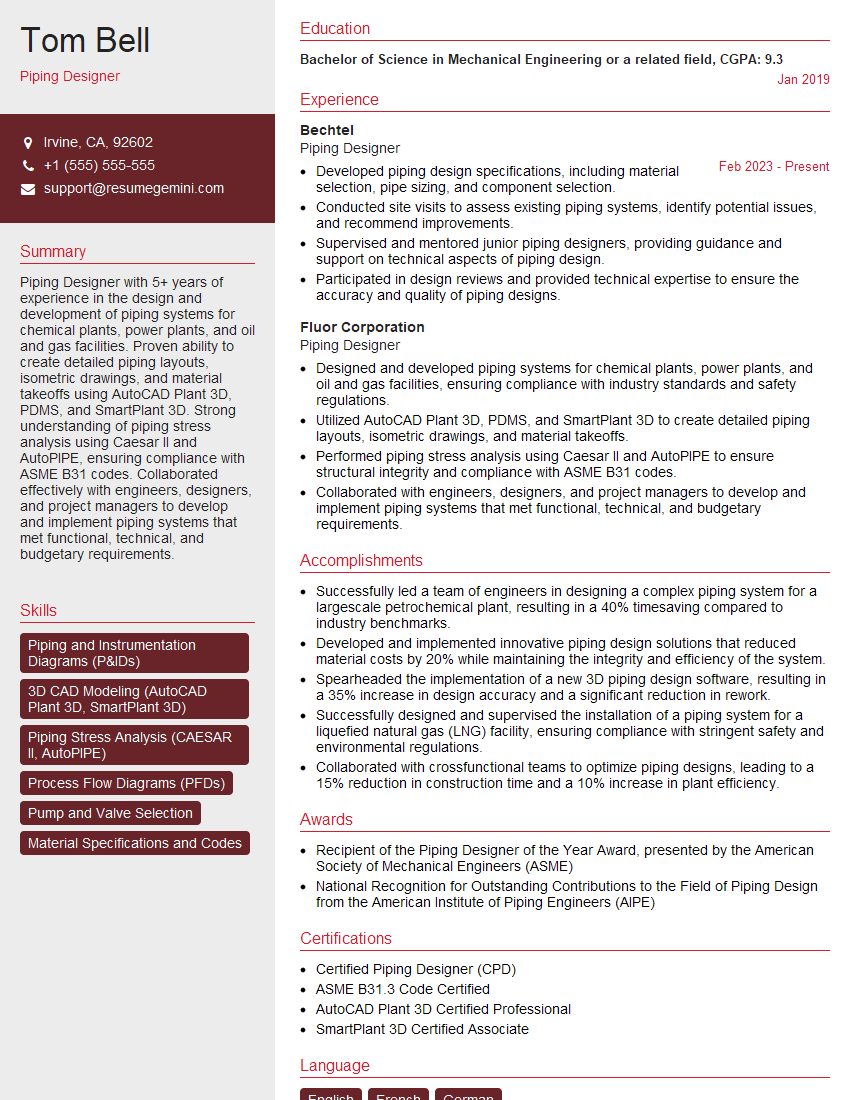
Mastering carbon steel piping opens doors to exciting and rewarding career opportunities in various industries. To stand out from the competition, a well-crafted resume is crucial. An ATS-friendly resume is essential for getting your application noticed by recruiters and hiring managers. We highly recommend using ResumeGemini to build a professional, impactful resume that highlights your skills and experience. ResumeGemini offers examples of resumes tailored to the Carbon Steel Piping industry to help you craft a winning application. Take the next step in your career journey today!
Explore more articles
Users Rating of Our Blogs
Share Your Experience
We value your feedback! Please rate our content and share your thoughts (optional).
What Readers Say About Our Blog
To the interviewgemini.com Webmaster.
Very helpful and content specific questions to help prepare me for my interview!
Thank you
To the interviewgemini.com Webmaster.
This was kind of a unique content I found around the specialized skills. Very helpful questions and good detailed answers.
Very Helpful blog, thank you Interviewgemini team.