Cracking a skill-specific interview, like one for Change Detection for Remote Sensing, requires understanding the nuances of the role. In this blog, we present the questions you’re most likely to encounter, along with insights into how to answer them effectively. Let’s ensure you’re ready to make a strong impression.
Questions Asked in Change Detection for Remote Sensing Interview
Q 1. Explain the concept of change detection in remote sensing.
Change detection in remote sensing is the process of identifying differences in the Earth’s surface features over time using remotely sensed imagery. Imagine taking two photographs of the same area, one today and one a year ago. Change detection would highlight the differences – perhaps a new road, deforestation, or a building constructed. This is crucial for monitoring various environmental and human-induced changes, allowing us to understand patterns and make informed decisions. We use different image acquisition dates for the analysis, which can be anything from days, months or even years apart. These images are then analyzed to identify changes using various techniques.
Q 2. What are the different types of change detection methods?
Change detection methods broadly fall into two categories: image differencing and post-classification comparison.
- Image differencing techniques directly compare pixel values of two or more images. Examples include image subtraction, image ratioing, and change vector analysis (CVA). These methods are computationally efficient but sensitive to noise and variations in atmospheric conditions.
- Post-classification comparison involves independently classifying each image and then comparing the classification maps to identify changes. This approach offers greater accuracy by considering the contextual information captured in each classification but requires more processing time and can be susceptible to classification errors.
- Other methods include spectral indices analysis, such as NDVI difference, which leverages specific spectral signatures to track vegetation change. Also, object-based image analysis (OBIA) is gaining popularity, using image segments as analytical units instead of individual pixels, thereby reducing noise impacts.
Q 3. Describe the advantages and disadvantages of post-classification comparison.
Post-classification comparison offers the advantage of producing a thematic change map directly showing the type of change (e.g., forest to urban). It’s also less sensitive to radiometric differences between images because it focuses on classifying land cover types rather than direct pixel comparisons. However, it’s computationally expensive, prone to classification errors that propagate through the change detection process, and accuracy is limited by the accuracy of the individual classifications. For instance, if your initial classification misidentifies a wetland as grassland, any subsequent change analysis will be inaccurate.
Q 4. Explain image differencing and its applications.
Image differencing is a simple yet effective change detection method that directly compares corresponding pixels in two images. The simplest form is image subtraction, where pixel values of one image are subtracted from the corresponding pixel values in the other. A resulting non-zero value suggests a change. Image ratioing is another technique; it divides the pixel values of one image by those of the other. This is particularly useful for detecting subtle changes that might be masked by overall brightness variations in the original images. Applications are widespread, ranging from monitoring deforestation and urban sprawl to tracking glacier retreat and agricultural land-use changes. For example, by subtracting a pre-hurricane satellite image from a post-hurricane image, we can quickly and efficiently assess the extent of damage.
Q 5. What is image registration and why is it crucial for change detection?
Image registration is the process of aligning two or more images to a common coordinate system. It’s absolutely crucial for change detection because accurate comparison of pixel values requires that the corresponding pixels represent the same location on the Earth’s surface. If images aren’t properly registered, any change detection results will be inaccurate and unreliable. Imagine trying to compare two maps that aren’t properly aligned; you’d end up drawing false conclusions. Similarly, misregistered satellite images can lead to false positives or negatives in change detection.
Q 6. How do you handle cloud cover and shadows in change detection analysis?
Cloud cover and shadows significantly complicate change detection analysis. They mask the underlying surface features, leading to missing data or inaccurate change assessments. Several strategies help mitigate these issues. One approach involves selecting cloud-free images, but this may limit the available data. Alternatively, we can use image processing techniques like cloud masking to remove or fill in cloud-covered areas. This might involve using a cloud mask derived from another data source like a meteorological satellite. For shadows, we can try to use data from different times of day to avoid shadowing. Advanced methods involve using image fusion or sophisticated atmospheric correction models to estimate surface reflectance even in shadowed areas.
Q 7. Discuss the role of spectral indices in change detection.
Spectral indices, such as the Normalized Difference Vegetation Index (NDVI), play a vital role in change detection. These indices use specific combinations of spectral bands to highlight particular features, particularly changes in vegetation. For example, a change in NDVI can indicate changes in vegetation cover, biomass, or health. By calculating the difference in NDVI values over time (NDVI difference), we can efficiently track vegetation changes such as deforestation or regrowth. This approach simplifies interpretation by focusing on the specific aspect of interest, leading to more robust change detection results. For example, using NDVI difference, we can effectively monitor the progress of a reforestation project by measuring the increase in vegetation over time.
Q 8. What are the limitations of using NDVI for change detection?
While the Normalized Difference Vegetation Index (NDVI) is a widely used indicator of vegetation health and is frequently employed in change detection, it has several limitations. Its primary drawback is its sensitivity to atmospheric effects like aerosols and clouds, which can significantly impact its accuracy. Variations in illumination conditions (e.g., shadows) and soil background also influence NDVI values, leading to misinterpretations of change. For example, a change in NDVI might be misinterpreted as vegetation loss when it’s actually due to shadowing from a newly constructed building. Further, NDVI struggles to differentiate between different types of vegetation cover. A high NDVI could represent dense vegetation or a less dense but highly reflective type of vegetation, masking subtle but important changes. Finally, the dynamic range of NDVI is limited, potentially leading to saturation at high biomass levels, resulting in an inability to detect subtle changes in dense vegetation. In summary, while useful, NDVI should be employed cautiously in change detection and often requires supplementary data or techniques for improved accuracy.
Q 9. Explain the process of unsupervised classification for change detection.
Unsupervised classification for change detection doesn’t require pre-labeled data. It automatically groups pixels based on their spectral similarity. The process typically involves these steps:
- Preprocessing: This includes atmospheric correction, geometric correction, and potentially data transformation techniques to enhance spectral differences between image dates. For example, we might apply a tasseled cap transformation to highlight specific vegetation characteristics.
- Image differencing or ratioing: The simplest approach involves subtracting the pixel values of one image from another, resulting in a difference image. Alternatively, pixel values can be ratioed. Large differences or ratios indicate changes.
- Clustering: An unsupervised clustering algorithm, such as ISODATA or k-means, is applied to the difference image or ratio image. This groups pixels into clusters based on spectral similarity. The number of clusters needs to be carefully determined. Too few might mask subtle changes, too many might lead to noisy results.
- Change detection map generation: Once the clusters are defined, a change detection map can be generated by assigning each cluster a class label that represents a type of change (e.g., deforestation, urban expansion, no change).
Imagine analyzing satellite images of a forest before and after a fire. Unsupervised classification would automatically group pixels based on their spectral signature, identifying areas with significantly altered characteristics (burned areas) as a distinct cluster, thus mapping the fire extent without needing prior knowledge of where the fire occurred.
Q 10. How do you assess the accuracy of your change detection results?
Accuracy assessment is crucial. We typically use a reference dataset representing the ‘ground truth’ to compare against our change detection results. This reference dataset might be derived from high-resolution imagery, field surveys, or other accurate sources. A common approach is to randomly select a set of samples from the change detection map and visually inspect or check them against the reference data. The accuracy is calculated by comparing the classification results with the reference data, typically using error matrices and metrics like overall accuracy, producer’s accuracy, user’s accuracy, and kappa coefficient.
Q 11. Describe different error matrices and their use in evaluating change detection accuracy.
Error matrices, also known as confusion matrices, summarize the performance of a change detection classification. A typical error matrix shows the number of correctly and incorrectly classified pixels for each class. For example, a 2×2 matrix for binary change detection (change/no-change) looks like this:
		Predicted Change	Predicted No Change
Actual Change		a		b
Actual No Change		c		d
Where:
a: correctly classified change pixels (true positives)b: incorrectly classified change pixels as no-change (false negatives)c: incorrectly classified no-change pixels as change (false positives)d: correctly classified no-change pixels (true negatives)
From this matrix, various metrics are derived such as:
- Overall Accuracy: (a+d)/(a+b+c+d)
- Producer’s Accuracy (for change): a/(a+b) (How well the classification correctly identifies actual changes)
- User’s Accuracy (for change): a/(a+c) (How reliable a ‘change’ classification is)
- Kappa Coefficient: Measures the agreement between the classification and reference data, accounting for chance agreement. A higher kappa value indicates better accuracy.
More complex matrices can be used for multi-class change detection with additional rows and columns for different types of changes.
Q 12. What are the common sources of error in change detection analysis?
Several factors contribute to errors in change detection. Atmospheric effects (clouds, haze) can mask changes or introduce false positives. Illumination variations (shadows, seasonal variations) can significantly alter spectral signatures, leading to misclassifications. Spatial resolution differences between datasets can result in registration errors and inaccurate change detection. Temporal resolution issues (e.g., infrequent image acquisition) might miss rapid changes. Radiometric errors (sensor calibration, noise) can also impact results. The accuracy of the reference data used for validation is also a critical source of uncertainty. For example, a field survey might not accurately capture subtle changes.
Q 13. How do you handle spatial and temporal resolution differences in multi-temporal datasets?
Handling spatial and temporal resolution differences requires careful preprocessing. For spatial differences, image resampling techniques (e.g., nearest neighbor, bilinear interpolation) are applied to match the resolutions. However, resampling can introduce artifacts. For temporal differences, data fusion techniques or the selection of specific dates can be used. For instance, we can choose dates that minimize atmospheric interference or use advanced data fusion techniques to combine the strengths of multiple datasets. More sophisticated methods use advanced techniques like super-resolution or spatiotemporal data fusion methods (like using time-series analysis techniques) to mitigate the effects of resolution mismatches.
Q 14. Explain the concept of object-based image analysis (OBIA) for change detection.
Object-based image analysis (OBIA) offers a powerful approach to change detection by moving beyond pixel-based classification. Instead of treating each pixel individually, OBIA segments the image into meaningful objects (e.g., buildings, trees, fields). These objects are characterized by their spectral, spatial, and contextual properties. Change detection in OBIA typically involves segmenting both the before and after images independently, identifying corresponding objects between the two datasets, and finally comparing their properties. This object-based approach is less sensitive to noise and speckle compared to pixel-based methods and can better handle heterogeneous land cover types, producing more accurate and robust change detection results. Think of it like comparing apples to apples instead of comparing individual pixels of apples to each other, allowing for a more contextual and comprehensive change analysis. For example, OBIA could accurately detect the expansion of a single building without being confused by variations in shadowing or minor changes in the surrounding vegetation.
Q 15. Compare and contrast pixel-based and object-based change detection methods.
Pixel-based and object-based change detection are two primary approaches for analyzing changes over time using remote sensing data. Pixel-based methods treat each pixel as an independent unit, comparing its spectral values across different images. Object-based methods, on the other hand, first segment the imagery into meaningful objects (e.g., buildings, trees, roads) and then compare these objects across time.
- Pixel-based methods are simpler to implement and computationally less demanding. They often involve image differencing, image ratios, or post-classification comparison. Think of it like comparing individual squares in a pixel art image – a simple but potentially less accurate way of seeing the overall change. A common technique is calculating the difference between two images (e.g., subtracting the spectral values of one image from another). Significant differences then indicate a change. For example, a large difference in the near-infrared band might highlight deforestation.
- Object-based methods offer greater accuracy, especially in heterogeneous landscapes, as they account for spatial context. Imagine comparing two paintings – a pixel-based method would focus on the change of color in individual brushstrokes, while an object-based method would identify the changes in overall elements like trees or buildings. This approach usually requires image segmentation using algorithms like region growing or watershed segmentation. Then, change detection is performed on the resulting objects.
The choice between these methods depends on factors like the spatial resolution of the imagery, the complexity of the landscape, and the desired level of detail in the change detection results. Pixel-based methods are often sufficient for relatively homogenous areas and when computational resources are limited, whereas object-based methods are beneficial for complex landscapes requiring high accuracy.
Career Expert Tips:
- Ace those interviews! Prepare effectively by reviewing the Top 50 Most Common Interview Questions on ResumeGemini.
- Navigate your job search with confidence! Explore a wide range of Career Tips on ResumeGemini. Learn about common challenges and recommendations to overcome them.
- Craft the perfect resume! Master the Art of Resume Writing with ResumeGemini’s guide. Showcase your unique qualifications and achievements effectively.
- Don’t miss out on holiday savings! Build your dream resume with ResumeGemini’s ATS optimized templates.
Q 16. Describe your experience with specific software used for change detection (e.g., ArcGIS, ENVI, QGIS).
I have extensive experience using ArcGIS, ENVI, and QGIS for change detection. Each software package offers unique strengths.
- ArcGIS provides a comprehensive suite of tools for image processing, geoprocessing, and data analysis. I’ve used its spatial analyst extension extensively for pixel-based change detection techniques like image differencing and post-classification comparison. Its ability to integrate with other GIS data makes it particularly powerful for contextual analysis. For instance, I used ArcGIS to analyze land-use changes in a rapidly urbanizing region, overlaying change detection results with existing road networks and demographic data.
- ENVI is known for its powerful image processing capabilities and its specialized tools for hyperspectral data. I have leveraged ENVI’s capabilities in analyzing multispectral and hyperspectral data for tasks like change detection in agricultural areas. For instance, I utilized spectral indices like the Normalized Difference Vegetation Index (NDVI) to monitor crop health and detect changes due to drought or disease.
- QGIS is an excellent open-source option offering a flexible platform for change detection. I’ve utilized QGIS’s processing toolbox to implement various change detection algorithms, particularly for projects where cost-effectiveness was critical. Its plugin ecosystem expands its functionality, enabling the integration of custom scripts and advanced algorithms.
My experience spans from basic image differencing to more sophisticated techniques involving advanced image segmentation and classification using these platforms.
Q 17. How do you choose the appropriate change detection method for a specific application?
Choosing the appropriate change detection method is crucial for obtaining reliable results. The selection process involves carefully considering several factors:
- Spatial resolution of the imagery: High-resolution data enables more detailed analysis and is generally better suited for object-based methods. Low-resolution data might necessitate pixel-based methods.
- Type of change: The nature of the change (e.g., gradual or abrupt, subtle or dramatic) influences method selection. For gradual changes, time-series analysis might be required. Abrupt changes can often be detected with simpler techniques.
- Landscape complexity: Homogenous areas are more suitable for pixel-based approaches. Complex landscapes with diverse features generally benefit from object-based methods.
- Data availability and computational resources: Object-based methods are computationally more intensive and require specialized software and hardware. Pixel-based methods are generally faster and more accessible.
- Accuracy requirements: The level of precision needed in the change detection results plays a key role. If high accuracy is essential, advanced methods like object-based approaches or machine learning might be necessary.
For example, if I need to detect deforestation in a relatively homogenous forest area using Landsat data, a simple pixel-based differencing approach might suffice. However, if I’m analyzing urban growth with high-resolution aerial imagery, an object-based approach might be more appropriate to distinguish individual buildings and roads accurately.
Q 18. Discuss the use of machine learning algorithms in change detection.
Machine learning (ML) algorithms have revolutionized change detection. Traditional methods often rely on pre-defined rules or thresholds, making them less adaptable to complex patterns. ML algorithms, on the other hand, learn these patterns from data, enhancing accuracy and automation.
- Supervised classification: This involves training a classifier (e.g., Support Vector Machines (SVM), Random Forest, or k-Nearest Neighbors) on labeled data representing change and no-change areas. The trained classifier then predicts change in new data.
- Unsupervised classification: This approach does not require labeled data. Algorithms such as k-means clustering can group pixels based on their spectral similarity across time, and clusters representing change can then be identified.
Consider an application where we want to automatically detect the spread of urban areas over time. A supervised approach would involve labeling pixels in a subset of images as ‘urban’ or ‘non-urban’, training a model, and then applying the trained model to other images. This approach significantly reduces manual effort and increases efficiency compared to visual interpretation.
Q 19. Explain your understanding of deep learning for change detection.
Deep learning, a subfield of machine learning, employs artificial neural networks with multiple layers to extract high-level features from data. This capability is particularly advantageous for change detection due to its ability to learn intricate spatial and spectral patterns from remote sensing imagery.
- Convolutional Neural Networks (CNNs): These are commonly used for image classification and are particularly effective for identifying changes from remote sensing images. CNNs can learn hierarchical features, starting from simple edges and textures to complex objects and land cover patterns.
- Recurrent Neural Networks (RNNs): RNNs are suitable for analyzing time-series data. They can capture temporal dependencies in image sequences, helping to identify gradual changes over time, such as those associated with glacial retreat or coastal erosion.
Deep learning often outperforms traditional methods, particularly when dealing with large datasets and complex changes. The downside is its need for substantial computing power and a potentially large amount of training data. One example could be using a CNN to detect subtle changes in vegetation health over seasons by learning from a large collection of multi-temporal satellite images.
Q 20. What are some real-world applications of change detection using remote sensing?
Change detection using remote sensing finds applications across numerous fields:
- Urban planning: Monitoring urban sprawl, infrastructure development, and changes in land use.
- Agriculture: Assessing crop health, yield prediction, and detecting changes in agricultural practices.
- Forestry: Monitoring deforestation, forest fires, and changes in forest cover.
- Disaster management: Assessing the extent of damage after natural disasters (e.g., earthquakes, floods, hurricanes).
- Environmental monitoring: Tracking changes in glaciers, coastal areas, and wetlands.
- Military applications: Detecting changes in military installations, troop movements, and infrastructure.
For instance, in urban planning, change detection can inform infrastructure development by identifying areas experiencing rapid growth. In disaster response, it can provide crucial information on the scale of damage for effective resource allocation and aid delivery.
Q 21. Describe your experience in working with different types of remote sensing data (e.g., Landsat, Sentinel, aerial imagery).
My experience encompasses a broad range of remote sensing data, including Landsat, Sentinel, and aerial imagery. Each data source possesses unique characteristics that influence the choice of change detection method.
- Landsat: I’ve extensively used Landsat data for long-term monitoring of land cover changes due to its long historical archive and moderate spatial resolution. Its multispectral bands are valuable for analyzing vegetation, urban areas, and water bodies. A project I worked on involved analyzing decades of Landsat imagery to map deforestation trends in the Amazon rainforest.
- Sentinel: Sentinel data, with its high revisit frequency and high spatial resolution (especially Sentinel-2), is ideal for monitoring rapidly changing phenomena. I’ve used Sentinel data for detecting changes in agricultural fields, mapping flood inundation, and monitoring coastal erosion. The high temporal resolution allowed for capturing the dynamics of these processes in detail.
- Aerial imagery: High-resolution aerial imagery provides exceptionally detailed information for urban and infrastructure change detection. I’ve worked with aerial imagery to monitor construction activity, identify illegal encroachment, and assess the impact of urban development on green spaces. The fine detail allowed for accurate object-based analysis.
My experience working with these diverse datasets allows me to effectively tailor my change detection approach to the specific data characteristics and project requirements.
Q 22. How do you interpret the results of a change detection analysis?
Interpreting change detection results involves a multi-step process that goes beyond simply identifying changes. It requires understanding the context of the changes, assessing their significance, and validating the results. First, I visually inspect the output maps or images, looking for patterns and areas of significant change. This is often complemented by quantitative analysis, such as calculating the area of change, the type of change (e.g., deforestation, urbanization), and the rate of change over time. For example, a map showing deforestation might highlight not just the extent of lost forest cover, but also identify specific regions experiencing rapid deforestation, potentially indicating illegal logging activity. Then, I use statistical measures like accuracy assessments (e.g., producer’s and user’s accuracy) to evaluate the reliability of the change detection results. This involves comparing the detected changes with ground truth data or high-resolution imagery to quantify the accuracy and identify potential errors. Finally, I consider external factors that could have influenced the results, such as atmospheric conditions, sensor limitations, or seasonal variations. This holistic approach ensures a robust and reliable interpretation of the change detection analysis.
Q 23. Explain the importance of data pre-processing in change detection.
Data pre-processing is absolutely crucial for accurate change detection. Think of it as preparing your ingredients before cooking – if your ingredients aren’t properly cleaned and prepped, your dish won’t turn out well. Similarly, raw remote sensing data often contains noise, inconsistencies, and geometric distortions that can significantly affect the accuracy of change detection results. Pre-processing steps typically include atmospheric correction (removing the effects of atmospheric scattering and absorption), geometric correction (ensuring accurate spatial registration), radiometric calibration (converting digital numbers to physically meaningful units), and data filtering (reducing noise and improving signal-to-noise ratio). For example, atmospheric correction is essential for comparing images acquired at different times or under varying atmospheric conditions, as atmospheric effects can significantly alter the spectral signatures of objects. Without proper pre-processing, spurious changes might be detected, leading to inaccurate interpretations.
Q 24. Describe your experience with Geographic Information Systems (GIS) software.
I have extensive experience with various GIS software packages, including ArcGIS, QGIS, and ERDAS IMAGINE. My expertise encompasses data import, processing, analysis, and visualization. In change detection projects, I routinely utilize these tools for image pre-processing, change detection algorithm implementation (e.g., image differencing, post-classification comparison), accuracy assessment, and map production. For instance, I’ve used ArcGIS’s spatial analyst tools to perform post-classification comparison for land cover change analysis, and QGIS’s processing toolbox for automating batch processing of large datasets. My proficiency extends to scripting using Python within these environments, which has enabled me to automate repetitive tasks and develop custom workflows tailored to specific project needs.
Q 25. How do you handle data uncertainty and error propagation in change detection?
Data uncertainty and error propagation are inherent in remote sensing and change detection. I address these using several strategies. First, I rigorously assess the quality of the input data, considering factors such as sensor resolution, data acquisition parameters, and potential sources of error. Second, I employ robust change detection algorithms that are less sensitive to noise and uncertainty. For example, using a classification-based approach with multiple classifiers and comparing the results can help identify and minimize error. Third, I incorporate uncertainty estimates into the final results, such as presenting confidence intervals or probability maps. This means instead of a simple ‘change’ or ‘no change’ map, I might create a map that shows the probability of change for each pixel. Finally, ground truthing, which involves validating the detected changes with field observations or high-resolution imagery, is crucial to assess the accuracy and reliability of the results. The entire process is documented transparently to showcase the inherent uncertainties.
Q 26. Explain your understanding of different data formats used in remote sensing (e.g., GeoTIFF, HDF).
My understanding of remote sensing data formats is comprehensive. I’m proficient in working with GeoTIFF, a widely used format that stores georeferenced raster data, preserving spatial information. I also have experience with HDF (Hierarchical Data Format), particularly useful for handling large, complex datasets often generated by satellite sensors like MODIS or Landsat. I understand the metadata associated with these formats, allowing me to extract information about the sensor, acquisition parameters, and processing history, all crucial for ensuring data quality and contextual interpretation. Other formats like ENVI, NITF, and even JPEG2000 are part of my repertoire. The choice of data format depends heavily on the specific application, dataset size, and analysis requirements. My experience allows me to seamlessly transition between these formats and efficiently manage data for change detection analysis.
Q 27. Describe a challenging change detection project you worked on and how you overcame the challenges.
A particularly challenging project involved detecting subtle changes in coastal wetlands using multispectral imagery. The challenges stemmed from the high spectral similarity between different wetland vegetation types and the presence of atmospheric effects and water turbidity, leading to noisy data and ambiguous results. To overcome these, I employed a multi-stage approach. First, I meticulously pre-processed the data, applying advanced atmospheric correction techniques and noise reduction filters. Then, I used a combination of spectral indices, such as the Normalized Difference Vegetation Index (NDVI), and object-based image analysis (OBIA) to enhance the spectral separability of wetland classes. Finally, I incorporated ancillary data like elevation models and hydrological information to improve the accuracy of change detection. By combining sophisticated image processing techniques with contextual information, I successfully identified subtle changes in wetland extent and composition, providing valuable insights for coastal management.
Q 28. How do you stay updated with the latest advancements in remote sensing and change detection techniques?
Staying updated in this rapidly evolving field is paramount. I actively participate in professional organizations like the IEEE Geoscience and Remote Sensing Society, attend relevant conferences and workshops (e.g., ISPRS), and regularly read peer-reviewed journals like Remote Sensing of Environment and IEEE Transactions on Geoscience and Remote Sensing. I also closely follow online resources, including NASA’s Earthdata website and ESA’s resources. Furthermore, I leverage online courses and webinars to learn about new techniques and software. This multi-faceted approach keeps me abreast of the latest advancements in remote sensing technologies, change detection algorithms, and data analysis methods, ensuring I can effectively apply the most appropriate and state-of-the-art techniques to my projects.
Key Topics to Learn for Change Detection for Remote Sensing Interview
- Fundamental Concepts: Understand the core principles of change detection, including different types of change (e.g., spectral, spatial, temporal) and the various data sources used (e.g., multispectral, hyperspectral imagery, LiDAR).
- Image Preprocessing Techniques: Familiarize yourself with essential preprocessing steps like geometric correction, atmospheric correction, and radiometric calibration, and their impact on accurate change detection.
- Change Detection Methods: Master various change detection algorithms, including image differencing, image ratioing, principal component analysis (PCA), and post-classification comparison. Be prepared to discuss their strengths and weaknesses.
- Classification Techniques: Gain a strong understanding of supervised and unsupervised classification methods relevant to change detection, including their application and interpretation in identifying changed areas.
- Accuracy Assessment: Learn how to evaluate the accuracy of change detection results using metrics like overall accuracy, producer’s accuracy, and user’s accuracy. Understand the importance of error matrices.
- Practical Applications: Be ready to discuss real-world applications of change detection, such as urban expansion monitoring, deforestation detection, land cover mapping, and disaster assessment.
- Software and Tools: Demonstrate familiarity with common remote sensing software packages used for change detection (e.g., ENVI, ArcGIS, QGIS). Highlight your experience with relevant tools and functionalities.
- Problem-Solving Approaches: Practice identifying and addressing common challenges in change detection, such as cloud cover, shadow effects, and mixed pixels. Showcase your analytical and problem-solving skills.
- Emerging Trends: Stay updated on the latest advancements in change detection, including the use of deep learning and artificial intelligence for automated change detection.
Next Steps
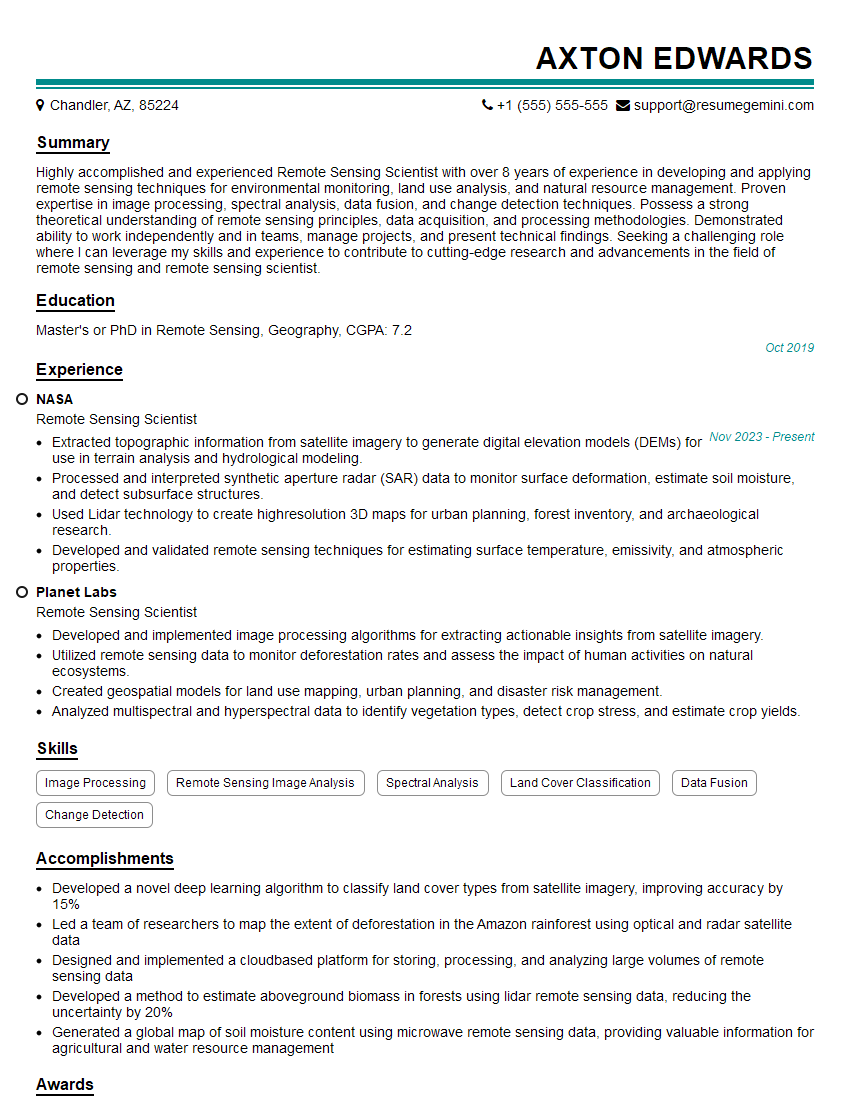
Mastering Change Detection for Remote Sensing opens doors to exciting career opportunities in environmental monitoring, urban planning, and disaster management. To significantly boost your job prospects, creating a strong, ATS-friendly resume is crucial. ResumeGemini is a trusted resource that can help you build a professional resume tailored to highlight your skills and experience. Take advantage of their resources and examples of resumes specifically designed for candidates in Change Detection for Remote Sensing to make your application stand out.

Explore more articles
Users Rating of Our Blogs
Share Your Experience
We value your feedback! Please rate our content and share your thoughts (optional).
What Readers Say About Our Blog
To the interviewgemini.com Webmaster.
Very helpful and content specific questions to help prepare me for my interview!
Thank you
To the interviewgemini.com Webmaster.
This was kind of a unique content I found around the specialized skills. Very helpful questions and good detailed answers.
Very Helpful blog, thank you Interviewgemini team.