Interviews are more than just a Q&A session—they’re a chance to prove your worth. This blog dives into essential Chemical Reactions and Properties interview questions and expert tips to help you align your answers with what hiring managers are looking for. Start preparing to shine!
Questions Asked in Chemical Reactions and Properties Interview
Q 1. Explain Le Chatelier’s principle and provide a practical example.
Le Chatelier’s principle states that if a change of condition is applied to a system in equilibrium, the system will shift in a direction that relieves the stress. Think of it like a balancing act; if you disturb the balance, the system will try to restore it.
For example, consider the synthesis of ammonia: N2(g) + 3H2(g) ⇌ 2NH3(g). This reaction is exothermic (releases heat). If we increase the temperature (adding heat), the system will shift to the left, favoring the reverse reaction (endothermic) to absorb the added heat and partially counteract the temperature increase. Conversely, increasing the pressure will favor the forward reaction, producing more ammonia because there are fewer moles of gas on the product side.
In industrial settings, understanding Le Chatelier’s principle is crucial for optimizing reaction conditions. For instance, the Haber-Bosch process for ammonia production uses high pressure and moderate temperatures to maximize ammonia yield.
Q 2. Describe the difference between exothermic and endothermic reactions.
Exothermic reactions release heat to their surroundings, resulting in a temperature increase. Imagine lighting a match; the burning wood releases heat, warming the air around it. The enthalpy change (ΔH) for an exothermic reaction is negative.
Endothermic reactions absorb heat from their surroundings, causing a temperature decrease. Think about dissolving ammonium nitrate in water – the solution becomes noticeably colder. The enthalpy change (ΔH) for an endothermic reaction is positive.
Q 3. What are the factors affecting reaction rates?
Several factors influence the rate of a chemical reaction. These include:
- Concentration of reactants: Higher concentrations lead to more frequent collisions between reactant molecules, increasing the reaction rate.
- Temperature: Increasing temperature increases the kinetic energy of molecules, resulting in more frequent and energetic collisions, thus accelerating the reaction.
- Surface area: For reactions involving solids, a larger surface area provides more contact points for reactants, speeding up the reaction. Think about a wood fire – finely chopped wood burns faster than a large log.
- Presence of a catalyst: Catalysts provide an alternative reaction pathway with lower activation energy, significantly increasing the reaction rate without being consumed themselves.
- Nature of reactants: The inherent reactivity of the reactants plays a role. Some substances react readily, while others are less reactive.
Q 4. Explain the concept of activation energy.
Activation energy is the minimum energy required for a reaction to occur. It’s like the energy needed to push a boulder over a hill; once it’s over the crest, it rolls down the other side spontaneously. Molecules need to collide with sufficient energy to break existing bonds and form new ones. Reactions with lower activation energies proceed faster.
Catalysts work by lowering the activation energy, providing a more energetically favorable pathway for the reaction to proceed. This is why they dramatically increase reaction rates without being consumed in the process.
Q 5. Define equilibrium constant and its significance.
The equilibrium constant (Keq) is a value that expresses the relationship between the concentrations of products and reactants at equilibrium for a reversible reaction. It indicates the extent to which a reaction proceeds to completion at a given temperature. A large Keq signifies that the equilibrium lies far to the right (favoring products), while a small Keq indicates that the equilibrium lies to the left (favoring reactants).
The significance of Keq lies in its ability to predict the direction a reaction will proceed under specific conditions. It’s essential in various fields, from industrial chemical processes to understanding biological systems.
For example, for the generic reversible reaction: aA + bB ⇌ cC + dD, the equilibrium constant is expressed as: Keq = [C]c[D]d / [A]a[B]b where [A], [B], [C], and [D] represent the equilibrium concentrations of the respective species.
Q 6. How do catalysts affect reaction rates?
Catalysts accelerate reaction rates by providing an alternative reaction pathway with a lower activation energy. They do this by forming temporary intermediates with the reactants, facilitating bond breaking and formation. Importantly, catalysts are not consumed during the reaction; they emerge unchanged at the end.
Enzymes are biological catalysts that play a vital role in biochemical reactions. Their high specificity and efficiency are essential for life processes. In industrial applications, catalysts are used extensively to enhance the rate and efficiency of chemical production, saving energy and resources.
Q 7. Describe different types of chemical bonds (ionic, covalent, metallic).
Chemical bonds hold atoms together in molecules and compounds. There are three main types:
- Ionic bonds: These bonds form through electrostatic attraction between oppositely charged ions. One atom loses electrons (becoming a positively charged cation) while another gains electrons (becoming a negatively charged anion). Table salt (NaCl) is a classic example, formed by the electrostatic attraction between Na+ and Cl– ions.
- Covalent bonds: These bonds involve the sharing of electrons between atoms. This sharing creates a stable electron configuration for both atoms. Water (H2O) is a prime example, with oxygen sharing electrons with two hydrogen atoms.
- Metallic bonds: These bonds are found in metals and are characterized by a sea of delocalized electrons surrounding positively charged metal ions. The electrons are free to move throughout the metal lattice, accounting for the high electrical and thermal conductivity of metals.
Q 8. Explain the concept of electronegativity and its impact on bonding.
Electronegativity is a fundamental concept in chemistry that describes the ability of an atom within a molecule to attract electrons towards itself. It’s essentially a measure of an atom’s greed for electrons. The higher the electronegativity value, the stronger the atom’s pull on electrons in a chemical bond. This property significantly impacts the type of bond formed between atoms.
Consider a bond between two atoms with differing electronegativities, such as hydrogen (H) and oxygen (O) in a water molecule (H₂O). Oxygen is significantly more electronegative than hydrogen, meaning it attracts the shared electrons in the covalent bonds more strongly. This uneven distribution of electrons leads to a polar covalent bond, where one end of the bond (the oxygen atom) carries a partial negative charge (δ-) and the other end (the hydrogen atoms) carries a partial positive charge (δ+). In contrast, a bond between two atoms with similar electronegativities, like two carbon atoms (C-C), results in a nonpolar covalent bond, with an even distribution of electrons.
The impact on bonding extends beyond polarity. Electronegativity differences dictate the strength and nature of chemical bonds, influencing the reactivity and properties of molecules. For instance, large differences in electronegativity can lead to the formation of ionic bonds, where electrons are completely transferred from one atom to another, resulting in the formation of ions and a strong electrostatic attraction.
Q 9. What are intermolecular forces and how do they influence the properties of substances?
Intermolecular forces are attractive or repulsive forces that act between molecules. Unlike intramolecular forces (bonds within a molecule), intermolecular forces are relatively weaker. However, they play a crucial role in determining the physical properties of substances like boiling point, melting point, viscosity, and solubility.
- London Dispersion Forces (LDFs): These are the weakest intermolecular forces and are present in all molecules. They arise from temporary fluctuations in electron distribution, creating temporary dipoles that induce dipoles in neighboring molecules. The strength of LDFs increases with the size and surface area of the molecule.
- Dipole-Dipole Forces: These forces exist between polar molecules, which have permanent dipoles due to differences in electronegativity between atoms. The positive end of one dipole attracts the negative end of another dipole.
- Hydrogen Bonding: A special type of dipole-dipole force that occurs when a hydrogen atom is bonded to a highly electronegative atom (such as oxygen, nitrogen, or fluorine). Hydrogen bonds are stronger than typical dipole-dipole forces and are responsible for many unique properties of water, for example.
The strength of intermolecular forces significantly influences a substance’s properties. For example, substances with strong intermolecular forces generally have higher boiling and melting points because more energy is needed to overcome these forces and change the state of matter. Water’s high boiling point is a direct consequence of its strong hydrogen bonding.
Q 10. Explain the difference between polar and nonpolar molecules.
The difference between polar and nonpolar molecules lies in the distribution of electrons within the molecule. This distribution is determined by the electronegativity of the atoms and the geometry of the molecule.
Polar molecules have an uneven distribution of electrons, resulting in a permanent dipole moment. This occurs when there is a significant difference in electronegativity between the atoms in the molecule, and the molecule’s geometry does not cancel out the individual bond dipoles. Water (H₂O) is a classic example: the oxygen atom is more electronegative than the hydrogen atoms, creating a bent molecule with a net dipole.
Nonpolar molecules have an even or nearly even distribution of electrons, resulting in no net dipole moment. This can happen when the molecule contains only nonpolar bonds (like in methane, CH₄), or when the polar bonds within the molecule are arranged symmetrically so their individual dipole moments cancel each other out (like in carbon dioxide, CO₂).
The polarity of a molecule greatly affects its properties, including its solubility, boiling point, and interactions with other molecules. Polar molecules tend to dissolve in polar solvents (like water), while nonpolar molecules dissolve in nonpolar solvents (like oil).
Q 11. Describe the different states of matter and their properties.
Matter exists in three primary states: solid, liquid, and gas. Each state is characterized by distinct properties related to the arrangement and movement of its constituent particles (atoms, molecules, or ions).
- Solid: Particles in a solid are closely packed in a fixed, ordered arrangement. They have strong intermolecular forces and vibrate in place, but their movement is restricted. Solids have a definite shape and volume.
- Liquid: Particles in a liquid are close together but not in a fixed arrangement. They have weaker intermolecular forces than solids and move more freely, allowing liquids to flow and take the shape of their container. Liquids have a definite volume but no definite shape.
- Gas: Particles in a gas are far apart and move randomly at high speeds. They have very weak intermolecular forces, leading to compressibility and expansion to fill their container. Gases have neither a definite shape nor a definite volume.
There is also a fourth state of matter, plasma, which exists at extremely high temperatures and consists of ionized particles. Understanding the properties of different states of matter is crucial in various fields, such as material science, chemical engineering, and atmospheric science.
Q 12. Explain the concept of solubility and factors affecting it.
Solubility refers to the ability of a substance (solute) to dissolve in another substance (solvent) to form a homogeneous mixture called a solution. The extent of solubility is often expressed as the maximum amount of solute that can dissolve in a given amount of solvent at a specific temperature and pressure.
Several factors influence solubility:
- Nature of solute and solvent: The general rule is “like dissolves like.” Polar solutes tend to dissolve in polar solvents, while nonpolar solutes dissolve in nonpolar solvents. For example, salt (NaCl, ionic and polar) dissolves readily in water (polar), but not in oil (nonpolar).
- Temperature: The solubility of most solids in liquids increases with increasing temperature. However, the solubility of gases in liquids generally decreases with increasing temperature.
- Pressure: Pressure significantly affects the solubility of gases in liquids. Henry’s Law states that the solubility of a gas is directly proportional to its partial pressure above the liquid.
- Particle size: Smaller solute particles dissolve faster because they have a larger surface area exposed to the solvent.
Understanding solubility is critical in many applications, from pharmaceutical drug delivery (ensuring drugs dissolve properly in the body) to environmental remediation (assessing the solubility of pollutants in water).
Q 13. What are colligative properties and give examples.
Colligative properties are properties of a solution that depend only on the concentration of solute particles (number of particles), not on the identity of the solute. These properties are a consequence of the disruption of solvent-solvent interactions by the presence of solute particles.
Examples of colligative properties include:
- Vapor pressure lowering: The presence of a nonvolatile solute lowers the vapor pressure of the solvent. This is because the solute particles occupy some of the surface area of the liquid, reducing the number of solvent molecules that can escape into the gas phase.
- Boiling point elevation: The boiling point of a solution is higher than that of the pure solvent. This is because more energy is required to overcome the lowered vapor pressure and achieve boiling.
- Freezing point depression: The freezing point of a solution is lower than that of the pure solvent. This is because the solute particles interfere with the solvent molecules’ ability to form the ordered structure of the solid phase.
- Osmotic pressure: Osmotic pressure is the pressure required to prevent the flow of solvent across a semipermeable membrane from a region of high solvent concentration (pure solvent) to a region of low solvent concentration (solution). This is a crucial concept in biology, particularly in understanding water movement across cell membranes.
Understanding colligative properties has applications in various fields, such as determining molecular weights of unknown substances and designing antifreeze solutions.
Q 14. Explain the concept of pH and its importance.
pH is a measure of the acidity or basicity of a solution. It is defined as the negative logarithm (base 10) of the hydrogen ion concentration ([H⁺]) in a solution:
pH = -log₁₀[H⁺]
A pH of 7 indicates a neutral solution (equal concentrations of H⁺ and hydroxide ions, OH⁻). Values below 7 indicate acidity (higher H⁺ concentration), while values above 7 indicate basicity (higher OH⁻ concentration). The pH scale typically ranges from 0 to 14, although solutions with pH values outside this range are possible.
pH is incredibly important in numerous areas:
- Biology: The pH of bodily fluids needs to be tightly controlled for proper enzyme function and overall health. Changes in blood pH can have serious consequences.
- Chemistry: Many chemical reactions are highly sensitive to pH changes. Controlling pH is crucial for optimizing reaction yields and selectivity.
- Environmental science: The pH of water systems is vital for aquatic life. Acid rain, for example, lowers the pH of lakes and rivers, harming fish populations.
- Industry: Many industrial processes, such as food processing, pharmaceuticals, and water treatment, require precise pH control.
pH measurement is routinely performed using pH meters or indicators, providing essential information about the chemical environment.
Q 15. Describe different types of chemical reactions (e.g., redox, acid-base, precipitation).
Chemical reactions are processes that lead to the transformation of substances. They can be broadly categorized into several types, each characterized by specific changes in the substances involved. Let’s explore some key examples:
Redox Reactions (Reduction-Oxidation): These reactions involve the transfer of electrons between species. One substance undergoes oxidation (loss of electrons), while another undergoes reduction (gain of electrons). A classic example is the rusting of iron, where iron (Fe) loses electrons to oxygen (O2) to form iron oxide (Fe2O3).
4Fe + 3O2 → 2Fe2O3Acid-Base Reactions: These reactions involve the transfer of protons (H+ ions) between an acid (proton donor) and a base (proton acceptor). A common example is the neutralization reaction between hydrochloric acid (HCl) and sodium hydroxide (NaOH):
HCl + NaOH → NaCl + H2O. The reaction produces salt (NaCl) and water (H2O).Precipitation Reactions: These reactions occur when two soluble ionic compounds in aqueous solution react to form an insoluble ionic compound (precipitate) that settles out of the solution. For instance, mixing silver nitrate (AgNO3) and sodium chloride (NaCl) solutions produces a white precipitate of silver chloride (AgCl):
AgNO3(aq) + NaCl(aq) → AgCl(s) + NaNO3(aq)Combustion Reactions: These reactions involve the rapid reaction of a substance with oxygen, often producing heat and light. Burning wood or propane gas are everyday examples of combustion. For example:
C3H8 + 5O2 → 3CO2 + 4H2OSynthesis Reactions: These reactions involve the combination of two or more substances to form a single, more complex product. For example, the formation of water from hydrogen and oxygen:
2H2 + O2 → 2H2O
Understanding these reaction types is crucial for predicting reaction outcomes and designing chemical processes.
Career Expert Tips:
- Ace those interviews! Prepare effectively by reviewing the Top 50 Most Common Interview Questions on ResumeGemini.
- Navigate your job search with confidence! Explore a wide range of Career Tips on ResumeGemini. Learn about common challenges and recommendations to overcome them.
- Craft the perfect resume! Master the Art of Resume Writing with ResumeGemini’s guide. Showcase your unique qualifications and achievements effectively.
- Don’t miss out on holiday savings! Build your dream resume with ResumeGemini’s ATS optimized templates.
Q 16. Explain the process of titration and its applications.
Titration is a quantitative analytical technique used to determine the concentration of an unknown solution (analyte) by reacting it with a solution of known concentration (titrant). It’s like carefully measuring how much of one ingredient you need to completely react with another.
The process involves slowly adding the titrant from a burette to the analyte, usually using an indicator to signal the endpoint – the point at which the reaction is complete. The volume of titrant used is then used to calculate the concentration of the analyte using stoichiometry.
Applications: Titration finds widespread use in various fields:
- Chemistry: Determining the concentration of acids, bases, oxidizing agents, and reducing agents.
- Environmental Science: Analyzing water quality, measuring pollutants.
- Medicine: Determining drug concentrations in pharmaceuticals.
- Food Science: Analyzing the acidity of food products (e.g., vinegar, wine).
For example, acid-base titrations are used to determine the concentration of acetic acid in vinegar using a standardized sodium hydroxide solution. The endpoint is often indicated by a color change using an indicator like phenolphthalein.
Q 17. How do you determine the empirical and molecular formula of a compound?
Determining the empirical and molecular formulas of a compound involves different approaches.
Empirical Formula: This represents the simplest whole-number ratio of atoms in a compound. It’s determined experimentally by finding the mass percentages of each element in the compound. For example, if a compound’s analysis shows 80% carbon (C) and 20% hydrogen (H), you can determine the empirical formula as follows:
- Assume 100g of the compound, so 80g is C and 20g is H.
- Convert grams to moles using molar masses: 80g C / 12g/mol = 6.67 mol C; 20g H / 1g/mol = 20 mol H
- Divide each mole value by the smallest mole value to get the simplest ratio: 6.67 mol C / 6.67 mol = 1 C; 20 mol H / 6.67 mol = 3 H
- The empirical formula is CH3
Molecular Formula: This represents the actual number of atoms of each element in a molecule. To obtain this, you need the empirical formula and the compound’s molar mass. Let’s say the molar mass of the compound in our example is 30 g/mol. The empirical formula mass of CH3 is 15 g/mol (12 + 3). The ratio of the molar mass to the empirical formula mass (30/15 = 2) indicates that the molecular formula is twice the empirical formula: C2H6 (Ethane).
Q 18. Describe the concept of stoichiometry and its use in calculations.
Stoichiometry is the quantitative relationship between reactants and products in a chemical reaction, based on the law of conservation of mass. It’s essentially about the math of chemical reactions. It allows us to predict the amount of product formed or reactant needed given a balanced chemical equation.
Use in Calculations: Stoichiometric calculations use the mole ratios from balanced equations. For example, consider the reaction: 2H2 + O2 → 2H2O
This tells us that 2 moles of hydrogen react with 1 mole of oxygen to produce 2 moles of water. We can use this ratio to calculate the amount of water produced from a given amount of hydrogen. If we have 4 moles of H2, we can expect 4 moles of H2O to be produced (a 1:1 ratio).
Q 19. Explain the concept of limiting reactants.
The limiting reactant is the reactant that gets completely consumed first in a chemical reaction, thus limiting the amount of product that can be formed. Think of it as the ingredient that runs out first in a recipe, preventing you from making more of the dish.
To identify the limiting reactant, you need the balanced chemical equation and the amounts of all reactants. You then calculate the amount of product that can be formed from each reactant individually. The reactant producing the least amount of product is the limiting reactant.
Example: Consider the reaction: N2 + 3H2 → 2NH3. If you have 2 moles of N2 and 6 moles of H2, the H2 is the limiting reactant because it only allows for 4 moles of NH3 to form. Even though you have more N2, there isn’t enough H2 to react with it all.
Q 20. How do you calculate the percent yield of a reaction?
Percent yield represents the efficiency of a chemical reaction. It compares the actual yield (the amount of product obtained experimentally) to the theoretical yield (the maximum amount of product that could be formed, calculated using stoichiometry). The formula is:
Percent Yield = (Actual Yield / Theoretical Yield) x 100%
For example, if the theoretical yield of a reaction is 100 grams of product, but you obtain only 80 grams experimentally, the percent yield is (80g / 100g) x 100% = 80%.
A lower percent yield can be due to factors like incomplete reactions, side reactions, loss of product during purification, or experimental errors.
Q 21. Describe different types of chromatography techniques.
Chromatography is a separation technique used to separate the components of a mixture based on their different affinities for a stationary and a mobile phase. Think of it like a race where different substances move at different speeds depending on how much they stick to the track (stationary phase) versus how much they’re carried by the wind (mobile phase).
Several types of chromatography exist, including:
Thin-Layer Chromatography (TLC): A simple technique using a thin layer of adsorbent material (e.g., silica gel) on a plate. The mobile phase moves up the plate by capillary action, separating the components based on their adsorption to the stationary phase.
Column Chromatography: Uses a vertical column packed with the stationary phase. The mobile phase is passed through the column, separating components that elute at different times.
Gas Chromatography (GC): The mobile phase is a gas (e.g., helium), and the stationary phase is a liquid or solid coated on a column. Components are separated based on their vapor pressures and interactions with the stationary phase.
High-Performance Liquid Chromatography (HPLC): Uses a high-pressure pump to force the mobile phase (liquid) through a column packed with a stationary phase. It offers high resolution and is widely used in analytical chemistry.
Each technique is optimized for specific types of mixtures and compounds. For instance, gas chromatography is ideal for volatile compounds, while HPLC is used for a broader range of compounds, including non-volatile and thermally labile ones.
Q 22. Explain the principles of spectroscopy (e.g., UV-Vis, IR, NMR).
Spectroscopy is a powerful analytical technique that exploits the interaction of electromagnetic radiation with matter to determine the structure and composition of a substance. Different types of spectroscopy use different regions of the electromagnetic spectrum. Let’s look at UV-Vis, IR, and NMR:
- UV-Vis Spectroscopy: This technique uses ultraviolet and visible light. Molecules absorb UV-Vis light causing electrons to transition to higher energy levels. The wavelength of light absorbed is characteristic of the molecule’s electronic structure, particularly conjugated systems (alternating single and double bonds). This is widely used for quantitative analysis (determining concentration) and qualitative analysis (identifying compounds) in many fields, from environmental monitoring to pharmaceutical analysis. For example, the presence of specific chromophores (light-absorbing groups) in a molecule can be identified through its UV-Vis spectrum.
- IR Spectroscopy (Infrared Spectroscopy): IR spectroscopy probes the vibrational modes of molecules. Molecules absorb IR radiation at frequencies corresponding to their vibrational energy levels. The resulting IR spectrum acts as a fingerprint for the molecule. Different functional groups (e.g., C=O, O-H, N-H) exhibit characteristic absorption bands, allowing for identification of these groups within the molecule. For instance, a strong broad peak around 3300 cm-1 typically indicates the presence of an O-H group in an alcohol or carboxylic acid.
- NMR Spectroscopy (Nuclear Magnetic Resonance Spectroscopy): NMR spectroscopy uses the magnetic properties of atomic nuclei to study molecular structure. Nuclei with odd mass numbers (like 1H and 13C) possess a magnetic moment and can absorb radiofrequency radiation when placed in a strong magnetic field. The chemical environment of a nucleus influences its absorption frequency (chemical shift), allowing for the identification of different types of atoms in a molecule and their connectivity. For example, the 1H NMR spectrum of ethanol shows distinct signals for the methyl (CH3) and methylene (CH2) protons due to their different chemical environments.
In summary, each spectroscopy technique provides complementary information about a molecule. Combining data from these techniques is often necessary to fully characterize an unknown compound.
Q 23. How would you identify an unknown substance using chemical tests?
Identifying an unknown substance involves a systematic approach combining various chemical tests. It’s like a detective investigation where each test provides clues. The strategy depends on the initial information available (e.g., its physical state, color, odor). Here’s a general approach:
- Physical Observations: Begin by noting the physical properties like color, odor, state (solid, liquid, gas), melting point, boiling point, and solubility in water or other solvents. These provide initial clues.
- Preliminary Chemical Tests: Conduct simple tests like flame tests (for metal ions), pH tests (to determine acidity or basicity), and solubility tests. These help narrow down possibilities.
- Specific Functional Group Tests: Employ tests specific to the functional groups potentially present in the unknown substance. For instance, testing for the presence of halogens (using silver nitrate solution), carbonyl groups (using 2,4-dinitrophenylhydrazine), or hydroxyl groups (using Lucas reagent).
- Instrumental Analysis: If needed, utilize spectroscopic techniques (UV-Vis, IR, NMR, Mass Spectrometry) for detailed structural elucidation. These provide definitive identification.
- Comparison with Known Compounds: Finally, compare the observed properties and test results with literature values or databases of known compounds. This ensures accurate identification.
Example: If a substance is a colorless liquid with a sweet odor, soluble in water and turns blue litmus paper red, preliminary tests suggest an acidic organic compound. Further tests could reveal the presence of a carboxylic acid group. Spectroscopic analysis would confirm the exact structure.
Q 24. Describe the safety precautions for handling chemicals in a laboratory.
Safety is paramount in any chemistry lab. Handling chemicals requires strict adherence to safety protocols to prevent accidents and injuries. Key precautions include:
- Personal Protective Equipment (PPE): Always wear appropriate PPE, including safety goggles, lab coats, gloves, and closed-toe shoes. Select gloves appropriate for the specific chemicals being handled.
- Proper Handling Techniques: Never directly smell chemicals; use a wafting motion. When handling corrosive chemicals or strong oxidizers, work in a well-ventilated area or under a fume hood. Dispose of waste chemicals according to the established procedures.
- Emergency Preparedness: Familiarize yourself with the location of safety showers, eyewash stations, fire extinguishers, and emergency exits. Know emergency contact procedures.
- Chemical Hygiene Plan (CHP): Adhere to the lab’s CHP, which outlines specific safety measures, waste disposal protocols, and emergency response procedures. This ensures consistency in safety practices.
- Careful Labeling and Storage: Ensure all chemicals are properly labeled and stored according to their compatibility. Incompatible chemicals must be stored separately to prevent dangerous reactions.
- Risk Assessment: Before starting any experiment, conduct a thorough risk assessment to identify potential hazards and plan appropriate safety measures.
Never take shortcuts with safety! A moment of carelessness can lead to severe consequences. Remember, safety is a shared responsibility.
Q 25. Explain the concept of molarity and molality.
Both molarity and molality are units of concentration used in chemistry, but they differ in how they define the amount of solute relative to the amount of solvent:
- Molarity (M): Molarity is defined as the number of moles of solute per liter of solution.
- Molality (m): Molality is defined as the number of moles of solute per kilogram of solvent.
Example: A 1 M solution of NaCl contains 1 mole of NaCl dissolved in 1 liter of the NaCl solution. A 1 m solution of NaCl contains 1 mole of NaCl dissolved in 1 kilogram of water (the solvent).
The key difference is that molarity depends on the volume of the solution, which changes with temperature, while molality depends on the mass of the solvent, which remains constant with temperature. Therefore, molality is preferred in situations where temperature variations are significant, such as in colligative property calculations.
Q 26. Describe the difference between precision and accuracy in chemical measurements.
Precision and accuracy are crucial concepts in chemical measurements, but they represent different aspects of the quality of data:
- Accuracy: Accuracy refers to how close a measurement is to the true value. A highly accurate measurement is very close to the accepted value.
- Precision: Precision refers to how close repeated measurements are to each other. A highly precise measurement shows very little variation between repeated trials.
Analogy: Imagine you’re trying to hit the bullseye on a dartboard. High accuracy means your darts are clustered near the bullseye, regardless of how tightly clustered they are. High precision means your darts are clustered tightly together, regardless of where they are on the board. Ideally, you want both high accuracy and high precision.
Example: Let’s say the true mass of a substance is 10.00 g. Measurements of 10.01 g, 10.02 g, and 10.00 g are both precise (close to each other) and accurate (close to 10.00 g). However, measurements of 9.50 g, 9.52 g, and 9.48 g are precise (close to each other) but not accurate.
Q 27. How do you analyze and interpret experimental data from chemical reactions?
Analyzing experimental data from chemical reactions involves a systematic approach, combining quantitative analysis with qualitative interpretation. The process usually involves these steps:
- Data Collection: Carefully record all relevant data, including initial concentrations, reaction times, temperature, volumes, and observed changes (e.g., color change, precipitate formation).
- Data Organization: Organize the data in tables and graphs for easier visualization. Create plots showing reaction progress (e.g., concentration vs. time), and any other relevant relationships.
- Quantitative Analysis: Perform calculations to determine reaction rates, yields, equilibrium constants, or other relevant quantities. This typically involves using stoichiometry and appropriate equations.
- Qualitative Interpretation: Interpret trends and patterns observed in the data, and explain these observations in terms of the underlying chemical principles. This might involve considering reaction mechanisms or factors affecting reaction rates.
- Error Analysis: Evaluate sources of error in the experiment and estimate the uncertainty in the results. This involves considering random errors (due to limitations in measurement) and systematic errors (due to flaws in the experimental design).
- Conclusion and Report Writing: Draw conclusions based on the analysis, relate the findings to the initial hypotheses, and report the results clearly and concisely in a formal lab report.
Example: In a kinetics experiment, plotting the natural logarithm of reactant concentration against time can help determine the order of a reaction. The slope of the resulting line is related to the rate constant. Analyzing the shape of the curve and other data helps in elucidating the reaction mechanism.
Q 28. Explain the importance of proper record-keeping in chemical experiments.
Proper record-keeping is crucial in chemical experiments for several reasons:
- Reproducibility: Detailed records allow others (and yourself later) to reproduce the experiment exactly. This is essential for verifying results and ensuring scientific rigor.
- Error Tracking: Complete records help identify potential sources of error in the experiment. This enables improvement of experimental design and methodology.
- Intellectual Property: Detailed records provide evidence of your work and serve as protection for intellectual property. This is particularly important in research and development.
- Data Integrity: Accurate and thorough record-keeping ensures the integrity and reliability of the data. This is fundamental in any scientific endeavor.
- Regulatory Compliance: In many settings (e.g., industrial laboratories), strict record-keeping is required by regulatory bodies to ensure safety and compliance.
- Collaboration: Well-maintained records facilitate collaboration among researchers, enabling effective communication and sharing of results.
Imagine a scenario where you have a breakthrough discovery but lack detailed records. Reproducing the experiment becomes challenging, potentially losing the opportunity for further research and development. Detailed, accurate records are invaluable.
Key Topics to Learn for Chemical Reactions and Properties Interview
- Stoichiometry and Balancing Equations: Mastering the art of balancing chemical equations and performing stoichiometric calculations is fundamental. This forms the basis for understanding quantitative aspects of reactions.
- Types of Chemical Reactions: Develop a strong understanding of different reaction types (e.g., synthesis, decomposition, single/double displacement, combustion, acid-base, redox). Be prepared to explain their mechanisms and provide examples.
- Thermochemistry: Grasp the concepts of enthalpy, entropy, and Gibbs free energy. Understand how these thermodynamic parameters govern reaction spontaneity and equilibrium.
- Chemical Kinetics: Learn about reaction rates, rate laws, and activation energy. Be able to interpret and apply rate data to understand reaction mechanisms.
- Chemical Equilibrium: Understand Le Chatelier’s principle and its applications. Be able to calculate equilibrium constants and predict the effects of changes in conditions on equilibrium position.
- Acid-Base Chemistry: Review concepts like pH, pKa, buffers, and titrations. Understand the different acid-base theories (Arrhenius, Brønsted-Lowry).
- Redox Reactions: Master oxidation states, balancing redox equations, and the use of electrochemical cells. Understand concepts like electrochemistry and its applications.
- Practical Applications: Prepare examples of how these concepts are applied in various fields, such as industrial chemistry, environmental science, or materials science. Think about specific processes or technologies you are familiar with.
- Problem-Solving Approaches: Practice solving a wide range of problems involving stoichiometry, equilibrium calculations, and reaction kinetics. This will build your confidence and sharpen your analytical skills.
Next Steps
A strong understanding of Chemical Reactions and Properties is crucial for success in many chemical-related careers, opening doors to exciting opportunities for growth and advancement. To maximize your job prospects, it’s essential to present your skills effectively. Creating an ATS-friendly resume is vital in getting your application noticed. ResumeGemini is a trusted resource that can help you build a professional and impactful resume. We provide examples of resumes tailored to Chemical Reactions and Properties to guide you in showcasing your expertise. Invest time in crafting a compelling resume – it’s your first impression with potential employers.

Senior Research Scientist Resume Sample

Chemical Engineer Resume Sample

Chemical Process Engineer Resume Sample

Spectroscopist Resume Sample
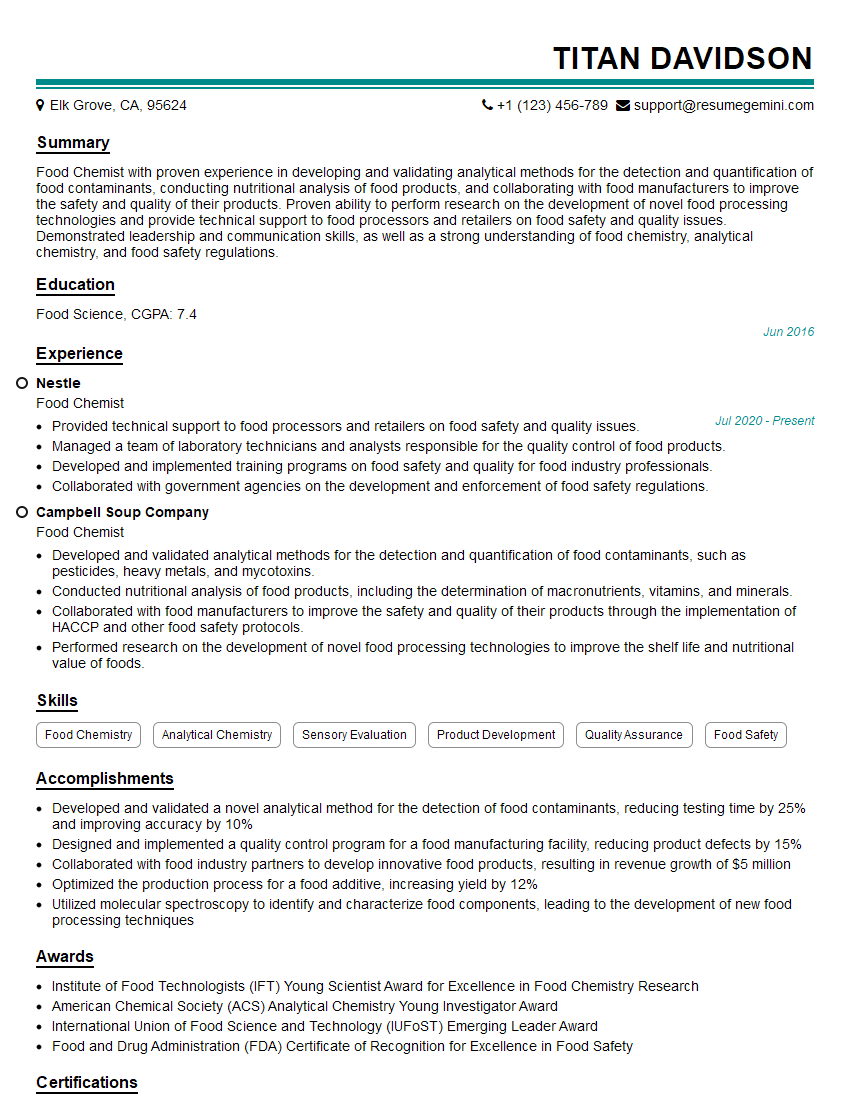
Food Chemist Resume Sample

Biochemist Resume Sample

Analytical Chemist Resume Sample

Electrochemist Resume Sample

Forensic Chemist Resume Sample

Inorganic Chemist Resume Sample

Physical Chemist Resume Sample

Process Chemist Resume Sample

Research Chemist Resume Sample

Materials Scientist Resume Sample

Chemical Technician Resume Sample
Explore more articles
Users Rating of Our Blogs
Share Your Experience
We value your feedback! Please rate our content and share your thoughts (optional).
What Readers Say About Our Blog
To the interviewgemini.com Webmaster.
Very helpful and content specific questions to help prepare me for my interview!
Thank you
To the interviewgemini.com Webmaster.
This was kind of a unique content I found around the specialized skills. Very helpful questions and good detailed answers.
Very Helpful blog, thank you Interviewgemini team.