Preparation is the key to success in any interview. In this post, we’ll explore crucial Collection Cataloguing interview questions and equip you with strategies to craft impactful answers. Whether you’re a beginner or a pro, these tips will elevate your preparation.
Questions Asked in Collection Cataloguing Interview
Q 1. Explain the difference between descriptive, subject, and structural metadata.
Metadata in collection cataloging describes the items in a collection, allowing for efficient retrieval and management. We categorize metadata into three main types: descriptive, subject, and structural.
- Descriptive metadata describes the physical or digital characteristics of an item. Think of it as answering the ‘what’ questions. Examples include title, author, publication date, publisher, dimensions (for physical items), and file format (for digital items). For a book, descriptive metadata might include the title, author’s name, ISBN, number of pages, and publication year. For a digital image, it would include file type, dimensions, resolution, and creation date.
- Subject metadata describes the topical content of an item. This answers the ‘about’ questions. It involves assigning keywords, controlled vocabulary terms (like Library of Congress Subject Headings or MeSH terms), and classification numbers (like Dewey Decimal or Library of Congress Classification) to reflect the item’s themes and subjects. For example, a book about the history of the Roman Empire would have subject metadata relating to Roman history, ancient Rome, the Roman Empire, and potentially related geographic locations and historical periods.
- Structural metadata describes the internal organization of a complex item. This is particularly important for digital collections. It focuses on how elements within an item relate to each other, such as chapters in a book or individual images within a digital collection. For example, structural metadata for a digitized newspaper might describe the relationship between articles, advertisements, and other components within a single issue. A digital audio file might have structural metadata indicating the chapters and timestamps for each chapter.
These three types work together to provide a comprehensive description of a collection item, making it readily discoverable and usable.
Q 2. Describe your experience with various cataloging standards (e.g., RDA, MARC, Dublin Core).
I have extensive experience working with a variety of cataloging standards, each with its own strengths and applications.
- Resource Description and Access (RDA): RDA is the current international standard for creating descriptive bibliographic records. I’m proficient in applying RDA’s principles for creating consistent and comprehensive metadata records, focusing on the creation of rich and detailed descriptions that enhance discoverability and access. I’ve used RDA to catalog diverse materials, from books and journals to archival collections and born-digital items.
- MARC (Machine-Readable Cataloging): I’m highly skilled in using MARC 21, the standard format for encoding bibliographic data in machine-readable form. I understand the intricacies of MARC tagging, field structures, and subfields, and can effectively manipulate and interpret MARC records using various cataloging software and tools. I’ve worked extensively with MARC records to create, edit, and migrate metadata.
- Dublin Core: I’m experienced in using the Dublin Core Metadata Element Set, a simple metadata schema particularly useful for the web. Its lightweight nature makes it ideal for quick metadata creation and for interoperability across various systems and platforms. I’ve frequently used Dublin Core to enhance the metadata of digital assets for online discovery and access.
My experience working with these different standards allows me to adapt my cataloging approach depending on the specific requirements of a collection and the intended users.
Q 3. How do you handle conflicting or incomplete metadata records?
Dealing with conflicting or incomplete metadata records is a common challenge in collection cataloging. My approach involves a systematic investigation and a commitment to accuracy and consistency.
- Identify the conflict or incompleteness: I carefully examine the record to pinpoint the exact nature of the problem. This includes comparing multiple sources to determine which one is more reliable.
- Verify the information: I use various sources to verify the conflicting information. This could include checking original materials, consulting authority files, or referencing related records. Sometimes, this may involve contacting experts or subject matter specialists.
- Prioritize accuracy: If conflicting information exists, I select the most reliable source after careful examination of all available evidence. I thoroughly document the resolution process, including the rationale behind the decision.
- Supplement incomplete data: When dealing with incomplete records, I thoroughly research and fill in the missing information whenever possible, drawing on reliable external sources. I clearly document what information has been added and the sources used to supplement the information.
- Document Decisions: I always maintain thorough documentation of all actions and decisions made regarding conflicting or incomplete metadata. This documentation is essential for traceability and accountability.
Handling these challenges requires meticulous attention to detail, critical thinking, and a deep understanding of cataloging principles and best practices.
Q 4. What are the key principles of authority control in collection cataloguing?
Authority control is crucial for ensuring consistency and accuracy in metadata. It’s the process of creating and maintaining controlled vocabularies and standardized forms for names, terms, and subjects.
Key principles include:
- Uniqueness: Each concept or entity (person, place, subject, etc.) should have only one authorized record. This avoids duplication and inconsistency across the catalog.
- Consistency: All references to a particular entity should use the same authorized form. For example, if ‘Shakespeare, William’ is the authorized form, every record mentioning him should use this exact form.
- Authority Files: These are databases that store standardized information about authorized forms and their associated data (e.g., dates, alternative spellings). These are essential tools for managing authority control.
- Cross-References: When alternative forms of a name or subject are used (e.g., variations in spelling), cross-references within the authority file link these variations to the single, authorized form.
- Regular Review and Maintenance: Authority files must be regularly reviewed and updated to reflect new information and changes over time. This involves adding new terms, correcting errors, and merging duplicate records.
Authority control ensures that searches yield consistent and relevant results, regardless of the variations in spelling or terminology used by different users.
Q 5. Describe your experience with different metadata schemas.
My experience encompasses a range of metadata schemas, each suited for different purposes and contexts.
- MARC (Machine-Readable Cataloging): As mentioned before, my experience with MARC 21 is substantial, focusing on creating, editing, and interpreting bibliographic records.
- Dublin Core: I am comfortable working with the Dublin Core schema, particularly for its simplicity and suitability for web-based applications and digital asset management.
- MODS (Metadata Object Description Schema): I have worked with MODS, a more comprehensive schema than Dublin Core, providing richer metadata for digital libraries and repositories.
- METS (Metadata Encoding & Transmission Standard): I understand how to use METS to structure and describe complex digital objects, providing a detailed outline of the structure and components of a digital collection.
Understanding the nuances of various schemas allows me to select the most appropriate one for a given task and ensure interoperability and data exchange across various platforms.
Q 6. How do you ensure data quality and consistency in a large collection?
Maintaining data quality and consistency in a large collection requires a multi-faceted approach.
- Establish Clear Metadata Standards: Define and document clear, consistent metadata standards, guidelines, and best practices that are applicable to the entire collection. Ensure that all cataloging staff adhere to these standards.
- Implement Authority Control: Utilize authority files to control variations in names, terms, and subjects, as discussed previously. This is key to maintaining consistency.
- Regular Data Quality Checks: Routinely conduct data quality checks and audits to detect and correct inconsistencies or errors. This may involve automated scripts or manual reviews of a sample of records.
- Use Metadata Validation Tools: Leverage tools that automatically validate metadata records against established standards to check for errors and inconsistencies before they are added to the collection.
- Training and Documentation: Provide thorough training to cataloging staff on the established metadata standards, guidelines, and best practices. Maintain comprehensive documentation that serves as a readily accessible resource.
- Collaborative Workflow: Implement a collaborative workflow that allows for review and validation of metadata records by multiple catalogers before they are finalized and added to the collection.
Proactive measures and a commitment to accuracy are crucial for achieving high data quality and consistency in a large collection. This allows for easier retrieval, enhanced discoverability, and reduces the chances of errors.
Q 7. Explain your experience with digital asset management systems.
My experience with digital asset management (DAM) systems includes both hands-on use and strategic planning for their effective implementation.
I understand the importance of DAM systems in organizing, managing, and preserving digital assets. This includes experience with:
- Metadata Input and Management: I am proficient in using DAM systems to input, edit, and manage metadata, ensuring that descriptive, subject, and structural metadata are appropriately captured and organized.
- Workflows and Processes: I’m familiar with implementing workflows within DAM systems for tasks such as metadata creation, review, and approval. This optimizes efficiency and ensures consistent application of metadata standards.
- Integration with other systems: I’ve worked with integrating DAM systems with other library management systems and discovery layers, creating a seamless user experience and facilitating data exchange.
- Selection and Implementation: I’ve participated in the selection and implementation of DAM systems, taking into consideration factors such as scalability, functionality, and integration with existing infrastructure.
- Training and Support: I understand the necessity of providing training and support to end-users to ensure effective use of the DAM system and the consistent application of metadata standards.
My experience allows me to contribute effectively to all stages of the DAM lifecycle, from planning and implementation to ongoing management and support.
Q 8. What are your preferred tools for metadata creation and editing?
My preferred tools for metadata creation and editing depend on the project’s scope and the collection’s characteristics. For smaller projects or individual items, I find spreadsheet software like Excel or Google Sheets quite efficient for initial data entry and organization. These allow for easy sorting and manipulation before import into a more robust system.
However, for larger-scale projects or collections requiring more sophisticated metadata management, I rely on dedicated metadata editors and cataloging software. Examples include MarcEdit for MARC record editing (a standard format for library cataloging), and various Collection Management Systems (CMS) which I’ll discuss later. These systems allow for standardized metadata schemas, controlled vocabulary enforcement, and collaborative workflows. I also utilize specialized software for specific file types, such as Adobe Bridge for image metadata management.
Finally, I’m proficient in using scripting languages like Python to automate metadata creation and enrichment tasks. This is particularly useful for large batches of items requiring consistent metadata application or for extracting metadata from different file formats.
Q 9. How do you manage metadata for different file formats (e.g., images, videos, text)?
Managing metadata across diverse file formats requires a flexible and adaptable approach. The key is to apply consistent metadata principles while acknowledging the unique characteristics of each format. For instance, image files (JPEG, TIFF) would require metadata focused on aspects like camera settings (ISO, aperture), date taken, and geographic location (latitude/longitude) in addition to descriptive metadata like title, subject, and creator. Tools like Adobe Bridge excel at managing image-specific metadata. Video files (MP4, MOV) would need metadata relating to resolution, frame rate, and technical aspects of the production process, alongside descriptive metadata.
Text files (PDF, DOCX, TXT) may utilize metadata embedded within the file itself or require additional metadata through external sources. This is where a CMS becomes invaluable, providing a centralized platform to link disparate metadata to the appropriate digital asset regardless of the file format. The crucial aspect is to utilize standardized metadata schemas or ontologies (like Dublin Core) that facilitate interoperability and search.
Q 10. Explain your experience with controlled vocabularies and thesauri.
Controlled vocabularies and thesauri are fundamental to ensuring consistency and findability in metadata. They provide a standardized set of terms for describing subjects, genres, and other aspects of a collection. Using these controlled terms, rather than free-text descriptions, avoids inconsistencies and allows for more effective searching and retrieval.
My experience involves using widely-accepted thesauri such as Library of Congress Subject Headings (LCSH) and Art & Architecture Thesaurus (AAT) for specific projects. I’m also familiar with creating and managing custom controlled vocabularies tailored to the particular characteristics and needs of a given collection. This might involve collaborating with subject matter experts to develop a comprehensive and relevant vocabulary, using tools that allow for hierarchical organization and synonym management, ultimately enhancing the discoverability of the collection. For example, if I was cataloging a collection of vintage toys, a custom controlled vocabulary would ensure consistent use of terms relating to toy manufacturers, materials, and types of play.
Q 11. Describe your experience with collection management systems (CMS).
I have extensive experience working with a variety of Collection Management Systems (CMS), including open-source options like Fedora and more commercially available systems like CONTENTdm and Archivematica. My experience encompasses all aspects of CMS use, from initial setup and configuration to data import, metadata management, and user access control. I understand the importance of selecting the appropriate CMS based on the size and complexity of the collection, budget, and technical infrastructure.
My work with CMS includes creating and customizing metadata schemas, designing user interfaces for efficient navigation and searching, and implementing workflows to support both individual and collaborative cataloging efforts. I’m also skilled in migrating metadata from one system to another, a critical skill when dealing with legacy systems or evolving technological needs. I view CMS implementation not just as technical implementation, but as an opportunity to improve user experience and ensure the longevity of the collection.
Q 12. How do you ensure the long-term preservation of metadata?
Ensuring long-term preservation of metadata is paramount. This involves several key strategies, starting with the adoption of stable and widely-supported metadata schemas (like Dublin Core) that are less susceptible to technological obsolescence. It’s crucial to avoid proprietary formats that might become unreadable in the future.
Another key aspect is data migration planning. Technological change is inevitable, so anticipating the need for moving metadata to new systems is essential. This involves regular data audits, format assessments, and the development of comprehensive migration plans. Furthermore, preservation involves creating backups and utilizing robust storage solutions, such as cloud storage with version control. Finally, creating a comprehensive preservation policy detailing procedures for long-term metadata management is crucial to ensure the ongoing accessibility and integrity of the collection’s metadata.
Q 13. Describe your experience working with diverse collection types (e.g., archives, manuscripts, photographs).
I have worked with a broad range of collection types, including archives, manuscripts, photographs, and born-digital materials. Each type presents its unique cataloging challenges. For example, archival materials may involve complex provenance research to accurately describe the origins and history of the items. Manuscripts often require specialized skills in paleography (the study of ancient handwriting) and codicology (the study of manuscripts). Photographs may need detailed description of the image content, camera details, and associated persons. These require adaptation in metadata schemas to capture the specific data needed.
In each case, my approach centers on understanding the context and the specific needs of the material. This involves close collaboration with subject matter experts (archivists, historians, etc.) to ensure the accuracy and completeness of the metadata. Furthermore, the ability to adapt cataloging practices to the unique characteristics of each collection type is crucial for ensuring effective access and preservation.
Q 14. How do you approach the cataloging of born-digital materials?
Cataloging born-digital materials presents unique challenges due to the constantly evolving technological landscape and the diverse range of file formats. My approach involves a multi-faceted strategy focusing on three key aspects: accurate description, technical metadata capture, and preservation planning.
Accurate description involves identifying and documenting the content, authorship, and context of the materials, just as with traditional materials. However, technical metadata plays a much larger role with born-digital items. This might include file formats, software requirements, and checksums for file integrity verification. Preservation planning involves determining appropriate storage, access protocols, and migration strategies to account for technological obsolescence. I employ tools specifically designed to work with digital objects and metadata schemas suited for digital preservation, ensuring the long-term accessibility and authenticity of these materials. I often work with emulators or virtual machines to preserve the ability to access files that rely on obsolete software.
Q 15. How do you handle copyright and intellectual property issues in cataloguing?
Handling copyright and intellectual property (IP) in cataloging is crucial for legal compliance and ethical practice. It involves accurately identifying and documenting the rights associated with each item in a collection. This means carefully examining the item itself for copyright notices, contacting rights holders when necessary, and applying appropriate metadata to reflect the copyright status.
For example, if a collection includes photographs, I would check for copyright information on the photograph itself (often found on the back or in accompanying documentation). If no copyright information is found, I would research the photographer to determine if the work is still under copyright. If it is, I would need to obtain permission for use or restrict access based on the copyright holder’s stipulations. If the work is in the public domain, I would document that fact in the catalog record using appropriate controlled vocabularies, such as the RDA (Resource Description and Access) vocabulary.
I would use controlled vocabulary and standardized fields within a cataloging system (like MARC21) to consistently record copyright information. This ensures that anyone searching the catalog can easily understand the copyright status and limitations of use of each item. This might involve using specific fields to note the copyright date, copyright holder, and any restrictions on access or reproduction.
Career Expert Tips:
- Ace those interviews! Prepare effectively by reviewing the Top 50 Most Common Interview Questions on ResumeGemini.
- Navigate your job search with confidence! Explore a wide range of Career Tips on ResumeGemini. Learn about common challenges and recommendations to overcome them.
- Craft the perfect resume! Master the Art of Resume Writing with ResumeGemini’s guide. Showcase your unique qualifications and achievements effectively.
- Don’t miss out on holiday savings! Build your dream resume with ResumeGemini’s ATS optimized templates.
Q 16. What is your approach to creating finding aids?
Creating finding aids is a critical aspect of making archival collections accessible and usable. My approach involves a multi-stage process, focusing on clarity, accuracy, and user-friendliness. It starts with a thorough understanding of the collection itself – its scope, arrangement, and content. I analyze the collection’s structure and identify key themes and access points that would be helpful to researchers.
I then design a finding aid that provides clear and concise information about the collection. This usually includes a detailed description of the collection’s contents, its history, its organization (e.g., a hierarchical structure for folders and boxes), and a subject index if relevant. I would use descriptive headings and subheadings to guide users effectively. I also incorporate controlled vocabularies where applicable for consistent terminology. For example, a collection of historical maps would include subject headings for geography, cartography and relevant historical periods.
Beyond textual descriptions, I also consider incorporating visual elements when appropriate. This might include digital images of key items within the collection to give users a ‘sneak peek’. The finding aid is then reviewed for completeness and accuracy before release to ensure ease of use and clarity. For example, I’d conduct user testing if time permits.
Q 17. Describe your experience with data migration and conversion.
Data migration and conversion is a common task in cataloging, involving transferring data from one system or format to another. My experience includes projects involving converting legacy cataloging systems to more modern systems, adapting MARC records to Dublin Core metadata, and cleaning and transforming data to improve consistency and accuracy.
One example involved migrating a large collection of MARC21 records from a local system to a national discovery platform. This required thorough planning to address data mapping, data cleaning, validation and error handling. I used various scripts and tools (e.g., XSLT transformations) to ensure data integrity during the migration process. I also developed clear procedures for quality assurance to verify the accuracy of the migrated data and address any inconsistencies.
Another significant challenge was migrating a collection of legacy records with inconsistent and sometimes missing metadata. This required a multi-stage process, including data cleanup, standardization of subject headings, and data enrichment where possible. We used a combination of automated scripts and manual review to ensure that the final result was clean and accurate.
Q 18. How do you prioritize tasks when faced with conflicting deadlines?
Prioritizing tasks with conflicting deadlines requires a structured approach. My strategy involves a combination of project management techniques and clear communication. I begin by assessing each task’s importance and urgency using a prioritization matrix (like Eisenhower’s Urgent/Important matrix). This allows me to identify high-priority tasks that require immediate attention and those that can be delegated or scheduled for later.
Once the priorities are set, I create a detailed work schedule with realistic deadlines for each task. This schedule is regularly reviewed and updated to accommodate any unforeseen delays or changes in priorities. Open and proactive communication with stakeholders is essential in managing expectations and adjusting deadlines where necessary. If unavoidable conflicts arise, I discuss them openly and transparently, proposing options for resolution and clearly communicating potential impacts.
I use project management tools to track progress, manage tasks, and ensure accountability. For example, I might use a Kanban board or a Gantt chart to visualize task dependencies and deadlines. Using tools for collaboration enables transparency and helps me prioritize efficiently.
Q 19. Explain your experience with quality assurance and error detection in cataloguing.
Quality assurance and error detection are paramount in cataloging. My approach involves implementing a multi-layered quality control process throughout the cataloging workflow. This begins with establishing clear standards and guidelines, using controlled vocabularies and authority files to ensure consistency in the metadata.
After cataloging, I perform rigorous quality checks, using automated tools and manual review. Automated tools can identify syntax errors, inconsistencies in formatting, and missing or incomplete data elements. Manual review, on the other hand, focuses on checking the accuracy and completeness of descriptive metadata and subject analysis. For example, I’ll cross-reference the information to make sure that cataloging adheres to AACR2 or RDA standards.
I regularly utilize batch editing features in cataloging systems to rectify common errors, ensuring data consistency across the catalog. I also perform spot checks and audits to ensure that quality control measures are effective and identify areas for improvement. Documentation of the process allows for consistency of quality checks by others.
Q 20. How do you handle problematic or ambiguous metadata elements?
Handling problematic or ambiguous metadata elements requires careful consideration and a systematic approach. My strategy involves researching the issue thoroughly before making any decisions. I start by carefully examining the source material to understand the context of the ambiguous element.
If the problem lies in understanding terminology or concepts, I consult relevant reference works, authority files, and subject matter experts. If the ambiguity stems from conflicting or incomplete information in the source material, I document the conflicting information within the catalog record, noting the source of the ambiguity. I would also consult with colleagues or supervisors for advice on the best course of action.
For example, encountering an item with an unclear publication date might involve consulting similar publications to infer a plausible date range, carefully documenting the rationale within the metadata record. Transparency and documentation are key to managing these situations.
Q 21. How do you stay current with developments in the field of cataloging and metadata?
Staying current in cataloging and metadata requires ongoing professional development. I actively participate in professional organizations like the American Library Association (ALA) and attend conferences and workshops focused on cataloging best practices and emerging technologies.
I subscribe to relevant journals and newsletters to stay informed about developments in metadata standards, cataloging rules, and emerging technologies that are shaping the field. I also actively engage in online communities and discussion forums related to cataloging, sharing knowledge and engaging in collaborative problem-solving.
Furthermore, I regularly review and update my own knowledge and skills by undertaking professional development courses and workshops; this ensures I maintain a high level of proficiency in applying standards and best practices within the constantly evolving field.
Q 22. Explain your experience with metadata harvesting and aggregation.
Metadata harvesting and aggregation are crucial for creating comprehensive, searchable collections. Harvesting involves automatically collecting metadata from diverse sources – think online archives, museum databases, or even social media – using protocols like OAI-PMH (Open Archives Initiative Protocol for Metadata Harvesting). Aggregation then takes this harvested metadata and combines it into a unified resource, often using a central repository or index. This allows users to search across multiple, disparate collections through a single interface.
In my previous role at the National Library, I led a project to aggregate metadata from various historical archives across the country. We used OAI-PMH to harvest Dublin Core metadata from each archive’s repository. This involved configuring harvesting agents, handling potential errors (like data inconsistencies), and mapping the harvested metadata into a standardized format for our central repository. The resulting aggregated catalogue significantly increased the discoverability of these historical documents, making them accessible to a much broader audience.
Another instance involved building a metadata aggregator for a university library system. This required dealing with diverse metadata schemas (MARC, MODS, Dublin Core), implementing data cleaning and transformation processes to ensure consistency, and integrating the aggregated data with the library’s existing discovery system. The solution increased efficiency in metadata management and provided a seamless search experience for users.
Q 23. Describe your experience with linked data and semantic web technologies.
Linked data and the semantic web are transformative technologies for cataloging. Linked data leverages the power of URIs (Uniform Resource Identifiers) to connect related pieces of information across different datasets. This interlinking creates a web of knowledge, allowing for richer contextual understanding and enhanced search capabilities. Semantic web technologies utilize ontologies and vocabularies (like schema.org or Dublin Core) to define the meaning and relationships between data elements, enabling machines to understand and reason about the information.
For example, linking a particular book record in our catalogue with the author’s biography in a separate biographical database significantly enriches the user experience. A user searching for a book by Jane Austen might also see links to her life, other works, and critical reviews, all automatically presented thanks to linked data.
I have practical experience implementing linked data in a museum catalogue. We created linked data representations of our artefacts, linking them to related geographical locations, historical periods, and biographical information of artists. This resulted in a far more informative and engaging online experience for our visitors. It also paved the way for implementing more sophisticated querying and data analysis, opening up new possibilities for research and exhibition curation. This work involved creating RDF (Resource Description Framework) representations of our data and deploying a SPARQL endpoint for data access.
Q 24. How do you ensure accessibility and discoverability of collection materials?
Ensuring accessibility and discoverability is paramount in collection cataloging. It involves several key strategies.
- Metadata Enrichment: Using comprehensive and consistent metadata is fundamental. This includes descriptive metadata (title, author, date), subject headings (controlled vocabularies like Library of Congress Subject Headings), and access points (names of people, places, and subjects). Employing multilingual metadata is key for reaching diverse audiences.
- Structured Data: Utilizing structured data formats (like JSON-LD or RDF) enhances machine readability and supports advanced search and data analytics, improving discoverability.
- Controlled Vocabularies: Using consistent and standardized vocabularies (e.g., Library of Congress Subject Headings, Getty AAT) ensures that users using different search terms will still find relevant materials.
- Accessibility Standards: Adhering to accessibility standards like WCAG (Web Content Accessibility Guidelines) is essential for making the catalogue usable by people with disabilities. This includes providing alternative text for images, transcripts for audio and video content, and ensuring keyboard navigation.
- User-Friendly Interface: Designing a clear, intuitive, and visually appealing user interface is crucial. Faceted navigation, advanced search options, and effective search result presentation are vital.
For example, in a project I worked on at a university archive, we improved accessibility by adding descriptive alt text to all digital images, implementing screen reader compatibility, and translating our metadata into several languages.
Q 25. What is your understanding of FRBR and its application in cataloging?
FRBR (Functional Requirements for Bibliographic Records) is a conceptual model that describes the relationships between different manifestations of a work. Instead of focusing solely on individual bibliographic records, FRBR helps us understand a work’s lifecycle, encompassing various editions, formats, and expressions.
The FRBR model outlines four core entities: Work (the intellectual content), Expression (the realization of the work in a particular form like a text or musical score), Manifestation (the physical or digital embodiment, like a specific edition of a book), and Item (a particular physical or digital instance). Understanding these entities helps cataloguers create a more complete and accurate representation of a collection.
For example, the same ‘work’ (e.g., Hamlet by Shakespeare) can have numerous ‘expressions’ (a modern English translation, an original early modern English version), each with many ‘manifestations’ (different publishers, editions, formats), and numerous ‘items’ (multiple copies of a particular edition in different libraries).
In practical application, FRBR guides the creation of linked data in bibliographic catalogs, facilitating better discovery of related items. It also helps in managing complex cataloguing situations involving various editions, translations, and adaptations of a single work.
Q 26. Explain your experience with user interface and user experience (UI/UX) design for collection access.
User interface and user experience (UI/UX) design are critical for making collections easily accessible. A poorly designed interface can hinder discoverability regardless of how rich the underlying data is.
My experience encompasses designing user-friendly search interfaces with faceted navigation, intuitive filtering options, and clear visual presentation of search results. I’ve worked on projects where we used user testing and feedback to iterate on designs and improve usability. For example, we found that replacing a complex keyword search with a simple, guided search greatly improved user satisfaction and search success rates.
I also have experience with the design of digital exhibits and virtual tours which demand a combination of excellent UI/UX to engage users with the collection, alongside intuitive navigation and information architecture. These projects involved close collaboration with designers, developers and archivists, following a user-centered design approach.
A key aspect is understanding user needs and expectations, so user research and testing are essential components in my workflow. This helps in identifying pain points and optimizing the user experience.
Q 27. Describe a situation where you had to resolve a complex cataloging problem. What was your solution?
One complex cataloging problem involved a collection of anonymous 18th-century manuscripts. Identifying the authors and the precise dates of creation was challenging due to lack of explicit information within the manuscripts themselves.
My solution involved a multi-faceted approach:
- Paleographic Analysis: I collaborated with a paleographer to analyze the handwriting styles present in the manuscripts to potentially identify the same hand across different documents, suggesting common authorship.
- Content Analysis: We analyzed the content of the manuscripts, searching for recurring themes, writing styles, and references that might help identify authors or contextualize the materials.
- Historical Research: Extensive archival research was conducted to uncover related documents or correspondence that might provide clues about the authors and their activities.
- Comparative Cataloging: We compared our findings with existing catalog records in similar collections, identifying potential connections and authors based on stylistic similarities.
This painstaking process allowed us to tentatively identify some authors and date ranges for several of the manuscripts. The resulting catalog records included detailed descriptions of the provenance, content, and potential authorship, along with statements of uncertainty where appropriate. The key was acknowledging limitations and documenting the research process, ensuring transparency and rigorous scholarship.
Q 28. How would you explain complex cataloging concepts to non-technical users?
Explaining complex cataloging concepts to non-technical users requires clear communication and relatable analogies. I use a layered approach:
- Start with the ‘Why’: Begin by explaining the purpose of cataloging – to make collections easily findable and understandable. I might use the analogy of a library’s card catalog or a well-organized filing system.
- Use simple language: Avoid technical jargon. Instead of saying ‘MARC records’, I might say ‘detailed descriptions of each item’.
- Visual aids: Diagrams or examples can illustrate complex relationships. For instance, showing a visual representation of FRBR’s four entities – Work, Expression, Manifestation, Item – can make the concept easier to grasp.
- Focus on the user benefit: Emphasize how cataloging improves access and usability for researchers, students, and the general public.
- Break down complex ideas into smaller chunks: Avoid overwhelming the audience with too much information at once.
For example, when explaining metadata, I might show them a simple example of metadata like a song’s title, artist, album etc. on a music streaming platform and explain how this information allows you to find the music you want. This relatable example clarifies how metadata facilitates efficient information retrieval in any context.
Key Topics to Learn for Collection Cataloguing Interview
- Metadata Standards and Schemas: Understanding and applying standards like MARC, Dublin Core, and RDA is crucial. Consider the implications of choosing different schemas for different collection types.
- Cataloguing Principles and Best Practices: Learn about the principles of authority control, descriptive cataloguing, subject access, and classification. Practice applying these principles to diverse materials.
- Digital Asset Management and Metadata: Explore the unique challenges and best practices for cataloguing digital objects, including images, audio, and video. Consider metadata schemas specifically designed for digital assets.
- Database Management Systems (DBMS): Familiarize yourself with relational databases and their application in library cataloguing. Understand how data is structured and queried within a library management system (LMS).
- Cataloguing Workflow and Procedures: Understand the steps involved in the cataloguing process, from initial assessment to final record creation and quality control. Consider different workflows for different collection types and cataloguing environments.
- Problem-Solving and Decision-Making in Cataloguing: Prepare to discuss how you handle ambiguous or incomplete information, conflicting data, or inconsistencies in existing records. Highlight your ability to make informed decisions based on best practices and professional judgement.
- Collection Analysis and Organization: Demonstrate your understanding of how cataloguing contributes to effective collection management and user access. Discuss strategies for organizing and managing collections of varying sizes and complexities.
Next Steps
Mastering Collection Cataloguing opens doors to exciting career opportunities within libraries, archives, museums, and other cultural heritage institutions. A strong foundation in these skills is highly sought after, leading to rewarding roles with increasing responsibility and impact. To significantly boost your job prospects, invest time in crafting an ATS-friendly resume that highlights your skills and experience effectively. ResumeGemini is a trusted resource that can help you build a professional and impactful resume tailored to the specific requirements of Collection Cataloguing positions. Examples of resumes tailored to Collection Cataloguing are provided to guide your resume creation process.

Knowledge Manager Resume Sample
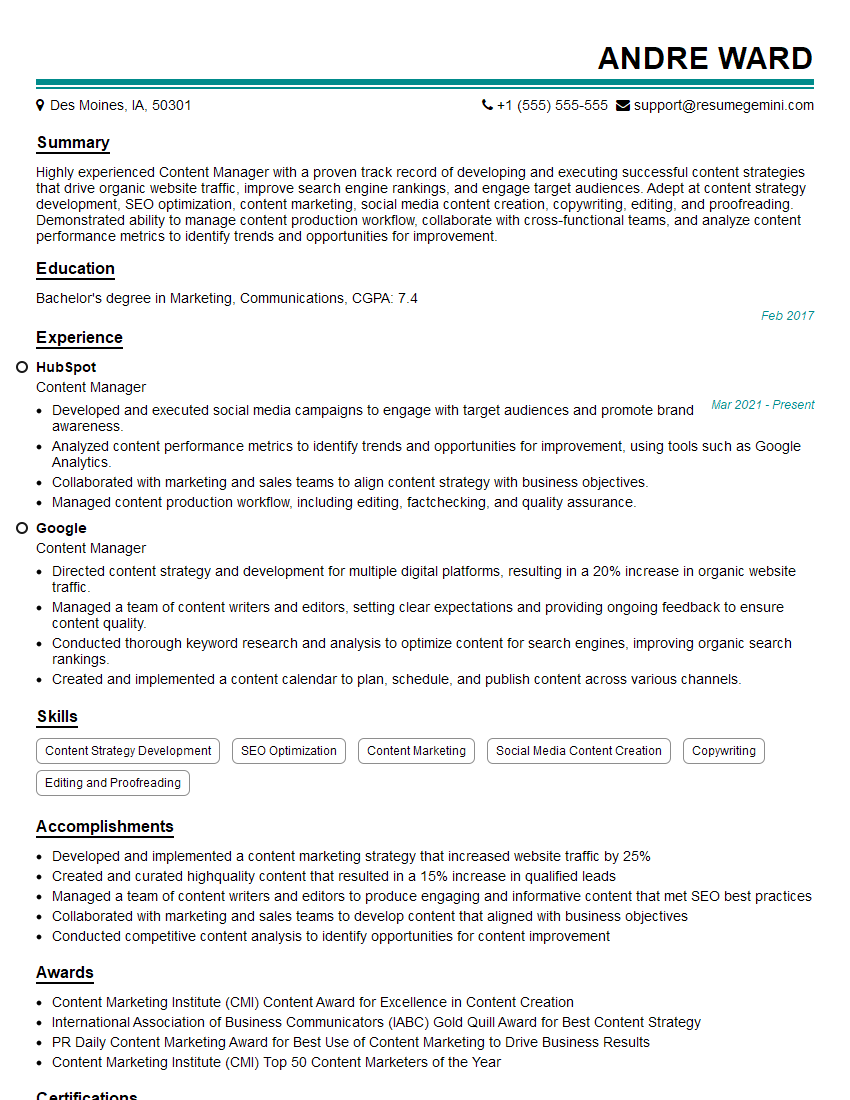
Content Manager Resume Sample
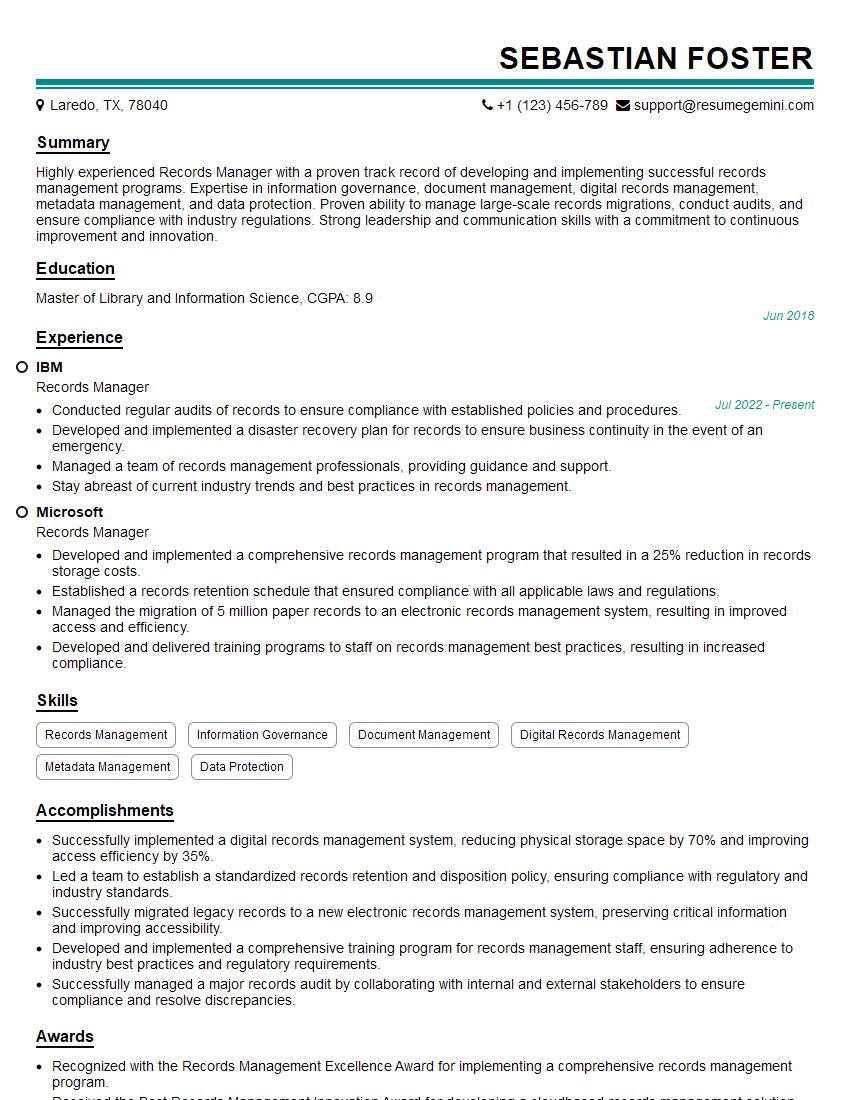
Records Manager Resume Sample
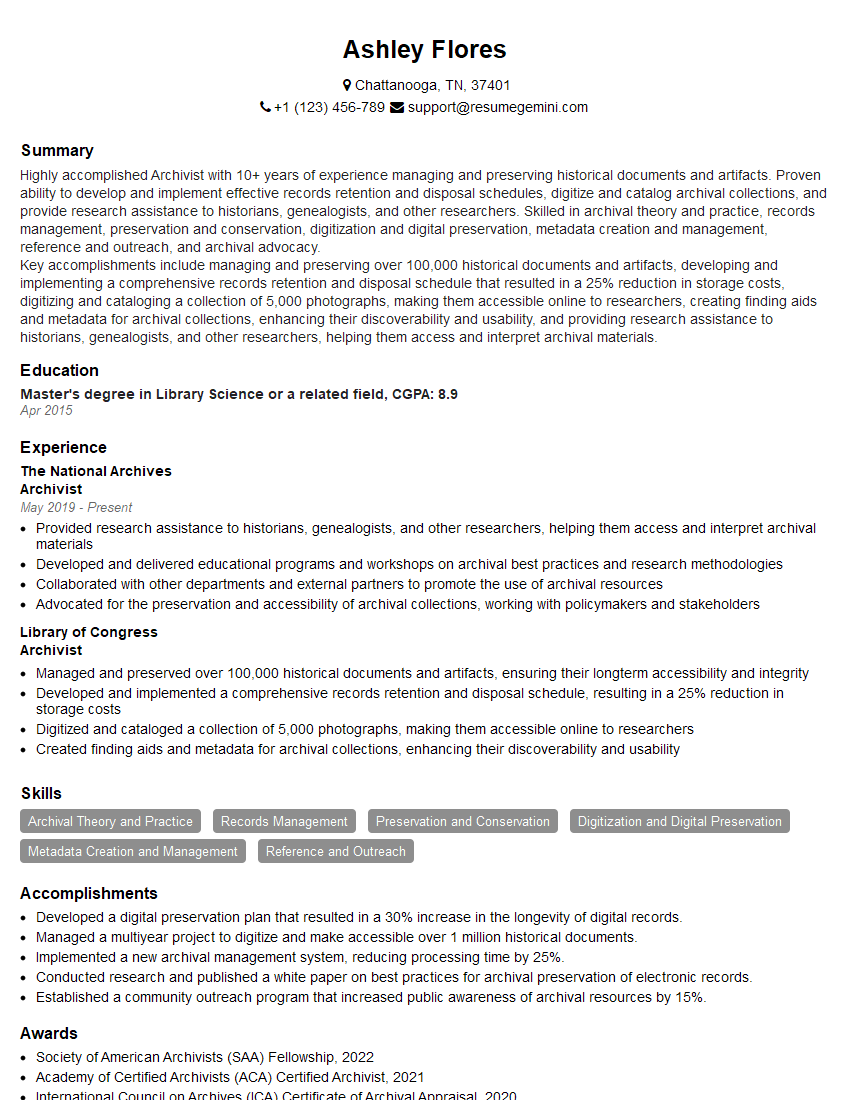
Archivist Resume Sample
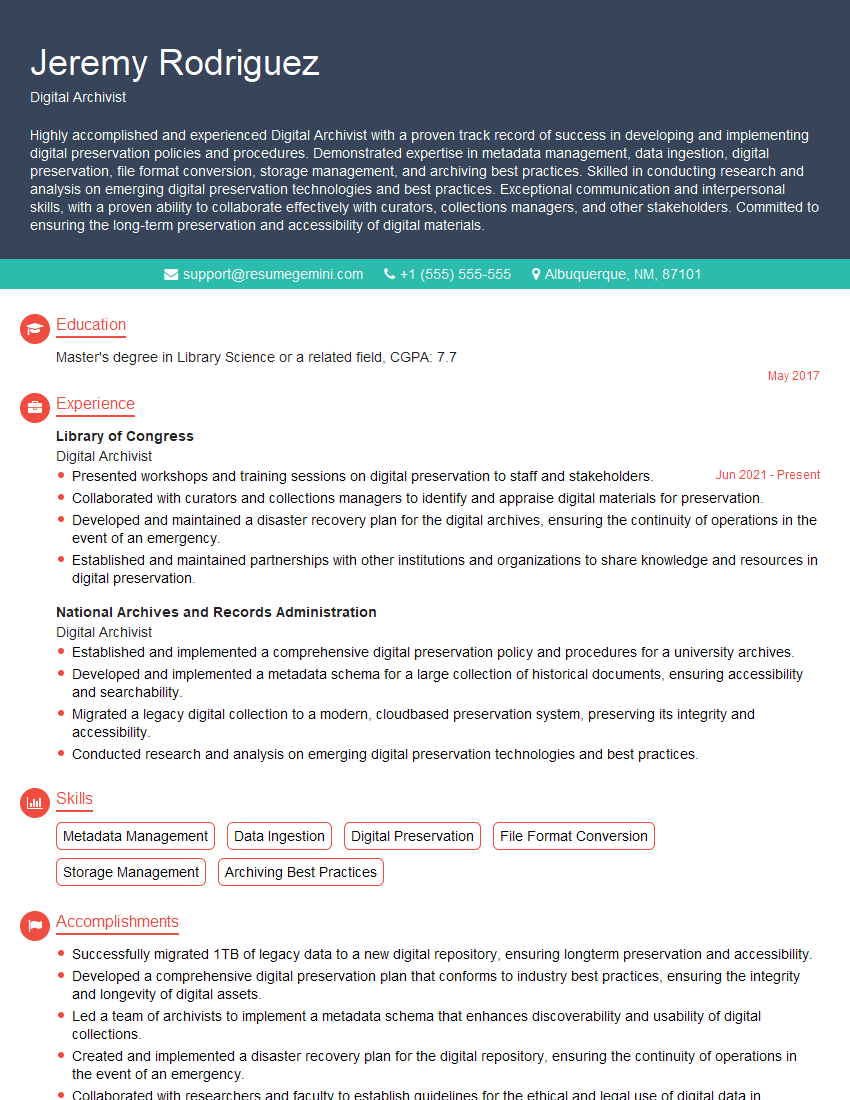
Digital Archivist Resume Sample
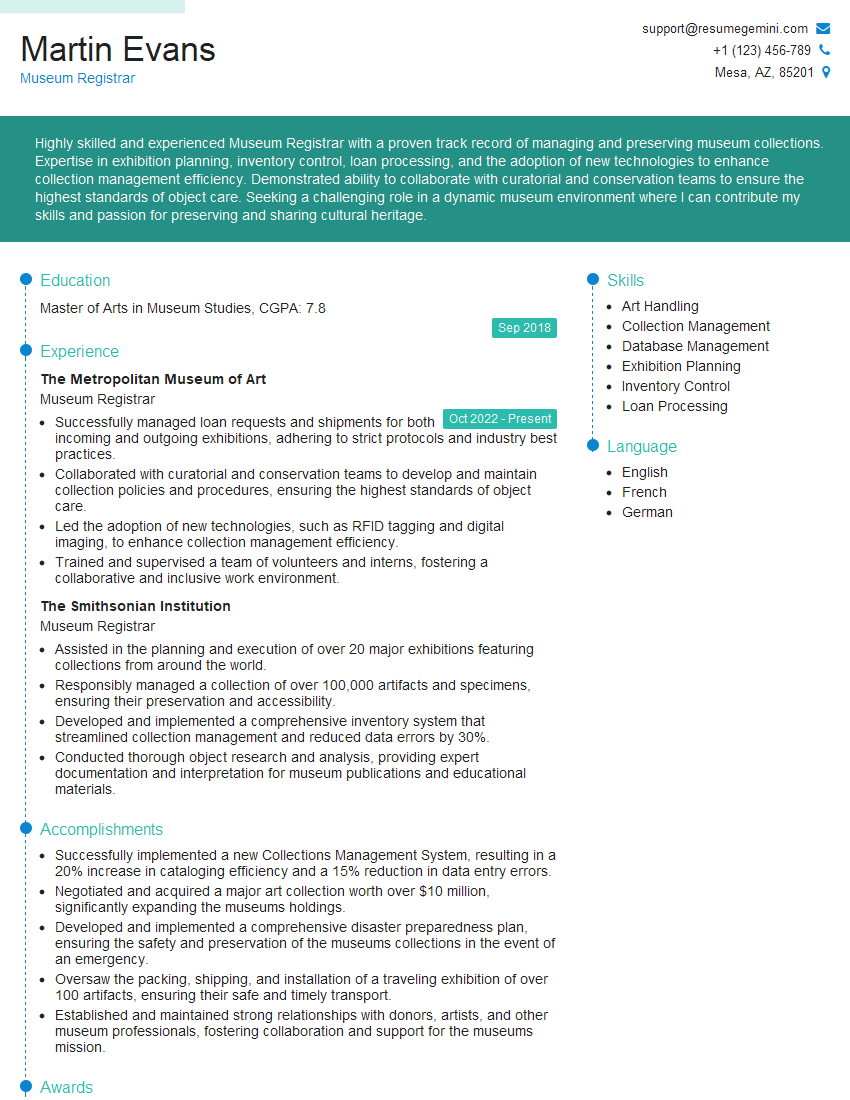
Museum Registrar Resume Sample
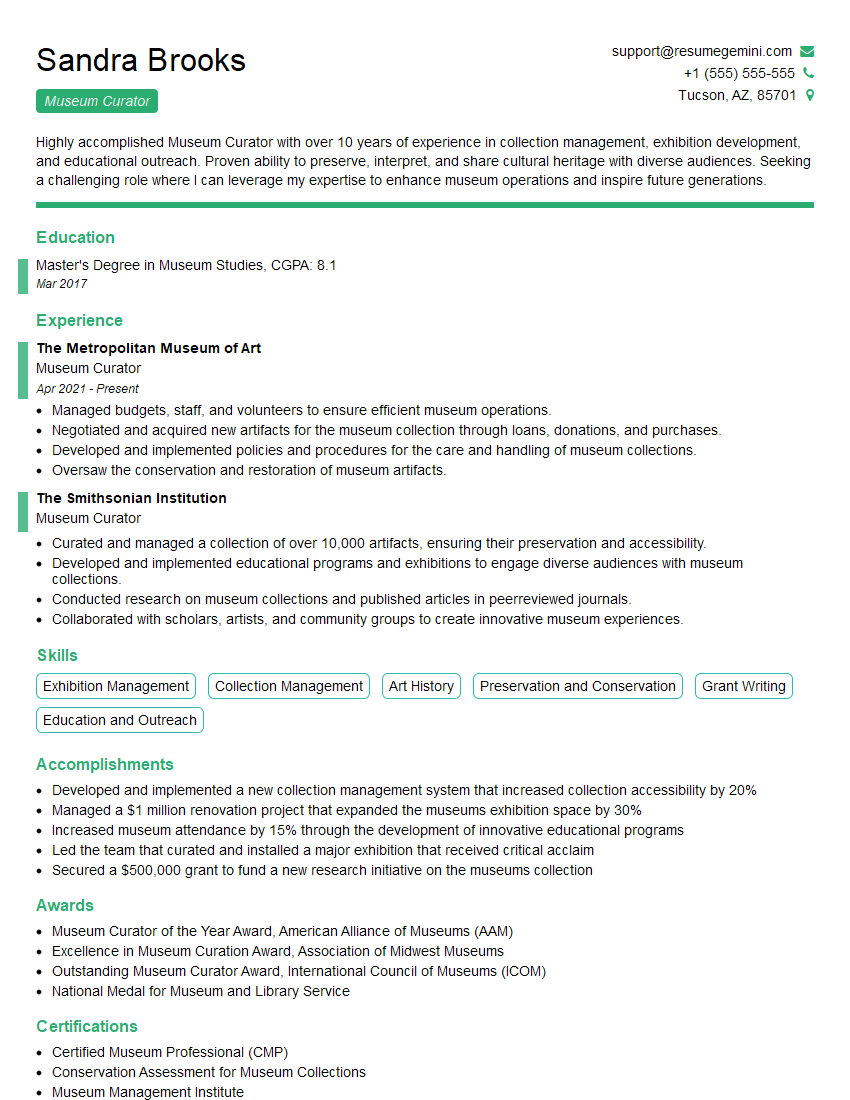
Museum Curator Resume Sample
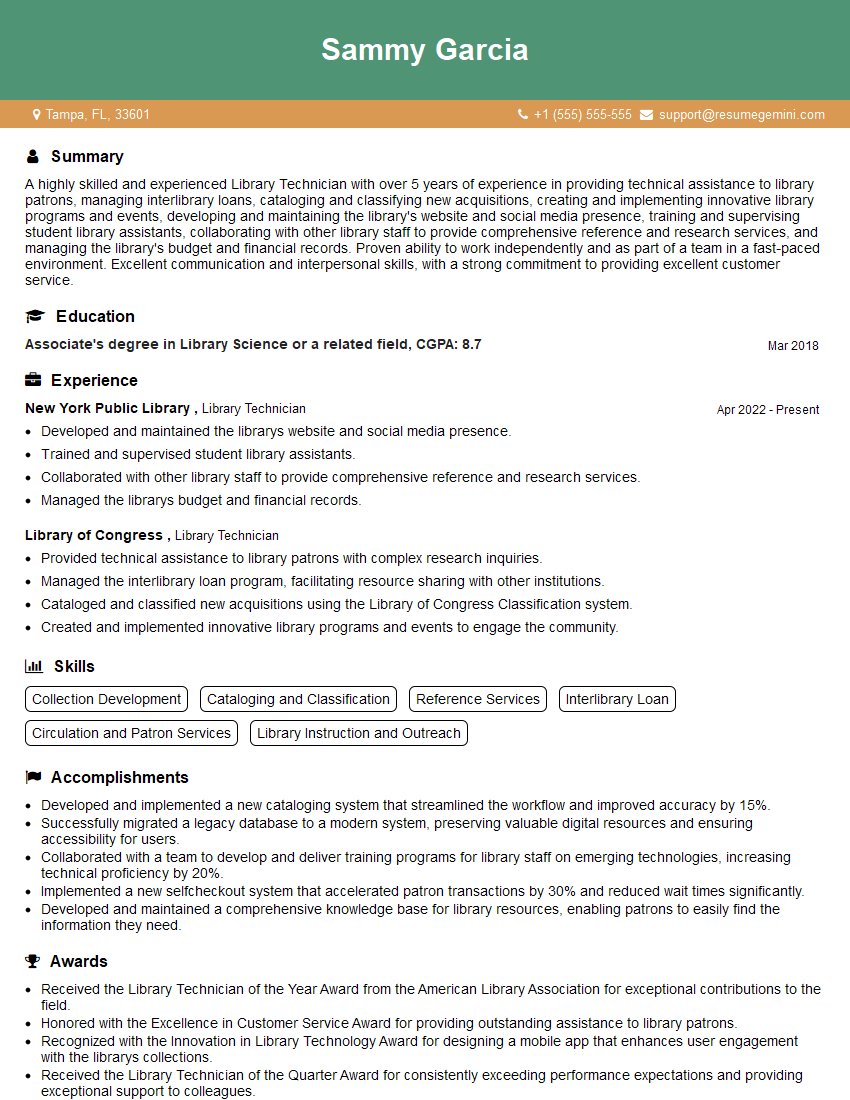
Library Technician Resume Sample
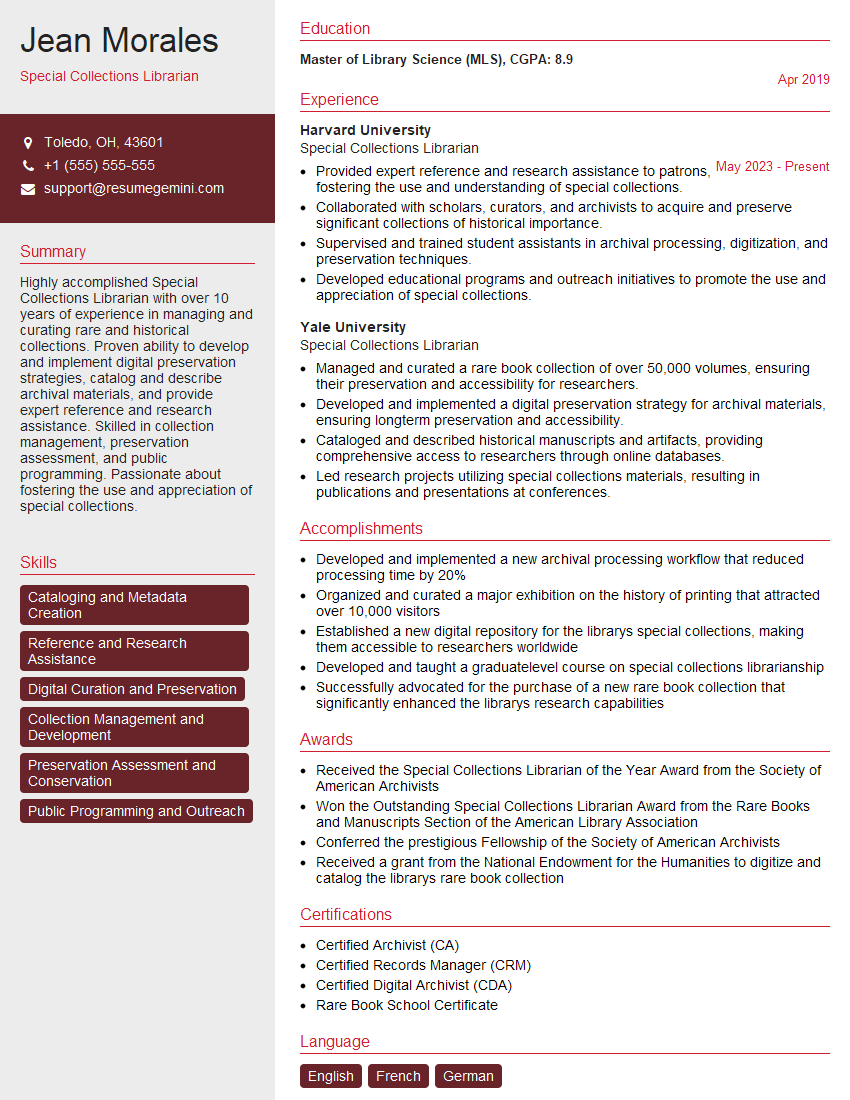
Special Collections Librarian Resume Sample
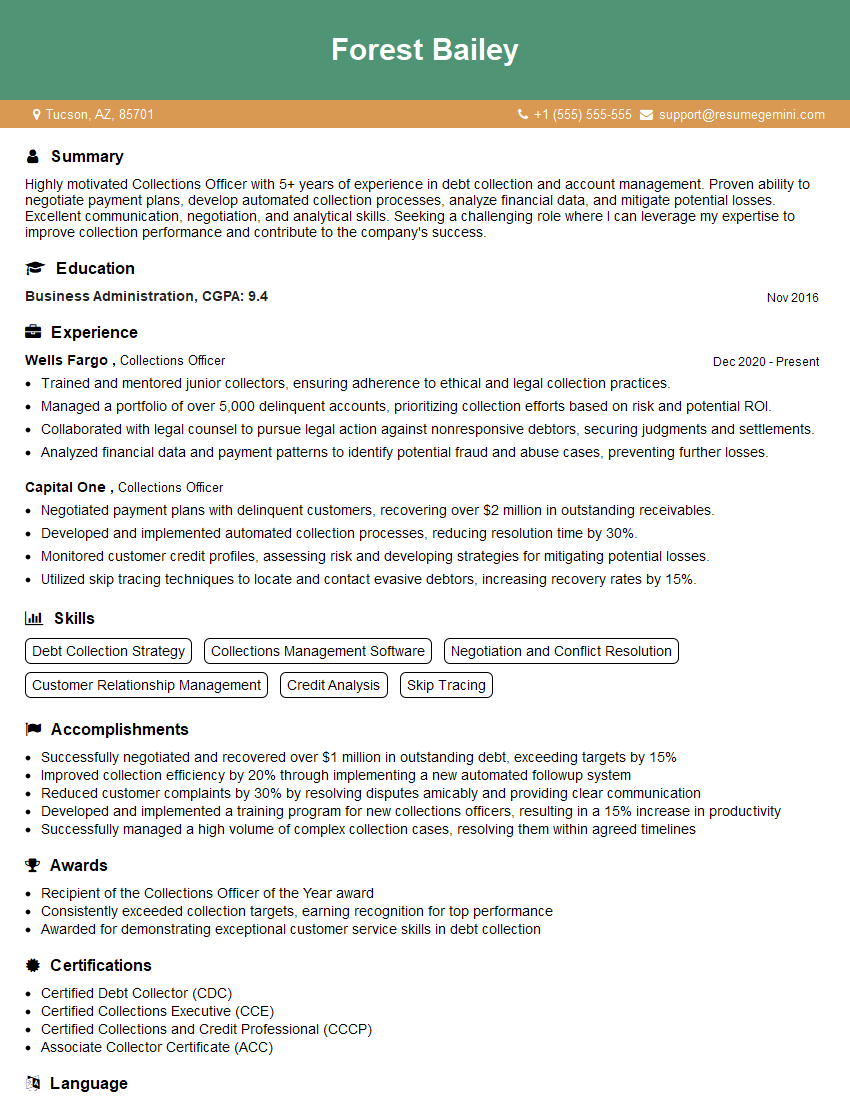
Collections Officer Resume Sample
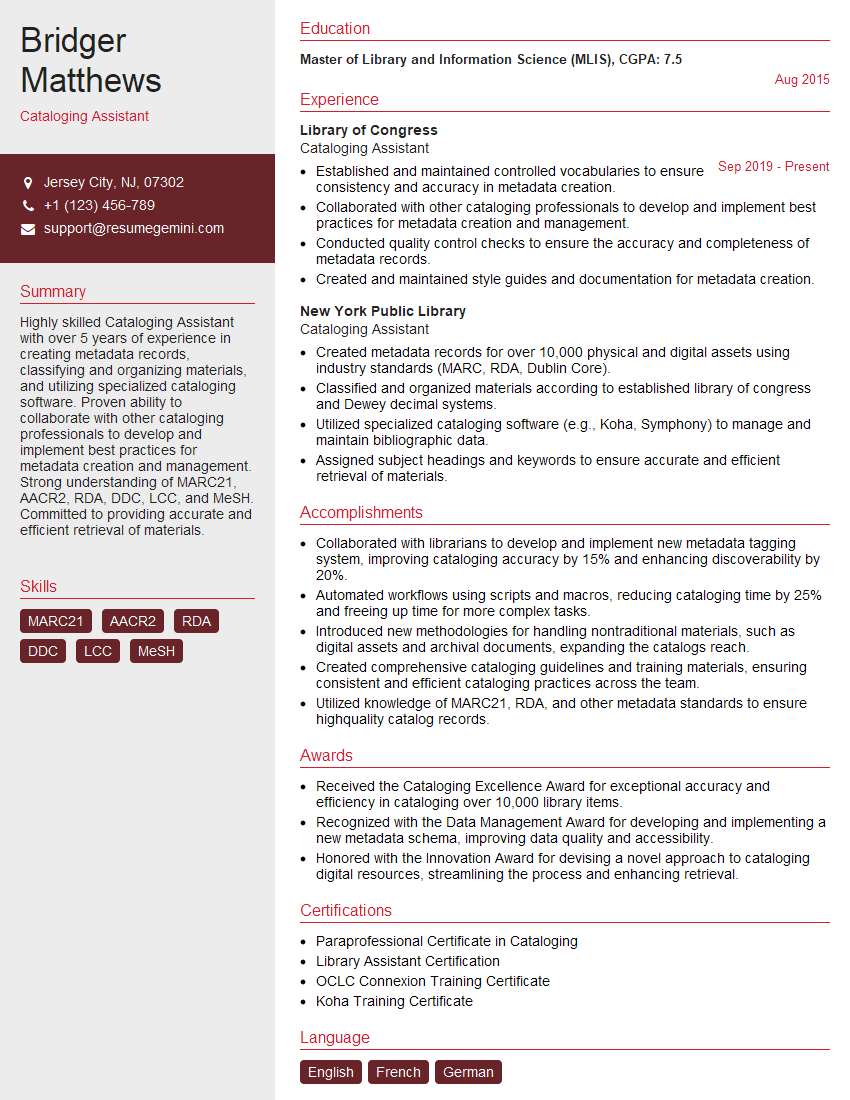
Cataloging Assistant Resume Sample
Explore more articles
Users Rating of Our Blogs
Share Your Experience
We value your feedback! Please rate our content and share your thoughts (optional).
What Readers Say About Our Blog
To the interviewgemini.com Webmaster.
Very helpful and content specific questions to help prepare me for my interview!
Thank you
To the interviewgemini.com Webmaster.
This was kind of a unique content I found around the specialized skills. Very helpful questions and good detailed answers.
Very Helpful blog, thank you Interviewgemini team.