The thought of an interview can be nerve-wracking, but the right preparation can make all the difference. Explore this comprehensive guide to Stanford CoreNLP interview questions and gain the confidence you need to showcase your abilities and secure the role.
Questions Asked in Stanford CoreNLP Interview
Q 1. Explain the architecture of Stanford CoreNLP.
Stanford CoreNLP is a suite of NLP tools organized around a pipeline architecture. Think of it as an assembly line for text processing. Each stage of the pipeline, or annotator, performs a specific task, and the output of one annotator becomes the input for the next. This allows for a modular design; you can select only the components you need for your specific task. The core components communicate using a shared representation, typically a sentence-based dependency tree.
The pipeline generally begins with tokenization (breaking text into words), followed by sentence splitting, part-of-speech (POS) tagging, lemmatization, and named entity recognition (NER). Later stages might include dependency parsing, coreference resolution, and sentiment analysis. The results of each stage are combined to provide a rich, semantically-enriched representation of the input text.
This pipeline approach is efficient and scalable because processing happens incrementally. It also makes the system highly customizable—you decide which tools are necessary.
Q 2. Describe the different annotators available in Stanford CoreNLP and their functionalities.
Stanford CoreNLP offers a comprehensive set of annotators. Imagine them as specialized workers on our text-processing assembly line:
- Tokenizer: Breaks down text into individual words and punctuation marks.
- Sentence Splitter: Divides the text into grammatically correct sentences.
- Part-of-Speech (POS) Tagger: Assigns grammatical tags (e.g., noun, verb, adjective) to each word.
- Lemmatizer: Reduces words to their base or dictionary form (e.g., ‘running’ becomes ‘run’).
- Named Entity Recognizer (NER): Identifies and classifies named entities such as people, organizations, locations, etc.
- Constituency Parser: Creates a tree-like representation of the grammatical structure of the sentence (phrase structure).
- Dependency Parser: Represents grammatical relationships between words in a sentence using directed graphs.
- Coreference Resolution: Identifies mentions of the same entity throughout the text (e.g., ‘He’ refers to ‘John’).
- Sentiment Analysis: Determines the overall sentiment (positive, negative, neutral) expressed in the text.
Each annotator brings unique capabilities. For instance, NER improves information extraction while dependency parsing unveils the intricate relationships within a sentence, which is crucial for question answering or machine translation.
Q 3. How would you use Stanford CoreNLP for Named Entity Recognition (NER)?
Using CoreNLP for Named Entity Recognition (NER) is straightforward. You essentially load the necessary annotator and process your text. Here’s a simplified example (Java):
Properties props = new Properties();
props.setProperty("annotators", "tokenize, ssplit, ner");
StanfordCoreNLP pipeline = new StanfordCoreNLP(props);

String text = "Barack Obama was born in Honolulu, Hawaii.";
Annotation document = new Annotation(text);
pipeline.annotate(document);

for (CoreMap sentence : document.get(SentencesAnnotation.class)) {
    for (CoreLabel token : sentence.get(TokensAnnotation.class)) {
        String ne = token.get(NamedEntityTagAnnotation.class);
        if (ne != null && !ne.equals("O")) {
            System.out.println(token.originalText() + ": " + ne);
        }
    }
}
This code snippet first initializes CoreNLP with the necessary annotators (tokenization, sentence splitting, and NER). It then processes the input text. The loop iterates through the sentences and tokens, extracting named entities and printing them along with their types. This provides a basic yet efficient mechanism for information extraction tasks.
Q 4. How would you handle different languages using Stanford CoreNLP?
Stanford CoreNLP supports multiple languages, but it requires downloading language-specific models. For example, to process German text, you’d need to download the German models. The process usually involves configuring the properties file to specify the language model to be used.
CoreNLP uses different models for each language. These models are trained on large corpora of text in that language. This means that for multilingual support, you need to download and specify the correct model path for your target language. The basic pipeline architecture remains consistent, but the specific annotators utilize language-specific linguistic resources.
Q 5. Explain the concept of POS tagging and how Stanford CoreNLP performs it.
Part-of-speech (POS) tagging is the process of assigning grammatical categories (e.g., noun, verb, adjective, adverb) to words in a sentence. Imagine it as giving each word a grammatical label. This is fundamental because the grammatical role of a word significantly impacts its meaning and how it contributes to the sentence’s overall structure.
Stanford CoreNLP’s POS tagger uses a statistical model trained on a large corpus of tagged text. The model learns patterns and probabilities associated with different word forms and their contexts. When given a new sentence, it considers the word’s surrounding words and its own form to predict the most likely POS tag. This isn’t just a simple lookup; it’s a sophisticated probability calculation based on the trained model. The accuracy relies heavily on the size and quality of the training data.
For example, ‘bank’ could be a noun (river bank) or a verb (to bank money). The tagger utilizes context to disambiguate this.
Q 6. Describe the difference between rule-based and statistical approaches in NLP, and how CoreNLP leverages both.
Rule-based approaches in NLP rely on manually crafted rules and patterns to perform tasks. Think of them as explicit instructions for the system. Statistical approaches, on the other hand, use machine learning models trained on data to infer patterns and make predictions. These rely on the power of data and statistical inference.
Stanford CoreNLP often combines both. For instance, while its POS tagger and NER are predominantly statistical, the dependency parser might incorporate some rule-based elements for handling specific linguistic phenomena not well captured by statistics. The rule-based components might address edge cases or refine the output of the statistical components, enhancing overall accuracy and robustness. This hybrid approach leverages the strengths of both methodologies—the precision of hand-crafted rules and the flexibility and scalability of statistical models.
Q 7. How does Stanford CoreNLP handle dependency parsing?
Stanford CoreNLP’s dependency parser analyzes the grammatical structure of a sentence by identifying dependencies between words. Instead of a hierarchical phrase-structure tree like in constituency parsing, it creates a directed graph showing relationships like subject-verb, verb-object, etc. Each word is a node, and arcs represent the relationships.
The parser uses a statistical model, usually trained on a treebank (a corpus of sentences annotated with dependency parse trees). This model learns to predict the most likely dependencies between words given their context. The algorithm considers factors like word order, POS tags, and lexical information to generate a dependency tree. This tree provides a rich, graph-based representation of the sentence’s grammatical structure, useful for various downstream NLP tasks such as semantic role labeling and question answering.
For example, in the sentence “The dog chased the ball,” the parser would identify ‘dog’ as the subject and ‘ball’ as the object of the verb ‘chased,’ illustrating the dependency relationships between these words.
Q 8. How can you customize Stanford CoreNLP’s pipeline for specific NLP tasks?
Stanford CoreNLP’s power lies in its highly customizable pipeline. Think of it like an assembly line for text processing. Instead of using every tool in the factory, you can pick and choose which ones are necessary for your specific job. You achieve this through the pipeline.addAnnotator() method. For instance, if you only need Part-of-Speech tagging and lemmatization, you wouldn’t need the Named Entity Recognizer (NER) or Coreference Resolution. This makes it incredibly efficient and resource-friendly.
Let’s say you are building a system to analyze customer reviews, focusing solely on sentiment. You could create a pipeline with just the tokenize, ssplit, pos, and sentiment annotators. This would skip unnecessary steps like NER, resulting in faster processing. The code would look something like this:
Properties props = new Properties();
props.setProperty("annotators", "tokenize, ssplit, pos, sentiment");
StanfordCoreNLP pipeline = new StanfordCoreNLP(props);
This customization allows you to tailor CoreNLP perfectly to your task, improving performance and resource utilization.
Q 9. Explain the concept of Coreference Resolution and its implementation in Stanford CoreNLP.
Coreference Resolution is the task of identifying mentions in text that refer to the same real-world entity. Imagine reading a sentence like, “Barack Obama was born in Honolulu. He became the 44th president of the United States.” Coreference resolution would identify “Barack Obama” and “He” as referring to the same person.
Stanford CoreNLP accomplishes this using a sophisticated machine learning model. The coref annotator within the pipeline identifies these coreferences and groups them together. The output is a structured representation showing which mentions are linked. This is incredibly useful for tasks like information extraction, question answering, and building knowledge graphs, as it allows you to consolidate information about a single entity from various mentions scattered throughout the text. For example, you could use this to easily summarize all the information a document contains about a particular person or organization.
//Sample output (simplified) might look like this:
{“mention1”: “Barack Obama”, “mention2”: “He”, “clusterId”: 1}
{“mention3”: “the 44th president of the United States”, “clusterId”: 1}
Q 10. How do you evaluate the performance of a named entity recognition system built using CoreNLP?
Evaluating a Named Entity Recognition (NER) system involves comparing its output to a gold standard—a manually annotated dataset where entities are correctly labeled. Common metrics include precision, recall, and the F1-score. Precision measures the accuracy of the system’s predictions (how many of its identified entities are actually correct), while recall measures its completeness (how many of the actual entities it correctly identified). The F1-score is the harmonic mean of precision and recall, providing a balanced measure of performance.
To evaluate your CoreNLP-based NER system, you’d first need a test dataset with entities labeled. Then, you’d run your CoreNLP pipeline on this dataset and compare its output to the gold standard labels. Several tools and libraries can assist in this process. You can write code to compare your predictions against the gold standard labels, calculating precision, recall, and F1-score. This allows you to systematically assess the strengths and weaknesses of your NER system and identify areas for improvement.
Q 11. How would you use Stanford CoreNLP for sentiment analysis?
Stanford CoreNLP’s sentiment annotator provides a straightforward way to perform sentiment analysis. After running the relevant parts of the pipeline (typically including tokenization and sentence splitting), you simply access the sentiment information. Each sentence receives a sentiment classification (e.g., positive, negative, neutral), and optionally, a fine-grained sentiment score for each sentence.
For example, after processing a review such as “This product is amazing! I highly recommend it.” The sentiment annotator might output a positive classification with a high score. Conversely, a sentence like “I am disappointed with the poor quality” would likely receive a negative classification with a low score. You can then analyze the overall sentiment of the text based on these individual sentence sentiments, for instance, by computing the average sentiment score or by determining the dominant sentiment category.
Q 12. Describe the process of using Stanford CoreNLP for relation extraction.
Relation extraction is the task of identifying relationships between entities in text. For example, extracting the relationship “Barack Obama was president of the United States.” While CoreNLP doesn’t directly provide a dedicated relation extraction annotator, it gives you the building blocks to create one. You’d start by using CoreNLP’s NER to identify entities. Then, you’d use dependency parsing or other linguistic features provided by CoreNLP (e.g., Part-of-Speech tags, named entities) to find relationships between those entities. You might use regular expressions, machine learning models, or a combination to identify and classify these relationships.
A common approach would be to create features based on the words and grammatical relations between entities, then train a classifier (e.g., a Support Vector Machine or a neural network) to predict the type of relationship between each pair of entities identified by the NER system.
Q 13. What are some limitations of Stanford CoreNLP?
While extremely powerful, Stanford CoreNLP has some limitations. It requires significant memory, which can be a bottleneck when processing large datasets or long documents. Its performance can be slower compared to some more lightweight libraries. It also has a steeper learning curve than some other NLP libraries, requiring a good understanding of Java or its wrapper libraries. The models it uses may not be optimized for all languages or domains, potentially reducing performance on less-common languages or specialized texts. Finally, it needs to be downloaded and set up properly, which is not as simple as directly installing a python package
Q 14. Compare and contrast Stanford CoreNLP with other NLP libraries (e.g., SpaCy, NLTK).
Stanford CoreNLP, SpaCy, and NLTK are all prominent NLP libraries, but they differ in several key aspects. CoreNLP excels in accuracy and the breadth of its features, offering a comprehensive suite of NLP tools. It’s especially known for its strong performance in tasks like dependency parsing and coreference resolution. However, it’s Java-based, can be resource-intensive, and has a higher barrier to entry.
SpaCy is Python-based, making it extremely popular due to Python’s widespread use in data science and its large community support. It’s known for its speed and efficiency, especially well-suited for production environments. Its features are less extensive than CoreNLP’s, but it’s still a powerful and versatile library. NLTK, also Python-based, prioritizes flexibility and ease of use, perfect for education and exploration. It provides a massive range of algorithms and corpora but often requires more manual configuration and can be less efficient than SpaCy for large-scale processing.
In essence: CoreNLP prioritizes accuracy and comprehensiveness; SpaCy prioritizes speed and ease of use in Python; NLTK prioritizes flexibility and experimentation.
Q 15. How do you handle ambiguity in natural language processing using Stanford CoreNLP?
Ambiguity is a common challenge in NLP because human language is inherently flexible. Stanford CoreNLP tackles this using probabilistic models and statistical methods. For example, consider the sentence “I saw the bat.”
This sentence is ambiguous: it could refer to a baseball bat or a flying mammal. CoreNLP’s part-of-speech (POS) tagger and named entity recognizer (NER) attempt to resolve this by analyzing the context. The POS tagger will assign grammatical roles to each word (e.g., ‘saw’ as a verb, ‘bat’ as a noun). The NER might identify ‘bat’ as a potential animal if other words in the text suggest a wildlife context, or leave it unclassified if the context is unclear. Ultimately, CoreNLP provides the different possible interpretations, along with probabilities associated with each interpretation, allowing the developer to select the most likely meaning based on the application’s needs. It doesn’t definitively ‘solve’ ambiguity but rather quantifies and presents the possible interpretations.
Another strategy is using dependency parsing. CoreNLP’s dependency parser creates a tree structure showing grammatical relationships between words. Examining these relationships can help disambiguate meanings by revealing which words modify others. For instance, a modifier like ‘baseball’ near ‘bat’ would strongly suggest the tool meaning.
Career Expert Tips:
- Ace those interviews! Prepare effectively by reviewing the Top 50 Most Common Interview Questions on ResumeGemini.
- Navigate your job search with confidence! Explore a wide range of Career Tips on ResumeGemini. Learn about common challenges and recommendations to overcome them.
- Craft the perfect resume! Master the Art of Resume Writing with ResumeGemini’s guide. Showcase your unique qualifications and achievements effectively.
- Don’t miss out on holiday savings! Build your dream resume with ResumeGemini’s ATS optimized templates.
Q 16. Explain the concept of lemmatization and stemming, and how CoreNLP implements them.
Lemmatization and stemming are text normalization techniques used to reduce words to their base or dictionary form (lemma). Think of it as finding the root of a word. While both aim for this, they differ in their approach.
Stemming is a crude heuristic process that chops off prefixes or suffixes. It’s faster but can lead to non-dictionary words (e.g., stemming “running” might yield “runn”, which isn’t a word). CoreNLP uses the StanfordLemmatizer which performs stemming.
Lemmatization, on the other hand, is more sophisticated. It considers the context and uses a vocabulary and morphological analysis to determine the correct lemma. For example, lemmatizing “better” would correctly produce “good”, whereas stemming might just remove the suffix resulting in ‘better’. CoreNLP leverages its lemmatizer which is integrated with its POS tagger to achieve accurate lemmatization.
CoreNLP implements both. You choose which to use depending on the needs of your application. For instance, if speed is critical and minor inaccuracies are acceptable, stemming is preferable. If accuracy is paramount, lemmatization is a better choice. Both are accessed through the CoreNLP pipeline.
Q 17. How would you preprocess text data before feeding it to Stanford CoreNLP?
Preprocessing text before feeding it to CoreNLP is crucial for improved accuracy and efficiency. Think of it as preparing the ingredients before cooking a meal.
- Cleaning: Removing irrelevant characters (e.g., HTML tags, excessive whitespace, special symbols) using regular expressions.
- Lowercasing: Converting text to lowercase to ensure consistency. This prevents the model from treating different capitalizations as different words.
- Tokenization: Splitting text into individual words or tokens. CoreNLP handles this internally, but you might want to perform preliminary tokenization if you need specific tokenization rules for your domain.
- Handling Numbers and Dates: Standardizing numbers and dates into consistent formats. This might involve converting them to numerals or specific date formats.
- Removing Stop Words: Eliminating common words (e.g., “the”, “a”, “is”) that often don’t contribute significantly to analysis. However, be cautious; removing stop words can be detrimental in some tasks (e.g., sentiment analysis). CoreNLP does not perform stop-word removal automatically.
Example using Python to remove HTML tags:
import retext = re.sub('<[^<]+?>', '', text)Q 18. How do you handle out-of-memory errors when processing large text datasets with CoreNLP?
Out-of-memory (OOM) errors are common when processing massive datasets with CoreNLP, especially when dealing with long documents or a large number of documents. The key is to process data in smaller, manageable chunks.
- Chunking: Divide the large text dataset into smaller files or blocks. Process each chunk individually, then combine the results. This strategy reduces the memory footprint at any given time.
- Memory Management: Ensure proper memory management in your application. Close unused objects and resources as soon as you’re done with them to prevent memory leaks.
- Distributed Processing: For extremely large datasets, consider using a distributed processing framework like Spark or Hadoop. Distribute the processing workload across multiple machines to handle the load.
- CoreNLP Server: Use the CoreNLP server mode. This mode allows you to send requests to a running server instead of loading the entire library into your application. This greatly reduces memory overhead.
It is crucial to profile your code and identify memory bottlenecks, tailoring the chunking size to your available resources.
Q 19. Describe different ways to improve the accuracy of Stanford CoreNLP’s annotations.
Improving CoreNLP’s annotation accuracy involves several strategies:
- Custom Models: Train CoreNLP’s models on a domain-specific corpus. If you’re working with medical text, train the NER model on medical data. This dramatically improves accuracy within that domain.
- Parameter Tuning: Experiment with CoreNLP’s various parameters (e.g., changing the POS tagger’s model or adjusting parameters for NER). Different settings can significantly impact performance.
- Data Cleaning and Preprocessing: Thorough preprocessing ensures the quality of input data, resulting in better annotation quality. Addressing noisy or inconsistent data before analysis is critical.
- Ensemble Methods: Combine annotations from multiple CoreNLP runs with different settings or models to improve overall accuracy. For example, run NER multiple times with different parameter settings and combine the results using voting or a weighted average.
- Post-Processing: Implement post-processing rules to correct common errors. This often involves rule-based systems to refine the annotations based on patterns or linguistic rules.
Q 20. How would you integrate Stanford CoreNLP into a larger application?
Integrating CoreNLP into a larger application depends on the application’s architecture and programming language. But the core approach remains consistent.
Method 1: Direct Integration (Java): If your application is Java-based, you can directly integrate CoreNLP as a library. This is the simplest approach; you call CoreNLP’s functions directly from your code.
Method 2: REST API (Any Language): Use the CoreNLP server mode to expose its functionality as a REST API. This allows you to access CoreNLP’s capabilities from any programming language using HTTP requests. This makes integration much simpler across different programming languages.
Method 3: Pipeline Approach: In many NLP applications, you may need to chain together multiple CoreNLP functionalities (e.g., tokenization, POS tagging, NER). CoreNLP supports this elegantly through pipeline mechanisms, streamlining your workflow.
Regardless of the method, you’ll need to manage input and output appropriately. This could involve file I/O, database interactions, or streaming data processing, depending on your application’s data flow.
Q 21. Explain the importance of tokenization and how it’s handled in CoreNLP.
Tokenization is the process of splitting text into individual units called tokens. These tokens can be words, punctuation marks, or even sub-word units. It’s the fundamental first step in almost all NLP tasks.
Imagine trying to understand a sentence without separating it into words; it would be nearly impossible. Tokenization is that crucial step of separating the sentence into understandable units.
CoreNLP handles tokenization automatically as part of its pipeline. It uses sophisticated algorithms that consider punctuation, contractions (e.g., “don’t”), and other linguistic nuances. The tokenizer isn’t just a simple space splitter; it’s designed to handle various complexities of language. The specific tokenizer used can be configured, allowing you to fine-tune the tokenization process for your particular application’s needs.
Q 22. What are the different ways to serialize and deserialize CoreNLP annotations?
Stanford CoreNLP offers several ways to serialize and deserialize annotations, primarily focusing on efficiency and compatibility. The most common methods involve using the Stanford CoreNLP’s built-in serialization mechanisms, leveraging Java’s object serialization, or employing external libraries like Jackson for JSON serialization.
XML Serialization: CoreNLP naturally outputs annotations in XML format. This is a human-readable and widely supported format, ideal for debugging or integration with other XML-processing tools. You can directly access the XML string representation of the annotations and parse it as needed.
<coreference> ... </coreference>
Object Serialization (Java): For internal use within a Java application, you can directly serialize the CoreNLP annotation objects using Java’s built-in serialization capabilities. This is efficient but limits interoperability with non-Java systems.
ObjectOutputStream oos = new ObjectOutputStream(new FileOutputStream("annotations.ser"));
oos.writeObject(annotations);
JSON Serialization (using Jackson): For better interoperability, especially with web applications or other languages, consider using a JSON library like Jackson. You’ll need to convert CoreNLP’s annotation objects into a suitable JSON structure before serialization. This provides a flexible and lightweight format.
//Requires adding Jackson dependency
ObjectMapper mapper = new ObjectMapper();
String jsonString = mapper.writeValueAsString(annotations);
The choice depends on your specific needs. For simple debugging or sharing among Java applications, XML or Java serialization is sufficient. For wider compatibility and easier data exchange, JSON is generally preferred.
Q 23. How would you debug a problem with Stanford CoreNLP’s output?
Debugging Stanford CoreNLP’s output often involves a systematic approach. The first step is to carefully examine the raw output. Is the annotation missing entirely, or are specific annotations incorrect? This helps pinpoint the problem area.
Check Input Data: The most common source of errors is incorrect or poorly formatted input text. Ensure your input text is properly encoded and free of unexpected characters. Try simplifying the input to isolate the problem.
Examine the CoreNLP Properties File: Verify that your properties file (
-propsargument) contains the correct settings for the annotators you’re using. An incorrect setting, or a missing required model, will lead to unexpected results.Inspect Individual Annotators: CoreNLP runs a pipeline of annotators. If the problem is in the dependency parsing, for instance, ensure you have the appropriate model (e.g.,
edu.stanford.nlp.trees.EnglishGrammaticalStructure). Carefully analyze the output of each annotator to identify where the error occurs.Logging and Debugging: Stanford CoreNLP provides detailed logging. Adjust the logging level to get more verbose output during annotation. You can use a debugger to step through the code and examine the state of variables within the CoreNLP pipeline.
Test with a Smaller Dataset: If you are processing a large dataset, test with a smaller subset to identify the source of the problem more quickly.
Debugging effectively relies on a combination of careful observation, understanding the CoreNLP architecture, and utilizing its logging and debugging features. Think of it like troubleshooting a car – you systematically check each component until you find the faulty part.
Q 24. Discuss the use of Stanford CoreNLP for question answering systems.
Stanford CoreNLP plays a crucial role in building question answering (QA) systems. Its various annotators provide the necessary linguistic analysis to understand both the question and the answer text.
Tokenization and Sentence Splitting: CoreNLP accurately breaks down text into individual words and sentences, forming the foundation for further processing.
Part-of-Speech Tagging: Determining the grammatical role of each word (noun, verb, adjective, etc.) allows the system to understand the grammatical structure of both the question and the answer candidate.
Named Entity Recognition (NER): Identifying named entities like people, organizations, and locations helps extract key information and improve the accuracy of answering factual questions.
Dependency Parsing: This crucial annotator reveals the grammatical relationships between words in a sentence. It is used to understand the question’s meaning and how the answer relates to the question.
Coreference Resolution: Identifying mentions of the same entity throughout the text is vital for understanding complex relationships and maintaining context across sentences.
By combining the outputs of these annotators, a QA system can extract relevant information, perform semantic analysis, and provide accurate answers. Imagine building a QA system about a specific news article; CoreNLP can transform the unstructured text into structured information that can be easily analyzed for question answering. The system then leverages these annotations to compare the question with the information in the text to pinpoint the best answer.
Q 25. How can you optimize the performance of Stanford CoreNLP for large-scale applications?
Optimizing Stanford CoreNLP’s performance for large-scale applications requires a multi-faceted approach. The key lies in understanding the bottlenecks and strategically addressing them.
Annotator Selection: Only enable the annotators strictly necessary for your task. Running unnecessary annotators consumes resources without adding value.
Parallel Processing: Stanford CoreNLP supports parallel processing. You can process text in parallel using multiple threads, significantly reducing processing time for large datasets.
Batch Processing: Instead of processing individual documents one at a time, batch processing allows for efficient processing of multiple documents simultaneously.
Caching: If you’re reusing the same models repeatedly, implement caching to avoid redundant computations. Store pre-processed results (if appropriate to your application).
Memory Management: Pay close attention to memory usage. Large texts and extensive annotations can lead to memory exhaustion. Use efficient data structures and consider techniques like memory mapping for handling large files efficiently.
Hardware Optimization: For very large-scale applications, consider using a distributed computing framework (like Spark) to distribute the load across multiple machines. This is particularly effective for enormous datasets that exceed the capabilities of a single machine.
Imagine processing millions of tweets; without optimization, this task would be incredibly slow. By employing these techniques, you can significantly reduce processing time and make large-scale applications practical.
Q 26. Explain the role of properties files in configuring Stanford CoreNLP.
Properties files are essential for configuring Stanford CoreNLP. They provide a structured way to specify the annotators to be used, model paths, and various other parameters. These files are typically in the standard Java .properties format, using key-value pairs.
For example, a properties file might contain:
annotators = tokenize, ssplit, pos, lemma, ner
modelPath = models/
This specifies that the pipeline should include tokenization, sentence splitting, part-of-speech tagging, lemmatization, and named entity recognition. The modelPath indicates where to find the necessary linguistic models. Other properties might define the memory allocation, character encoding, etc.
Using a properties file is beneficial because it allows you to centralize your configuration, making it easy to manage and modify settings without changing code. It enhances code maintainability and portability.
Q 27. Describe how to handle different character encodings with Stanford CoreNLP.
Handling different character encodings is crucial for correctly processing text from various sources. Stanford CoreNLP uses UTF-8 by default, but you can adjust this using the properties file.
To specify a different encoding (e.g., ISO-8859-1), add the following line to your properties file:
encoding = ISO-8859-1
Alternatively, you can specify the encoding directly when reading the input text using Java’s input stream readers:
InputStreamReader reader = new InputStreamReader(new FileInputStream("your_file.txt"), "ISO-8859-1");Ignoring character encoding can lead to incorrect analysis, especially with accented characters or non-Latin alphabets. This is especially important when working with multilingual data or data sourced from different systems that may use different encodings.
Q 28. How would you use Stanford CoreNLP for building a chatbot?
Stanford CoreNLP forms a powerful base for building chatbots. Its capabilities in natural language understanding (NLU) provide the chatbot with the ability to process user input and generate meaningful responses.
Natural Language Understanding (NLU): CoreNLP’s annotators enable the chatbot to understand the user’s intent, extract key information, and resolve ambiguities. The chatbot needs to identify entities, keywords, and understand the overall sentiment expressed by the user.
Dialogue Management: The chatbot’s logic to handle the conversation flow (including context management) is usually implemented separately, often using a state machine or other dialogue management techniques.
Response Generation: Based on the understood intent and extracted information, the chatbot needs a mechanism to generate appropriate responses. This can involve template-based responses or more advanced techniques like neural machine translation.
For example, a simple chatbot might use CoreNLP to extract the intent and entities from a user’s question. If the user asks “What is the weather in London?”, CoreNLP would identify “weather” as the intent and “London” as the location. The chatbot would then query a weather API and generate an appropriate response. CoreNLP provides the fundamental NLU building blocks, allowing you to create a chatbot that understands user inputs in a natural way.
Key Topics to Learn for Stanford CoreNLP Interview
- Part-of-Speech Tagging (POS): Understand the core principles and algorithms behind POS tagging. Consider how different tagging schemes impact downstream tasks and be prepared to discuss their limitations.
- Named Entity Recognition (NER): Explore different NER approaches, including rule-based, statistical, and deep learning methods. Be ready to discuss real-world applications, like information extraction from news articles or social media.
- Dependency Parsing: Grasp the concept of syntactic dependency and different parsing algorithms (e.g., transition-based, graph-based). Be able to explain how dependency trees represent sentence structure.
- Coreference Resolution: Understand how CoreNLP identifies and resolves coreferences within a text. Discuss the challenges and limitations of this task and potential applications in summarization or question answering.
- Sentiment Analysis: Explore different approaches to sentiment analysis, including lexicon-based and machine learning methods. Discuss the complexities of sentiment detection and its applications in various domains.
- Practical Application & Problem Solving: Prepare to discuss how you would use Stanford CoreNLP to solve a specific NLP problem. Think about data preprocessing, model selection, evaluation metrics, and handling potential challenges.
- Data Structures and Algorithms: While specific algorithms within CoreNLP might not be the focus, a strong understanding of fundamental data structures and algorithms is essential for tackling any technical interview related to NLP.
Next Steps
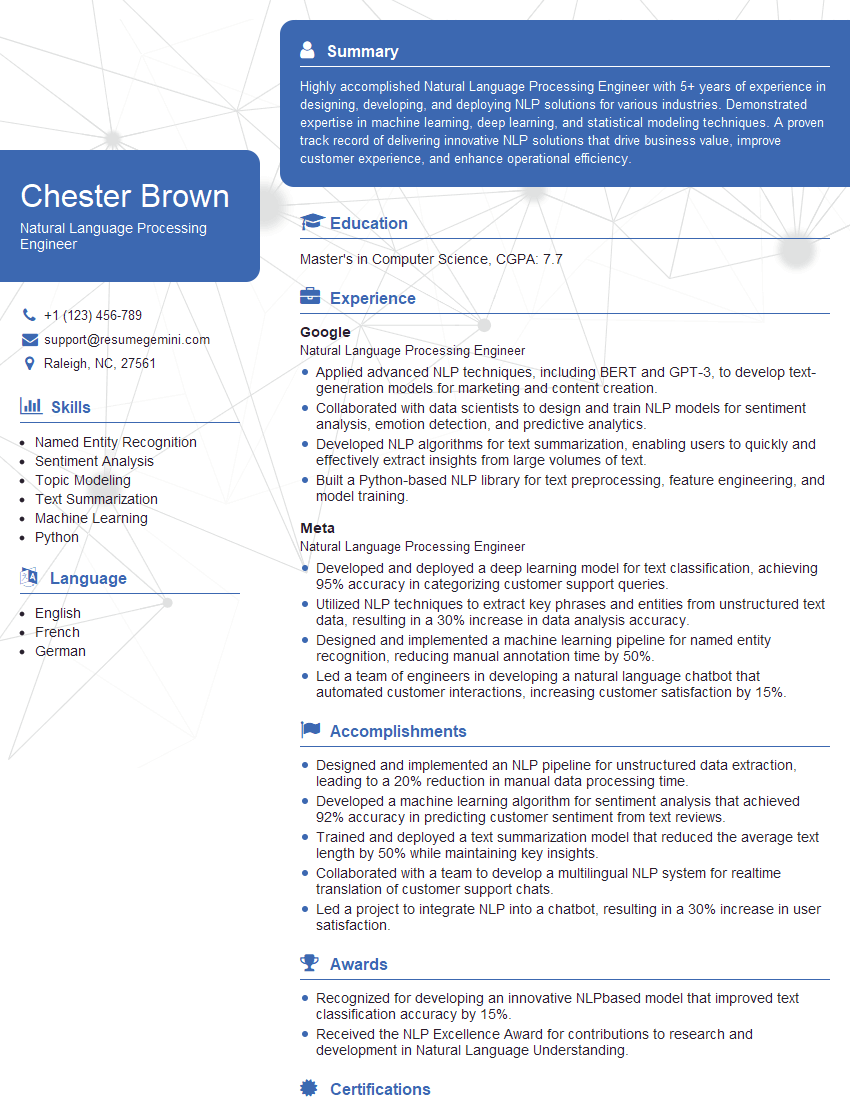
Mastering Stanford CoreNLP significantly enhances your profile for roles in Natural Language Processing, Machine Learning, and Data Science. These skills are highly sought after, opening doors to exciting and impactful careers. To maximize your job prospects, it’s crucial to present your skills effectively through a well-crafted, ATS-friendly resume. We strongly recommend using ResumeGemini to build a professional and impactful resume that highlights your Stanford CoreNLP expertise. ResumeGemini provides examples of resumes tailored to Stanford CoreNLP to help you create a compelling application.
Explore more articles
Users Rating of Our Blogs
Share Your Experience
We value your feedback! Please rate our content and share your thoughts (optional).
What Readers Say About Our Blog
To the interviewgemini.com Webmaster.
Very helpful and content specific questions to help prepare me for my interview!
Thank you
To the interviewgemini.com Webmaster.
This was kind of a unique content I found around the specialized skills. Very helpful questions and good detailed answers.
Very Helpful blog, thank you Interviewgemini team.