Interviews are more than just a Q&A session—they’re a chance to prove your worth. This blog dives into essential Compressor Operation and Maintenance interview questions and expert tips to help you align your answers with what hiring managers are looking for. Start preparing to shine!
Questions Asked in Compressor Operation and Maintenance Interview
Q 1. Explain the difference between centrifugal and reciprocating compressors.
Centrifugal and reciprocating compressors are two fundamentally different types, distinguished primarily by how they achieve compression. Think of it like this: a centrifugal compressor is like a fan, accelerating the gas outwards to increase its pressure; a reciprocating compressor is like a pump, using pistons to repeatedly compress and expel gas.
- Centrifugal Compressors: These use rotating impellers to accelerate the gas, increasing its kinetic energy, which is then converted to pressure energy as the gas slows down in a diffuser. They are generally more suited for high-volume, low-pressure applications, such as in large industrial gas pipelines or HVAC systems. They’re known for their smooth operation and high flow rates but can be less efficient at very high pressure ratios.
- Reciprocating Compressors: These utilize pistons moving back and forth within cylinders to compress the gas. Each piston stroke compresses a fixed volume of gas, making them ideal for high-pressure, low-volume applications, such as in natural gas processing or refrigeration systems. While they can achieve very high pressure ratios, they’re often noisy, require more maintenance, and have a pulsating flow.
In essence, the choice between the two depends on the specific application requirements – the desired pressure, volume flow rate, and overall efficiency targets.
Q 2. Describe the process of compressor lubrication and its importance.
Compressor lubrication is critical for preventing wear and tear, reducing friction, and maintaining efficient operation. The lubricant acts as a cushion between moving parts, minimizing direct metal-to-metal contact, which can lead to overheating and component failure.
The lubrication process typically involves a dedicated oil system that circulates the oil through the compressor, delivering it to bearings, seals, and other critical components. The type of oil used depends on the compressor type, operating conditions (temperature and pressure), and the gas being compressed. Synthetic oils are often preferred for their superior thermal stability and resistance to oxidation.
Regular oil analysis is essential to ensure the oil’s condition remains optimal. Contamination, degradation, or excessive wear can be detected early through analysis, preventing catastrophic failures. Improper lubrication can lead to increased maintenance costs, reduced efficiency, and ultimately, premature compressor failure. Imagine trying to run an engine without oil – the consequences are immediate and severe; the same principle applies to compressors.
Q 3. How do you identify and troubleshoot common compressor malfunctions?
Identifying and troubleshooting compressor malfunctions requires a systematic approach. It often starts with observing the compressor’s performance indicators – pressure, temperature, vibration, and oil condition. Deviations from normal operating parameters are often the first clues.
- High Discharge Temperature: This could indicate insufficient cooling, a faulty valve, or excessive load. Checking the cooling system (e.g., air or water cooling), examining the valves for leaks or obstructions, and reviewing the operating load are crucial steps.
- High Vibration: Excessive vibration can point to an imbalance in the rotating components, bearing wear, or mechanical looseness. Visual inspection, vibration analysis using specialized equipment, and potentially a mechanical alignment check are necessary.
- Low Discharge Pressure: This suggests a leak in the system, a problem with the compressor’s suction, or insufficient capacity. Leak detection using specialized tools, inspection of suction lines and filters, and evaluating the overall system capacity are required.
- Oil Leaks: Oil leaks often signify seal or gasket failure. Careful inspection of seals, gaskets, and fittings is necessary, and replacement might be required.
Troubleshooting involves systematically eliminating potential causes until the root problem is identified. Detailed logs, maintenance records, and possibly consultation with a compressor specialist are often invaluable in this process.
Q 4. What are the safety procedures for working on a compressor system?
Safety is paramount when working on compressor systems. These systems often operate under high pressure and contain hazardous materials, posing significant risks if safety procedures aren’t strictly followed.
- Lockout/Tagout (LOTO): Before any maintenance or repair work, the compressor must be completely isolated from the power source using a LOTO procedure. This prevents accidental startup and ensures the safety of personnel.
- Personal Protective Equipment (PPE): Appropriate PPE, including safety glasses, gloves, hearing protection, and possibly respirators, should be worn at all times. The specific PPE will depend on the task and the potential hazards.
- Gas Detection: In cases where flammable or toxic gases are involved, gas detection equipment should be used to monitor the atmosphere and ensure a safe working environment. Regular checks are vital.
- Confined Space Entry: If working within a confined space (e.g., compressor enclosure), proper confined space entry procedures must be followed, including atmospheric monitoring, ventilation, and rescue protocols.
- Proper Training: All personnel involved in compressor maintenance should receive adequate training on safe work practices and the specific hazards associated with the system.
Failure to adhere to safety procedures can lead to serious injury or fatality. Safety should be prioritized above all else.
Q 5. Explain the significance of compressor discharge temperature.
Compressor discharge temperature is a critical indicator of compressor efficiency and overall health. High discharge temperatures can be a symptom of several issues, significantly impacting operational efficiency and potentially leading to equipment damage.
An excessively high discharge temperature might suggest problems like insufficient cooling, high compression ratio, internal leaks, valve issues, or fouling within the compressor. This temperature directly correlates to the energy consumption of the compressor and the stress on the components. High temperatures can lead to oil degradation, seal damage, and even catastrophic component failure. Monitoring this parameter allows for proactive maintenance and prevents expensive breakdowns.
Conversely, an unusually low discharge temperature might indicate low compressor loading or a malfunction in the control system. It’s essential to always compare the actual discharge temperature to the manufacturer’s recommended operating range. This provides a benchmark against which anomalies can be identified and addressed promptly.
Q 6. How do you perform a compressor oil analysis?
Compressor oil analysis involves taking a sample of the lubricating oil and analyzing its properties in a laboratory to assess its condition and identify potential problems. This is a proactive maintenance technique, allowing for early detection of issues before they lead to significant damage.
The analysis typically includes several parameters:
- Viscosity: Checks the oil’s thickness, which can change due to degradation or contamination.
- Acidity (TAN): Measures the acid content, indicating oxidation and degradation.
- Particle Count: Determines the amount of solid contaminants (wear debris, etc.), indicating potential wear in the compressor.
- Water Content: Indicates the presence of water in the oil, which can lead to corrosion and emulsion formation.
- Spectroscopic Analysis: More advanced analysis techniques, such as infrared spectroscopy, provide a detailed assessment of the oil’s composition.
Regular oil analysis helps identify wear trends, detect potential contamination, and assess the overall health of the compressor. This proactive approach helps to extend the lifespan of the compressor and prevent unexpected downtime.
Q 7. Describe the different types of compressor valves and their functions.
Compressor valves are critical components that regulate the flow of gas during the compression process. Different types of valves cater to various applications and requirements. They’re designed to open and close rapidly and precisely, ensuring efficient compression.
- Reed Valves: Simple, lightweight valves that utilize a thin, flexible metal reed that is pushed open by the gas pressure and closes due to its elasticity. They’re common in smaller, low-pressure reciprocating compressors.
- Plate Valves: These valves consist of a flat metal plate held in place by a spring. Gas pressure pushes the plate open, and the spring closes it. They’re commonly found in reciprocating compressors and offer better durability than reed valves.
- Poppet Valves: Used in larger compressors, these consist of a conical or disc-shaped valve that is lifted by gas pressure and closes due to a spring or gravity. They offer good sealing and high durability but are more complex than reed or plate valves.
The choice of valve type depends on factors like the pressure, gas flow rate, and the compressor’s overall design. The valve’s functionality is crucial for the efficient and reliable operation of the compressor, ensuring proper gas flow and preventing leakage.
Q 8. What are the causes and effects of compressor surging?
Compressor surging is a violent, unstable operating condition characterized by significant pressure and flow fluctuations. Imagine a rollercoaster – that’s what the pressure inside the compressor experiences during a surge. It’s detrimental to the compressor’s health and efficiency.
Causes: Surging primarily occurs when the compressor’s discharge pressure exceeds its capacity to deliver the compressed gas. This imbalance can stem from several factors:
- Sudden reduction in demand: If the downstream system suddenly requires less compressed air, the compressor continues to produce at the same rate, leading to a pressure buildup.
- Valve malfunction: A stuck or malfunctioning discharge valve can prevent the proper release of compressed air, contributing to surging.
- System blockage: A blockage in the discharge piping restricts airflow, causing a pressure buildup and triggering a surge.
- Improper control settings: Incorrectly set pressure controllers or other control devices can create an unstable operating condition, pushing the compressor beyond its safe operating limits.
- Compressor design limitations: Some compressor designs are inherently more prone to surging than others, especially when operating near their minimum flow capacity.
Effects: The consequences of compressor surging can be severe:
- Mechanical damage: The intense pressure fluctuations cause significant stress on the compressor components, potentially leading to damage of bearings, seals, valves, and even the compressor casing.
- Reduced efficiency: Surging dramatically reduces the compressor’s efficiency, wasting energy and increasing operating costs.
- Safety hazards: In severe cases, surging can cause catastrophic failure of the compressor, potentially leading to injury or even death. The loud noise and vibrations associated with surging can also pose safety hazards.
- Production downtime: Surging necessitates immediate shutdown and repair, resulting in production delays and financial losses.
Preventing surging involves careful system design, proper control implementation, and regular maintenance. Imagine a carefully balanced scale; maintaining this balance between supply and demand is crucial to avoid the destructive effects of surging.
Q 9. How do you maintain compressor seals and prevent leaks?
Maintaining compressor seals and preventing leaks is critical for safety, efficiency, and longevity. Seals are the unsung heroes preventing the escape of compressed air and oil, and their failure can lead to significant problems.
Maintenance Strategies:
- Regular Inspection: Frequent visual inspections are essential to detect wear, damage, or leaks. Look for signs of oil weeping, cracks, or excessive wear on the seal surfaces. Think of it as a routine car check-up – vital for preventing major issues down the line.
- Proper Lubrication: Using the correct type and quantity of lubricant is crucial for seal longevity. Insufficient lubrication leads to friction and premature wear, while incorrect lubricants can damage the seal material.
- Controlled Temperature: Extreme temperatures can degrade seal materials. Maintaining the compressor within its operating temperature range will help extend seal lifespan. Think of how extreme heat or cold affects rubber – the same principle applies to compressor seals.
- Preventative Replacement: Plan for seal replacements based on manufacturer recommendations or observed wear and tear. Waiting until a seal fails completely can lead to more extensive damage and downtime.
- Correct Installation: Proper installation of seals is critical to avoid initial leakage. This means using the correct tools and following manufacturer guidelines meticulously.
Leak Detection & Repair: Detecting leaks early is key. Techniques include:
- Visual Inspection: Look for obvious signs of leaks, like oil stains or escaping compressed air.
- Pressure Testing: Pressurize the system and monitor for pressure drops, indicating leaks.
- Leak Detection Fluid: Apply specialized fluid to suspected leak areas to visualize escaping gases.
When repairs are needed, ensure the seals are replaced with OEM-specified parts for optimal performance and compatibility. A small investment in preventative maintenance saves large expenses from costly repairs later.
Q 10. Explain the importance of regular compressor inspections.
Regular compressor inspections are crucial for preventing costly failures, ensuring safe operation, and maximizing efficiency. It’s like scheduling regular check-ups for your health – a small preventative effort can save significant problems down the line.
Importance:
- Early Detection of Issues: Regular inspections allow for early detection of potential problems, such as leaks, wear, or impending failures, allowing for timely repairs before significant damage occurs.
- Preventative Maintenance: Inspections enable the implementation of proactive maintenance, extending the lifespan of the compressor and reducing the likelihood of unexpected downtime.
- Safety Assurance: Regular inspections ensure safe operation of the compressor, mitigating potential hazards such as explosions or leaks.
- Improved Efficiency: Well-maintained compressors operate at peak efficiency, resulting in energy savings and reduced operating costs.
- Compliance: Many industries have safety and maintenance regulations that require regular inspections.
Inspection Checklist: A typical inspection includes:
- Visual Inspection: Check for leaks, damage to components, and signs of wear.
- Vibration Monitoring: Assess vibration levels to detect imbalances or bearing wear. High vibrations can indicate impending failure.
- Temperature Checks: Monitor operating temperatures to ensure they’re within the acceptable range.
- Pressure Readings: Verify pressure readings at various points in the system to identify potential blockages or leaks.
- Lubricant Level Checks: Check oil levels and quality to ensure proper lubrication.
- Air Filter Inspection: Inspect and clean or replace air filters to maintain optimal airflow.
A documented inspection schedule and log are essential for tracking maintenance activities and identifying trends that may indicate underlying problems. Remember, prevention is far more cost-effective than cure when dealing with industrial compressors.
Q 11. What are the different types of compressor controls?
Compressor controls regulate the compressor’s operation to meet varying demands while maintaining efficient and safe operation. They are the brain of the compressor system, adapting to changing needs.
Types of Compressor Controls:
- On/Off Controls: The simplest type, the compressor runs at full capacity when activated and shuts off when demand is met. Think of it as a light switch – either on or off, no in-between.
- Capacity Control: These systems vary the compressor’s output to match demand. This might involve controlling the speed of the compressor or unloading some cylinders (in reciprocating compressors) or adjusting inlet guide vanes (in centrifugal compressors).
- Pressure Control: These maintain a constant discharge pressure. If pressure drops, the compressor output increases, and vice versa. This ensures a stable supply of compressed air.
- Load/Unload Control: In reciprocating compressors, this involves selectively engaging and disengaging cylinders. As demand increases, more cylinders are engaged, and vice versa. This offers a stepwise capacity adjustment.
- Variable Speed Drives (VSD): VSDs allow for continuous speed adjustment, providing precise control of the compressor’s output and maximizing efficiency across the entire operating range.
- Microprocessor-Based Controls: Modern compressors often employ advanced microprocessor-based controls. These systems offer sophisticated control algorithms, remote monitoring, and data logging capabilities, providing optimized performance and improved diagnostics.
The choice of control system depends on factors like compressor type, application requirements, and budget. For example, a large industrial application might utilize a VSD for precise control and energy savings, while a smaller application might use simpler on/off controls.
Q 12. How do you troubleshoot a compressor that is not reaching its rated capacity?
Troubleshooting a compressor that’s not reaching its rated capacity requires a systematic approach. It’s like diagnosing a car that’s not running at its best – you need to systematically eliminate potential causes.
Troubleshooting Steps:
- Check Inlet Conditions: Ensure adequate intake air pressure and temperature. Restricted intake airflow (due to a clogged filter, for instance) significantly reduces capacity.
- Inspect Discharge System: A blocked or restricted discharge line will limit the compressor’s ability to deliver air. Check for blockages or excessive pressure drop.
- Examine Valves: Ensure all valves (suction, discharge, safety) are functioning correctly. Sticking or leaking valves can significantly impact capacity.
- Verify Lubrication: Insufficient or contaminated lubrication can lead to reduced efficiency and capacity. Check oil levels and condition.
- Inspect Seals: Leaking seals will reduce the system’s pressure and capacity. Look for signs of leaks.
- Check Motor Performance: Verify the motor is operating at its rated power and speed. A faulty motor or insufficient power supply will limit capacity.
- Review Control Settings: Check that the control system is correctly configured and that there are no faulty settings that might be limiting output.
- Assess Intercoolers (if applicable): In multi-stage compressors, intercoolers cool the compressed air between stages. If intercoolers malfunction, the entire system’s capacity is impacted.
- Analyze System Pressure: Monitor pressure readings throughout the system to identify points of pressure loss.
Using a combination of visual inspection, pressure measurements, and performance data analysis, the root cause of the reduced capacity can be identified. Remember to consult the compressor’s operational and maintenance manuals for detailed troubleshooting information.
Q 13. Explain the principles of compressor capacity control.
Compressor capacity control allows you to adjust the output of the compressor to match the demand, maximizing efficiency and minimizing energy waste. Imagine a faucet – you control the flow of water, and the same principle applies to compressor capacity control.
Principles:
- Variable Speed Drives (VSD): VSDs adjust the motor’s speed, directly controlling the compressor’s output. This provides a seamless, efficient adjustment across the entire capacity range. They are like a smooth, continuous adjustment of the water faucet.
- Reciprocating Compressor Unloading: In reciprocating compressors, cylinders can be unloaded (deactivated) to reduce the compressor’s output. This provides stepwise capacity adjustment. Think of it like turning off individual taps to regulate the overall water flow.
- Centrifugal Compressor Inlet Guide Vanes: Centrifugal compressors use inlet guide vanes to control the flow of air into the impeller. Adjusting these vanes alters the compressor’s output. This offers a continuous adjustment, similar to a variable speed drive.
- Bypass Valves: Bypass valves direct a portion of the compressed air back to the suction side, reducing the effective output of the compressor. This is a simpler approach, often used in smaller systems.
The choice of capacity control method depends on the specific compressor type and application requirements. VSDs are increasingly popular due to their superior efficiency and precise control, but other methods remain relevant in certain circumstances. The goal is always to match the compressor’s output to the actual demand, minimizing waste and maximizing operational efficiency.
Q 14. Describe the process of compressor shutdown and start-up procedures.
Safe and proper shutdown and start-up procedures are essential for compressor longevity and safety. These procedures are like pre-flight checks for an airplane – vital before operation.
Shutdown Procedure:
- Reduce Load: Gradually reduce the load on the compressor by lowering the demand from the downstream system.
- Allow Cool-Down: Allow the compressor to cool down to prevent thermal stress on components, especially crucial after prolonged operation.
- Isolate the Compressor: Isolate the compressor from the system by closing appropriate valves.
- Turn off the Power: Turn off the power supply to the compressor motor.
- Check for Leaks: Inspect for any leaks after the compressor has been shut down.
- Document Shutdown: Record the shutdown in a logbook, noting any observations.
Start-up Procedure:
- Inspect Compressor: Visually inspect the compressor for any damage or obstructions.
- Check Lubricant Levels: Ensure the lubricant level is adequate and within specifications.
- Check for Leaks: Inspect for any leaks prior to initiating the start-up sequence.
- Open Valves: Open the appropriate valves to allow for airflow.
- Start the Motor: Start the compressor motor, observing any unusual sounds or vibrations.
- Monitor Operation: Monitor the compressor’s parameters (pressure, temperature, current) during the initial operating period to ensure stable performance.
- Document Start-up: Record the start-up in a logbook, noting any observations.
Following these procedures diligently helps ensure the safe and efficient operation of the compressor and prevents premature wear or unexpected failures. Always refer to the manufacturer’s specific instructions for your compressor model.
Q 15. How do you interpret compressor performance data?
Interpreting compressor performance data involves analyzing key parameters to assess its health and efficiency. We look at things like discharge pressure, suction pressure, amperage draw, oil temperature, and capacity. These readings, often monitored via a control system or gauges, are compared against the manufacturer’s specifications and historical data for the specific compressor model.
For example, a consistently high discharge pressure might indicate a restriction downstream, such as a clogged filter or a problem with the condenser. Conversely, low suction pressure could signal a refrigerant leak or insufficient refrigerant charge. High amperage draw, beyond normal operating range, often points to mechanical issues like worn bearings or piston rings. Analyzing trends over time is crucial – a gradual increase in amperage, for instance, could be an early warning sign of impending failure, allowing for preventative maintenance.
We use this data to create performance curves and compare them against ideal operating conditions. Deviations allow for targeted troubleshooting and optimization of the system. Specialized software can also help automate data analysis and alert us to potential problems.
Career Expert Tips:
- Ace those interviews! Prepare effectively by reviewing the Top 50 Most Common Interview Questions on ResumeGemini.
- Navigate your job search with confidence! Explore a wide range of Career Tips on ResumeGemini. Learn about common challenges and recommendations to overcome them.
- Craft the perfect resume! Master the Art of Resume Writing with ResumeGemini’s guide. Showcase your unique qualifications and achievements effectively.
- Don’t miss out on holiday savings! Build your dream resume with ResumeGemini’s ATS optimized templates.
Q 16. What are the common causes of compressor vibration?
Compressor vibration stems from several sources, often interacting in complex ways. Unbalanced rotating components like impellers or pistons are primary culprits. Worn bearings, misalignment of compressor shafts or motor mounts, and internal mechanical damage (such as a cracked piston or bent connecting rod) also lead to increased vibration. Fluid dynamic issues within the compressor, such as pulsations or cavitation, can also induce vibrations.
External factors contribute as well. Improper installation, loose mountings, or resonance (where the compressor’s natural frequency matches an external vibration frequency) can amplify existing vibrations significantly. For instance, a compressor mounted on a weak or improperly designed base might resonate significantly, causing much greater vibrations than expected. Similarly, a poorly maintained piping system can introduce additional vibration.
Diagnosing the root cause requires systematic inspection, including visual checks for misalignment, measurements of vibration amplitude and frequency using vibration sensors, and analysis of the overall system. Often, a combination of factors is responsible, and a thorough investigation is necessary.
Q 17. Explain the process of compressor overhaul.
A compressor overhaul is a major maintenance activity involving a complete disassembly, inspection, cleaning, repair, and reassembly of the compressor. It’s typically undertaken when less invasive maintenance is insufficient to restore performance or when significant wear is detected during routine inspections.
The process typically begins with a thorough safety check and isolation of the compressor from the system. Next, the compressor is disassembled, taking care to meticulously document the process, using specialized tools and techniques to avoid damage. Each component is then thoroughly inspected for wear, damage, and defects. Worn or damaged parts are replaced with OEM-approved components.
After cleaning and inspection, the compressor is reassembled following precise specifications. A final testing phase ensures proper functionality before reintegration into the refrigeration system. This involves checking for leaks, proper oil levels, and correct performance parameters. A thorough log of all work completed and parts replaced is maintained for future reference.
Q 18. What safety precautions are necessary when handling refrigerants?
Handling refrigerants demands strict adherence to safety protocols due to their potential health hazards and environmental impact. Many refrigerants are flammable, toxic, or both, requiring specialized handling equipment and training. Proper ventilation is essential to prevent the buildup of harmful gases, and personal protective equipment (PPE) such as safety glasses, gloves, and respirators should always be used.
Before working with any refrigerant system, it’s vital to identify the specific refrigerant involved and understand its properties. Always follow the manufacturer’s safety guidelines and relevant regulations (e.g., EPA regulations in the US). Proper recovery and recycling techniques are crucial. Refrigerant should never be released into the atmosphere; approved recovery and recycling equipment is necessary to ensure responsible handling. Leak detection and repair are performed using specialized leak detectors and leak-stopping compounds. Training and certification in refrigerant handling are essential for all personnel involved.
Q 19. Describe different compressor types (screw, scroll, etc.) and their applications.
Several compressor types cater to different applications based on factors like capacity, pressure, and efficiency.
- Screw compressors: These use two helical rotors to compress refrigerant. They’re known for high capacity and relatively low pulsation, making them ideal for large-scale refrigeration and air conditioning systems such as those in industrial settings or large commercial buildings.
- Scroll compressors: Employ two spiral-shaped plates to trap and compress refrigerant. They are quiet and efficient, commonly used in residential and light commercial air conditioning and refrigeration systems.
- Reciprocating compressors: Use pistons to compress the refrigerant. They are suitable for a wide range of applications, but can be noisier than other types and typically less efficient at larger capacities. They are common in smaller systems.
- Centrifugal compressors: Use rotating impellers to accelerate the refrigerant. These compressors are highly efficient for very large-scale applications, such as industrial chillers. They generally operate at higher speeds and higher capacities than other types.
The choice of compressor type depends heavily on the specific application’s requirements and cost considerations. Each type has its own strengths and weaknesses in terms of efficiency, noise levels, maintenance needs, and initial cost.
Q 20. How do you diagnose a compressor with excessive noise?
Excessive compressor noise can stem from various issues. The first step is to identify the type of noise – is it a high-pitched squeal, a low-frequency rumble, or a rattling sound? This helps to narrow down the possible causes.
High-pitched squealing often indicates problems with belts, bearings, or lubrication. A low-frequency rumble might suggest misalignment, loose mountings, or internal component wear. Rattling noises could point to loose parts, worn internal components, or fluid turbulence. A systematic approach using diagnostic tools is crucial. Vibration analysis, using vibration sensors and analyzers, precisely determines the frequency and amplitude of vibrations. These measurements help isolate the source of the noise.
Careful visual inspection, listening with a stethoscope to pinpoint the sound source, and checking oil levels and quality are also valuable steps. Sometimes, replacing worn components, tightening loose bolts, or addressing misalignment resolves excessive noise issues.
Q 21. How does compressor efficiency relate to energy consumption?
Compressor efficiency directly impacts energy consumption. A more efficient compressor requires less energy to achieve the same cooling or heating capacity. Efficiency is often expressed as the ratio of the useful work done (cooling or heating) to the energy input (electricity). Higher efficiency means lower energy consumption and reduced operating costs.
For example, a compressor with a higher COP (Coefficient of Performance) requires less electricity to produce the same amount of cooling. Factors influencing efficiency include the type of compressor, operating conditions (ambient temperature, load), and proper maintenance. Regular maintenance, ensuring optimal refrigerant charge and proper lubrication, significantly contributes to maintaining higher efficiency and lowering energy consumption. Regular performance monitoring and timely maintenance interventions are crucial for optimizing energy use and prolonging the life of the compressor.
Q 22. What are the different methods for compressor capacity control?
Compressor capacity control involves adjusting the amount of air or gas delivered by the compressor to match the demand. This prevents wasting energy and ensures optimal system performance. Several methods achieve this:
Suction Throttling: This involves partially closing the suction valve, reducing the amount of gas entering the compressor. It’s simple but less efficient at lower capacities as it increases pressure drop and can lead to higher energy consumption at part load. Imagine partially blocking the intake of a vacuum cleaner – it reduces suction power.
Discharge Throttling: Similar to suction throttling but involves partially closing the discharge valve. This is generally less efficient and can put additional stress on the compressor.
Variable Speed Drive (VSD): A VSD adjusts the motor speed, thus controlling the compressor’s rotational speed and consequently, its output. This is the most energy-efficient method for varying capacity, allowing for precise control and significant energy savings. Think of a car’s accelerator – smoothly controlling speed rather than on/off.
Multiple Compressor Units: Utilizing multiple smaller compressors that can be switched on or off based on demand. This offers flexibility and allows for a staged approach to capacity control. Like having several smaller pumps instead of one large one.
Reciprocating Compressor’s Unloaders: In reciprocating compressors, unloaders bypass some of the cylinders, reducing the effective compression capacity. This mechanism allows for discrete capacity steps.
Q 23. Describe the function of a compressor’s safety relief valve.
A compressor’s safety relief valve (SRV) is a critical safety device designed to protect the system from overpressure. If the compressor’s discharge pressure exceeds a predetermined set point, the SRV opens, releasing compressed gas to the atmosphere or a safe discharge location. This prevents catastrophic failures such as pipe ruptures or equipment damage. Think of it as a pressure safety valve in a pressure cooker – preventing dangerous explosions.
Regular inspection and testing of the SRV are crucial to ensure its functionality. A malfunctioning SRV can compromise the system’s safety. Proper maintenance includes verifying its opening pressure and ensuring free movement. Often these are tested using compressed air to confirm the opening pressure and seal integrity upon closing.
Q 24. How do you maintain the integrity of compressor piping and connections?
Maintaining the integrity of compressor piping and connections is paramount for safety and operational efficiency. It involves a multi-pronged approach:
Regular Inspection: Visual inspections should be conducted regularly to check for signs of corrosion, leaks, cracks, or damage. Pay close attention to welds, flanges, and connections.
Pressure Testing: Periodic pressure testing is essential to identify leaks and ensure the system can withstand operating pressures. Hydrostatic testing is commonly used, filling the system with water under pressure.
Proper Installation: Ensure all connections are properly tightened to the manufacturer’s specifications, using the correct gaskets and materials. Improper installation is a leading cause of leaks and failures.
Corrosion Protection: In corrosive environments, protective coatings or specialized materials should be used to prevent corrosion of the piping. Regular cleaning to remove contaminants is also crucial.
Vibration Monitoring: Excessive vibrations can weaken connections and piping over time. Monitoring vibration levels helps to identify potential problems early on.
Q 25. Explain the role of pressure switches and pressure gauges in compressor operation.
Pressure switches and pressure gauges are essential components for compressor operation, providing monitoring and control functionality.
Pressure Switches: These devices automatically control the compressor’s start and stop based on pressure levels. A low-pressure switch initiates the compressor when the pressure drops below a set point, while a high-pressure switch shuts it down when the pressure reaches the upper limit. They provide automated control and prevent overpressure.
Pressure Gauges: Pressure gauges display the current pressure within the compressor system. They provide real-time monitoring of operating parameters and allow operators to identify potential problems early, like a gradual pressure drop indicating a leak.
Together, these components ensure safe and efficient compressor operation. Regular calibration of the pressure switches and gauges is important to ensure accuracy.
Q 26. What are the signs of compressor wear and tear?
Signs of compressor wear and tear vary depending on the compressor type, but some common indicators include:
Increased Vibration: Excessive vibration is often an early sign of bearing wear, misalignment, or internal component failure.
Higher Operating Temperatures: Increased temperatures can indicate reduced efficiency, lubrication issues, or impending component failure. Regular temperature monitoring is crucial.
Increased Oil Consumption: Higher than normal oil consumption often points to worn piston rings, seals, or internal leaks in reciprocating compressors. For centrifugal compressors, it could point to seal wear.
Reduced Capacity: A decrease in the compressor’s output despite adequate speed and power indicates internal wear or valve issues.
Unusual Noises: Unusual noises such as knocking, squealing, or rattling often indicate mechanical problems requiring immediate attention.
Leaks: Air or gas leaks indicate a problem with seals, valves or piping.
Regular maintenance and inspections can help detect these issues early and prevent major failures.
Q 27. How do you calculate compressor power consumption?
Calculating compressor power consumption depends on the type of compressor and the specific operating conditions. A common approach uses the following formula:
Power (kW) = (Flow Rate (m³/s) * Pressure Rise (Pa)) / (Efficiency * 1000)
Where:
Flow Rate: The volume of gas compressed per unit of time.
Pressure Rise: The difference between the discharge and suction pressures.
Efficiency: The compressor’s isentropic efficiency (a measure of its effectiveness in converting energy to compressed gas). This is often obtained from the compressor’s performance curves or manufacturer’s data.
This is a simplified calculation. For more accurate results, specific compressor characteristics, including motor efficiency and system losses, should be considered. In practice, manufacturers often provide detailed performance curves and data that should be utilized.
Q 28. What are the environmental considerations related to compressor operation?
Environmental considerations related to compressor operation primarily revolve around:
Greenhouse Gas Emissions: Compressors consume energy, and the electricity used to power them often comes from sources that produce greenhouse gases. Choosing energy-efficient compressors and optimizing operating parameters can mitigate this impact. Using renewable energy sources to power the compressor is also a key consideration.
Noise Pollution: Compressors can generate significant noise, which can be disruptive to the environment and nearby communities. Noise reduction measures, such as enclosures or acoustic dampening, are often implemented. Properly maintaining the compressor can help reduce unnecessary noise.
Refrigerant Emissions: Some compressors use refrigerants that can contribute to ozone depletion or global warming. Selecting environmentally friendly refrigerants and ensuring proper leak detection and repair are crucial.
Air and Water Pollution: Depending on the gas compressed and any potential leaks, there could be associated air or water pollution. Careful maintenance and leak detection prevent these issues. Furthermore, proper disposal of any contaminated fluids is crucial.
Choosing energy-efficient equipment, implementing best practices, and adhering to environmental regulations are crucial for minimizing the environmental impact of compressor operation.
Key Topics to Learn for Compressor Operation and Maintenance Interview
- Compressor Types and Principles: Understanding reciprocating, centrifugal, and screw compressors; their operating principles, and suitability for different applications. This includes knowledge of thermodynamic cycles and pressure-volume relationships.
- Safety Procedures and Regulations: Familiarity with lockout/tagout procedures, handling of refrigerants and hazardous materials, and adherence to relevant safety standards (e.g., OSHA). Practical application involves demonstrating understanding of risk assessment and mitigation strategies.
- Troubleshooting and Diagnostics: Identifying common compressor malfunctions (e.g., low capacity, high discharge temperature, excessive vibration); utilizing diagnostic tools (pressure gauges, temperature sensors, vibration analyzers); and applying systematic troubleshooting methodologies.
- Preventive Maintenance: Understanding scheduled maintenance tasks (oil changes, filter replacements, lubrication); developing and implementing effective preventive maintenance programs; and utilizing predictive maintenance techniques (vibration analysis, oil analysis) to anticipate potential problems.
- Compressor Controls and Instrumentation: Knowledge of PLC (Programmable Logic Controller) systems, control valves, pressure and temperature sensors, and other instrumentation used in compressor systems; understanding their function and how to interpret data from these systems.
- Energy Efficiency and Optimization: Understanding methods to improve compressor efficiency, such as optimizing operating parameters, implementing energy-saving technologies, and conducting energy audits. Practical application involves calculating and analyzing energy consumption data.
- Repair and Overhaul Procedures: Familiarity with common compressor repairs, including component replacement, seal replacement, and valve adjustments; understanding overhaul procedures and best practices for restoring compressor functionality.
Next Steps
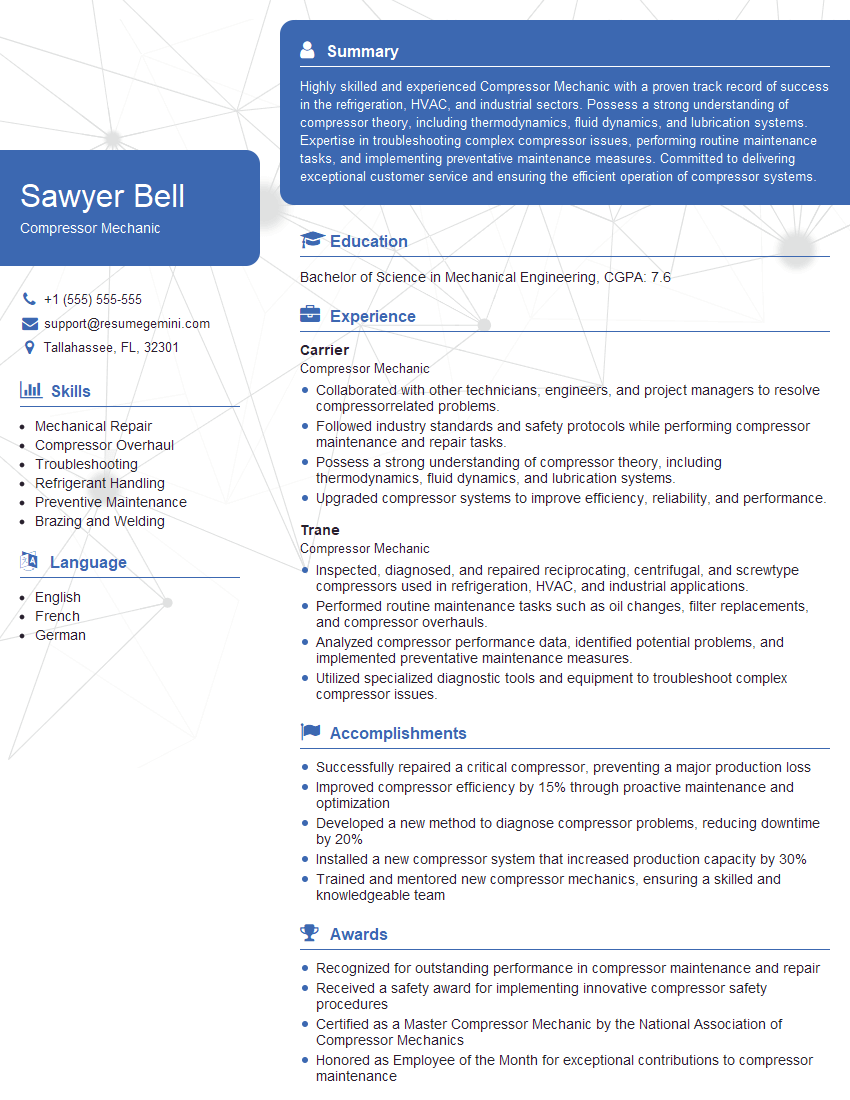
Mastering Compressor Operation and Maintenance opens doors to rewarding careers with excellent growth potential in various industries. To maximize your job prospects, creating a strong, ATS-friendly resume is crucial. ResumeGemini is a trusted resource to help you build a professional and effective resume that highlights your skills and experience. ResumeGemini provides examples of resumes tailored specifically to Compressor Operation and Maintenance positions to help you present your qualifications in the best possible light. Take the next step in your career journey today!


Explore more articles
Users Rating of Our Blogs
Share Your Experience
We value your feedback! Please rate our content and share your thoughts (optional).
What Readers Say About Our Blog
To the interviewgemini.com Webmaster.
Very helpful and content specific questions to help prepare me for my interview!
Thank you
To the interviewgemini.com Webmaster.
This was kind of a unique content I found around the specialized skills. Very helpful questions and good detailed answers.
Very Helpful blog, thank you Interviewgemini team.