Preparation is the key to success in any interview. In this post, we’ll explore crucial Custom Drapery Fabrication interview questions and equip you with strategies to craft impactful answers. Whether you’re a beginner or a pro, these tips will elevate your preparation.
Questions Asked in Custom Drapery Fabrication Interview
Q 1. Explain the process of measuring for custom draperies.
Accurate measuring is paramount in custom drapery fabrication. It’s not just about getting the width and height; it’s about understanding the window’s architecture and desired drapery fullness. We start by measuring the window’s width at several points, noting any inconsistencies. Then, we measure the height from the desired mounting point (e.g., the ceiling, the window casing) to the floor, again at multiple points. We also note the window’s depth (how far it recesses into the wall) and any obstructions like window molding or unusual angles. Crucially, we discuss with the client their desired drapery style – whether it should be floor-length, puddle-length (where the fabric pools on the floor), or something else – to determine the exact final length. This detailed approach minimizes fabric waste and ensures a perfect fit. For instance, a bay window requires careful measurement of each segment, plus the overall width. We always document measurements with clear diagrams and client approval before proceeding.
Q 2. Describe different drapery heading styles and their applications.
Drapery heading styles dictate the top treatment and significantly influence the overall look. Some popular styles include:
- Pinch Pleat: Elegant and classic, creating evenly spaced, pinched folds. Best for formal settings and heavier fabrics.
- Goblet Pleat: Similar to pinch pleat but with a more dramatic, rounded fold at the top. Suitable for luxurious fabrics and upscale spaces.
- French Pleat: Features graceful, cascading folds that are meticulously stitched. Adds a sense of sophistication and works well with various fabrics.
- Box Pleat: Neat, squared folds that offer a contemporary or traditional feel depending on the fabric choice and overall design.
- Ripplefold: Creates a soft, continuous wave across the top. Modern and sleek, suitable for lightweight to medium-weight fabrics.
- Eyelet: Simple and contemporary, featuring grommets (metal rings) through which the rod passes. Works best with medium to heavy weight fabrics.
The choice depends on the client’s style preference, the fabric weight, and the window’s architectural style. A modern interior might favor ripplefold or eyelet headings, while a traditional setting could benefit from pinch pleats or French pleats.
Q 3. What fabrics are best suited for lining draperies?
Lining serves multiple crucial purposes in drapery fabrication: it improves the drape of the fabric, adds opacity for privacy, and protects the face fabric from sun damage and fading. The best lining fabric depends on the face fabric and desired outcome.
- Linen: A natural fiber, offering a soft drape but can be prone to wrinkles. Good for heavier face fabrics.
- Cotton: Affordable, readily available, breathes well, offering some wrinkle resistance. Suitable for medium-weight fabrics.
- Silk: Luxurious, drapes beautifully, adds a touch of elegance. However, it’s expensive and requires careful handling. Best for high-end projects.
- Polyester: Durable, wrinkle-resistant, and relatively inexpensive. A good option for various face fabrics and demanding applications.
- Blackout Lining: Specialised lining that completely blocks light. Crucial for bedrooms or media rooms.
Choosing a lining that complements the drape and weight of the face fabric is critical for achieving the desired aesthetic and functionality.
Q 4. How do you calculate fabric yardage for pleated draperies?
Calculating fabric yardage for pleated draperies is complex and depends on several factors: the finished width, the pleat style, the fullness factor (how much extra fabric is used to create the pleats), and the length. Let’s illustrate with an example:
Scenario: We need pinch-pleat draperies with a finished width of 100 inches and a fullness factor of 2.5 (meaning the fabric used will be 2.5 times the finished width).
Calculation:
- Determine the total fabric width: 100 inches (finished width) x 2.5 (fullness factor) = 250 inches
- Convert inches to yards: 250 inches / 36 inches/yard ≈ 6.94 yards
- Account for length: Add the desired length of the drapery (e.g., 96 inches or 8 feet), considering the hem allowance and heading allowance at the top. This would be added to the 6.94 yards. Let’s say this added length results in approximately 10 yards total.
The final yardage depends on the design, with different pleat types requiring different fullness factors and thus, different yardage amounts.
Professional software can assist in these calculations, taking into account various pleat styles and material shrinkage. It is crucial to account for the width and length of each panel in addition to material waste.
Q 5. Explain the difference between interlining and lining.
Both interlining and lining enhance draperies, but they serve different purposes. Lining is the innermost layer, directly attached to the face fabric. Its primary roles are to improve drape, add opacity, and protect the face fabric. Interlining, on the other hand, is a layer inserted between the lining and the face fabric. It provides body, structure, and insulation. Think of it as the ‘skeleton’ that shapes and supports the drapes.
For example, interlining can add weight to a lightweight fabric, creating fuller, more luxurious pleats, or provide insulation for better energy efficiency. A lining alone might improve drape, but an interlining layer would give the drapery more body and a more refined look. In essence, lining refines the look and feel, while interlining adds structure and definition.
Q 6. What are common drapery hardware options and their installation methods?
Drapery hardware choices significantly impact functionality and aesthetics. Options include:
- Rods: Available in various materials (wood, metal, etc.), diameters, and finishes. Installation involves attaching brackets to the wall or ceiling, then inserting the rod.
- Tracks: Offer flexibility for complex window shapes like bay windows. Installation requires attaching the track to the ceiling or wall using appropriate brackets and ensuring smooth operation.
- Cords and Carriers: Used with traverse rods or tracks, allowing for smooth opening and closing. Proper installation involves connecting the cords to the carriers and ensuring a balanced operation. This will require the careful measurement and cutting of cordage, depending on the length of the drapery panel.
- Rings and Clips: Used to hang drapes on rods. Installation involves attaching rings or clips to the heading of the drapery panel.
The choice depends on the drapery style, weight of the fabric, and the client’s preferences. Installation requires precision and attention to detail to ensure smooth operation and a professional finish. Incorrect installation can lead to operational issues or even damage to the drapery.
Q 7. Describe your experience with different sewing techniques used in drapery fabrication.
My experience encompasses a wide range of sewing techniques crucial for high-quality drapery fabrication. These include:
- Pleat Stitching: Precise and consistent stitching is paramount for creating uniform and aesthetically pleasing pleats. This requires mastery of different stitch lengths and tensions, depending on the fabric and pleat style. I’m proficient in both machine and hand-stitching techniques, selecting the appropriate method based on the complexity and scale of the project.
- Seam Finishing: Proper seam finishing is essential for durability and a professional appearance. I regularly use techniques such as serging, pinking, and French seams to prevent fraying and enhance the longevity of the draperies.
- Gathering and Shirring: These techniques are frequently used for creating soft, flowing folds. I’m adept at controlling the gathering density to achieve the desired fullness and drape. This technique varies in complexity based on fabric selection.
- Heading Construction: The accuracy of the heading construction directly impacts the overall look of the drapes. I have extensive experience in various heading styles (as described earlier) and understand how fabric manipulation affects the final aesthetic.
- Hand-sewing techniques: I’m skilled in the finer hand-sewing techniques required for more intricate details or embellishments, such as attaching decorative trims or delicate beading.
Combining these techniques, I can create bespoke draperies tailored to the client’s needs and design vision.
Q 8. How do you handle difficult fabric weights or textures?
Handling difficult fabric weights and textures requires a nuanced approach. Heavier fabrics, like velvet or brocade, demand stronger hardware and more robust sewing techniques. We might use reinforced seams, heavier-duty lining, and specialized stitching to prevent tearing or sagging. Conversely, sheer fabrics necessitate careful handling to avoid snags or tears. This involves using fine needles, appropriate tension settings on sewing machines, and often a specialized interlining to add body and drape without compromising the delicate nature of the material.
For example, when working with a heavy damask, we’d use a walking foot on our industrial sewing machine to ensure even feed of both the fabric and lining, preventing puckering. With silk, we’d meticulously pre-wash and press the fabric to remove any potential wrinkles before cutting and sewing. Each fabric presents a unique challenge, and our team’s experience allows us to adapt our techniques for optimal results.
Q 9. How do you ensure precise pattern matching on draperies?
Precise pattern matching is crucial for a polished, professional look. We achieve this through meticulous planning and execution. Before cutting, we carefully lay out the fabric, ensuring the pattern repeats seamlessly across panels. This often involves rotating and mirroring pattern pieces to maximize fabric usage and maintain continuity. We mark the pattern repeat on the fabric with tailor’s chalk and double-check measurements before cutting. This is particularly important for larger window treatments where mismatched patterns can be glaringly obvious.
For instance, with a large, bold floral pattern, we might create a full-scale mock-up to confirm the pattern flow before cutting the final pieces. For more intricate patterns, we may use a specialized software to digitally map out the layout, minimizing waste and maximizing matching accuracy. A final quality check is always done before installation to ensure perfect alignment.
Q 10. How do you deal with unexpected issues during installation?
Unexpected issues during installation are a reality. We’re prepared to handle them efficiently and effectively. This might involve adjusting hardware, making minor alterations to the drapery panels, or even working with the client to find an alternative solution. Communication is key. We always keep the client informed of any unforeseen problems and collaborate to find the best resolution.
For example, if a wall is uneven, we may need to adjust the track installation or add support brackets to ensure the draperies hang properly. If the window dimensions are slightly different from the initial measurements, we might use concealed seam adjustments to perfectly fit the window. Our experience and resourcefulness allow us to resolve these issues quickly and minimize disruption to the client.
Q 11. Describe your experience with different types of drapery tracks and rods.
My experience encompasses a wide range of drapery tracks and rods, from simple tension rods to sophisticated motorized systems. I’m familiar with various materials including wood, metal, and plastic, as well as different styles and operating mechanisms, such as traverse rods, stationary rods, and ceiling-mounted tracks. Understanding the capabilities and limitations of each type is essential for recommending the right solution for a client’s specific needs and budget.
For instance, traverse rods are ideal for large windows where the draperies need to be opened and closed easily. Motorized tracks offer convenience and are particularly suitable for high windows or those difficult to reach. We carefully consider factors like weight capacity, style, and ease of operation when choosing the appropriate hardware.
Q 12. How do you troubleshoot common drapery installation problems?
Troubleshooting drapery installation problems often involves systematic investigation. Common issues include uneven hanging, gaps between panels, or malfunctioning hardware. We systematically check each element, starting with the hardware installation. Is the track level? Are the brackets securely fastened? Then we examine the drapery panels themselves—are they properly sewn and weighted? Do they need further adjustments? Finally, we assess the wall or window conditions to rule out any structural issues influencing the drape.
For example, if panels are uneven, we might check the weight distribution, adding weights or adjusting the pleat formation. If there are gaps, we’d check the fullness calculation and the spacing of the hardware. Our diagnostic process is methodical, allowing us to pinpoint the problem and implement a prompt, effective solution.
Q 13. Explain the importance of quality control in drapery fabrication.
Quality control is paramount in drapery fabrication. It ensures the finished product meets the highest standards of craftsmanship and client expectations. Our quality control process starts with fabric selection—ensuring high-quality materials and checking for flaws. It extends through each stage of production: cutting, sewing, finishing, and finally, a thorough inspection before installation. This ensures consistency, durability, and an exceptional final product. Any deviations from our standards are immediately addressed.
We use checklists and detailed documentation at every stage to maintain traceability and accountability. Regular calibration of our sewing machines and ongoing staff training contribute to our unwavering commitment to quality. The reputation of our business hinges on the excellence of our work, and quality control is the cornerstone of that reputation.
Q 14. How do you maintain consistent quality across multiple projects?
Maintaining consistent quality across multiple projects requires a structured approach. This begins with standardized processes and detailed work instructions for every step of the fabrication process. We also utilize regularly scheduled quality control checks and team training to ensure everyone adheres to the same high standards. Our team is well-versed in using the same tools and techniques, which minimizes variation. Regular performance reviews and feedback loops further refine our processes and improve overall quality.
We also have a comprehensive system for documenting our successes and challenges, allowing us to learn from past projects and continuously improve our methods. This commitment to consistent quality not only satisfies our clients but also builds trust and strengthens our brand.
Q 15. What safety precautions do you take during drapery installation?
Safety is paramount during drapery installation. Before I even begin, I conduct a thorough site survey to identify potential hazards like unstable ladders, electrical wiring, or fragile surfaces. I always use appropriate safety equipment, including a sturdy ladder with a weight capacity exceeding my own and the weight of the materials, a safety harness if working at significant heights, and work gloves to protect my hands. I also ensure the work area is clear of obstructions to prevent tripping hazards. I follow all relevant OSHA guidelines and company safety protocols. For example, if installing heavy draperies, I’ll have a helper assist to prevent strain or accidents. If working with sharp tools like shears, I take extra care to keep them pointed away from myself and others, ensuring they’re handled with precision and stored safely when not in use. Communication is key; I always let the homeowner know my plans and keep them informed of my progress to ensure their safety and peace of mind.
Career Expert Tips:
- Ace those interviews! Prepare effectively by reviewing the Top 50 Most Common Interview Questions on ResumeGemini.
- Navigate your job search with confidence! Explore a wide range of Career Tips on ResumeGemini. Learn about common challenges and recommendations to overcome them.
- Craft the perfect resume! Master the Art of Resume Writing with ResumeGemini’s guide. Showcase your unique qualifications and achievements effectively.
- Don’t miss out on holiday savings! Build your dream resume with ResumeGemini’s ATS optimized templates.
Q 16. How do you handle customer complaints or revisions?
Handling customer complaints or revisions is a crucial part of the job and an opportunity to build trust. I begin by actively listening to their concerns without interruption, ensuring I completely understand their perspective. I then reiterate their points to confirm understanding and avoid miscommunications. Depending on the issue, I may offer various solutions. If it’s a simple adjustment like a minor alteration in length, I may be able to make the correction on-site immediately. If it’s a more significant revision, like a change in pleat style, I explain the process, any potential cost implications, and the estimated timeframe for completion. Transparency is vital here. I always provide written confirmation of the agreed-upon changes and a revised timeline. I strive to exceed customer expectations by going the extra mile and finding creative solutions to ensure their complete satisfaction. For instance, I once had a client unhappy with the colour match of their lining fabric. Instead of simply replacing the panels, I worked with a textile supplier to find a complementary fabric that would perfectly blend with their existing decor. This showed my commitment to exceeding their initial expectations.
Q 17. Describe your experience with different types of pleats (e.g., pinch pleats, goblet pleats).
I’m experienced with a wide range of pleat styles, each offering a unique aesthetic. Pinch pleats, for instance, are classic and create a clean, tailored look. They are formed by pinching the fabric at regular intervals and securing them with stitching. Goblet pleats, on the other hand, are more dramatic, characterized by their rounded, cup-like shapes. They add a luxurious touch to draperies and require more fabric. Other styles I frequently work with include box pleats (which create structured rectangular folds), inverted pleats (where the pleats point upwards), and French pleats (a more complex version of pinch pleats with added fullness). The choice of pleat style depends entirely on the client’s preference, the style of the room, and the overall design scheme. For example, pinch pleats might suit a modern minimalist interior, while goblet pleats would be more appropriate for a traditional or opulent setting. My skill lies not just in executing these pleats but also in advising clients on the most suitable option based on their vision.
Q 18. What are your skills in operating industrial sewing machines?
My industrial sewing machine skills are highly proficient. I’m adept at operating various models, including high-speed, computerized machines and those designed for specialized tasks like heavy-duty stitching or decorative stitching. I’m comfortable working with different types of fabric, from delicate silks to heavy-weight velvets, and I understand how to adjust the machine settings to achieve the best results for each. I’m also familiar with routine maintenance and troubleshooting. I can diagnose and resolve common mechanical issues, perform basic repairs, and change needles and bobbins efficiently. This proficiency translates into higher quality, faster production times, and reduced downtime, allowing me to handle even the most demanding custom drapery projects efficiently and effectively.
Q 19. How do you determine the appropriate weight and fullness for draperies?
Determining the appropriate weight and fullness of draperies is crucial for achieving the desired aesthetic and functionality. The weight of the fabric is influenced by the type of material and its density. Heavier fabrics, such as velvet or brocade, are more suitable for formal settings, providing a sense of richness and luxury. Lighter fabrics, like linen or sheer silks, are better suited for brighter, more casual spaces. Fullness refers to the amount of fabric used in relation to the width of the rod or track. A fuller drapery will create softer, more voluminous folds, while a less full drapery will have tighter, more tailored folds. The fullness factor is typically expressed as a multiple (e.g., 2x fullness meaning twice the width of the rod). I consider the client’s preferences, the room size, and the style of the drapery when making these decisions. For example, floor-length draperies in a large room might require 2.5x or even 3x fullness for a dramatic effect, while a smaller window might only require 1.5x fullness for a more understated look.
Q 20. How familiar are you with various types of drapery lining materials?
I have extensive familiarity with various drapery lining materials, each with its own properties and benefits. Common lining materials include cotton, polyester, and silk. Cotton linings are breathable and affordable, making them suitable for many applications. Polyester linings are durable and wrinkle-resistant, while silk linings provide a luxurious feel and drape beautifully. In addition to these standard options, there are also specialized linings such as blackout linings (which block light), interlining (which adds body and weight to the fabric), and flame-retardant linings (for safety purposes). The choice of lining material is dependent on factors such as light control, insulation needs, and the overall design aesthetic. For example, a blackout lining is essential for a bedroom where darkness is crucial for sleep. Selecting the correct lining not only enhances the appearance but also significantly improves the longevity and performance of the draperies.
Q 21. Explain your process for creating a drapery pattern from design specifications.
Creating a drapery pattern from design specifications involves a methodical process. I begin by carefully reviewing the client’s design specifications, paying close attention to measurements, fabric type, and desired style. This includes the window dimensions (width and height), the desired length of the drapery (including pooling or break), the type of heading (pleats, grommets, etc.), and the desired fullness. Then, I create a detailed sketch, often including scale drawings, to visualize the final product. This step allows for adjustments and clarification before cutting the fabric. Next, I create a paper pattern, usually starting with a basic rectangle representing the finished dimensions, then adding allowances for seams, hems, and pleats. The exact calculations depend on the chosen style; for instance, creating a pattern for goblet pleats requires a more detailed calculation to ensure the correct shape and size. Finally, I carefully cut the fabric based on the paper pattern, double-checking all measurements throughout the process. This ensures accurate cutting and minimizes fabric waste. A precise and well-made pattern is the foundation of a perfect pair of custom draperies.
Q 22. How do you handle alterations or adjustments to existing drapery patterns?
Altering existing drapery patterns requires precision and a keen eye for detail. My process begins with a thorough examination of the existing pattern, noting any areas requiring adjustment. This might involve changes to the length, width, or even the style of the drape. I then use a combination of techniques, including careful measuring and marking on the pattern itself, to make the necessary modifications. For example, if a client wants to shorten a pair of curtains, I’ll carefully measure the desired reduction and adjust the pattern accordingly, ensuring the hem allowance and other design elements remain consistent. Sometimes, this involves creating entirely new pattern pieces to seamlessly incorporate the change. For more complex alterations, like changing the fullness of the drape, I might need to recalculate the fabric yardage required and adjust the pattern to accommodate the new fullness. I always create a test piece before cutting into the final fabric to ensure the alterations are correct and the final product meets the client’s expectations. This meticulous approach prevents costly mistakes and ensures a perfect fit.
Q 23. Describe your experience with working with different types of fabrics (e.g., silk, velvet, linen).
My experience spans a wide range of fabrics, each presenting unique challenges and rewards. Working with silk, for example, demands extra care due to its delicate nature. I use specialized needles and threads and employ gentle handling techniques to prevent snags or tears. The drape and fluidity of silk require precise cutting and careful seam finishing to achieve a luxurious, flawless result. Velvet, on the other hand, requires different techniques altogether. Its pile needs to be handled carefully to maintain its texture and prevent crushing during the fabrication process. I pay close attention to the nap direction during cutting and sewing to ensure a consistent look. Linen, with its characteristic texture, requires careful planning during the design phase. I might choose to use different interfacings or linings to improve the drape and body of the linen, achieving the desired level of formality or casualness. Understanding the properties of each fabric – its drape, weight, texture, and how it reacts to different sewing techniques – is essential for achieving the best possible results.
Q 24. How do you maintain a clean and organized work environment?
Maintaining a clean and organized work environment is crucial for efficiency and quality control. My workspace is organized using a system of clearly labeled bins and shelves for fabrics, notions, and tools. I clean my workspace regularly, removing scraps and lint. This system helps prevent cross-contamination of fabrics and ensures I can find what I need quickly, saving valuable time and preventing mistakes. For example, I dedicate separate areas for cutting, sewing, and pressing, preventing the transfer of dust or debris. A clean environment also helps to keep the finished products free from contamination, maintaining the high standard of quality I aim for. Regular cleaning prevents build-up of lint or dust that can damage delicate fabrics.
Q 25. How do you manage your time effectively to meet project deadlines?
Effective time management is key in meeting project deadlines. I use a project management system that allows me to track all tasks and deadlines for each project. I break down larger projects into smaller, manageable tasks, assigning realistic deadlines to each. Prioritization is key; I focus on the most time-sensitive tasks first. This ensures a smooth workflow and avoids any last-minute rushes. I also regularly review my schedule and adjust as needed, accommodating unforeseen delays. Communication with clients is crucial; I keep them updated on the progress of their projects and promptly address any concerns. This proactive approach not only ensures timely completion but also fosters a strong client relationship.
Q 26. Describe your experience with working on large-scale drapery projects.
I have extensive experience working on large-scale drapery projects, including those for hotels, theaters, and large residences. These projects require meticulous planning and coordination. For instance, a recent project involved creating custom drapes for a large hotel ballroom. This involved managing a team, coordinating fabric sourcing, and ensuring consistent quality across hundreds of panels. Careful measurement and detailed pattern-making were crucial to ensure a perfect fit and a uniform look across the entire installation. Effective communication with the client, design team, and installation crew was key to the successful completion of the project on time and within budget. Detailed planning, including creating a meticulous schedule and utilizing efficient production techniques, is essential to manage the complexity and scale of these projects.
Q 27. How do you collaborate with designers and installers?
Collaboration is paramount in this field. I work closely with designers to understand their vision and translate it into reality. This involves discussing fabric choices, design details, and technical aspects of the project. Clear and open communication ensures that the final product meets the designer’s expectations. With installers, I ensure that the drapes are properly prepared for installation. This might include adding specific hardware or pre-treating the fabric to protect it. I am always available to answer questions and provide assistance during the installation process, ensuring a seamless transition from fabrication to installation. A collaborative approach builds strong working relationships and ensures a successful project from start to finish.
Q 28. What are your strengths and weaknesses in the context of drapery fabrication?
My strengths lie in my meticulous attention to detail, my ability to manage complex projects, and my proficiency in working with a wide range of fabrics. I also pride myself on my strong communication skills and ability to collaborate effectively. One area where I strive to improve is delegating tasks more effectively in large projects. While I enjoy hands-on involvement, recognizing when to delegate certain tasks to other team members will improve overall efficiency and allow me to focus on high-level aspects of the project. This is something I’m actively working on improving through training and experience.
Key Topics to Learn for Custom Drapery Fabrication Interview
- Fabric Selection and Properties: Understanding different fabric types (e.g., linen, silk, velvet), their drape, weight, and suitability for various applications. Knowing how to assess fabric quality and durability.
- Measurement and Pattern Making: Mastering accurate window and drapery measurements, creating precise patterns, and understanding different pleat styles (e.g., pinch pleats, goblet pleats).
- Construction Techniques: Proficiency in sewing techniques specific to drapery fabrication, including lining, heading tape application, and various finishing methods. Understanding different hardware options and their installation.
- Design and Consultation: Knowledge of drapery design principles, including scale, proportion, and color coordination. Ability to understand client needs and offer design solutions.
- Project Management: Experience with scheduling, budgeting, and managing resources effectively throughout the drapery fabrication process. Understanding project timelines and potential challenges.
- Troubleshooting and Problem Solving: Ability to identify and resolve issues related to fabric defects, pattern inconsistencies, or installation challenges. Demonstrating a practical approach to problem-solving.
- Safety Procedures: Familiarity with safety regulations and practices related to sewing machinery and handling fabrics. Demonstrating an understanding of workplace safety.
Next Steps
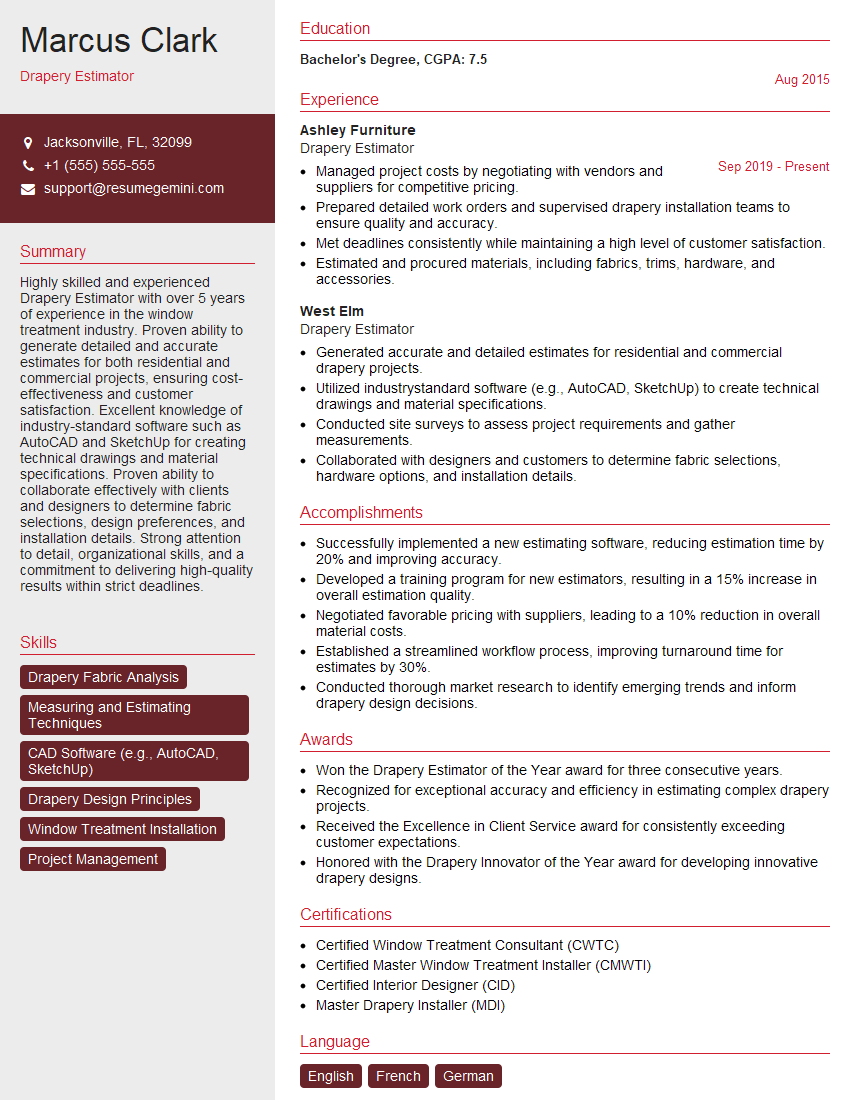
Mastering custom drapery fabrication opens doors to exciting career opportunities in a creative and skilled trade. Advancement often involves project leadership, specialized techniques, and client relationship management. To maximize your job prospects, creating a strong, ATS-friendly resume is crucial. ResumeGemini is a trusted resource that can help you build a professional resume tailored to highlight your skills and experience. Examples of resumes tailored to Custom Drapery Fabrication are available to guide you.
Explore more articles
Users Rating of Our Blogs
Share Your Experience
We value your feedback! Please rate our content and share your thoughts (optional).
What Readers Say About Our Blog
To the interviewgemini.com Webmaster.
Very helpful and content specific questions to help prepare me for my interview!
Thank you
To the interviewgemini.com Webmaster.
This was kind of a unique content I found around the specialized skills. Very helpful questions and good detailed answers.
Very Helpful blog, thank you Interviewgemini team.