The right preparation can turn an interview into an opportunity to showcase your expertise. This guide to Cutting and Measuring interview questions is your ultimate resource, providing key insights and tips to help you ace your responses and stand out as a top candidate.
Questions Asked in Cutting and Measuring Interview
Q 1. Explain the different types of cutting tools and their applications.
Cutting tools are diverse, each suited for specific materials and applications. The choice depends heavily on the material’s properties (hardness, thickness, etc.) and the desired cut quality.
- Knives: From utility knives for everyday cutting of paper and cardboard to specialized knives like box cutters, these offer versatility for light-duty tasks. Accuracy relies heavily on the user’s skill.
- Scissors: Ideal for fabric, paper, and other flexible materials. Different types exist, like pinking shears (for preventing fraying) and trimming scissors (for detailed work).
- Shears: Heavy-duty versions of scissors used for thicker materials like metal sheets (tin snips) or heavier fabrics. Their robust construction allows for powerful cuts.
- Rotary Cutters: Employ a circular blade for precise cutting of multiple layers of fabric or paper. These are highly efficient for quilters and paper crafters.
- Band Saws: Use a continuous band of toothed steel to cut through various materials, including wood, metal, and plastics. They offer flexibility and can handle intricate curves.
- Circular Saws: Possess a rotating circular blade, ideal for quick, straight cuts in wood or other materials. Different blade types are selected based on material hardness and desired cut quality.
- Laser Cutters: Utilize a laser beam to precisely cut through a vast array of materials, from acrylic and wood to fabric and metal. They offer high accuracy and intricate cutting capabilities.
- Water Jet Cutters: Employ a high-pressure stream of water to cut through materials, providing precise cuts with minimal heat-affected zones, ideal for sensitive materials.
For example, while a utility knife is perfectly fine for cutting cardboard, attempting to cut thick metal with it would be dangerous and ineffective. A band saw or laser cutter would be much more suitable for that task.
Q 2. Describe your experience with various measurement instruments (e.g., rulers, calipers, micrometers).
My experience encompasses a wide range of measurement instruments, each with its specific strengths and limitations. Understanding these limitations is crucial for accurate measurements.
- Rulers: Essential for basic linear measurements. I’m proficient in using both metric and imperial rulers, ensuring careful alignment and minimizing parallax error (error caused by viewing the measurement at an angle).
- Calipers: These provide more precise measurements, particularly for internal and external dimensions. I’m experienced with both vernier calipers (offering precision to 0.01 mm or 0.0005 inches) and digital calipers (providing digital readout for easier interpretation).
- Micrometers: Micrometers offer the highest precision, capable of measuring to 0.001 mm or 0.00005 inches. I’m adept at using both the ratchet mechanism (to avoid excessive pressure) and understanding the thimble readings. This is essential for extremely accurate work, like machining parts.
In a recent project involving the creation of precisely-sized metal components, the use of micrometers was critical. The slightest deviation could have rendered the components unusable. The precision afforded by micrometers ensured the successful completion of that project.
Q 3. How do you ensure accuracy and precision in cutting and measuring?
Accuracy and precision are paramount in cutting and measuring. It’s not enough to be merely close; we aim for consistent, repeatable results. Several strategies contribute to this goal:
- Calibration: Regularly calibrating measurement tools against known standards is essential. This ensures that the instruments remain accurate over time. Out-of-calibration tools lead to significant errors.
- Proper Technique: Consistent use of proper measuring techniques is crucial, such as ensuring correct alignment of rulers, using calipers with even pressure, and understanding the zero-point on micrometers.
- Multiple Measurements: Taking multiple measurements at different points and averaging them reduces the impact of random errors.
- Environmental Factors: Being aware of environmental factors like temperature and humidity is important, as they can affect both the material and the measurement tools. For example, temperature changes can cause dimensional changes in metal.
- Sharp Tools: Using sharp cutting tools is critical. Dull tools lead to inaccurate cuts, often requiring rework and increasing the chances of damaging the material.
For instance, when cutting a large piece of fabric for a garment, I’ll take several measurements at various points to account for any slight inconsistencies in the material itself. This ensures a proper fit and avoids costly mistakes.
Q 4. What are the common sources of error in cutting and measuring, and how do you mitigate them?
Several sources of error can affect the accuracy of cutting and measuring processes. Identifying and mitigating these errors is crucial for achieving high-quality results.
- Tool Wear: Dull or damaged cutting tools lead to inaccurate cuts and increased material waste. Regular sharpening or replacement is essential.
- Measurement Error: Parallax error, improper tool use, and failing to account for tool thickness all contribute to measurement inaccuracies.
- Material Variation: Inconsistencies in the material itself can lead to variations in cuts. For instance, wood can have knots or variations in density.
- Environmental Factors: Temperature and humidity fluctuations can impact both the material and the tools, leading to inaccurate measurements and cuts.
- Human Error: Mistakes in reading measurements, improper alignment of tools, and fatigue can all introduce errors. Careful attention to detail and adherence to standardized procedures are paramount.
To mitigate these errors, we employ techniques such as regular tool maintenance and calibration, using proper measuring techniques, and implementing quality control checks throughout the process. We also prioritize training and standardized procedures for all operators to ensure consistency and minimize human error.
Q 5. Describe your experience with different cutting techniques (e.g., hand cutting, machine cutting).
My experience spans a range of cutting techniques, each with its own advantages and disadvantages.
- Hand Cutting: This offers versatility but relies heavily on the user’s skill and precision. It’s suitable for smaller, intricate cuts where machine cutting might be less precise or impractical. Examples include cutting fabric with scissors or using a utility knife.
- Machine Cutting: Machine cutting offers greater speed, precision, and consistency for repetitive tasks, especially for large or complex cuts. Types include band saws for wood, laser cutters for intricate shapes, and CNC routers for detailed work.
For example, while hand cutting is ideal for creating unique, customized cuts in fabric, using a laser cutter would be more efficient and accurate for creating numerous identical parts in acrylic.
I am comfortable selecting the appropriate cutting technique depending on the project requirements and available resources. Each method requires a different skill set, tool selection, and safety precaution. Safety always takes priority.
Q 6. How do you interpret technical drawings and specifications for cutting and measuring?
Interpreting technical drawings and specifications is fundamental to accurate cutting and measuring. It requires careful attention to detail and a solid understanding of engineering drawings and associated standards.
I’m proficient in reading various types of drawings, including orthographic projections, isometric views, and section views. I can identify key dimensions, tolerances, and material specifications. I understand the importance of tolerance ranges and how they influence the acceptable variation in the final product. For instance, a tolerance of ±0.5mm means the final dimension can vary by up to 0.5mm in either direction and still be considered acceptable.
Before commencing any cutting operations, I always thoroughly review the drawings and specifications to ensure a clear understanding of the required dimensions and tolerances. This prevents costly mistakes and ensures the final product meets the required specifications.
Q 7. Explain your experience with material handling and storage related to cutting operations.
Material handling and storage are crucial aspects of maintaining the integrity of materials and ensuring safety during cutting operations. Improper handling can lead to damage, waste, and potentially accidents.
- Proper Storage: Materials should be stored appropriately to prevent damage or deterioration. For example, wood should be stored in a dry place to avoid warping, while metals might require protection against corrosion.
- Safe Handling: Using appropriate handling equipment such as carts, lifts, and slings helps prevent injuries and damage to the materials. Large or heavy materials require careful handling to prevent accidents.
- Organization: Organized storage makes it easy to locate materials, saving time and improving efficiency. A well-organized workspace improves safety and workflow.
- Material Protection: Using protective coverings or wraps where necessary prevents damage during storage and transportation. For example, wrapping delicate materials before transport prevents scratches or tears.
In one project involving large sheets of plywood, proper storage, using appropriate lifting techniques, and ensuring a well-organized workspace were critical in preventing damages and ensuring the smooth completion of the cutting operations. Efficient material handling minimizes waste and maximizes productivity.
Q 8. How do you ensure the safety of yourself and others while operating cutting equipment?
Safety is paramount in any cutting operation. My approach is built around a layered system of precautions, starting with thorough training and adherence to all safety regulations. This includes always wearing appropriate Personal Protective Equipment (PPE), such as safety glasses, hearing protection, and cut-resistant gloves, depending on the material being cut.
Before operating any equipment, I meticulously inspect it for any damage or malfunctions. I ensure that all guards are in place and functioning correctly. I also maintain a clean and organized workspace, free of clutter that could cause accidents. During operation, I maintain a safe distance from the cutting blades and avoid any distractions. Finally, I’m always mindful of my colleagues and ensure they also maintain safe practices.
For example, when using a circular saw, I always ensure the blade is sharp to prevent binding and kickback, a common cause of accidents. I also use a push stick for smaller pieces to keep my hands away from the blade. Think of it like driving – defensive driving saves lives, and defensive cutting does too.
Q 9. Describe your experience with quality control procedures for cutting and measuring.
Quality control is integral to my work. It begins with verifying the accuracy of the cutting plans and ensuring all measurements are correct. I use various measuring tools, from precision rulers and calipers to laser measuring devices, depending on the project’s demands and material precision requirements. After cutting, I meticulously inspect each piece, comparing it against the original specifications. I check for dimensional accuracy, straightness of cuts, and the absence of any defects like burrs or scorch marks (depending on the cutting method). If discrepancies arise (within tolerance, of course – more on that later), I document them and take corrective action.
I’ve used statistical process control (SPC) techniques in some projects to monitor the consistency of cutting dimensions. This involves collecting data on multiple cuts and analyzing it to identify any trends or variations. The goal is continuous improvement, reducing waste, and consistently meeting the required quality levels.
Q 10. How do you calculate material requirements for a given project?
Calculating material requirements is a crucial step that minimizes waste and ensures project success. The process starts with a thorough understanding of the project design, including the dimensions of all components. I then account for material loss during the cutting process, such as kerf (the width of the cut made by the tool), and add extra material as a safety margin. This margin accounts for potential errors during cutting and ensures I have enough material to complete the project.
For example, if I’m cutting 10 pieces of wood, each measuring 12 inches long, and the kerf of my saw is 0.25 inches, my calculation would look like this: (10 pieces * 12 inches/piece) + (9 cuts * 0.25 inches/cut) = 122.25 inches. I’d then add a safety margin (e.g., 1 inch) to account for potential errors, resulting in a total material requirement of approximately 123.25 inches.
Q 11. What is your experience with different types of materials (e.g., fabrics, metals, wood)?
My experience spans various materials, each demanding unique cutting techniques and considerations. With fabrics, I’m proficient in using pattern cutting techniques, ensuring precise alignment and minimizing fraying. I understand the importance of using appropriate shears and the impact of fabric grain on the final product. Working with metals requires understanding the properties of different alloys and using specialized tools such as shears, saws, and laser cutters. Safety precautions, like eye protection and proper ventilation are crucial here.
Woodworking demands an understanding of wood grain, the use of different saws (circular, jigsaw, band saw), and proper techniques for achieving clean, precise cuts. I have experience with various types of wood, from softwoods to hardwoods, and understand how the material properties affect the cutting process. I’m also familiar with different joining techniques used after cutting the wood pieces.
Q 12. Explain your understanding of tolerance and its importance in cutting and measuring.
Tolerance refers to the permissible variation in a dimension from a specified value. It represents the acceptable range of error. For example, a specification might call for a piece to be 10 inches long with a tolerance of ±0.1 inches. This means any piece between 9.9 and 10.1 inches is acceptable. Tolerance is critical because it defines the acceptable quality level for the finished product.
Tight tolerances demand greater precision in cutting and measuring, often requiring more specialized tools and techniques. Looser tolerances allow for a wider margin of error, which might speed up the process but might lead to a slightly less precise product. The choice of tolerance depends on the application; a highly precise machine component would need a much tighter tolerance than a simple wooden frame.
Q 13. How do you manage discrepancies between measured values and specifications?
Discrepancies between measured values and specifications need immediate attention. First, I verify the accuracy of my measurements using multiple tools and techniques. If the error is within the acceptable tolerance, it’s simply documented. If the discrepancy exceeds the tolerance, I investigate the root cause. This might involve checking the measuring tools for calibration, reviewing the cutting process for potential errors (e.g., tool wear, incorrect settings), or re-examining the original specifications.
Depending on the severity and the project’s requirements, I might need to make corrections. This could involve re-cutting the piece, adjusting the cutting process, or, in extreme cases, revisiting the design. Comprehensive documentation is essential at each step, ensuring transparency and facilitating improvements in future projects.
Q 14. Describe your problem-solving approach when facing unexpected challenges during cutting operations.
My problem-solving approach focuses on methodical investigation and creative solutions. When faced with an unexpected challenge, I first stop and assess the situation safely. I then gather information: What went wrong? What are the constraints? I might consult reference materials, seek advice from colleagues, or analyze the data collected. I break down the problem into smaller, manageable parts, allowing me to address each challenge systematically.
For instance, if a piece breaks during cutting, I’d examine the material for defects, assess the tool’s condition, and review my cutting technique. The solution might involve switching to a different tool, modifying the cutting technique, or selecting a stronger material. The key is to approach the problem logically, document the solution, and learn from the experience to prevent similar issues in the future. This is about learning through experience – every challenge is an opportunity to refine my skills and processes.
Q 15. How do you maintain and calibrate cutting and measuring equipment?
Maintaining and calibrating cutting and measuring equipment is crucial for accuracy and safety. This involves regular cleaning, inspection, and calibration using standardized procedures. For example, a measuring tape might be checked against a known standard length, while a rotary cutter blade needs to be sharp and free from damage.
- Regular Cleaning: Removing debris and dust from tools prevents inaccurate measurements and damage to materials.
- Inspection for Damage: Checking for cracks, bends, or other damage on rulers, squares, and cutting tools is critical to prevent accidents and errors.
- Calibration: Using certified standards or comparison tools, we verify the accuracy of measuring instruments. For example, I’ve used a precision gauge block to check the accuracy of my calipers.
- Blade Sharpening/Replacement: For rotary cutters and shears, regular sharpening or replacement is key to maintain clean cuts and prevent material fraying. A dull blade can lead to inconsistent cuts and damage the material.
- Lubrication: Some equipment, like shears or certain types of cutting machines, may require lubrication to maintain smooth operation and prevent premature wear.
Think of it like maintaining a high-precision instrument – regular care ensures it performs flawlessly.
Career Expert Tips:
- Ace those interviews! Prepare effectively by reviewing the Top 50 Most Common Interview Questions on ResumeGemini.
- Navigate your job search with confidence! Explore a wide range of Career Tips on ResumeGemini. Learn about common challenges and recommendations to overcome them.
- Craft the perfect resume! Master the Art of Resume Writing with ResumeGemini’s guide. Showcase your unique qualifications and achievements effectively.
- Don’t miss out on holiday savings! Build your dream resume with ResumeGemini’s ATS optimized templates.
Q 16. What is your experience with computerized cutting systems?
I have extensive experience with computerized cutting systems, including both automated cutting tables and CAD/CAM software for pattern design and nesting. My experience ranges from operating and maintaining these systems to programming cutting paths for optimal material usage. I’m proficient in several software packages, including [mention specific software, e.g., Lectra, Gerber], and am comfortable troubleshooting technical issues and integrating them into a larger production workflow.
For instance, in a previous role, we used a computerized cutting table to cut hundreds of garment pieces daily. My proficiency in the associated software allowed me to optimize cutting layouts, reducing material waste by 15% within the first month. This involved mastering the nesting algorithms and experimenting with different layout strategies.
I understand the importance of accurate data input and output and consistently verify the generated cutting paths to ensure precision and efficiency.
Q 17. Explain your understanding of different cutting patterns and layouts.
Understanding cutting patterns and layouts is fundamental in this field. Patterns define the shape and size of each piece, while layouts determine how those patterns are arranged on the fabric to minimize waste. There are various types of layouts, including:
- Marker Making: Creating a layout that maximizes fabric usage. This involves arranging patterns efficiently, often using specialized software.
- Spread Layout: A more manual method where patterns are physically arranged on a large fabric spread. This approach is used with some manual cutting and with certain fabric types.
- Nesting: A computerized technique to optimize the arrangement of patterns for minimum material waste.
Different cutting patterns, such as those for garments, upholstery, or packaging, require different layout strategies. Factors like grain direction, fabric width, and pattern complexity influence the best approach.
For example, when working with symmetrical patterns, mirroring them on the layout can save material and time.
Q 18. How do you optimize cutting patterns to minimize waste?
Optimizing cutting patterns to minimize waste is a constant focus. This involves several strategies:
- Efficient Nesting Software: Using specialized software to automatically arrange patterns is crucial. These programs use algorithms to find the most efficient layout. I have experience with nesting software, and I know how to fine-tune the settings to accommodate various constraints.
- Manual Optimization: In cases where software isn’t suitable, careful manual arrangement is needed. This requires a good eye for space utilization and understanding of the pattern shapes.
- Leftover Piece Utilization: Strategically using leftover fabric pieces from previous cuts to create smaller parts or for other projects reduces waste significantly.
- Grain Line Alignment: Ensuring that patterns are aligned correctly with the fabric grain minimizes distortion and allows for better material use.
- Scale Optimization: Sometimes, scaling patterns slightly can lead to a significant reduction in waste. This needs careful consideration to maintain the desired functionality and appearance.
Imagine a jigsaw puzzle – efficient nesting is like finding the optimal arrangement of pieces to fully fill the space.
Q 19. Describe your experience with working under pressure and meeting deadlines.
I thrive in fast-paced environments and am adept at meeting deadlines. I’ve consistently delivered high-quality work under pressure, even in situations with short turnaround times. My organizational skills and ability to prioritize tasks allow me to handle multiple projects concurrently without compromising accuracy or efficiency.
For example, I once had to produce a large batch of garments in less than half the usual timeframe. I immediately developed a detailed plan, delegated tasks where appropriate, and worked extra hours to ensure that everything was completed on time and to the required standards. The project was successfully delivered, with minimal errors, demonstrating my skill at managing pressure and meeting stringent deadlines.
Q 20. How do you prioritize tasks in a fast-paced cutting and measuring environment?
Prioritizing tasks in a fast-paced cutting and measuring environment requires a systematic approach. I use a combination of techniques, including:
- Urgency and Importance: I prioritize tasks based on their urgency and importance. Time-sensitive projects with critical deadlines take precedence.
- Project Dependencies: I identify tasks that are dependent on others, sequencing them appropriately to avoid delays.
- Work Breakdown Structure: Breaking down large projects into smaller, manageable tasks simplifies scheduling and tracking progress.
- Visual Management: Using tools like Kanban boards or task management software helps in visualizing workflows and tracking progress.
Effective prioritization ensures that the most crucial tasks are completed first, minimizing potential disruptions and ensuring timely project completion.
Q 21. How do you communicate effectively with other team members during cutting operations?
Effective communication is vital for seamless cutting operations. I communicate clearly and concisely, both verbally and in writing, ensuring everyone is informed and on the same page. I actively listen to my team members, value their input, and address any concerns promptly. I believe in a collaborative environment.
For example, before starting a large cutting project, I always have a pre-production meeting to review the patterns, discuss any potential challenges, and assign responsibilities. During the cutting process, I maintain open communication with the team, addressing any questions or issues that arise immediately to avoid bottlenecks or errors.
Clear and proactive communication prevents misunderstandings, ensures efficiency, and fosters a positive and productive team environment.
Q 22. Describe your experience with documenting cutting and measuring procedures.
Documenting cutting and measuring procedures is crucial for maintaining consistency and efficiency. My approach involves creating detailed, step-by-step instructions, incorporating visual aids like diagrams and photographs. These documents cover everything from material preparation and machine setup to the cutting process itself, including safety protocols. For example, in a recent project involving intricate laser cutting of acrylic sheets, I created a document outlining the optimal laser settings for different thicknesses, the precise placement of the material on the cutting bed, and the necessary post-processing steps. This ensured that all team members could consistently produce high-quality cuts, regardless of their experience level. I also incorporate checklists for quality control at various stages of the process to minimize errors and identify potential issues early on.
Beyond individual procedures, I maintain a central repository of all documentation, easily accessible to the team. This repository is regularly updated to reflect any process improvements or changes in materials. This systematic approach ensures consistency, facilitates training, and allows for easy troubleshooting.
Q 23. How do you ensure consistent quality in mass production cutting operations?
Consistent quality in mass production cutting is achieved through a combination of factors. Firstly, rigorous machine calibration and maintenance are paramount. Regular checks on the cutting tools, laser alignment (if applicable), and overall machine functionality are essential to prevent inconsistencies. Think of it like tuning a musical instrument – a poorly tuned instrument produces discordant sounds, just as a poorly calibrated machine produces inaccurate cuts.
Secondly, standardized operating procedures are crucial. Every step, from material handling to final inspection, must be clearly defined and consistently followed. This includes using pre-cut templates or digital cutting patterns generated from CAD/CAM software. Quality control checks are integrated at each stage, with clearly defined acceptance criteria. For instance, we might employ statistical process control (SPC) methods to monitor the dimensions of cut pieces, ensuring they fall within the specified tolerances. Finally, continuous improvement is key. Regularly analyzing production data and feedback helps identify areas for improvement and refine the overall process.
Q 24. Explain your understanding of different cutting methods (e.g., shear cutting, laser cutting).
Different cutting methods offer unique advantages depending on the material and desired outcome. Shear cutting, for example, is a mechanical process using a blade to sever material. It’s often cost-effective for large-scale operations with relatively simple shapes, and suitable for materials like sheet metal. However, it can produce slightly less precise cuts than other methods and may cause burrs, requiring additional finishing.
Laser cutting, conversely, utilizes a high-powered laser beam to vaporize or melt material, enabling intricate designs and high precision. It’s ideal for materials like acrylic, wood, and thin metals. Its advantages include high speed, minimal material waste, and clean cuts. However, it’s more expensive to set up and operate, and may not be suitable for all materials. Other methods include waterjet cutting (for hard materials), plasma cutting (for thicker metals), and routing (for wood and plastics). Understanding the strengths and limitations of each method is crucial for selecting the most appropriate technique for a specific application.
Q 25. Describe your experience with troubleshooting malfunctions in cutting machinery.
Troubleshooting cutting machinery requires a systematic approach. My first step is always safety – ensuring the machine is powered down and locked out before any inspection or repair. Then, I carefully examine the problem, focusing on observable symptoms. For instance, if the cuts are inconsistent, I might check the blade sharpness (shear cutting) or laser alignment (laser cutting). If the machine is not operating at all, I’ll look at power supply, control systems, and safety interlocks.
I use a combination of diagnostic tools, including manuals, schematics, and online resources to pinpoint the root cause. I always document my findings and the repair process. For example, I once diagnosed a recurring jamming issue in a shear cutter by tracing it to a misaligned guide rail. Careful adjustment resolved the problem, and the detailed notes in my log helped prevent the issue from reoccurring. My approach is based on careful observation, methodical analysis, and the utilization of available resources.
Q 26. How do you handle damaged or defective materials during the cutting process?
Handling damaged or defective materials during cutting is vital for maintaining both efficiency and quality. My approach involves a thorough inspection of materials before the cutting process begins. This helps to identify and segregate defective pieces, preventing them from disrupting the workflow and potentially damaging the cutting equipment. Depending on the nature and extent of the damage, I might salvage usable portions of the material or discard it entirely.
A clear record-keeping system is essential. This tracks the quantity and cause of damaged materials, helping to identify potential issues in the material supply chain. For example, if we consistently receive batches with surface imperfections, this information informs discussions with suppliers to improve quality control on their end. Proper waste management protocols are also crucial for environmentally responsible disposal of damaged or unusable materials.
Q 27. What are your preferred methods for verifying the accuracy of cuts?
Verifying the accuracy of cuts employs a multi-pronged approach. For simple shapes, using calipers or measuring tapes is sufficient. For more complex geometries, digital measuring tools like coordinate measuring machines (CMMs) provide precise measurements. Visual inspection is always part of the process, checking for burrs, inconsistencies, and deviations from the intended design.
In many cases, I rely on comparison with digital templates or CAD models. This allows for a quick and accurate assessment of whether the actual cut pieces match the intended design. Documenting the measurement process, including the tools used and the results obtained, is crucial for maintaining traceability and ensuring accountability. We often use statistical methods to analyze measurement data to assess the overall accuracy and consistency of the cutting process.
Q 28. Describe your experience with using CAD/CAM software for cutting and measuring applications.
CAD/CAM software is essential for modern cutting and measuring applications. My experience encompasses using various software packages to design and generate cutting paths for a wide range of materials and machine types. This includes creating 2D and 3D models, optimizing cutting paths to minimize waste and maximize efficiency, and generating CNC codes for automated cutting machines.
I’m proficient in using software features for simulating the cutting process, predicting material usage, and identifying potential collisions or errors. This allows for early detection and correction of design flaws before they reach the production floor. For example, in a recent project involving complex curved cuts, using the software’s simulation features allowed me to optimize the cutting path, reducing cutting time by 15% and minimizing material waste. My skills in CAD/CAM software are critical for ensuring accuracy, efficiency, and cost-effectiveness in our cutting operations.
Key Topics to Learn for Cutting and Measuring Interview
- Understanding Fabric Properties: Learn to identify different fabric types, their drape, and how these properties influence cutting and measuring techniques. Consider the impact of fabric weight, stretch, and shrinkage.
- Pattern Interpretation and Manipulation: Practice reading and understanding pattern instructions, including grading, marking, and making adjustments for fit and style variations. Be prepared to discuss your experience with various pattern types (e.g., slopers, block patterns).
- Accurate Measuring Techniques: Master accurate body measurements and pattern measurements using appropriate tools. Understand the importance of precision and consistency in this crucial stage.
- Cutting Techniques: Explore different cutting methods (e.g., manual, electric, automated) and their applications. Discuss your proficiency with various cutting tools and safety procedures.
- Layout Planning and Efficiency: Understand how to efficiently layout patterns on fabric to minimize waste and optimize material usage. Discuss strategies for managing different fabric widths and grainlines.
- Quality Control and Problem-Solving: Be ready to discuss strategies for identifying and correcting cutting errors, ensuring accurate measurements, and maintaining consistent quality throughout the process. Describe how you troubleshoot common challenges.
- Advanced Techniques (if applicable): Depending on the role, you may need to demonstrate knowledge of specialized cutting and measuring techniques, such as those used for specific garments or in industrial settings.
Next Steps
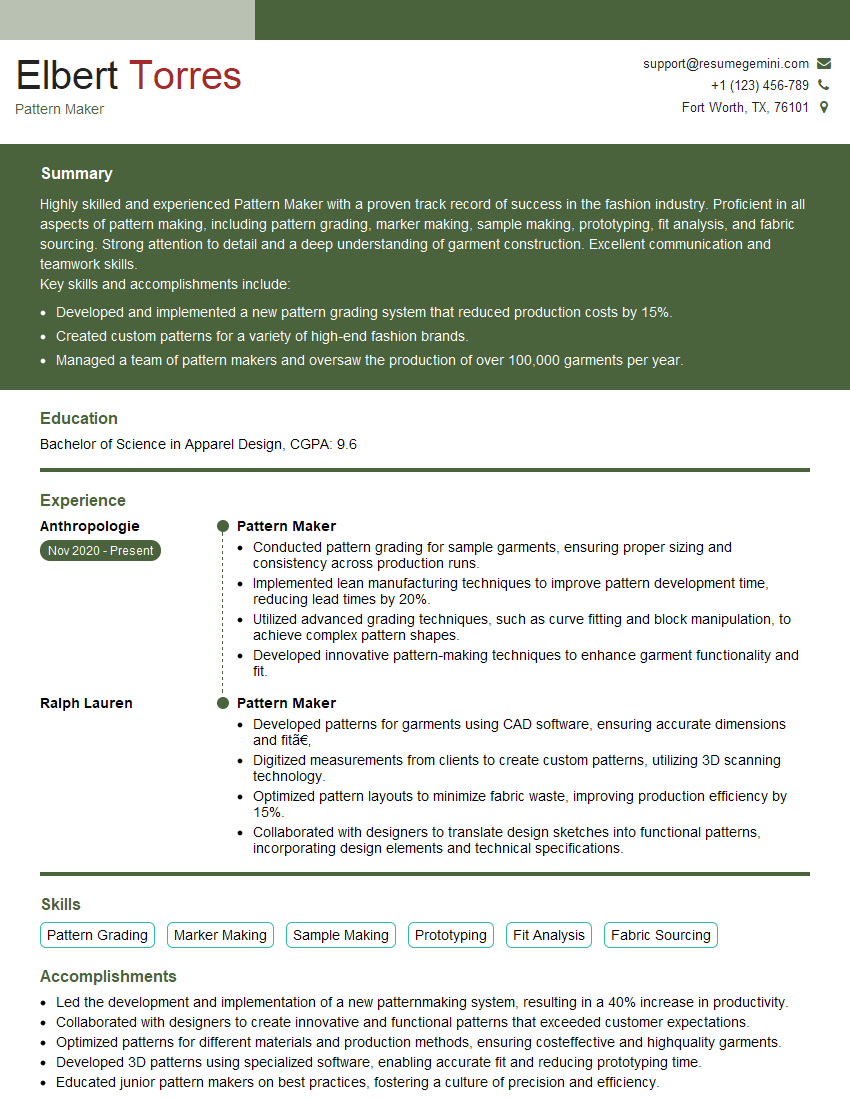
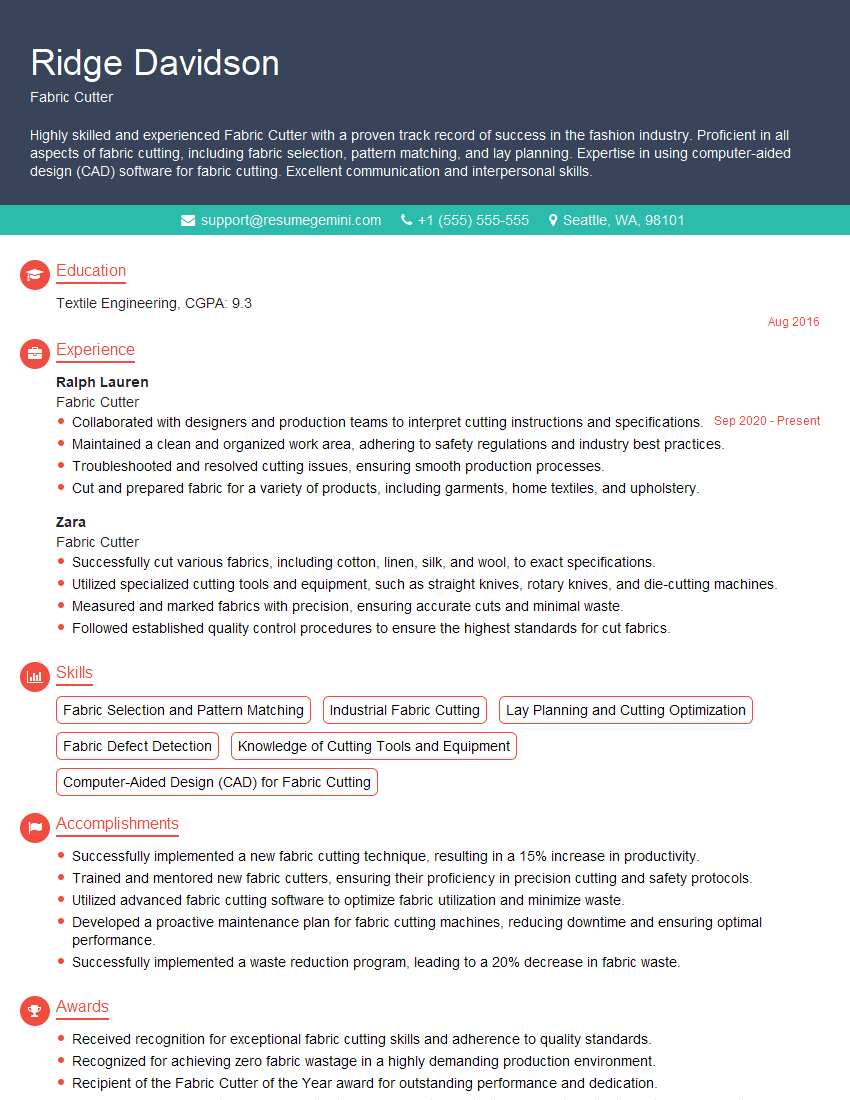
Mastering cutting and measuring is fundamental for success in the garment industry, opening doors to diverse roles and career advancement opportunities. A strong understanding of these skills demonstrates precision, attention to detail, and problem-solving abilities – highly valued attributes in this field. To significantly enhance your job prospects, focus on creating an ATS-friendly resume that highlights your skills and experience effectively. ResumeGemini is a trusted resource that can help you build a professional and impactful resume. We offer examples of resumes tailored specifically to Cutting and Measuring roles to guide you in creating a compelling application.




Explore more articles
Users Rating of Our Blogs
Share Your Experience
We value your feedback! Please rate our content and share your thoughts (optional).
What Readers Say About Our Blog
To the interviewgemini.com Webmaster.
Very helpful and content specific questions to help prepare me for my interview!
Thank you
To the interviewgemini.com Webmaster.
This was kind of a unique content I found around the specialized skills. Very helpful questions and good detailed answers.
Very Helpful blog, thank you Interviewgemini team.