The right preparation can turn an interview into an opportunity to showcase your expertise. This guide to Cutting and Shaping Bricks interview questions is your ultimate resource, providing key insights and tips to help you ace your responses and stand out as a top candidate.
Questions Asked in Cutting and Shaping Bricks Interview
Q 1. What are the different methods for cutting bricks?
Cutting bricks requires precision and the right tools. The method you choose depends on the brick type, the cut required (straight, angled, etc.), and the scale of the project. Common methods include:
Brick Bolster and Brick Hammer: This traditional method uses a bolster (a metal plate) to guide the hammer blows, ensuring a clean, straight cut. It’s ideal for relatively straight cuts, especially on softer bricks. Think of it like using a guide when sawing wood – it prevents straying.
Brick Saw (Manual or Electric): Manual brick saws use a diamond-embedded blade to score and snap the brick. Electric saws offer faster cuts, especially useful for large projects. The choice between wet and dry cutting depends on the type of brick and personal preference. Wet cutting helps manage dust and keeps the blade cool.
Angle Grinder with Diamond Blade: For intricate or angled cuts, an angle grinder with a diamond blade offers versatility. This method is fast but generates considerable dust and requires safety precautions. Imagine it as a power tool equivalent of a very precise chisel.
Brick Cutter (Specialized Tool): Specialized brick cutters use a scoring mechanism and lever action to cleanly break bricks. These are often used for straight cuts and are quicker than a hammer and bolster for multiple cuts.
The best method depends on factors like the type of cut, number of bricks to be cut and the tools available. For instance, a small repair job might use a hammer and bolster, while a large construction project would utilize electric saws.
Q 2. Describe the process of shaping bricks for curved walls.
Shaping bricks for curved walls is a more intricate process. It typically involves cutting individual bricks to specific shapes to create the desired curve. The process commonly involves:
Planning and Layout: Accurately mapping out the curve’s radius and the shape each brick needs to take. This often involves precise calculations and drawings.
Cutting: Using methods mentioned in the previous answer (angle grinder, brick saw), bricks are cut to conform to the curve. Multiple smaller cuts are often required for a smooth finish.
Grinding and Shaping: Once the rough cuts are made, grinding and shaping may be needed to achieve a perfect fit. This refines the brick to seamlessly integrate into the curved wall. Think of a sculptor carefully refining their work.
Trial Fitting and Adjustment: Continuously checking the fit and making adjustments as needed to ensure the bricks fit perfectly together and create a fluid curve.
This process is often iterative, requiring patience and attention to detail. An example of this would be creating a semicircular archway— each brick carefully shaped to fit the radius of the arc.
Q 3. How do you ensure accurate cuts when working with different brick types?
Accurate cuts are paramount for both aesthetics and structural integrity. Different brick types require different approaches:
Hard Bricks: Require more powerful tools like an angle grinder with a diamond blade or a specialized brick cutter. The harder the brick, the more precise the tool needs to be to avoid chipping or shattering.
Soft Bricks: Can be cut using a hammer and bolster, a hand saw, or even a sharp chisel. However, even with softer bricks, it’s important to use a steady hand to avoid uneven cuts.
Facing Bricks: These are often more delicate and require careful cutting to preserve their surface finish. An electric wet saw is often preferred for these as it minimizes dust and prevents chipping.
Regardless of the brick type, pre-marking the cut lines with a pencil or marker is crucial to guide the tool. Always practice on scrap bricks first to find the optimal technique and adjust your pressure or cutting speed as needed. It’s like practicing before performing a surgical cut – precision is essential.
Q 4. What safety precautions are essential when cutting bricks?
Safety is paramount when cutting bricks. Essential precautions include:
Eye Protection: Always wear safety glasses to shield your eyes from flying debris. Dust masks are also highly recommended, particularly when using power tools.
Hearing Protection: Power tools can be very noisy. Use earplugs or earmuffs to prevent hearing damage.
Respiratory Protection: Brick dust is harmful when inhaled. A dust mask is crucial. Consider using a wet cutting method to minimize dust.
Gloves: Wear gloves to protect your hands from cuts and abrasions.
Proper Tool Use: Always follow the manufacturer’s instructions for your tools. Ensure the blades are sharp and in good condition.
Stable Work Area: Work on a stable and level surface to prevent accidental slips or falls.
Appropriate Clothing: Wear sturdy work boots and close-toed shoes.
Ignoring safety precautions can lead to serious injuries. Always prioritize your safety and work in a well-ventilated area.
Q 5. Explain the importance of using the correct tools for brick cutting.
Using the correct tools is crucial for efficiency, accuracy, and safety. The wrong tool can lead to damaged bricks, inefficient work, or injury. For example:
A hammer and bolster are inefficient for precise angled cuts, which would be better achieved with an angle grinder.
An angle grinder is too powerful for delicate facing bricks, which might be better cut with a wet saw.
A hand saw might struggle with extremely hard bricks, requiring a powered saw instead.
Choosing the right tool depends on the type of brick, desired cut, and the scale of the job. Always consider factors like the brick’s hardness, required precision, and available tools to select the most appropriate equipment for a clean, accurate, and safe cut. Think of it like choosing the right wrench for the right bolt – it’s about efficiency and precision.
Q 6. How do you handle damaged or flawed bricks during a project?
Dealing with damaged or flawed bricks requires careful consideration. The approach depends on the severity of the damage and the project’s scope:
Minor Cracks or Chips: If the damage is minor and doesn’t compromise structural integrity, the brick might be usable in less visible areas, like the back of a wall. Consider using it where it won’t impact the overall appearance.
Significant Damage: Bricks with significant damage should be replaced entirely. Using damaged bricks can weaken the structure and affect the aesthetic appeal of the final product. It’s better to ensure the structural soundness.
Flawed Bricks: Bricks with manufacturing flaws (e.g., inconsistent color or size) should be inspected for structural weaknesses before being used. They may be used in less visible areas or rejected depending on the flaw’s severity.
It’s crucial to have extra bricks on hand to account for damage or flaws. Replacing damaged bricks ensures the final product is aesthetically pleasing and structurally sound.
Q 7. What are the common challenges faced when shaping bricks?
Shaping bricks presents several common challenges:
Achieving Precise Cuts: Especially when dealing with complex curves or angled cuts, maintaining precision can be difficult. Careful planning, the right tools, and steady hand are crucial.
Managing Dust and Debris: Cutting bricks generates significant dust and debris, requiring appropriate safety measures (dust masks, eye protection, and a well-ventilated work area). Wet cutting methods are helpful in mitigating this.
Brick Breakage: Hard bricks can be prone to cracking or shattering during cutting, requiring skill and the right tools to avoid damage. Practice is vital to get the right pressure and technique.
Time Consumption: Shaping bricks, especially for complex designs, can be time-consuming. Careful planning and efficient techniques are needed to complete the job within a reasonable timeframe.
Overcoming these challenges requires careful planning, using the right tools, and developing proficiency in various cutting techniques. Practice and patience are key.
Q 8. Describe your experience with different bricklaying patterns.
Bricklaying patterns are crucial for structural integrity and aesthetic appeal. My experience encompasses a wide range, including common bonds like running bond, stack bond, English bond, and Flemish bond. I’m also proficient in more complex patterns like herringbone and basketweave, which require precise cutting and placement. For example, creating a Flemish bond involves alternating headers and stretchers, demanding accurate cutting of bricks to achieve the desired aesthetic. I’ve worked on projects where intricate patterns were essential for matching existing structures or creating unique architectural features. Understanding the nuances of each pattern, including the required brick sizes and quantities, is paramount for efficient and effective bricklaying.
Q 9. How do you measure and mark bricks for accurate cutting?
Accurate measurement and marking are fundamental. I typically use a combination of measuring tapes, squares, and marking pencils. First, I carefully measure the required brick length, taking into account any necessary cuts. Then, I use a square to ensure accurate transfer of measurements onto the brick’s surface. I usually mark the cut line with a clear, precise pencil stroke to guide the cutting process. For complex cuts, I might use a template made from sturdy material like cardboard or metal to ensure consistent accuracy across multiple bricks. For instance, when creating an arch, a meticulously crafted template guarantees the perfect fit of each brick segment.
Q 10. What are the different types of brick saws and their applications?
Several brick saws cater to different needs. Handheld saws, like the mason’s saw, are best for simple cuts and are readily portable. Wet saws, using an abrasive blade and water coolant, provide cleaner, more precise cuts, ideal for intricate work. They’re particularly useful for cutting hard bricks or large quantities. Power saws, offering greater cutting speed, are suitable for larger projects, but require more safety precautions and skill. Finally, diamond-blade saws, known for their durability and efficiency, can cut through most brick types with minimal effort, especially useful for large-scale projects with hard bricks. The choice depends on the project scale, brick type, and desired cut quality.
Q 11. How do you determine the appropriate cutting method based on the project requirements?
Selecting the right cutting method depends on several factors. The type of brick (hardness, porosity) significantly influences the choice of tool. Hard bricks necessitate a diamond-blade saw for efficient and clean cuts, whereas softer bricks might be manageable with a handheld saw. The complexity of the cut dictates the precision required. Simple cuts can be handled with hand tools, while intricate shapes necessitate power saws or wet saws. The project’s scale – a small repair versus a large construction – determines the efficiency needed. A power saw is optimal for large projects, whereas a handheld saw might suffice for minor adjustments. Ultimately, experience and understanding of each tool’s capabilities are crucial for making the best choice.
Q 12. Explain your experience using hand tools for brick cutting and shaping.
My experience with hand tools includes using a brick hammer and bolster chisel for scoring and breaking bricks. This method requires precision and control, particularly when creating angled cuts or specific shapes. I’ve used a variety of chisels for shaping bricks, and have gained a feel for the appropriate force and angle required for clean breaks. For example, creating a keystone for an arch often involves multiple precise chisel strokes to achieve the required shape and curvature. While power tools offer efficiency, hand tools allow for finer control and are essential for specific shaping tasks.
Q 13. How do you manage waste materials during brick cutting?
Waste management is crucial for efficiency and environmental responsibility. I carefully plan cuts to minimize waste by optimizing brick usage. Leftover pieces are often reusable for smaller infill sections or for creating custom shapes. Waste bricks are sorted – usable fragments are stored separately from rubble. On larger projects, I work with the site manager to ensure proper disposal of unusable materials, following all local regulations and environmental guidelines. Recycling or repurposing brick fragments whenever possible is part of my standard practice.
Q 14. Describe your knowledge of various brick bonding patterns.
Brick bonding patterns dictate how bricks are arranged, affecting both aesthetics and structural strength. My knowledge encompasses various patterns: Running bond (simplest, cost-effective); English bond (headers and stretchers alternating, strong); Flemish bond (headers and stretchers alternating in each course, decorative); Stack bond (bricks stacked directly on top, less structurally sound but modern aesthetic); and various variations thereof. I understand how different bond patterns affect mortar usage and the overall strength of the wall. Selecting the right bonding pattern is part of the initial project design phase, considering factors like load-bearing requirements and visual appeal.
Q 15. How do you handle complex angles and curves when cutting and shaping bricks?
Handling complex angles and curves in brick cutting requires precision and the right tools. It’s like sculpting with bricks, not just laying them. We don’t just rely on a single method; the approach depends on the complexity of the curve.
For gentle curves: I often use a brick saw with a diamond blade, carefully making a series of shallow cuts to gradually shape the brick. It’s a bit like carving wood – slow, steady cuts are key to avoid shattering the brick.
For sharper angles: A grinder with a diamond cutting disc provides more control for precise cuts. Safety glasses and a dust mask are essential here. I’ll often make a template from cardboard first to ensure accuracy.
For complex, multi-faceted curves: I’ll often create a template from a flexible material like thin sheet metal, carefully tracing the curve. This template is then used to mark the cuts on multiple bricks, ensuring consistency. This is similar to creating a pattern for sewing, ensuring all pieces fit perfectly.
Regardless of the method, I always test-fit frequently to ensure the pieces fit seamlessly. It’s better to make many small adjustments than one large, irreversible one.
Career Expert Tips:
- Ace those interviews! Prepare effectively by reviewing the Top 50 Most Common Interview Questions on ResumeGemini.
- Navigate your job search with confidence! Explore a wide range of Career Tips on ResumeGemini. Learn about common challenges and recommendations to overcome them.
- Craft the perfect resume! Master the Art of Resume Writing with ResumeGemini’s guide. Showcase your unique qualifications and achievements effectively.
- Don’t miss out on holiday savings! Build your dream resume with ResumeGemini’s ATS optimized templates.
Q 16. What are the common problems encountered during brick shaping, and how do you solve them?
Common problems in brick shaping include cracking, chipping, and inaccurate cuts. These problems can arise from several sources:
Using dull blades: Dull blades lead to uneven cuts and increased risk of cracking. Regular blade sharpening or replacement is crucial.
Incorrect cutting techniques: Applying too much pressure, forcing the cut, or using inappropriate tools can easily damage the brick. Patience and the right tool for the job are essential.
Brick quality: Some bricks are inherently more brittle or porous than others, making them more prone to chipping. Knowing your material is key.
Moisture content: Working with wet bricks can increase the risk of cracking during the cutting process.
Solutions involve preventative measures. Using sharp tools, proper techniques, and selecting appropriate brick types are crucial. If a brick cracks during shaping, the solution is often replacement. There are no shortcuts; accuracy and attention to detail are paramount.
Q 17. How do you ensure the structural integrity of the brickwork after cutting and shaping?
Ensuring structural integrity after cutting and shaping bricks involves careful consideration of several factors. It’s about more than just aesthetics; it’s about building something stable and safe.
Proper brick selection: Choosing high-quality, robust bricks is the first step. They should be able to withstand the stresses of cutting and the weight of the structure.
Clean cuts: Precise cuts minimize stress concentrations, preventing weak points in the brickwork. A clean cut distributes the load evenly.
Adequate mortar support: Using the right type and sufficient amount of mortar is vital. It acts as a cushion and helps distribute the load, compensating for any irregularities in the shaped bricks.
Careful placement: Each shaped brick should be precisely placed to ensure it bears its weight properly and doesn’t exert undue stress on other bricks.
Thinking about load distribution is crucial; imagine building a bridge – each part needs to play its role perfectly for a stable structure.
Q 18. Describe your experience working with different mortar types.
My experience encompasses various mortar types, each with its own characteristics and applications. The choice of mortar significantly impacts the overall strength and longevity of the brickwork.
Type N mortar: A versatile mortar suitable for most applications, offering a good balance of strength and workability. It’s a common choice for many projects.
Type S mortar: A high-strength mortar often used in areas subject to higher compressive loads or where durability is critical. I use this where structural integrity is paramount.
Type M mortar: This high-strength mortar is used for projects under extreme stress or harsh conditions, like high-rise structures.
Knowing the properties of each type allows me to select the most appropriate one for a specific project, ensuring the long-term stability of the structure. It’s not a matter of simply grabbing any mortar; the selection is crucial to the project’s success.
Q 19. Explain the importance of maintaining consistent brick size and shape during a project.
Maintaining consistent brick size and shape is paramount for achieving a structurally sound and aesthetically pleasing brick wall. Inconsistency leads to unevenness, potentially compromising structural integrity and visual appeal.
Structural integrity: Uniform bricks allow for consistent load distribution across the wall. Inconsistent brick sizes can create weak points, making the wall more susceptible to cracks or collapse.
Aesthetic appeal: Consistent dimensions ensure a neat and uniform appearance, enhancing the overall quality of the finished wall. Inconsistent sizing can make a wall look messy and unprofessional.
Mortar usage: Consistent brick size reduces mortar consumption as you require less material to fill the gaps.
Imagine building a wall with mismatched LEGO bricks; it wouldn’t stand well and would look disheveled. Bricklaying is similar: consistency is vital for structural strength and beauty.
Q 20. How do you ensure the quality and accuracy of your work?
Quality and accuracy are maintained through meticulous planning and execution. I always prioritize accuracy and attention to detail at every stage of the process.
Precise measurements: Careful measurements are taken to ensure all cuts are accurate and that each brick fits precisely into its intended position. Using precise tools is key here.
Regular checks: Frequent quality checks are integrated into the process to identify and correct any inconsistencies or errors early on. It’s better to correct minor problems than to deal with major issues later.
Proper tooling: I rely on high-quality, well-maintained tools. Sharp blades, accurate measuring instruments, and appropriate safety equipment are crucial.
Experience and skill: Years of experience allow for quick identification of issues and enable the adoption of efficient, error-minimizing techniques.
It’s a combination of skilled technique and a dedicated approach. I aim for perfection, understanding that a small mistake can have significant consequences.
Q 21. Describe your experience with bricklaying in various weather conditions.
Bricklaying in various weather conditions requires adaptability and the use of appropriate techniques to ensure the work’s quality and safety.
Extreme heat: Working in intense heat can lead to rapid mortar drying, potentially compromising its bond strength. I might need to work earlier or later in the day and ensure sufficient water is available to maintain the mortar’s consistency.
Cold weather: Freezing temperatures can damage the mortar before it sets properly. Anti-freeze additives can be added to the mortar, and work needs to be carefully scheduled to avoid freezing temperatures.
Rain: Rain can significantly affect both the mortar and the bricks themselves, impacting the bond and the bricks’ integrity. I would either postpone the work until the weather clears, or use protective coverings to shield the work from rain.
Adapting to varying weather conditions is an essential aspect of professional bricklaying, a skill honed through years of experience in the field. Safety is always paramount, and work must be tailored to suit the climate to ensure structural integrity and workers’ well-being.
Q 22. How do you use templates or jigs to aid in accurate cutting and shaping?
Templates and jigs are indispensable for achieving precise cuts and shapes in bricklaying. Think of them as guides, ensuring consistency and accuracy, especially when dealing with complex designs or large-scale projects. They’re essentially customized patterns that you create to match the specific dimensions needed for a particular brick.
For simple cuts: A simple jig might be a piece of wood with a precisely measured notch to guide your brick saw, ensuring a perfectly straight cut every time. Imagine making several bricks all need to be 3 inches shorter than standard. A wooden jig with a 3-inch stop block would guarantee uniformity.
For complex shapes: For more intricate shapes, you might build a more elaborate jig from plywood or metal, possibly incorporating multiple angles and curves. This is crucial when working with arches, curves, or other architectural features that require precisely shaped bricks. For example, creating a keystone for an arch would involve a meticulously crafted jig to ensure the perfect fit and structural integrity.
Templates: Templates are often cardboard or thin metal cutouts of the desired shape. These are placed on the brick and used as a guide for marking the cut lines. This ensures consistent shapes, especially useful when numerous bricks of the same non-standard shape are needed.
Using templates and jigs not only saves time but significantly enhances the overall quality and professional look of the finished brickwork.
Q 23. Explain your approach to solving unexpected problems on-site regarding brick cutting and shaping.
On-site problem-solving is a critical skill in bricklaying. Unexpected issues, like damaged bricks or inconsistent dimensions, require quick thinking and adaptability. My approach is systematic:
Assess the problem: Carefully examine the situation. What specifically is wrong? How significant is the issue? Is it a single brick or a larger problem affecting multiple units?
Identify potential solutions: Brainstorm various solutions. Can the problem be fixed with a simple adjustment, or does it require more extensive work, such as replacing bricks or modifying the layout?
Choose the best solution: Weigh the pros and cons of each option, considering factors like time, cost, and impact on the project’s overall aesthetic. Sometimes, a quick repair is preferable, while others necessitate more time-intensive solutions.
Implement and evaluate: Execute the chosen solution meticulously, and carefully check the results. Does the fix hold up? Does it affect surrounding bricks or the project’s structural integrity?
Document and learn: If the issue was significant, document the problem and solution for future reference. This helps avoid repeating the same mistakes, promoting continuous improvement in efficiency and problem-solving skills.
For instance, if a brick is cracked, I would assess the severity and location. A minor crack might be manageable with careful patching and reinforcement, while a major crack might require replacing the brick entirely. The decision depends on the structural implications and the overall visual impact.
Q 24. How do you ensure the longevity and durability of the brickwork?
Ensuring longevity and durability in brickwork involves a multi-faceted approach, focusing on material selection, proper construction techniques, and effective maintenance.
Material Quality: Using high-quality bricks with low water absorption rates is crucial. These bricks are less susceptible to damage from frost or water penetration, which are major causes of deterioration.
Proper Mortar Mix: The mortar used must be correctly mixed and applied to ensure a strong bond between bricks. Using the correct mortar type for the climate is also essential. A poorly mixed or incorrectly applied mortar will weaken the brickwork and lead to premature deterioration.
Careful Construction: Proper bricklaying techniques, including the use of adequate support, proper leveling, and attention to detail, are vital. Each brick must be placed securely, ensuring a consistent and strong bond across the structure.
Weather Protection: Protecting the brickwork from excessive moisture is key. This might involve using flashing to divert water away from the structure, or ensuring adequate ventilation to prevent dampness. Proper drainage around the foundation is also crucial.
Regular Maintenance: Routine inspections can help identify and address minor issues before they escalate. This could involve checking for cracks, loose mortar, or signs of water damage. Prompt repair can extend the lifespan of the brickwork significantly.
Think of it like building a house of cards – each brick must be carefully placed to maintain stability. A weak link in the chain can compromise the entire structure.
Q 25. What are the considerations for cutting and shaping reclaimed or antique bricks?
Reclaimed or antique bricks present unique challenges due to their age, potential variations in size and shape, and often, fragility. Special care is required during cutting and shaping:
Careful Assessment: Examine each brick for cracks, chips, or weaknesses before attempting any cutting or shaping. Some bricks might be too fragile to handle any manipulation.
Specialized Tools: Hand tools like brick chisels and hammers, rather than power tools, are often preferred to avoid causing further damage. Power tools can easily shatter a weakened antique brick.
Slow and Steady Approach: Cutting and shaping must be done slowly and carefully, with frequent checks to prevent unexpected breakage. This might necessitate using a combination of chiseling, grinding, and careful filing to achieve the desired shape.
Mortar Selection: The mortar used needs to be compatible with the old brick. Often, a lime-based mortar is preferred as it is more flexible and less likely to damage the existing brickwork.
Support and Reinforcement: If necessary, employ additional support to prevent damage during the process. This might involve using temporary supports or backing materials to prevent cracking or breakage.
Working with reclaimed bricks is like working with antiques – each piece is unique and requires individualized attention.
Q 26. How do you calculate the required number of bricks for a given project?
Calculating the required number of bricks involves a few key steps:
Measure the area: Accurately measure the wall area (length and height) you’ll be covering in bricks.
Account for openings: Subtract the area of any openings like windows or doors.
Determine brick dimensions: Note the dimensions (length, width, and height) of the bricks being used, including mortar joints.
Calculate bricks per square foot: Divide the total area by the area of a single brick (including mortar joints) to find the approximate number of bricks per square foot. This will depend on the brick’s dimensions and the thickness of the mortar joints.
Calculate total number of bricks: Multiply the number of bricks per square foot by the total area of brickwork.
Add wastage: Always add extra bricks to account for breakage, cutting waste, and potential errors. A 5-10% increase is often recommended.
For example, a wall measuring 10ft x 8ft with a brick that’s 8 inches long x 3 inches high, including mortar joints, would require a different calculation than a wall built with a different sized brick. The key is attention to detail and thorough measurement.
Q 27. What are the best practices for cleaning and maintaining brick cutting tools?
Proper cleaning and maintenance of brick cutting tools are crucial for their longevity and effectiveness. Neglecting this can lead to dull blades, rust, and ultimately, damage to the bricks themselves.
Immediate Cleaning: After each use, remove any excess mortar or brick dust from the tools using a wire brush, stiff brush, or compressed air. This prevents the debris from hardening and damaging the tools.
Thorough Cleaning: Periodically, give your tools a deeper clean. This might involve using a solvent to remove stubborn mortar residue. For masonry saws, clean the blade thoroughly to remove any embedded material.
Lubrication: For tools with moving parts, regular lubrication is essential to ensure smooth operation and prevent wear. Follow the manufacturer’s recommendations for the type and frequency of lubrication.
Sharpening: Dull blades are inefficient and prone to damage. Sharpen your tools regularly, using appropriate sharpening techniques and equipment. This will improve cutting efficiency and safety.
Storage: Store tools in a clean, dry place, protected from moisture and extreme temperatures. Using protective coatings or covers can help prevent rust and corrosion.
Think of it like maintaining a finely tuned instrument – regular care ensures its effectiveness and extends its lifespan.
Q 28. Describe your experience working as part of a team on a bricklaying project.
Teamwork is essential in bricklaying. My experience working in teams has been highly positive. I value clear communication, shared responsibility, and mutual respect.
Communication: Open and clear communication is key. This includes discussing the project’s plans, ensuring everyone understands their roles and responsibilities, and addressing any issues or concerns promptly.
Coordination: Efficient coordination is critical, especially on larger projects. This involves planning the workflow, managing materials, and ensuring a smooth flow of tasks. Everyone needs to know what the other team members are doing to avoid conflicts or delays.
Mutual Support: Team members need to support each other. This involves helping with difficult tasks, sharing knowledge and skills, and providing encouragement. A positive team environment is crucial for success.
Problem-Solving: Working collaboratively to solve unexpected problems is vital. This requires open communication, a willingness to brainstorm solutions, and the ability to adapt to changing circumstances.
I remember one project where we faced a particularly challenging arch. By working together, sharing ideas, and using our combined skills, we overcame the challenge and successfully completed the arch to the client’s satisfaction.
Key Topics to Learn for Cutting and Shaping Bricks Interview
- Brick Selection and Properties: Understanding different brick types (clay, concrete, etc.), their strengths, weaknesses, and suitability for various applications. This includes knowledge of brick sizes, weight, and porosity.
- Cutting Techniques: Mastering various brick cutting methods, including using a brick saw, hand tools (e.g., hammer and chisel), and understanding the safety procedures involved in each.
- Shaping Techniques: Familiarity with techniques for shaping bricks to meet specific design requirements, including grinding, sanding, and potentially using specialized molding tools.
- Tool Maintenance and Safety: Demonstrating knowledge of proper tool maintenance, safety precautions, and the identification of potential hazards associated with brick cutting and shaping.
- Quality Control and Inspection: Understanding how to inspect cut and shaped bricks for defects, ensuring they meet project specifications, and knowing how to address any inconsistencies.
- Project Planning and Estimation: The ability to estimate material needs, plan cutting and shaping processes efficiently, and understand the impact of different techniques on project timelines and budgets.
- Waste Management and Sustainability: Awareness of environmentally conscious practices related to brick cutting, shaping, and disposal of waste materials.
Next Steps
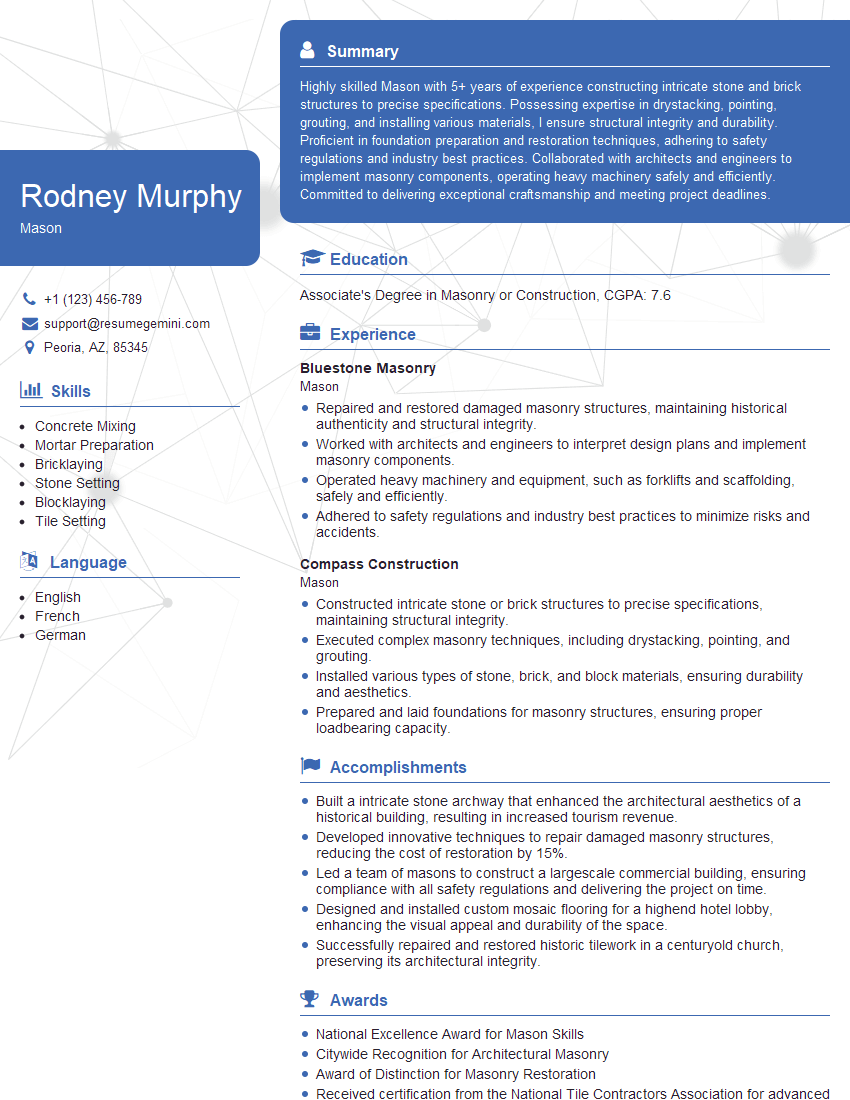
Mastering the art of cutting and shaping bricks opens doors to diverse and rewarding opportunities in the construction and masonry industries. A strong understanding of these techniques is crucial for career advancement, leading to increased responsibility and higher earning potential. To maximize your job prospects, invest time in crafting an ATS-friendly resume that effectively highlights your skills and experience. ResumeGemini is a trusted resource to help you build a professional and impactful resume that catches the eye of recruiters. Examples of resumes tailored to Cutting and Shaping Bricks are available to help guide you through this process.



Explore more articles
Users Rating of Our Blogs
Share Your Experience
We value your feedback! Please rate our content and share your thoughts (optional).
What Readers Say About Our Blog
To the interviewgemini.com Webmaster.
Very helpful and content specific questions to help prepare me for my interview!
Thank you
To the interviewgemini.com Webmaster.
This was kind of a unique content I found around the specialized skills. Very helpful questions and good detailed answers.
Very Helpful blog, thank you Interviewgemini team.