Every successful interview starts with knowing what to expect. In this blog, we’ll take you through the top DCS Operation and Monitoring interview questions, breaking them down with expert tips to help you deliver impactful answers. Step into your next interview fully prepared and ready to succeed.
Questions Asked in DCS Operation and Monitoring Interview
Q 1. Explain the architecture of a typical DCS system.
A typical Distributed Control System (DCS) architecture is built around a modular design, promoting scalability and redundancy. Think of it like a sophisticated network of interconnected brains managing a complex process. At the heart are the controllers, often referred to as Programmable Logic Controllers (PLCs) in simpler systems, which execute control algorithms and manage the I/O (input/output) signals from the process. These controllers communicate with each other and other system components via a high-speed network, often a proprietary network for better reliability.
Input/Output (I/O) modules are crucial for connecting the DCS to the real-world process. These modules interface with sensors (measuring temperature, pressure, flow, etc.) and actuators (valves, pumps, heaters, etc.). They convert analog signals from sensors to digital data for the controllers and vice versa for actuators.
The operator stations provide the human-machine interface (HMI). These stations display process data, allow operators to monitor and control the process, and manage alarms. This is often achieved through graphical displays and user-friendly software interfaces.
A historian system continuously logs process data for analysis, reporting, and troubleshooting. This data can be used to optimize the process, identify trends, and improve efficiency.
Finally, a engineering workstation allows engineers to configure, program, and maintain the entire system. This includes tasks like modifying control strategies, adding new I/O points, and updating software.
- Redundancy is often built into each component to ensure high availability.
- Communication protocols are vital for seamless information exchange between different parts of the DCS. Examples include Ethernet/IP, PROFIBUS, and others, depending on the vendor.
Q 2. Describe your experience with different DCS platforms (e.g., Honeywell, Siemens, Rockwell).
I have extensive experience with several leading DCS platforms, including Honeywell Experion, Siemens PCS 7, and Rockwell Automation’s PlantPAx. My experience spans across various industries, including oil and gas, chemicals, and power generation.
With Honeywell Experion, I’ve worked on projects involving complex refinery processes, focusing on optimizing control strategies for improved efficiency and safety. I’m proficient in configuring its advanced control functions, troubleshooting complex issues, and managing system upgrades.
My work with Siemens PCS 7 has centered around power plant applications, where I’ve dealt with the challenges of integrating various subsystems and ensuring seamless operation across diverse equipment. I’m familiar with its integrated engineering environment and its capabilities for distributed control and advanced process control (APC).
Lastly, my experience with Rockwell Automation’s PlantPAx has been primarily in the chemical industry, where I’ve focused on implementing batch control systems, ensuring rigorous quality control, and integrating safety instrumented systems (SIS). I’m comfortable navigating its architecture and leveraging its functionalities for batch recipe management and data acquisition.
Q 3. How do you troubleshoot a DCS alarm?
Troubleshooting a DCS alarm is a systematic process. It’s like detective work, and requires a methodical approach. First, identify the alarm; what variable triggered it, and what’s its severity? Second, review the alarm history for patterns. Is this a recurring alarm? Are there any related alarms occurring at the same time? Next, check the process itself. Does the actual process parameter match the value reported by the DCS? Look for discrepancies.
Then, verify the instrumentation. Is the sensor or actuator functioning correctly? A faulty sensor can lead to false alarms. Check for calibration issues or physical damage. Review the control logic to check if the alarm is triggered by a faulty control algorithm or incorrect thresholds. Finally, consider system issues. Is there any network problem affecting communication between the controllers and operator stations?
For example, if a high-temperature alarm is triggered, I’d check the temperature sensor calibration, the temperature readings from other nearby sensors, the status of the cooling system (is it functioning correctly?), and the historical data to see if this temperature increase is a gradual trend or a sudden spike. I might also analyze the control loops to see if there are any tuning issues.
Q 4. What are the common causes of DCS system failures?
DCS system failures can stem from various sources, broadly categorized into hardware, software, and environmental factors. Hardware failures include problems with I/O modules, controllers, network components, and operator stations. These could be caused by age, wear, or unexpected events like power surges. Software failures can result from bugs in the control algorithms, HMI software, or operating systems. Poor programming practices or inadequate testing can lead to such issues.
Environmental factors such as extreme temperatures, humidity, or vibrations can also compromise the system’s reliability. Consider the impact of a power outage—it can shut down the entire process unless appropriate backup systems are in place. Cybersecurity threats are a growing concern, where malicious attacks can disrupt operations or compromise data integrity. Improper configuration of security settings can leave the system vulnerable.
Imagine a scenario where a valve fails to open due to a faulty actuator. This could be a hardware failure leading to a process upset. Or a software bug could lead to the wrong control strategy being executed, causing a similar issue.
Q 5. Explain your understanding of DCS redundancy and failover mechanisms.
DCS redundancy and failover mechanisms are critical for ensuring high availability and preventing catastrophic failures. Redundancy means having multiple components in parallel, such that if one fails, another automatically takes over. This is like having a backup generator for your house: when the primary power source fails, the backup kicks in.
Redundant controllers are common, with each controller running an identical copy of the control program. If one controller fails, the other seamlessly takes over, ensuring continuous operation. Similar redundancy is implemented for network components, power supplies, and I/O modules.
Failover mechanisms define how the system handles the transition from the primary component to the backup. This involves automatic detection of failures, switching to the backup, and minimizing the disruption to the process. These mechanisms are meticulously designed to ensure a smooth transition with minimal downtime. A well-designed system can have seamless failover, making the change almost imperceptible to the operator.
Q 6. Describe your experience with DCS historian systems.
DCS historian systems are crucial for storing and retrieving process data. Think of them as the system’s memory, recording every important process variable over time. This data is essential for performance analysis, troubleshooting, reporting, and regulatory compliance. I’ve worked with various historian systems, including OSIsoft PI, Aspen InfoPlus.21, and vendor-specific historian solutions integrated with the DCS.
My experience encompasses configuring historians to archive specific data points, setting up alarm notifications based on historical trends, and generating reports for various purposes, including regulatory compliance reports and performance optimization studies. I’m also adept at querying and analyzing historical data using various tools and techniques. For example, I’ve used historical data to identify the root cause of a recurring process upset, leading to improved control strategies and reduced downtime.
Q 7. How do you ensure the security of a DCS system?
Ensuring the security of a DCS system is paramount, especially in today’s threat landscape. A compromised DCS can lead to significant safety hazards, production losses, and environmental damage. A multi-layered approach is vital.
Network security involves implementing firewalls, intrusion detection systems, and secure network protocols to protect the system from external threats. Access control is a must, with strict user authentication and authorization procedures in place. Software security includes regularly updating the system software, applying security patches, and using anti-virus software. Physical security involves securing the DCS hardware from unauthorized access and physical damage. This may involve controlled access to control rooms and regular physical inspections of the equipment.
Regular security audits and penetration testing are vital to identify vulnerabilities and implement preventive measures. Employee training is crucial for raising awareness about cybersecurity threats and best practices. Finally, a well-defined incident response plan is critical for handling security incidents effectively and minimizing their impact.
Q 8. What are your strategies for optimizing DCS performance?
Optimizing DCS performance involves a multifaceted approach focusing on efficiency, reliability, and safety. My strategies begin with proactive monitoring using advanced analytics to identify bottlenecks and potential issues before they impact operations. This includes analyzing historical data to pinpoint recurring problems and predict future needs.
- Regular Software Updates and Patching: Keeping the DCS software up-to-date is crucial for bug fixes, performance enhancements, and security. I meticulously follow vendor recommendations and implement updates during planned downtime to minimize disruption.
- Network Optimization: A robust and efficient network is essential for high-speed data transfer and reliable communication between DCS components. This includes optimizing network bandwidth, implementing redundancy protocols, and monitoring network latency. In one project, we identified a network bottleneck causing slow response times by utilizing network monitoring tools. Implementing a dedicated network segment for the DCS drastically improved performance.
- Hardware Maintenance and Preventative Measures: Regular hardware inspections and preventative maintenance are key to avoid unexpected failures. This involves checking for overheating, loose connections, and ensuring proper cooling systems are functional. A proactive maintenance schedule, coupled with regular testing of backup systems, can significantly reduce downtime.
- Efficient Process Control Algorithms: Optimizing control loops through proper tuning and algorithm selection (like using advanced control strategies when appropriate) can improve process stability and reduce energy consumption. For instance, switching from a basic PID controller to a model predictive controller (MPC) in a refinery improved product quality and reduced waste.
- Operator Training and Procedure Optimization: Well-trained operators are essential for efficient DCS management. Regular training programs, clear operating procedures, and effective alarm management protocols reduce errors and improve response times during unexpected events.
Ultimately, the goal is a robust, reliable, and efficient DCS system supporting safe and optimized plant operations.
Q 9. Explain your experience with DCS loop tuning.
DCS loop tuning is a critical skill in process control, directly influencing process stability and performance. My experience spans various industries, including oil and gas and chemical processing, where I’ve tuned loops for diverse processes like temperature control, pressure regulation, and flow rate management.
My approach involves a combination of theoretical understanding and practical application. I start by understanding the process dynamics: determining the process gain, time constant, and dead time. This often involves using techniques like step testing or relay auto-tuning.
I’m proficient in various tuning methods, including Ziegler-Nichols, Cohen-Coon, and advanced methods like Internal Model Control (IMC). The choice of method depends on the process characteristics and desired performance. For example, a fast-responding process might require aggressive tuning, while a slow-responding process might benefit from a more conservative approach. After tuning a loop, I carefully monitor its response to setpoint changes and disturbances, adjusting parameters as needed to achieve optimal performance: minimal overshoot, rapid settling time, and good disturbance rejection.
Documentation is crucial. I maintain thorough records of tuning parameters, test results, and any adjustments made. This is essential for troubleshooting and future modifications.
Q 10. Describe your experience with DCS configuration and programming.
My experience with DCS configuration and programming encompasses several major platforms, including Siemens PCS 7, Honeywell Experion, and ABB 800xA. My skills include developing and implementing control strategies, configuring alarms and annunciators, creating custom faceplates and displays, and integrating third-party devices.
I’m proficient in using configuration tools and programming languages specific to each platform. For example, I have extensive experience using function blocks in Siemens PCS 7 and utilizing scripting capabilities in Honeywell Experion to automate tasks and improve efficiency. A recent project involved integrating a new gas chromatograph into an existing DCS using OPC communication, requiring significant configuration and programming expertise.
I follow strict configuration management protocols, ensuring version control and backup systems are in place to prevent data loss and ensure system integrity. My approach always prioritizes clarity and maintainability in code, using structured programming techniques and commenting extensively to facilitate future modifications and troubleshooting.
Q 11. How do you handle critical situations or emergencies in a DCS environment?
Handling critical situations in a DCS environment requires a calm and systematic approach. My experience involves addressing various emergencies, including equipment failures, process upsets, and safety shutdowns.
My response strategy follows these steps:
- Rapid Assessment: Quickly identify the nature and severity of the problem using the DCS’s alarm system and process monitoring tools. Prioritize based on potential safety hazards and impact on plant operations.
- Emergency Procedures: Immediately implement pre-defined emergency procedures specific to the situation. These procedures should be well-documented, tested regularly, and readily accessible to operators.
- Isolate the Problem: If possible, isolate the affected area of the plant to prevent further escalation of the problem. This might involve shutting down equipment or rerouting process streams.
- Corrective Actions: Take appropriate corrective actions to restore the process to a stable state. This might involve manual intervention, adjusting control loops, or restarting equipment.
- Root Cause Analysis: After the emergency is resolved, conduct a thorough root cause analysis to determine what led to the incident and implement preventative measures to avoid future occurrences. This often involves collaborating with maintenance and engineering teams.
Clear communication is crucial throughout the entire process, ensuring seamless collaboration between operators, engineers, and management.
Q 12. Explain your understanding of process control concepts (PID control, cascade control).
Process control concepts like PID control and cascade control are fundamental to my work. Let’s define them:
- PID Control: This is a widely used feedback control loop mechanism that adjusts a control element to minimize the error between a desired setpoint and a measured process variable. PID stands for Proportional, Integral, and Derivative. The proportional term addresses the current error, the integral term addresses accumulated error, and the derivative term anticipates future error based on the rate of change.
Example: A PID controller regulating temperature maintains a desired temperature by adjusting a heating element's output. - Cascade Control: This is an advanced control strategy where one control loop (the secondary loop) regulates a setpoint for another control loop (the primary loop). This enhances control performance by addressing disturbances more quickly and efficiently. For instance, a cascade control system could use a secondary loop to regulate the flow of steam to a heating element, directly influencing the primary loop’s temperature control. This achieves tighter temperature control compared to a single loop solution.
Understanding these concepts allows me to design and implement efficient and robust control systems, improving process stability, efficiency, and safety.
Q 13. Describe your experience with DCS graphic displays and human-machine interfaces (HMIs).
Effective DCS graphic displays and HMIs are crucial for efficient plant operation and monitoring. My experience involves designing, developing, and maintaining HMIs for various processes and platforms.
I’m skilled in creating user-friendly interfaces that provide clear and concise information about process variables, alarms, and system status. This includes designing intuitive navigation, utilizing effective color coding, and employing clear symbols to represent different process elements. For example, using different colors to represent normal, warning, and critical states provides operators with a quick visual assessment of plant health.
I prioritize ease of use and operator efficiency, creating HMIs optimized for different tasks and user roles. This includes designing displays for overview monitoring, detailed process control, and trend analysis. In one project, implementing a new HMI layout reduced operator response time to alarms by 20%, enhancing plant safety and efficiency. Ensuring compatibility and consistency across different DCS platforms is also a priority.
Q 14. What is your experience with DCS hardware maintenance and troubleshooting?
DCS hardware maintenance and troubleshooting are crucial aspects of ensuring system reliability and preventing downtime. My experience encompasses preventative maintenance, troubleshooting hardware failures, and performing repairs or replacements.
My preventative maintenance approach includes regular inspections of hardware components (e.g., I/O modules, processors, network devices), checking connections, verifying proper cooling, and testing backup systems. I follow manufacturer recommendations and develop tailored maintenance schedules based on the specific hardware and operational needs.
Troubleshooting involves systematic identification and resolution of hardware issues. This involves using diagnostic tools, checking error logs, and analyzing system behavior to pinpoint the root cause. A recent example involved troubleshooting an intermittent communication failure between a remote I/O module and the main DCS. Through systematic checks, I identified a faulty cable causing the issue. I am familiar with various hardware components, including I/O modules, PLCs, network switches, and communication protocols, and understand the importance of proper grounding and electrical safety procedures.
Q 15. How do you document DCS system changes and modifications?
Documenting DCS system changes and modifications is crucial for maintaining system integrity, traceability, and regulatory compliance. We use a robust, multi-layered approach. Firstly, all changes are initiated through a formal change management system, typically using a ticketing or workflow system. This ensures proper authorization and review before any alteration is implemented.
Secondly, detailed documentation is created and meticulously maintained. This includes a description of the change, the reason for the change, the impact assessment, and step-by-step procedures. We use version control systems to track all modifications to the DCS configuration files and application code. Specific documentation includes:
- Change Request Forms: These detail the justification, proposed solution, and potential risks.
- Engineering Drawings: Updated diagrams reflecting new hardware or wiring.
- Software Configuration Files: Version-controlled copies of all application and database changes.
- Testing Procedures and Results: Documentation showing rigorous testing before and after the change.
Finally, after implementation, a post-implementation review is conducted to assess the success of the change and identify areas for improvement in our processes. This feedback loop is essential for continuous improvement of our change management strategy. For instance, during a recent upgrade of our Honeywell Experion DCS, we documented every step of the PLC firmware update, including pre- and post-update checks, ensuring seamless transition and minimal downtime.
Career Expert Tips:
- Ace those interviews! Prepare effectively by reviewing the Top 50 Most Common Interview Questions on ResumeGemini.
- Navigate your job search with confidence! Explore a wide range of Career Tips on ResumeGemini. Learn about common challenges and recommendations to overcome them.
- Craft the perfect resume! Master the Art of Resume Writing with ResumeGemini’s guide. Showcase your unique qualifications and achievements effectively.
- Don’t miss out on holiday savings! Build your dream resume with ResumeGemini’s ATS optimized templates.
Q 16. Explain your experience with DCS backup and recovery procedures.
Robust backup and recovery procedures are paramount for ensuring DCS system availability and data integrity. My experience encompasses both online and offline backup strategies, depending on the specific needs of the system. Online backups involve creating backups while the system remains operational, minimizing downtime. Offline backups, on the other hand, require taking the system offline, allowing for a complete and consistent backup.
We typically employ a tiered backup approach:
- Regular backups (daily): Incremental backups to local storage for quick recovery from minor incidents.
- Full backups (weekly): Complete system backups to offsite storage for disaster recovery.
- Database backups: Separate, frequent backups of the historian database for long-term data retention.
The recovery process involves meticulously following documented procedures. This includes verifying the integrity of the backup, restoring the system from the backup, and performing thorough testing to ensure everything functions correctly. For example, in one instance, we successfully recovered a critical DCS system within four hours after a server failure, thanks to our well-defined procedures and regularly tested backups. We also conduct regular drills to ensure our team is well-versed in these procedures.
Q 17. What is your experience with DCS network communication protocols (e.g., Modbus, Profibus)?
My experience includes extensive work with various DCS network communication protocols. Understanding these protocols is crucial for integrating DCS systems with other plant equipment and systems. I have hands-on experience with:
- Modbus TCP/RTU: Used extensively for communicating with PLCs, sensors, and actuators. I’ve troubleshooted numerous communication issues by analyzing Modbus messages and addressing network configuration problems.
- Profibus DP/PA: Used for high-speed, real-time communication in process automation applications. I have experience in configuring and troubleshooting Profibus networks, including addressing issues like bus errors and communication timing.
- Ethernet/IP: Used for communication between PLCs and other devices in industrial automation systems. My skills encompass configuring and monitoring Ethernet/IP networks and using diagnostic tools to identify and resolve communication faults.
- OPC UA: The modern standard for industrial data exchange. I’m proficient in setting up and configuring OPC UA servers and clients for seamless data integration between different systems.
Troubleshooting often involves analyzing network traffic using tools such as Wireshark to pinpoint communication bottlenecks or errors. I am familiar with different network topologies and hardware components, allowing me to identify and resolve network-related problems efficiently.
Q 18. Describe your experience with DCS data acquisition and reporting.
DCS data acquisition and reporting is crucial for effective process monitoring, control, and optimization. My expertise covers the entire data lifecycle, from acquisition to presentation. This involves configuring data points, setting up alarm thresholds, and creating custom reports and dashboards.
I’m proficient in using DCS historian software to manage and analyze historical process data. This includes:
- Data Point Configuration: Setting up and configuring data points to ensure accurate and reliable data acquisition.
- Alarm Management: Configuring alarms to alert operators of critical process deviations.
- Report Generation: Creating custom reports and dashboards to visualize process data and identify trends.
- Data Analysis: Using historical data to identify areas for improvement and optimize process parameters.
For instance, in a previous role, I developed a custom report that automated the generation of daily production reports, significantly improving efficiency and providing valuable insights into production trends. I also have experience working with different reporting tools, allowing me to create tailored reports suitable for various stakeholders.
Q 19. Explain your approach to root cause analysis in a DCS system failure.
Root cause analysis (RCA) for DCS system failures requires a systematic and methodical approach. My strategy typically involves:
- Gather Information: This involves collecting data from various sources, including alarm logs, operator logs, system diagnostics, and witness accounts.
- Identify Symptoms and Events: Defining the specific problem and the sequence of events leading to the failure.
- Develop Theories: Based on the gathered information, formulating hypotheses regarding the potential root causes.
- Test Theories: Using available data and knowledge to validate or reject the proposed hypotheses.
- Identify Root Cause: Determining the underlying reason for the failure, not just the immediate symptom.
- Develop Corrective Actions: Implementing preventative measures to prevent recurrence of the failure.
- Verify Effectiveness: Monitoring the system to confirm that the implemented corrective actions are effective.
I utilize various RCA methodologies, including the ‘5 Whys’ technique and fault tree analysis. In a recent case, a sudden shutdown was traced, using fault tree analysis, not to a sensor failure as initially suspected, but to a cascading failure due to an unnoticed software bug in the safety instrumented system. This highlights the importance of systematic investigation to find the true root cause.
Q 20. How do you ensure data integrity in a DCS system?
Ensuring data integrity in a DCS system is crucial for making accurate decisions and maintaining regulatory compliance. This involves a multi-pronged strategy:
- Data Validation: Implementing data validation checks at various points in the data acquisition process to ensure data accuracy and consistency. This may include range checks, plausibility checks, and cross-checks against other data sources.
- Redundancy: Implementing redundant systems and components to ensure data availability even in case of failures. This includes redundant sensors, PLCs, and network connections.
- Data Logging and Archiving: Implementing a robust data logging and archiving system to ensure the long-term preservation of data. This should include measures for data security and access control.
- Regular Audits: Performing regular audits of the DCS system to verify data integrity and identify potential vulnerabilities.
- Cybersecurity Measures: Implementing robust cybersecurity measures to protect the DCS system from unauthorized access and cyberattacks. This includes firewalls, intrusion detection systems, and access control mechanisms.
For example, implementing digital signatures on logged data ensures data authenticity and prevents unauthorized modification. We also regularly perform data reconciliation checks, comparing DCS data to data from other sources to identify discrepancies and potential errors.
Q 21. What is your experience with DCS validation and qualification?
DCS validation and qualification (V&Q) is essential for ensuring the system meets its intended purpose and operates reliably and safely. My experience encompasses both hardware and software aspects of V&Q, following industry best practices such as GAMP 5.
The process typically involves:
- Defining Requirements: Clearly defining the requirements for the DCS system in terms of functionality, safety, and performance.
- Design Qualification (DQ): Reviewing the design of the DCS system to ensure it meets the defined requirements.
- Installation Qualification (IQ): Verifying that the DCS system is installed and configured correctly.
- Operational Qualification (OQ): Testing the DCS system to ensure it operates as intended under defined operating conditions.
- Performance Qualification (PQ): Demonstrating that the DCS system consistently meets its performance requirements over time.
Documentation is critical throughout the V&Q process. We meticulously record all test procedures, results, and deviations. I have led numerous V&Q projects, ensuring compliance with relevant regulatory guidelines and industry standards. This often involves collaboration with engineers, operators, and regulatory bodies to achieve successful validation.
Q 22. Describe your experience with using DCS simulation tools.
My experience with DCS simulation tools spans several years and various platforms. I’ve extensively used simulators like Emerson’s DeltaV Simulator and Rockwell Automation’s FactoryTalk Simulation to test control logic, operator training, and process optimization strategies before deploying them to the actual plant. For example, during a recent project involving a new refinery unit, we leveraged DeltaV Simulator to mimic different process upsets – like a sudden drop in feedstock pressure – allowing operators to practice their response and helping us fine-tune the control algorithms to ensure optimal and safe operation. This virtual environment prevented costly downtime and potential safety hazards in the real-world implementation. Beyond operator training, the simulator helped us identify and resolve logic flaws in the control system early in the development lifecycle, saving significant time and resources.
I’m also proficient in using various simulation tools to create custom models that accurately reflect the dynamics of specific processes. This often involves integrating process models, such as those built in Aspen Plus or Hysys, with the DCS simulation software. This level of detailed modelling allows for a more realistic simulation and enables thorough testing of complex scenarios, like emergency shutdowns or start-up procedures.
Q 23. How do you handle conflicting priorities in a DCS environment?
Conflicting priorities in a DCS environment are a common occurrence. My approach involves a structured prioritization framework based on risk assessment, urgency, and impact. I typically use a weighted scoring system that factors in the potential safety consequences, the impact on production output, and the urgency of the request. Imagine a scenario where you have a minor alarm requiring attention, a process parameter drifting outside its optimal range, and a critical safety alert. I would immediately address the critical safety alert first, then prioritize the drifting parameter based on its potential to escalate into a major issue, and finally address the minor alarm. This approach ensures that the most critical issues receive immediate attention, minimizing potential damage and ensuring plant safety.
Effective communication is paramount. I ensure all stakeholders – operators, engineers, and management – are clearly informed about the prioritization process and the reasoning behind it. Transparent communication minimizes misunderstandings and fosters collaboration during potentially stressful situations.
Q 24. Explain your experience with integrating DCS systems with other plant systems.
I have extensive experience integrating DCS systems with other plant systems, including SCADA, PLC’s, historians, and enterprise resource planning (ERP) systems. One project involved integrating a new DCS with an existing SCADA system responsible for monitoring the water treatment plant of a large chemical facility. The integration involved developing custom communication protocols (often using OPC UA or Modbus) to allow for seamless data exchange between the two systems. This required careful consideration of data formats, security protocols, and data redundancy to prevent data loss or inconsistencies. The end result was improved plant-wide visibility and monitoring capabilities, contributing to better overall process efficiency and control.
Another example involved integrating the DCS with an ERP system to automate reporting and inventory management. This integration streamlined operations and provided real-time visibility into production data and inventory levels, which improved supply chain management and optimized production planning.
Q 25. What safety measures are you familiar with in a DCS environment?
Safety is paramount in a DCS environment. I’m familiar with various safety measures including:
- Emergency Shutdown Systems (ESD): Understanding the logic and functionality of ESD systems is critical. I’ve participated in numerous ESD system design reviews and testing. Regular testing and simulations are vital to ensure the ESD system operates as designed under various fault conditions.
- High Integrity Protection Systems (HIPS): I have experience designing and implementing HIPS for critical process parameters, employing independent safety instrumented systems to prevent hazardous events. The use of SIL (Safety Integrity Level) classifications ensures appropriate safety levels are met.
- Alarm Management: Poor alarm management can lead to operator fatigue and missed critical alerts. I’m skilled in designing alarm systems that minimize false alarms, and efficiently communicate critical events using different alarm prioritization methods.
- Functional Safety Standards: I’m proficient in implementing safety standards like IEC 61511 (Functional safety of process safety systems) and IEC 61508 (Functional safety of electrical/electronic/programmable electronic safety-related systems).
- Lockout/Tagout Procedures: I adhere to stringent lockout/tagout procedures to prevent accidental energization of equipment during maintenance or repairs.
Q 26. Describe your experience with DCS troubleshooting using diagnostic tools.
DCS troubleshooting often involves utilizing a range of diagnostic tools. My experience includes utilizing DCS-specific diagnostic software, historians for trending data analysis, and specialized network analyzers to pinpoint problems. For instance, recently, during an unexpected process shutdown, the DCS historian played a crucial role. By reviewing historical data, we identified a gradual increase in a specific process variable that ultimately triggered the shutdown. This allowed us to trace the root cause back to a faulty sensor.
I’m also skilled in using advanced diagnostic techniques such as loop testing, signal analysis, and event logging to identify the root cause of malfunctions. A structured troubleshooting approach, combining these tools and techniques with a good understanding of the process and control system, is essential for timely and effective problem resolution. Sometimes even simple techniques like checking wiring connections or verifying power supply are crucial first steps.
Q 27. How do you stay updated on the latest DCS technologies and trends?
Staying updated on DCS technologies and trends involves continuous learning. I regularly attend industry conferences and webinars, participate in online courses and training programs offered by vendors like Emerson, Rockwell Automation, and Siemens. I also actively follow industry publications, journals, and online forums to stay informed about the latest advancements in DCS architecture, cybersecurity, and advanced process control strategies like model predictive control (MPC).
Moreover, I actively seek opportunities to work on new projects that incorporate cutting-edge technologies. Hands-on experience with new systems and technologies provides invaluable learning opportunities and keeps my skills sharp. Engaging with professional organizations like ISA (Instrumentation, Systems, and Automation Society) also provides valuable insights into the future direction of DCS technologies.
Key Topics to Learn for DCS Operation and Monitoring Interview
- DCS Architecture and Fundamentals: Understanding the different components of a Distributed Control System (DCS), including PLCs, HMIs, and communication networks. This includes knowledge of various topologies and their strengths and weaknesses.
- Process Control Strategies: Familiarity with different control loops (PID, cascade, ratio), their tuning methods, and troubleshooting techniques. Be prepared to discuss practical examples of implementing and adjusting these strategies.
- Alarm Management and Response: Understanding alarm prioritization, effective alarm handling procedures, and strategies for minimizing false alarms. Discuss your experience with alarm reduction techniques and strategies.
- Data Acquisition and Analysis: Knowledge of data logging, historical trending, and the use of DCS data for process optimization and troubleshooting. This includes familiarity with various data visualization techniques.
- Security and Cybersecurity in DCS: Understanding the security implications of DCS systems and the measures to protect them from cyber threats. Be ready to discuss best practices and relevant standards.
- Troubleshooting and Problem-Solving: Demonstrate your ability to systematically troubleshoot DCS issues, identify root causes, and implement effective solutions. Be prepared to discuss your approach to problem-solving using real-world examples.
- Regulatory Compliance: Knowledge of relevant industry standards and regulations related to DCS operation and monitoring (e.g., ISA, IEC standards). Discuss how your experience ensures compliance.
- Backup and Recovery Procedures: Understanding the criticality of data backups and recovery strategies in case of system failures. Describe your experience with implementing and testing such procedures.
Next Steps
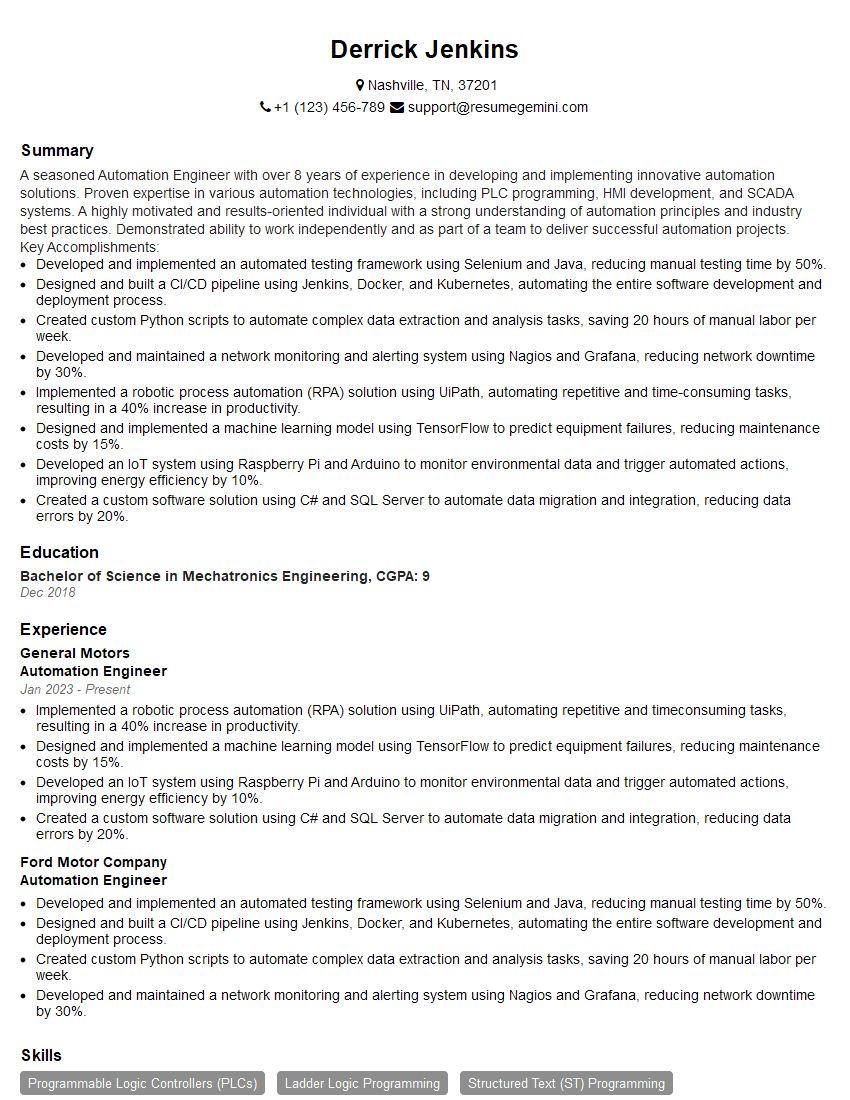
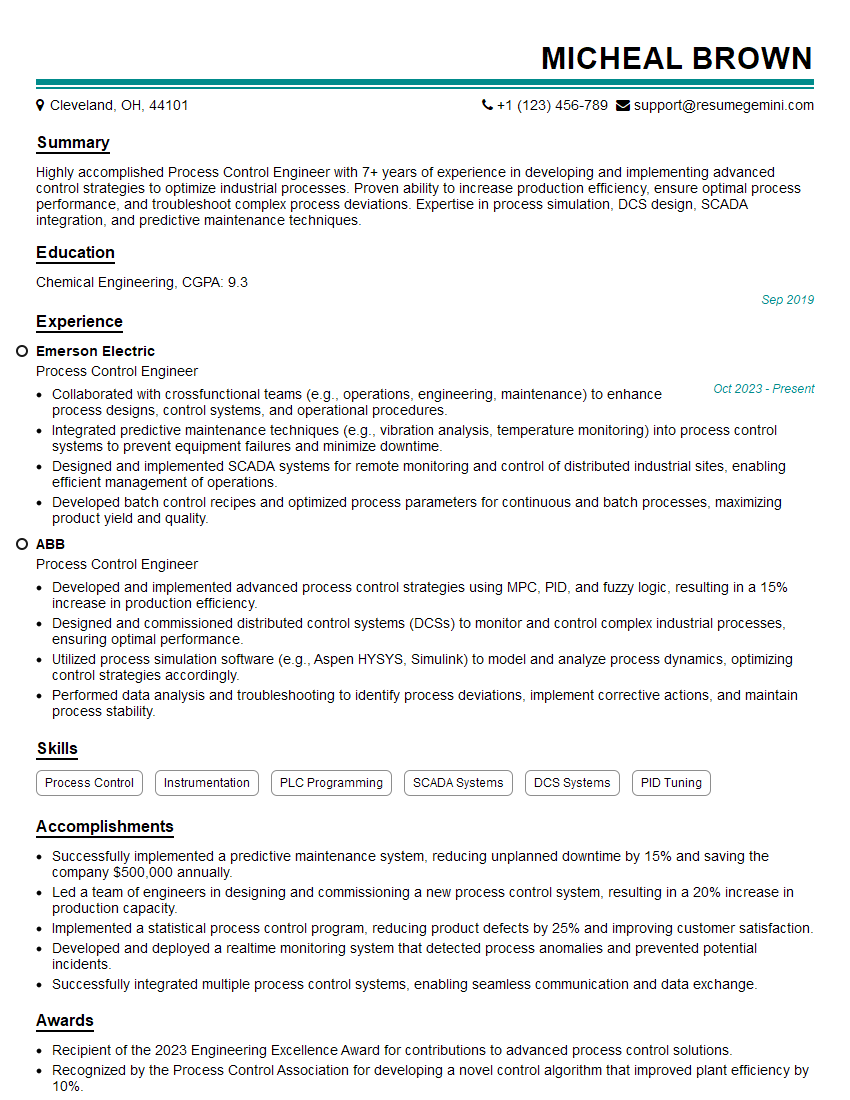
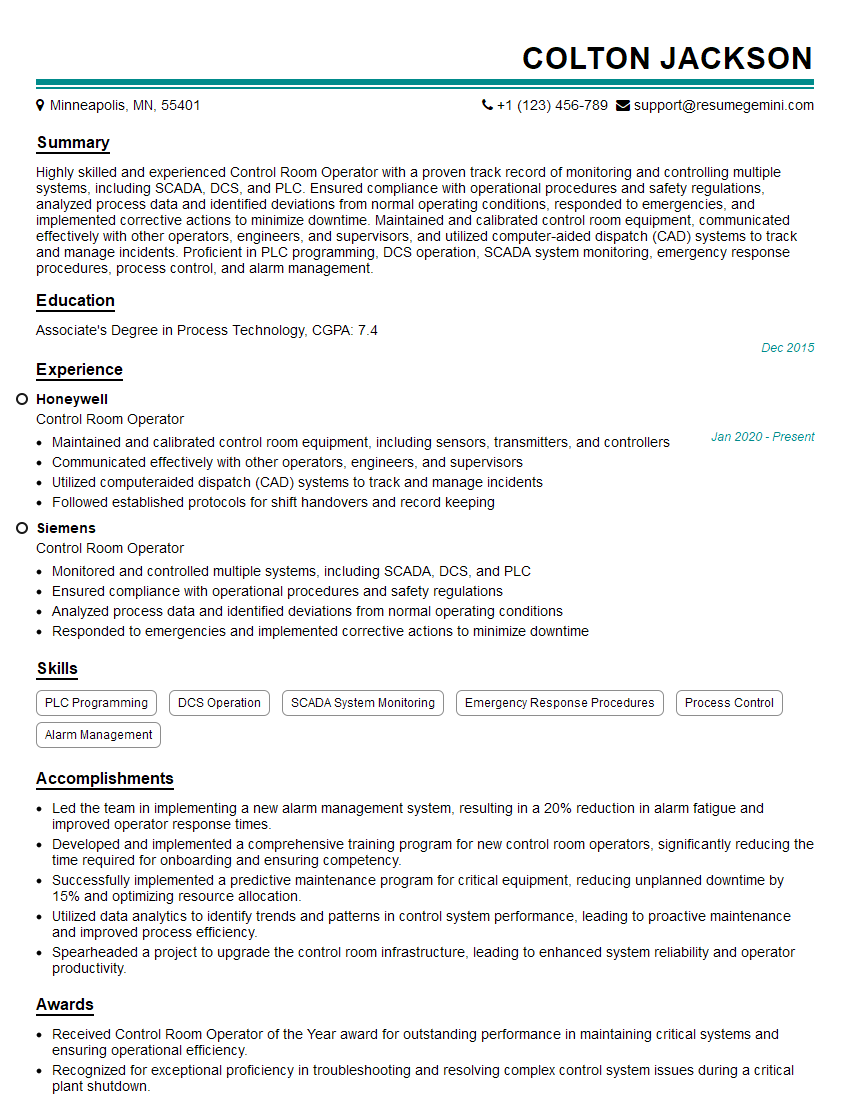
Mastering DCS Operation and Monitoring is crucial for a successful and rewarding career in process automation. This skillset is highly sought after, opening doors to diverse roles with increasing responsibility and compensation. To maximize your job prospects, focus on building an ATS-friendly resume that clearly highlights your skills and experience. ResumeGemini is a trusted resource to help you create a professional and impactful resume that stands out. Examples of resumes tailored to DCS Operation and Monitoring are available to guide you, ensuring your application gets noticed.
Explore more articles
Users Rating of Our Blogs
Share Your Experience
We value your feedback! Please rate our content and share your thoughts (optional).
What Readers Say About Our Blog
To the interviewgemini.com Webmaster.
Very helpful and content specific questions to help prepare me for my interview!
Thank you
To the interviewgemini.com Webmaster.
This was kind of a unique content I found around the specialized skills. Very helpful questions and good detailed answers.
Very Helpful blog, thank you Interviewgemini team.