Are you ready to stand out in your next interview? Understanding and preparing for Digital Photography for Nature Documentation interview questions is a game-changer. In this blog, we’ve compiled key questions and expert advice to help you showcase your skills with confidence and precision. Let’s get started on your journey to acing the interview.
Questions Asked in Digital Photography for Nature Documentation Interview
Q 1. Explain your experience with various camera systems (DSLR, mirrorless, etc.) for nature photography.
My experience spans across various camera systems, each offering unique advantages for nature photography. I’ve extensively used DSLR cameras, appreciating their robust build, extensive lens selection, and optical viewfinders for precise focusing in bright conditions. However, the advancements in mirrorless technology have significantly impacted my workflow. Mirrorless cameras, like those from Sony and Fujifilm, offer superior autofocus performance, especially for tracking fast-moving subjects like birds in flight, along with the advantage of silent shooting, crucial for undisturbed wildlife observation. I find myself increasingly leaning towards mirrorless systems for their overall versatility and image quality, particularly in low-light situations. For instance, I recently captured stunning shots of a nocturnal owl using a mirrorless camera with its superior low-light capabilities.
Q 2. Describe your proficiency in different lenses and their applications in nature photography (e.g., telephoto, macro, wide-angle).
Lens selection is paramount in nature photography. A telephoto lens, such as a 100-400mm or even a longer 600mm lens, is essential for capturing distant wildlife without disturbing them. I often use a 150-600mm lens for capturing birds in their natural habitat, allowing me to get incredibly detailed images while maintaining a safe distance. For close-up shots of insects or flowers, a macro lens, typically with a magnification ratio of 1:1 or higher, is indispensable. I’ve had great success using a 100mm macro lens for capturing intricate details of flora. Finally, a wide-angle lens, like a 16-35mm, offers a broader perspective, perfect for landscapes and capturing the environment surrounding the subject, providing crucial context to my images. It’s not just about the focal length, but also the aperture; fast lenses (low f-numbers like f/2.8) are incredibly useful for capturing sharp images in low light conditions.
Q 3. How do you manage light and exposure in challenging outdoor conditions (e.g., low light, backlighting)?
Managing light and exposure in challenging outdoor conditions requires a deep understanding of both your camera’s settings and the environment. Low-light situations demand increasing the ISO sensitivity, understanding the trade-off between noise and image sharpness. I often use a tripod and a remote shutter release to minimize camera shake. Backlighting can lead to underexposed subjects, so I frequently employ techniques like fill flash, using a speedlight or reflector to bounce light onto the subject. Mastering exposure compensation is crucial; I frequently use spot metering to focus on the subject’s exposure, ensuring it’s properly lit while managing the dynamic range of the scene. For example, when shooting a deer in a forest during twilight, I’ll combine a high ISO, a wide aperture, and potentially a fill flash to achieve a properly exposed image with minimal noise.
Q 4. What are your preferred image editing techniques for nature photography, and which software are you proficient in (e.g., Lightroom, Photoshop)?
My post-processing workflow heavily relies on Adobe Lightroom and Photoshop. Lightroom is my primary tool for initial adjustments—white balance correction, exposure tweaks, contrast adjustments, and sharpening. I then bring complex edits into Photoshop for things that need more precision, such as cloning out distracting elements, more advanced retouching, or HDR merging for improved dynamic range. I favor a non-destructive editing approach, meticulously layering adjustments to preserve image quality and allow for easy revisions. Techniques like dodging and burning are crucial for highlighting key elements and adding depth. I also utilize masking extensively to isolate specific areas for targeted edits. For example, I might use masking in Photoshop to selectively brighten a bird’s plumage without altering the background.
Q 5. Discuss your approach to composition and storytelling in nature photography.
Composition and storytelling are at the heart of my nature photography. I strive to apply the rule of thirds, leading lines, and other compositional guidelines to create visually appealing images. Storytelling goes beyond a single image; I aim to capture the essence of the subject and its environment. This might involve showcasing the animal’s behavior, its interaction with its habitat, or the beauty of its surroundings. For instance, a photograph of a lone wolf howling at sunset would tell a story of solitude and wilderness. I aim for simplicity and clarity; a powerful image often conveys more than a cluttered one.
Q 6. How do you ensure the ethical treatment of wildlife while photographing them?
Ethical considerations are paramount. I prioritize the well-being of wildlife above all else. This means maintaining a safe distance, avoiding disruptive behavior, and never interfering with natural processes. I never use bait or lures to attract animals, and I’m always mindful of the impact my presence might have. I research the local regulations and guidelines for photographing wildlife and always seek permits when necessary. My goal isn’t to control or manipulate the animals; it’s to observe and document them respectfully in their natural habitat.
Q 7. Explain your workflow from image capture to final output, including post-processing and archiving.
My workflow begins with careful planning—researching locations, understanding animal behavior, and anticipating ideal light conditions. Once I capture images, I meticulously review them on location, deleting obvious misses. Back at my studio, I import images into Lightroom for initial processing, carefully adjusting exposure, contrast, and white balance. Complex edits are handled in Photoshop, followed by export at high resolution for archiving and printing. I use a robust archiving system with multiple backups, employing both local and cloud storage to ensure long-term preservation of my work. Keywords and metadata are critically important for efficient organization and retrieval of images in the future.
Q 8. Describe your experience with various file formats (RAW, JPEG) and their advantages in nature photography.
In nature photography, the choice between RAW and JPEG file formats significantly impacts the final image quality and post-processing capabilities. RAW files are uncompressed or minimally compressed, containing all the data captured by the camera’s sensor. JPEGs, on the other hand, are compressed, resulting in smaller file sizes but also a loss of some image data.
- RAW Advantages: RAW files offer unparalleled flexibility in post-processing. You have much greater control over aspects like exposure, white balance, contrast, and sharpening, allowing you to recover detail in shadows or highlights that might be lost in a JPEG. This is particularly crucial in nature photography where lighting conditions can be unpredictable. For example, if I’m shooting a sunset and slightly underexpose the RAW file, I can significantly recover detail in the shadows during editing. I can also correct white balance issues if the scene is heavily influenced by the setting sun’s warm light.
- JPEG Advantages: JPEGs are smaller and easier to share and manage, making them suitable for quick snapshots or situations where immediate sharing is necessary, such as social media posts. However, the quality sacrifice can be noticeable, especially when significant editing is required.
- My Approach: I primarily shoot in RAW format for nearly all my nature photography work. The increased post-processing flexibility is invaluable, ensuring I get the best possible image quality and creative control. I only use JPEGs if immediate sharing is critical and image quality is less of a priority.
Q 9. How do you deal with unpredictable weather conditions during a photoshoot?
Unpredictable weather is an inherent challenge in nature photography. Preparation and adaptability are key. Before any shoot, I meticulously check the forecast and pack accordingly. This includes waterproof camera bags, rain covers for my gear, and extra batteries (cold weather drains batteries faster).
- Adaptability: If the weather turns unexpectedly, I adjust my plans. A sudden downpour might mean seeking shelter and waiting it out, or creatively using the rain itself to create atmospheric shots (rainbows, misty scenes). A sudden change in light might mean adjusting my aperture, ISO, or shutter speed to compensate.
- Safety First: My safety and the safety of my equipment are always top priorities. I avoid dangerous situations and never risk getting caught in a severe storm.
- Example: During a bird photography trip, a sudden hailstorm forced me to retreat. Instead of being frustrated, I used the time to observe the birds seeking shelter, gaining insights into their behavior. When the storm cleared, I managed to get some incredible shots of them drying their feathers.
Q 10. How do you approach photographing shy or elusive wildlife subjects?
Photographing shy wildlife requires patience, camouflage, and a respectful approach. Disturbing animals should always be avoided.
- Camouflage and Patience: I use camouflage clothing and try to blend into the environment. I approach slowly and quietly, giving the animal ample time to acclimate to my presence. Hours of stillness can be necessary. Think of it like a silent meditation, completely immersed in my surroundings.
- Understanding Animal Behavior: I study the habits and patterns of the species I’m photographing. Knowing their typical feeding times, resting spots, or migratory routes drastically increases my chances of capturing them without disturbing them.
- Long Lenses and Teleconverters: Telephoto lenses with a significant zoom range (e.g., 600mm or 800mm) allow me to photograph animals from a safe and respectful distance. Teleconverters further extend this reach, especially helpful for very shy or distant animals.
- Using Blinds or Concealment: For particularly sensitive animals, using a natural blind (e.g., behind a bush or rock) or a portable hide can significantly improve my success rate and prevent animal distress.
Q 11. Explain your understanding of camera traps and their effective deployment for wildlife photography.
Camera traps are invaluable tools for capturing elusive wildlife in their natural habitat without disturbing them. These remotely triggered cameras record images or videos when motion is detected.
- Deployment Strategy: Effective deployment involves choosing locations with high animal activity (based on tracks, scat, or previous sightings), using appropriate lures or bait (carefully considering ethical implications and local regulations), and ensuring the camera is securely fastened and well-camouflaged. The choice of camera is important, and factors to consider are sensor sensitivity, battery life, and the quality of the images and videos the camera produces.
- Data Management: Checking the camera traps regularly is essential to download images, change batteries, and adjust settings as needed. Proper organization and labeling of images are crucial for managing a potentially large number of files.
- Ethical Considerations: It is crucial to prioritize animal welfare. Never use harmful baits or traps, and adhere to local laws and regulations. Ensure you are not disturbing or stressing the animals.
- Example: I recently used camera traps to document the nocturnal activity of a rare species of owl. By strategically placing the cameras near their known nesting grounds, I captured fascinating images of the owl hunting and interacting with its young, something that would have been nearly impossible to achieve with traditional photography techniques.
Q 12. Describe your familiarity with different lighting techniques (natural light, flash, strobes).
Mastering lighting is fundamental to successful nature photography. Natural light, flash, and strobes each offer unique advantages and disadvantages.
- Natural Light: The “golden hour” (sunrise and sunset) offers warm, soft light ideal for wildlife and landscape photography. The “blue hour” (twilight) produces a moody, atmospheric effect. Understanding how light changes throughout the day and utilizing it creatively is essential.
- Flash/Strobes: Flash and strobes are useful for filling in shadows, freezing motion, or illuminating subjects in low-light conditions. However, it is crucial to use these responsibly. Avoid over-powering the scene, creating harsh shadows, or startling wildlife. Consider using diffusers or reflectors to soften the light.
- My Approach: I prefer natural light whenever possible. However, I will strategically utilize flash or strobes when necessary, always considering the impact on the subject and aiming for natural-looking results.
- Example: I used flash to subtly light a hummingbird feeding on a flower in the shade, freezing its rapid wing movements and revealing details otherwise lost in the dark.
Q 13. How do you handle image sharpness and focus in various shooting scenarios?
Image sharpness and focus are paramount in nature photography. Various factors influence this, and it requires a combination of technique and equipment.
- Focus Techniques: Mastering autofocus modes (single-shot, continuous, etc.) is crucial. For stationary subjects, single-shot AF is sufficient. For moving subjects, continuous AF (with the appropriate settings) is necessary. Back-button focusing gives greater control over focus point selection.
- Aperture and Depth of Field: A smaller aperture (larger f-number, e.g., f/8 or f/11) increases depth of field, ensuring more of the scene is in focus. This is useful for landscapes or when you need to keep both the foreground and background sharp. A larger aperture (smaller f-number, e.g., f/2.8) creates a shallow depth of field, ideal for isolating the subject and blurring the background (bokeh).
- Image Stabilization: Using image stabilization (in the lens or camera body) minimizes camera shake, particularly important at slower shutter speeds or with longer lenses.
- Tripods and Monopods: For optimal sharpness, especially in low light or with telephoto lenses, a tripod is highly recommended. Monopods offer a balance between stability and portability.
Q 14. What is your experience with high-speed photography for capturing dynamic moments in nature?
High-speed photography is a specialized area in nature photography allowing you to capture fleeting moments that would be invisible to the naked eye.
- Equipment: High-speed photography requires a camera capable of fast shutter speeds (1/8000th of a second or faster) and a fast lens. A fast shutter speed is crucial to freeze the action; however, you may have to increase the ISO to compensate for the lack of light. A good example of this would be a high-speed shot of a hummingbird in flight.
- Techniques: Mastering your camera’s settings (shutter speed, aperture, ISO) is crucial, along with understanding your subject’s behavior to anticipate the precise moment to trigger the shot. Continuous shooting mode can improve your chances of capturing the perfect moment.
- Lighting: Sufficient light is crucial. You will either need bright sunlight or external lighting (strobes or flash).
- Challenges: High-speed photography presents challenges in achieving proper focus and exposure. Experimentation is key to mastering the technique, and it often requires multiple attempts to capture the desired image.
- Example: I used high-speed photography to capture a sequence of images of a kingfisher diving into the water to catch its prey. This revealed incredible detail in the bird’s movement and the splash of the water.
Q 15. How do you manage and organize a large library of nature photographs?
Managing a large nature photography library requires a robust system. Think of it like curating a museum collection – meticulous organization is key. I use a combination of methods. First, I employ a hierarchical folder structure on my hard drives, categorized by year, location, species (if applicable), and subject. For example: 2023/Costa Rica/Birds/Hummingbirds/. This allows for quick retrieval. Second, I utilize a powerful cataloging program like Lightroom Classic or Capture One. These programs allow me to keyword images extensively (e.g., #CostaRica #Hummingbird #RufoustailedHummingbird #Rainforest #Macro) and rate images based on quality, enabling efficient searching and filtering. Finally, regular backups to multiple external hard drives and cloud storage are crucial to prevent data loss – a critical step that’s often overlooked.
Imagine trying to find a specific image of a hummingbird without keywords! The process would be excruciating. My system ensures effortless access to any photo, regardless of its age or location.
Career Expert Tips:
- Ace those interviews! Prepare effectively by reviewing the Top 50 Most Common Interview Questions on ResumeGemini.
- Navigate your job search with confidence! Explore a wide range of Career Tips on ResumeGemini. Learn about common challenges and recommendations to overcome them.
- Craft the perfect resume! Master the Art of Resume Writing with ResumeGemini’s guide. Showcase your unique qualifications and achievements effectively.
- Don’t miss out on holiday savings! Build your dream resume with ResumeGemini’s ATS optimized templates.
Q 16. Describe your experience with color management and printing processes.
Color management is paramount in nature photography, impacting how accurate colors appear across various devices. From capture to print, I maintain a consistent color workflow. I shoot in RAW format which retains more color information than JPEG. I calibrate my monitor using a colorimeter to ensure accurate on-screen representation. I also profile my printer, creating a custom ICC profile that accounts for the printer’s unique characteristics. This ensures the printed image closely matches my monitor preview. For professional prints, I often work with a high-quality print lab that utilizes state-of-the-art color management systems. They offer various paper types, each with unique color properties. Choosing the right paper (matte, glossy, fine art) greatly affects the final result; certain papers enhance the vibrancy of a rainforest scene while others suit the subtle tones of a mountain landscape.
One time, I printed a series of images for an exhibition. Without proper color calibration, the vibrant greens of a jungle scene were significantly muted in the final print. The experience reinforced the critical importance of accurate color management across the entire workflow.
Q 17. How do you choose the right equipment for a specific nature photography project?
Equipment selection depends heavily on the project. For macro photography of insects, a high-quality macro lens with a close focusing distance and a tripod are essential. A ring flash provides even lighting. For wildlife photography in remote locations, lightweight gear is prioritized. This might involve a telephoto lens with image stabilization, a sturdy but lightweight tripod, and possibly a monopod for stability in challenging terrains. A camera with a fast autofocus system and good low-light performance is important when shooting in low light conditions or capturing fast-moving subjects. For landscapes, a wide-angle lens combined with a tripod and filters (e.g., graduated neutral density filter for balancing bright skies and dark foregrounds) are important.
Consider this analogy: you wouldn’t use a hammer to screw in a screw. Similarly, using the wrong lens for a specific project compromises image quality. I always carefully plan my equipment based on the environment, subject matter, and desired photographic style.
Q 18. What are some common challenges you face in nature photography and how do you overcome them?
Nature photography presents unique challenges. Weather is a significant factor – rain, wind, and extreme temperatures can damage equipment and hinder shooting. Lack of light in forests or caves requires mastering techniques like long exposure photography and high ISO shooting, which introduce noise. Wildlife photography requires patience and knowledge of animal behavior; elusive subjects may not always cooperate.
Overcoming these challenges involves planning and preparation. Weatherproof bags and camera covers protect equipment. I use noise reduction techniques in post-processing software to manage high ISO noise. Most importantly, thorough research on animal behavior helps anticipate their movements and increases the chance of capturing compelling images. I remember one shoot where I spent hours waiting for a specific bird to emerge; patience is key.
Q 19. Discuss your experience with different types of camera stabilization techniques.
Camera stabilization is crucial for sharp images, especially with telephoto lenses or in low light. I employ various techniques. My primary method is using a sturdy tripod, ideally a carbon fiber one for its lightweight strength. For handheld shooting, in-body image stabilization (IBIS) and lens-based image stabilization (IS) are invaluable, minimizing camera shake. Monopods offer a compromise between tripod stability and handheld portability, useful for situations requiring some mobility. I also utilize techniques like bracing myself against a tree or rock for added stability. For extremely long exposures, I sometimes even use remote shutter releases to eliminate vibrations from pressing the shutter button.
Think of it like balancing a tightrope – a tripod is like having a strong safety net, while IBIS/IS is like having excellent balance. Combining various techniques provides the best possible stabilization.
Q 20. How do you ensure your photographs are technically sound (correct exposure, focus, white balance)?
Achieving technically sound images relies on understanding the exposure triangle (aperture, shutter speed, ISO). I use my camera’s metering modes to determine an initial exposure, then fine-tune it using the histogram, ensuring proper exposure without blown highlights or crushed shadows. Precise focus is achieved using autofocus modes appropriate for the subject (e.g., single-point autofocus for static subjects, continuous autofocus for moving subjects). Accurate white balance is crucial for realistic color rendition. I often shoot in RAW, allowing me to adjust white balance later in post-processing, offering flexibility if conditions change during the shoot. For tricky lighting situations, I might use exposure bracketing to capture multiple images at different exposures, which can be merged later for optimal results.
Ignoring these technical aspects can result in blurry, poorly exposed, or color-cast images. Mastering these skills is fundamental to professional nature photography.
Q 21. Describe your knowledge of wildlife behavior and its relevance to successful photography.
Understanding wildlife behavior is paramount. Knowing an animal’s daily routine, its preferred habitats, and its typical behaviors significantly increases the chances of capturing good photographs. For example, knowing that certain birds are more active at dawn and dusk allows for optimal lighting and behavior observation. Understanding animal communication (body language, sounds) helps anticipate movements and capture candid moments. Respecting their space and avoiding disturbance is also crucial for ethical photography and ensuring the animals’ well-being. I often research the species before a shoot, studying their habits, and considering factors like mating season or migratory patterns, maximizing the probability of a successful photoshoot.
Imagine trying to photograph a shy deer without understanding its habits; you’d likely end up with nothing but distant and blurry shots. My knowledge of wildlife behavior translates directly into better photographs and ethical interactions.
Q 22. How do you maintain the integrity and authenticity of your nature photographs?
Maintaining the integrity and authenticity of nature photographs is paramount. It’s about ensuring the image accurately reflects the scene as it was, without misleading manipulation. This involves a commitment to ethical practices throughout the entire process, from capturing the image to its final presentation.
- No Cloning or Excessive Cloning: While selective removal of minor distracting elements might be acceptable (like a stray piece of trash), cloning significant portions of an image to dramatically alter the composition is unethical and compromises authenticity. For example, cloning out an entire group of birds to make the main subject stand out more is unacceptable.
- Minimal Post-Processing: Post-processing is essential for adjusting exposure, contrast, and sharpening, but it should enhance, not fabricate. Overly saturated colours, unrealistic sharpening, or the artificial addition of elements cross the line. Think subtle adjustments rather than dramatic transformations.
- Transparency in Editing: If any significant adjustments are made, especially those that might be considered controversial (e.g., removing elements, or adjusting light), it’s crucial to document and disclose these alterations transparently. This builds trust with viewers and maintains integrity.
- Respecting the Environment: Avoid actions that might harm the environment to obtain a shot. This includes staying on designated trails, not disturbing wildlife, and leaving the area as you found it. A stunning photograph shouldn’t come at the cost of environmental damage.
Ultimately, ethical nature photography is about honesty and responsible storytelling. It’s about presenting the beauty of the natural world truthfully, without distortion or fabrication.
Q 23. Discuss your experience in presenting your nature photography work (portfolios, exhibitions).
Presenting my nature photography work has been a rewarding journey, involving various avenues to share my passion. I’ve found success through diverse methods:
- Online Portfolios: I maintain a professional website and utilize platforms like Behance and 500px to showcase my work. These platforms offer easy ways to reach a wider audience and receive feedback. Carefully curated galleries are key, focusing on high-quality images and compelling narratives.
- Print Exhibitions: Participating in both solo and group exhibitions has been crucial. Careful selection and presentation are vital. The exhibition setting allows for larger prints, enhancing the viewer’s experience, and facilitates face-to-face interaction and direct feedback.
- Publications and Books: Collaborating with magazines, journals, and publishing houses allows for wider exposure of my work and the messages I aim to convey. Carefully selecting the right publications which align with your style and values is crucial.
- Social Media: While less formal, platforms like Instagram and Flickr can be effective for sharing work, building a following, and engaging with a broader community. It’s important to develop a consistent brand identity to make sure your aesthetic and style remain consistent.
Throughout these experiences, I’ve learned the importance of a strong narrative. Every image tells a story, and the way I present it — whether through captions, exhibition layout, or publication design — is integral to the viewer’s understanding and appreciation.
Q 24. Describe your understanding of copyright and licensing for nature photographs.
Copyright and licensing are fundamental aspects of nature photography. Understanding them is crucial for both ethical and practical reasons.
- Copyright Ownership: As the photographer, I automatically own the copyright to my images from the moment of creation. This means I have exclusive rights to reproduce, distribute, display, and create derivative works from my photographs.
- Licensing: Copyright allows me to grant licenses to others for specific uses of my images. These licenses can range from simple permission for personal use to more complex agreements for commercial purposes, including print publications, online use, or merchandise.
- Creative Commons Licenses: I sometimes use Creative Commons licenses to allow for specific uses of my images while retaining copyright. These licenses provide a flexible framework for sharing my work while setting clear terms for usage.
- Protecting Copyright: It’s essential to watermark images, register copyrights (especially for significant commercial use), and include clear usage terms on websites and online platforms to prevent unauthorized use. This can involve tracking down unauthorized usage and issuing cease and desist letters.
- Fair Use Considerations: While I retain copyright, there are limitations like ‘fair use’ in some jurisdictions. For example, limited use of my images for educational purposes might be permissible without direct licensing, but the appropriate and legal use always needs careful consideration.
A deep understanding of copyright and licensing is crucial to protect my work, manage its usage, and fairly compensate me for its use by others.
Q 25. How do you stay updated on the latest advancements in nature photography techniques and technology?
Staying updated in nature photography demands continuous learning. My strategies include:
- Reading Industry Publications: I regularly read magazines and online journals dedicated to photography, particularly those focusing on nature and wildlife photography. These publications often feature articles on new techniques, equipment reviews, and discussions on ethical practices.
- Attending Workshops and Conferences: Immersive learning experiences are invaluable. Workshops provide opportunities for hands-on training, feedback from experts, and networking with fellow photographers. Conferences offer insights into broader trends, discussions of ethical considerations, and a chance to see the work of renowned professionals.
- Following Leading Photographers: I actively follow renowned nature photographers online and through their publications. This helps expose myself to different styles and techniques and allows me to gain inspiration from their work and learn from their experience.
- Online Courses and Tutorials: Many online platforms offer high-quality courses covering specific aspects of nature photography, from post-processing techniques to advanced lighting strategies. These courses offer flexible, self-paced learning options.
- Experimentation and Practice: Continuous experimentation with different techniques, equipment, and locations is vital. I regularly set myself challenges, forcing myself to improve.
Staying updated is not merely about adopting the latest technology, but about refining skills, understanding emerging ethical considerations, and staying informed about environmental best practices.
Q 26. What are your strategies for achieving creative and artistic impact in nature photography?
Achieving creative and artistic impact in nature photography involves a multifaceted approach that blends technical skill with artistic vision.
- Composition and Framing: I pay close attention to composition, using techniques like the rule of thirds, leading lines, and symmetry to create visually appealing images. The framing of the subject is crucial, carefully choosing what to include and exclude from the image to emphasize certain elements.
- Lighting: Understanding and mastering light is paramount. The golden hour (sunrise and sunset) often provides the most dramatic and evocative lighting conditions. I also experiment with backlighting, sidelighting, and other lighting techniques to achieve specific moods and effects.
- Point of View and Perspective: Varying my point of view, from ground level to elevated positions, can significantly impact the image’s impact. Unusual perspectives can create unique and visually striking photographs.
- Telling a Story: Beyond the aesthetics, my goal is to tell a story. A captivating image evokes emotions and connects viewers to the subject and its environment. I try to capture moments that reveal something about the behaviour, interactions, or beauty of the natural world.
- Post-Processing: While advocating for authenticity, I use post-processing tools to enhance the mood and atmosphere. Careful adjustments to colour, contrast, and tone can greatly enhance an image’s artistic impact without sacrificing authenticity.
Ultimately, creative impact hinges on a thoughtful blend of technical mastery, aesthetic sensibility, and a genuine connection with the natural world.
Q 27. Explain your understanding of environmental considerations in nature photography.
Environmental considerations are central to my nature photography practice. My commitment to sustainability and responsible behaviour guides every aspect of my work.
- Minimal Impact Practices: I always strive to minimize my environmental footprint. This includes sticking to established trails, avoiding disturbing wildlife, and leaving the environment undisturbed. I never place myself between an animal and its escape route.
- Wildlife Interaction: I maintain a respectful distance from animals, avoiding any actions that might stress or endanger them. Using telephoto lenses is essential for this. I never interfere with animal behaviour or habitats.
- Leave No Trace: After a shoot, I meticulously clean up any trash I might have brought in or encountered, leaving the location exactly as I found it. This is a fundamental principle of responsible outdoor recreation.
- Supporting Conservation Efforts: I actively participate in conservation initiatives and collaborate with organizations dedicated to environmental protection. Sometimes a part of my work’s proceeds goes toward supporting conservation causes.
- Raising Awareness: My photography strives to highlight the beauty and fragility of the natural world, promoting awareness about environmental issues and the importance of conservation.
Responsible nature photography involves a deep respect for the environment and a commitment to acting as a steward of the natural world. My actions reflect an understanding that the environment is far more important than any single photograph.
Q 28. How do you collaborate with other professionals (e.g., researchers, conservationists) in nature photography projects?
Collaboration is a significant aspect of my work. I frequently partner with researchers and conservationists on projects that benefit both creative expression and scientific understanding.
- Scientific Research: I’ve collaborated with researchers on projects documenting specific species or ecosystems. My photographs provide visual data that complements their scientific findings. This often involves carefully planned shoots that align with the researcher’s objectives.
- Conservation Initiatives: Partnering with conservation organizations allows me to use my photography to raise awareness about endangered species or threatened habitats. Images can be used in educational campaigns, fundraising materials, and advocacy efforts.
- Documentary Projects: I often collaborate on larger documentary projects, combining my visual skills with the expertise of researchers and writers. These projects can focus on specific environmental issues, wildlife behaviour, or the impact of human activities on the environment.
- Sharing Data and Resources: I am committed to sharing my photographic data, when appropriate, with collaborators to further scientific understanding and conservation efforts.
- Building Relationships: Establishing strong relationships with researchers and conservationists is essential for successful collaboration. This involves mutual respect, clear communication, and shared objectives.
These collaborations create opportunities to leverage the strengths of different disciplines, resulting in impactful projects that benefit both artistic expression and environmental protection.
Key Topics to Learn for Digital Photography for Nature Documentation Interview
- Camera Operation & Settings: Understanding aperture, shutter speed, ISO, and their impact on image quality in various natural light conditions. Practical application: Explain how you’d adjust settings for capturing a fast-moving bird versus a detailed landscape.
- Composition & Storytelling: Mastering techniques like the rule of thirds, leading lines, and framing to create compelling and impactful nature photographs. Practical application: Describe your approach to composing a shot that effectively conveys the scale and beauty of a mountain range.
- Lighting & Exposure: Understanding different types of natural light (golden hour, blue hour, etc.) and how to use them to your advantage. Practical application: Explain how you handle challenging lighting situations like backlighting or harsh shadows.
- Post-Processing & Workflow: Efficiently editing and processing images using software like Adobe Lightroom or Photoshop. Practical application: Describe your workflow for processing a series of images from a nature shoot, including your approach to color correction and sharpening.
- Wildlife Photography Ethics & Practices: Understanding and adhering to ethical guidelines for photographing wildlife, minimizing disturbance, and respecting their habitats. Practical application: Describe your approach to photographing shy or endangered species.
- Gear Selection & Maintenance: Knowing the advantages and disadvantages of various camera bodies, lenses, and accessories for nature photography. Practical application: Justify your choice of equipment for a specific type of nature photography assignment (e.g., macro photography of insects).
- Image Management & Archiving: Organizing and backing up your large image libraries efficiently and effectively. Practical application: Explain your system for managing and archiving your photographic work.
Next Steps
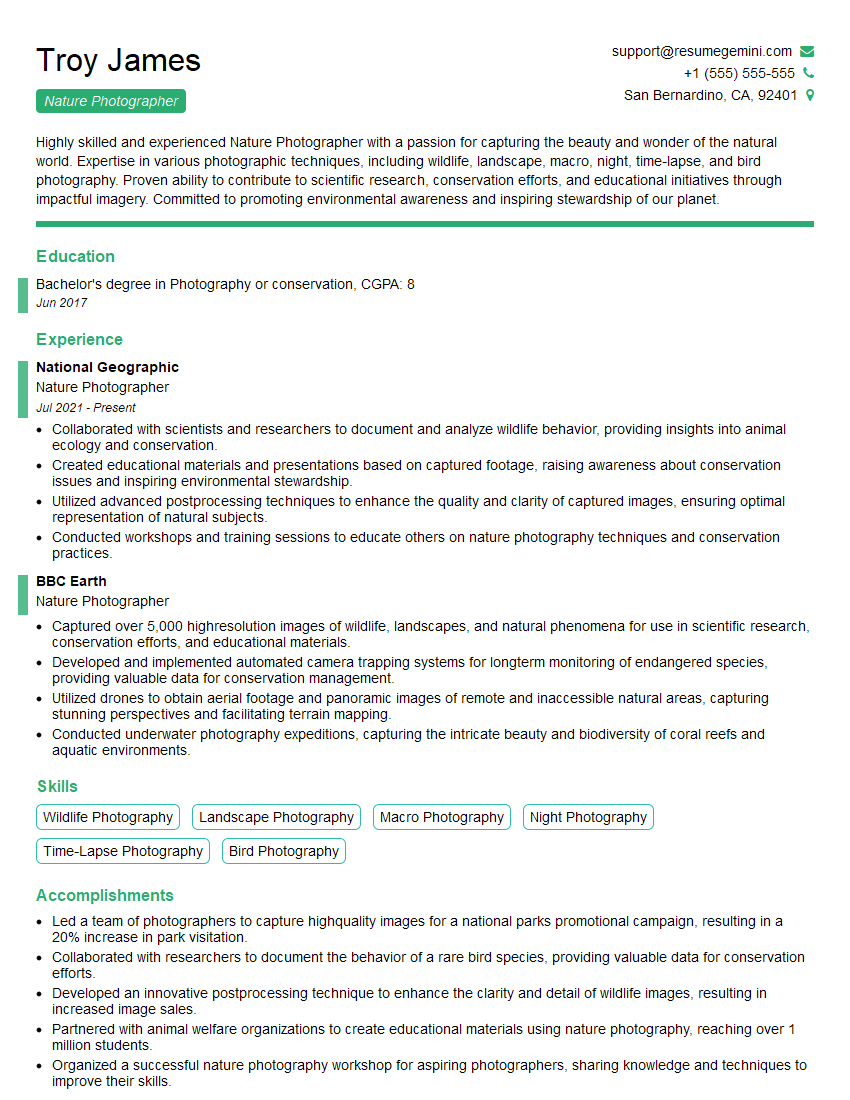
Mastering Digital Photography for Nature Documentation opens doors to exciting careers in conservation, journalism, scientific research, and more. To significantly boost your job prospects, it’s crucial to present your skills effectively. Creating an ATS-friendly resume is key – it ensures your qualifications are properly recognized by applicant tracking systems. We strongly recommend using ResumeGemini to build a professional and impactful resume. ResumeGemini provides excellent tools and resources, including examples of resumes tailored specifically to Digital Photography for Nature Documentation, ensuring your application stands out from the competition.
Explore more articles
Users Rating of Our Blogs
Share Your Experience
We value your feedback! Please rate our content and share your thoughts (optional).
What Readers Say About Our Blog
To the interviewgemini.com Webmaster.
Very helpful and content specific questions to help prepare me for my interview!
Thank you
To the interviewgemini.com Webmaster.
This was kind of a unique content I found around the specialized skills. Very helpful questions and good detailed answers.
Very Helpful blog, thank you Interviewgemini team.