Interviews are more than just a Q&A session—they’re a chance to prove your worth. This blog dives into essential Drip Irrigation System Design and Installation interview questions and expert tips to help you align your answers with what hiring managers are looking for. Start preparing to shine!
Questions Asked in Drip Irrigation System Design and Installation Interview
Q 1. Explain the principles of drip irrigation.
Drip irrigation operates on the principle of delivering water slowly and directly to the roots of plants, mimicking natural rainfall. Instead of flooding an entire field, it uses a network of tubes and emitters to release small amounts of water at precisely controlled rates. This targeted approach minimizes water waste, increases water use efficiency, and promotes healthier plant growth.
Imagine watering your houseplants one by one with a watering can versus using a garden hose to soak the entire floor. Drip irrigation is like the watering can approach – precise and efficient.
Q 2. What are the advantages and disadvantages of drip irrigation compared to other irrigation methods?
Compared to other irrigation methods like flood or sprinkler irrigation, drip irrigation offers several advantages:
- Water conservation: Water is delivered directly to the roots, minimizing evaporation and runoff.
- Increased yields: Consistent moisture at the root zone promotes healthier plant growth and higher yields.
- Reduced weed growth: Only the plant root zone is watered, suppressing weed growth.
- Improved fertilizer application: Fertilizers can be directly applied with the water, improving nutrient uptake.
- Reduced labor costs: Automation options reduce the need for manual labor.
However, drip irrigation also has some disadvantages:
- Higher initial cost: Setting up a drip irrigation system requires a greater upfront investment compared to simpler methods.
- Clogging issues: Emitters can clog if the water source isn’t properly filtered.
- Maintenance requirements: Regular maintenance and cleaning are necessary to ensure proper function.
- Not ideal for all crops: Some crops with shallow, extensive root systems might not benefit fully.
Choosing the right irrigation method depends heavily on the specific crops, soil type, water availability, and budget.
Q 3. Describe different types of drip emitters and their applications.
Drip emitters come in various types, each suited for different applications:
- Pressure-compensating emitters: These emitters maintain a consistent flow rate even with variations in water pressure throughout the system. They’re ideal for uneven terrains.
- Non-pressure-compensating emitters: These emitters deliver water at a flow rate that varies with pressure. Suitable for relatively flat areas with consistent pressure.
- In-line emitters: These are small openings punched directly into the tubing. They are simple and low cost but may be prone to clogging.
- Drip tape emitters: The emitters are embedded directly into the tape itself, simplifying installation for large areas but less flexible in terms of emitter spacing.
- Micro-sprinklers: These emitters deliver water in a spray pattern, useful for crops that require a slightly wider coverage.
For example, a vineyard with a steep slope would benefit greatly from using pressure-compensating emitters to ensure even water distribution to each vine, while a flat field of potatoes may use simple in-line emitters or drip tape for cost efficiency.
Q 4. How do you determine the appropriate spacing and flow rate for drip emitters?
Determining appropriate spacing and flow rate is crucial for effective drip irrigation. It involves considering several factors:
- Crop type and water requirements: Different crops have varying water needs, influencing the flow rate per emitter and the spacing between them.
- Soil type: Well-drained sandy soils require more frequent, lower-volume irrigation than heavier clay soils which retain water better.
- Climate: Higher temperatures and wind speeds lead to greater evapotranspiration, demanding higher flow rates.
- Emitter type: Different emitters have different flow rates, which should be accounted for during design.
A common approach involves calculating the total water requirement for the area, determining the number of emitters needed, and then calculating the flow rate per emitter based on the emitter spacing. Software tools and online calculators are readily available to assist in this process. For example, if the crop requires 1 inch of water per week and the emitter delivers 0.5 gallons per hour, you’d need to calculate the time needed for each irrigation cycle to meet the water demand.
Q 5. Explain the importance of pressure regulation in drip irrigation systems.
Pressure regulation is critical in drip irrigation to prevent damage to components and ensure even water distribution. High pressure can lead to emitter failure and unequal water delivery, while low pressure reduces efficiency and water coverage. Pressure-regulating valves or pressure-compensating emitters are essential for maintaining consistent pressure across the entire system. Think of it like a water slide: uniform pressure keeps everything moving smoothly. Uneven pressure would cause some sections to move too fast, while others would stagnate.
Examples of pressure regulation methods include pressure-reducing valves, pressure-regulating valves, and the use of pressure-compensating emitters. These elements ensure a stable pressure throughout the system regardless of elevation changes or pipe length, improving distribution and longevity of the system.
Q 6. How do you design a drip irrigation system for a sloped terrain?
Designing a drip irrigation system for sloped terrain requires careful consideration of pressure variations. Here’s a step-by-step approach:
- Divide the slope into zones: Split the area into smaller, relatively flat zones to maintain consistent pressure within each section.
- Install pressure-regulating valves: Place pressure-regulating valves at the beginning of each zone to manage pressure differences.
- Use pressure-compensating emitters: These maintain a consistent flow rate despite variations in pressure within each zone.
- Utilize a manifold system: A manifold system can be used to distribute water evenly across different zones and regulate pressure effectively.
- Consider the elevation difference: The higher the elevation difference, the more zones may be necessary. Proper calculations are crucial to prevent under-watering or over-watering specific sections of the slope.
By carefully zoning and regulating pressure, you can ensure even watering across a sloped terrain, preventing waterlogging at the bottom and dry spots at the top. This is vital for optimal crop growth on uneven landscapes.
Q 7. Describe different methods for filtering water in drip irrigation systems.
Filtering water is crucial to prevent clogging of drip emitters. Several methods exist:
- Screen filters: These are simple and inexpensive, using mesh screens to remove larger debris. Regular cleaning is essential.
- Disc filters: These employ a stack of discs with fine mesh to remove smaller particles, requiring less frequent cleaning compared to screen filters.
- Sand filters: These utilize a bed of sand to filter out suspended solids. They require backwashing for cleaning and are more suited for larger systems.
- Self-cleaning filters: These automate the cleaning process using a rotating mechanism to dislodge trapped debris. They reduce manual effort but involve a higher initial investment.
The choice of filter depends on water quality, system size, and budget. For example, a system with a high sediment load might benefit from a sand filter, while a smaller residential system might only need a screen filter. Proper filtration is an investment in the long-term health and performance of the entire drip irrigation system.
Q 8. How do you calculate the water requirements for a specific crop using drip irrigation?
Calculating water requirements for a specific crop using drip irrigation involves understanding the crop’s evapotranspiration (ET) rate, which is the water lost to the atmosphere through evaporation from the soil and transpiration from the plant. This is influenced by factors like climate, soil type, and the crop’s growth stage. We use several methods to determine this, often employing tools like weather data and crop coefficient tables. A common approach involves using the Penman-Monteith equation, a complex formula factoring in various environmental parameters. However, for practical purposes, many growers utilize simpler methods, such as using readily available crop evapotranspiration charts provided by agricultural extension services. These charts typically provide ET values based on the crop type and local climate conditions.
Example: Let’s say a chart indicates the ET for tomatoes in a specific region is 0.4 inches per day. To determine the water requirement for 1 acre (43,560 sq ft), we multiply this value by the area: 0.4 inches/day * 43,560 sq ft = 17,424 cubic inches per day. Converting cubic inches to gallons (231 cubic inches per gallon), we get approximately 75 gallons per day per acre. This is a simplified example, and adjustments need to be made for irrigation efficiency (typically 80-90% for drip) and soil water holding capacity.
In practice, we might also consider the soil’s water-holding capacity to determine how often to irrigate. If the soil holds a significant amount of water, less frequent, deeper irrigation may suffice. Conversely, sandy soils require more frequent but shallower irrigations.
Q 9. What are the common problems encountered during drip irrigation system installation?
Common problems during drip irrigation system installation stem from several sources. One major issue is poor planning and design. This can lead to inadequate water pressure, uneven water distribution, or emitter clogging. Inadequate site preparation is another frequent problem. Failing to clear the area of rocks and debris before laying the tubing can damage the system and cause blockages.
Incorrect tubing selection can also create headaches. Using a tubing diameter that’s too small for the required flow rate will result in low pressure and uneven watering. Similarly, using unsuitable tubing materials can lead to leaks or premature failure. Improper emitter spacing is another critical issue. Incorrect spacing leads to either overwatering or underwatering of plants. Finally, incorrect filtration – or its absence – will cause the system to clog quickly, rendering it useless.
Example: I once worked on a project where the installer failed to account for elevation changes in the field. This resulted in insufficient pressure in the higher sections of the field, leading to significant water stress on the plants in those areas.
Q 10. How do you troubleshoot a low-pressure problem in a drip irrigation system?
Troubleshooting low pressure in a drip irrigation system requires a systematic approach. The first step is to check the main water supply. Ensure the valve is fully open and the water pressure from the source is sufficient. Next, inspect the mainline and laterals for blockages, looking for kinks, debris, or damaged sections. A simple pressure gauge at various points will help pinpoint the location of pressure loss. You can also check each emitter individually for flow, and look for any obvious obstructions.
Filter condition is another critical element. A clogged filter will dramatically restrict water flow. Cleaning or replacing the filter is often sufficient to restore pressure. If the pressure drop occurs gradually along the lateral, it’s possible to have a gradual build-up of sediments in the tubing itself.
Step-by-step approach:
- Check the main water supply and pressure.
- Inspect the mainline and laterals for blockages or damage.
- Check the filter and clean or replace if necessary.
- Inspect emitters for clogs; flush individual lines if needed.
- If the problem persists, section the system and test each section to pinpoint the location of the pressure drop.
Example: If the pressure is low only at the end of a long lateral line, the problem might be a clog or a too-small diameter line for the length, leading to friction loss. If low pressure is widespread, the filter or main water supply is the most likely culprit.
Q 11. Explain the process of installing a drip irrigation system, from design to completion.
Installing a drip irrigation system involves a multi-step process that begins with a careful design phase. This includes assessing the site, determining the water requirements, and mapping the layout of the system. We need to identify the water source, evaluate the soil type, and consider the type and spacing of plants or crops. The design phase incorporates selecting appropriate tubing, emitters, and filtration systems. A detailed schematic is created, including pipe sizes and lengths, emitter locations, and the placement of valves and other components.
The next phase involves site preparation, including clearing the area, leveling if necessary, and marking the locations for the mainlines, laterals, and emitters. Then comes the installation of the components: laying the mainline, connecting laterals, installing emitters, and finally connecting the system to the water source. The system should be thoroughly pressure tested after installation. Regular monitoring ensures its proper function. This may also involve installation of a pressure regulator.
Completion entails a final inspection to ensure everything is functioning as expected, including proper water distribution and pressure. Thorough documentation of the entire process should be kept for future reference. This ensures ease of maintenance and troubleshooting down the line.
Q 12. How do you maintain and repair a drip irrigation system?
Maintaining and repairing a drip irrigation system is crucial for its longevity and efficiency. Regular maintenance should include flushing the system at the beginning and end of each growing season to remove sediment buildup. Inspecting the entire system for leaks, broken emitters, or damaged tubing is essential, and addressing such issues promptly helps avoid larger problems later. Cleaning or replacing the filters regularly is also very important. Filters should be routinely checked and cleaned. Consider using a water meter to track water use and identify unexpected water loss due to leaks.
Repair procedures might include replacing damaged sections of tubing, fixing leaks with repair patches or by replacing the affected tubing, and clearing clogged emitters by using a cleaning solution or by replacing them. The frequency of maintenance will depend on factors like water quality and the type of soil.
Example: Regular flushing can be done by simply opening the flush valves at the end of lines to clear out any debris. If an emitter is clogged, you might try using a small wire or needle to clear it. However, replacing clogged emitters is often more efficient than trying to clean them.
Q 13. What are the different types of tubing used in drip irrigation systems?
Drip irrigation systems utilize various types of tubing, each with its own advantages and disadvantages. Polyethylene (PE) tubing is the most common type, known for its flexibility, durability, and relatively low cost. It’s available in various diameters and wall thicknesses, allowing for customization based on pressure and flow requirements. Polyvinyl chloride (PVC) tubing is more rigid and less flexible than PE but offers greater durability and resistance to UV degradation. It’s often used for mainlines and areas where greater strength is required.
Other materials include flexible polyethylene (PEX) tubing that can withstand higher pressures and has excellent corrosion resistance. The choice of tubing depends on factors such as system pressure, the length of the lines, the soil conditions, and budget. For example, PE tubing is the standard choice in most situations due to cost-effectiveness and ease of installation, while PVC may be preferred for applications demanding higher pressures or longer service life.
Q 14. Describe different types of filtration systems used in drip irrigation.
Effective filtration is paramount in drip irrigation to prevent clogging of emitters and maintain system efficiency. Several filtration systems are used, each suited for different water qualities and system sizes. Screen filters are the simplest, utilizing mesh screens to remove larger particles. They’re inexpensive and easy to maintain but have limited efficiency and are unsuitable for water with high sediment loads.
Disk filters use stacked disks with progressively finer filtration capabilities. They are more efficient than screen filters and are better suited for water containing high amounts of sediment. Sand filters provide superior filtration and remove fine suspended particles, but are more complex and require periodic backwashing. Hydrocyclone filters use centrifugal force to separate solids from the water; they are very efficient and are suitable for high-flow systems.
The selection of a filtration system depends on factors such as the water quality, the system’s size, and the desired level of filtration. For instance, a small garden system with relatively clean water might only require a screen filter, while a large agricultural system with high sediment concentration would benefit from a combination of screen, disk, and sand filters.
Q 15. How do you select the appropriate pump for a drip irrigation system?
Selecting the right pump for a drip irrigation system is crucial for its efficient operation. It involves considering several key factors. First, you need to determine the total flow rate required – the amount of water needed to irrigate the entire area within a specific timeframe. This is calculated based on the number and flow rate of emitters, factoring in pressure loss across the system. Second, the total head, or the vertical distance the water needs to be pumped, plus friction losses in the pipes, needs to be calculated. This determines the pump’s required pressure. Third, you must select a pump with a sufficient power rating to overcome the head and deliver the required flow rate. Consider the pump’s efficiency and material compatibility (e.g., corrosion resistance). Finally, choosing a pump with features like automatic pressure regulation or a built-in pressure sensor ensures consistent water delivery and prevents over-pressurization which can damage the system.
Example: Let’s say you need to deliver 10 gallons per minute (GPM) at a pressure of 40 PSI to a field. You’d consult pump performance curves – charts that show flow rate vs. pressure for a specific pump model – to find a pump that can meet this requirement or better. Always choose a pump that has a slightly higher capacity than strictly needed to accommodate future expansions.
Career Expert Tips:
- Ace those interviews! Prepare effectively by reviewing the Top 50 Most Common Interview Questions on ResumeGemini.
- Navigate your job search with confidence! Explore a wide range of Career Tips on ResumeGemini. Learn about common challenges and recommendations to overcome them.
- Craft the perfect resume! Master the Art of Resume Writing with ResumeGemini’s guide. Showcase your unique qualifications and achievements effectively.
- Don’t miss out on holiday savings! Build your dream resume with ResumeGemini’s ATS optimized templates.
Q 16. Explain the role of a pressure compensating emitter.
A pressure compensating emitter (PCE) is a crucial component in drip irrigation, especially in uneven terrain. Unlike standard emitters whose flow rate varies with pressure, a PCE maintains a constant flow rate regardless of pressure fluctuations within the system. This is achieved through a built-in mechanism that regulates the water flow. Imagine a system with varying elevations – a standard emitter at a higher point would receive less water due to lower pressure. The PCE compensates for this, ensuring each plant receives the same amount of water, maximizing efficiency and uniformity.
Practical Application: In hilly vineyards or sloped landscapes where pressure changes drastically, PCEs guarantee consistent watering across the entire field. They are also helpful when the system includes long laterals or multiple zones, minimizing inconsistencies caused by pressure drops in various parts of the system.
Q 17. What are the environmental benefits of using drip irrigation?
Drip irrigation offers significant environmental benefits compared to traditional methods like flood or sprinkler irrigation. Firstly, it drastically reduces water waste because water is delivered directly to the plant roots, minimizing evaporation and runoff. This is particularly crucial in arid and semi-arid regions. Secondly, drip irrigation leads to reduced weed growth since the soil between plants remains dry, reducing weed germination and growth. Thirdly, it minimizes soil erosion as water isn’t applied forcefully across the soil surface. Finally, it allows for precise fertilizer application through fertigation (applying fertilizer along with irrigation water), reducing fertilizer runoff and pollution of water bodies.
Example: A farmer using drip irrigation can potentially reduce water consumption by 50% or more compared to flood irrigation, conserving precious water resources and reducing the environmental impact of agriculture.
Q 18. How do you design for water conservation in a drip irrigation system?
Designing for water conservation in drip irrigation involves a multi-pronged approach. First, a precise site assessment is vital – understanding soil type, slope, and plant water requirements allows for optimal emitter spacing and flow rates. Second, using pressure compensating emitters ensures that all plants get equal water even with varied pressures in the system. Third, implementing a monitoring system with soil moisture sensors or flow meters allows for real-time adjustment of irrigation based on actual soil conditions, preventing overwatering. Fourth, employing techniques like mulching helps conserve soil moisture by reducing evaporation. Finally, regular system maintenance – checking for leaks and ensuring proper operation – prevents water loss and inefficiency.
Strategy: Employing weather-based irrigation controllers that adjust watering schedules according to rainfall and evapotranspiration significantly reduces water usage and improves efficiency.
Q 19. Describe different types of controllers used in drip irrigation systems.
Various controllers manage the operation of drip irrigation systems. Basic timers offer simple on/off scheduling, suitable for smaller systems with minimal needs. Time clocks provide more sophisticated scheduling, enabling setting different watering durations for various zones. Weather-based controllers incorporate weather data (rain sensors, evapotranspiration calculations) to adjust watering schedules automatically, optimizing water use. PC-based systems allow for comprehensive control and monitoring, offering advanced features like remote control and data logging. Finally, smart irrigation controllers integrate with mobile applications, offering remote access, real-time monitoring, and sophisticated scheduling algorithms based on weather forecasts and soil sensors.
Example: A large commercial greenhouse might use a PC-based system to manage multiple zones with individual environmental controls, while a small home garden might be sufficiently controlled by a simple timer.
Q 20. How do you plan for system expansion or modifications?
Planning for system expansion or modifications requires foresight and a modular design. First, the initial design should incorporate provisions for future expansion by using larger diameter mainline pipes and including spare capacity in the pump and controller. Second, detailed system maps and component specifications should be maintained. Third, when modifying, always prioritize compatibility – ensure new components are compatible with existing ones in terms of pressure, flow rate, and fittings. Fourth, always consider the potential impact on existing zones when adding new components. Finally, proper documentation of all changes will ensure efficient troubleshooting and future modifications.
Practical tip: Using color-coded pipes or easily identifiable labels helps during expansion or maintenance.
Q 21. How do you handle difficult soil conditions during installation?
Handling difficult soil conditions during installation requires careful planning and execution. Rocky or compacted soil may require pre-installation soil preparation – tilling or loosening the soil to ensure proper emitter placement and avoid pipe damage. Clay soil can obstruct water flow; using larger diameter laterals or more frequent emitter spacing can mitigate this issue. Sandy soil poses the risk of water percolation; optimizing emitter flow rates and considering mulching are crucial. For sloped terrains, using pressure compensating emitters and proper layout of laterals prevent uneven watering. When working in sensitive areas, choose methods that minimize soil disturbance. Accurate surveying and planning are key to successful installation in any challenging soil condition.
Example: In areas with large rocks, using flexible tubing might help navigate around obstacles and avoid damage. In clay soils, consider adding a filter to prevent clogging.
Q 22. What safety precautions should be taken during installation and maintenance?
Safety is paramount during drip irrigation system installation and maintenance. Think of it like working with any other plumbing system, but with added considerations for water pressure and potential chemical exposure. Before starting any work, always:
- Disconnect the water supply: This prevents accidental flooding or injury from pressurized water.
- Wear appropriate personal protective equipment (PPE): This includes safety glasses, gloves, and sturdy footwear to protect against sharp objects and chemicals.
- Be mindful of underground utilities: Call your local utility companies before digging to avoid damaging gas lines, power cables, or water mains. A simple call can prevent serious accidents.
- Use caution when handling chemicals: Fertilizers and other irrigation additives can be harmful. Always follow the manufacturer’s instructions and wear appropriate PPE.
- Work with a partner: Many tasks, like lifting heavy equipment or working in confined spaces, are safer with an extra set of hands.
- Regularly inspect the system: Identify and address potential hazards like leaks, broken pipes, or damaged emitters before they become major issues.
For example, I once worked on a large vineyard where a careless digger damaged the main water line. By following proper safety protocols, including calling the utility company beforehand, we avoided a potentially disastrous situation.
Q 23. Explain the concept of micro-irrigation and its applications.
Micro-irrigation, a subset of drip irrigation, involves delivering water directly to the plant roots through small emitters. Imagine a tiny showerhead for each plant, providing efficient and targeted watering. This contrasts sharply with traditional overhead irrigation, which can lead to significant water loss through evaporation and runoff.
Applications are diverse and include:
- Agriculture: High-value crops like fruits, vegetables, and vineyards benefit from the precise water delivery and reduced weed growth.
- Landscaping: Efficiently watering gardens, lawns, and trees minimizes water waste and reduces maintenance.
- Greenhouses: Controlled environment conditions are enhanced with precise watering schedules, improving plant health and yield.
- Nurseries: Consistent watering ensures optimal plant growth and reduces stress during transplantation.
In a recent project for a local farmer, we implemented a micro-irrigation system in his strawberry fields, resulting in a 30% increase in yield and a significant reduction in water consumption compared to their previous flood irrigation method.
Q 24. How do you address issues of clogging in drip emitters?
Clogged drip emitters are a common issue, often caused by sediment, algae, or mineral buildup. Addressing this requires a multi-pronged approach.
- Preventative Measures: Using a filter at the system’s inlet is crucial. This acts as a first line of defense, trapping larger particles before they reach the emitters. Regular filter cleaning is essential.
- Flushing: A simple solution is to flush the system with clean water at high pressure using a flushing valve. This pushes out accumulated debris. We can also use specialized cleaning solutions designed for drip irrigation systems following manufacturer’s instructions.
- Individual Emitter Cleaning: For stubborn clogs, individual emitters can be removed and cleaned using a small brush or needle. This is more time-consuming but effective for localized blockages.
- System Design: Proper system design also plays a role. Selecting appropriate emitters for the water source and soil type reduces the chance of clogging.
For instance, during an audit of an existing system, we discovered that the filter was inadequate and required an upgrade. This simple change significantly improved system performance and reduced emitter clogging.
Q 25. What are the typical materials used in drip irrigation system construction?
Drip irrigation systems use a variety of durable and reliable materials. The choice depends on factors like water quality, soil conditions, and budget.
- Polyethylene (PE) Tubing: Commonly used for the main lines and laterals due to its flexibility, durability, and resistance to UV degradation.
- Polyvinyl Chloride (PVC) Pipe: Used for larger mainlines where higher pressure is needed. It’s more rigid than PE tubing.
- Drip Emitters: These come in various types (pressure compensating, non-pressure compensating) and materials, often plastic, and are designed to deliver water at a controlled rate.
- Fittings: A range of fittings are used to connect different components, including elbows, tees, and unions, typically made of plastic.
- Filters: Essential for protecting the system from clogging. These can be made of various materials like mesh or screen.
For example, in arid regions, UV-resistant PE tubing is preferred to ensure longevity, while in areas with high water pressure, PVC might be more suitable for main lines. The selection of materials is a critical aspect of system design.
Q 26. How do you perform a system audit to assess efficiency?
A system audit assesses the efficiency and effectiveness of a drip irrigation system. This involves a thorough inspection and analysis.
- Visual Inspection: Check for leaks, damaged emitters, clogged lines, and proper functioning of filters and valves.
- Pressure Testing: Measure the water pressure at various points in the system to identify pressure drops indicating blockages or leaks.
- Flow Rate Measurement: Measure the flow rate at individual emitters to verify they are delivering the correct amount of water. This might involve using a flow meter.
- Soil Moisture Monitoring: Assess the soil moisture levels to determine if the irrigation is delivering the right amount of water to the plants.
- Data Analysis: Collect data on water usage, pressure, and flow rates to identify areas for improvement. This might involve using software designed to analyze system performance.
I once conducted an audit where we discovered a significant leak in the mainline that was causing a substantial water loss. By identifying and repairing this leak, we improved the overall system efficiency by over 20%.
Q 27. How do you integrate smart irrigation technology into a drip irrigation system?
Integrating smart irrigation technology can significantly enhance the efficiency and effectiveness of a drip irrigation system. This generally involves adding sensors, controllers, and software.
- Soil Moisture Sensors: These sensors provide real-time information about soil moisture levels, enabling the system to water only when needed.
- Weather Stations: Real-time weather data (rain, temperature, humidity) can automatically adjust irrigation schedules based on prevailing conditions.
- Smart Controllers: These controllers use data from sensors and weather stations to optimize watering schedules, reducing water waste and improving plant health.
- Irrigation Software: Software helps manage the system remotely, track data, create customized irrigation schedules, and receive alerts about potential issues.
For example, in a recent project, we integrated a smart controller with soil moisture sensors into a large landscape irrigation system. This resulted in a 40% reduction in water consumption without compromising plant health. The data collected also allowed us to fine-tune the system over time for optimal performance.
Q 28. Describe your experience with different irrigation software or design tools.
Throughout my career, I’ve worked with a range of irrigation software and design tools. My experience encompasses both commercial and open-source options.
- [Software Name 1]: This professional-grade software excels in designing complex systems, automating calculations, and creating detailed reports. Its user-friendly interface simplifies the design process.
- [Software Name 2]: An open-source option that provides powerful design and simulation capabilities. It is particularly useful for customized solutions and detailed analysis.
- [Software Name 3]: A cloud-based platform that offers remote system monitoring, data analysis, and automated scheduling features. Its mobile app is convenient for field work.
Each software has its strengths and weaknesses, and the best choice depends on the project requirements and the user’s familiarity with various software features. I adapt my approach to utilize the most appropriate tools for each unique project.
Key Topics to Learn for Drip Irrigation System Design and Installation Interview
- Hydraulic Design Principles: Understanding pressure, flow rates, and head loss calculations; applying these principles to design efficient and effective irrigation systems.
- Component Selection and Sizing: Choosing appropriate pumps, filters, pressure regulators, and emitters based on site-specific conditions and crop requirements; demonstrating knowledge of different emitter types and their applications.
- Layout and Piping Design: Creating efficient and cost-effective piping layouts; selecting appropriate pipe materials and diameters; understanding the importance of proper slope and elevation considerations.
- Water Source Evaluation: Assessing water availability, quality, and pressure; determining the suitability of different water sources for drip irrigation; understanding water rights and regulations.
- Soil and Crop Considerations: Analyzing soil types and their impact on irrigation system design; understanding crop water requirements and irrigation scheduling techniques; optimizing water usage for maximum efficiency.
- Installation Techniques and Best Practices: Demonstrating knowledge of proper installation procedures; understanding the importance of accurate measurements, proper pipe joining techniques, and emitter placement; ensuring system functionality and longevity.
- Troubleshooting and Maintenance: Identifying common problems in drip irrigation systems; diagnosing malfunctions; performing routine maintenance; understanding repair and replacement procedures.
- System Automation and Control: Understanding the principles of automated irrigation control; familiarity with different control systems and technologies; discussing the advantages and limitations of automation.
- Sustainability and Water Conservation: Demonstrating a commitment to water conservation and sustainable irrigation practices; discussing techniques to minimize water waste and maximize efficiency.
- Health and Safety Regulations: Understanding relevant safety regulations and procedures related to irrigation system installation and maintenance.
Next Steps
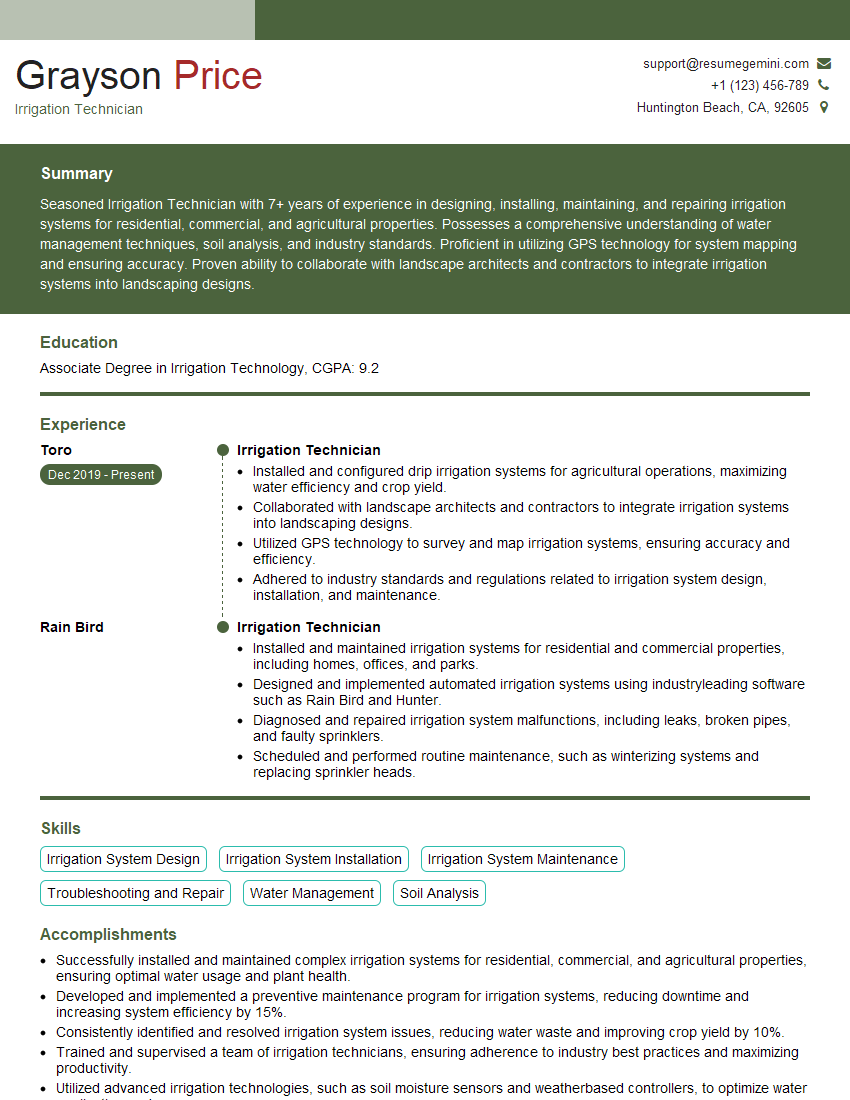
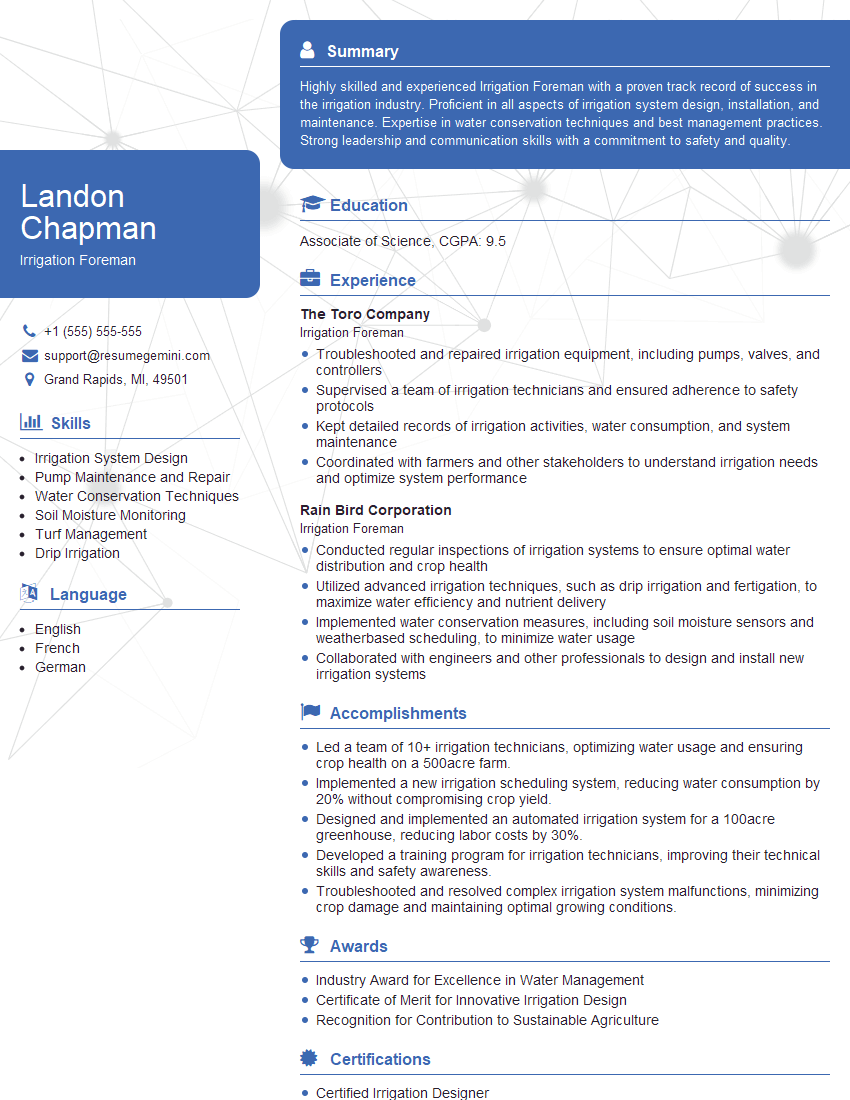
Mastering Drip Irrigation System Design and Installation opens doors to rewarding careers in agriculture, landscaping, and water management. A strong understanding of these principles is highly valued by employers. To maximize your job prospects, create an ATS-friendly resume that highlights your skills and experience effectively. ResumeGemini is a trusted resource that can help you build a professional resume that stands out. ResumeGemini provides examples of resumes tailored to Drip Irrigation System Design and Installation to help you get started.

Explore more articles
Users Rating of Our Blogs
Share Your Experience
We value your feedback! Please rate our content and share your thoughts (optional).
What Readers Say About Our Blog
To the interviewgemini.com Webmaster.
Very helpful and content specific questions to help prepare me for my interview!
Thank you
To the interviewgemini.com Webmaster.
This was kind of a unique content I found around the specialized skills. Very helpful questions and good detailed answers.
Very Helpful blog, thank you Interviewgemini team.