Interviews are more than just a Q&A session—they’re a chance to prove your worth. This blog dives into essential Education Techniques interview questions and expert tips to help you align your answers with what hiring managers are looking for. Start preparing to shine!
Questions Asked in Education Techniques Interview
Q 1. Explain the difference between constructivist and behaviorist learning theories.
Behaviorism and constructivism represent fundamentally different approaches to understanding how learning occurs. Behaviorism, rooted in the work of psychologists like Pavlov and Skinner, views learning as a change in observable behavior, primarily driven by external stimuli and reinforcement. Learners are seen as passive recipients of information, with learning occurring through conditioning and repetition. Think of a dog learning to salivate at the sound of a bell (classical conditioning) or a child learning to raise their hand in class to get attention (operant conditioning).
In contrast, constructivism emphasizes the active role of the learner in constructing their own understanding of the world. This theory, championed by Piaget and Vygotsky, posits that learning is a process of building upon prior knowledge and experiences. Learners are active participants, engaging in exploration, experimentation, and social interaction to create meaning. A constructivist classroom might involve students designing their own experiments to test a scientific hypothesis or collaborating on a project that requires them to synthesize information from multiple sources.
In essence, behaviorism focuses on observable behaviors and external rewards, while constructivism highlights the internal mental processes and active construction of knowledge.
Q 2. Describe your experience designing curriculum aligned with Common Core standards (or equivalent).
I have extensive experience designing curriculum aligned with Common Core State Standards (CCSS), particularly in the areas of English Language Arts and Mathematics. In one instance, I developed a fifth-grade ELA unit focusing on informational text analysis. This involved breaking down the CCSS standards into smaller, manageable learning objectives. For example, one objective was for students to identify the main idea and supporting details in complex nonfiction texts. To achieve this, the curriculum incorporated various activities: close readings of age-appropriate articles and texts, graphic organizers to map out main ideas and supporting details, collaborative discussions, and writing assignments requiring students to synthesize information from multiple sources. Formative assessments such as quizzes and exit tickets monitored student progress throughout the unit, allowing for adjustments to instruction as needed. Summative assessments, such as a research-based writing assignment, provided a comprehensive evaluation of student understanding.
Similarly, in mathematics, I’ve created units on fractions and decimals, meticulously aligning activities and assessments with the specific CCSS-M standards. The curriculum leveraged manipulatives, interactive games, and real-world problem-solving tasks to ensure a deep understanding of these foundational mathematical concepts.
Q 3. What assessment methods are most effective for evaluating student learning outcomes?
Effective assessment is multifaceted and depends on the learning objectives. There’s no single ‘best’ method, but a combination of approaches usually yields the most comprehensive picture of student learning. Formative assessments, conducted throughout the learning process, provide ongoing feedback and inform instruction. Examples include:
- Exit tickets: Brief questions answered at the end of class to gauge immediate understanding.
- Quizzes and short assignments: Regular checks for comprehension of key concepts.
- Observations: Watching students during activities to assess their engagement and problem-solving skills.
Summative assessments, given at the end of a unit or course, measure overall achievement. These include:
- Tests and exams: Comprehensive evaluations of knowledge and skills.
- Projects and presentations: Demonstrate application of knowledge in a real-world context.
- Portfolios: Collections of student work showcasing growth and achievement over time.
The most effective approach often involves a combination of these methods, using formative assessments to guide instruction and summative assessments to measure overall learning outcomes.
Q 4. How do you differentiate instruction to meet the needs of diverse learners?
Differentiated instruction is crucial for meeting the diverse needs of learners. My approach involves considering various aspects of learner diversity, including learning styles, readiness levels, and interests. This means:
- Providing varied learning materials: Offering texts at different reading levels, incorporating visual aids, and providing audio support.
- Using flexible grouping strategies: Implementing whole-class instruction, small-group activities, and individual work as appropriate.
- Offering choice in assignments: Allowing students to select projects or activities that align with their interests and learning preferences.
- Providing tiered assignments: Creating assignments at different levels of complexity to cater to varying levels of readiness.
- Utilizing technology to personalize learning: Employing adaptive learning platforms that adjust to individual student needs.
For example, when teaching a math lesson on fractions, I might provide manipulatives for kinesthetic learners, visual diagrams for visual learners, and word problems for verbal learners. I might also offer different levels of challenge within the same assignment, allowing some students to focus on basic operations while others tackle more complex problems.
Q 5. Describe your experience using educational technology to enhance learning.
I have extensive experience integrating educational technology to enhance learning. For example, I’ve used interactive whiteboards to make lessons more engaging and collaborative, incorporating multimedia elements to cater to diverse learning styles. I’ve also utilized learning management systems (LMS) like Canvas or Moodle to deliver assignments, provide feedback, and track student progress. Furthermore, I’ve incorporated educational apps and simulations to make learning more interactive and hands-on. For instance, in a science class, students used virtual lab simulations to conduct experiments safely and efficiently. In language arts, students used online tools to research and write collaboratively. These technologies not only enhance engagement but also provide valuable data-driven insights into student learning, helping me adjust my teaching strategies as needed.
Q 6. Explain your understanding of Bloom’s Taxonomy and how you apply it in your teaching.
Bloom’s Taxonomy provides a framework for categorizing cognitive skills from basic recall to higher-order thinking. It’s a hierarchical model, with each level building upon the previous one. I use it to design lessons that progress students through these cognitive levels. For instance, when teaching about the American Revolution, I might start with:
- Remembering: Students recall key dates, figures, and events.
- Understanding: Students explain the causes and consequences of the war.
- Applying: Students analyze primary source documents to determine the perspectives of different participants.
- Analyzing: Students compare and contrast the strategies of the British and American armies.
- Evaluating: Students assess the effectiveness of the various tactics used in the war.
- Creating: Students create a presentation, essay, or debate demonstrating a comprehensive understanding of the conflict.
By carefully structuring lessons to incorporate these levels, I ensure students develop a deep and meaningful understanding of the subject matter, going beyond simple memorization to critical thinking and creative application.
Q 7. How do you incorporate formative and summative assessments into your teaching practice?
Formative and summative assessments are integral to my teaching practice. Formative assessments are ongoing checks for understanding that inform my instruction. Examples include quick quizzes, exit tickets, informal observations, and class discussions. These help me identify areas where students are struggling and adjust my teaching accordingly. For example, if students consistently miss questions about a specific concept on a quiz, I know to revisit that topic with different explanations and examples.
Summative assessments provide a comprehensive evaluation of student learning at the end of a unit or course. Examples include unit tests, projects, presentations, and final exams. These measure students’ overall understanding and mastery of the material. I use the data from summative assessments to inform future curriculum planning and identify areas for improvement in my teaching.
The combination of both formative and summative assessments provides a holistic picture of student learning and allows me to effectively tailor my instruction to meet individual needs.
Q 8. What strategies do you use to manage classroom behavior effectively?
Effective classroom management is the cornerstone of successful teaching. It’s not about strict control, but about creating a positive and productive learning environment. My approach is proactive and preventative, focusing on building relationships and establishing clear expectations from day one.
Positive Reinforcement: I consistently praise and reward positive behaviors, both individually and as a class. This could be through verbal acknowledgment, small prizes, or even simply a positive note on their work. For example, I might publicly acknowledge a student who helps a classmate or shows exceptional effort on a project.
Clear Expectations and Rules: From the start, I co-create classroom rules with my students, ensuring they understand the ‘why’ behind each rule. This promotes buy-in and ownership. The rules are clearly displayed and regularly reviewed.
Non-Verbal Cues: I use non-verbal cues such as proximity control (moving closer to a disruptive student) or eye contact to redirect behavior subtly before it escalates. This minimizes disruptions to the learning process for the rest of the class.
Individualized Attention: I take the time to get to know each student individually, understanding their strengths, weaknesses, and learning styles. This allows me to address potential behavioral issues proactively, understanding their root causes.
Consistent Consequences: While positive reinforcement is key, consistent consequences for negative behaviors are essential. These consequences should be fair, predictable, and related to the misbehavior. This creates a sense of accountability.
Q 9. Describe your experience developing and delivering engaging online learning experiences.
Designing engaging online learning experiences requires a different approach than traditional classroom teaching. It’s crucial to leverage technology to enhance interaction, collaboration, and accessibility.
Interactive Content: I avoid passive learning by incorporating interactive elements such as quizzes, polls, simulations, and videos into my online courses. For instance, using a platform like Kahoot! for quick quizzes can boost engagement and knowledge retention.
Collaborative Projects: Online collaboration tools like Google Docs or collaborative whiteboards allow students to work together on projects, fostering teamwork and communication skills. I carefully structure these projects to ensure every student contributes meaningfully.
Asynchronous and Synchronous Learning: I blend asynchronous activities (that students can complete at their own pace) with synchronous sessions (live online classes) to cater to different learning styles and schedules. This ensures flexibility and allows for real-time interaction.
Regular Feedback and Communication: Open and regular communication is vital in online learning. I use platforms like discussion forums, email, and video conferencing to provide regular feedback, answer student questions, and maintain a sense of community.
Accessibility Considerations: I ensure that all online materials are accessible to students with disabilities, adhering to WCAG guidelines. This includes providing transcripts for videos, alternative text for images, and adaptable assessment formats.
Q 10. How do you promote student collaboration and communication in your classroom?
Promoting collaboration and communication is crucial for developing 21st-century skills. I use a variety of strategies to foster this in my classroom.
Think-Pair-Share: This simple yet effective technique encourages students to think independently, discuss their ideas with a partner, and then share their insights with the larger group.
Group Projects: I design group projects that require students to work together towards a common goal. This could involve research projects, presentations, or creative problem-solving tasks. I carefully assign roles and responsibilities to ensure equitable participation.
Class Discussions: I facilitate engaging class discussions by asking open-ended questions and encouraging students to build on each other’s ideas. I use strategies like ‘talking sticks’ or ‘numbered heads together’ to ensure everyone participates.
Peer Feedback: I regularly incorporate peer feedback activities, allowing students to learn from each other and develop critical thinking skills. I provide clear guidelines and rubrics to guide this process effectively.
Collaborative Technology Tools: I use online collaboration platforms like Google Docs, Slides, or Padlet to facilitate teamwork, even outside of class. These tools allow students to work together seamlessly on projects, regardless of location.
Q 11. What methods do you use to provide effective feedback to students?
Effective feedback is crucial for student learning. It needs to be timely, specific, actionable, and focused on both the process and the product.
Descriptive Feedback: Instead of simply giving a grade, I provide descriptive feedback that explains what the student did well and what areas need improvement. For example, instead of saying ‘good job,’ I might say, ‘Your analysis of the data was thorough, but you could strengthen your conclusion by providing more specific evidence.’
Focused Feedback: I prioritize feedback on the most important aspects of the assignment, rather than trying to cover everything at once. This ensures that students focus on the key learning objectives.
Timely Feedback: I provide feedback promptly, allowing students to learn from their mistakes and improve their performance before moving on to the next task. Delayed feedback loses its impact.
Multiple Feedback Methods: I use a variety of methods to provide feedback, including written comments, verbal feedback, and online annotation tools. I choose the method best suited to the student and the assignment.
Student-Led Conferences: When appropriate, I engage students in self-reflection and encourage them to share their progress and challenges during student-led conferences. This fosters a sense of ownership over their learning.
Q 12. How do you adapt your teaching style to different learning preferences?
Catering to diverse learning preferences is essential for inclusive teaching. I use a variety of instructional strategies to accommodate different learning styles.
Visual Learners: I incorporate visuals such as diagrams, charts, videos, and presentations into my lessons. I make extensive use of visual aids and graphic organizers.
Auditory Learners: I use discussions, lectures, audio recordings, and music to engage auditory learners. I allow for verbal explanations and opportunities for discussion.
Kinesthetic Learners: I include hands-on activities, experiments, role-playing, and movement breaks into my lessons. I encourage movement and active participation.
Differentiated Instruction: I differentiate my instruction by providing varied materials, activities, and assessment options. This caters to the different readiness levels and learning needs within the classroom.
Flexible Grouping: I employ flexible grouping strategies, allowing students to work independently, in pairs, or in small groups, depending on the activity and their learning needs.
Q 13. Describe your experience with Universal Design for Learning (UDL).
Universal Design for Learning (UDL) is a framework for creating inclusive learning environments that cater to the diverse needs of all learners. My experience with UDL has significantly enhanced my teaching practice.
Multiple Means of Representation: I provide information in multiple formats, including text, audio, video, and visuals. This caters to different learning preferences and strengths.
Multiple Means of Action and Expression: I offer students diverse ways to demonstrate their understanding, such as writing essays, creating presentations, performing skits, or designing projects. This allows students to express their learning in ways that are comfortable and effective for them.
Multiple Means of Engagement: I incorporate a variety of activities and strategies to maintain student interest and motivation. This involves providing choices, incorporating real-world relevance, and promoting collaboration.
Technology Integration: UDL often leverages technology to provide flexible access to information and different ways for students to interact with the material. Assistive technologies are also easily integrated.
Ongoing Assessment and Adjustment: I regularly assess how well my lessons are meeting the diverse needs of my students and make adjustments as needed. This iterative approach ensures that the UDL principles are continuously implemented.
Q 14. How do you integrate technology effectively into your teaching practice?
Effective technology integration goes beyond simply using gadgets; it’s about thoughtfully incorporating technology to enhance the learning process.
Learning Management Systems (LMS): I utilize LMS platforms (like Canvas or Moodle) to organize course materials, communicate with students, deliver assignments, and provide feedback. This streamlines the learning process and improves communication.
Interactive Simulations and Games: I use educational simulations and games to make learning more engaging and interactive, allowing students to actively participate and apply concepts. For example, using a virtual lab for science experiments.
Collaboration Tools: Google Workspace, Microsoft Teams, or other collaboration tools foster communication and teamwork. This allows for real-time feedback and project development.
Educational Apps and Software: I leverage a variety of educational apps and software based on the specific subject and learning objectives. Examples include digital whiteboards, presentation software, and educational games.
Digital Storytelling and Media Creation: I encourage students to create digital stories, videos, and presentations to enhance their communication skills and demonstrate their learning creatively. This improves engagement and showcases their understanding.
Q 15. What is your approach to addressing student learning gaps?
Addressing student learning gaps requires a multi-faceted approach that focuses on identifying the gap, providing targeted support, and monitoring progress. It begins with a thorough assessment to pinpoint the specific areas where a student is struggling. This might involve formal assessments like standardized tests, but also informal methods like classroom observations and analyzing student work. Once the gap is identified, I tailor instruction to address it. This could involve providing extra one-on-one support, assigning differentiated assignments, or utilizing supplemental learning materials. For example, if a student struggles with fractions, I might start with concrete manipulatives before moving to abstract concepts. Regular monitoring of progress is crucial, using formative assessments to track their understanding and adjust my teaching accordingly. This iterative process ensures that students receive the support they need to close the learning gap successfully.
Imagine a student struggling with reading comprehension. After assessing their skills, I might find they lack background knowledge on the topics discussed in the text. To bridge this gap, I’d introduce relevant supplemental materials, perhaps videos or articles, to build their understanding. I would also provide them with strategies for annotating texts and breaking down complex passages into smaller, manageable chunks. Through regular check-ins and targeted practice, I would monitor their progress and adapt my support as needed.
Career Expert Tips:
- Ace those interviews! Prepare effectively by reviewing the Top 50 Most Common Interview Questions on ResumeGemini.
- Navigate your job search with confidence! Explore a wide range of Career Tips on ResumeGemini. Learn about common challenges and recommendations to overcome them.
- Craft the perfect resume! Master the Art of Resume Writing with ResumeGemini’s guide. Showcase your unique qualifications and achievements effectively.
- Don’t miss out on holiday savings! Build your dream resume with ResumeGemini’s ATS optimized templates.
Q 16. Explain your experience with differentiated instruction strategies.
Differentiated instruction is a cornerstone of my teaching philosophy. It acknowledges that students learn at different paces and in different ways. My approach involves creating a learning environment that caters to diverse learning styles and needs. This includes providing a variety of learning activities—some hands-on, others more abstract—to engage students through various modalities (visual, auditory, kinesthetic). I also differentiate the content itself, adjusting the complexity and level of challenge based on individual student needs. For example, I might offer different reading levels for a single text or create tiered assignments that allow students to work at their own pace and level of understanding.
In a recent lesson on the American Revolution, I differentiated instruction by providing different levels of reading material on the topic. Some students read simplified versions focusing on key events, while others tackled more complex texts analyzing political and social aspects. For the assignment, some students created timelines, others wrote essays, and still others presented dramatic reenactments. This allowed all students to demonstrate their understanding in ways that aligned with their strengths and learning styles.
Q 17. How do you create a positive and inclusive learning environment for all students?
Creating a positive and inclusive learning environment is essential for student success. It starts with building strong relationships with each student, showing genuine interest in their lives and perspectives. I foster a classroom culture of respect, where students feel safe to express themselves and participate actively without fear of judgment. I use inclusive language, ensuring all students feel valued and represented. I also incorporate diverse perspectives and materials into my lessons, representing different cultures, backgrounds, and abilities.
For example, I make a point to use diverse examples in my lessons—highlighting achievements from various cultures and showcasing people with different abilities. I also create group activities that encourage collaboration and peer support, building a sense of community within the classroom. Establishing clear expectations for behavior and providing positive reinforcement are equally important in fostering a respectful and supportive learning environment. If conflicts arise, I mediate with fairness and empathy, working towards resolution that prioritizes mutual respect.
Q 18. What are some common challenges in education and how do you address them?
Several common challenges exist in education, including large class sizes, limited resources, diverse learning needs, and lack of parental involvement. Large class sizes make it difficult to provide individualized attention to each student. To address this, I strategically use cooperative learning activities, allowing students to teach and learn from one another. Limited resources require creative problem-solving; I explore free online resources and collaborate with colleagues to share materials and strategies. Addressing diverse learning needs involves utilizing differentiated instruction strategies, as discussed earlier.
Encouraging parental involvement can be challenging. I proactively communicate with parents through regular updates, newsletters, and parent-teacher conferences. I also make myself readily available to answer questions and address concerns. Addressing these challenges requires a proactive and flexible approach, a willingness to collaborate with colleagues and parents, and a commitment to finding creative solutions to support all learners.
Q 19. How do you stay current with the latest research and best practices in education?
Staying current with the latest research and best practices in education is a continuous process. I actively participate in professional development opportunities, attending workshops, conferences, and webinars on topics relevant to my field. I regularly read educational journals and research articles, focusing on evidence-based practices and innovative teaching strategies. I also actively engage in online professional learning communities, sharing ideas and collaborating with other educators. Furthermore, I regularly review and update my curriculum to incorporate new knowledge and technologies.
For example, I recently attended a workshop on incorporating technology into the classroom. This helped me integrate interactive simulations and online collaborative tools into my teaching, enhancing student engagement and learning outcomes. Regularly seeking out feedback from my students and colleagues also helps me identify areas for improvement and stay abreast of emerging trends and best practices.
Q 20. Describe your experience with project-based learning.
Project-based learning (PBL) is a highly effective approach that engages students in in-depth exploration of real-world problems or challenges. In my experience, PBL fosters critical thinking, collaboration, and problem-solving skills. Students work in teams or individually on a complex project, requiring them to apply their knowledge and skills to create a tangible product or presentation. The project provides a context for learning, making the material more relevant and engaging. I typically structure PBL projects with clear learning objectives, a defined timeline, and opportunities for student self-assessment and peer feedback.
For instance, I recently implemented a PBL project where students designed and built a model of a sustainable city. This required them to research energy sources, waste management, and urban planning, applying their knowledge of science, social studies, and technology. The final product was a presentation showcasing their model and explaining the sustainable design choices they made. This approach allowed students to experience the learning process in a meaningful and engaging manner.
Q 21. How do you foster critical thinking skills in your students?
Fostering critical thinking skills involves more than just memorizing facts; it’s about equipping students with the ability to analyze information, evaluate arguments, and form their own reasoned judgments. I use various strategies to promote this, including open-ended questioning, encouraging debate and discussion, and requiring students to justify their reasoning. I present students with complex problems and scenarios that require them to analyze information from multiple perspectives, evaluate evidence, and formulate solutions. I also model critical thinking myself by explicitly articulating my own thought processes as I solve problems or analyze information.
For example, when discussing historical events, I encourage students to analyze primary and secondary sources, identify biases, and form their own interpretations. I might also pose open-ended questions such as ‘What were the underlying causes of the event?’ or ‘What were the long-term consequences?’ This approach pushes them beyond simple recall and into the realm of thoughtful analysis and interpretation. Providing regular opportunities for feedback and reflection also helps students develop and refine their critical thinking skills.
Q 22. What strategies do you use to engage students with diverse learning styles?
Engaging students with diverse learning styles requires a multifaceted approach that caters to visual, auditory, kinesthetic, and reading/writing preferences. I believe in employing a variety of teaching methods to ensure all students have opportunities to learn and succeed.
- Visual Learners: I use diagrams, charts, videos, and mind maps to present information. For example, when teaching the water cycle, I use a colorful diagram and short animated video to illustrate the process.
- Auditory Learners: I incorporate discussions, lectures, and audio recordings. In history class, I might use audio excerpts from primary sources or podcasts to bring the past to life.
- Kinesthetic Learners: I incorporate hands-on activities, experiments, role-playing, and group projects. In science, a hands-on experiment building a volcano allows for direct engagement.
- Reading/Writing Learners: I use readings, writing assignments, and research projects. For literature, providing opportunities for analysis through essay writing or creative writing helps engage this learning style.
Furthermore, I differentiate instruction by providing varied assignments and assessment options, allowing students to demonstrate their understanding in ways that best suit their strengths.
Q 23. How do you assess student understanding of complex concepts?
Assessing understanding of complex concepts requires going beyond simple recall questions. I utilize a variety of assessment strategies to gain a holistic picture of student comprehension.
- Formative Assessments: These are ongoing checks for understanding, such as quick quizzes, exit tickets, think-pair-share activities, and informal observations. This allows me to adjust my teaching in real-time.
- Summative Assessments: These provide a comprehensive evaluation at the end of a unit or course. Examples include essays, projects, presentations, and tests requiring higher-order thinking skills (analysis, synthesis, evaluation).
- Performance-Based Assessments: These assessments allow students to demonstrate their knowledge and skills through practical application, such as creating a model, conducting a presentation, or solving a real-world problem.
For example, after teaching about photosynthesis, I might have students design and present a model of a plant cell highlighting the process, instead of just a written test.
Q 24. Explain your experience with developing and implementing learning objectives.
Developing and implementing learning objectives is crucial for effective teaching. I use the SMART framework (Specific, Measurable, Achievable, Relevant, Time-bound) to create clear and concise objectives.
For example, instead of a vague objective like “Students will learn about the Civil War,” a SMART objective would be: “By the end of the unit, students will be able to accurately identify three major causes of the Civil War and explain their significance in a 500-word essay.” This ensures the objective is specific, measurable (through the essay), achievable, relevant to the curriculum, and time-bound (by the end of the unit).
I then align my teaching strategies, assessments, and resources with these objectives to ensure they are effectively met. I regularly review and adjust objectives as needed based on student progress and learning needs.
Q 25. How do you utilize data to inform your instructional decisions?
Data informs my instructional decisions in several key ways. I collect data from various sources, including formative and summative assessments, student work samples, observations, and feedback.
- Identifying Learning Gaps: Data helps me pinpoint areas where students are struggling. For example, if a significant number of students score poorly on a specific section of a test, I know to re-teach that concept using different methods.
- Tracking Student Progress: I use data to monitor individual and group progress over time. This helps me tailor instruction to meet individual needs and celebrate successes.
- Informing Curriculum Development: By analyzing data across multiple years, I can identify trends in student performance and adjust my curriculum accordingly. This might involve modifying content, adjusting pacing, or incorporating new teaching strategies.
For instance, if I consistently observe students struggling with a particular type of math problem, I may incorporate additional practice problems or provide more targeted instruction using different teaching strategies.
Q 26. Describe your experience with peer observation and feedback.
Peer observation and feedback are invaluable for professional growth. I actively participate in peer observations, both giving and receiving feedback. I find this process beneficial for identifying areas of strength and areas for improvement in my teaching practice.
During an observation, I focus on specific aspects of teaching, such as classroom management, instructional strategies, student engagement, and assessment techniques. The feedback I receive allows me to reflect on my practice and identify areas where I can refine my methods. I also provide constructive and supportive feedback to my colleagues, focusing on both positive aspects and suggestions for improvement. This collaborative approach fosters a culture of continuous improvement.
For example, a colleague’s observation might highlight my effective use of visual aids, but also suggest incorporating more interactive activities to increase kinesthetic learner engagement.
Q 27. How do you encourage students to take ownership of their learning?
Encouraging student ownership of their learning is crucial for fostering intrinsic motivation and lifelong learning. I achieve this through various strategies.
- Student Choice: Offering students choices in assignments, projects, and learning activities allows them to pursue their interests and develop a sense of agency.
- Goal Setting: Working collaboratively with students to establish learning goals helps them understand the purpose of their learning and take responsibility for achieving those goals.
- Self-Assessment and Reflection: Providing opportunities for students to reflect on their learning process and evaluate their progress enhances their self-awareness and promotes metacognition (thinking about thinking).
- Collaboration and Peer Learning: Group work and peer learning activities encourage students to support each other and share responsibility for learning.
For example, I might offer students a choice between writing an essay, creating a presentation, or designing a project to demonstrate their understanding of a historical event.
Q 28. What is your philosophy of education?
My philosophy of education is rooted in the belief that all students are capable of learning and achieving their full potential. I strive to create a supportive and inclusive classroom environment where students feel safe to take risks, make mistakes, and learn from their experiences. I believe in fostering critical thinking, creativity, collaboration, and communication skills.
My approach emphasizes student-centered learning, where students are active participants in their own learning rather than passive recipients of information. I believe in using a variety of teaching methods to cater to diverse learning styles and needs. My goal is to equip students not only with knowledge and skills but also with the ability to learn independently and adapt to the ever-changing world.
Key Topics to Learn for Education Techniques Interview
- Learning Theories: Understand key pedagogical approaches like constructivism, behaviorism, and cognitivism. Consider their practical implications in diverse learning environments.
- Differentiated Instruction: Explore strategies for adapting teaching methods to meet the diverse needs of learners, including students with IEPs or 504 plans. Be prepared to discuss specific examples of successful differentiation.
- Assessment and Evaluation: Master various assessment techniques, from formative to summative, and discuss the importance of using data to inform instruction. Consider different types of assessments and their purposes.
- Classroom Management: Discuss effective strategies for creating a positive and productive learning environment. Be ready to address challenges like student behavior and engagement.
- Curriculum Development: Understand the principles of curriculum design and the process of aligning instruction with learning objectives and standards. Be prepared to discuss your experience with curriculum development or adaptation.
- Technology Integration: Explore the ethical and effective use of technology to enhance teaching and learning. Discuss specific examples of technology tools you’ve used or would like to use.
- Collaboration and Communication: Discuss your experience collaborating with colleagues, parents, and administrators. Highlight your communication skills and ability to work effectively in a team.
- Educational Technology & Tools: Familiarize yourself with popular educational software and platforms, and be prepared to discuss their advantages and disadvantages in various contexts.
Next Steps
Mastering effective Education Techniques is crucial for career advancement in the education field. A strong understanding of these principles will allow you to create engaging and impactful learning experiences for your students and demonstrate your commitment to professional growth. To significantly enhance your job prospects, it’s vital to create a resume that not only showcases your skills but also gets past Applicant Tracking Systems (ATS). ResumeGemini is a trusted resource to help you build a professional and ATS-friendly resume. We provide examples of resumes tailored to Education Techniques to give you a head start. Invest time in crafting a compelling resume that reflects your expertise and passion for education—it’s your first impression!
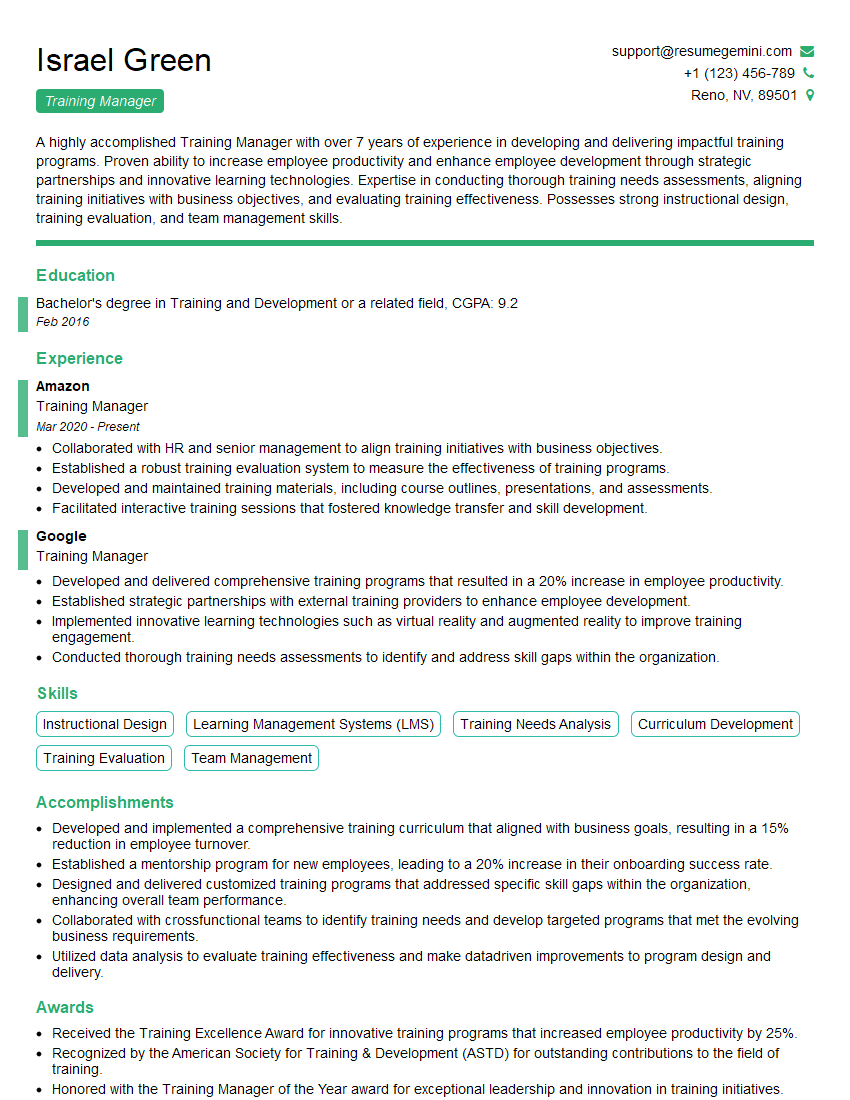
Training Manager Resume Sample
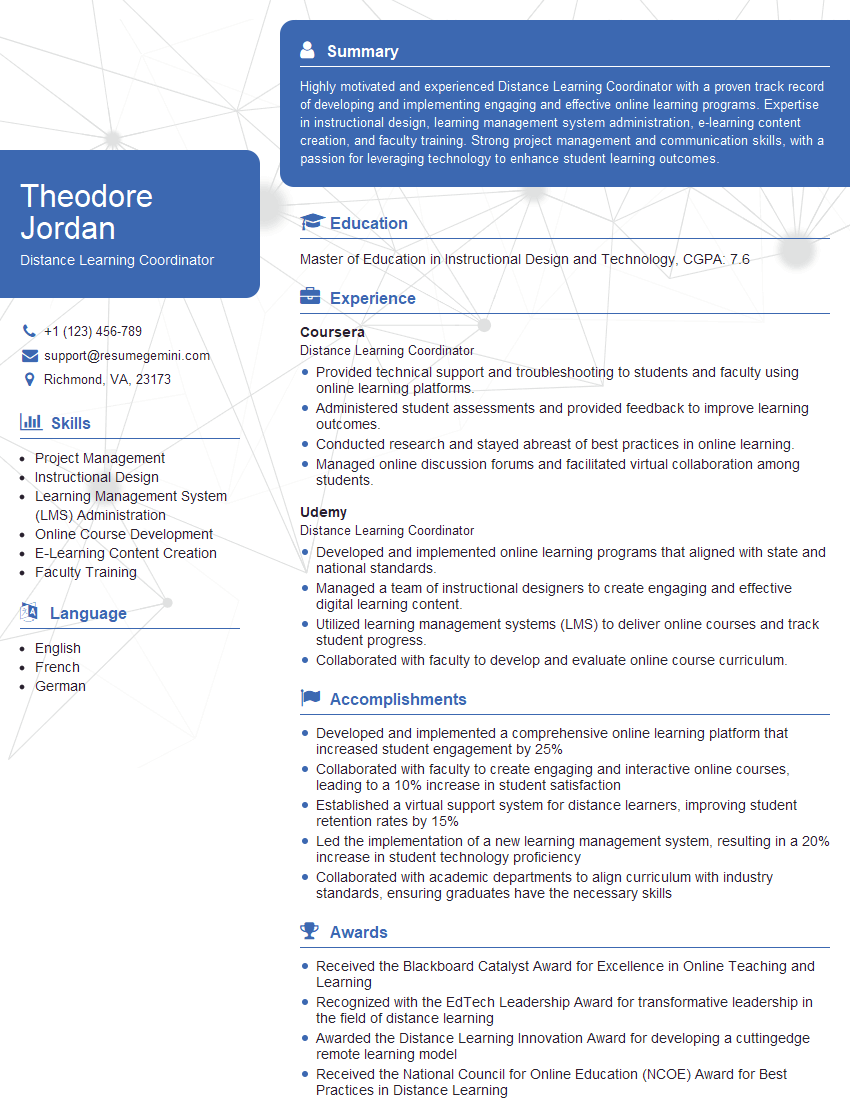
Distance Learning Coordinator Resume Sample
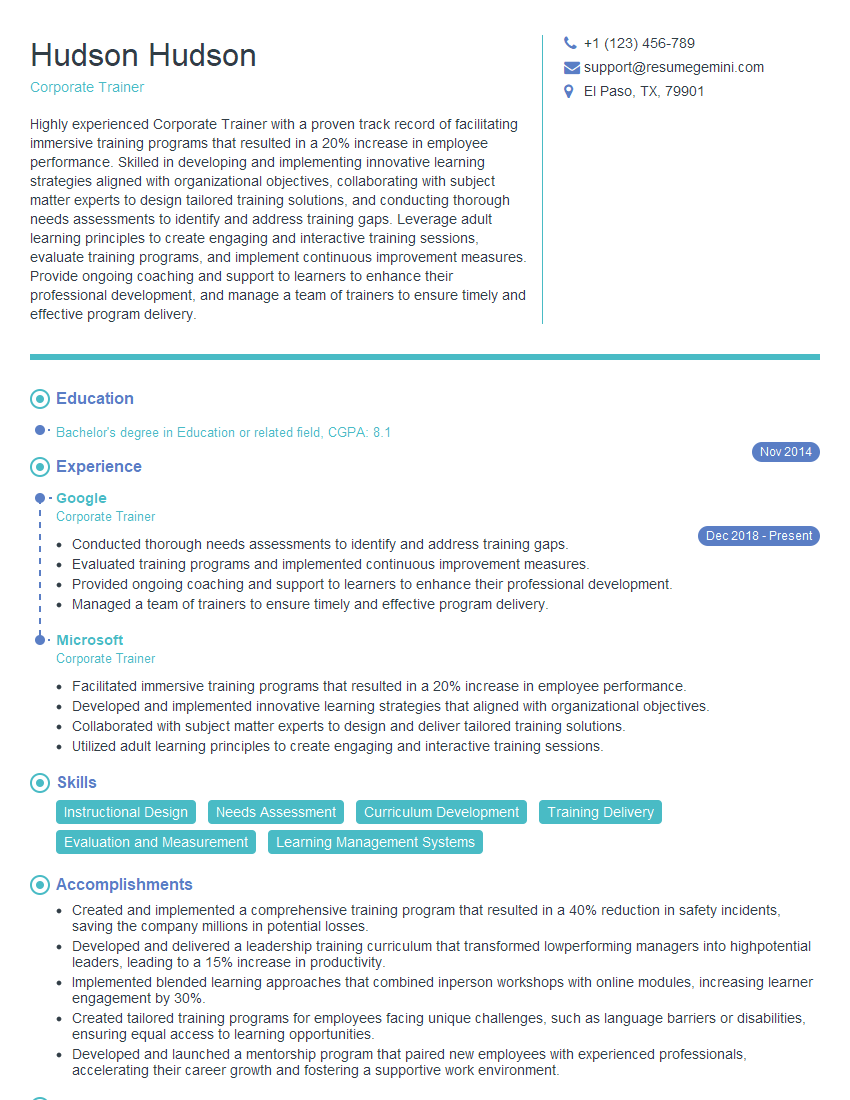
Corporate Trainer Resume Sample

Curriculum Developer Resume Sample

Training Specialist Resume Sample
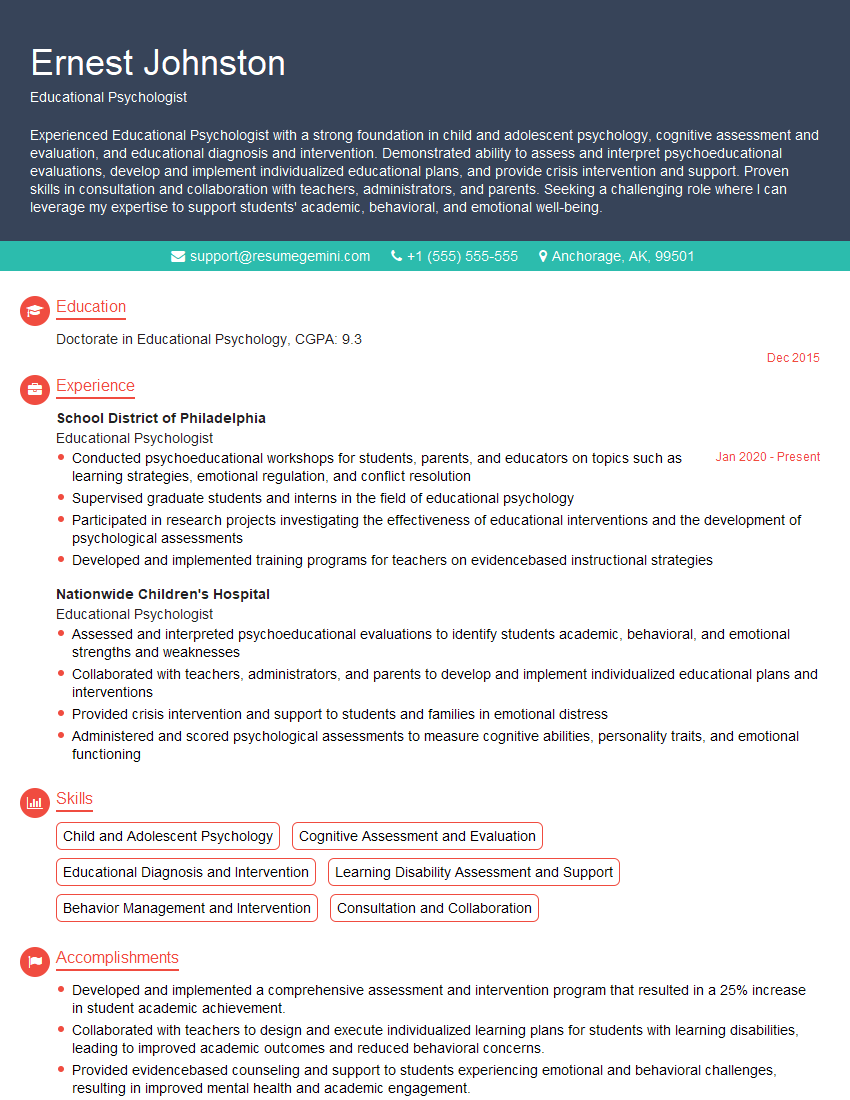
Educational Psychologist Resume Sample
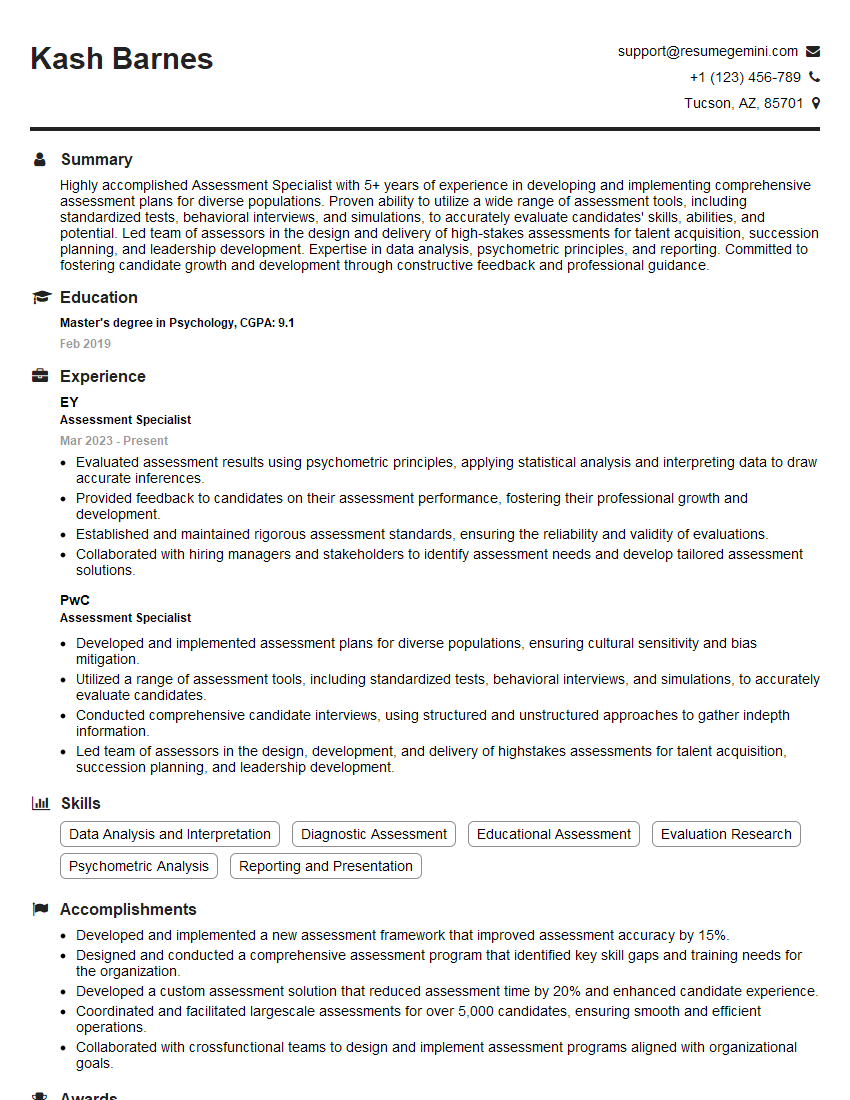
Assessment Specialist Resume Sample
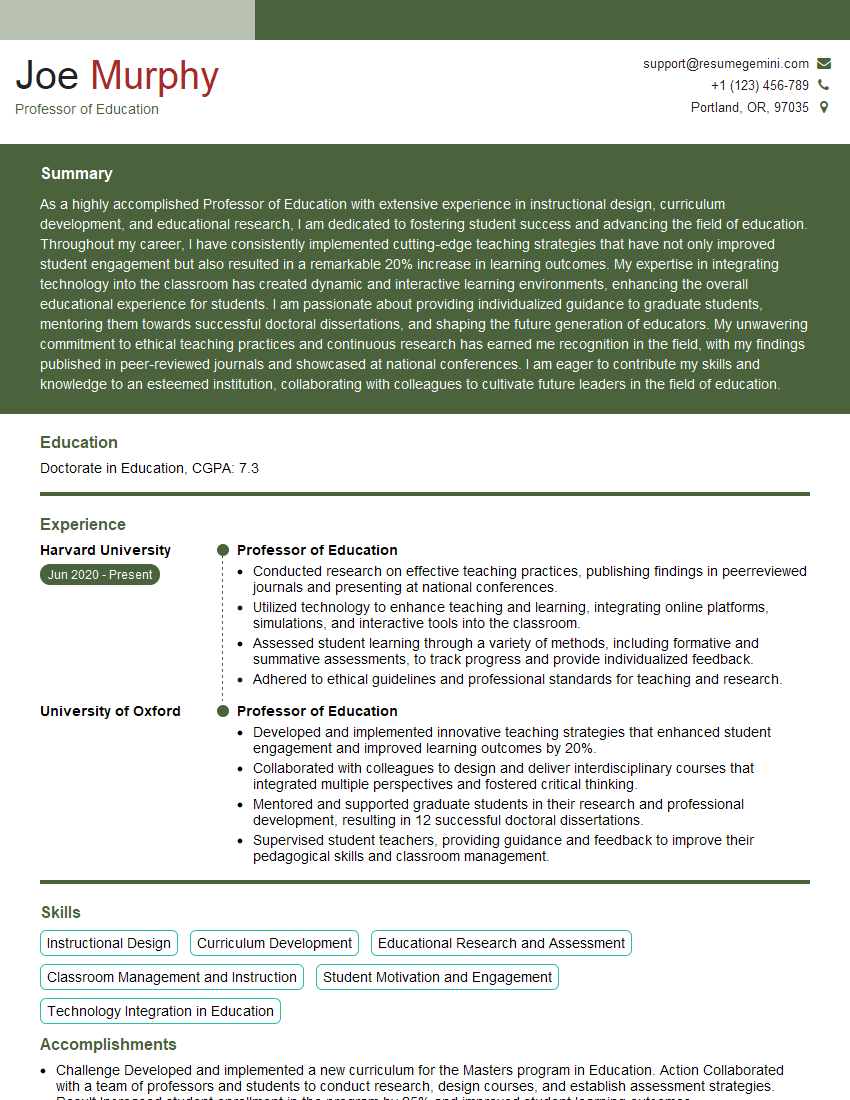
Professor of Education Resume Sample

Adult Education Instructor Resume Sample
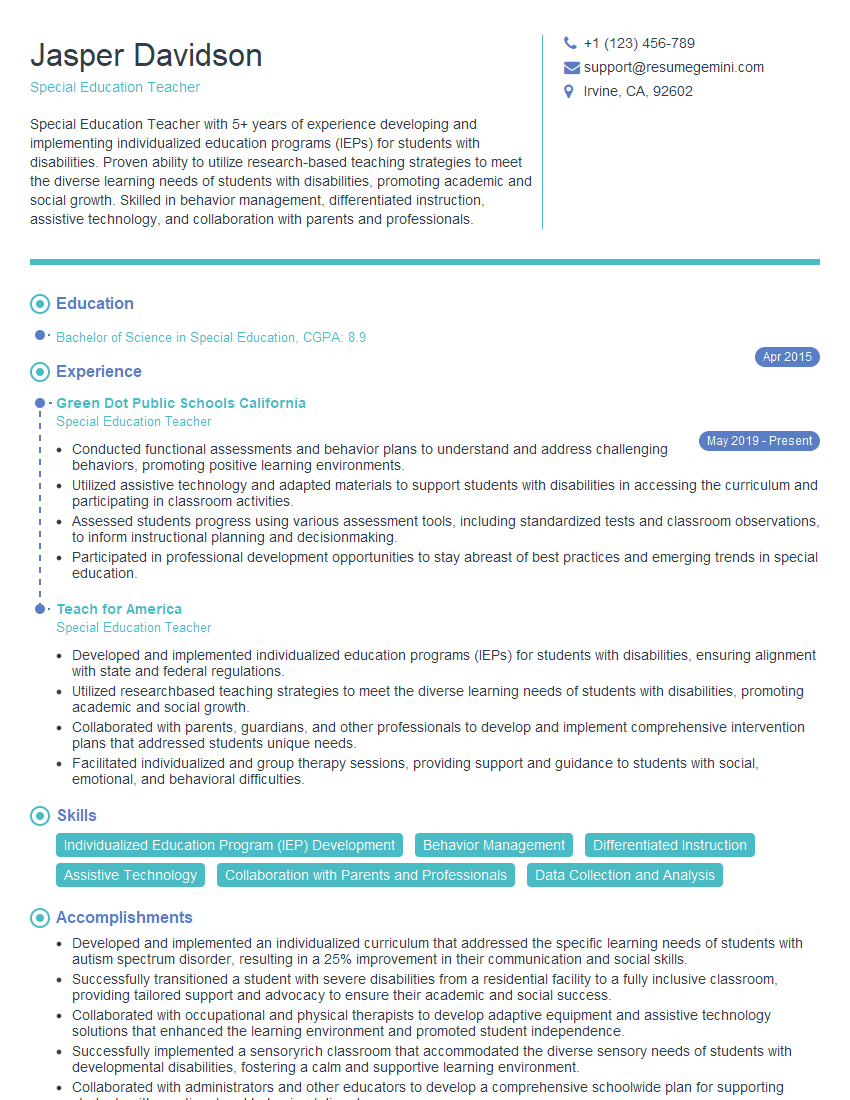
Special Education Teacher Resume Sample
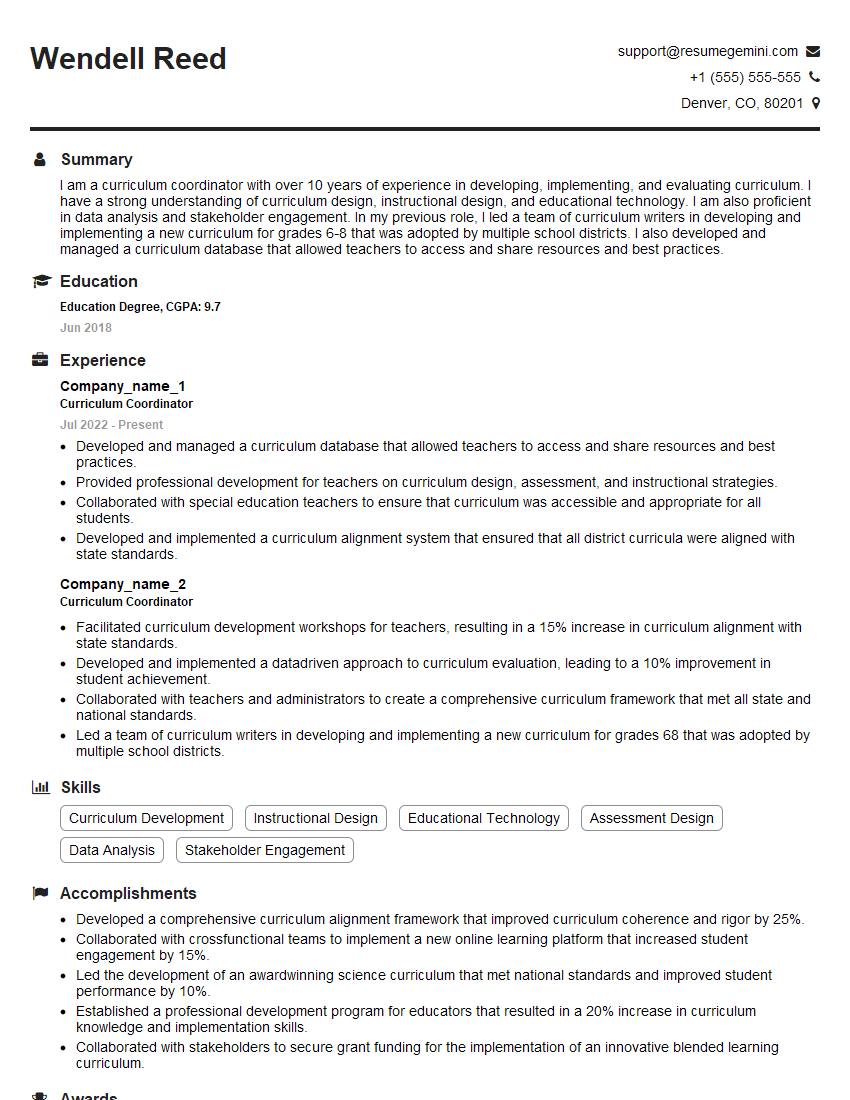
Curriculum Coordinator Resume Sample
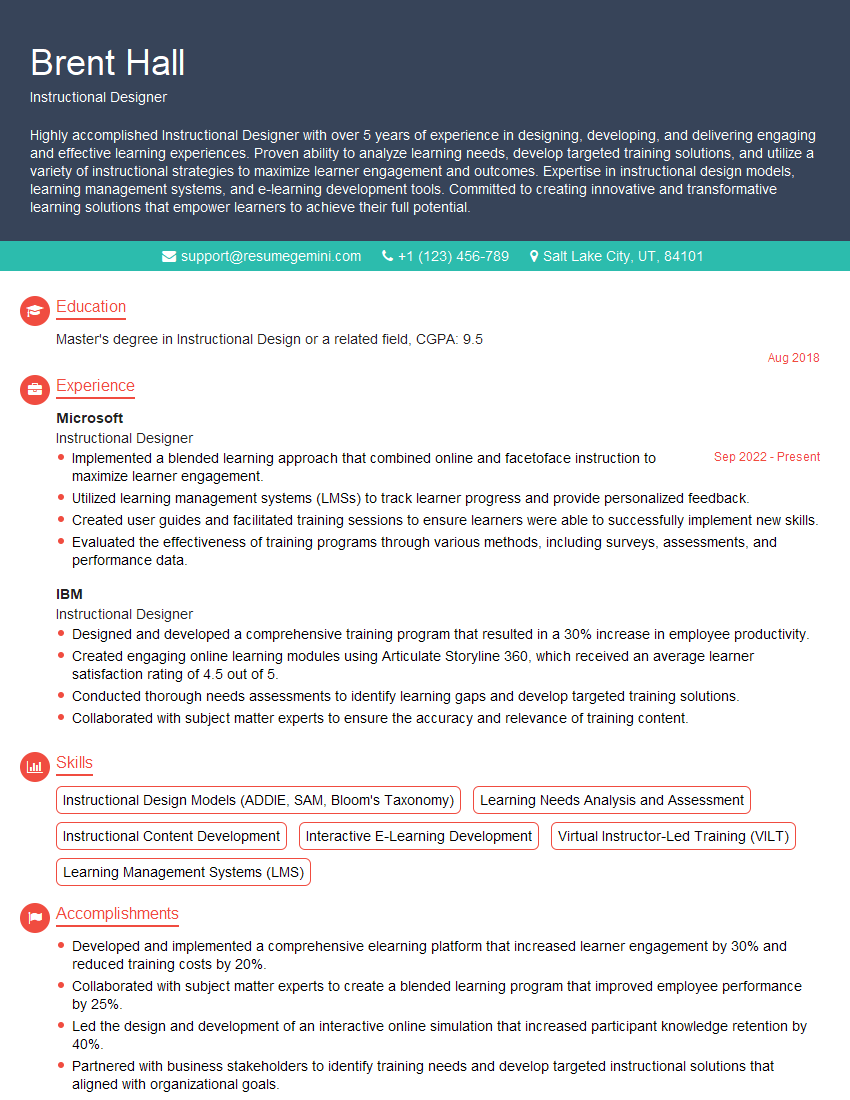
Instructional Designer Resume Sample

Educational Technologist Resume Sample
Explore more articles
Users Rating of Our Blogs
Share Your Experience
We value your feedback! Please rate our content and share your thoughts (optional).
What Readers Say About Our Blog
To the interviewgemini.com Webmaster.
Very helpful and content specific questions to help prepare me for my interview!
Thank you
To the interviewgemini.com Webmaster.
This was kind of a unique content I found around the specialized skills. Very helpful questions and good detailed answers.
Very Helpful blog, thank you Interviewgemini team.