Feeling uncertain about what to expect in your upcoming interview? We’ve got you covered! This blog highlights the most important Electrical Equipment Repair interview questions and provides actionable advice to help you stand out as the ideal candidate. Let’s pave the way for your success.
Questions Asked in Electrical Equipment Repair Interview
Q 1. Describe your experience troubleshooting faulty electrical motors.
Troubleshooting faulty electrical motors involves a systematic approach combining visual inspection, measurement, and analysis. I start by visually inspecting the motor for obvious signs of damage, such as loose connections, burnt insulation, or mechanical wear. Then, I’ll use a multimeter to check the motor’s windings for continuity and insulation resistance. Low resistance indicates a short circuit, while high resistance or open circuit suggests a broken winding. I also check the motor’s voltage and current using a clamp meter to see if they’re within the manufacturer’s specifications. If the problem isn’t immediately apparent, I might use a motor analyzer to perform more in-depth tests, such as checking for bearing wear, imbalance, or stator faults. For example, I once worked on a motor that was exhibiting excessive vibration. After thorough inspection, I found a loose bearing which was resolved by replacing the faulty bearing. This illustrates the importance of a comprehensive approach, encompassing both electrical and mechanical aspects.
Q 2. Explain the process of diagnosing a malfunctioning circuit breaker.
Diagnosing a malfunctioning circuit breaker begins with ensuring safety – always de-energize the circuit before inspection! I then visually inspect the breaker for any signs of damage, such as scorch marks or tripped mechanisms. Next, I use a multimeter to check the voltage on both sides of the breaker. If the voltage is present on the input side but absent on the output, it indicates the breaker is tripped. The reason for tripping needs investigation. A simple reset might suffice for a minor overload, but persistent tripping could indicate a more serious problem such as a short circuit in the protected circuit or a faulty breaker itself. I also check the breaker’s amperage rating to ensure it matches the circuit’s load. Using a clamp meter, I measure the current draw of the circuit to ensure it’s not exceeding the breaker’s rating. For example, I once encountered a breaker that kept tripping, even after resetting. Through further testing, I identified an overloaded circuit due to faulty appliances. Replacing those appliances solved the recurring problem.
Q 3. How do you identify and resolve issues with three-phase power systems?
Issues with three-phase power systems often manifest as voltage imbalances, phase-to-phase short circuits, or neutral current problems. Identifying these issues requires specialized equipment and a thorough understanding of three-phase power principles. I begin by measuring the voltage and current in each phase using a multimeter and clamp meter. Voltage imbalances (significant differences in voltage between phases) indicate a problem. Similarly, high neutral current could signal an imbalance, an improperly grounded system, or a single-phasing condition. To detect phase-to-phase faults, I use a dedicated insulation resistance tester. Phase-to-ground faults are investigated using similar techniques. Analyzing power quality data loggers reveals trends in voltage and current that pinpoint the problem. For example, a factory experienced frequent production stoppages due to three-phase imbalances. Using a power quality analyzer, we identified a poorly connected transformer as the root cause, leading to an efficient resolution by correcting the connection.
Q 4. What safety precautions do you adhere to when working with high-voltage equipment?
Safety is paramount when working with high-voltage equipment. I always follow established safety protocols, including lockout/tagout procedures to ensure the equipment is completely de-energized before starting any work. This prevents accidental energization and avoids potential electrical shock. I use appropriate personal protective equipment (PPE) such as insulated gloves, safety glasses, and arc flash suits to reduce the risk of injury. I also use insulated tools and perform regular equipment checks before and after each task. I always work with a partner, ensuring another qualified electrician is present for assistance and as a safety observer. Furthermore, I always have a clear understanding of the work permit system, ensuring work is authorized and all necessary safety measures are in place. Any work involving high voltage necessitates meticulous planning and execution.
Q 5. Describe your experience with various types of electrical testing equipment (e.g., multimeters, oscilloscopes).
My experience encompasses a wide range of electrical testing equipment. Multimeters are essential for basic voltage, current, and resistance measurements. I use clamp meters for non-contact current measurements, vital in live circuits. Oscilloscopes allow visualization of waveforms, crucial for analyzing transient events and detecting harmonic distortions in AC power systems. I’m also proficient with insulation resistance testers to detect damaged insulation in motors and cables, and power quality analyzers to diagnose power supply issues. For example, using an oscilloscope, I once diagnosed a motor control problem caused by high-frequency noise on the power line that wasn’t detectable with a simple multimeter.
Q 6. How do you interpret electrical schematics and wiring diagrams?
Interpreting electrical schematics and wiring diagrams is fundamental to my work. I begin by understanding the symbols and conventions used in the diagram. I then trace the flow of power and signals from the source to the load, identifying components and their interconnections. I pay close attention to wire colours, numbering, and terminal designations. I use the schematic to identify the path of current and pinpoint possible faults based on the symptoms of the malfunction. I often cross-reference the schematic with the physical layout of the equipment, ensuring accuracy. Experience allows me to quickly visualize how changes to the circuit will affect other parts of the system. For instance, while repairing an industrial machine, I relied heavily on the wiring diagram to trace the problematic signal pathway to a loose connector, avoiding unnecessary disassembly.
Q 7. Explain your process for repairing damaged electrical wiring.
Repairing damaged electrical wiring begins with thorough inspection to determine the extent of the damage. All power must be de-energized and locked out before commencing work. I then carefully remove the damaged section, ensuring the remaining wires are clean and undamaged. I use appropriate connectors or splicing techniques according to the wire gauge and type. All connections are carefully insulated to prevent short circuits. I use heat-shrink tubing for added protection, ensuring all repairs meet safety standards and regulations. I always document the repair work and, where necessary, update the system diagrams. For example, I once repaired wiring in a damp environment. I meticulously prepared the area, selected weather-resistant materials, and sealed the connections to prevent future corrosion and potential hazards.
Q 8. How do you diagnose and repair faulty control circuits?
Diagnosing and repairing faulty control circuits involves a systematic approach. Think of it like detective work – you need to gather clues to identify the culprit. First, I’d visually inspect the circuit for any obvious problems like loose connections, burnt components, or damaged wiring. Then, I’d use a multimeter to check voltage levels, current flow, and continuity at various points in the circuit. This helps pinpoint where the problem lies – a short circuit, an open circuit, or a faulty component like a relay or a switch. For example, if a motor isn’t starting, I might check the power supply to the motor starter, then the control relay, and finally the limit switches to see if they’re signaling correctly. Once the faulty component is identified, it’s replaced, and the circuit is tested to ensure proper functionality. Sometimes, circuit diagrams are essential; I always meticulously check schematics to understand the circuit’s logic flow and trace signals.
For instance, I once worked on a conveyor system where the control circuit for a specific motor was malfunctioning. By systematically checking voltage at each point in the circuit, I discovered a burnt-out transistor. Replacing the transistor resolved the issue. This case highlighted the importance of thorough inspection and systematic troubleshooting.
Q 9. What experience do you have with Programmable Logic Controllers (PLCs)?
I have extensive experience with PLCs, both in programming and troubleshooting. I’m proficient in various PLC programming languages, including Ladder Logic, Function Block Diagram (FBD), and Structured Text. My experience spans different PLC brands, such as Allen-Bradley, Siemens, and Schneider Electric. I can effectively read and modify existing PLC programs, diagnose faults by examining PLC I/O status, and implement changes to improve system performance. For example, I recently debugged a PLC program controlling a packaging machine where a timing issue caused misalignment. By modifying the program’s timer settings and adding error checks, I resolved the problem and increased efficiency. I also regularly use PLC programming software to simulate processes and test code before deployment, thereby reducing downtime.
Beyond basic programming, I’m comfortable with advanced functions such as data logging, networking, and communication protocols used to integrate PLCs with other industrial systems.
Q 10. Describe your experience with repairing AC and DC motors.
Repairing AC and DC motors requires understanding their fundamental differences. AC motors use alternating current and typically have a simpler construction, while DC motors use direct current and are often more complex with commutators and brushes. In either case, diagnosis starts with a visual inspection for obvious damage – burnt windings, loose connections, or mechanical wear. I use specialized tools like insulation resistance testers and motor winding testers to check for insulation breakdown and shorted windings. For AC motors, I might test for phase imbalances or capacitor failures. For DC motors, I’d check the commutator for wear and brush condition. If the problem lies in the windings, they might need to be rewound, a process I’m skilled in. If it’s a mechanical issue, I’d address bearing wear or alignment problems. I’ve repaired many motors across various applications, including industrial pumps, conveyors, and robotic systems. One memorable occasion involved a large AC motor that had suffered a winding failure. By carefully rewinding the motor, I was able to avoid costly replacement and get the system back online quickly. This showcases the value of effective motor diagnosis and repair.
Q 11. How familiar are you with different types of transformers?
My familiarity with transformers extends across various types. I’m comfortable working with power transformers, which step up or step down voltage in power distribution systems, and instrument transformers (current and potential transformers), used for measurement and protection. I understand the differences in their construction, applications, and potential failure modes. For example, power transformers can fail due to overheating, insulation breakdown, or short circuits in the windings. Instrument transformers can fail due to saturation or inaccuracies in their transformation ratio. I can diagnose these issues through various tests, including checking winding resistance, insulation resistance, and the transformation ratio. I’ve worked on transformers ranging in size from small instrument transformers to large power transformers used in industrial settings. Troubleshooting and repair may involve winding replacement, core repairs, or bushing replacement. It’s crucial to handle these with safety precautions due to the high voltages involved.
Q 12. Explain your understanding of electrical safety codes and regulations.
Electrical safety is paramount in my work. I’m fully aware of and adhere to all relevant electrical safety codes and regulations, including the National Electrical Code (NEC) and OSHA standards. This involves using proper lockout/tagout procedures before working on any energized equipment. Understanding color codes for wiring and knowing how to use appropriate personal protective equipment (PPE) such as insulated gloves and safety glasses are crucial. I am also trained in arc flash safety and understand the hazards associated with high-voltage equipment. I always prioritize safety; a thorough risk assessment is done before every task and proper safety measures are always followed. Even seemingly simple repairs require careful consideration of safety procedures to mitigate risks. Negligence is unacceptable; safety is always my top priority.
Q 13. How do you handle emergency situations involving electrical equipment?
In emergency situations involving electrical equipment, my first priority is safety. If there’s a fire, I immediately evacuate the area and call emergency services. If there’s an electrical shock victim, I follow established emergency procedures, prioritizing their safety and administering first aid if qualified. If the equipment is malfunctioning and causing a hazard, I immediately isolate it from the power source using lockout/tagout procedures. Before attempting any repair, I ensure the equipment is completely de-energized and that it’s safe to work on. In one case, a short circuit caused a small fire in a control panel. I immediately shut off the power, used a fire extinguisher to put out the blaze, and then called the fire department to ensure the area was safe. After the situation was under control, I began a thorough investigation into the cause of the short circuit.
Q 14. Describe your experience with preventive maintenance on electrical equipment.
Preventive maintenance is crucial for extending the lifespan of electrical equipment and preventing unexpected failures. My preventive maintenance experience encompasses a variety of tasks, including visual inspections for wear and tear, cleaning electrical contacts and connections, tightening loose bolts, checking insulation resistance, lubricating moving parts, and testing protective devices like circuit breakers and fuses. I also create and maintain preventive maintenance schedules tailored to the specific equipment and its operational requirements. Regular preventive maintenance can identify potential problems before they escalate into major failures, leading to significant cost savings and avoiding production downtime. For example, I established a preventive maintenance program for a manufacturing plant that reduced equipment failures by 40%, resulting in significant cost savings and increased productivity. This program involved scheduled inspections, cleaning, and testing of critical electrical equipment.
Q 15. What is your experience with different types of sensors and transducers?
My experience with sensors and transducers spans a wide range of technologies used in industrial electrical equipment. I’m proficient in working with various types, including:
- Temperature Sensors: Thermocouples, RTDs (Resistance Temperature Detectors), and thermistors. I understand the different calibration methods and the importance of accurate temperature readings for process control and equipment protection. For example, I recently troubleshooted a faulty thermocouple in a large industrial oven, resulting in significant cost savings by preventing production downtime.
- Pressure Sensors: Strain gauge-based pressure transducers, piezoelectric sensors, and capacitive sensors. I can diagnose problems related to sensor drift, signal noise, and calibration issues. I recall an instance where a faulty pressure sensor in a hydraulic system led to inaccurate pressure readings, potentially causing equipment damage. Through careful testing and replacement, I prevented a major incident.
- Proximity Sensors: Inductive, capacitive, and photoelectric sensors. Understanding their operating principles and limitations is crucial for proper application and troubleshooting. I’ve worked extensively with these sensors in automation systems, ensuring accurate detection of objects for robotic control and material handling.
- Flow Sensors: Various types including ultrasonic, magnetic, and turbine flowmeters. I’m familiar with the signal processing required for accurate flow measurements and the impact of flow measurement errors on process efficiency. A recent project involved calibrating a malfunctioning flowmeter on a chemical processing line, improving the accuracy of material dispensing.
My expertise extends beyond simply recognizing sensor types; it includes understanding their signal conditioning needs, integrating them into control systems, and diagnosing faults based on observed symptoms.
Career Expert Tips:
- Ace those interviews! Prepare effectively by reviewing the Top 50 Most Common Interview Questions on ResumeGemini.
- Navigate your job search with confidence! Explore a wide range of Career Tips on ResumeGemini. Learn about common challenges and recommendations to overcome them.
- Craft the perfect resume! Master the Art of Resume Writing with ResumeGemini’s guide. Showcase your unique qualifications and achievements effectively.
- Don’t miss out on holiday savings! Build your dream resume with ResumeGemini’s ATS optimized templates.
Q 16. How do you perform insulation resistance testing?
Insulation resistance testing is a critical safety procedure for ensuring the integrity of electrical equipment. It measures the resistance of the insulation material between conductive parts, indicating its ability to prevent current leakage. A lower-than-expected resistance value indicates potential insulation degradation, posing a significant safety hazard and the risk of electrical shock or equipment failure.
The procedure typically involves using a megohmmeter (or insulation resistance tester), connecting the leads to the conductors under test, and applying a high DC voltage. The megohmmeter measures the resistance in megaohms (MΩ). The acceptable resistance value depends on the voltage rating and type of equipment. For example, high-voltage motors will have significantly higher insulation resistance requirements than low-voltage control circuits.
Before testing, it’s crucial to ensure that the equipment is de-energized and properly discharged. The test results are documented, and any readings below the acceptable limits need thorough investigation and usually necessitate repair or replacement of the affected components.
I always adhere to all safety regulations during insulation testing, including the use of appropriate personal protective equipment (PPE).
Q 17. Explain your experience with repairing power supplies.
Repairing power supplies involves a systematic approach, combining diagnostic skills with a strong understanding of power electronics. My experience covers a wide range of power supply types, including linear, switching, and uninterruptible power supplies (UPS).
Troubleshooting starts with visual inspection, checking for obvious signs of damage, such as burnt components or loose connections. I then proceed with systematic testing, using multimeters, oscilloscopes, and other specialized test equipment to measure voltages, currents, and waveforms. Common faults I encounter include failed capacitors, transistors, diodes, and integrated circuits (ICs).
For example, I once repaired a switching power supply in a large industrial machine. The initial symptom was intermittent power outages. Through meticulous testing, I identified a faulty switching transistor. Replacing the transistor and verifying the functionality through a series of tests restored the power supply’s functionality.
My experience also encompasses repairing various power supply topologies including buck, boost, and buck-boost converters. I’m proficient in reading schematics and using datasheets to identify and replace components.
Q 18. How do you troubleshoot problems with variable frequency drives (VFDs)?
Troubleshooting Variable Frequency Drives (VFDs) requires a thorough understanding of their operational principles, including the control circuitry, power electronics, and motor control aspects. Common issues include faults in the control circuitry, power modules, or the motor itself.
My troubleshooting strategy begins with examining the VFD’s display for any error codes. These codes provide valuable clues about the nature of the problem. I then use multimeters and oscilloscopes to check for proper input voltage, output voltage and current waveforms, and DC bus voltage. I also check for correct communication signals between the VFD and the controlling system.
For instance, I recently repaired a VFD that was exhibiting erratic speed control. By analyzing the error codes and using an oscilloscope, I pinpointed a problem with a faulty feedback signal from the motor encoder. Replacing the encoder resolved the issue.
I also have experience working with various communication protocols such as Modbus and Profibus, helping to isolate issues related to communication between the VFD and other industrial devices.
Q 19. What is your experience with repairing or replacing circuit boards?
Repairing and replacing circuit boards requires precision and a strong understanding of electronics. My experience encompasses working with various types of circuit boards, ranging from simple printed circuit boards (PCBs) to complex multi-layered boards.
The process starts with a thorough inspection to identify damaged components, broken traces, or other abnormalities. This often involves using magnifying glasses and microscopes. Then I use specialized tools like soldering irons and hot air stations to carefully remove and replace faulty components. If necessary, I use techniques like trace repair to fix damaged circuit board traces. For complex boards, I use specialized equipment such as an X-ray machine to identify hidden damage.
Before replacing a component, I always check the datasheet for compatibility and ensure that the replacement part meets the specifications of the original.
One challenging repair involved a circuit board with a micro-crack in a multilayer PCB. This was only detectable with an X-ray machine. After repairing the crack with conductive epoxy, I thoroughly tested the functionality of the repaired board.
Q 20. How do you document your repair work and maintain accurate records?
Accurate and detailed documentation is critical for maintaining a history of repairs, enabling future troubleshooting, and ensuring accountability. My documentation process typically includes the following steps:
- Initial Assessment: I record the initial symptoms, the equipment’s model number, and any relevant serial numbers.
- Testing and Diagnosis: I document all tests performed, including the test equipment used, and the results obtained. This includes both quantitative data (e.g., voltage and current measurements) and qualitative observations (e.g., signs of overheating or physical damage).
- Repair Procedures: I record the steps taken during the repair, including component replacements, adjustments made, and any modifications to the equipment.
- Final Testing and Verification: I document the results of final tests performed to ensure the equipment’s proper functionality after repair.
- Parts Used: I maintain a log of all parts used during the repair process, including part numbers and suppliers.
All documentation is meticulously maintained in a digital format using a computerized maintenance management system (CMMS), ensuring easy access and searchability. This allows quick retrieval of relevant information for future repairs or analysis of recurring issues.
Q 21. Explain your experience with different types of electrical connectors and terminations.
My experience encompasses a wide range of electrical connectors and terminations used in various industrial equipment. This includes:
- Screw Terminals: Common in low-voltage applications, requiring proper torque to ensure a secure connection. I’m meticulous about ensuring adequate torque for reliable operation and preventing overheating.
- Crimp Terminals: Used extensively in higher current applications, requiring the use of appropriate crimping tools to ensure a strong and reliable connection. Incorrect crimping can lead to loose connections and potential fire hazards.
- Wire Connectors: Various types, including quick-disconnect connectors, providing efficient and convenient means of joining or disconnecting wires. I select the appropriate connector based on voltage, current, and environmental conditions.
- Industrial Connectors: Heavy-duty connectors used in harsh environments. I’m proficient in working with various industrial connector types, such as Deutsch connectors, Amphenol connectors, and many others. Understanding the specific requirements of each type, such as their environmental sealing capabilities, is crucial for reliable operation.
Beyond the physical connections, I also understand the importance of proper wire stripping, insulation, and strain relief to ensure safety and longevity. I utilize appropriate tools and techniques to prevent damage to wires during termination.
Q 22. How do you handle situations where you encounter unexpected problems during repair?
Unexpected problems are the bread and butter of electrical equipment repair. My approach is systematic and methodical. First, I ensure my own safety – disconnecting power, using appropriate PPE (Personal Protective Equipment). Then, I meticulously document the unexpected issue, including any observed symptoms and initial readings. This detailed record is crucial for troubleshooting and future reference. Next, I systematically investigate the problem. I might start with a visual inspection, checking for obvious damage like loose connections or burnt components. Then, I’ll move on to using diagnostic tools to pinpoint the fault. For instance, if dealing with a motor, I might use a motor analyzer to check its windings for shorts or opens. This process of elimination helps narrow down the potential causes. If the problem persists, I leverage my experience to consider less common issues, perhaps referencing technical manuals or consulting with colleagues. A recent example involved a seemingly simple circuit breaker tripping repeatedly. Initial checks revealed nothing. However, by carefully measuring voltage drops across sections of the circuit, I discovered a high-resistance connection in a hard-to-reach area, a problem easily missed during a cursory inspection. It highlights the importance of thoroughness and a systematic approach.
Q 23. What software and tools are you familiar with for electrical equipment diagnostics?
My toolbox includes both hardware and software. On the hardware side, I’m proficient with multimeters (both analog and digital), clamp meters, insulation testers, motor analyzers, thermal imagers, and oscilloscopes. These tools allow me to accurately measure voltage, current, resistance, insulation integrity, temperature, and waveform characteristics, vital for diagnosing electrical faults. Software-wise, I’m familiar with various diagnostic software packages specific to different manufacturers of industrial equipment. This includes software for PLC (Programmable Logic Controller) programming and troubleshooting. For instance, I regularly utilize Siemens TIA Portal and Rockwell Automation Studio 5000 to troubleshoot and program PLCs controlling industrial machinery. I’m also adept at using specialized software for analyzing data collected from diagnostic tools, allowing for a deeper understanding of equipment behavior and potential failure points. This data-driven approach is crucial for proactive maintenance and predictive analysis.
Q 24. Describe your experience with working on large industrial equipment.
I have extensive experience working on large industrial equipment, including high-voltage switchgear, large AC/DC motors, transformers, and power distribution systems in manufacturing plants and industrial facilities. A significant project involved troubleshooting a malfunctioning 480V motor-driven conveyor system in a large food processing plant. The conveyor was crucial to the production line, and downtime was extremely costly. Using a combination of motor analysis, thermal imaging, and PLC diagnostics, I successfully identified a failing motor bearing, the root cause of the system’s intermittent failures. This wasn’t just a matter of replacing the motor; it involved carefully coordinating the repair with the production schedule to minimize downtime, ensuring the system was back online quickly and safely. This project demonstrated my ability to handle complex systems, prioritize repairs, and work effectively under pressure in a critical industrial environment. This also involved coordinating with other technicians to ensure the repair was done properly, minimizing downtime.
Q 25. What is your understanding of grounding and bonding in electrical systems?
Grounding and bonding are fundamental to electrical safety and system integrity. Grounding connects the non-current-carrying metallic parts of equipment to the earth, providing a low-resistance path for fault currents to flow. This protects against electric shock and prevents dangerous voltage buildup. Bonding connects metallic parts of the system to each other, equalizing their potential and preventing voltage differences that could lead to dangerous arcing or sparking. An improperly grounded system can lead to equipment malfunction, electric shock hazards, and even fires. A system lacking proper bonding might lead to voltage differences between equipment enclosures, resulting in a shock hazard if someone touches two parts at the same time. Imagine a scenario where a faulty appliance has a live wire touching its metal casing. A proper ground provides a path for the fault current to flow directly to earth, tripping a circuit breaker and preventing a shock. Without grounding, the metal casing would become energized, posing a significant risk. Regular inspection and maintenance of grounding and bonding systems are crucial for ensuring safety and reliability.
Q 26. How do you prioritize repair tasks in a busy maintenance schedule?
Prioritizing repair tasks in a busy maintenance schedule requires a systematic approach. I typically use a combination of methods. First, I assess the criticality of each task based on factors such as safety risks (e.g., a faulty fire alarm system), production impact (e.g., a failed machine crucial to a production line), and the potential for escalation (e.g., a minor leak that could become a major flood). I then use a combination of scheduling software and prioritization matrices to organize the workload, often employing methods like the Eisenhower Matrix (Urgent/Important) to categorize tasks. For example, a critical piece of equipment causing significant production downtime will naturally take precedence over a less important, non-urgent maintenance task. Communication is key here; I regularly coordinate with maintenance managers and production teams to ensure that priorities are aligned, and any unforeseen issues are addressed promptly. This collaborative approach ensures that critical tasks are handled effectively and efficiently, minimizing downtime and potential hazards.
Q 27. Describe your experience with different types of relays and their applications.
I’m experienced with various types of relays, including electromechanical, solid-state, and numerical relays. Electromechanical relays are simple, robust devices using electromagnets to switch contacts. They are often found in older systems and are relatively easy to understand and maintain. Solid-state relays utilize semiconductors and are known for their faster switching speeds and increased reliability. Numerical relays are microprocessor-based and offer advanced protection features, data logging, and communication capabilities. They are commonly used in modern power systems for protection and control. Each relay type has specific applications. For example, I might use an electromechanical overload relay to protect a motor from excessive current, a solid-state relay to control a heating element, and a numerical relay in a high-voltage substation for fault detection and protection. Understanding the characteristics and applications of each type is critical for effective troubleshooting and system design. My experience includes replacing a faulty solid-state relay in a control circuit of a large industrial oven. The faulty relay caused inconsistent heating, affecting product quality. After diagnosing the issue using a multimeter and checking the relay’s switching characteristics, I carefully replaced the faulty unit with an identical one, and verified its function, thus resolving the issue.
Q 28. Explain your understanding of fault current calculations
Fault current calculations are essential for designing safe and reliable electrical systems. These calculations determine the magnitude of current that would flow during a fault (short circuit), such as a short-to-ground or phase-to-phase fault. This information is critical for selecting appropriate protective devices (circuit breakers, fuses) to interrupt the fault current quickly and safely, preventing damage to equipment and preventing fire hazards. The calculations typically involve using Ohm’s Law (V=IR) and considering the impedance of the system, including the source impedance, cable impedance, and the impedance of the equipment involved. Software tools are often used to simplify these calculations, especially in complex systems. For instance, I might use ETAP (Electrical Transient Analyzer Program) or SKM PowerTools to model a power system and perform fault current calculations. This helps determine the available fault current at various points in the system. Accurate fault current calculations ensure that the protective devices are sized appropriately, thus preventing damage to equipment and ensuring the safety of personnel. For example, when designing a new power distribution panel, I’d perform fault current calculations to determine the interrupting capacity required for the circuit breakers, ensuring that they can safely interrupt the fault current if a short circuit occurs.
Key Topics to Learn for Electrical Equipment Repair Interview
- Electrical Fundamentals: Understanding Ohm’s Law, Kirchhoff’s Laws, AC/DC circuits, and basic circuit analysis is crucial for diagnosing and repairing electrical faults.
- Motor Control Systems: Gain a solid grasp of different motor types (AC, DC, servo), their control circuits, and troubleshooting techniques for common motor problems. Practical experience with VFDs (Variable Frequency Drives) is highly valuable.
- Troubleshooting and Diagnostics: Develop systematic approaches to fault finding, utilizing multimeters, oscilloscopes, and other diagnostic tools. Practice identifying faulty components and tracing signals within complex circuits.
- Safety Procedures: Demonstrate a thorough understanding of electrical safety regulations and practices, including lockout/tagout procedures and working safely with high-voltage equipment.
- Common Equipment Repair: Familiarize yourself with the repair and maintenance of various electrical equipment such as transformers, generators, switchgears, and industrial control panels. Understanding their operational principles is key.
- Preventive Maintenance: Showcase your knowledge of preventative maintenance strategies, including routine inspections, testing, and lubrication to extend equipment lifespan and avoid costly breakdowns.
- Blueprint Reading and Schematics: Ability to interpret electrical schematics, wiring diagrams, and blueprints is essential for understanding equipment design and facilitating repairs.
- PLC Programming (if applicable): If your target roles involve Programmable Logic Controllers (PLCs), understanding basic PLC programming and troubleshooting is a significant advantage.
Next Steps
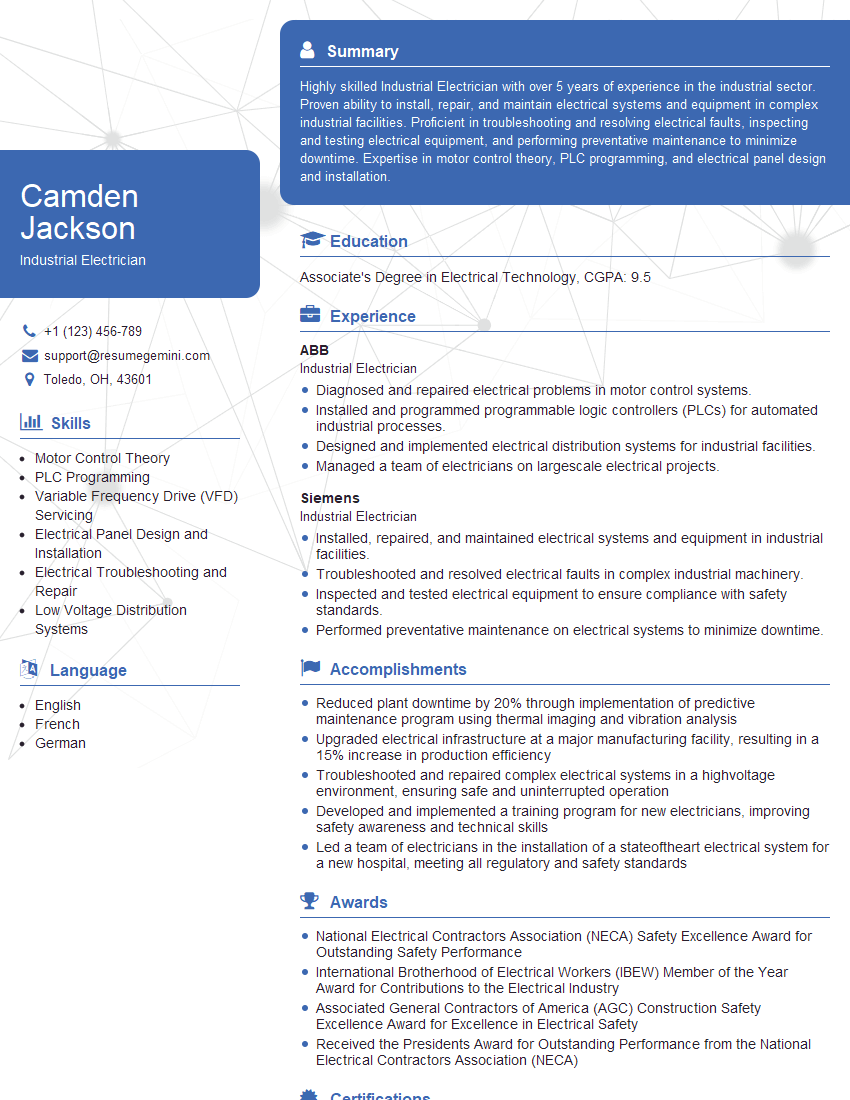
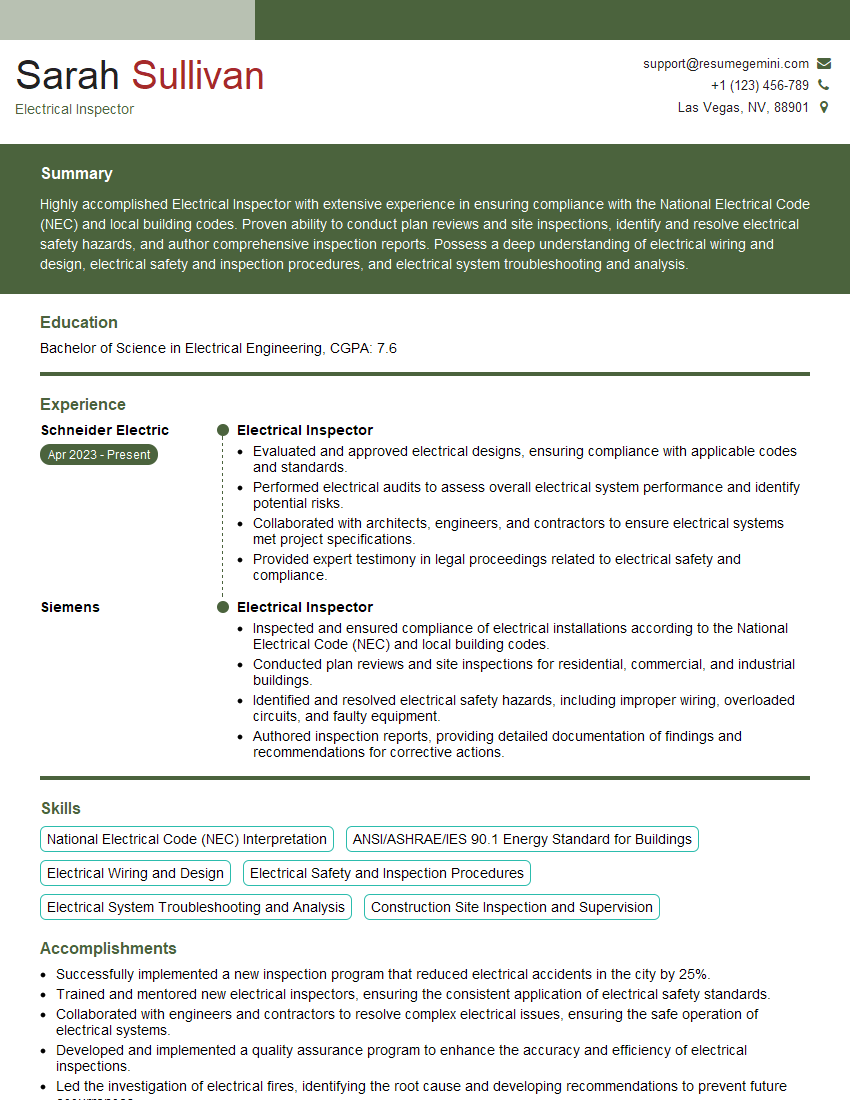
Mastering Electrical Equipment Repair opens doors to a rewarding career with excellent growth potential. Demand for skilled technicians is consistently high, offering opportunities for advancement and specialization. To maximize your job prospects, invest time in crafting a professional, ATS-friendly resume that highlights your skills and experience effectively. ResumeGemini is a trusted resource for building impactful resumes; utilize their tools and resources to create a compelling document that showcases your abilities. Examples of resumes tailored to Electrical Equipment Repair are available to help you get started.



Explore more articles
Users Rating of Our Blogs
Share Your Experience
We value your feedback! Please rate our content and share your thoughts (optional).
What Readers Say About Our Blog
To the interviewgemini.com Webmaster.
Very helpful and content specific questions to help prepare me for my interview!
Thank you
To the interviewgemini.com Webmaster.
This was kind of a unique content I found around the specialized skills. Very helpful questions and good detailed answers.
Very Helpful blog, thank you Interviewgemini team.