Preparation is the key to success in any interview. In this post, we’ll explore crucial Electrical Test and Troubleshooting interview questions and equip you with strategies to craft impactful answers. Whether you’re a beginner or a pro, these tips will elevate your preparation.
Questions Asked in Electrical Test and Troubleshooting Interview
Q 1. Explain the difference between series and parallel circuits.
The fundamental difference between series and parallel circuits lies in how the components are connected and how the current flows. In a series circuit, components are connected end-to-end, forming a single path for current flow. Think of it like a single-lane road – all the traffic (current) must pass through each component. If one component fails, the entire circuit breaks, like a broken road blocking all traffic. The total resistance in a series circuit is simply the sum of the individual resistances (Rtotal = R1 + R2 + R3…).
In a parallel circuit, components are connected across each other, creating multiple paths for current flow. Imagine this as a multi-lane highway – the traffic (current) can split and travel through different paths. If one component fails, the others continue to function, as the remaining lanes are still open. The total resistance in a parallel circuit is calculated using the reciprocal formula: 1/Rtotal = 1/R1 + 1/R2 + 1/R3… This means the overall resistance is always less than the smallest individual resistance.
Example: Christmas tree lights are often wired in series – if one bulb burns out, the whole string goes dark. Household wiring, on the other hand, is primarily parallel – if one appliance fails, the others continue to work.
Q 2. Describe different types of multimeters and their applications.
Multimeters are essential tools for electrical testing, coming in various types, each suited for different applications.
- Analog Multimeters: These use a moving needle to indicate measurements. They are generally more robust and less susceptible to damage from overloads, but less precise than digital counterparts. They’re excellent for quick checks in environments with potential for electrical noise.
- Digital Multimeters (DMMs): These display measurements digitally, offering higher precision and easier readability. They typically measure voltage (AC and DC), current (AC and DC), resistance, and often capacitance, frequency, and diode test capabilities. DMMs are the workhorse of most electrical troubleshooting tasks.
- Clamp Meters: These specialize in measuring current without needing to break the circuit. A clamp is placed around a wire, allowing measurement of the current flowing through it. They are indispensable for high-current applications, such as measuring motor currents or currents in large cables, reducing the risk of electrical shock.
- Specialty Multimeters: These are designed for specific tasks such as insulation resistance testing (Megohmmeters), or testing of low impedance circuits.
The application of each multimeter depends on the specific task. A DMM is ideal for general troubleshooting, while a clamp meter is necessary for high-current measurements, and a Megohmmeter is essential for safety testing of high voltage insulation.
Q 3. How do you troubleshoot a faulty circuit breaker?
Troubleshooting a faulty circuit breaker involves a systematic approach prioritizing safety. Never attempt this without proper safety training and equipment.
- Visual Inspection: Carefully inspect the circuit breaker for any obvious signs of damage, such as burn marks, loose connections, or tripped breaker. A tripped breaker will be in the ‘off’ position.
- Check for Overload: If the breaker is tripped, determine if it’s due to an overload on the circuit. Too many devices drawing high power can trip the breaker. Unplug some appliances to reduce the load.
- Check for Short Circuit: If the breaker trips immediately after resetting, it indicates a potential short circuit. This requires careful tracing of the circuit to find the fault. A short circuit is a low-resistance path that causes excessive current to flow.
- Test for Voltage: Using a non-contact voltage tester (NCVT) or a multimeter, verify the presence of voltage at the breaker’s terminals. Absence of voltage points towards a problem upstream in the electrical system.
- Replace if Necessary: If the breaker is consistently tripping after addressing potential overloads or short circuits, the breaker itself might be faulty and needs replacement. Always replace with a breaker of the same rating.
Remember, if you are uncomfortable performing these steps, it’s crucial to call a qualified electrician.
Q 4. What are the safety precautions when working with high voltage?
Working with high voltage is inherently dangerous. Safety must always be the paramount concern.
- Lockout/Tagout Procedures: Implement lockout/tagout (LOTO) procedures to de-energize the circuit completely before working on it. This prevents accidental energization during the work.
- Personal Protective Equipment (PPE): Use appropriate PPE, including insulated gloves, safety glasses, and arc-flash protective clothing depending on voltage level. High Voltage work frequently requires specialized protective suits and insulated tools.
- Proper Training and Certification: Only trained and certified personnel should work with high voltage. Proper training is essential to understand the hazards and how to mitigate them.
- Work Permits and Supervision: Obtain necessary work permits and ensure adequate supervision is present during high-voltage tasks.
- Emergency Procedures: Establish clear emergency procedures and have readily available first aid and emergency response plans.
Example: Before working on a high voltage power line, a qualified electrician would ensure the line is de-energized using LOTO, wear appropriate PPE including arc-flash rated clothing, and have a spotter present for added safety.
Q 5. Explain Ohm’s Law and its applications in troubleshooting.
Ohm’s Law is the fundamental relationship between voltage (V), current (I), and resistance (R) in an electrical circuit. It states: V = I * R
This law is crucial in troubleshooting because it allows us to calculate one of the parameters (V, I, or R) if we know the other two. For example:
- If we measure the voltage across a resistor and the current flowing through it, we can calculate the resistor’s resistance.
- If we know the resistance of a component and the current flowing through it, we can calculate the voltage drop across it.
- If we know the voltage applied to a circuit and the resistance of the circuit, we can calculate the current that flows.
Application in Troubleshooting: Let’s say a light bulb isn’t working. We can use Ohm’s Law to diagnose the problem. We can measure the voltage at the bulb’s terminals. If the voltage is zero, the problem is likely upstream, in the wiring or the power source. If the voltage is present, we can measure the resistance across the bulb. If the resistance is extremely high or infinite (open circuit), the bulb is faulty. If the resistance is much lower than expected, then it might indicate a short circuit somewhere in the circuit.
Q 6. How do you use a digital oscilloscope to diagnose electrical problems?
A digital oscilloscope is a powerful tool for visualizing and analyzing electrical signals over time. It’s invaluable for diagnosing a wide range of electrical problems.
Diagnosing Electrical Problems:
- Signal Integrity: The oscilloscope displays the shape, amplitude, and frequency of signals. Deviations from expected waveforms indicate problems, such as signal attenuation, noise interference, or distortion.
- Timing Analysis: By observing the timing relationships between signals, the oscilloscope helps identify timing-related issues such as glitches, delays, or race conditions.
- Fault Isolation: By probing different points in a circuit, an oscilloscope can pinpoint the location of a fault, such as a short circuit, open circuit, or a faulty component.
- Transient Analysis: Oscilloscope can capture very short transient events such as spikes or glitches.
Procedure: First, set up the oscilloscope appropriately selecting the time base and voltage range relevant to the signal being measured. Next, connect the oscilloscope probes to the appropriate points in the circuit. Then, observe the waveform displayed on the screen. Compare the measured waveform to the expected waveform to diagnose any problems. Advanced features such as triggering and measurement functions help to analyze the signals effectively.
Example: In a motor control circuit, the oscilloscope can be used to check the drive signal for proper shape and timing. Any distortion or missing pulses might pinpoint the cause of the motor malfunction.
Q 7. Describe different types of electrical wiring and their applications.
Electrical wiring comes in various types, each suited for different applications:
- Solid Wire: A single strand of metal conductor. It’s less flexible but suitable for applications where movement is limited, such as wiring in appliances or within walls.
- Stranded Wire: Multiple smaller strands twisted together. It’s more flexible than solid wire, making it ideal for wiring that needs to bend frequently, such as appliance cords or wiring in mobile equipment.
- Copper Wire: The most common type of conductor due to its high conductivity and relatively low cost. Used in the vast majority of electrical circuits.
- Aluminum Wire: Lighter and cheaper than copper, but has lower conductivity and is more prone to oxidation. Commonly used in high voltage power transmission and distribution.
- Coaxial Cable: Consists of a central conductor surrounded by an insulator, a shield, and an outer jacket. Used for high-frequency signals, such as cable TV and internet connections.
- Fiber Optic Cable: Transmits data as pulses of light through optical fibers. Used in high-bandwidth applications, such as internet and telecommunications.
The choice of wiring depends on factors like voltage, current, flexibility requirements, environment, and cost. For example, high-voltage power lines use aluminum conductors because of their weight advantage, while appliance cords use stranded copper wires for flexibility and durability.
Q 8. What are the common causes of short circuits?
Short circuits, or shorts, occur when an unintended path of low resistance allows current to flow between two points in a circuit that are supposed to be at different potentials. Think of it like creating a shortcut on a highway – instead of taking the long route, the current takes the path of least resistance, often leading to excessive current flow and potential damage.
- Damaged Insulation: Worn, frayed, or melted insulation on wires can expose the conductors, allowing them to touch and create a short. Imagine a worn-out garden hose springing a leak – the water (current) takes the easier path.
- Loose Connections: Poorly crimped or corroded connections can increase resistance, causing overheating and eventually creating a short circuit. A loose wire nut on a home wiring job is a perfect example.
- Foreign Objects: Metal debris, tools, or even rodents can bridge the gap between live conductors, causing a short. Picture a stray screw falling into a junction box.
- Overloaded Circuits: Drawing more current than a circuit is designed to handle can cause overheating and potentially lead to a short. This is like trying to fit too much water into a small pipe.
- Manufacturing Defects: Faulty components or wiring in appliances or equipment can result in internal short circuits. This is often the case with faulty electronics.
Identifying the exact cause requires careful inspection, often with the aid of multimeters and other testing equipment.
Q 9. How do you test for continuity in a circuit?
Testing for continuity verifies if there’s a complete, unbroken path for current to flow between two points in a circuit. We typically use a multimeter set to the continuity test mode. This mode usually emits a beeping sound and/or displays a ‘continuity’ indicator if a complete path is detected. Think of it like testing if a water pipe is fully open and unobstructed.
The process is straightforward:
- Set the Multimeter: Select the continuity test mode (usually symbolized by a diode symbol with a sound wave).
- Connect the Probes: Touch the multimeter probes to the two points in the circuit you want to test. One probe connects to one end and the other connects to the other end of the path in question.
- Interpret the Results: A continuous tone or an indicator light indicates that there’s a good connection; no tone or a high resistance reading suggests there’s a break in the circuit.
Example: To check if a switch is properly closing a circuit, you would place one probe on one side of the switch and the other probe on the other side; a continuous tone indicates a closed circuit. No tone indicates an open circuit.
Q 10. Explain the concept of grounding and its importance.
Grounding is the process of connecting a point in an electrical circuit to the earth, providing a low-resistance path for fault currents to flow. This is critically important for safety and equipment protection. It prevents dangerous voltage buildup on exposed metal parts and helps to prevent electrical shocks and fires.
Importance:
- Safety: If a fault occurs (e.g., a short circuit or insulation failure), the fault current will flow through the ground path, tripping a circuit breaker or blowing a fuse, protecting people from electric shock.
- Equipment Protection: Grounding helps to protect sensitive equipment from voltage surges and spikes by providing an escape route for excess electrical energy.
- Noise Reduction: Grounding can help to reduce electrical noise in sensitive circuits.
Think of it like this: Imagine a dam holding back water (electricity). Grounding is like an overflow valve – if the water level gets too high, it safely releases the excess, preventing the dam from bursting (equipment failure or electrical shock).
Q 11. How do you interpret a wiring diagram?
Wiring diagrams are schematic representations of electrical circuits, showing the interconnection of components and wires. They’re essential for understanding how a circuit works, troubleshooting problems, and installing or modifying equipment. They use symbols to represent various components (switches, resistors, motors, etc.) and lines to represent the wires connecting them.
To interpret a wiring diagram:
- Familiarize Yourself with Symbols: Understanding the standard symbols used in the diagram is crucial (e.g., a circle with a cross inside indicates a ground connection).
- Trace the Path: Follow the lines to trace the current path from the power source through the different components.
- Identify Components: Determine the function of each component and how it interacts with other components in the circuit.
- Note the Connections: Pay attention to how wires are connected, noting any junctions or branches in the circuit.
- Reference the Key: Many diagrams have a key or legend that defines any specialized symbols used. Many utilize standardized symbols, but consistency isn’t guaranteed across all diagrams.
Example: A simple circuit diagram showing a light switch controlling a light bulb would show the power source (typically a circle with a plus and minus symbol), the switch (a switch symbol), the light bulb (a circle with a filament symbol), and the lines indicating how they are interconnected.
Q 12. What are the different types of electrical relays and their functions?
Electrical relays are electromechanical or solid-state switches that use a small electrical current to control a larger current. They are used for various purposes, such as motor control, overload protection, and signal switching. They act as an intermediary, switching a heavy-duty current using a smaller control signal.
Types and Functions:
- Electromechanical Relays: These are the traditional type, using an electromagnet to actuate a mechanical switch. They’re robust and reliable but can be slower than solid-state relays.
- Solid-State Relays (SSRs): These use semiconductor devices instead of mechanical contacts. They’re faster, quieter, and have a longer lifespan than electromechanical relays, but they may be more sensitive to voltage spikes.
- Time-Delay Relays: These introduce a time delay before switching, often used in sequence control or to prevent false triggering.
- Overload Relays: These protect motors and other equipment from excessive current draw.
- Contactor Relays: Used to switch high-current circuits, commonly in motor starting applications.
The specific function of a relay depends on its design and application, making it a very versatile component in electrical systems.
Q 13. How do you troubleshoot a faulty motor?
Troubleshooting a faulty motor involves a systematic approach to identify the root cause of the malfunction. It often starts with visual inspection, followed by electrical tests and mechanical checks.
Steps:
- Visual Inspection: Check for any obvious physical damage, such as loose connections, burned wires, or damaged components (bearings, belts).
- Electrical Tests:
- Continuity Test: Check for continuity in the motor windings using a multimeter. An open winding indicates a break in the coil.
- Insulation Resistance Test: Use a megohmmeter to measure the insulation resistance between the windings and the motor frame. Low resistance suggests insulation breakdown.
- Voltage Test: Verify the correct voltage is reaching the motor terminals.
- Current Test: Measure the motor current during operation; excessive current can indicate problems with the windings or bearings.
- Mechanical Checks:
- Bearing Inspection: Check for bearing wear or damage which might cause excessive friction and motor failure. Look and listen for unusual sounds.
- Shaft Alignment: Ensure the motor shaft is properly aligned with the driven equipment.
- Load Test: Gradually apply load to the motor to check for unusual noises or performance issues.
- Advanced Diagnostics: In complex cases, you may need specialized tools such as motor testers or vibration analyzers.
The process depends on the motor type (AC, DC, etc.) and the nature of the fault, but these steps form a good general approach.
Q 14. Describe the process of testing a three-phase motor.
Testing a three-phase motor involves verifying that each phase is receiving the correct voltage and that the motor windings are in good condition. This ensures balanced power distribution, preventing issues such as overheating or motor failure.
Process:
- Visual Inspection: Begin by visually inspecting the motor terminals, connections, and overall condition.
- Voltage Measurement: Use a multimeter to measure the voltage between each phase and ensure they are balanced (approximately equal voltage between phases). A significant voltage imbalance can indicate a problem in the power supply or wiring.
- Current Measurement: Measure the current flowing in each phase. Unbalanced currents point to issues with the motor windings or load.
- Resistance Measurement: Check the resistance between each phase using a multimeter. Large discrepancies can indicate a winding problem.
- Insulation Resistance Test: Use a megohmmeter (or insulation resistance tester) to measure the insulation resistance of the windings to the motor frame. This tests for any insulation breakdown.
- Rotation Test (optional): This is often done to confirm the motor’s rotational direction. If the direction is incorrect, some internal wiring could be incorrectly phased.
Important safety precautions should always be followed when working with three-phase power – disconnect the power before starting any testing.
Q 15. What are the common causes of power surges?
Power surges, or transient overvoltages, are sudden increases in voltage that exceed the normal operating voltage of electrical equipment. Think of it like a sudden rush of water in a pipe, far exceeding the normal flow. These surges can be incredibly damaging, potentially frying sensitive electronics.
- Lightning Strikes: A major culprit. Lightning can induce massive voltage spikes into power lines, traveling considerable distances.
- Switching Transients: Large electrical equipment like motors or transformers switching on or off can create significant voltage fluctuations.
- Utility Problems: Faults on the power grid, such as short circuits or downed power lines, can propagate surges across wide areas.
- Nearby Construction: Welding and other high-current activities can cause voltage spikes in nearby circuits.
- Faulty Appliances: A malfunctioning appliance can sometimes generate surges within your home’s electrical system.
Understanding the sources of power surges is critical for implementing proper protection, like surge protectors and surge arresters, to safeguard equipment and prevent costly repairs.
Career Expert Tips:
- Ace those interviews! Prepare effectively by reviewing the Top 50 Most Common Interview Questions on ResumeGemini.
- Navigate your job search with confidence! Explore a wide range of Career Tips on ResumeGemini. Learn about common challenges and recommendations to overcome them.
- Craft the perfect resume! Master the Art of Resume Writing with ResumeGemini’s guide. Showcase your unique qualifications and achievements effectively.
- Don’t miss out on holiday savings! Build your dream resume with ResumeGemini’s ATS optimized templates.
Q 16. How do you test for insulation resistance?
Insulation resistance testing measures the ability of an insulator to resist the flow of current. A high insulation resistance indicates good insulation, while low resistance suggests damage or degradation and potential safety hazards. Think of it like checking for leaks in a water pipe; a small leak indicates a problem that needs attention before it becomes catastrophic.
We typically use a Megohmmeter (or Megger) for this test. It applies a high DC voltage across the insulation and measures the resulting leakage current. The resistance is expressed in megaohms (MΩ).
- Power Off: Ensure the circuit is completely de-energized and locked out/tagged out for safety.
- Connect the Megger: Connect the Megger leads to the conductor and the grounded component being tested, ensuring good contact.
- Apply Voltage: Select the appropriate voltage setting on the Megger based on the insulation’s rated voltage and begin the test.
- Read the Resistance: The Megger will display the insulation resistance value. Compare this value against the manufacturer’s specifications or industry standards to determine if the insulation is acceptable.
- Document Results: Record the test results, date, and time for future reference and compliance.
Low insulation resistance necessitates further investigation and possible repair or replacement of the faulty insulation to prevent short circuits and electrical hazards.
Q 17. Explain the principles of AC and DC circuits.
AC (Alternating Current) and DC (Direct Current) circuits differ fundamentally in the way they deliver electrical energy. In a DC circuit, the current flows in one direction, like water flowing consistently through a pipe. In an AC circuit, the current reverses direction periodically, like a water pump that pushes water back and forth.
- DC Circuits: Characterized by a constant voltage and current flowing in a single direction. Batteries are a common source of DC power. Simple resistive circuits are easily analyzed using Ohm’s Law (V=IR).
- AC Circuits: The voltage and current vary sinusoidally over time. Household power outlets are a prime example of AC power. AC circuits are more complex to analyze, often requiring techniques beyond Ohm’s Law, involving concepts like impedance, phase angles, and reactance (in circuits with capacitors and inductors).
The choice between AC and DC depends on the application. DC is often preferred for electronics that require a stable voltage, while AC’s ease of generation and transmission makes it ideal for power distribution over long distances.
Q 18. How do you use a clamp meter to measure current?
A clamp meter is a versatile tool for measuring current without breaking the circuit. Its jaws clamp around a current-carrying conductor, and a current transformer inside the meter measures the magnetic field produced by the current. It’s like having a non-invasive way to measure the flow of water in a pipe without cutting the pipe open.
- Safety First: Ensure the circuit is properly de-energized if working on live circuits. Always use appropriate safety measures.
- Select AC/DC: Select the appropriate current type (AC or DC) on the clamp meter.
- Clamp Around Conductor: Open the jaws of the clamp meter and carefully clamp them around the single conductor carrying the current you wish to measure. Ensure only one conductor is within the jaws.
- Read the Measurement: The clamp meter will display the current reading in amperes (A).
- Range Selection: Select an appropriate current range before measuring to avoid exceeding the meter’s capacity.
Clamp meters are invaluable for troubleshooting circuits, verifying load currents, and ensuring electrical systems operate within safe limits.
Q 19. What are the common causes of overheating in electrical equipment?
Overheating in electrical equipment can stem from several factors, ultimately leading to potential fire hazards or equipment failure. It’s like a car overheating – too much friction or insufficient cooling leads to problems.
- High Load Currents: Exceeding the rated current capacity of the equipment forces it to work harder, generating excessive heat.
- Poor Ventilation: Inadequate airflow around the equipment prevents heat dissipation, leading to overheating.
- Loose Connections: High resistance in loose connections generates heat due to the I²R losses.
- Faulty Components: Malfunctioning components like motors, capacitors, or resistors can overheat.
- Dirt and Debris Buildup: Accumulated dust and debris can insulate the equipment and hinder heat transfer.
- Ambient Temperature: High ambient temperatures exacerbate overheating problems.
Regular inspection, proper ventilation, and maintaining appropriate load currents are crucial to preventing overheating and ensuring the longevity and safety of electrical equipment.
Q 20. Describe the process of replacing a faulty capacitor.
Replacing a faulty capacitor requires careful attention to safety and proper procedure. Capacitors can store lethal electrical energy, even when disconnected from a circuit. Think of it as a tiny battery that can deliver a painful shock.
- Safety First: Disconnect the power supply and discharge the capacitor completely using a suitable discharge tool. Never assume a capacitor is fully discharged; always verify.
- Identify the Capacitor: Note the capacitor’s specifications (voltage rating, capacitance, and type) before removing it for replacement with an exact match.
- Remove the Faulty Capacitor: Carefully desolder or disconnect the capacitor’s leads from the circuit board or wiring.
- Install the New Capacitor: Install the new capacitor, ensuring correct polarity (if applicable). For polarized capacitors, reverse polarity could damage the circuit.
- Solder (if necessary): Solder the new capacitor’s leads securely, ensuring proper connections.
- Test the Circuit: After reassembling the circuit, carefully test it to ensure proper functionality.
Always double-check your work and follow safety guidelines to avoid any electrical shock or damage to the equipment.
Q 21. How do you test for voltage drop in a circuit?
Voltage drop is the reduction in voltage along a conductor caused by the current flowing through it. Think of it like the pressure drop in a water pipe as the water flows over a distance; the further the water travels, the more pressure is lost.
To test for voltage drop, you’ll need a multimeter.
- Measure the Voltage at the Source: Measure the voltage at the source of the circuit (e.g., battery terminals or power supply).
- Measure the Voltage at the Load: Measure the voltage across the load (the device or component consuming the power).
- Calculate the Voltage Drop: Subtract the voltage at the load from the voltage at the source. This difference is the voltage drop across the conductor.
- Compare to Acceptable Limits: Compare the measured voltage drop to acceptable limits based on the conductor’s specifications and the load’s requirements. Excessive voltage drop indicates a problem, potentially needing larger conductors.
Excessive voltage drop can lead to reduced performance and even damage to equipment. Understanding and minimizing voltage drop is crucial for designing and troubleshooting electrical systems.
Q 22. Explain the concept of impedance and its significance.
Impedance is the opposition to the flow of alternating current (AC) in a circuit. Unlike resistance, which only considers the opposition to direct current (DC), impedance also accounts for the effects of capacitance and inductance. Think of it like this: resistance is a friction that slows down the flow of water in a pipe, while impedance is a combination of friction, a constriction that limits flow, and an inertia effect that resists changes in flow rate. It’s measured in ohms (Ω).
Its significance lies in its crucial role in AC circuit analysis and design. Understanding impedance allows us to predict the current flow, voltage drops, and power consumption in AC circuits, which is fundamental for designing efficient and safe electrical systems. For instance, matching the impedance of a loudspeaker to the amplifier is crucial for optimal sound reproduction and to prevent damage. A mismatch can lead to reduced sound quality or even damage to the equipment.
The impedance (Z) is calculated using this equation: Z = √(R² + (XL – XC)²), where R is the resistance, XL is the inductive reactance, and XC is the capacitive reactance.
Q 23. Describe different types of sensors used in electrical systems.
Electrical systems employ a wide variety of sensors to monitor and control various parameters. Here are a few examples:
- Temperature Sensors: Thermocouples, thermistors, and RTDs (Resistance Temperature Detectors) measure temperature variations, crucial for things like motor protection or environmental monitoring.
- Current Sensors: Current transformers (CTs) and Hall effect sensors measure current flow, used extensively in power monitoring and protection systems to detect overloads and faults.
- Voltage Sensors: Voltage transformers (VTs) and potential dividers measure voltage levels. Safety systems rely heavily on these for monitoring and ensuring equipment operates within safe voltage ranges.
- Position Sensors: Potentiometers, encoders, and proximity sensors detect the position or movement of mechanical components. In robotics or industrial automation these are essential for precise control.
- Pressure Sensors: These measure pressure levels in systems like hydraulic or pneumatic controls.
The choice of sensor depends entirely on the application and the specific parameter to be measured. Factors like accuracy, range, environmental conditions, and cost all contribute to the selection process.
Q 24. How do you troubleshoot a faulty circuit using logic probes?
Logic probes are invaluable tools for troubleshooting digital circuits. They provide a visual indication of high (logic 1) and low (logic 0) states, as well as pulse detection. Troubleshooting with a logic probe involves systematically checking signal levels at different points in the circuit to isolate the fault.
- Visual Inspection: Begin with a thorough visual inspection of the circuit board for obvious damage like burnt components or loose connections.
- Power Supply Check: Verify that the power supply is providing the correct voltage. A logic probe will confirm if the power rails are functional.
- Signal Tracing: Start at the input of the circuit and trace the signals using the logic probe. Compare the observed signals with the expected signals based on the circuit diagram. Any deviation indicates a potential fault.
- Isolation of the Fault: By systematically tracing the signals, the location of the fault can be pinpointed. The faulty component may exhibit incorrect logic levels or pulses.
- Component Testing: After identifying the suspected component, use a multimeter or other appropriate test equipment to verify its functionality.
Example: If a digital clock isn’t displaying the correct time, you could use a logic probe to check for the correct signal at the clock input and its propagation through various logic gates. A missing or incorrect signal points to the problem area.
Q 25. What are the common causes of intermittent faults?
Intermittent faults are frustrating because they appear and disappear unpredictably. The most common causes include:
- Loose Connections: Worn or corroded connectors, loose wires, or poor soldering can create intermittent contact.
- Cold Solder Joints: A poor solder connection can fail when subjected to vibration or temperature changes.
- Component Failure: Components like capacitors or transistors can develop intermittent faults due to internal degradation, often triggered by temperature or voltage fluctuations.
- Cracked Circuit Boards: Tiny hairline cracks in the PCB can lead to intermittent open circuits.
- Electrostatic Discharge (ESD): ESD can damage sensitive components, causing intermittent behavior.
- Environmental Factors: Temperature, humidity, and vibration can exacerbate underlying problems, leading to intermittent faults.
Troubleshooting these requires patience and systematic investigation. Often, applying stress like vibration or temperature changes while observing the symptoms helps to reveal the cause.
Q 26. Explain the use of signal generators in testing.
Signal generators produce calibrated electrical signals with specific waveforms, frequencies, and amplitudes. They are essential for testing various aspects of electrical and electronic circuits and systems.
- Testing Amplifiers: A signal generator provides an input signal to check the amplifier’s gain, frequency response, and distortion.
- Filter Testing: Signal generators are used to determine the cutoff frequencies and attenuation characteristics of filters.
- Component Testing: They can be used to test the response of individual components like inductors, capacitors and operational amplifiers.
- System Integration: Signal generators help verify proper interaction and communication between different parts of a system.
- Fault Injection: A signal generator can simulate fault conditions to test the robustness of a system’s protective mechanisms.
By precisely controlling the input signal, we can observe the system’s response and identify any anomalies or deviations from expected behavior.
Q 27. How do you perform a safety inspection of electrical equipment?
Safety inspections of electrical equipment are crucial to prevent accidents. A thorough inspection involves:
- Visual Inspection: Check for obvious signs of damage such as frayed wires, loose connections, burn marks, and cracks in insulation.
- Grounding and Bonding: Verify proper grounding to ensure protection against electric shock. Examine grounding wires and connections for corrosion or damage.
- Overcurrent Protection: Check that circuit breakers and fuses are properly sized and functional.
- Insulation Testing: Use a megger (insulation resistance tester) to measure the insulation resistance of cables and equipment to detect insulation degradation.
- Lockout/Tagout Procedures: Before working on any electrical equipment, always follow lockout/tagout procedures to prevent accidental energization.
- Personal Protective Equipment (PPE): Always use appropriate PPE such as insulated gloves, safety glasses, and safety shoes when working with electrical equipment.
Documentation is vital; all findings and corrective actions must be meticulously recorded.
Q 28. Describe your experience with different types of test equipment.
Throughout my career, I’ve extensively used a variety of test equipment, including:
- Multimeters: Essential for basic measurements of voltage, current, and resistance.
- Oscilloscope: For analyzing waveforms and identifying signal anomalies, essential for understanding dynamic behavior.
- Function Generators: To generate various test signals.
- Logic Analyzers: Used for complex digital circuit analysis and troubleshooting.
- Spectrum Analyzers: For analyzing frequency components of signals.
- Power Meters: For accurate measurements of power consumption.
- Insulation Testers (Meggers): For assessing insulation quality in high-voltage systems.
- Clamp Meters: For safe and convenient current measurement without breaking the circuit.
My experience with these tools has equipped me with the capability to diagnose a wide array of electrical and electronic faults, ensuring efficient repair and maintenance procedures in various settings.
Key Topics to Learn for Electrical Test and Troubleshooting Interview
- Basic Electrical Theory: Understanding Ohm’s Law, Kirchhoff’s Laws, and series/parallel circuits is fundamental. Practice applying these concepts to real-world scenarios.
- Schematic Reading and Interpretation: Become proficient in understanding and interpreting electrical schematics. Practice identifying components, tracing signals, and understanding circuit functionality.
- Test Equipment Proficiency: Familiarize yourself with common test equipment like multimeters, oscilloscopes, and function generators. Understand their applications and limitations.
- Troubleshooting Methodologies: Master systematic troubleshooting techniques, such as the divide-and-conquer approach, and learn to use diagnostic tools effectively.
- Safety Procedures: Demonstrate a strong understanding of electrical safety regulations and practices. This is crucial for any role involving electrical work.
- Common Electrical Faults: Learn to identify and diagnose common electrical faults, such as short circuits, open circuits, and ground faults. Understand the causes and consequences of these faults.
- Digital Logic and Troubleshooting: For more advanced roles, understanding digital logic circuits and troubleshooting techniques will be beneficial.
- Industrial Control Systems (ICS): Depending on the specific role, familiarity with Programmable Logic Controllers (PLCs) and other industrial control systems may be necessary.
- Problem-Solving and Analytical Skills: Highlight your ability to approach complex problems methodically and logically. Showcase your analytical thinking skills.
Next Steps
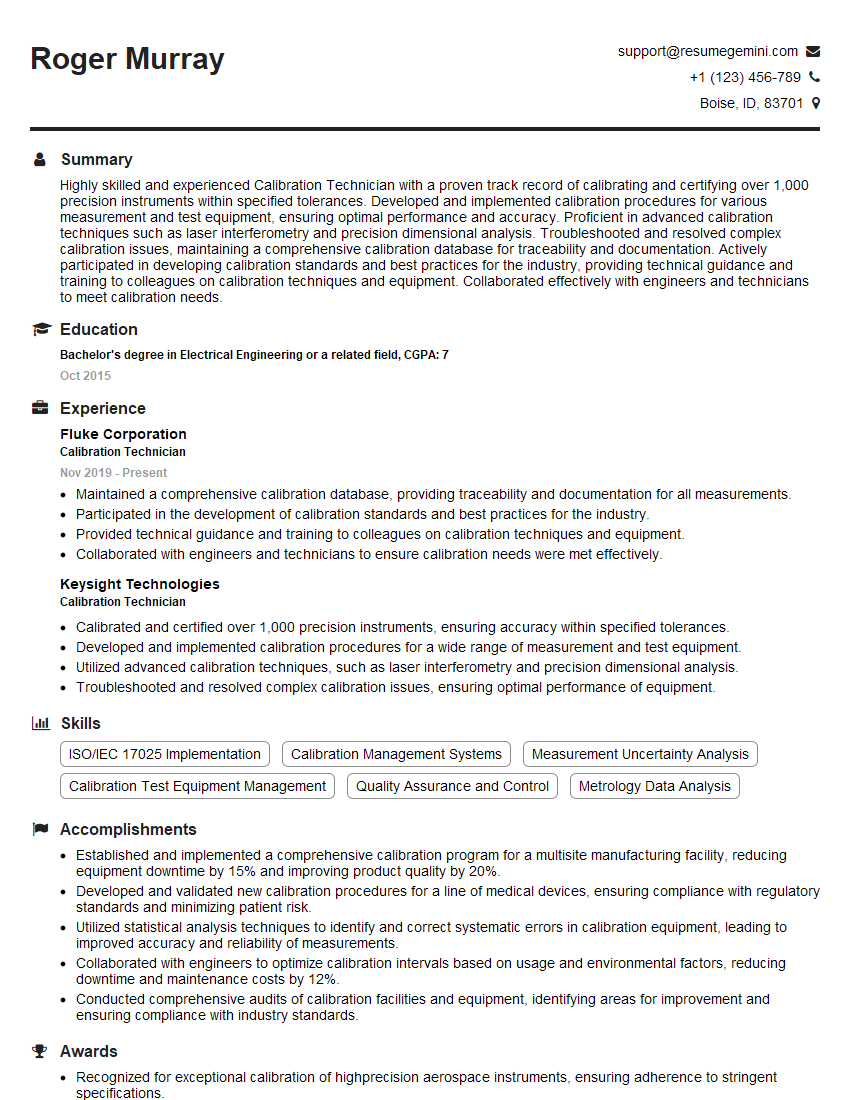
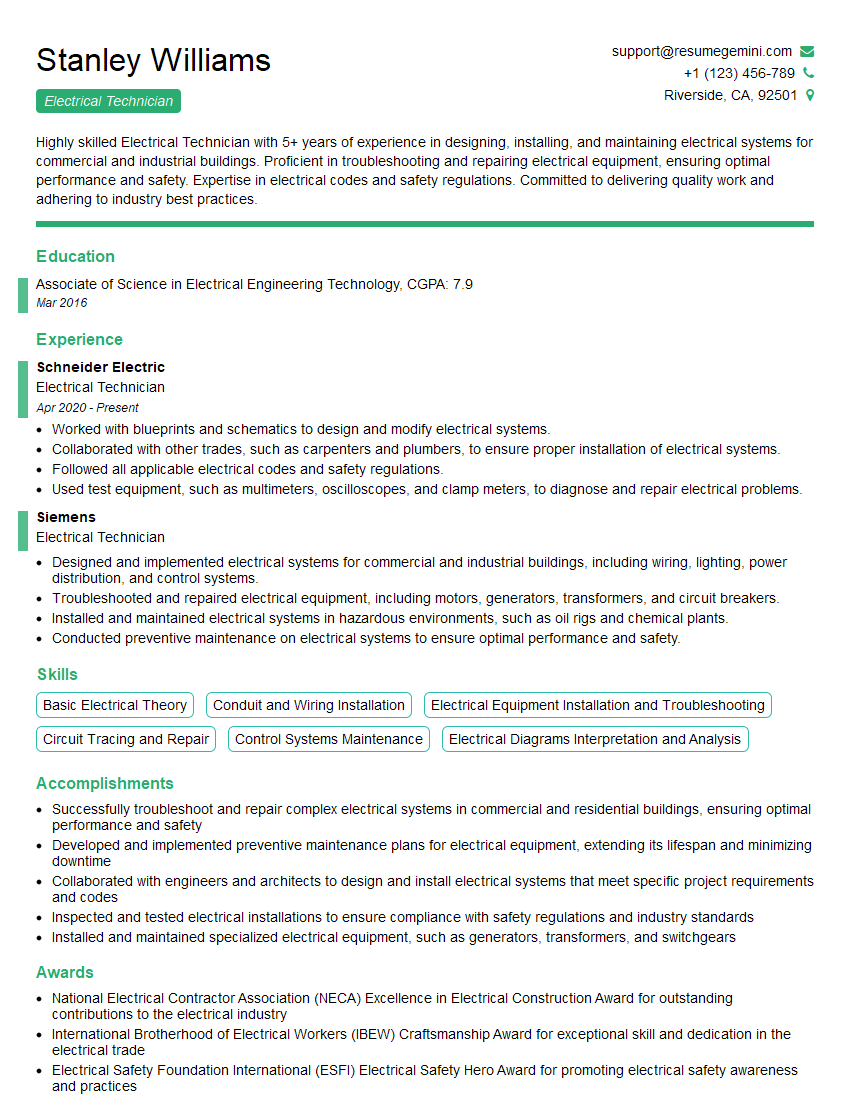
Mastering Electrical Test and Troubleshooting opens doors to exciting career opportunities and significant professional growth within the electrical and electronics industries. A strong understanding of these concepts is highly valued by employers, leading to increased earning potential and advancement possibilities. To maximize your job prospects, create an ATS-friendly resume that effectively showcases your skills and experience. ResumeGemini is a trusted resource to help you build a professional and impactful resume. ResumeGemini provides examples of resumes tailored to Electrical Test and Troubleshooting roles to help guide you in creating your own compelling application materials.


Explore more articles
Users Rating of Our Blogs
Share Your Experience
We value your feedback! Please rate our content and share your thoughts (optional).
What Readers Say About Our Blog
To the interviewgemini.com Webmaster.
Very helpful and content specific questions to help prepare me for my interview!
Thank you
To the interviewgemini.com Webmaster.
This was kind of a unique content I found around the specialized skills. Very helpful questions and good detailed answers.
Very Helpful blog, thank you Interviewgemini team.