The right preparation can turn an interview into an opportunity to showcase your expertise. This guide to Experience in Translation and Transcription interview questions is your ultimate resource, providing key insights and tips to help you ace your responses and stand out as a top candidate.
Questions Asked in Experience in Translation and Transcription Interview
Q 1. What CAT tools are you proficient in?
I’m proficient in several Computer-Assisted Translation (CAT) tools, each with its own strengths. My core competency lies in SDL Trados Studio, a widely used industry-standard CAT tool. I’m adept at leveraging its features such as translation memory (TM), terminology management, and quality assurance checks. I also have experience with memoQ, a highly customizable CAT tool known for its collaborative features. Finally, I’m familiar with Across Language Server, particularly useful for managing large-scale translation projects and maintaining consistent terminology across multiple documents. My proficiency extends to using these tools to maximize efficiency and ensure consistent high-quality translations across all projects.
Q 2. Explain your experience with different translation methodologies (e.g., direct, indirect, etc.).
My experience encompasses various translation methodologies. Direct translation, where I translate directly from the source language to the target language, is my primary approach, especially for languages I’m highly proficient in. This method allows for a more natural and nuanced translation. However, I also utilize indirect translation, particularly when working with less familiar languages or highly specialized terminology. This involves translating into a known intermediary language first, then to the target language. This approach helps to maintain accuracy and precision. I also incorporate transcreation, which goes beyond direct translation and adapts the source material to resonate better with the target audience’s cultural context and style, particularly useful for marketing materials. Selecting the right methodology is crucial to delivering a high-quality translation that meets the client’s needs.
Q 3. How do you handle ambiguous terminology in a translation project?
Handling ambiguous terminology is a critical aspect of translation. My approach involves a multi-step process. First, I thoroughly research the context of the ambiguous term, examining the surrounding text, images, or any accompanying documents to understand its intended meaning. Second, I consult reliable terminology databases and resources such as industry-specific glossaries, specialized dictionaries, and online terminological resources. Third, if ambiguity persists, I proactively communicate with the client or project manager to clarify the intended meaning, ensuring a shared understanding before finalizing the translation. Documenting these decisions in a style guide for consistent application across the entire project is essential. For example, if I encounter the ambiguous term “bank,” I would investigate whether it refers to a financial institution or the side of a river. The context dictates the correct translation.
Q 4. Describe your process for quality assurance in translation.
My quality assurance (QA) process is rigorous and multi-layered. It begins with a thorough self-review, where I meticulously check for accuracy, consistency, and fluency. Then I utilize the QA functionalities built into my CAT tools, such as concordance searches to identify inconsistencies and potential errors. I also perform a final review paying close attention to grammar, style, and terminology, ensuring the translated text adheres to the client’s specifications. If working on larger projects, I incorporate a peer review process, where another translator or editor reviews the translation for a fresh perspective and identifies any missed errors. Finally, I conduct a thorough final check against the original text before delivery, ensuring that every aspect of the translation meets the highest standards.
Q 5. What are some common challenges you face in transcription, and how do you overcome them?
Transcription presents several challenges. Poor audio quality, including background noise, overlapping speech, and low audio levels, is a frequent hurdle. I overcome this by using noise reduction software and employing active listening techniques to discern words amidst the noise. Accents and dialects can also present a challenge. I address this by researching the speaker’s accent and using specialized transcription software that can accommodate various accents. Fast or mumbled speech can also make transcription difficult. I address this by using transcription software that allows for pausing and replaying sections to ensure accuracy. Finally, specialized terminology requires additional research to ensure accuracy. I compensate for this by researching the subject matter to accurately transcribe any technical or jargon-specific terms.
Q 6. How do you ensure accuracy and consistency in your transcription work?
Accuracy and consistency in transcription are paramount. My approach involves using high-quality transcription software and employing standardized punctuation and formatting. I create a style guide at the start of every project that defines rules for handling numbers, dates, names, and other elements consistently. I actively listen to the audio/video multiple times, taking notes and clarifying any ambiguities before transcribing. I always verify my transcription against the original audio to ensure accuracy. Finally, I conduct thorough proofreading checks to identify any spelling, grammar, or punctuation errors. This meticulous approach ensures the final transcript is accurate, consistent, and easy to read.
Q 7. Explain your experience with different audio/video formats used in transcription.
I possess extensive experience working with diverse audio and video formats commonly used in transcription. These include WAV, MP3, MP4, MOV, and AVI files. I’m proficient in using various software applications that can handle these different formats, enabling me to transcribe from a wide range of sources. My experience spans from simple audio recordings to complex video conferences and webinars, and I can adapt my methods to accommodate any specific format requirements. This versatility allows me to accept and handle a wide range of projects, catering to the needs of various clients.
Q 8. How familiar are you with specialized terminology in specific fields (e.g., legal, medical)?
My familiarity with specialized terminology extends across various fields, including legal, medical, technical, and financial. I approach each project by first conducting thorough research to familiarize myself with the specific jargon and nuances of the subject matter. This involves consulting relevant glossaries, dictionaries, and professional literature. For instance, in a legal translation, I would carefully study legal precedents and terminology specific to contracts, patents, or criminal law, ensuring accurate and precise rendering of terms like ‘habeas corpus‘ or ‘prima facie‘. Similarly, medical translations require a deep understanding of anatomical terms, medical procedures, and pharmaceutical nomenclature. I utilize established terminology databases and resources to ensure consistency and accuracy in my work. This proactive research phase is critical for producing high-quality, error-free translations that accurately reflect the source material’s meaning and intent.
Q 9. How do you manage large volumes of translation or transcription projects?
Managing large translation or transcription projects involves a structured approach leveraging project management tools and strategies. I typically start by breaking down the project into smaller, manageable tasks. This could involve dividing a large document into chapters or sections, assigning different parts to team members (if working collaboratively), or creating a detailed timeline. I then use project management software to track progress, deadlines, and resources. This might include tools like Asana, Trello, or even a simple spreadsheet. Consistent communication with clients and team members is crucial, ensuring everyone is informed about progress, potential roadblocks, and any necessary adjustments to the plan. Regular quality checks throughout the process help identify and address issues early on, preventing delays or compromising quality. The key is to employ efficient workflows and robust communication to ensure the project stays on track and is completed to the highest standards.
Q 10. What is your experience with translation memory tools?
I have extensive experience using translation memory (TM) tools like SDL Trados Studio, memoQ, and Across. These tools are invaluable for improving efficiency and consistency. TMs store previously translated segments, allowing for quick retrieval and reuse of translations. This reduces workload, ensures consistency in terminology, and significantly speeds up the translation process. For example, if a phrase like ‘terms and conditions‘ has been translated in a previous project, the TM will automatically suggest the previously approved translation in the new project. This not only saves time but also maintains consistent terminology across multiple projects for a given client. Moreover, TM tools allow for quality assurance by highlighting potential inconsistencies and offering suggestions for improved translations. Regular updates and maintenance of these TMs are essential for optimizing their effectiveness.
Q 11. How do you prioritize tasks when working on multiple translation or transcription projects simultaneously?
Prioritizing tasks when handling multiple projects requires a clear understanding of deadlines, client needs, and project complexities. I typically employ a prioritization matrix, considering urgency and importance. Projects with tighter deadlines or higher client priority often take precedence. I also break down projects into smaller, manageable tasks, assigning each a deadline and prioritizing them based on their contribution to the overall project completion. Using project management software with features like Gantt charts assists in visualizing dependencies between tasks and scheduling them effectively. For example, a high-priority urgent translation might be prioritized over a less urgent transcription project, even if the latter has a larger volume. Regular review and adjustment of the priority list ensures that the most critical tasks receive timely attention and that all projects are completed successfully.
Q 12. Describe your experience with different file formats used in translation and transcription.
My experience encompasses a wide range of file formats commonly used in translation and transcription. These include standard document formats like .doc, .docx, .pdf, .rtf, and .txt. I also work with specialized file formats used in desktop publishing, such as .indd (InDesign) and .qxd (QuarkXPress). Additionally, I’m proficient in handling subtitling formats like .srt and .ttml, and transcription formats like .trs and .xml. The ability to work with various file formats is crucial for seamless integration with different clients and workflows. Understanding the nuances of each format ensures that the translated or transcribed content is accurately rendered and maintains its original formatting.
Q 13. How do you deal with inconsistent or poor quality source material in translation?
Dealing with inconsistent or poor-quality source material requires a proactive and meticulous approach. If inconsistencies are minor, such as grammatical errors or typos, I typically correct them while clearly noting the changes for the client. However, for more significant inconsistencies, I discuss the issues with the client to clarify the intended meaning or obtain additional information. This might involve requesting clarification on ambiguous terms, confirming the intended style and tone, or requesting revised source material if necessary. In situations where the source material is severely fragmented or incoherent, I might need to consult with subject matter experts to ensure accuracy. The goal is always to deliver a high-quality translation, even if the source material presents challenges. Transparency and proactive communication with the client are essential in handling such situations.
Q 14. How do you handle deadlines and time management in translation/transcription projects?
Deadlines and time management are critical in translation and transcription. I use a combination of time-tracking tools, detailed project plans, and effective prioritization techniques. I break down projects into smaller, manageable tasks, assigning each a realistic deadline. I use project management software to track progress and identify potential delays proactively. Regular communication with clients ensures that they’re aware of any potential challenges and allows us to work collaboratively to find solutions. For instance, if unexpected issues arise, I will immediately communicate with the client to explore options, potentially adjusting the scope or timeline to ensure successful project delivery without compromising quality. Proactive planning, clear communication, and a commitment to efficient workflows are essential for meeting deadlines consistently.
Q 15. What is your preferred method for managing feedback and revisions in your work?
Managing feedback and revisions effectively is crucial for delivering high-quality translations and transcriptions. My preferred method involves a combination of clear communication and organized tracking. I always request feedback in a structured format, often using a tracked changes feature in a word processor like Microsoft Word or Google Docs. This allows me to see exactly what needs to be adjusted and easily reference the original text. For larger projects, I utilize project management tools that allow for version control and threaded comments.
For example, if a client suggests a change to a specific term, I’ll note the change, discuss its implications (if any), and then incorporate it. If I have questions or if the change conflicts with established terminology, I’ll communicate that clearly and proactively to the client before making any alterations. This collaborative approach ensures accuracy and meets client expectations.
Post-revision, I always send a revised document with a summary of changes made, referencing specific sections with comments. This transparent approach fosters trust and enables clients to easily review and approve the final version efficiently.
Career Expert Tips:
- Ace those interviews! Prepare effectively by reviewing the Top 50 Most Common Interview Questions on ResumeGemini.
- Navigate your job search with confidence! Explore a wide range of Career Tips on ResumeGemini. Learn about common challenges and recommendations to overcome them.
- Craft the perfect resume! Master the Art of Resume Writing with ResumeGemini’s guide. Showcase your unique qualifications and achievements effectively.
- Don’t miss out on holiday savings! Build your dream resume with ResumeGemini’s ATS optimized templates.
Q 16. What software or tools do you typically use for transcription?
My transcription workflow relies heavily on several software tools, each serving a specific purpose. For audio transcription, I primarily use Otter.ai and Trint for their accurate speech-to-text capabilities, especially for longer recordings. These platforms also offer features like timestamping, speaker identification, and export options to various formats. For video transcription, I often prefer Descript which offers more advanced capabilities like audio editing and collaboration features alongside transcription.
For smaller projects or quick notes, I also use built-in transcription features on mobile devices, and even voice-to-text applications on my computer for short-form audio files. Ultimately, the choice of software depends on the project’s complexity, length, and the client’s specific requirements, but the underlying objective is always to maintain accuracy and efficiency.
Q 17. Describe your understanding of terminology management.
Terminology management is the systematic process of identifying, defining, and consistently using terms within a specific field or project. It’s essential for ensuring consistency and accuracy, particularly in specialized domains such as medicine, law, or technology. This involves creating and maintaining a terminology database – a controlled vocabulary or glossary – that serves as a single source of truth for all terms used throughout the project.
For instance, if I’m translating a medical document, I’d need to ensure consistent use of terms like ‘symptomatic’ or ‘prognosis’. A well-maintained terminology database helps prevent inconsistencies and ensures that translations are both accurate and unambiguous. Tools like SDL Trados Studio and memoQ include built-in terminology management features, making the process smoother and more efficient.
I approach terminology management by first thoroughly researching the client’s domain, establishing a baseline glossary by identifying key terms. Next, I constantly update and review the glossary throughout the translation or transcription process. This iterative process helps me adapt to nuances that may arise during the project. The result is a more accurate and professional end-product that reflects a deep understanding of the subject matter.
Q 18. How familiar are you with different types of transcription (e.g., verbatim, intelligent, etc.)?
I’m proficient in various transcription types. Verbatim transcription captures every word spoken, including filler words like “um” and “ah.” Intelligent verbatim is similar but omits some filler words and corrects minor grammatical errors, while maintaining the speaker’s intent. Clean verbatim goes further, removing disfluencies and cleaning up grammar.
Beyond these, I understand and can execute other types like summary transcription (condensing a longer speech into key points), medical transcription (requiring specialized knowledge), and legal transcription (demanding absolute accuracy and adherence to legal terminology). The client’s requirements dictate which transcription type is most suitable. For example, a marketing video might only need a clean verbatim transcription, whereas legal proceedings require a highly accurate verbatim record.
Q 19. How do you ensure the confidentiality of sensitive information in your work?
Confidentiality is paramount. I adhere to strict protocols to protect sensitive information. This starts with signed Non-Disclosure Agreements (NDAs) with clients, outlining the terms of confidentiality and potential consequences of breaches. I store all project files securely, using password-protected devices and encrypted cloud storage.
Furthermore, I work in secure environments, and avoid discussing project details with anyone outside of the client relationship. Once a project is completed, all sensitive data is deleted from my systems in accordance with the NDA stipulations. For highly sensitive materials, I might even employ more robust security measures such as data encryption software. My commitment to confidentiality extends to every aspect of my work, ensuring client peace of mind.
Q 20. What is your experience with machine translation post-editing?
My experience with machine translation (MT) post-editing is significant. MT is a powerful tool for speeding up the translation process, but it often requires human intervention to refine the output. Post-editing involves reviewing the machine-generated translation and correcting errors, improving fluency, and ensuring accuracy.
I use various strategies, depending on the quality of the initial MT output. Sometimes, it might just need minor corrections, and at other times, it might require a near-complete rewrite. My approach prioritizes maintaining the original meaning and intent, while adapting the style to the target language. I’m familiar with various MT engines and understand their strengths and weaknesses, allowing me to tailor my post-editing approach for optimal results. This blend of technology and human expertise leads to quicker turnaround times while maintaining high-quality outputs.
Q 21. How do you approach translating culturally specific content?
Translating culturally specific content requires sensitivity and cultural awareness. It’s more than just word-for-word translation; it’s about conveying the intended meaning and impact within the target culture. I approach such projects by deeply researching the cultural context of both the source and target languages. This might involve studying idioms, metaphors, and cultural norms that may not directly translate.
For example, a humorous phrase in one culture might be offensive in another. I strive to find culturally appropriate equivalents that maintain the original message’s essence, using a combination of direct translation, adaptation, and transcreation (recreating the message in a way that resonates with the target audience). Consulting with native speakers in the target language is often invaluable, as they can provide insights into subtle cultural nuances and suggest alternative phrasing for accurate and effective communication.
Q 22. What are your strategies for maintaining accuracy and fluency in translations?
Maintaining accuracy and fluency in translation is paramount. My strategy relies on a multi-pronged approach. First, I meticulously research the source text, ensuring deep comprehension of its nuances, cultural context, and intended meaning. This includes understanding any specialized terminology or idiomatic expressions. Second, I leverage a variety of resources, including dictionaries, glossaries, and online corpora, to find the most accurate and natural-sounding equivalents in the target language. Third, I employ a rigorous editing process, reviewing my work multiple times to check for grammatical errors, consistency, and overall flow. This often involves reading the translation aloud to catch awkward phrasing or inconsistencies in tone. Finally, I utilize translation memory tools and CAT (Computer-Assisted Translation) software to maintain consistency across projects and improve efficiency while flagging potential inconsistencies. For example, if translating a legal document, I ensure the terminology perfectly aligns with established legal frameworks in the target language, avoiding any ambiguity that could lead to misinterpretations.
Q 23. Explain your experience with different types of translation (e.g., literary, technical, etc.).
My experience spans various translation types. I’ve worked extensively on technical translations, such as manuals for medical devices or software documentation, demanding precise terminology and clarity. This often requires understanding complex technical concepts and presenting them accessibly to the target audience. I’ve also handled literary translations, where preserving the author’s style, tone, and cultural references is crucial. This requires a deeper understanding of the source text’s literary devices and the ability to replicate them effectively in the target language. Furthermore, I have experience in marketing translations, adapting marketing materials for different cultural contexts and ensuring they resonate with the local audience. Each type necessitates a different approach; for example, a technical translation prioritizes accuracy above all else, while literary translation may prioritize stylistic equivalence over literal word-for-word rendering. For instance, translating a Shakespearean sonnet demands a poetic approach far different from translating an engineering blueprint.
Q 24. How do you adapt your approach based on the target audience?
Adapting my approach to the target audience is critical. Consider translating a scientific article versus a children’s book—the language, style, and level of detail must differ significantly. For a scientific audience, I focus on precision and use specialized terminology appropriately. In contrast, when translating for children, I simplify language, use shorter sentences, and employ a more playful tone. Understanding the audience’s cultural background is also crucial; what is acceptable in one culture might be offensive or inappropriate in another. I always consider the purpose of the translation. Is it to inform, persuade, or entertain? This guides my choice of register, style, and vocabulary. For instance, a marketing translation for a young, tech-savvy audience will have a completely different tone and style compared to a translation aimed at senior citizens.
Q 25. What strategies do you employ to improve your speed and efficiency in translation/transcription?
Improving speed and efficiency involves mastering CAT tools, developing strong keyboard skills, and utilizing translation memory. CAT tools allow for efficient translation and management of terminology consistency across projects. Learning keyboard shortcuts significantly reduces the time spent on repetitive tasks. Translation memory stores previously translated segments, significantly speeding up the process for recurring phrases or sentences. Furthermore, I constantly refine my workflow. This includes techniques like pre-editing the source text to identify areas needing special attention and using effective research strategies to minimize time spent searching for information. Regular practice and continuous learning are essential for maintaining and improving speed and accuracy.
Q 26. How do you handle situations where you encounter unfamiliar terminology?
Encountering unfamiliar terminology is a common challenge. My approach involves a structured research process. First, I try to determine the context in which the term is used. This often helps narrow down the search. Then, I consult specialized dictionaries, glossaries, and online resources, including industry-specific websites and academic journals. If the term remains elusive, I might contact subject matter experts for clarification. Documenting newly learned terminology in a personal glossary helps avoid repetition of research efforts in the future. For example, while translating a medical document, I might encounter a highly specialized term. Using reliable medical dictionaries and cross-referencing with other reputable resources allows me to choose the most appropriate and accurate equivalent in the target language. Ensuring the accuracy and consistency of terminology is critical, particularly in specialized fields.
Q 27. Describe your experience with quality control checks in your work.
Quality control is an integral part of my workflow. My process typically involves multiple stages of review. First, I perform a self-review to check for grammatical errors, style consistency, and overall accuracy. Second, I employ proofreading techniques, reading my work aloud or backward to identify potential errors. Third, I use CAT tools that often have built-in quality assurance features. Finally, where appropriate, a second translator or editor reviews my work for a fresh perspective. This multi-layered approach ensures the final product is accurate, fluent, and error-free. For highly sensitive documents or projects, I might use automated quality checks and style guides to maintain consistency and adhere to specific stylistic requirements.
Key Topics to Learn for Your Translation & Transcription Interview
- Translation Theory & Practice: Understand different translation approaches (e.g., direct, literal, idiomatic), the importance of context and cultural nuances, and common translation pitfalls.
- Transcription Methods & Software: Familiarize yourself with various transcription styles (e.g., verbatim, intelligent), different audio/video formats, and popular transcription software (e.g., Trint, Otter.ai). Be prepared to discuss your proficiency with these tools and your preferred workflow.
- Quality Assurance & Editing: Discuss your approach to proofreading and editing translated and transcribed content, including grammar, spelling, punctuation, and style consistency. Highlight your attention to detail and ability to identify and correct errors.
- Terminology & Subject Matter Expertise: Showcase your knowledge of specialized terminology within specific fields (e.g., medical, legal, technical). Be prepared to discuss how you handle unfamiliar terminology and ensure accuracy.
- Technology & Tools: Demonstrate your familiarity with CAT (Computer-Assisted Translation) tools, translation memory (TM), and terminology management systems. Discuss your experience using such tools to improve efficiency and consistency.
- Ethical Considerations: Be prepared to discuss the ethical implications of translation and transcription, including confidentiality, plagiarism, and copyright issues. Highlight your commitment to professional ethics.
- Problem-Solving & Adaptability: Discuss your approach to handling challenges such as ambiguous audio, complex terminology, and tight deadlines. Demonstrate your ability to adapt to different projects and client needs.
Next Steps: Unlock Your Career Potential
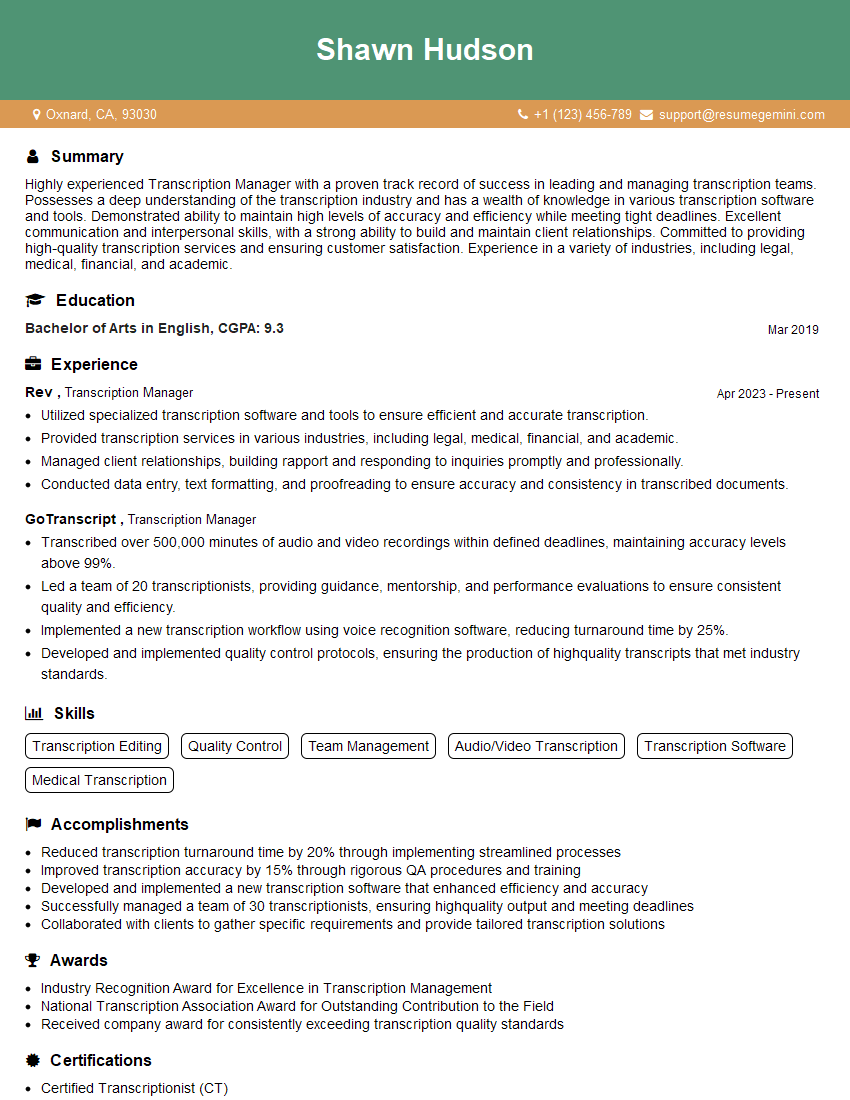
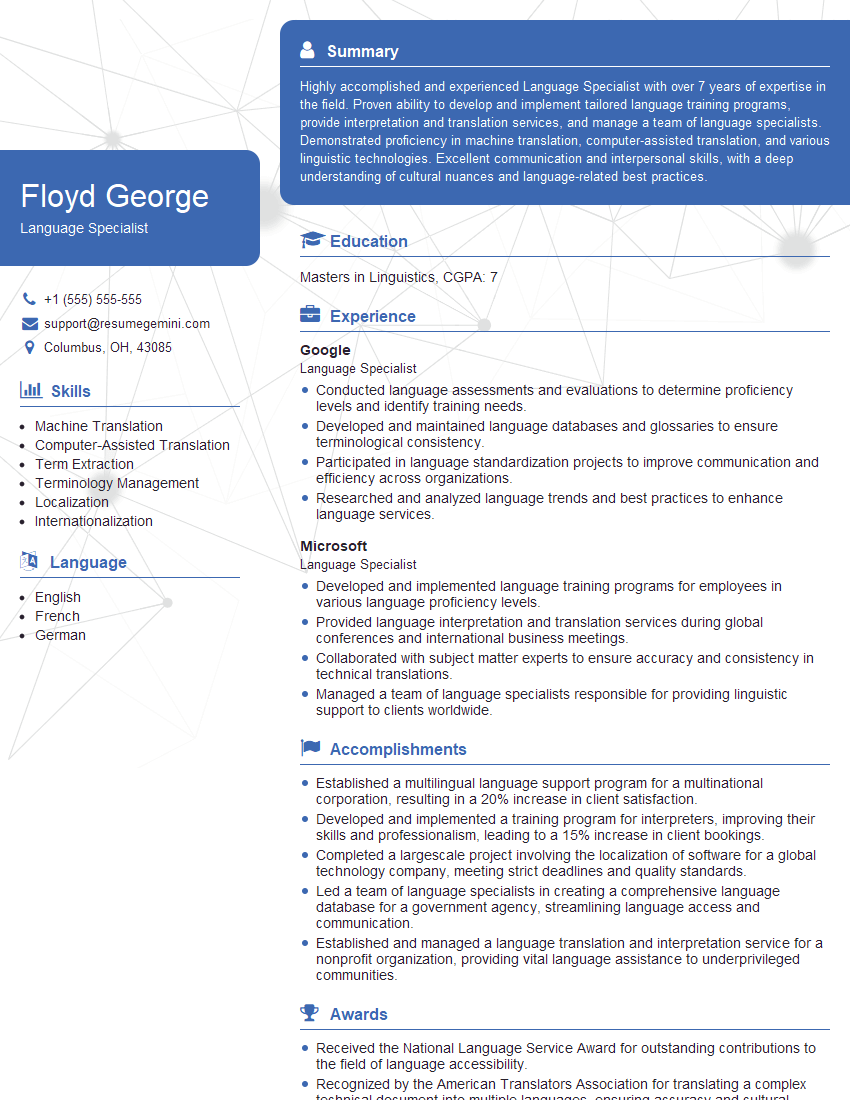
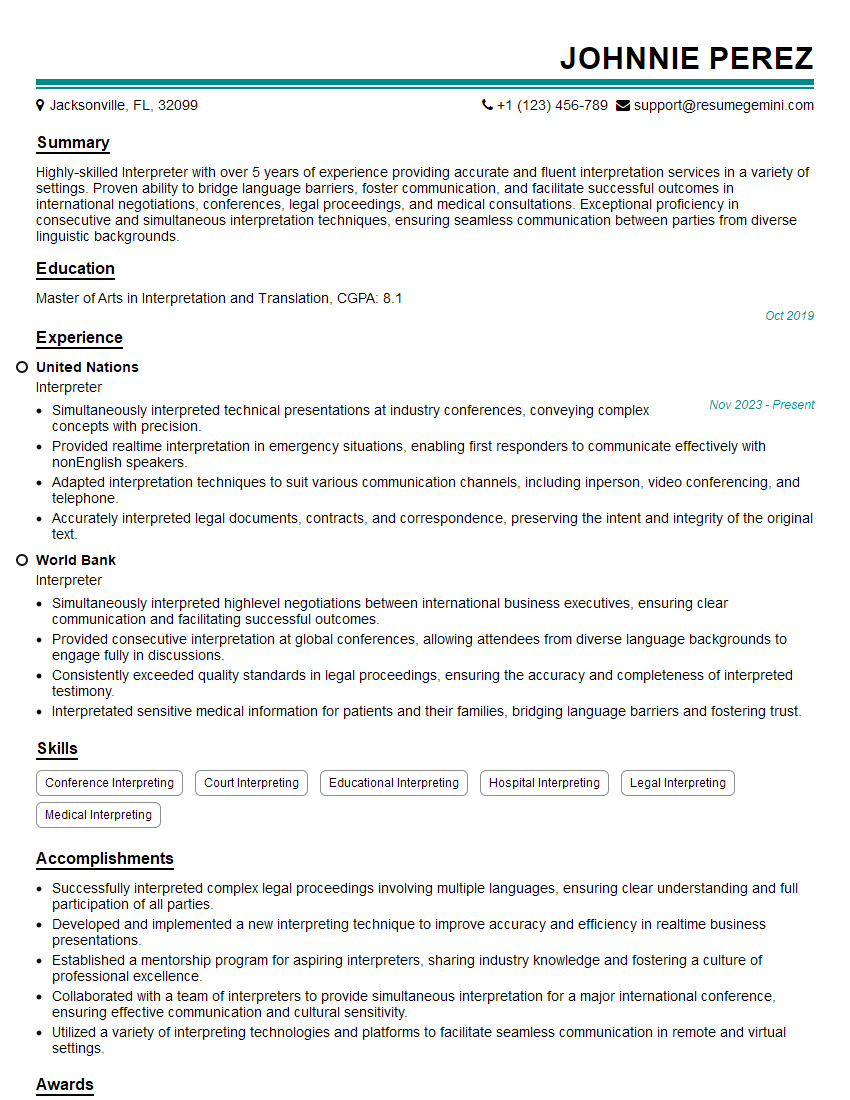
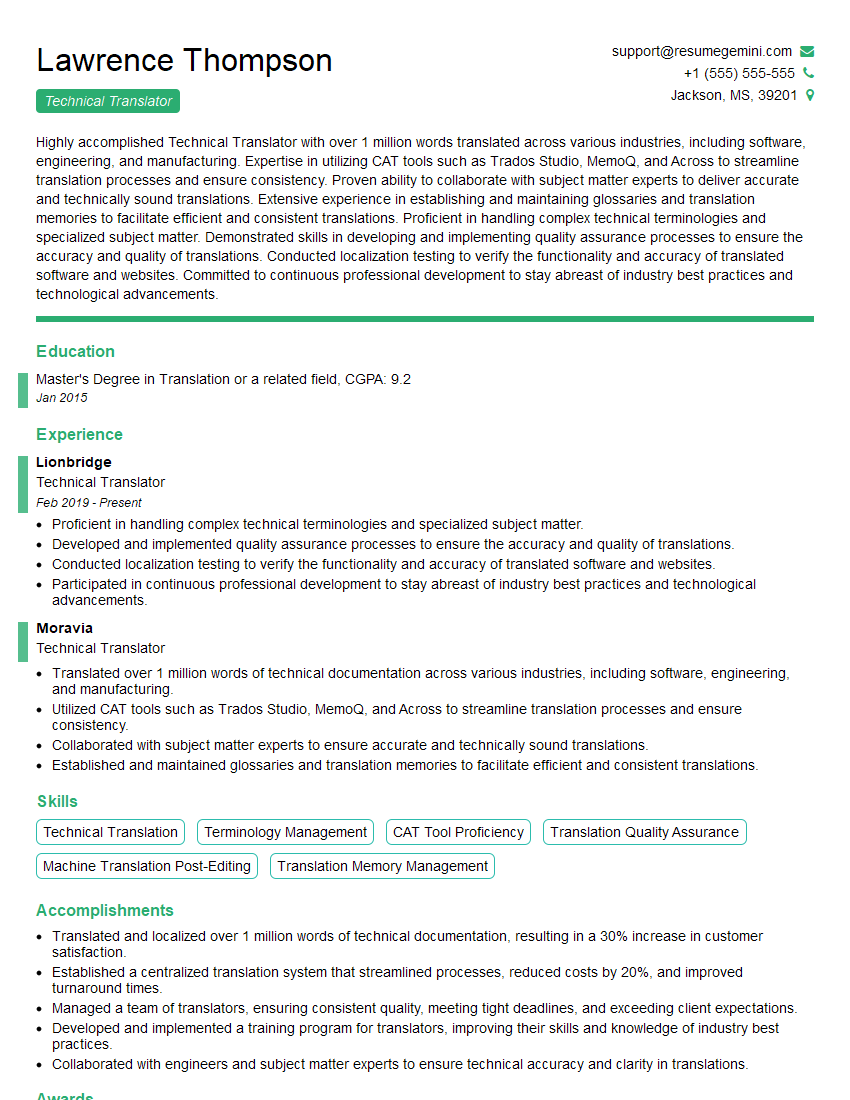
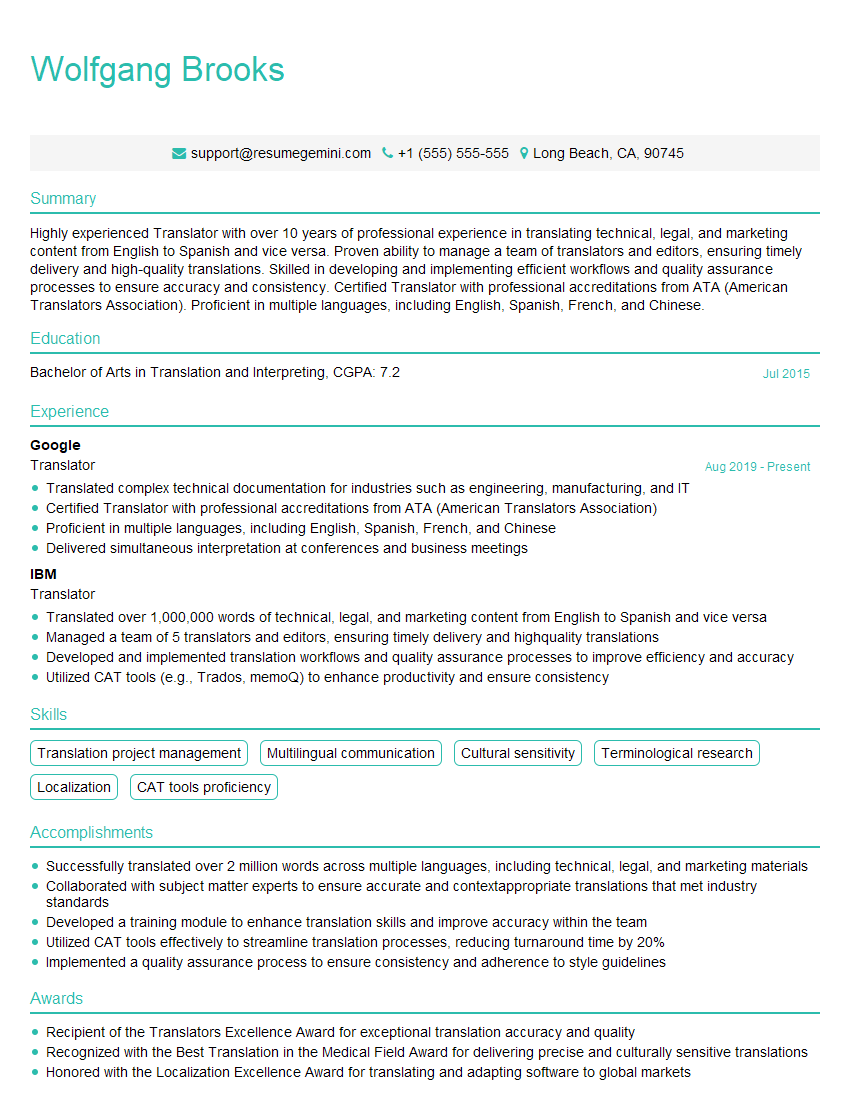
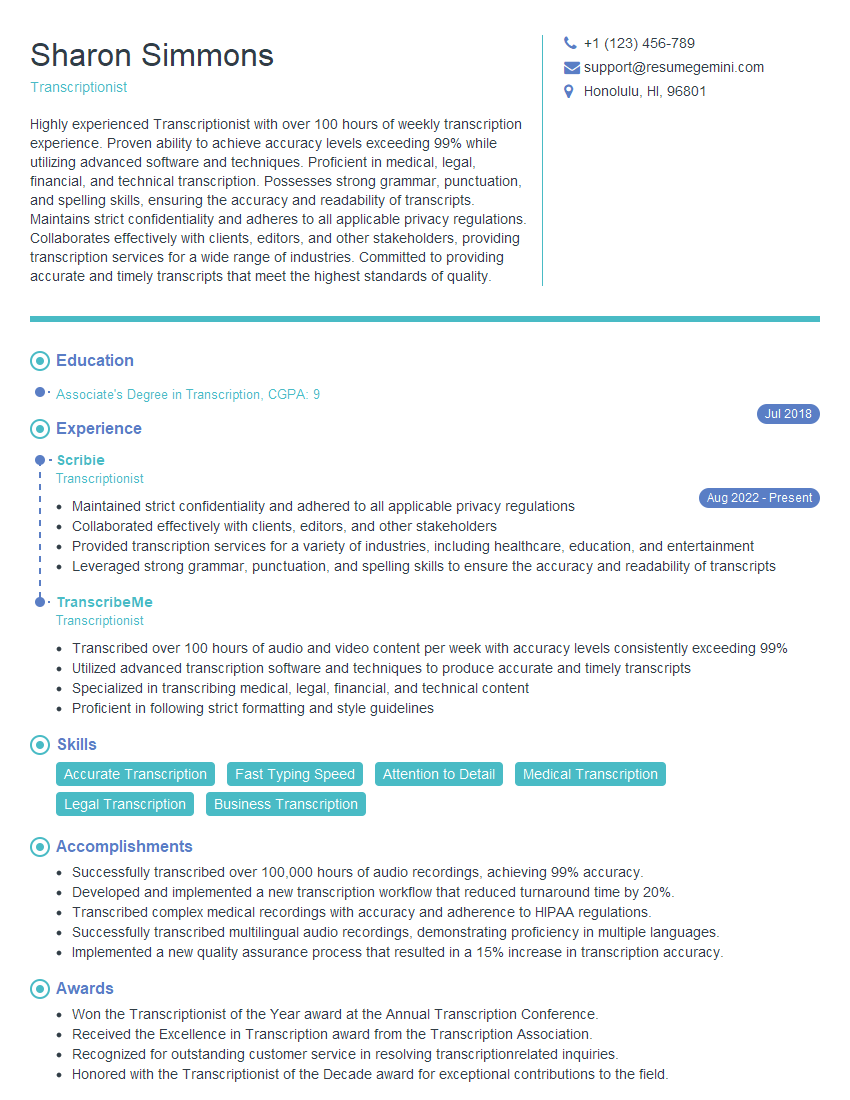
Mastering translation and transcription skills opens doors to exciting career opportunities in diverse industries. A strong resume is crucial for showcasing your abilities and securing your dream job. To maximize your job prospects, focus on creating an ATS-friendly resume that highlights your key skills and experience effectively. ResumeGemini is a trusted resource to help you build a professional and impactful resume. We provide examples of resumes tailored to translation and transcription roles to guide you. Invest time in crafting a compelling resume – it’s your first impression on potential employers.
Explore more articles
Users Rating of Our Blogs
Share Your Experience
We value your feedback! Please rate our content and share your thoughts (optional).
What Readers Say About Our Blog
To the interviewgemini.com Webmaster.
Very helpful and content specific questions to help prepare me for my interview!
Thank you
To the interviewgemini.com Webmaster.
This was kind of a unique content I found around the specialized skills. Very helpful questions and good detailed answers.
Very Helpful blog, thank you Interviewgemini team.