Unlock your full potential by mastering the most common Experience with working with students who are English language learners interview questions. This blog offers a deep dive into the critical topics, ensuring you’re not only prepared to answer but to excel. With these insights, you’ll approach your interview with clarity and confidence.
Questions Asked in Experience with working with students who are English language learners Interview
Q 1. Describe your experience differentiating instruction for students with varying English proficiency levels.
Differentiating instruction for English language learners (ELLs) means tailoring teaching methods and materials to meet the diverse needs of students at varying proficiency levels. It’s not a one-size-fits-all approach; instead, it requires a nuanced understanding of each student’s strengths and weaknesses.
For example, in a single classroom, I might have students ranging from beginners who are just starting to acquire basic vocabulary to advanced learners who are nearly fluent. To address this, I use a tiered approach to assignments. Beginner learners might focus on simple sentence construction and vocabulary related to a topic, while intermediate learners might work on paragraph writing and more complex vocabulary, and advanced learners could engage in debates or research projects requiring higher-level critical thinking and language skills. This approach ensures that all students are challenged appropriately and feel a sense of accomplishment.
I also use different grouping strategies to cater to varying needs. Sometimes, I group students by proficiency, providing targeted support to those who need it. At other times, I utilize mixed-ability groups, encouraging peer learning and collaboration where stronger students can support their peers. This helps to build a supportive and inclusive classroom environment.
Q 2. What strategies do you employ to assess English language learners’ comprehension and fluency?
Assessing ELLs’ comprehension and fluency requires a multifaceted approach that goes beyond traditional tests. I employ a variety of formative and summative assessment strategies to gain a holistic understanding of their language development.
- Formative Assessments: These are ongoing assessments that inform my instruction. I use techniques like observation during class discussions, informal writing activities, and quick quizzes to gauge their understanding of concepts. I also regularly conduct one-on-one conferences to identify their individual learning gaps.
- Summative Assessments: These are formal assessments used to evaluate student learning at the end of a unit or course. I employ various methods, including oral presentations, projects, written essays, and standardized tests (where appropriate), but I always adapt these to account for the students’ level of language proficiency. For instance, I might allow students to use dictionaries or provide sentence starters during writing assessments.
For fluency, I assess both oral and written fluency. I often record students during presentations or conversations to analyze their pronunciation, grammatical accuracy, and overall coherence. For written fluency, I focus on the flow of their writing and their ability to express themselves effectively.
Q 3. How do you incorporate culturally responsive teaching practices into your ESL lessons?
Culturally responsive teaching acknowledges and celebrates the diverse cultural backgrounds of my students, incorporating their experiences and perspectives into the curriculum. It’s about creating a classroom that reflects the richness and diversity of my students’ lives.
For instance, I often start my lessons with discussions about students’ home countries, their languages, and their cultures. I also integrate literature, music, and art from various cultures into my lessons. When teaching about historical events, I ensure I present diverse perspectives, avoiding a Eurocentric or Western-centric view of history. This allows students to see themselves reflected in the curriculum and builds a sense of belonging and value in the classroom.
Furthermore, I adapt my teaching methods to accommodate different learning styles and preferences. Some cultures place a higher value on collaborative learning, while others may emphasize individual work. I make a conscious effort to provide opportunities for both types of learning activities.
Q 4. Explain your approach to scaffolding instruction for students acquiring English as a second language.
Scaffolding is a crucial aspect of teaching ELLs. It involves providing temporary support to help students learn new concepts and skills. The support is gradually removed as students become more proficient.
I employ various scaffolding techniques, such as:
- Modeling: I demonstrate the task or skill I expect students to perform, showing them step-by-step how to do it.
- Graphic Organizers: These visual aids help students organize their thoughts and ideas, making it easier for them to understand and process information. Think mind maps, flow charts, or story maps.
- Sentence Starters and Frames: These provide students with a structure for their writing or speaking, reducing the cognitive load of language production.
- Pre-teaching Vocabulary: I introduce new vocabulary before the lesson using visuals and real-world examples.
- Chunking Information: Breaking down complex tasks or concepts into smaller, more manageable chunks.
The key is to provide the appropriate level of support tailored to each student’s needs. As students progress, the scaffolding is gradually reduced until they can independently perform the task.
Q 5. What methods do you use to promote student collaboration and communication in an ESL classroom?
Promoting collaboration and communication is key to creating an engaging and effective ESL classroom. I use a variety of methods to encourage student interaction.
- Think-Pair-Share: Students think individually, discuss with a partner, and then share with the whole class.
- Jigsaw Activities: Students work in groups, each responsible for learning a portion of the material, which they then teach to others.
- Role-Playing: Students act out real-life scenarios, practicing their communication skills in a fun and engaging way.
- Group Projects: Collaborative projects encourage students to work together, communicate effectively, and share their ideas.
- Peer Editing and Feedback: Students review and provide feedback on each other’s work, promoting peer learning and self-assessment.
In addition to these activities, I create a classroom environment that values and encourages communication. I model respectful communication, and explicitly teach students appropriate communication strategies.
Q 6. How do you address the emotional and social needs of English language learners?
Addressing the emotional and social needs of ELLs is crucial for their academic success. Many ELLs face significant challenges adapting to a new culture and language, which can impact their emotional and social well-being.
I create a supportive and inclusive classroom environment where students feel safe, respected, and valued. This includes:
- Building Relationships: I take the time to get to know my students individually, learning about their backgrounds, interests, and challenges.
- Providing Emotional Support: I am available to listen to my students’ concerns and provide guidance and support when needed.
- Celebrating Cultural Diversity: I create opportunities for students to share their cultures with the class. This helps build a sense of community and belonging.
- Promoting Positive Peer Relationships: I encourage students to support and help each other.
- Collaborating with Families: I maintain open communication with parents and guardians, keeping them informed of their child’s progress and any challenges they may be facing.
If students exhibit significant emotional or social challenges, I work with the school counselor or other support staff to provide appropriate intervention.
Q 7. Describe your experience using technology to enhance ESL instruction.
Technology can be a powerful tool for enhancing ESL instruction. I use a variety of technological tools to engage students and support their learning.
- Interactive Whiteboards: I use interactive whiteboards for multimedia presentations, games, and collaborative activities.
- Language Learning Apps: Apps like Duolingo or Babbel can provide supplementary language practice and vocabulary building.
- Online Dictionaries and Translators: These are valuable tools for students to look up unfamiliar words and phrases.
- Virtual Field Trips: These provide students with opportunities to explore different places and cultures.
- Video Conferencing: This allows students to connect with native speakers and practice their communication skills.
However, I carefully select and integrate technology, ensuring that it enhances, rather than replaces, human interaction and teacher support. It’s about using technology strategically to complement, not dominate, the learning experience.
Q 8. What are some common challenges faced by English language learners, and how do you address them?
English language learners (ELLs) face a multitude of challenges, often intertwined and impacting their learning experience significantly. These can be broadly categorized into linguistic, academic, and socio-emotional challenges.
- Linguistic Challenges: These include difficulties with pronunciation, vocabulary acquisition, grammar comprehension, and understanding different linguistic structures compared to their native language. For example, a student whose native language doesn’t have articles (like ‘a’ and ‘the’) might struggle to use them correctly in English.
- Academic Challenges: ELLs often face challenges in understanding complex academic texts, following instructions, participating in class discussions, and completing assignments that require high levels of English proficiency. Imagine a student trying to solve a math word problem when they don’t understand the vocabulary used to describe the problem itself.
- Socio-emotional Challenges: These involve feelings of isolation, anxiety about speaking English, cultural adjustment difficulties, and potential lack of confidence in their academic abilities. The fear of making mistakes can be a significant barrier to participation.
Addressing these challenges requires a multi-faceted approach. I employ differentiated instruction, providing various learning materials and activities to cater to different learning styles and proficiency levels. I use visual aids, real-world examples, and hands-on activities to make learning more engaging and accessible. I also create a supportive and inclusive classroom environment where students feel safe to take risks and make mistakes without judgment. Regular check-ins and one-on-one support are crucial to address individual needs and build confidence.
Q 9. How do you adapt assessments to ensure fair and accurate evaluation of ELLs’ progress?
Fair and accurate assessment of ELLs requires moving beyond traditional standardized tests that might not accurately reflect their actual understanding. I employ a variety of assessment methods to get a holistic picture of their progress:
- Modified Assessments: This involves adapting the format and language of assessments to align with the students’ proficiency levels. For example, I might provide vocabulary support, simplify complex instructions, or allow oral responses instead of written ones.
- Alternative Assessments: These are non-traditional methods that focus on demonstrating understanding through various means. This could include projects, presentations, portfolios, or performance-based tasks that showcase their skills in a more authentic context. For example, a student might create a presentation instead of writing an essay on a historical topic.
- Observations and Anecdotal Records: Regularly observing students’ participation in class discussions, their work habits, and their interactions with peers provides valuable qualitative data that complements more formal assessments.
- Using multiple assessment measures: This minimizes the risk that one assessment method might not accurately reflect a student’s ability. Combining several different types of assessments ensures a more comprehensive understanding.
It is crucial to consider the student’s cultural background and prior learning experiences when interpreting assessment results. A score might reflect linguistic challenges rather than a lack of understanding.
Q 10. What strategies do you use to build rapport and trust with students from diverse linguistic backgrounds?
Building rapport and trust with ELLs from diverse linguistic backgrounds is paramount. I start by showing genuine interest in their cultures and backgrounds. I use icebreaker activities that allow students to share their experiences and learn about each other. I actively listen to their concerns and perspectives, creating a space where they feel heard and valued. Non-verbal communication is very important and making eye contact, smiling, and using encouraging body language creates a welcoming atmosphere. I use simple, clear language, avoiding idioms and slang to ensure everyone understands. Furthermore, I intentionally incorporate culturally relevant materials and learning activities, reflecting the diversity of the classroom.
One example: I once had a student who was hesitant to participate. By learning about her interest in art, I incorporated art-related activities into our lessons. This allowed her to express herself creatively while gradually building her confidence in using English.
Q 11. Describe your experience working with parents or guardians of English language learners.
Working with parents or guardians of ELLs is crucial for their academic success. I maintain open and consistent communication, using translators or interpreters when necessary. I share student progress regularly, explaining their strengths and areas for improvement in a clear and accessible manner. I involve parents in their child’s learning journey through newsletters, parent-teacher conferences, and home-school connection activities. For instance, I might suggest simple activities parents can do at home to reinforce language learning. I also emphasize the importance of supporting their child’s bilingualism and cultural identity, viewing it as an asset rather than a deficit. Building trust and respect is vital for fostering collaboration. I also actively seek their feedback and insights on how I can better support their child’s learning needs.
For example, I had a parent who was initially concerned about their child’s progress. Through regular communication and collaboration, we created a learning plan that integrated both home and school efforts, resulting in significant improvements for the student.
Q 12. How do you integrate language development across different subject areas?
Integrating language development across different subject areas is crucial for effective ELL instruction. I use a content-based approach where language learning is embedded within the context of other subjects. This allows students to apply their language skills in meaningful ways while simultaneously learning about other subjects.
For example, during a science lesson on the water cycle, students can create diagrams, write short explanations, and present their findings to the class, thus strengthening their vocabulary, writing, and speaking skills. In math, using visual aids and real-life contexts can make learning the vocabulary more engaging. Similarly, history lessons can be used to build reading comprehension, and art class can be used to foster creative language development. By connecting language to relevant content, learning becomes more relevant and engaging, helping students see the practical application of their developing language skills.
Q 13. What resources and materials do you find most effective for teaching English language learners?
Effective resources and materials for teaching ELLs are diverse and should align with students’ needs and levels. I find the following particularly useful:
- Authentic Materials: These are real-world materials like children’s books, magazines, newspapers, songs, videos, and podcasts. They provide exposure to authentic language use, making learning more engaging and relevant.
- Differentiated Instruction Materials: These materials are designed to cater to different levels and learning styles. Examples include leveled readers, graphic organizers, and interactive games.
- Technology-Enhanced Resources: Interactive language learning software, online dictionaries, and language learning apps provide valuable supplementary tools that engage students and cater to different learning preferences. I often use multimedia to enhance comprehension and engagement.
- Visual Aids: Pictures, diagrams, charts, and other visuals are extremely helpful in conveying meaning, especially when students are unfamiliar with the vocabulary.
- Bilingual Dictionaries and Glossaries: These support students in connecting their native language with English.
The choice of materials should always be guided by the students’ proficiency levels and learning needs. A good balance of authentic materials and differentiated instructional resources is key.
Q 14. How do you monitor and track the progress of English language learners?
Monitoring and tracking ELL progress requires a multifaceted approach that combines formative and summative assessments. I use a variety of methods to monitor student progress:
- Regular Formative Assessments: These are ongoing assessments like quizzes, classwork, and exit tickets, providing real-time feedback and allowing for adjustments in instruction. They are used to monitor progress frequently and make instructional changes.
- Summative Assessments: These are larger-scale assessments like tests, projects, and presentations that evaluate students’ overall learning outcomes. These give a broader picture of progress over a longer period.
- Data Tracking Systems: I use data tracking tools to monitor individual student progress over time, identify trends, and inform instructional decisions. This could be a simple spreadsheet or a more sophisticated school-wide data management system.
- Portfolio Assessment: Student portfolios showcasing their work over time offer a holistic view of their progress, including their growth in language proficiency and academic understanding.
- Parent-Teacher Communication: Regular communication with parents or guardians provides valuable insights into students’ progress outside the classroom.
The data collected from these methods helps inform my instructional practices, ensuring that students receive the appropriate level of support to succeed. Regular review of this data allows for effective interventions and adjustments to teaching strategies.
Q 15. How do you differentiate instruction to meet the needs of students with varying learning styles?
Differentiating instruction to meet diverse learning styles is crucial for ESL students. It’s about recognizing that students learn in different ways – visually, auditorily, kinesthetically, and through various combinations. Instead of a one-size-fits-all approach, I adapt my teaching to cater to these preferences.
- Visual Learners: For visual learners, I incorporate lots of colorful charts, diagrams, and visual aids. For example, when teaching vocabulary related to food, I might use flashcards with pictures alongside the words. I also use graphic organizers to help them structure their thoughts and writing.
- Auditory Learners: I use audio recordings, discussions, and pair/group work to engage auditory learners. For example, listening to short stories or participating in role-playing activities helps reinforce language skills. I also make sure to clearly pronounce words and provide repetitive practice.
- Kinesthetic Learners: These students benefit from hands-on activities. I incorporate games, movement activities, and real-world simulations into my lessons. Building a model of a city to learn location prepositions, or acting out scenarios to practice dialogue, are examples of how I engage them.
- Multimodal Approach: Often, students are a blend of learning styles. Therefore, I employ a multimodal approach, integrating visual, auditory, and kinesthetic activities in a single lesson to maximize learning for all students.
Regular observation and formative assessments help me identify each student’s preferred learning style and tailor my instruction accordingly. It’s an ongoing process of adjustment and refinement based on student responses and progress.
Career Expert Tips:
- Ace those interviews! Prepare effectively by reviewing the Top 50 Most Common Interview Questions on ResumeGemini.
- Navigate your job search with confidence! Explore a wide range of Career Tips on ResumeGemini. Learn about common challenges and recommendations to overcome them.
- Craft the perfect resume! Master the Art of Resume Writing with ResumeGemini’s guide. Showcase your unique qualifications and achievements effectively.
- Don’t miss out on holiday savings! Build your dream resume with ResumeGemini’s ATS optimized templates.
Q 16. Describe your experience with different ESL teaching methodologies (e.g., communicative language teaching, task-based learning).
My experience encompasses several ESL teaching methodologies. I’ve found that combining different approaches is often most effective.
- Communicative Language Teaching (CLT): CLT focuses on using language in meaningful contexts. I utilize this by creating opportunities for students to communicate naturally – through discussions, role-plays, and presentations. For instance, I might set up a mock restaurant scenario where students practice ordering food in English. The emphasis is on fluency and effective communication, rather than perfect grammatical accuracy at the initial stages.
- Task-Based Learning (TBL): TBL involves completing tasks that require language use. This could be anything from writing a short story to planning a trip. I structure tasks to be progressively challenging, building upon previously acquired skills. For example, students might first complete a simple sentence-writing task, then progress to writing a paragraph, and eventually a short story. This approach fosters collaborative learning and problem-solving.
- Grammar-Translation Method: While not solely reliant on this method, I do integrate explicit grammar instruction when necessary, explaining grammatical rules and providing opportunities for practice. However, this is always contextualized within communicative activities to ensure students see the practical application of grammar.
By blending these methodologies, I create a dynamic and engaging learning environment that promotes both accuracy and fluency in English.
Q 17. How do you use formative assessment to inform your instruction for English language learners?
Formative assessment is essential for guiding my instruction with ESL students. It provides ongoing feedback on student understanding and allows me to adjust my teaching strategies in real-time.
- Quick Checks: I use short quizzes, exit tickets, and informal observations during class to gauge comprehension immediately after introducing a new concept.
- Think-Pair-Share: This collaborative activity allows students to discuss their understanding of a topic and helps me identify any misconceptions quickly.
- Student Self-Assessment: I provide opportunities for students to reflect on their learning and identify areas where they need more support. This promotes metacognition and self-directed learning.
- Observation: Closely observing students during activities allows me to note their strengths and weaknesses and tailor subsequent activities to address specific needs.
The data gathered from formative assessments informs my lesson planning and ensures that my instruction remains relevant and effective. For example, if I notice many students struggling with a particular grammatical concept, I will dedicate more time to it in the next lesson or employ different teaching strategies.
Q 18. What are your strategies for promoting literacy development in English language learners?
Promoting literacy development in ESL students requires a multifaceted approach that focuses on building both oral language and reading/writing skills.
- Immersive Reading: I provide access to a variety of engaging reading materials at different levels – from graphic novels and simple stories to age-appropriate chapter books. I encourage wide reading to expand vocabulary and improve comprehension.
- Interactive Writing: I use journal writing, collaborative storytelling, and other creative writing activities to foster writing fluency. I provide individualized feedback and support to improve their writing skills.
- Vocabulary Building: I use various techniques like flashcards, word games, and context clues to help students learn new vocabulary effectively. We also explore the etymology (origin) of words to help with comprehension and retention.
- Phonics Instruction: For students needing foundational phonics skills, I incorporate explicit instruction in letter-sound relationships and blending/segmenting skills.
- Read-Alouds: I regularly read aloud to students, modeling fluent reading and promoting a love of reading.
I also work closely with parents and librarians to encourage literacy development beyond the classroom.
Q 19. How do you support English language learners’ participation in mainstream classrooms?
Supporting ESL students’ participation in mainstream classrooms requires careful planning and collaboration.
- Pre-teaching vocabulary and key concepts: Before a mainstream lesson, I might pre-teach key vocabulary and concepts to ensure ESL students are prepared.
- Providing visual aids and graphic organizers: Visual supports help students understand complex information and follow along with lessons.
- Pair ESL students with strong English speakers: Peer support can be invaluable, helping ESL students feel more comfortable and confident.
- Modifying assignments as needed: This might involve providing extended time, allowing the use of dictionaries, or simplifying instructions.
- Communicating regularly with mainstream teachers: Collaboration is crucial to ensure a cohesive and supportive learning environment.
The key is to create an inclusive environment where all students feel welcome, respected, and supported.
Q 20. How do you incorporate real-world contexts into your ESL lessons?
Incorporating real-world contexts makes ESL lessons relevant and engaging. It helps students see the practical application of English and improves their ability to use the language authentically.
- Community Projects: We might participate in community clean-up drives, volunteering at local organizations, or researching local history, integrating language learning with real-world action.
- Current Events: Discussing age-appropriate news events or cultural happenings helps students connect their learning to the world around them.
- Simulations: We can simulate real-life scenarios, such as visiting a doctor’s office, ordering food in a restaurant, or planning a trip, to practice English in relevant situations.
- Guest Speakers: Inviting guest speakers from various professions exposes students to different language uses and cultural perspectives.
- Field Trips: Field trips to museums, libraries, or other locations provide opportunities for language use in authentic contexts.
By grounding lessons in real-world scenarios, I make learning more meaningful and memorable for students.
Q 21. What is your experience with providing individualized support to English language learners?
Providing individualized support is paramount for ESL students. Each student’s learning journey is unique, with different strengths, weaknesses, and learning styles.
- Differentiated Instruction: This involves adapting my teaching methods and materials to meet the individual needs of each student. This might mean providing extra support to students struggling with particular concepts or offering enrichment activities to challenge advanced learners.
- One-on-One Tutoring: I dedicate time for one-on-one sessions to address individual challenges and provide personalized feedback.
- Personalized Learning Plans: I develop individualized learning plans for students with specific learning goals and strategies. These plans outline short-term and long-term objectives, learning activities, and assessment methods.
- Collaboration with Parents/Guardians: Regular communication with parents keeps them informed of their child’s progress and helps to ensure a consistent learning environment at home and school.
- Utilizing Technology: I incorporate educational apps and online resources to provide tailored practice and support.
By providing individualized support, I help students reach their full potential and develop confidence in their language abilities. I believe in celebrating every small success to motivate and encourage continued growth.
Q 22. How do you collaborate with other teachers and support staff to meet the needs of English language learners?
Collaboration is key to effectively supporting English Language Learners (ELLs). I believe in a multi-faceted approach, involving regular communication and shared planning with general education teachers, special education staff, and ESL specialists.
Shared Planning: We collaboratively design lessons and units that integrate language development into the regular curriculum. For example, if the history class is studying the American Revolution, we might work together to ensure that vocabulary and comprehension strategies are explicitly taught to ELLs. This could involve pre-teaching key vocabulary, providing graphic organizers, and modifying assignments to meet diverse learning needs.
Co-teaching: I frequently co-teach with general education teachers, sharing responsibility for instruction and creating a supportive learning environment for all students. This allows me to model effective language teaching strategies and provide immediate support to ELLs.
Data Sharing: We regularly share assessment data to track student progress and adjust our teaching strategies accordingly. This might involve looking at standardized test scores, informal assessments like classroom observations and portfolio reviews, to identify areas where students need additional support.
Professional Development: Participating in collaborative professional development sessions with other staff members ensures that we are all up-to-date on best practices for teaching ELLs. This allows us to collectively refine our approaches and ensure consistency in support.
Q 23. Describe your experience with using authentic materials in your ESL classroom.
Authentic materials are crucial for creating engaging and relevant learning experiences for ELLs. I regularly incorporate materials like newspaper articles, children’s literature in English, music videos, and podcasts into my lessons. These resources bridge the gap between classroom learning and real-world language use.
Example 1: When teaching vocabulary related to weather, instead of using textbook definitions, I might use a weather report video clip from a local news station. Students can then discuss the weather conditions and practice using the new vocabulary in context.
Example 2: To enhance reading comprehension, I use age-appropriate children’s books with accompanying audio versions. Students listen and follow along, improving pronunciation and comprehension simultaneously. Afterward, we discuss the story’s plot, characters, and themes, providing opportunities for oral language practice.
Differentiation: I differentiate the use of authentic materials based on students’ proficiency levels. For beginner ELLs, I might provide simplified versions of articles or focus on specific vocabulary. For advanced learners, I might use more complex texts and encourage critical analysis.
Q 24. What is your understanding of the stages of second language acquisition?
Krashen’s theory of second language acquisition provides a useful framework for understanding the stages of language development. While individual learners progress at different paces and in varied ways, the stages generally include:
Pre-production: Students may not speak much, but they are absorbing language passively. They are listening, observing, and beginning to understand.
Early Production: Students start to produce single words and short phrases. They are building vocabulary and developing basic sentence structures.
Speech Emergence: Students begin to speak in longer sentences and communicate more effectively, though there might still be grammatical errors.
Intermediate Fluency: Students can communicate more easily and express themselves with greater accuracy, although they may still need support with complex grammar and vocabulary.
Advanced Fluency: Students have near-native fluency and can communicate effectively in most situations.
It’s important to remember that these are not rigid stages, and students may move back and forth between them. My teaching adapts to meet students at their individual levels.
Q 25. How do you use technology to facilitate communication between home and school for families of ELLs?
Technology plays a vital role in bridging the communication gap between home and school. I utilize several strategies to ensure families are informed and actively involved in their child’s language learning journey:
Class Website/Learning Management System (LMS): I maintain a class website or use an LMS to share lesson plans, assignments, resources, and student progress updates. This allows parents to stay informed about what their children are learning.
Translation Tools: I use translation tools to communicate important information in the families’ native languages. This ensures that families understand announcements, assignments, and progress reports.
Communication Apps: I use messaging apps like ClassDojo or Remind to quickly send updates, announcements, and answer questions from families. This provides a convenient and accessible way to communicate.
Parent-Teacher Conferences (virtual or in-person): I hold regular parent-teacher conferences – both virtual and in-person options are offered – to discuss student progress and collaboratively set goals. Translation services are provided when needed.
Q 26. Describe your experience with different types of ESL assessment tools (e.g., standardized tests, informal assessments).
A comprehensive assessment plan involves using a variety of tools to obtain a holistic view of a student’s language proficiency. I use both standardized tests and informal assessments:
Standardized Tests: These provide a baseline measure of language proficiency. Examples include the WIDA (World-Class Instructional Design and Assessment) assessments, which are commonly used to evaluate English language proficiency in K-12 settings. I understand the limitations of standardized tests and interpret results cautiously, considering them as only one piece of information about the student.
Informal Assessments: I frequently use informal assessment methods, including:
Observations: I observe students’ participation in class discussions, their written work, and their interactions with peers to gauge their progress.
Portfolios: Students maintain portfolios showcasing their work over time. This offers a more comprehensive picture of their development.
Running Records: These are used during reading activities to track students’ accuracy, fluency, and comprehension.
Anecdotal Notes: I jot down observations of students’ language use during classroom activities. These notes provide insights into their strengths and weaknesses.
Combining both formal and informal assessments gives a richer understanding of each student’s linguistic capabilities and learning needs.
Q 27. How do you incorporate technology into your ESL lessons to cater to different learning styles?
Technology offers diverse ways to cater to various learning styles in my ESL classroom. I use a multi-sensory approach:
Visual Learners: Interactive whiteboards, educational videos, and online games with visual cues cater to visual learners. For example, using online vocabulary builders with images associated with new words significantly improves retention for visual learners.
Auditory Learners: Podcasts, audiobooks, and online language learning apps with audio components are ideal for auditory learners. Utilizing online dictionaries with pronunciation features helps strengthen auditory comprehension and pronunciation.
Kinesthetic Learners: Interactive simulations, online activities requiring physical interaction, and role-playing scenarios help kinesthetic learners engage actively. Using online tools that allow students to create digital stories or presentations helps kinesthetic learners engage physically with the language.
Personalized Learning Platforms: I use online learning platforms that allow me to create personalized learning paths for each student based on their strengths and weaknesses. These platforms provide adaptive exercises that adjust to each student’s pace and learning style, offering tailored support.
Q 28. How would you handle a situation where a student is struggling to keep up with the pace of the class?
When a student struggles to keep up, I employ a multifaceted approach focusing on differentiation and support:
Individualized Learning Plan: I would create an individualized learning plan (ILP) to address the student’s specific needs. This plan would include clear learning goals, differentiated instruction, and strategies for supporting the student’s academic and social-emotional needs.
Targeted Instruction: I’d provide targeted instruction focusing on the areas where the student is struggling, breaking down complex concepts into smaller, manageable chunks. This might involve providing additional practice with specific grammar points, vocabulary, or reading comprehension strategies.
Assistive Technology: Depending on the student’s needs, I would explore the use of assistive technology, such as text-to-speech software or graphic organizers.
Collaboration with Support Staff: I would collaborate with special education teachers, ESL specialists, and other support staff to develop strategies for providing additional support. This team approach ensures a cohesive support system.
Positive Reinforcement and Encouragement: Maintaining a positive and supportive classroom environment is essential. I regularly offer encouragement and celebrate the student’s progress, no matter how small. This helps to build their confidence and motivation.
Parent/Guardian Communication: I would communicate with the student’s parent(s)/guardian(s) to discuss their concerns and collaboratively develop strategies to support the student’s learning at home.
Key Topics to Learn for Experience with working with students who are English language learners Interview
- Understanding Diverse Learner Needs: Explore various learning styles, cultural backgrounds, and proficiency levels among ELL students. Consider how these factors influence teaching strategies.
- Differentiated Instruction Techniques: Learn practical applications of differentiated instruction, including modifying materials, adapting teaching methods, and providing individualized support to meet diverse learning needs. Discuss specific examples from your experience.
- Assessment and Evaluation Strategies for ELLs: Understand the importance of using authentic assessment methods that accurately reflect ELL students’ comprehension and language abilities. Be prepared to discuss various assessment techniques and their limitations.
- Classroom Management and Building Rapport: Explore strategies for creating a supportive and inclusive classroom environment where ELL students feel comfortable taking risks and participating actively. Discuss techniques for fostering a sense of community and belonging.
- Collaboration and Communication with Parents/Guardians: Discuss effective strategies for communicating with parents/guardians of ELL students, emphasizing the importance of clear and culturally sensitive communication to build strong home-school partnerships.
- Utilizing Technology and Resources for ELLs: Explore the use of technology and online resources to support ELL instruction, including language learning apps, interactive websites, and multimedia materials. Discuss your experience integrating technology effectively.
- Addressing Language Acquisition Challenges: Be prepared to discuss common challenges faced by ELL students (e.g., vocabulary acquisition, pronunciation, grammar) and strategies to overcome these challenges. Consider the role of scaffolding and explicit instruction.
- Advocating for ELL Students: Discuss your experience advocating for the needs of ELL students within a school setting, highlighting your ability to collaborate with colleagues and administrators to ensure equitable access to education.
Next Steps
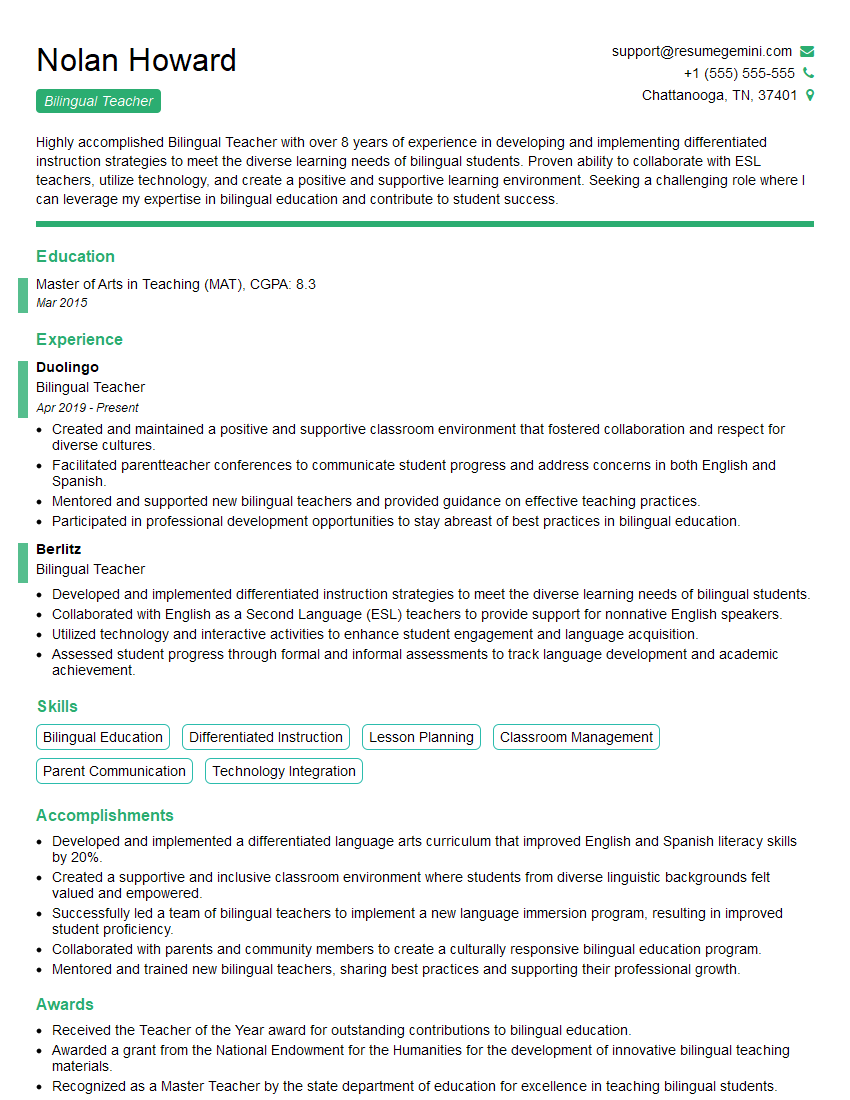
Mastering the nuances of working with English language learners significantly enhances your value as an educator. Demonstrating this expertise on your resume is crucial for career advancement. To increase your job prospects, create an ATS-friendly resume that clearly highlights your relevant skills and experience. ResumeGemini is a trusted resource that can help you build a professional and impactful resume. Examples of resumes tailored to highlight experience with English language learners are available within ResumeGemini to guide you.
Explore more articles
Users Rating of Our Blogs
Share Your Experience
We value your feedback! Please rate our content and share your thoughts (optional).
What Readers Say About Our Blog
To the interviewgemini.com Webmaster.
Very helpful and content specific questions to help prepare me for my interview!
Thank you
To the interviewgemini.com Webmaster.
This was kind of a unique content I found around the specialized skills. Very helpful questions and good detailed answers.
Very Helpful blog, thank you Interviewgemini team.