Interviews are opportunities to demonstrate your expertise, and this guide is here to help you shine. Explore the essential Federal Budget Analysis interview questions that employers frequently ask, paired with strategies for crafting responses that set you apart from the competition.
Questions Asked in Federal Budget Analysis Interview
Q 1. Explain the difference between discretionary and mandatory spending in the federal budget.
The federal budget is divided into two main categories of spending: discretionary and mandatory. The key difference lies in how the spending is authorized.
Discretionary spending requires annual appropriations from Congress. Think of it like your monthly budget for entertainment – you decide how much to spend each month. Examples include defense spending, education, infrastructure, and most non-entitlement programs. Congress has the power to adjust these amounts each year based on priorities and available funds.
Mandatory spending, on the other hand, is automatically funded each year based on existing laws. It’s like your monthly mortgage payment – you’re obligated to pay it regardless of your income for that month. Major components of mandatory spending are Social Security, Medicare, and Medicaid. These programs have formulas determining their spending, and altering them often requires significant legislative changes.
For instance, the Department of Defense’s budget is discretionary, meaning Congress can adjust its funding annually. However, Social Security benefits are mandatory, meaning payments are made based on pre-defined formulas and are not subject to yearly adjustments by Congress (except for changes to the law itself).
Q 2. Describe the process of the federal budget cycle.
The federal budget cycle is a complex process that unfolds over several months, involving various branches of government. It’s a collaborative effort, yet often marked by political negotiation and compromise.
- Spring: The President submits a budget proposal to Congress. This proposal outlines the administration’s spending priorities and revenue projections.
- Summer: Congressional committees review the proposal, holding hearings and conducting analysis. They develop their own versions of the budget.
- Fall: The House and Senate budget committees reconcile their versions, creating a final budget resolution. This resolution sets overall spending targets and limits.
- Late Fall/Winter: Congress passes individual appropriation bills, allocating funds to specific government agencies and programs. These bills must be signed into law by the President.
- October 1st (Fiscal Year Start): The new federal fiscal year begins. Ideally, all appropriation bills are passed by this date. If not, the government might operate under a continuing resolution.
Think of it as a carefully choreographed dance between the executive and legislative branches, with each step requiring meticulous planning and often characterized by a delicate balance of power.
Q 3. What are the major components of the federal budget?
The federal budget is comprised of several key components that allocate funding for various government operations and programs.
- Entitlement Programs: These programs provide benefits to individuals who meet specific eligibility criteria (e.g., Social Security, Medicare, Medicaid).
- Defense Spending: Funding for the military, national security, and related activities.
- Non-Defense Discretionary Spending: Funding for various government agencies and programs outside of the military, including education, infrastructure, research, and environmental protection.
- Interest on the National Debt: Payments on the accumulated national debt, representing a significant portion of the budget.
- Net Interest: The difference between the interest earned on government assets and the interest paid on government debt.
Each component plays a crucial role in the overall functioning of the government and its impact on society. The relative proportions of these components often reflect shifts in national priorities and economic conditions.
Q 4. How does the Congressional Budget Office (CBO) contribute to the budget process?
The Congressional Budget Office (CBO) serves as a nonpartisan agency providing crucial economic and budget data to Congress. Its analyses help shape the budget process in several key ways.
- Cost Estimates: The CBO provides independent cost estimates for proposed legislation, including budget bills. This allows Congress to understand the fiscal implications of policy decisions.
- Economic Forecasting: The CBO produces economic forecasts that inform budget discussions. These forecasts help assess the economic impact of various spending and revenue proposals.
- Budgetary Analyses: The CBO prepares analyses of the President’s budget proposal and other key budgetary documents. This helps Congress understand the budgetary landscape and assess the feasibility of different approaches.
In essence, the CBO acts as an objective scorekeeper, ensuring Congress has access to unbiased information for making informed decisions. Its role is indispensable for maintaining transparency and accountability in the budget process.
Q 5. What is an appropriation bill, and what is its role in funding government operations?
An appropriation bill is a legislative act that authorizes the government to spend money. It specifies the amount of money that can be spent by a particular government agency or program for a given fiscal year. They are essential for funding government operations.
Without appropriation bills, government agencies wouldn’t receive the funds necessary to operate. These bills detail funding levels for various aspects of government activities. For example, an appropriation bill might allocate $X to the Department of Education for K-12 education programs, specifying how that money can be spent within the guidelines outlined by the bill.
Congress passes multiple appropriation bills annually, covering different areas of government spending. The failure to pass appropriation bills can lead to government shutdowns or disruptions in services.
Q 6. Explain the concept of a continuing resolution and its implications.
A continuing resolution (CR) is a temporary funding measure that allows the government to continue operating when Congress hasn’t passed all the regular appropriation bills by the start of the fiscal year (October 1st). It essentially extends existing funding levels for a specified period, usually a few weeks or months.
While CRs prevent immediate government shutdowns, they have drawbacks. They often limit spending flexibility and can create uncertainty for government agencies and their employees. This uncertainty can hinder long-term planning and can impact the efficiency of government programs. They are a stop-gap measure and not a substitute for proper budgetary legislation.
For instance, a CR might keep funding at the previous fiscal year’s levels, even if there are urgent needs or changing priorities. This can lead to inefficiencies and hinder the implementation of new policies.
Q 7. Define and differentiate between deficit and debt.
Deficit and debt are related but distinct concepts frequently misunderstood in discussions about the federal budget.
The deficit refers to the difference between government spending and government revenue in a single fiscal year. If the government spends more than it brings in through taxes and other sources, it has a budget deficit. Think of it like your personal checking account – if you spend more than you earn in a month, you have a deficit that month.
The debt, on the other hand, is the total accumulation of past deficits over time. It’s the total amount of money the government owes to its creditors. Think of the debt as the sum total of all your past monthly deficits – the total amount you owe in your checking account due to past overspending.
A yearly budget deficit adds to the national debt, whereas a yearly budget surplus reduces it. Managing both the deficit and the debt is a crucial aspect of fiscal policy and plays a significant role in the overall economic health of the nation.
Q 8. How does the federal government borrow money to finance its budget?
The federal government borrows money primarily through the issuance of Treasury securities. These are essentially IOUs sold to investors, both domestic and international. Think of it like this: if the government needs more money than it takes in through taxes, it borrows from individuals, businesses, and even foreign governments. These securities come in various forms, including Treasury bills (short-term), notes (medium-term), and bonds (long-term), each with different maturities and interest rates. The demand for these securities influences the interest rates the government pays. Higher demand generally means lower interest rates, and vice-versa. The Treasury Department manages this borrowing process, ensuring the government has access to the funds needed to finance its operations. This borrowing significantly impacts the national debt.
Q 9. What are some key economic indicators used in federal budget analysis?
Several key economic indicators are crucial for federal budget analysis. These indicators provide a snapshot of the nation’s economic health and help policymakers make informed decisions about spending and taxation. Key examples include:
- Gross Domestic Product (GDP): This measures the total value of goods and services produced within a country’s borders. A strong GDP indicates a healthy economy, potentially allowing for increased government spending.
- Inflation Rate: This measures the rate at which prices for goods and services are rising. High inflation erodes the purchasing power of money and can necessitate adjustments to the budget.
- Unemployment Rate: The percentage of the workforce actively seeking employment but unable to find it. High unemployment often necessitates increased government spending on social programs.
- Interest Rates: The cost of borrowing money. Higher interest rates increase the cost of government borrowing, impacting budget deficits.
- Consumer Price Index (CPI): Measures changes in the price level of a basket of consumer goods and services, offering a gauge of inflation’s impact on consumers.
- Budget Deficit/Surplus: The difference between government spending and revenue. A persistent deficit adds to the national debt.
Analyzing these indicators together provides a comprehensive view of the economic landscape, guiding decisions within the federal budget.
Q 10. How do you assess the impact of proposed budget cuts on different government programs?
Assessing the impact of proposed budget cuts requires a multi-faceted approach. First, we need to identify the specific programs targeted for cuts and understand their objectives. Then, we quantify the proposed cuts – a 10% reduction in funding might have vastly different consequences for a large program compared to a small one. Next, we must analyze the potential consequences. This involves:
- Direct Impact: How will the service delivery of the program be affected by the reduction in funding? Will there be fewer staff, reduced service hours, or a decrease in the quality of services provided? We analyze data on program effectiveness and cost-benefit analyses to understand the true impact.
- Indirect Impact: What are the downstream consequences? For example, cuts to education funding might lead to lower future productivity and economic growth. We examine economic models and simulations to assess these cascading effects.
- Distributional Effects: Who will bear the brunt of these cuts? Are certain demographics or communities disproportionately affected? This requires an understanding of the program’s beneficiaries and their socio-economic profiles.
Finally, we compare the potential negative consequences with the intended benefits of the cuts, such as reduced deficits or increased spending in other priority areas. This helps policymakers make informed trade-offs.
Q 11. Describe your experience with budget reconciliation.
Budget reconciliation is a process used in the United States Congress to expedite the passage of certain budgetary legislation. It involves using special rules in the Senate to limit debate and overcome filibusters, allowing for quicker passage of budget-related bills. My experience includes assisting in the preparation of reconciliation instructions, which detail the changes to existing laws required to meet the budget targets. I’ve also analyzed the budgetary implications of proposed reconciliation items and assessed their compliance with the budget resolution. This work often requires close collaboration with congressional staff and other government agencies. A specific example involves working on a reconciliation package that focused on tax reform. My role involved projecting the revenue impacts of various tax proposals, comparing them to the budget targets and developing policy options to address any shortfalls.
Q 12. Explain the concept of pay-as-you-go (PAYGO) budgeting.
Pay-as-you-go (PAYGO) budgeting is a fiscal policy rule that requires any increases in mandatory spending or tax cuts to be offset by either spending reductions or revenue increases elsewhere in the budget. The goal is to prevent the budget from increasing the national debt. Imagine it as a household budget where any new expense needs to be matched by cutting another expense or increasing income. This approach helps maintain fiscal discipline, limiting the growth of the national debt, though it can also constrain policymakers’ ability to respond to unforeseen circumstances or invest in important programs.
Q 13. Discuss your understanding of the various budget models used in forecasting.
Various budget models are utilized for forecasting, each with its strengths and weaknesses. These include:
- Baseline Projections: These models project future spending and revenue based on existing laws and policies, essentially assuming no changes are made. They serve as a starting point for analysis.
- Dynamic Scoring: These models incorporate feedback loops between tax policies and economic behavior. A tax cut, for example, might stimulate economic activity, increasing revenues even if tax rates are lowered. These models are more complex and require sophisticated econometric techniques.
- Static Scoring: This simpler approach assumes that tax changes will not affect economic behavior. It’s easier to implement but potentially less accurate than dynamic scoring.
The choice of model depends on the specific questions being addressed and the level of detail required. For instance, static scoring might be sufficient for analyzing the immediate budgetary effects of a proposed policy change, while dynamic scoring is usually preferred for long-term forecasts involving significant changes in economic activity.
Q 14. How do you analyze the effectiveness of government spending programs?
Analyzing the effectiveness of government spending programs involves a rigorous process. It begins with clearly defined objectives: what is the program intended to achieve? Then, we gather data to measure the program’s outcomes. This often involves quantitative measures such as the number of people served, the reduction in a specific problem (e.g., crime rates), or improvements in specific indicators (e.g., literacy rates). Qualitative data, such as participant feedback or case studies, can also provide valuable insights. Furthermore, we look at cost-effectiveness: does the program achieve its goals efficiently? Comparing the costs to the achieved benefits using metrics like cost-benefit analysis helps determine a program’s value. We also analyze the program’s impact on various demographics or population segments to assess equity and fairness. Finally, we compare the program’s performance to similar programs or to alternative approaches. This helps refine programs and allocate future resources more effectively.
Q 15. How would you prioritize competing budget demands?
Prioritizing competing budget demands requires a systematic approach combining analytical rigor with strategic thinking. I’d begin by establishing clear objectives aligned with national priorities. This might involve examining the President’s budget proposal, Congressional mandates, and agency-specific goals. Then, I’d conduct a thorough cost-benefit analysis for each demand, evaluating its potential impact on key metrics like economic growth, social welfare, national security, and environmental sustainability. This involves quantifying both tangible and intangible benefits, using data from various sources such as economic models, demographic projections, and program evaluation reports.
Next, I’d apply a multi-criteria decision analysis (MCDA) framework, weighting the various criteria based on their importance relative to the overall objectives. This helps to objectively compare programs with potentially conflicting goals. For example, investing in infrastructure might require trade-offs with defense spending or social programs. Finally, I’d present my recommendations clearly and transparently, justifying my choices with data and highlighting potential trade-offs and risks. Sensitivity analysis would be used to demonstrate the robustness of the recommendations to changes in assumptions or inputs.
Career Expert Tips:
- Ace those interviews! Prepare effectively by reviewing the Top 50 Most Common Interview Questions on ResumeGemini.
- Navigate your job search with confidence! Explore a wide range of Career Tips on ResumeGemini. Learn about common challenges and recommendations to overcome them.
- Craft the perfect resume! Master the Art of Resume Writing with ResumeGemini’s guide. Showcase your unique qualifications and achievements effectively.
- Don’t miss out on holiday savings! Build your dream resume with ResumeGemini’s ATS optimized templates.
Q 16. What are your thoughts on the current state of the national debt?
The current state of the national debt is a significant concern. While it’s crucial to acknowledge the role of factors like economic downturns and unforeseen crises (such as pandemics), the long-term trajectory is unsustainable without significant fiscal reforms. The high level of debt increases the nation’s vulnerability to economic shocks, reduces the government’s fiscal flexibility to respond to future crises, and places a burden on future generations. High debt service costs also crowd out spending on essential public goods and services.
Addressing this requires a multi-pronged strategy. This could involve a combination of measures such as controlling discretionary spending, reforming entitlement programs to ensure their long-term solvency, identifying areas for increased tax revenue while ensuring fairness and promoting economic growth, and improving the efficiency of government operations. It’s important to note that any solution requires careful consideration of its potential impacts on different segments of the population and on the overall economy. Effective communication and public engagement are crucial to build consensus and support for necessary reforms.
Q 17. What software or tools are you proficient in for budget analysis?
My proficiency in budget analysis software is extensive. I’m adept at using tools like SAS, R, and STATA for statistical analysis and data visualization. I also have significant experience with spreadsheet software such as Microsoft Excel and Google Sheets for data manipulation and modeling. I utilize programming languages like Python, often with libraries like Pandas and NumPy, for complex data cleaning, analysis, and automation tasks. Furthermore, I’m familiar with specialized budget modeling software used by government agencies, including those used for forecasting and scenario planning. My skills extend to utilizing database management systems (DBMS) such as SQL Server and Oracle for efficient data retrieval and management.
Q 18. Explain your experience with data analysis techniques relevant to budget data.
My experience encompasses a wide array of data analysis techniques relevant to budget data. I regularly employ descriptive statistics to summarize key budget trends and patterns, using measures of central tendency, dispersion, and distribution. I use inferential statistics, such as hypothesis testing and regression analysis, to investigate relationships between budget variables and their impact on outcomes. For instance, I might investigate the correlation between government spending on education and future economic growth. Time series analysis is a crucial tool for forecasting future budget needs based on historical data, using techniques such as ARIMA modeling. I am also skilled in applying multivariate techniques like principal component analysis (PCA) to reduce the dimensionality of large datasets and identify underlying factors influencing budget outcomes.
Furthermore, I’m experienced with data visualization tools to effectively communicate complex budget information to stakeholders, using charts, graphs, and dashboards to present key findings clearly and concisely. My experience extends to data mining and predictive modeling using machine learning techniques for uncovering insights from large budget datasets to anticipate future needs and allocate resources efficiently.
Q 19. Describe a time you had to analyze complex financial data to make a budget recommendation.
In a previous role, I was tasked with analyzing the financial impact of a proposed expansion of a major social welfare program. The data was incredibly complex, encompassing various demographic factors, program participation rates, and projected cost increases. To tackle this, I first meticulously cleaned and organized the raw data, using SQL queries to extract relevant information from multiple databases. I then utilized R to conduct regression analysis to model the relationship between program participation and various demographic variables. This helped predict future participation rates and associated costs. I also incorporated Monte Carlo simulation to account for uncertainty in key assumptions, creating a range of potential cost scenarios.
My analysis revealed that while the proposed expansion would significantly increase program costs, the associated benefits, such as reduced poverty and improved health outcomes, outweighed the costs based on our cost-benefit analysis. This analysis, presented with clear visualizations and sensitivity analysis, was instrumental in securing funding for the program expansion.
Q 20. How do you manage competing deadlines and priorities in a fast-paced budget environment?
Managing competing deadlines and priorities in a fast-paced budget environment necessitates a highly organized and efficient approach. I utilize project management techniques, such as prioritizing tasks using methods like the Eisenhower Matrix (urgent/important), to ensure that the most critical tasks are addressed first. I break down large projects into smaller, manageable tasks with clear deadlines, using tools like project management software to track progress and identify potential bottlenecks. Effective communication with stakeholders is critical to keep them informed and manage expectations. I regularly review my schedule and adjust priorities as needed, ensuring flexibility in responding to unexpected events or changes in requirements. Proactive planning and meticulous attention to detail are crucial for success in this demanding environment.
Q 21. How do you stay current on changes in federal budget laws and regulations?
Staying current on changes in federal budget laws and regulations requires a multi-faceted approach. I regularly monitor publications from key government agencies such as the Congressional Budget Office (CBO), the Office of Management and Budget (OMB), and the Government Accountability Office (GAO). I subscribe to relevant newsletters and journals, and I actively participate in professional organizations and attend conferences focused on federal budget policy. Furthermore, I maintain a network of contacts within the federal government and in the private sector to stay informed about emerging trends and policy changes. I also regularly review relevant legal databases and legislative updates to ensure my understanding remains up-to-date. Continuous learning and professional development are essential in this dynamic field.
Q 22. What is your understanding of budget scorekeeping?
Budget scorekeeping is the process of tracking the actual spending and revenue of a government against its planned budget. It’s essentially a continuous comparison to ensure the budget is on track. This involves monitoring various accounts, identifying variances between planned and actual figures, and analyzing the reasons behind those differences. Think of it like a personal budget – you track your income and expenses to see if you’re sticking to your financial goals. In the federal government, this is critical for ensuring accountability, effective resource allocation, and informed decision-making.
Effective scorekeeping uses sophisticated systems and methodologies to aggregate data from numerous sources. These systems allow for detailed analysis, identifying potential problems early on, such as unexpected cost overruns or revenue shortfalls. For example, if a federal agency responsible for infrastructure projects consistently underspends its budget, scorekeeping might reveal inefficiencies in project management. Conversely, if an agency significantly overspends, it highlights the need for closer monitoring and potentially adjustments to project plans.
Q 23. How familiar are you with OMB Circulars A-11 and A-123?
I am very familiar with OMB Circulars A-11 and A-123. OMB Circular A-11, Preparation of the Federal Budget, provides detailed guidance on the process for preparing and submitting the federal budget to Congress. This includes everything from agency planning and the development of budget requests to the final submission of the budget document. Understanding A-11 is fundamental to comprehending the entire budget cycle. It outlines the required format, reporting standards, and the overall structure of budget submissions.
OMB Circular A-123, Management’s Responsibility for Internal Control, focuses on establishing and maintaining effective internal controls over government operations, including financial management. It’s crucial because strong internal controls are essential for accurate and reliable budget execution and scorekeeping. A-123 emphasizes risk management, ensuring that agencies have processes in place to mitigate potential financial risks and ensure compliance with laws and regulations. For example, A-123 underscores the need for robust systems to prevent fraud, waste, and abuse of taxpayer funds. My experience working with these circulars has provided a strong base for understanding the legal and procedural framework surrounding federal budget management.
Q 24. Describe your experience working with budget justification documents.
I have extensive experience working with budget justification documents. These documents, often quite lengthy and detailed, provide the rationale behind an agency’s budget requests. They typically include narrative descriptions of program goals and objectives, detailed cost breakdowns, performance metrics, and explanations of how the requested funds will be used to achieve the agency’s mission.
In my previous role, I was involved in reviewing and analyzing hundreds of these documents, ensuring their accuracy, consistency, and alignment with overall government priorities. I’ve worked with various agencies, from defense to education, helping them refine their justifications to be more compelling and evidence-based. This involved identifying areas where budget requests were weak, suggesting improvements to their narratives, and providing recommendations for better aligning their spending with performance outcomes. One specific example involved assisting a Department of Education program in strengthening their justification for a new technology initiative by highlighting its potential impact on student learning outcomes, which ultimately led to increased funding.
Q 25. How would you explain complex budget issues to a non-technical audience?
Explaining complex budget issues to a non-technical audience requires clear communication and relatable analogies. I use a step-by-step approach, starting with the big picture – what the budget is trying to achieve, and why it matters to them. For example, instead of focusing on specific appropriations, I might explain the budget’s impact on things like national security, healthcare, or education. Then, I break down complex concepts into smaller, digestible pieces using metaphors and real-world examples.
Consider explaining the difference between mandatory and discretionary spending using the analogy of a household budget: mandatory spending is like mortgage or loan payments – they’re obligations that must be met; discretionary spending is like deciding whether to buy groceries or go on a vacation – it requires choices and priorities. Visual aids like charts and graphs can also be incredibly helpful. Ultimately, successful communication lies in translating complex data into plain language that everyone can understand, ensuring the audience walks away with a clear understanding of the issues and their implications.
Q 26. What are some of the challenges you anticipate in future federal budget analysis?
The future of federal budget analysis presents several significant challenges. One major challenge is the increasing complexity of the federal budget, driven by factors like an aging population, rising healthcare costs, and technological advancements. Analyzing this complexity requires sophisticated analytical tools and techniques, coupled with deep expertise in various policy areas. We also face the challenge of incorporating data from multiple, often disparate, sources to get a holistic view.
Another challenge is the increasing need for data-driven decision-making. This requires developing effective systems for collecting, analyzing, and using data to evaluate the effectiveness of government programs and make informed budgetary choices. Finally, the growing national debt poses a serious constraint on future budget decisions. Finding a sustainable fiscal path will require difficult choices and a willingness to engage in thoughtful, long-term budget planning, something that has been lacking in recent years. This requires a balance between addressing immediate needs and planning for long-term financial stability.
Q 27. Describe your experience with performance-based budgeting.
Performance-based budgeting (PBB) is a method of budgeting that links funding to the achievement of measurable performance goals. Instead of simply allocating funds based on historical spending patterns, PBB emphasizes results. Agencies set specific, measurable, achievable, relevant, and time-bound (SMART) goals, and their funding is contingent, at least partially, on achieving those goals. This creates a stronger link between resource allocation and outcomes, leading to greater accountability and efficiency.
In my experience, I’ve helped agencies transition to PBB frameworks. This involves identifying key performance indicators (KPIs) that align with their strategic objectives, developing robust monitoring and evaluation systems to track progress, and building the capacity to use data-driven insights to make better budgetary decisions. For example, in working with a transportation agency, we helped them shift from a budget focused on simply maintaining roads to one where funding was tied to measurable improvements in road safety, traffic flow, and infrastructure quality. The focus on quantifiable improvements through performance measurement ensured better utilization of limited resources.
Key Topics to Learn for Federal Budget Analysis Interview
- Macroeconomic Principles & Fiscal Policy: Understanding the interplay between government spending, taxation, and economic growth. This includes knowledge of Keynesian and classical economic theories and their application to budget analysis.
- Budget Process & Legislation: Familiarize yourself with the steps involved in creating and passing a federal budget, including the roles of Congress, the executive branch, and relevant committees. Practical application involves analyzing proposed legislation and its budgetary implications.
- Revenue Forecasting & Analysis: Learn how to analyze tax revenue projections and understand the factors that influence them, such as economic growth, tax policy changes, and demographics. Practical application includes evaluating the accuracy and reliability of revenue forecasts.
- Expenditure Analysis & Program Evaluation: Develop skills in evaluating the effectiveness and efficiency of government programs. This includes understanding different types of program evaluations and cost-benefit analysis. Practical application involves using data to assess program outcomes and identify areas for improvement.
- Budgetary Data Analysis & Interpretation: Master the use of relevant software and databases to analyze large datasets related to the federal budget. Develop skills in data visualization and interpretation to effectively communicate findings. This includes proficiency in statistical analysis techniques.
- Government Accounting Standards: Understand the principles of government accounting and the standards used to report budgetary information. This includes familiarity with accrual and cash accounting methods.
- Long-Term Fiscal Projections & Sustainability: Develop the ability to analyze long-term fiscal trends and assess the sustainability of the federal budget. This includes understanding the impact of aging populations, rising healthcare costs, and other long-term factors.
Next Steps
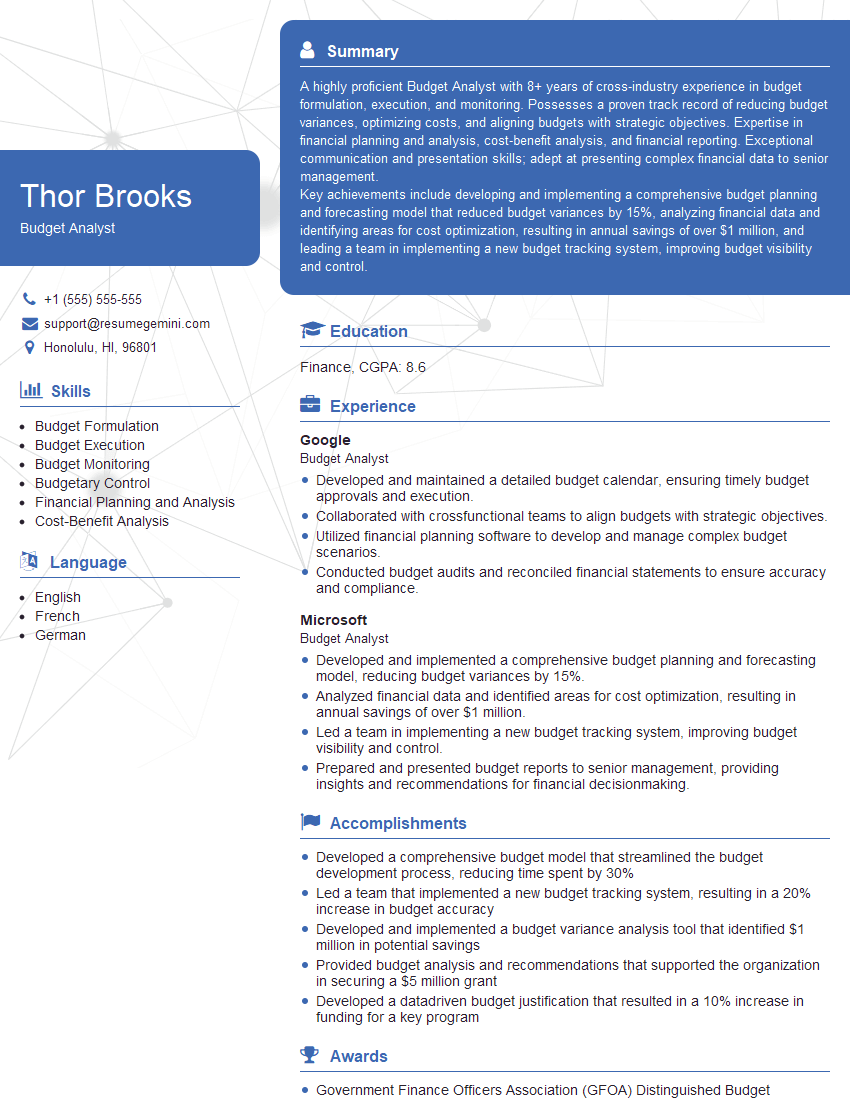
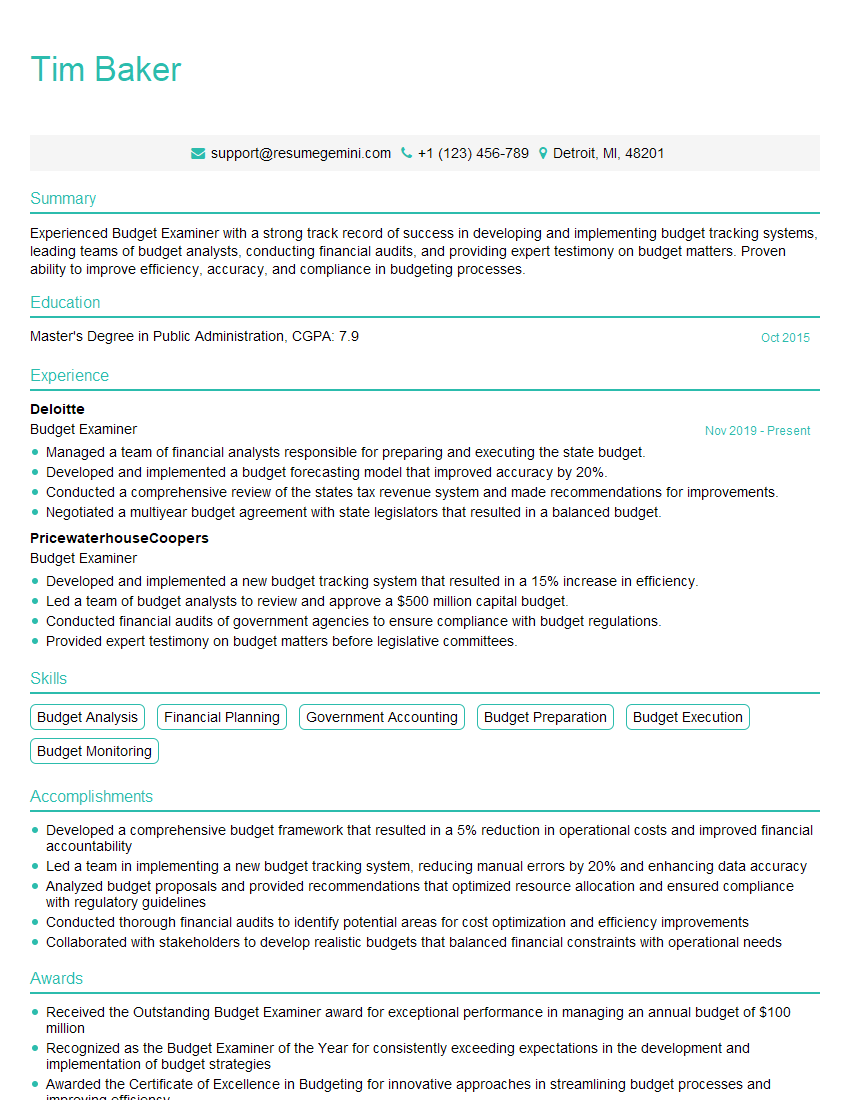
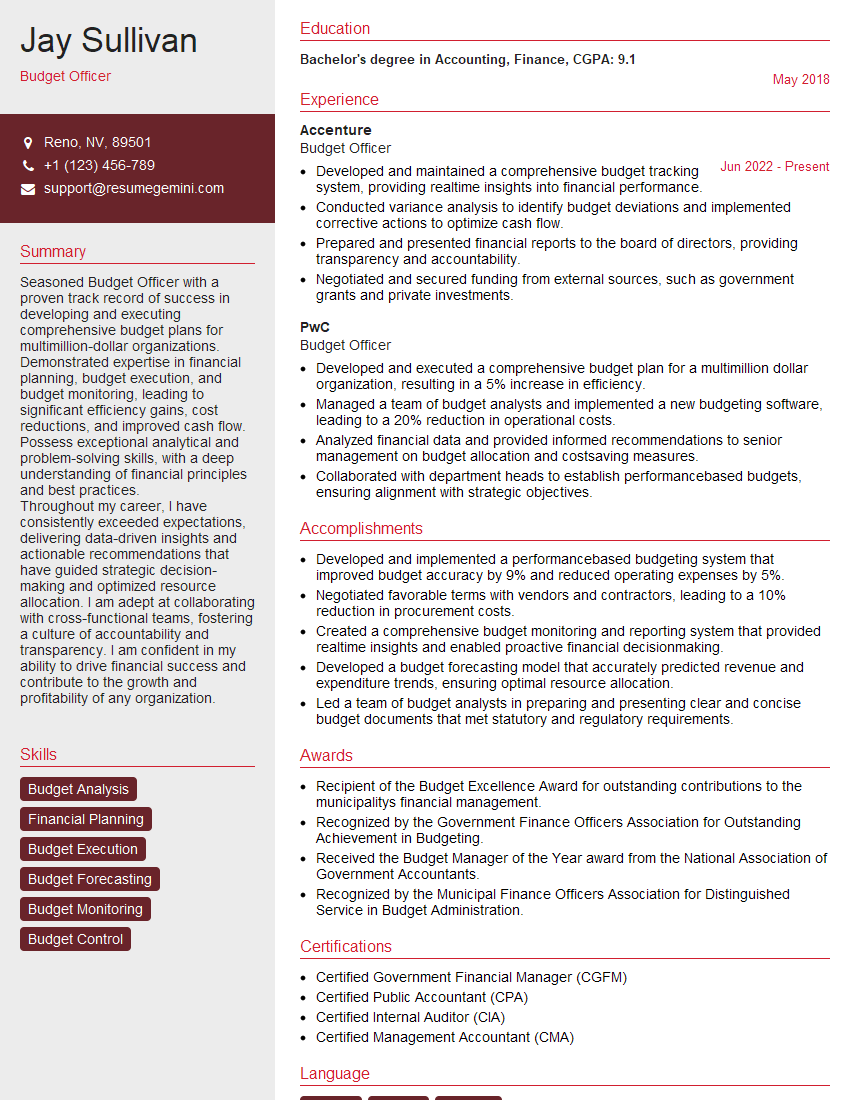
Mastering Federal Budget Analysis opens doors to exciting and impactful career opportunities within government and related sectors. It demonstrates a strong understanding of economic principles, policy processes, and data analysis – highly sought-after skills in today’s job market. To significantly boost your job prospects, create a compelling and ATS-friendly resume that highlights your expertise. ResumeGemini is a trusted resource that can help you craft a professional and effective resume tailored to the specific requirements of Federal Budget Analysis positions. Examples of resumes tailored to this field are provided to further assist you.
Explore more articles
Users Rating of Our Blogs
Share Your Experience
We value your feedback! Please rate our content and share your thoughts (optional).
What Readers Say About Our Blog
To the interviewgemini.com Webmaster.
Very helpful and content specific questions to help prepare me for my interview!
Thank you
To the interviewgemini.com Webmaster.
This was kind of a unique content I found around the specialized skills. Very helpful questions and good detailed answers.
Very Helpful blog, thank you Interviewgemini team.