The right preparation can turn an interview into an opportunity to showcase your expertise. This guide to Flexibility and Range of Motion Improvement interview questions is your ultimate resource, providing key insights and tips to help you ace your responses and stand out as a top candidate.
Questions Asked in Flexibility and Range of Motion Improvement Interview
Q 1. Explain the difference between flexibility and mobility.
While often used interchangeably, flexibility and mobility are distinct concepts. Flexibility refers to the passive range of motion in a joint, meaning the extent to which a joint can be passively moved by an external force (like a therapist or partner). Think of it as how far you can stretch a muscle. Mobility, on the other hand, is the active range of motion – the degree to which you can move a joint independently using your own muscles. It’s about how far you can move a joint on your own. A good analogy is a car’s steering wheel: flexibility is how far you can turn the wheel with your hands assisted, while mobility is how far you can turn it using only your muscles. Someone might have good flexibility but poor mobility, indicating tight muscles limiting active movement despite having a wider passive range.
Q 2. Describe the benefits of improving flexibility and range of motion.
Improving flexibility and range of motion offers numerous benefits, impacting both physical and mental well-being. Physically, it enhances performance in sports and daily activities by increasing power and efficiency of movement. It also reduces the risk of injury by improving muscle balance and joint stability. Increased blood flow to muscles enhances nutrient delivery and waste removal, improving recovery and reducing muscle soreness. Furthermore, improved posture and reduced muscle tension often lead to decreased back pain and other musculoskeletal issues. Mentally, increased flexibility can contribute to stress reduction and improved body awareness. Imagine the feeling of relief after a good stretch – that’s a direct effect of increased flexibility and reduced muscle tension.
Q 3. What are the common causes of limited flexibility?
Limited flexibility stems from several factors. Sedentary lifestyles, characterized by prolonged sitting, significantly contribute to muscle shortening and stiffness. Age plays a role as collagen, the connective tissue that provides elasticity, naturally degrades with time. Injury or surgery can lead to scar tissue formation, restricting joint movement. Improper posture over time can also create muscle imbalances and limit range of motion. Genetic factors also influence an individual’s natural flexibility. Finally, underlying medical conditions such as arthritis can directly restrict joint movement.
Q 4. What assessment methods do you use to evaluate a client’s flexibility and range of motion?
Assessing a client’s flexibility involves a combination of methods. Visual observation provides an initial overview of posture and movement patterns. Active range of motion (AROM) testing measures how far a client can move a joint independently. For example, I’d assess shoulder flexion by asking the client to reach overhead. Passive range of motion (PROM) testing is performed by moving the joint passively, revealing potential restrictions beyond active movement. Goniometry uses a device called a goniometer to quantify joint angles, offering precise measurements. Functional movement screens assess movement patterns during activities like squats or lunges, revealing weaknesses or imbalances impacting flexibility. The chosen assessment method depends on the client’s needs and the specific joints being assessed.
Q 5. Explain how you would design a flexibility program for a sedentary individual.
Designing a flexibility program for a sedentary individual requires a gradual and cautious approach. I begin with educating the client about the importance of flexibility and setting realistic goals. The program starts with low-intensity stretches, like static stretches held for 15-30 seconds, targeting major muscle groups. Examples include hamstring stretches, quadriceps stretches, and shoulder stretches. These are performed 2-3 times a week, initially focusing on form and avoiding pain. As flexibility improves, we can gradually increase the duration of the stretches, introduce dynamic stretches (controlled movements), and incorporate other modalities like foam rolling or self-massage. Progression is key; we start with manageable stretches and gradually increase intensity and duration to avoid overstretching and injury.
Q 6. How would you adapt a flexibility program for an athlete?
Adapting a program for an athlete requires a more sport-specific approach. The program should address muscle imbalances and limitations identified through assessment specific to their sport. For instance, a tennis player might need improved shoulder and hip flexibility, while a runner might need focused hamstring and calf flexibility. We’ll integrate proprioceptive neuromuscular facilitation (PNF) techniques, which involve contracting and relaxing the muscle group being stretched, for more efficient gains in range of motion. Dynamic stretches are incorporated before training sessions to prepare the body for activity, while static stretches are used post-training for recovery and flexibility enhancement. Frequency and intensity will be higher, tailored to the athlete’s training schedule and tolerance level, always ensuring adequate rest and recovery to prevent overtraining.
Q 7. What are some common contraindications for flexibility exercises?
Certain conditions warrant caution when performing flexibility exercises. Recent injuries or surgeries require a doctor’s clearance before starting any flexibility program, as stretching could aggravate the injury. Osteoporosis necessitates modified exercises to avoid excessive stress on bones. Hypermobility, characterized by excessively loose joints, demands careful stretching to prevent further joint laxity. Inflammatory conditions like rheumatoid arthritis might require modifying exercises to avoid exacerbating joint inflammation. Severe pain during stretching should always be a sign to stop and consult a healthcare professional. It’s crucial to listen to your body and prioritize safety.
Q 8. Describe different stretching techniques (e.g., static, dynamic, PNF).
Stretching techniques are broadly categorized into static, dynamic, and proprioceptive neuromuscular facilitation (PNF). Each targets flexibility differently.
- Static Stretching: This involves holding a stretch for a sustained period (typically 15-30 seconds). Think of touching your toes and holding the position. It increases muscle length by lengthening the sarcomeres (the contractile units of muscle). Example: Holding a hamstring stretch by reaching for your toes.
- Dynamic Stretching: This involves movement-based stretches, like arm circles or leg swings. It improves range of motion by preparing the muscles and joints for activity. It’s crucial for warming up before exercise, enhancing blood flow and increasing muscle temperature. Example: Leg swings or arm circles before a run.
- PNF Stretching: This advanced technique uses the neurological principles of muscle contraction and relaxation to improve flexibility. It involves alternating between isometric contraction (holding a muscle still against resistance) and passive stretching. This method often produces the greatest gains in flexibility, but requires careful execution to avoid injury. Example: A partner applies resistance as you push against their hand, followed by a passive stretch.
Q 9. How do you address pain or discomfort during flexibility exercises?
Pain during flexibility exercises is a warning sign. It’s crucial to differentiate between discomfort (a mild stretch sensation) and actual pain. Discomfort is acceptable; pain is not. If you experience pain, stop the exercise immediately.
Addressing pain involves several strategies:
- Reduce Intensity: Ease into the stretch gradually, avoiding sudden movements.
- Modify the Stretch: Adjust your body position to reduce stress on the painful area.
- Change Techniques: If static stretching causes pain, try dynamic stretching or foam rolling.
- Rest and Recover: Allow your body adequate time to rest and repair. Overtraining can exacerbate pain.
- Seek Professional Help: If pain persists, consult a physical therapist or doctor. They can diagnose the cause of the pain and provide a tailored treatment plan.
Q 10. What is the importance of proper warm-up before stretching?
A proper warm-up is essential before stretching to prepare the body for more strenuous activity. It increases blood flow to the muscles, raises muscle temperature, and improves elasticity. This reduces the risk of injury and enhances the effectiveness of the stretching session.
A good warm-up typically includes:
- Light Cardio: 5-10 minutes of light cardio, such as jogging or jumping jacks, to increase heart rate and blood flow.
- Dynamic Stretching: Arm circles, leg swings, torso twists – these prepare muscles for activity.
Think of it like warming up a car engine – you wouldn’t suddenly floor it without letting the engine warm up first!
Q 11. What are the benefits of foam rolling or self-myofascial release?
Foam rolling, or self-myofascial release (SMR), involves using a foam roller to apply pressure to muscles and fascia (the connective tissue that surrounds muscles). This helps to release tension, reduce muscle knots (trigger points), and improve flexibility.
Benefits of foam rolling include:
- Reduced Muscle Soreness: By breaking up adhesions in the fascia, foam rolling can alleviate muscle soreness after exercise.
- Improved Range of Motion: Releasing muscle tension directly improves flexibility and joint mobility.
- Enhanced Performance: Improved muscle function can lead to better athletic performance.
- Stress Relief: The act of self-massage can have a relaxing effect, reducing stress and tension.
Q 12. Explain the role of proprioception in improving flexibility.
Proprioception is your body’s awareness of its position in space. Strong proprioception is crucial for achieving and maintaining flexibility. It allows for better control and coordination during stretching, reducing the risk of injury. Improving proprioception involves activities that challenge your body’s balance and coordination.
Examples of exercises to improve proprioception:
- Balance exercises: Standing on one leg, balancing on an unstable surface.
- Yoga and Pilates: These practices emphasize body awareness and control.
- Proprioceptive exercises: Activities specifically designed to enhance body awareness.
The more aware you are of your body’s position, the better you can control your movements and achieve a deeper, safer stretch.
Q 13. How do you incorporate flexibility training into a broader fitness program?
Flexibility training shouldn’t be an isolated activity; it should be integrated into a comprehensive fitness program. It’s best scheduled after a warm-up or as a separate session.
Incorporating flexibility training:
- Post-Workout Stretching: Static stretching after a workout is effective for improving flexibility and reducing muscle soreness.
- Dedicated Stretching Sessions: Allocate specific time for stretching, focusing on different muscle groups.
- Yoga or Pilates Classes: These incorporate flexibility work into a full-body workout.
Remember to listen to your body and adjust the intensity and duration of stretches based on your individual needs and fitness level.
Q 14. How would you address muscle imbalances that affect flexibility?
Muscle imbalances, where some muscles are stronger or tighter than others, significantly restrict flexibility and can lead to injury. Addressing these imbalances is crucial for improving overall flexibility and preventing future issues.
Strategies to address muscle imbalances:
- Strengthen Weak Muscles: Identify weak muscle groups and incorporate strength training exercises to strengthen them.
- Stretch Tight Muscles: Focus on stretching the tight muscles that are restricting movement.
- Focus on Functional Exercises: Exercises that mimic real-life movements help to improve balance and coordination, reducing the likelihood of muscle imbalances.
- Professional Guidance: A physical therapist or certified personal trainer can help identify muscle imbalances and create a tailored program.
For example, tight hip flexors and weak glutes are common imbalances. Strengthening the glutes and stretching the hip flexors can restore balance and improve flexibility in the hip region.
Q 15. What are some common mistakes people make when stretching?
Many common stretching mistakes hinder progress and can even lead to injury. One frequent error is bouncing during stretches, which can overstretch muscles and damage connective tissue. Instead of bouncing, focus on slow, controlled movements. Another mistake is holding stretches for too short a time; muscles require time to lengthen and adapt. Finally, neglecting to breathe deeply during stretches restricts blood flow and limits the effectiveness of the stretch. People often forget to focus on proper form, leading to inefficient stretching or strain on the wrong muscle groups. For example, someone trying to stretch their hamstrings might round their back, engaging their spinal erectors rather than the target muscles.
- Bouncing: Avoid jerky movements; slow, controlled stretches are key.
- Insufficient Hold Time: Aim for 15-30 seconds per stretch, gradually increasing the hold time as flexibility improves.
- Poor Breathing: Inhale and exhale deeply throughout the stretch to promote relaxation and improve blood flow.
- Incorrect Form: Use mirrors or work with a qualified instructor to ensure correct posture and muscle engagement.
Career Expert Tips:
- Ace those interviews! Prepare effectively by reviewing the Top 50 Most Common Interview Questions on ResumeGemini.
- Navigate your job search with confidence! Explore a wide range of Career Tips on ResumeGemini. Learn about common challenges and recommendations to overcome them.
- Craft the perfect resume! Master the Art of Resume Writing with ResumeGemini’s guide. Showcase your unique qualifications and achievements effectively.
- Don’t miss out on holiday savings! Build your dream resume with ResumeGemini’s ATS optimized templates.
Q 16. How do you educate clients about proper stretching techniques?
Educating clients about proper stretching techniques involves a multi-pronged approach. I start with a clear explanation of the benefits of flexibility, emphasizing its role in injury prevention, improved performance, and enhanced overall well-being. I then demonstrate each stretch, highlighting proper form and explaining the targeted muscle groups. Visual aids, such as anatomical charts or videos, can greatly enhance understanding. Hands-on adjustments and feedback are crucial to correct any mistakes in real-time. Finally, I provide written materials – handouts or email summaries – that clients can refer to later. To make it relatable, I use analogies; for example, comparing a tight muscle to a rubber band that has been left in a cold place – stiff and inflexible. Stretching, therefore, is like gently warming and loosening that rubber band, restoring its elasticity.
I emphasize the importance of listening to their bodies and respecting individual limitations. I often integrate self-myofascial release techniques, such as foam rolling, into the stretching routine, as these techniques help address muscle tightness and prepare the muscles for stretching.
Q 17. How do you assess the effectiveness of a flexibility program?
Assessing the effectiveness of a flexibility program requires a combination of subjective and objective measures. Subjectively, I track client feedback on pain levels, range of motion improvements, and overall comfort levels during and after stretching. Objectively, I use tools to measure specific ranges of motion (ROM) like goniometers (to measure joint angles) and flexibility tests like the sit-and-reach test. Progress is tracked regularly, comparing baseline measurements with subsequent assessments over time. For example, if a client initially struggles to reach their toes in the sit-and-reach test, but after several weeks of consistent stretching they can reach further, that’s objective evidence of improvement. Regular reassessments (e.g., every 4-6 weeks) allow for adjustments to the program based on the client’s progress, ensuring continued improvement and preventing plateaus.
Q 18. How would you modify flexibility exercises for clients with specific medical conditions?
Modifying flexibility exercises for clients with specific medical conditions is crucial. Before initiating any program, I carefully review the client’s medical history and consult with their physician or physical therapist. For example, a client with osteoarthritis may require modifications to avoid excessive stress on affected joints; low-impact stretching and gentle range-of-motion exercises would be prioritized. A client with a recent hamstring strain might need to focus on gentle stretches of the opposing muscles (quadriceps) and avoid direct hamstring stretching until the injury heals. For clients with osteoporosis, stretches that avoid spinal flexion would be essential to minimize the risk of vertebral fractures. The modifications are often based on avoiding positions or movements that aggravate pain or increase risk of further injury.
Q 19. What is your experience with different types of flexibility assessment tools?
My experience with flexibility assessment tools is extensive. I regularly use goniometers to quantitatively measure joint angles, providing objective data on range of motion. The sit-and-reach test is a simple yet effective assessment of hamstring and lower back flexibility. I also incorporate functional movement screens, observing the client’s performance in everyday movements to identify areas of limited mobility that might not be captured by isolated ROM tests. In some cases, more specialized tools such as inclinometers (to measure angles precisely) or digital ROM devices may be used. The choice of tool depends largely on the client’s specific needs and the goals of the flexibility program.
Q 20. Describe your approach to progressive overload in flexibility training.
Progressive overload in flexibility training involves gradually increasing the intensity or duration of stretches over time. This could involve increasing the hold time of a stretch, moving into a deeper stretch, or adding more challenging variations of the stretch. It’s crucial to avoid pushing too hard too quickly, which can lead to injuries. Instead, I use a systematic approach. For example, if a client is initially able to hold a hamstring stretch for 15 seconds, I might gradually increase this to 20, then 25, and so on, over several sessions. Another way to apply progressive overload is to introduce new stretches that target different muscle groups or involve a greater range of motion. It’s like gradually building strength; you wouldn’t lift the maximum weight on your first day at the gym. The same principle applies to flexibility training; gradual progression is key for long-term gains and injury prevention.
Q 21. How do you determine the appropriate intensity and duration of stretching?
Determining the appropriate intensity and duration of stretching depends on several factors, including the client’s age, fitness level, flexibility goals, and any pre-existing medical conditions. Generally, I recommend holding stretches for 15-30 seconds, gradually increasing the duration as flexibility improves. The intensity should be a gentle pull, not a sharp pain. The ‘feel’ should be a sensation of tightness, not sharp pain. A good rule of thumb is to aim for a point of mild discomfort – a 5 or 6 out of 10 on a pain scale, rather than pushing to a 7 or 8. For older adults or those with limited mobility, shorter hold times and less intense stretches may be more appropriate. It is crucial to listen to the client’s feedback and adjust accordingly. The key is finding the sweet spot – enough intensity to stimulate improvement, but not so much that it causes harm. Flexibility training is a marathon, not a sprint.
Q 22. What are some evidence-based flexibility training protocols?
Evidence-based flexibility training protocols prioritize progressive overload, specificity, and individualization. They typically incorporate various techniques to improve range of motion.
- Static Stretching: Holding a stretch for a prolonged period (e.g., 15-30 seconds). This is effective for increasing muscle length and reducing muscle stiffness. An example is holding a hamstring stretch by reaching towards your toes.
- Dynamic Stretching: Performing controlled movements through a range of motion. This improves joint mobility and prepares muscles for activity. Arm circles and leg swings are examples.
- Proprioceptive Neuromuscular Facilitation (PNF): Involves contracting a muscle before stretching it, enhancing flexibility by using neuromuscular reflexes. A common technique is the contract-relax method.
- Myofascial Release: Applying gentle pressure to soft tissues to release tension and improve mobility. Foam rolling is a common self-myofascial release technique.
- Yoga and Pilates: These practices integrate various stretching and strengthening techniques, contributing to overall flexibility and body awareness.
The best protocol depends on the individual’s goals, current fitness level, and any existing injuries. A gradual progression is crucial to avoid injury. For example, a beginner might start with 10-15 minutes of static stretching, gradually increasing duration and intensity over time.
Q 23. How do you integrate flexibility training with strength training?
Integrating flexibility and strength training is crucial for optimal physical performance and injury prevention. A common approach involves alternating or strategically sequencing them within a workout.
- Before Strength Training: Dynamic stretching can improve muscle activation and reduce injury risk. This could include arm circles, leg swings, and torso twists.
- After Strength Training: Static stretching can help improve flexibility and reduce muscle soreness. This is when you hold stretches for a longer period.
- Alternating Days: This approach provides adequate recovery time for each training type. You might have a strength training day followed by a flexibility-focused day.
The order of exercises within a strength training session also matters. Larger muscle group exercises often precede smaller muscle group exercises. And within a strength training session, including brief rest periods with dynamic or isometric stretching helps in maintaining movement efficiency.
A well-rounded program balances both aspects; neglecting one can lead to muscular imbalances and limit athletic potential. For example, a weightlifter who neglects flexibility training may experience limited range of motion and increased injury susceptibility.
Q 24. Explain the concept of agonist/antagonist muscle pairs and their role in flexibility.
Agonist and antagonist muscle pairs work in opposition to each other. The agonist is the prime mover in a given movement, while the antagonist opposes the action of the agonist. Understanding their interplay is vital for effective flexibility training.
For example, in bicep curls, the biceps (agonist) flexes the elbow, while the triceps (antagonist) extends it. Tightness in either muscle can restrict the full range of motion. Flexibility training should address both. Overly tight antagonists can inhibit the full contraction of agonists which affect strength and power. We address this by implementing targeted stretches for both muscle groups. For instance, stretching both biceps and triceps ensures balanced flexibility around the elbow joint, improving the overall range of motion and reducing injury risk.
Q 25. How would you address client adherence and motivation in a flexibility program?
Client adherence and motivation are critical for successful flexibility programs. Strategies involve:
- Setting Realistic Goals: Starting with achievable goals and gradually increasing the difficulty keeps clients motivated and prevents burnout.
- Personalized Programs: Tailoring programs to individual needs, preferences, and limitations makes the process more enjoyable and relevant.
- Providing Education: Explaining the benefits of flexibility and how it relates to their daily life increases client buy-in and commitment.
- Tracking Progress: Monitoring improvements helps reinforce positive outcomes and keeps clients motivated. This could be through range of motion measurements or self-reported progress.
- Finding Enjoyable Activities: Incorporating activities like yoga, Pilates, or dance can make flexibility training more engaging and less of a chore.
- Building a Support System: Encouraging clients to work with a partner or join group classes can promote accountability and shared motivation.
- Regular Check-ins and Feedback: Provides opportunities to address challenges, adjust the program, and provide encouragement.
For example, a client might initially struggle with hamstring flexibility. Instead of overwhelming them with intense stretches, I’d start with gentler stretches, gradually increasing the duration and intensity as they improve. Celebrating their small wins along the way keeps them engaged and committed to the long-term process.
Q 26. What is your experience working with different populations (e.g., elderly, athletes, injured individuals)?
My experience working with diverse populations has shaped my approach to flexibility training. I’ve worked with:
- Elderly Individuals: Programs emphasize gentle movements and focus on maintaining functional mobility, often incorporating chair-based exercises and modifications to traditional stretches. Safety and injury prevention are paramount.
- Athletes: Programs are tailored to their specific sport, aiming to enhance performance and prevent injuries. This involves dynamic stretching before training, PNF techniques, and sport-specific flexibility exercises.
- Injured Individuals: Flexibility programs are carefully designed to address specific limitations and promote healing. Close collaboration with physical therapists and medical professionals is crucial in these cases. The focus is on regaining range of motion gradually without re-injuring the affected area.
Each population requires a highly individualized approach, understanding their unique needs, limitations, and goals. For instance, an elderly client might benefit from chair-based stretches due to balance issues, while an athlete may require more intense training to optimize their sport-specific movements.
Q 27. How do you stay current with the latest research and trends in flexibility and range of motion improvement?
Staying current involves continuous learning and engagement with the field’s advancements.
- Peer-Reviewed Journals: I regularly review journals such as the Journal of Strength and Conditioning Research and the British Journal of Sports Medicine for the latest research findings.
- Conferences and Workshops: Attending conferences and workshops allows me to network with other professionals and learn about the latest techniques and research developments.
- Professional Organizations: Membership in professional organizations such as the American College of Sports Medicine (ACSM) provides access to resources, publications, and continuing education opportunities.
- Online Resources and Databases: Utilizing reputable online databases like PubMed helps me stay updated on current research and trends.
This ongoing learning ensures my practice reflects the most current evidence-based techniques and that I can adapt my approaches as the field evolves.
Q 28. Describe a time you had to adapt a flexibility program due to unexpected challenges.
I once worked with a client recovering from a knee injury who experienced unexpected pain during a prescribed flexibility exercise. The initial program included a deep hamstring stretch.
Instead of continuing, I immediately stopped the exercise and assessed the situation. It turned out the pain wasn’t directly related to the hamstring but stemmed from an underlying patellar issue. I adapted the program by:
- Consulting a Physical Therapist: I sought input from a physical therapist specializing in knee injuries to gain further understanding of the client’s condition and limitations.
- Modifying the Stretches: I substituted the hamstring stretch with gentler quadriceps and hip flexor stretches, focusing on building up strength around the knee joint.
- Incorporating Therapeutic Exercises: I added exercises like isometric contractions and gentle range-of-motion activities as prescribed by the physical therapist.
- Prioritizing Pain Management: We incorporated pain-reducing measures such as ice and elevation, focusing on managing inflammation before increasing the intensity of the exercises.
This experience reinforced the importance of careful monitoring, client communication, and adapting programs based on individual responses. By listening to the client and working with other professionals, I was able to modify the flexibility program successfully, allowing the client to progress safely and effectively toward their rehabilitation goals.
Key Topics to Learn for Flexibility and Range of Motion Improvement Interview
- Biomechanics of Flexibility and Range of Motion: Understanding joint structure, muscle function, and the factors influencing flexibility (e.g., age, activity level, injury history).
- Assessment Techniques: Mastering various methods for evaluating flexibility and range of motion, including goniometry, visual observation, and functional movement screens. Knowing the limitations and advantages of each technique is crucial.
- Intervention Strategies: Developing a comprehensive understanding of various intervention approaches such as stretching (static, dynamic, PNF), mobilization techniques, and exercise prescription for improving flexibility and range of motion. This includes understanding contraindications and modifications for different populations.
- Program Design and Implementation: Learning how to design individualized programs that address specific client needs and goals, considering factors like age, fitness level, and specific limitations. This includes understanding the principles of progressive overload and the importance of client education and adherence.
- Common Injuries and Conditions Affecting Flexibility and Range of Motion: Understanding the relationship between flexibility limitations and common musculoskeletal injuries (e.g., low back pain, shoulder impingement). This includes recognizing the signs and symptoms and understanding appropriate referral processes.
- Therapeutic Exercise Principles: Applying principles of therapeutic exercise to improve flexibility and range of motion, including the use of resistance training, neuromuscular re-education, and functional training.
- Research and Evidence-Based Practice: Understanding the importance of staying current with the latest research and evidence-based practices in flexibility and range of motion improvement. This includes critically evaluating research and applying findings to clinical practice.
Next Steps
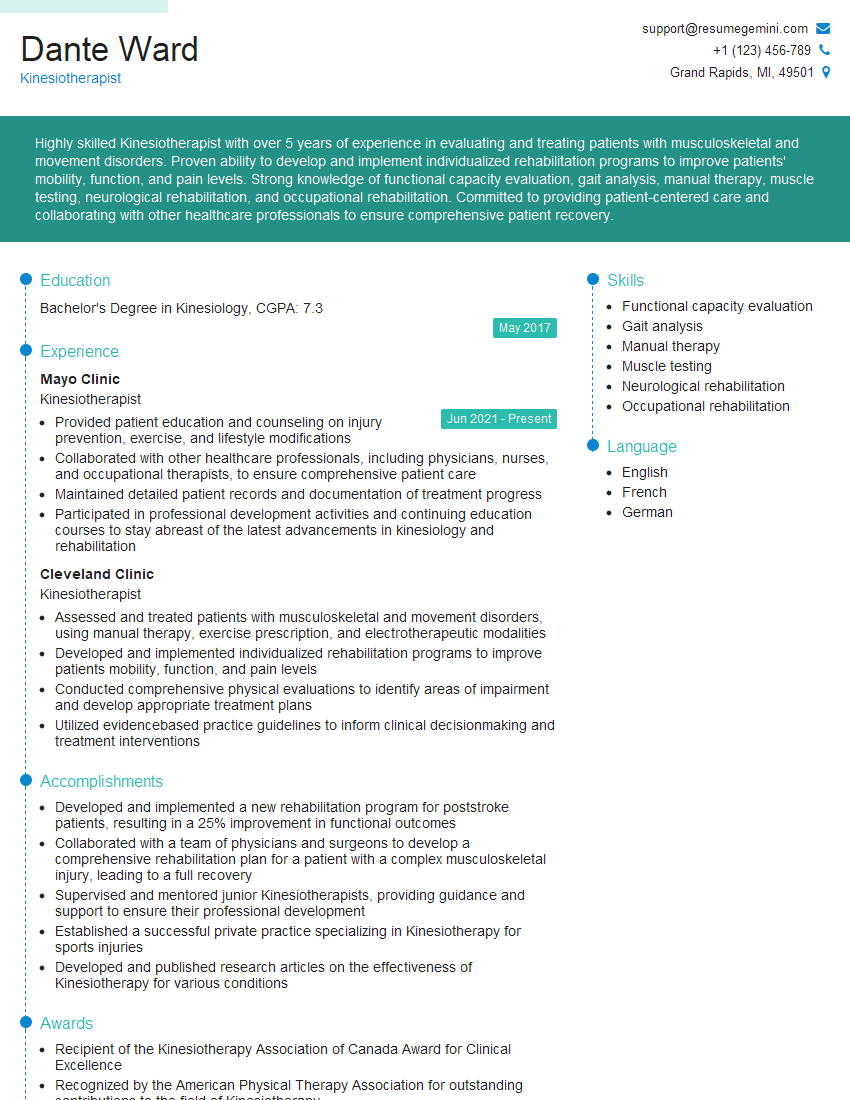
Mastering flexibility and range of motion improvement techniques is key to advancing your career in healthcare, fitness, or related fields. A strong understanding of these principles demonstrates your competency and opens doors to a wider range of opportunities. To maximize your job prospects, it’s vital to create a professional and ATS-friendly resume that highlights your skills and experience effectively. ResumeGemini is a trusted resource to help you build a compelling resume that showcases your qualifications. Examples of resumes tailored to the field of Flexibility and Range of Motion Improvement are available to guide you through the process.
Explore more articles
Users Rating of Our Blogs
Share Your Experience
We value your feedback! Please rate our content and share your thoughts (optional).
What Readers Say About Our Blog
To the interviewgemini.com Webmaster.
Very helpful and content specific questions to help prepare me for my interview!
Thank you
To the interviewgemini.com Webmaster.
This was kind of a unique content I found around the specialized skills. Very helpful questions and good detailed answers.
Very Helpful blog, thank you Interviewgemini team.