Cracking a skill-specific interview, like one for Floor and Wall Tiling, requires understanding the nuances of the role. In this blog, we present the questions you’re most likely to encounter, along with insights into how to answer them effectively. Let’s ensure you’re ready to make a strong impression.
Questions Asked in Floor and Wall Tiling Interview
Q 1. Explain the different types of tile adhesives and their applications.
Tile adhesives are the backbone of any successful tiling project. Choosing the right one depends heavily on the type of tile, the substrate (the surface you’re tiling onto), and the location. There are several key types:
- Cement-based adhesives: These are the workhorses of the industry, offering excellent strength and versatility. They’re suitable for most tile types and substrates, from ceramic and porcelain to natural stone, on walls and floors. Think of them as the reliable, all-purpose glue for your tiling needs. Different types exist, offering varying open times (how long the adhesive remains workable) and setting times.
- Modified thin-set mortars: These are cement-based adhesives enhanced with polymers (like latex) for improved flexibility, bond strength, and water resistance. They’re ideal for larger format tiles, uneven substrates, or areas prone to movement (like heated floors). They’re like the upgraded, supercharged version of standard cement-based adhesives.
- Epoxy adhesives: These two-part adhesives are incredibly strong and waterproof, making them perfect for areas with high moisture like swimming pools or shower stalls. They’re also very suitable for glass or highly polished tiles. However, they’re more expensive and require more precise mixing and application, so think of them as the specialized tools in the toolbox.
- Organic Adhesives: These are less common but can be used for specific applications, such as very thin tiles or delicate mosaics. These adhesives have their own unique properties that require specific expertise.
The choice depends greatly on the project. For a standard bathroom wall, a modified thin-set mortar would be a great choice. For a pool deck, epoxy is the only way to go. Always check the manufacturer’s instructions for specific recommendations.
Q 2. Describe the process of preparing a substrate for tile installation.
Substrate preparation is crucial; it’s the foundation upon which your tiling masterpiece will stand. A poorly prepared substrate leads to cracking, loose tiles, and a generally unsatisfactory result. The process involves several key steps:
- Cleaning: The surface must be completely clean and free from dust, debris, grease, or any loose material. This often involves sweeping, vacuuming, and potentially washing with a suitable cleaner.
- Repairing: Any cracks, holes, or unevenness in the substrate need to be repaired using appropriate patching compounds. This ensures a level and solid base.
- Priming: Applying a primer enhances adhesion between the substrate and the adhesive. The type of primer will depend on the substrate (e.g., concrete, drywall, plywood) and it acts like a bonding agent, creating a strong chemical link.
- Moisture Control: For substrates like concrete, moisture mitigation is key. This might involve applying a moisture-blocking membrane to prevent moisture from migrating upwards and weakening the bond. Moisture meters are used to assess the level of moisture.
- Leveling: For uneven surfaces, self-leveling compounds can be used to create a perfectly flat plane, which is essential for larger format tiles and to prevent stress on the tiles.
Imagine building a house – you wouldn’t start without a solid foundation! The same applies to tiling. Proper substrate preparation ensures a long-lasting and aesthetically pleasing result.
Q 3. What are the common methods for cutting tiles?
Cutting tiles accurately and cleanly is a skill honed through practice. Several methods exist:
- Manual Tile Cutter: This is a common tool for straight cuts. It uses a hardened steel wheel to score the tile, followed by snapping it along the score line. It’s great for straight cuts, easy to use and relatively inexpensive.
- Wet Saw: This uses an abrasive blade and water to cut through tiles cleanly, even the hardest porcelain tiles. It is essential for making precise cuts for angles, curves, and intricate designs and ideal for larger projects.
- Angle Grinder with Diamond Blade: For more aggressive cutting or for making rough cuts, an angle grinder with a diamond blade can be used. However, it requires more skill and is more prone to chipping the tiles. This tool offers excellent flexibility and cutting capability.
- Nippers: Small hand-held tools useful for small, precise cuts. They are best for removing small pieces of tile that have already been cut.
The choice depends on the type of tile, the complexity of the cut, and the level of precision required. For a simple, straight cut in a ceramic tile, a manual cutter is sufficient. For intricate designs or larger format porcelain tiles, a wet saw is necessary.
Q 4. How do you ensure proper grout spacing during tile installation?
Maintaining consistent grout spacing is vital for a professional-looking finish. Here are several techniques:
- Spacers: These small plastic or metal pieces are placed between tiles during installation to ensure uniform gaps. They come in various thicknesses, allowing for control over grout lines.
- Tape: For larger tiles or specific designs, you can use adhesive tape to create consistent gaps. This is often used to achieve the current popular trend of thin grout lines.
- Grout Spacing System: This system uses special spacers that mechanically align tiles and create consistent grout lines. It is useful for more complex layouts, large projects and increased speed and efficiency.
Remember to remove the spacers before the adhesive sets, ensuring you do not remove the spacers too early.
Q 5. What are the different types of grouts and their suitability for various applications?
Grout is the material that fills the spaces between tiles, adding strength, waterproofing, and aesthetics. Several types exist:
- Cement-based grout: This is a common and relatively inexpensive option suitable for most interior applications. It’s available in various colors and comes in sanded (for wider joints) and unsanded (for narrower joints) varieties.
- Epoxy grout: This is a superior choice for areas with high moisture or heavy traffic, like showers and pool decks. It’s highly durable, stain-resistant, and virtually impervious to water. Its use adds extra protection and longevity to the project.
- Sanded vs. Unsanded Grout: The choice depends on grout joint width. Sanded grout is only suitable for grout lines wider than 1/8th of an inch, due to its sand content.
For a standard bathroom floor, cement-based grout would suffice. For a shower, epoxy grout is recommended for its superior water resistance. Always select a grout that is compatible with your chosen tile.
Q 6. Explain the process of grouting and cleaning excess grout.
Grouting is the final step that brings your tiling project to life and protects it. Cleaning excess grout is equally important for maintaining a clean appearance.
- Grouting: Apply the grout using a rubber float, working it into the joints at a 45-degree angle. Ensure the grout completely fills the spaces between the tiles, and remove any excess grout from the tile surfaces. There are some very effective grout application tools to aid in efficient application.
- Cleaning: After the grout has begun to set (according to the manufacturer’s instructions), use a damp sponge to remove excess grout from the tile surfaces. Work in small sections, rinsing the sponge frequently. A soft cloth may be needed for final cleaning and to avoid scratching the tiles. Using a grout hazer or a grout removal tool can make this task easier and more effective.
- Final Cleaning: Once the grout has fully cured (usually 24-72 hours), clean the tiles with a suitable cleaner to remove any remaining haze or residue. Always follow the manufacturers instructions for cleaning.
Think of grouting as frosting a cake – it’s the finishing touch that elevates the overall look. Proper cleaning is vital to ensure the best outcome and protects the project.
Q 7. How do you handle difficult tile cuts, such as curves or angles?
Cutting tiles for curves or angles requires precision and the right tools. Here are some approaches:
- Using a Wet Saw with a Flexible Blade: For gentle curves, a wet saw with a flexible blade can be used to make multiple cuts, creating a curve by connecting them. The quality of cut will be dependent on the skill level and experience of the user.
- Using a Tile Nipper or Angle Grinder: For smaller, tighter curves or angles, tile nippers can be used to carefully chip away at the tile until the desired shape is achieved. An angle grinder can also be used, but care must be taken to avoid chipping or breaking the tile.
- Using a Template: For complex curves, creating a template (e.g., out of cardboard or plywood) can help guide the cutting process. The template can be traced onto the tile, and the tile can then be cut using a wet saw or angle grinder.
- Tile Mosaics: For intricate designs or curves, using smaller pre-cut tile mosaics or using a mosaic tile cutter may provide a less challenging approach and improve the quality of cut.
Cutting curves and angles often requires a combination of techniques and a bit of artistry. Practice and patience are key to achieving clean and precise cuts.
Q 8. Describe your experience with different types of tile, such as ceramic, porcelain, and natural stone.
My experience spans a wide range of tile types, each with its unique properties and applications. Ceramic tiles, known for their affordability and versatility, are perfect for walls and floors in many settings. Porcelain, a denser and more durable type of ceramic, excels in high-traffic areas and exterior applications due to its superior water resistance and strength. I’ve extensively worked with various porcelain finishes, from matte to highly polished. Natural stone, encompassing materials like marble, granite, travertine, and slate, offers unmatched beauty and elegance. However, they require specialized handling and sealing due to their porosity and susceptibility to staining. I’ve handled projects involving intricate stone mosaics and large-format slabs, learning to appreciate the unique challenges and rewards each material presents. For example, while installing a marble backsplash, I discovered the importance of meticulous cutting to avoid chipping and ensuring consistent grout lines. The project’s success relied on understanding the stone’s inherent properties and employing the appropriate tools and techniques.
- Ceramic: Versatile, affordable, suitable for walls and floors.
- Porcelain: Durable, water-resistant, ideal for high-traffic areas.
- Natural Stone (Marble, Granite, Travertine, Slate): Elegant, requires specialized handling and sealing.
Q 9. What are some common problems encountered during tile installation and how do you address them?
Common problems in tile installation often stem from poor substrate preparation, improper adhesive application, or inadequate expansion joints. Uneven surfaces can lead to cracked tiles or grout lines. Using the wrong adhesive for the tile type or substrate can result in poor bonding and tile failure. Forgetting to account for expansion and contraction, especially in larger areas, can cause cracking and buckling. I address these issues proactively. I always ensure the substrate is clean, level, and properly primed. I select adhesives based on the tile type and environmental conditions, following manufacturer recommendations meticulously. I incorporate expansion joints using appropriate materials to allow for movement. For instance, on a recent project with a large floor area, neglecting expansion joints resulted in minor cracking around the perimeter. I corrected this by carefully removing the affected grout, installing expansion joint material, and regrouting. Thorough preparation is key, avoiding costly mistakes and ensuring long-lasting results.
- Uneven Surfaces: addressed by using self-leveling compound.
- Incorrect Adhesive: Using appropriate adhesive per manufacturer guidelines.
- Lack of Expansion Joints: incorporating control joints at appropriate intervals.
Q 10. How do you calculate the amount of tile needed for a project?
Calculating tile quantities requires careful measurement and consideration of waste. First, I accurately measure the area to be tiled (length x width). Next, I add extra for cuts, breakage, and pattern matching. A 10-15% wastage factor is usually added for standard installations, but this can increase based on the complexity of the pattern or the size and shape of the tiles. For instance, when tiling a bathroom with intricate mosaic tiles, I might need to add 20-25% for cuts and waste. I always purchase a few extra tiles to account for unexpected damage or future repairs. It’s better to have a surplus than to be short and face delays. I also communicate these calculations clearly to clients to ensure transparency and manage expectations.
Total Tiles Needed = (Area to be Tiled + Waste Factor) / Area per Tile
Q 11. Explain your experience with waterproofing techniques in tile installations.
Waterproofing is crucial, particularly in wet areas like bathrooms and showers. I employ various techniques depending on the project’s specifics. A common method is using a waterproof membrane, applied directly to the substrate before tiling. This creates a barrier to prevent water penetration. I also ensure proper flashing around plumbing fixtures to seal any potential entry points. Additionally, I use specialized waterproof grout and sealants to further enhance protection. For instance, during a recent shower installation, I used a liquid-applied waterproofing membrane and meticulously followed the manufacturer’s instructions regarding drying time and application thickness. This created a robust waterproof barrier, ensuring the longevity and integrity of the tile work.
Q 12. What safety precautions do you take when working with tile and adhesives?
Safety is paramount. When working with tiles, I always wear safety glasses to protect my eyes from flying debris during cutting. I use gloves to protect my hands from sharp edges and chemical irritants in adhesives and sealants. Dust masks are essential to prevent inhaling tile dust, particularly when working with natural stone. Proper ventilation is crucial when working with adhesives and sealants, as many release volatile organic compounds. I also ensure the work area is well-lit and free of obstructions to prevent accidents. I always follow the manufacturer’s instructions for handling and applying adhesives and sealants and store them according to safety guidelines.
Q 13. How do you ensure the proper leveling of tiles during installation?
Achieving level tiles is crucial for a professional finish. I start by ensuring the substrate is perfectly level. For uneven surfaces, I use self-leveling compound to create a smooth and consistent base. During installation, I use leveling systems, such as tile spacers and wedges, to maintain consistent grout lines and prevent lippage (uneven tile heights). I regularly check the levelness using a level tool and make adjustments as needed. For large-format tiles, I might use a laser level for greater accuracy. Attention to detail in this stage significantly impacts the final aesthetic and structural integrity of the tiled surface. A meticulous approach here ensures a flat and even surface without unsightly lippage.
Q 14. Describe your experience with using different types of power tools in tile installation.
My experience encompasses various power tools essential for efficient and precise tile installation. A wet saw is crucial for accurately cutting tiles to size, especially for intricate cuts and patterns. An angle grinder with a diamond blade is useful for cutting tougher materials like porcelain and natural stone. A demolition hammer is sometimes necessary for removing existing tiles. I am proficient in using these tools safely and effectively, ensuring clean cuts and minimizing waste. For instance, when installing a complex mosaic design, I used the wet saw to create numerous precise cuts with minimal chipping, ensuring the pattern’s integrity and visual appeal. The appropriate use of these tools drastically reduces installation time while achieving high-quality results.
Q 15. How do you handle uneven substrates before tile installation?
Uneven substrates are the bane of any tiler’s existence! Before I even think about laying a tile, I meticulously assess the substrate’s levelness. A perfectly flat surface is crucial for a successful, long-lasting installation. Significant imperfections lead to cracked tiles, grout issues, and an overall unprofessional look. My approach involves several key steps:
- Assessment: I use a long, straight edge (typically a level or a long, perfectly straight piece of wood) and check for any significant dips or high spots. I measure the deviation from a perfectly flat plane.
- Self-Leveling Compound: For minor imperfections, a self-leveling compound is my go-to solution. This is a liquid mixture that flows evenly, filling in small gaps and creating a level surface. It’s crucial to follow the manufacturer’s instructions regarding mixing ratios and drying time.
- Backer Board: For larger irregularities, I’ll often use cement backer board. This offers a strong, stable base and can be easily installed over uneven surfaces. It also provides a solid, moisture-resistant layer, essential in areas like bathrooms and kitchens.
- Concrete Patching: For significant dips or holes in concrete substrates, I use a high-quality concrete patching compound. This needs to be properly prepared and allowed to cure completely before tiling.
Think of it like building a house – you wouldn’t build a house on uneven ground, would you? The same principle applies to tiling. A prepared, level substrate is the foundation for a beautiful and long-lasting tile installation.
Career Expert Tips:
- Ace those interviews! Prepare effectively by reviewing the Top 50 Most Common Interview Questions on ResumeGemini.
- Navigate your job search with confidence! Explore a wide range of Career Tips on ResumeGemini. Learn about common challenges and recommendations to overcome them.
- Craft the perfect resume! Master the Art of Resume Writing with ResumeGemini’s guide. Showcase your unique qualifications and achievements effectively.
- Don’t miss out on holiday savings! Build your dream resume with ResumeGemini’s ATS optimized templates.
Q 16. What are your preferred methods for cleaning and maintaining installed tiles?
Cleaning and maintaining tile is surprisingly straightforward, but regular attention ensures its longevity. My preferred methods depend on the type of tile and the specific soiling.
- Regular Cleaning: For routine cleaning, a simple solution of mild detergent and warm water usually suffices. I recommend using a soft mop or sponge to avoid scratching the tiles. Always rinse thoroughly and dry to prevent water spots.
- Grout Cleaning: Grout is porous and tends to accumulate dirt and grime. I recommend using a grout brush and a grout cleaner specifically designed for tile and grout. For stubborn stains, a solution of bleach and water (always following safety precautions) can be effective, but it should be tested on an inconspicuous area first.
- Specialized Cleaners: For more challenging stains (e.g., rust, mildew), specialized cleaners are available for different types of tile and grout. Always read and follow the manufacturer’s instructions carefully. It’s important to avoid harsh chemicals that might damage the tile’s finish.
- Sealing: Sealing the grout is a crucial step, especially in wet areas. This protects it from stains and moisture damage, significantly extending its life.
Regular maintenance, even a quick wipe-down after spills, makes all the difference in keeping tile looking its best. Think of it as preventative maintenance for your car – regular cleaning and attention prevent bigger problems down the road.
Q 17. Describe your experience with installing large format tiles.
Large format tiles (generally anything over 12×12 inches) present unique challenges but also offer a stunning, modern aesthetic. My experience involves careful planning and execution, emphasizing precision and minimizing potential issues.
- Substrate Preparation: With large format tiles, even minor imperfections in the substrate are amplified. Extra attention to leveling is paramount. I often use self-leveling compound and a laser level for absolute precision.
- Thin-Set Application: Properly mixing and applying thin-set is critical to ensure complete coverage and avoid voids under the tiles. Using a notched trowel with the appropriate notch size is essential to distribute the mortar evenly.
- Support System: For very large or heavy tiles, I sometimes use a support system, such as tile spacers or specialized tile lifting systems, to help distribute the weight and prevent sagging during installation.
- Cutting and Handling: Large format tiles require specialized cutting tools like wet saws to minimize chipping and breakage. Careful handling during installation is crucial to avoid damaging the tiles.
Recently, I installed 24×48 inch porcelain tiles in a spacious living room. The client was initially hesitant about the size, but the finished product was breathtaking. The key was meticulous preparation and a methodical approach to installation.
Q 18. Explain your knowledge of different tile installation patterns.
Tile installation patterns significantly impact the overall look and feel of a space. My knowledge encompasses a wide range of patterns, each with its own strengths and visual appeal. Some popular patterns include:
- Running Bond: The simplest and most common pattern, where tiles are laid in parallel rows with a staggered offset. It creates a clean, classic look.
- Stack Bond: Tiles are laid directly above each other, creating a more formal, modern effect.
- Herringbone: Tiles are laid in a V-shaped pattern, creating a visually interesting and dynamic look.
- Basketweave: Rectangular tiles are laid in a woven pattern, resembling a basket. It adds texture and visual interest.
- Diagonal: Tiles are laid at a 45-degree angle, giving the impression of a larger space.
The choice of pattern depends on the client’s preference, the size and shape of the tiles, and the overall design aesthetic of the space. I always discuss the options with clients, providing samples and visual aids to help them make the best choice.
Q 19. How do you ensure the longevity and durability of your tile installations?
Ensuring the longevity and durability of tile installations involves a multifaceted approach that begins long before the first tile is laid.
- Substrate Preparation: A level, stable substrate is fundamental. Addressing any imperfections before installation prevents future problems.
- Proper Material Selection: Choosing high-quality tiles and thin-set appropriate for the application (e.g., interior vs. exterior, wet areas) is crucial.
- Accurate Measurement and Cutting: Precision in cutting and spacing prevents unevenness and potential cracking.
- Correct Thin-Set Application: Ensuring complete coverage and the correct notched trowel size avoids voids under the tiles.
- Grout Selection and Application: Selecting a high-quality, appropriately colored grout and applying it correctly prevents cracking and staining.
- Sealing: Sealing the grout protects it from water damage and staining, particularly in wet areas.
Imagine a well-built house – it stands the test of time because of the quality of its materials and the precision of its construction. Similarly, a durable tile installation requires meticulous attention to detail at every stage of the process.
Q 20. What is your experience with thin-set mortar versus other adhesives?
Thin-set mortar is my preferred adhesive for most tile installations due to its versatility and strength. However, other adhesives exist, each with its own applications.
- Thin-set Mortar: A cement-based adhesive that’s ideal for most interior and exterior tile installations. Its strength and flexibility make it suitable for various tile types and substrates. It also offers good bonding properties.
- Modified Thin-set: Contains polymers that enhance its flexibility and bonding strength, particularly useful for large format tiles or installations over substrates with movement, like wood subfloors.
- Epoxy Adhesives: These are high-strength adhesives, often used for very large or heavy tiles or in demanding applications like commercial settings. They offer excellent waterproofing capabilities.
- Mastics: These are organic adhesives, often used for smaller tiles in less demanding applications. However, they are less durable and suitable for wet areas compared to thin-set mortars.
The choice of adhesive depends on factors such as tile size, substrate type, and intended use. I always choose the appropriate adhesive to ensure the longevity and integrity of the installation.
Q 21. Describe your approach to troubleshooting issues during a tile installation.
Troubleshooting is a critical skill for any tiler. My approach is systematic and involves carefully assessing the issue before implementing a solution. I usually follow these steps:
- Identify the Problem: Carefully examine the affected area. Is it a single tile or a larger section? What type of problem are we facing (cracked tile, loose tile, grout issues)?
- Determine the Cause: Was the substrate improperly prepared? Was the wrong adhesive used? Were the tiles not installed correctly?
- Develop a Solution: Based on the cause, I develop a solution. This might involve removing and reinstalling a loose tile, patching cracked grout, or even addressing substrate issues.
- Implement and Monitor: I implement the solution, ensuring the repair is done correctly. I monitor the repair for any further issues.
For instance, recently, I encountered a situation where several tiles started to crack after a few weeks. Upon investigation, I discovered the substrate hadn’t been adequately prepared. We had to remove the affected tiles, correct the substrate, and re-install, resulting in a successful long-term solution.
Q 22. What are the key considerations for installing tiles in wet areas, such as bathrooms or showers?
Installing tiles in wet areas like bathrooms and showers requires meticulous planning and execution to ensure longevity and prevent water damage. The key is selecting the right materials and employing proper installation techniques.
- Waterproof Membrane: A crucial first step is installing a waterproof membrane, such as a Schluter-Kerdi system, beneath the tiles. This acts as a barrier against water penetration, preventing mold and mildew growth and protecting the substrate. Think of it as a raincoat for your shower floor!
- Tile Selection: Choose tiles specifically designed for wet areas. Porcelain and ceramic tiles with low water absorption rates are ideal. Avoid natural stone tiles which are more porous unless they’ve been treated with a high-quality sealant.
- Mortar Selection: Use a high-quality, modified thin-set mortar designed for wet areas. This mortar provides superior adhesion and flexibility to withstand the constant exposure to moisture and temperature fluctuations.
- Grout Selection: Choose a grout with a high water resistance rating, such as epoxy grout. Epoxy grout is less porous than cement-based grouts, making it far more resistant to water penetration and staining. It is significantly more expensive, but the investment in longevity is worth it in wet areas.
- Proper Sloping: Ensure the shower floor slopes towards the drain to facilitate proper water drainage. This prevents water from pooling and causing damage.
- Sealant Application: Apply a high-quality silicone sealant to all joints and edges, including where the tile meets the wall, to create a waterproof seal and prevent water leakage.
Failing to address any of these points can lead to costly repairs down the line, including mold growth, tile cracking and even structural damage.
Q 23. Explain your experience with different types of tile trims and edging.
My experience with tile trims and edging is extensive, encompassing various materials and installation methods. The choice of trim depends largely on the tile type, the desired aesthetic, and the project’s budget.
- Metal Trims: Aluminum, stainless steel, and brass trims offer a sleek, modern look and are highly durable. They’re excellent for accentuating tile edges and transitions between different tile types or surfaces. I’ve used these extensively in contemporary bathrooms and kitchens.
- Plastic Trims: PVC trims are more economical but can be less durable and prone to cracking over time. They are a suitable option for areas with less wear and tear.
- Ceramic and Porcelain Trims: Matching trims offer a seamless and unified look. These require careful cutting and precision during installation to maintain a perfect aesthetic.
- Bullnose Tiles: For a classic look, bullnose tiles, which have a rounded edge, are excellent for finishing edges and corners without the need for additional trims. The effect is both elegant and timeless.
- Schluter Systems: I frequently utilize Schluter-Systems profile trims. These offer a range of profiles (metal, plastic) designed for various applications such as shower niches, wall transitions, and step edges. They ensure a watertight and aesthetically pleasing finish, particularly important in wet areas.
Proper installation of trims is crucial for both aesthetics and functionality. Incorrectly installed trims can leave gaps, leading to water penetration and compromised waterproofing.
Q 24. How do you manage your time and resources effectively during a tile installation project?
Effective time and resource management is critical for successful tile installations. My approach involves a multi-step process:
- Detailed Planning: Before starting any project, I create a detailed plan including material quantities, a step-by-step schedule, and potential challenges. This ensures I have everything needed, preventing delays and cost overruns.
- Material Procurement: I source materials from reputable suppliers, ensuring timely delivery. I always order a little extra to account for breakage or unforeseen circumstances. It’s far cheaper to have extra than to face delays ordering more mid-project.
- Teamwork and Communication: If working with a team, clear communication and well-defined roles are key to efficiency. This includes daily briefings and proactive problem-solving.
- Efficient Work Practices: I organize my workspace to optimize workflow and minimize wasted movement. Tools and materials are kept close at hand and properly stored. This approach minimizes waste and maintains safety.
- Regular Monitoring: I monitor progress against the schedule regularly and make adjustments as needed. This proactive approach allows me to address any unexpected issues promptly, preventing project delays.
This systematic approach allows me to consistently deliver projects on time and within budget, exceeding client expectations.
Q 25. Describe a challenging tile installation project and how you overcame the challenges.
One challenging project involved installing large-format porcelain tiles (36×36 inches) on a curved wall in a high-end residential bathroom. The challenge was maintaining consistent grout lines and ensuring the tiles remained securely adhered to the curved surface.
To overcome this, I used a combination of strategies:
- Precise Measurements and Layout: I meticulously measured and marked the curve, creating a precise layout to ensure consistent grout lines. This involved multiple measurements and careful consideration of tile placement.
- Flexible Thin-Set Mortar: I used a high-quality, flexible thin-set mortar designed for large-format tiles. This ensured strong adhesion and accommodated the curvature of the wall.
- Experienced Team: I coordinated with experienced assistants to carefully handle and position the large tiles, ensuring precision and consistency.
- Support System: I used a temporary support system to hold the tiles in place during the initial setting period, ensuring the weight of the tiles didn’t compromise the bond to the curved surface.
The project was successfully completed, resulting in a beautiful, seamless finish. This project highlighted the importance of planning, precision, and the right tools and materials in complex installations.
Q 26. What are the latest trends and technologies in the tile installation industry?
The tile industry is constantly evolving. Some of the latest trends and technologies include:
- Large-Format Tiles: The use of oversized tiles is increasing, creating a minimalist and modern aesthetic. This requires specialized installation techniques and tools.
- Digital Printing: Digital printing technology allows for highly customized and realistic tile designs. This expands design possibilities significantly.
- Rectified Tiles: Rectified tiles have precisely cut edges, allowing for narrower grout lines and a cleaner, more contemporary look. The use of rectified tiles often mandates precise layout planning.
- Smart Tiles: Smart tiles are incorporating features such as integrated heating, lighting, or even touch sensors, integrating technology into the design itself. These advanced tiles present both installation and design challenges, requiring specialist knowledge.
- Sustainable Materials: There’s a growing focus on sustainable and eco-friendly tile options, including recycled materials and tiles made with lower energy consumption processes. This aspect is becoming increasingly important for environmentally conscious clients.
Staying updated on these trends requires continuous learning and professional development. I regularly attend industry conferences and workshops to remain at the forefront of the field.
Q 27. How do you maintain a clean and organized worksite?
Maintaining a clean and organized worksite is paramount for both safety and efficiency. My approach consists of:
- Daily Cleanup: At the end of each workday, I thoroughly clean the work area, removing debris and disposing of waste materials properly. This prevents accidents and keeps the site safe.
- Organized Tool Storage: Tools and equipment are stored neatly and securely, preventing damage and ensuring they’re readily available. I use labeled containers and shelving units to keep everything organized.
- Protective Covering: I use drop cloths or other protective coverings to protect the surrounding areas from dust and damage during the installation process.
- Waste Management: I carefully sort and dispose of waste materials according to local regulations, minimizing environmental impact. This also keeps the site tidy and efficient.
- Regular Dust Control: Dust control measures, like using wet cutting techniques for tiles, are crucial in maintaining a clean workspace and preventing respiratory problems.
A clean and organized workspace not only improves safety but also contributes to a more efficient workflow and a higher-quality finish.
Q 28. What are your salary expectations for this position?
My salary expectations for this position are commensurate with my experience, skills, and the responsibilities involved. I’m open to discussing a competitive salary range based on the specifics of the role and the company’s compensation structure. I am confident that my expertise and proven track record justify a compensation that reflects my value to the organization.
Key Topics to Learn for Your Floor and Wall Tiling Interview
- Surface Preparation: Understanding substrate types (concrete, wood, etc.), assessing their suitability, and applying appropriate primers and treatments. Practical application: Explaining your process for preparing different surfaces for optimal tile adhesion.
- Tile Selection & Layout: Knowledge of various tile materials (ceramic, porcelain, natural stone), sizes, finishes, and design considerations. Practical application: Describing your approach to planning a tile layout, including managing cuts and waste.
- Installation Techniques: Mastering the methods for setting tiles using thin-set mortar, proper spacing, and leveling systems. Practical application: Explaining your preferred techniques for installing tiles on walls versus floors and addressing challenges like uneven surfaces.
- Grouting & Finishing: Selecting appropriate grout, applying it correctly, and cleaning excess grout for a professional finish. Practical application: Detailing your process for achieving a consistent and attractive grout finish, and how you handle different grout types.
- Tools & Equipment: Familiarity with common tiling tools (wet saw, tile nippers, trowels, etc.) and their proper usage. Practical application: Describing your experience with various tools and how you maintain them for optimal performance.
- Safety Procedures: Understanding and adhering to safety regulations, including proper personal protective equipment (PPE) and handling of hazardous materials. Practical application: Explaining your safety protocols when working with sharp tools or chemical products.
- Troubleshooting & Problem Solving: Identifying and resolving common tiling issues like cracked tiles, uneven grout lines, or poor adhesion. Practical application: Detailing your experience in diagnosing and resolving tiling problems efficiently.
Next Steps
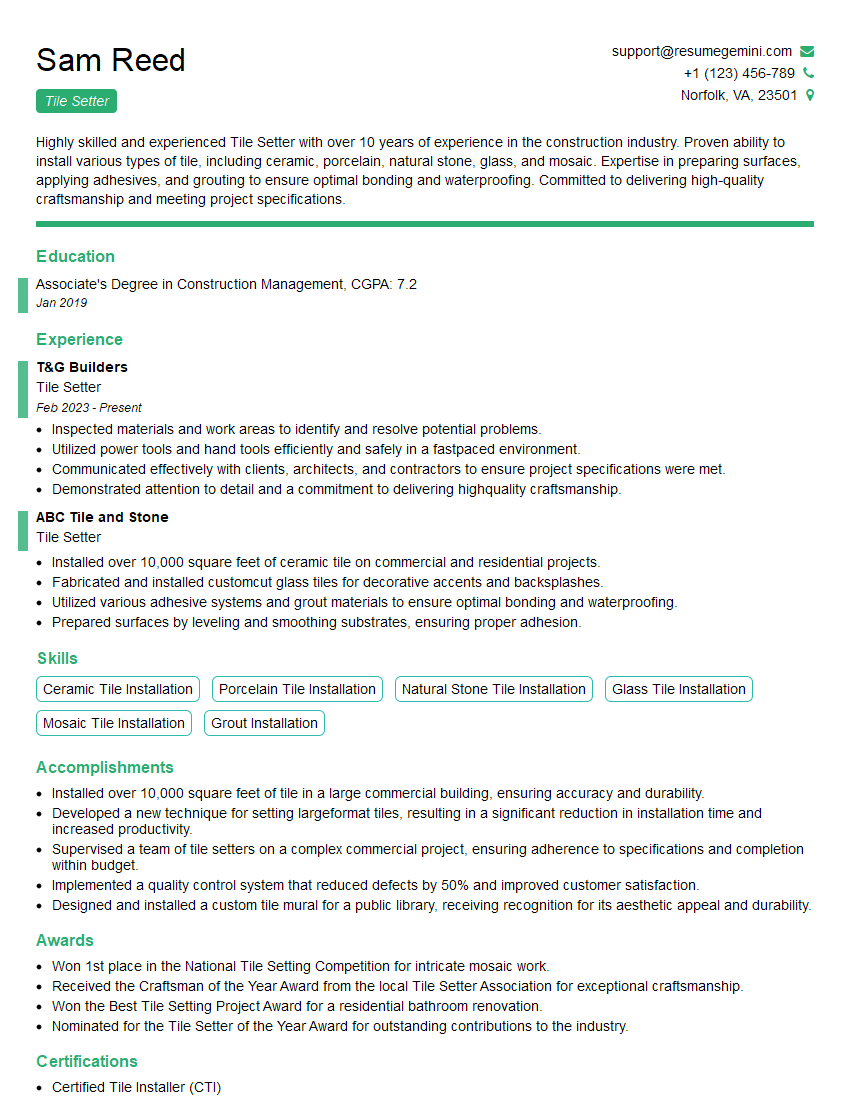
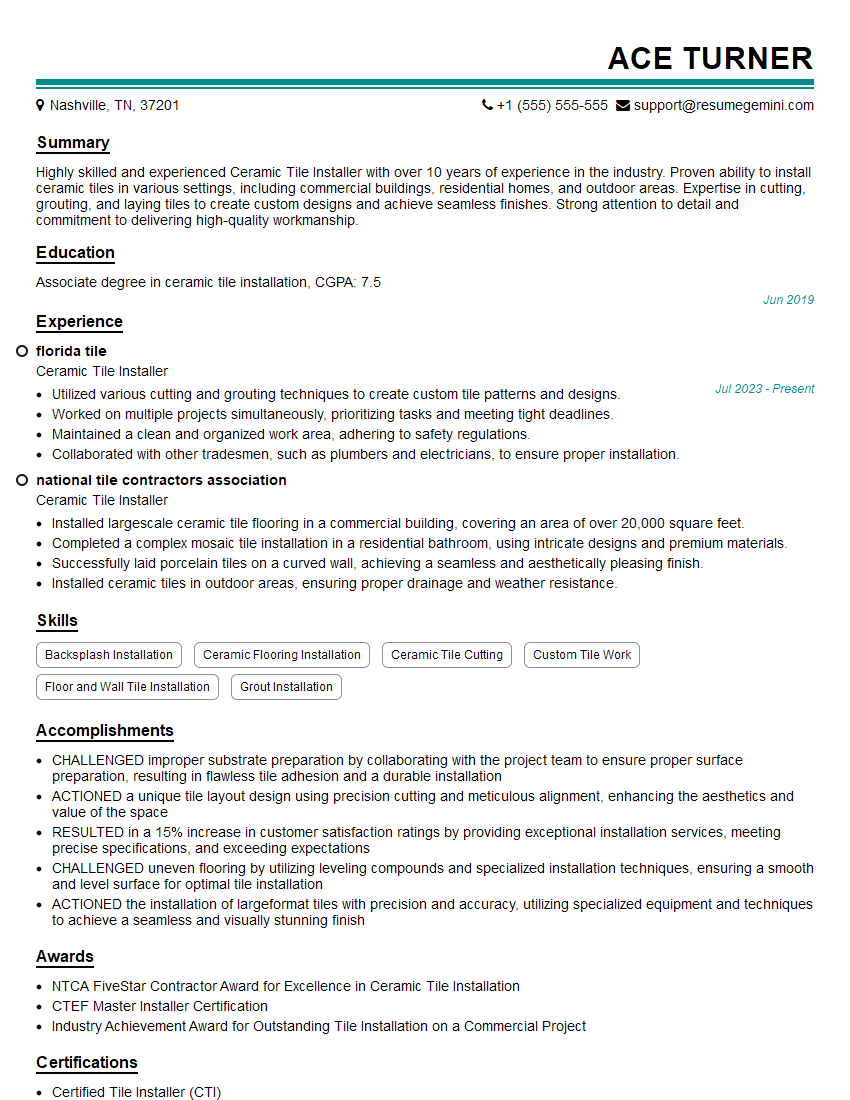
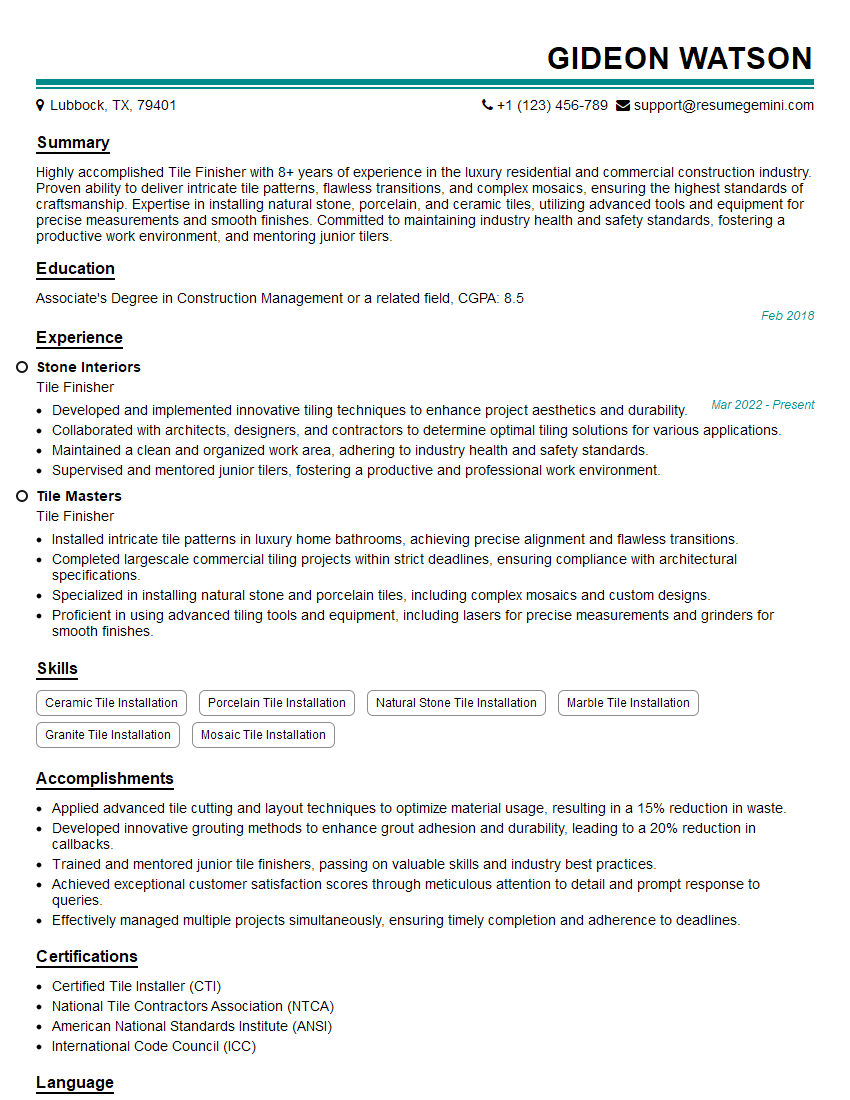
Mastering floor and wall tiling opens doors to a rewarding career with diverse opportunities for growth. To stand out to potential employers, a well-crafted resume is essential. An ATS-friendly resume increases your chances of being noticed by recruiters and getting your application reviewed. We highly recommend using ResumeGemini to create a professional and effective resume that showcases your skills and experience. ResumeGemini provides examples of resumes tailored specifically to the Floor and Wall Tiling industry to help you get started. Invest in your future and build a winning resume today!

Explore more articles
Users Rating of Our Blogs
Share Your Experience
We value your feedback! Please rate our content and share your thoughts (optional).
What Readers Say About Our Blog
To the interviewgemini.com Webmaster.
Very helpful and content specific questions to help prepare me for my interview!
Thank you
To the interviewgemini.com Webmaster.
This was kind of a unique content I found around the specialized skills. Very helpful questions and good detailed answers.
Very Helpful blog, thank you Interviewgemini team.