Cracking a skill-specific interview, like one for Foreign Currency, requires understanding the nuances of the role. In this blog, we present the questions you’re most likely to encounter, along with insights into how to answer them effectively. Let’s ensure you’re ready to make a strong impression.
Questions Asked in Foreign Currency Interview
Q 1. Explain the concept of bid-ask spread in the foreign exchange market.
The bid-ask spread is the difference between the bid price and the ask price of a currency pair. Imagine you’re at a currency exchange. The bid price is the price at which the exchange is willing to buy a currency from you, while the ask price is the price at which they’re willing to sell it to you. The spread represents the profit margin for the exchange or market maker.
For example, if the EUR/USD bid is 1.1000 and the ask is 1.1005, the spread is 0.0005. This small difference, often expressed in pips (points in percentage), can accumulate significantly in large transactions. The spread widens during periods of high market volatility or low liquidity, reflecting increased risk for the market maker.
Understanding the bid-ask spread is crucial for traders to determine their potential profit or loss. A wider spread means higher transaction costs, so traders should strive to find brokers with tighter spreads, especially when dealing with large sums of money.
Q 2. What are the major factors influencing exchange rates?
Exchange rates are influenced by a complex interplay of factors. Think of it as a giant scale, constantly balancing various forces.
- Economic Factors: Interest rate differentials (higher interest rates attract foreign investment), inflation rates (higher inflation weakens a currency), economic growth (strong growth strengthens a currency), and government debt levels all play significant roles.
- Political Factors: Political stability, government policies (such as trade agreements or capital controls), and geopolitical events (wars, elections) can dramatically impact currency values. Uncertainty breeds volatility.
- Market Sentiment: Investor confidence and speculation significantly influence exchange rates. News, rumors, and market trends can cause rapid fluctuations. A sudden surge in demand for a currency will push its price up.
- Supply and Demand: The fundamental principle of supply and demand dictates currency values. If the demand for a particular currency increases (e.g., due to increased exports), its value will appreciate.
- Central Bank Intervention: Central banks can intervene in the forex market to influence their currency’s value by buying or selling their currency reserves.
These factors often interact in unpredictable ways, making accurate forecasting challenging. A strong economy might be overshadowed by political instability, leading to a weaker currency despite positive fundamentals.
Q 3. Describe different types of foreign exchange risk and how to mitigate them.
Foreign exchange risk, also known as currency risk, refers to the potential for losses due to fluctuations in exchange rates. There are several types:
- Transaction Risk: The risk that the exchange rate will change between the time a transaction is agreed upon and the time it’s settled. Imagine a US company importing goods from Europe. If the Euro strengthens against the dollar during this period, the company will pay more in dollars.
- Translation Risk: The risk that the value of a company’s foreign assets and liabilities will change due to exchange rate fluctuations. Multinational corporations with subsidiaries in various countries are heavily exposed to this risk when reporting financial results.
- Economic Risk: The risk that exchange rate changes will affect a company’s long-term competitiveness and profitability. A weaker domestic currency can boost exports but also increase import costs.
Mitigation Strategies:
- Hedging: Using financial instruments like forward contracts, futures contracts, or currency options to lock in exchange rates and minimize exposure to future fluctuations.
- Natural Hedging: Matching foreign currency inflows and outflows to offset exposure. For example, a company could source materials from the same country where it sells its products.
- Currency Diversification: Spreading transactions across multiple currencies to reduce the impact of any single currency’s movement.
- Netting: Consolidating multiple transactions in the same currency to reduce the overall exposure.
The best approach to mitigating foreign exchange risk depends on the company’s specific circumstances, risk tolerance, and the nature of its foreign currency exposures.
Q 4. How do you calculate the profit or loss on a foreign exchange transaction?
Calculating profit or loss on a foreign exchange transaction involves comparing the initial exchange rate with the final exchange rate.
Example: Let’s say you buy 1000 Euros at an exchange rate of 1.10 USD/EUR (meaning 1 Euro costs 1.10 US dollars). Your initial investment is 1000 EUR * 1.10 USD/EUR = 1100 USD.
If you later sell those 1000 Euros at an exchange rate of 1.12 USD/EUR, you receive 1000 EUR * 1.12 USD/EUR = 1120 USD.
Your profit is 1120 USD – 1100 USD = 20 USD.
However, you also need to consider transaction costs (broker fees, commissions, spreads) which would reduce your overall profit.
Conversely, if you sold the Euros at a lower rate (e.g., 1.08 USD/EUR), you would incur a loss. The calculation remains the same; simply subtract the selling amount from the buying amount to determine the profit or loss.
Q 5. Explain the difference between spot and forward contracts.
Both spot and forward contracts are agreements to exchange currencies, but they differ in the timing of the transaction:
- Spot Contract: A spot contract involves the immediate exchange of currencies at the current market rate (the spot rate). Think of it like buying something at a store – you pay and receive the goods immediately.
- Forward Contract: A forward contract is an agreement to exchange currencies at a predetermined future date and exchange rate. This is like pre-ordering something; you agree on the price and delivery date in advance. The forward rate is usually based on the spot rate plus an adjustment for interest rate differentials and time.
Example: A company might use a forward contract to hedge against currency fluctuations. They know they need to pay for imports in three months’ time. They can enter into a forward contract today, locking in the exchange rate for that future transaction, removing the uncertainty associated with fluctuating rates.
Q 6. What are currency options and how are they used?
Currency options are contracts that give the buyer the right, but not the obligation, to buy or sell a specific currency at a predetermined price (the strike price) on or before a certain date (the expiration date).
There are two main types:
- Call Option: Gives the buyer the right to buy a currency at the strike price.
- Put Option: Gives the buyer the right to sell a currency at the strike price.
How they are used:
- Hedging: Companies can use options to protect themselves against adverse currency movements. A company expecting to receive payments in a foreign currency could buy a put option to limit potential losses if the foreign currency weakens.
- Speculation: Options can be used to speculate on future currency movements. If a trader believes a currency will appreciate, they might buy a call option.
Options provide flexibility compared to forward contracts. The buyer only exercises the option if it’s financially beneficial; otherwise, they simply let the option expire.
Q 7. What is the role of central banks in foreign exchange markets?
Central banks play a crucial role in foreign exchange markets. They are responsible for managing their country’s monetary policy and often intervene in the forex market to influence their currency’s value.
Their actions can include:
- Setting interest rates: Changes in interest rates influence capital flows and exchange rates. Higher rates typically attract foreign investment, strengthening the currency.
- Foreign exchange market interventions: Buying or selling their own currency to influence its value. This is often done to stabilize the exchange rate or prevent excessive volatility.
- Managing foreign exchange reserves: Central banks hold foreign currency reserves which they can use to intervene in the market.
- Influencing expectations: Central bank communication and policy announcements can significantly influence market expectations and exchange rates.
Central bank actions can have a significant impact on global currency markets. Their interventions are often aimed at maintaining price stability, managing inflation, and promoting economic growth.
Q 8. Describe your understanding of interest rate parity.
Interest rate parity (IRP) is a theory in finance that suggests the difference in interest rates between two countries should be equal to the difference in their forward and spot exchange rates. In simpler terms, it explains how interest rate differentials are reflected in currency exchange rates. There are two main forms: uncovered and covered.
Uncovered Interest Rate Parity (UIP): This suggests that the expected return on investing in a foreign currency should be equal to the return on investing domestically, after accounting for the expected change in the exchange rate. Let’s say the US interest rate is 5% and the Eurozone rate is 2%. UIP implies that the market expects the Euro to appreciate against the dollar by approximately 3% (5% – 2%) over the investment period to offset the higher US interest rate.
Covered Interest Rate Parity (CIP): This is a more straightforward concept. It uses the forward exchange rate instead of the expected future spot rate. CIP states that the return from investing in a foreign currency, hedged using a forward contract, should be equal to the return from investing domestically. This eliminates exchange rate risk. If CIP doesn’t hold, arbitrage opportunities exist.
Example: If the one-year interest rate in the US is 5% and in Japan is 1%, and the spot exchange rate is 1 USD = 110 JPY, then the one-year forward rate should be approximately 1 USD = 109 JPY (110 JPY * (1 + 0.01) / (1 + 0.05)). This compensates for the higher US interest rate, preventing arbitrage.
Q 9. How does purchasing power parity (PPP) affect exchange rates?
Purchasing Power Parity (PPP) is a theory stating that the exchange rate between two currencies should equal the ratio of the countries’ price levels for a basket of identical goods and services. In essence, it suggests that a unit of currency should buy the same amount of goods and services in different countries.
PPP affects exchange rates because if a country’s price level rises relative to another’s, its currency should depreciate to maintain the balance in purchasing power. For instance, if the price of a Big Mac is significantly higher in Country A than in Country B, then Country A’s currency is likely overvalued according to PPP. Market forces should then drive its currency downwards to reflect this price discrepancy. However, it’s important to note that PPP is a long-run theory and doesn’t always hold true in the short term, due to several factors such as trade barriers, transaction costs, and non-traded goods.
Example: If a basket of goods costs $100 in the US and €80 in the Eurozone, the PPP exchange rate should be 1 USD = 0.80 EUR. If the actual exchange rate is 1 USD = 0.90 EUR, the Euro is overvalued according to PPP, and the market would be expected to adjust it over time.
Q 10. Explain the concept of hedging in foreign exchange.
Hedging in foreign exchange involves using financial instruments to mitigate the risk of losses due to fluctuations in currency exchange rates. Businesses frequently engage in hedging to protect their profits from adverse movements in exchange rates.
Various hedging techniques exist:
- Forward Contracts: An agreement to exchange currencies at a predetermined rate on a future date. This locks in the exchange rate and eliminates the uncertainty.
- Futures Contracts: Similar to forwards but are standardized contracts traded on exchanges.
- Options Contracts: Provide the right, but not the obligation, to buy or sell currency at a specific price on or before a future date. This offers flexibility and allows for protection against unfavorable movements while retaining the potential for profit.
- Currency Swaps: An agreement to exchange principal and interest payments in one currency for another over a specific period. This is commonly used for managing long-term exposures.
Example: A US company expects to receive €1 million in three months. To hedge against a potential depreciation of the Euro, they could enter into a three-month forward contract to sell €1 million at a predetermined exchange rate, guaranteeing the USD equivalent they’ll receive.
Q 11. What is a currency swap and how does it work?
A currency swap is a derivative agreement between two parties to exchange principal and interest payments in different currencies. It’s essentially a series of simultaneous forward contracts. This allows companies to borrow in a currency where they can get a better interest rate, while mitigating exchange rate risk.
How it works: Party A agrees to pay Party B interest in Currency X based on a notional principal amount and receives interest in Currency Y from Party B based on the same notional principal amount. At the end of the swap, both parties return the notional principal amounts in their respective currencies. The interest rate, principal amounts, and the exchange rate for the notional principal are all fixed at the inception of the swap.
Example: A US company needs Japanese Yen (JPY) for an investment. They could enter into a currency swap with a Japanese company. The US company might pay interest in USD on a notional principal amount in USD, while receiving interest in JPY on the equivalent JPY principal amount. At maturity, they swap back the principal.
Q 12. Describe your experience with different trading platforms and systems.
Throughout my career, I’ve utilized a variety of trading platforms and systems, including Bloomberg Terminal, Refinitiv Eikon, and proprietary trading systems used by various banks. I’m proficient in using these platforms for market data analysis, order entry, risk management, and backtesting trading strategies.
My experience encompasses both front-end and back-end aspects. I’m familiar with different order types (market orders, limit orders, stop orders), real-time data feeds, charting tools, and risk management systems. I’ve worked with systems that integrate with internal accounting and compliance systems, ensuring adherence to regulatory requirements. Adapting to new platforms is a key skill, and I’m confident in my ability to quickly learn and efficiently use any new system.
Q 13. Explain your understanding of technical analysis in FX trading.
Technical analysis in FX trading focuses on identifying trends and patterns in price charts to predict future price movements. It relies on historical price data, volume, and other technical indicators, rather than fundamental economic factors.
Key aspects include:
- Chart Patterns: Identifying recurring patterns like head and shoulders, double tops/bottoms, triangles, which suggest potential price reversals or continuations.
- Technical Indicators: Using indicators such as moving averages, RSI (Relative Strength Index), MACD (Moving Average Convergence Divergence), Bollinger Bands, to identify overbought/oversold conditions, momentum changes and potential support/resistance levels.
- Support and Resistance Levels: Identifying price levels where buying or selling pressure is expected to be strong, influencing future price movement.
- Trendlines: Drawing lines connecting significant price highs or lows to identify the dominant trend.
It’s crucial to remember that technical analysis is not foolproof and should be used in conjunction with other forms of analysis, like fundamental analysis.
Q 14. How do you analyze fundamental factors impacting exchange rates?
Analyzing fundamental factors impacting exchange rates involves examining economic data and events that influence the supply and demand for currencies. These factors encompass a wide range:
- Interest Rates: Higher interest rates typically attract foreign investment, increasing demand for the currency and causing appreciation.
- Inflation: High inflation erodes purchasing power and typically leads to currency depreciation.
- Economic Growth: Strong economic growth usually strengthens a currency as it attracts investment.
- Government Debt: High levels of government debt can weaken a currency.
- Political Stability: Political uncertainty can negatively impact a currency’s value.
- Current Account Balance: A large current account deficit can put downward pressure on a currency, while a surplus tends to support it.
- Geopolitical Events: Significant geopolitical events can significantly affect exchange rates.
I utilize a combination of quantitative and qualitative analysis, studying economic reports (like GDP, CPI, trade balance), central bank statements, political developments, and market sentiment to forecast currency movements. I also use econometric models to quantify the impact of various factors on exchange rates.
Q 15. Describe your risk management strategies in foreign exchange trading.
My risk management strategy in foreign exchange trading is multifaceted and prioritizes a conservative approach. It hinges on three core pillars: diversification, position sizing, and stop-loss orders.
Diversification: I avoid concentrating my portfolio in any single currency pair or region. Spreading investments across multiple markets reduces the impact of a single adverse event. For example, instead of heavily betting on EUR/USD, I might spread my risk across EUR/JPY, GBP/USD, and AUD/USD.
Position Sizing: This is crucial. I meticulously calculate the maximum amount I’m willing to lose on any given trade, based on my overall capital. A common rule of thumb is to risk no more than 1-2% of my total capital on a single trade. This prevents catastrophic losses even if several trades go against me.
Stop-Loss Orders: These are automatic orders that sell a currency pair when it reaches a predetermined price. They help limit potential losses, acting as a safety net. I always use stop-loss orders, setting them strategically based on technical analysis and risk tolerance. For instance, if I buy EUR/USD at 1.1000, a stop-loss order at 1.0950 would limit my potential loss to 50 pips.
Beyond these core strategies, I also employ regular portfolio reviews, stress testing, and backtesting to refine my approach and identify potential weaknesses.
Career Expert Tips:
- Ace those interviews! Prepare effectively by reviewing the Top 50 Most Common Interview Questions on ResumeGemini.
- Navigate your job search with confidence! Explore a wide range of Career Tips on ResumeGemini. Learn about common challenges and recommendations to overcome them.
- Craft the perfect resume! Master the Art of Resume Writing with ResumeGemini’s guide. Showcase your unique qualifications and achievements effectively.
- Don’t miss out on holiday savings! Build your dream resume with ResumeGemini’s ATS optimized templates.
Q 16. How do you manage your trading portfolio in a volatile market?
Managing a trading portfolio in a volatile market requires a disciplined and adaptable approach. My strategy focuses on reducing risk and capitalizing on opportunities when they emerge.
Increased Vigilance: During periods of volatility, I closely monitor market news and economic indicators. This allows me to anticipate potential shifts in exchange rates and adjust my positions accordingly. I might rely more heavily on technical analysis to identify short-term trading opportunities.
Reduced Leverage: Volatility amplifies both profits and losses. I would therefore reduce the leverage I use in my trades, thereby minimizing the potential for significant losses.
Tight Stop-Losses: In volatile markets, stop-loss orders become even more critical. I might tighten my stop-losses to reduce exposure to sudden price swings. While this may lead to fewer profits, it will significantly mitigate the potential for large losses.
Hedging Strategies: I may employ hedging strategies to protect against specific risks. For example, if I hold a large position in a specific currency, I might use options or futures contracts to offset potential losses.
The key in a volatile market is patience and discipline. Avoid impulsive decisions and stick to your risk management plan.
Q 17. What are your preferred indicators for forecasting exchange rate movements?
I use a combination of technical and fundamental indicators for forecasting exchange rate movements. No single indicator is perfect, and I find the most accurate forecasts come from combining several.
Technical Indicators: These analyze price charts and historical data to identify patterns and predict future price movements. Examples include moving averages, Relative Strength Index (RSI), MACD, and Bollinger Bands. I use these to identify potential support and resistance levels, trend reversals, and overbought/oversold conditions.
Fundamental Indicators: These analyze economic factors that influence exchange rates. Examples include interest rate differentials, inflation rates (CPI), Gross Domestic Product (GDP) growth, and current account balances. A higher interest rate in a country, for example, will typically attract foreign investment, increasing demand for its currency.
Sentiment Indicators: I also consider market sentiment, often gauged by news headlines, social media trends, and surveys of market participants. A generally bullish market sentiment can push currency prices higher, even in the absence of strong economic fundamentals.
It’s vital to remember that forecasts are not guarantees. I always use multiple indicators, combine them with careful risk management, and stay alert to unexpected events.
Q 18. Explain your understanding of geopolitical risks in foreign exchange markets.
Geopolitical risks are significant factors influencing foreign exchange markets. These risks stem from political events and tensions that can abruptly shift investor sentiment and currency values.
Political Instability: Events like elections, coups, civil unrest, and wars can create uncertainty and lead to capital flight from affected regions. For example, the outbreak of a major conflict can sharply weaken a country’s currency as investors seek safety in other assets.
Trade Wars and Sanctions: Trade disputes and sanctions can significantly disrupt global trade and impact currency values. Tariffs imposed by one country on another can trigger retaliatory measures, negatively affecting the currencies of both involved nations.
Terrorism and Security Threats: Terrorist attacks or heightened security concerns can create volatility and trigger risk-aversion among investors, potentially causing investors to move away from riskier assets, such as emerging market currencies.
Changes in Government Policies: Unexpected policy shifts, such as changes in fiscal or monetary policy, can also impact exchange rates. For example, an unexpected increase in interest rates can strengthen a country’s currency.
I actively monitor geopolitical developments through reliable news sources and utilize geopolitical risk assessment models to understand and mitigate these risks in my trading strategies.
Q 19. How do you stay updated with the latest developments in the FX market?
Staying updated in the dynamic FX market is crucial. My approach involves a multi-pronged strategy:
News Monitoring: I subscribe to reputable financial news outlets (Bloomberg, Reuters, Financial Times) and use news aggregators to receive real-time updates on market-moving events. This ensures I’m aware of breaking news that could affect exchange rates.
Economic Calendar: I use an economic calendar to track upcoming economic data releases (e.g., CPI, GDP, employment figures). These releases often cause significant volatility, providing opportunities and requiring proactive adjustments to my positions.
Central Bank Statements & Speeches: I carefully analyze statements and speeches from central bank governors and officials for insights into monetary policy decisions, which heavily impact exchange rates. The tone and language used can be more influential than specific numbers.
Analyst Reports and Research: I review research reports from reputable financial institutions for in-depth analysis of currency trends and forecasts.
By combining these sources, I build a comprehensive view of the FX market and anticipate potential shifts in exchange rates.
Q 20. Describe your experience with regulatory compliance in the FX industry.
Regulatory compliance is paramount in the FX industry. My experience encompasses a thorough understanding and strict adherence to regulations such as KYC (Know Your Customer), AML (Anti-Money Laundering), and various trade reporting requirements.
KYC/AML: I am meticulous in verifying the identity of clients and ensuring all transactions comply with anti-money laundering regulations. This involves robust due diligence processes and ongoing monitoring of transactions for suspicious activity.
Trade Reporting: I am proficient in accurately reporting trades to relevant regulatory bodies, adhering to reporting deadlines and formats. This includes maintaining detailed records of all transactions.
Transaction Monitoring: I use transaction monitoring systems to identify and flag potentially suspicious activities, in line with regulatory requirements.
Regulatory Updates: I keep abreast of all regulatory changes and ensure my practices remain compliant with evolving standards. This involves ongoing professional development and staying informed about changes in regulations.
I understand that non-compliance can have severe legal and financial consequences, and I prioritize maintaining the highest ethical standards and full regulatory compliance.
Q 21. How do you interpret and utilize economic data (e.g., CPI, GDP) in your FX trading decisions?
Economic data such as CPI and GDP play a crucial role in my FX trading decisions. These indicators provide insights into the economic health of countries and can influence their currency values.
CPI (Consumer Price Index): CPI measures inflation. Higher-than-expected inflation can weaken a currency, as it reduces the purchasing power of that currency. Conversely, lower inflation can strengthen it. I analyze CPI figures to gauge the potential for future interest rate changes by central banks.
GDP (Gross Domestic Product): GDP reflects the overall economic output of a country. Strong GDP growth generally strengthens a country’s currency, as it signifies economic strength and attracts foreign investment. Conversely, weak GDP growth can weaken a currency.
Interest Rate Differentials: I analyze interest rate differentials between countries. Higher interest rates in one country compared to another can attract foreign investment, increasing demand for that country’s currency.
Other Key Data: Beyond CPI and GDP, I also consider other data points such as employment figures, trade balances, and government debt levels. These all collectively contribute to a comprehensive picture of a country’s economic health and influence my trading strategies.
It’s important to note that economic data is often released with some delay. I consider the market’s reaction to these releases as well, factoring in unexpected surprises and how the market is processing the information. Combining fundamental analysis with technical indicators helps me form well-rounded trading decisions.
Q 22. What is your experience with different order types in foreign exchange trading (e.g., market orders, limit orders)?
Foreign exchange trading involves various order types, each serving a different purpose. Understanding these is crucial for effective risk management and trade execution.
- Market Orders: These are executed immediately at the best available market price. They guarantee execution but offer no control over the price. Think of it like buying something at a store – you get it immediately but pay whatever the price tag says.
- Limit Orders: These are only executed if the market price reaches a specified level (your limit). This lets you control the price but doesn’t guarantee execution. It’s like putting in a bid at an auction – you only pay your maximum price.
- Stop Orders: These are triggered when the market price hits a predetermined level (your stop price), usually to limit losses or protect profits. They’re often used in conjunction with limit orders to set a target profit and a stop-loss point.
- Stop-Limit Orders: A combination of a stop and a limit order. The order becomes a limit order once the stop price is reached. This offers better price control than a simple stop order but still doesn’t guarantee execution.
In my experience, selecting the appropriate order type depends heavily on market volatility and my trading strategy. During periods of high volatility, market orders might be preferred for immediate execution, while during calmer periods, limit orders allow for better price control.
Q 23. Describe a situation where you had to make a critical decision in a time-sensitive FX trade.
During a period of significant political instability in a specific region, I was managing a large portfolio with substantial exposure to that region’s currency. News broke about a major political event that had the potential to drastically devalue the currency. I had only a few minutes to react.
My critical decision involved rapidly implementing a stop-loss order to mitigate potential losses. While this meant realizing a smaller loss than I had initially hoped for, it prevented a significantly larger loss that could have jeopardized the entire portfolio’s performance. The swift action, prioritizing risk management over potential gains, proved crucial in preserving capital.
Q 24. How do you handle discrepancies or errors in foreign exchange transactions?
Discrepancies or errors in FX transactions are unfortunately inevitable. My approach focuses on prompt identification, thorough investigation, and effective resolution.
- Immediate Identification: Reconciliation processes, comparing trade confirmations against internal records, are paramount. Any discrepancies are flagged immediately.
- Thorough Investigation: I meticulously examine transaction details, including timestamps, exchange rates, and amounts, to pinpoint the source of the error. This often involves reviewing internal systems and contacting the counterparty bank.
- Resolution: Depending on the nature of the error (e.g., data entry mistake, system glitch, or counterparty error), I work with relevant parties to rectify the issue. This might involve requesting adjustments, submitting claims, or escalating to senior management.
- Documentation: Every step of the process is meticulously documented to maintain a clear audit trail and prevent future occurrences.
A recent example involved a mismatched exchange rate in a large transaction. Through detailed investigation, we identified a data entry error on our end, which was corrected, and the transaction was amended to reflect the correct exchange rate.
Q 25. Explain your understanding of different FX trading strategies (e.g., carry trade, arbitrage).
Several FX trading strategies leverage different market dynamics. Let’s explore two key examples:
- Carry Trade: This involves borrowing a currency with a low-interest rate and investing in a currency with a high-interest rate. The profit comes from the interest rate differential. However, it’s crucial to consider exchange rate fluctuations. If the borrowed currency appreciates significantly against the invested currency, the trade can result in a loss. Imagine borrowing money at 1% and investing where you earn 5%; the difference is your profit, but currency movements can offset this.
- Arbitrage: This involves exploiting price discrepancies between different markets. If a currency is trading at slightly different prices on two exchanges, you can buy low on one exchange and simultaneously sell high on another, profiting from the price difference. This requires speed and efficient execution to capitalize on the often-small window of opportunity. It’s like finding a product cheaper in one store and selling it for more in another, instantly.
Other strategies include momentum trading (following market trends), mean reversion (betting on prices returning to their average), and pairs trading (profiting from the relative price movements of two correlated currencies).
Q 26. Describe your experience with using different charting software and technical indicators.
My experience encompasses a variety of charting software, including MetaTrader 4, TradingView, and Bloomberg Terminal. These platforms offer diverse tools for technical analysis.
I frequently use technical indicators like moving averages (to identify trends), Relative Strength Index (RSI) (to gauge momentum), MACD (to identify potential buy/sell signals), and Bollinger Bands (to measure volatility). My proficiency extends to customizing chart settings, overlaying different indicators, and interpreting their combined signals to generate actionable insights. The specific choice of software and indicators depends on the market being traded and the chosen trading strategy.
For instance, when trading highly volatile emerging market currencies, I might prioritize using Bollinger Bands and RSI to identify potential reversals and manage risk effectively.
Q 27. How would you evaluate the performance of a foreign exchange trading strategy?
Evaluating an FX trading strategy requires a comprehensive approach, going beyond simply looking at profit and loss. Key metrics include:
- Sharpe Ratio: Measures risk-adjusted return. A higher Sharpe ratio indicates better performance, considering the risk taken.
- Sortino Ratio: Similar to the Sharpe Ratio, but only considers downside risk.
- Maximum Drawdown: The largest peak-to-trough decline during a specific period. This highlights the strategy’s resilience to market downturns.
- Calmar Ratio: Relates the average annual rate of return to the maximum drawdown. A higher Calmar ratio suggests a more consistent strategy.
- Win Rate: The percentage of winning trades. This, combined with the average win/loss ratio, provides a holistic picture of trading effectiveness.
Furthermore, backtesting the strategy with historical data, stress testing it under various market conditions, and conducting thorough sensitivity analysis are crucial steps in validating its robustness and reliability.
Q 28. What are some ethical considerations in foreign exchange trading?
Ethical considerations in FX trading are paramount. They underpin market integrity and investor trust.
- Market Manipulation: Engaging in activities that artificially influence exchange rates is strictly prohibited and carries severe consequences.
- Insider Trading: Using non-public information to gain an unfair advantage is unethical and illegal.
- Client Confidentiality: Protecting client information and acting in their best interests are crucial ethical obligations.
- Conflict of Interest: Avoiding situations where personal interests conflict with professional duties is essential for maintaining integrity.
- Compliance with Regulations: Adhering to all relevant laws and regulations, including KYC (Know Your Customer) and AML (Anti-Money Laundering) procedures, is non-negotiable.
Maintaining the highest ethical standards is not only legally required but also crucial for building long-term credibility and trust within the financial markets.
Key Topics to Learn for Foreign Currency Interview
- Exchange Rate Mechanisms: Understand the different types of exchange rate regimes (floating, fixed, pegged, etc.) and their implications for businesses operating internationally. Consider the factors influencing exchange rate fluctuations.
- Foreign Exchange Risk Management: Explore hedging strategies (forward contracts, futures, options, swaps) used to mitigate the risk of adverse exchange rate movements. Discuss practical application in real-world scenarios, such as importing/exporting goods.
- International Payments and Settlements: Familiarize yourself with the process of international payments, including letters of credit, SWIFT transactions, and correspondent banking. Understand potential challenges and solutions.
- Currency Forecasting and Analysis: Learn about fundamental and technical analysis methods used to predict future exchange rate movements. Discuss the limitations of forecasting and the importance of risk management.
- Financial Reporting and Consolidation: Understand how foreign currency transactions are recorded and reported in financial statements, including translation and remeasurement adjustments. Consider the impact on key financial ratios.
- Regulations and Compliance: Become familiar with relevant regulations and compliance requirements related to foreign currency transactions, including anti-money laundering (AML) and know-your-customer (KYC) procedures.
- Case Studies and Problem Solving: Practice applying your knowledge to real-world case studies involving foreign currency transactions and risk management. Focus on analytical and problem-solving skills.
Next Steps
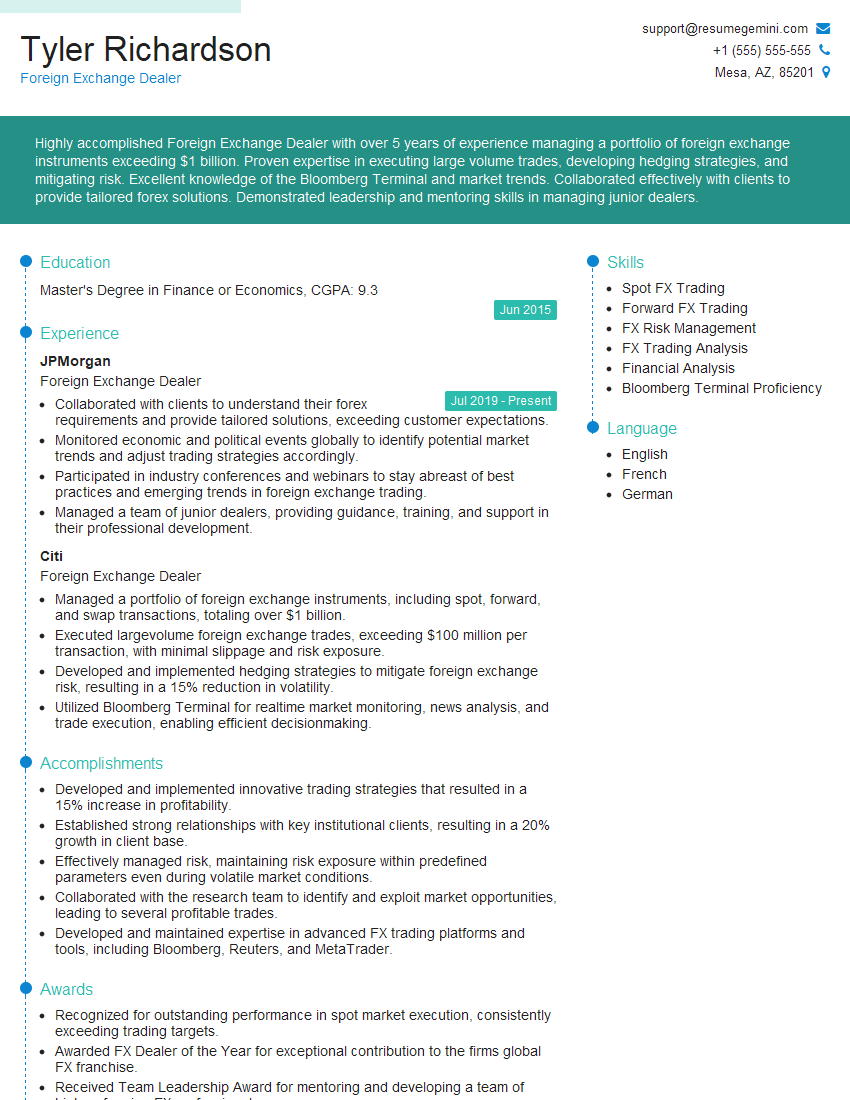
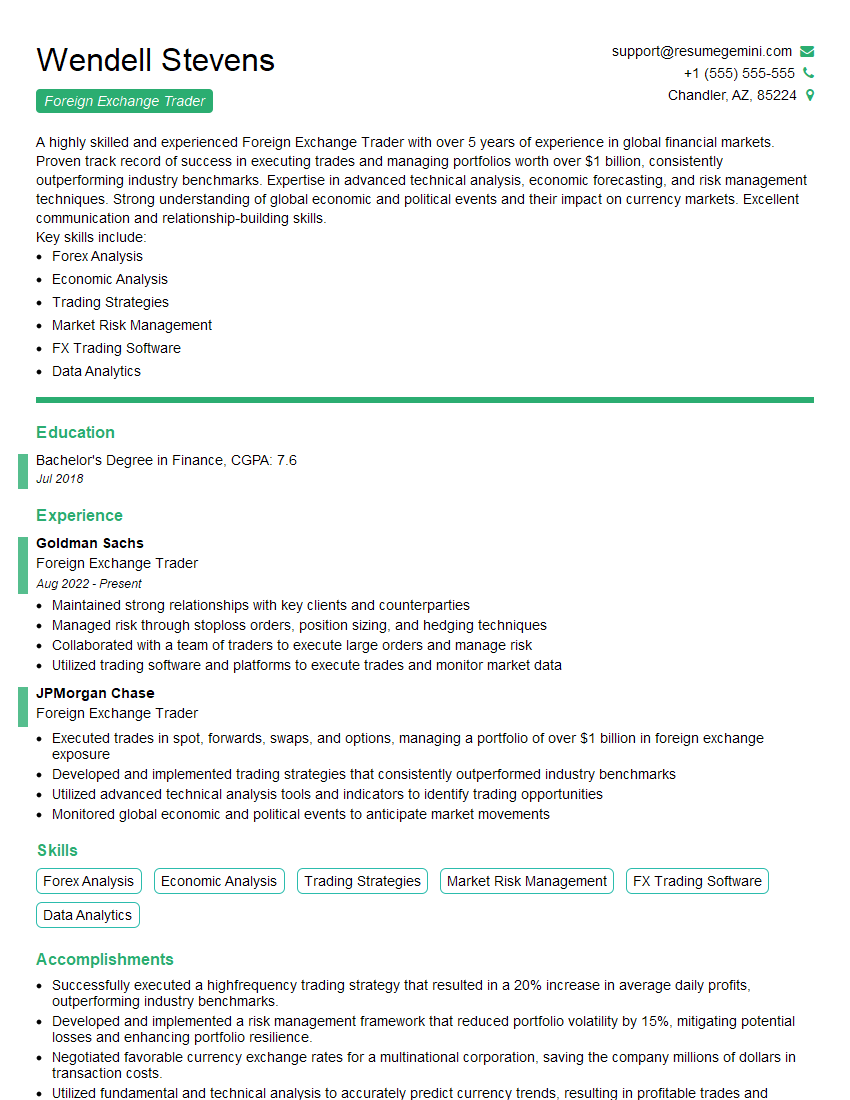
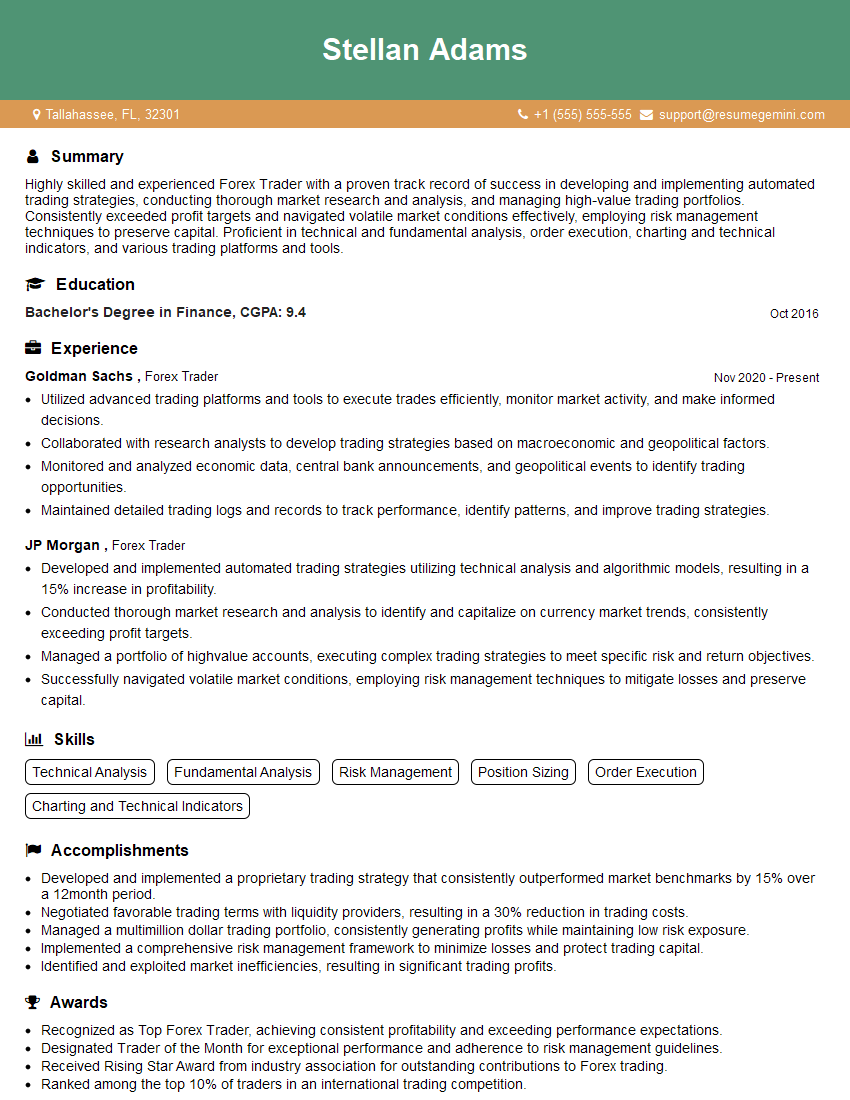
Mastering Foreign Currency is crucial for career advancement in finance, international business, and related fields. A strong understanding of these concepts will significantly enhance your job prospects and open doors to exciting opportunities. To maximize your chances of securing your dream role, create an ATS-friendly resume that effectively highlights your skills and experience. ResumeGemini is a trusted resource to help you build a professional and impactful resume that stands out from the competition. They provide examples of resumes tailored to the Foreign Currency field to guide you through the process. Invest time in crafting a compelling resume – it’s your first impression and a critical step in your job search.
Explore more articles
Users Rating of Our Blogs
Share Your Experience
We value your feedback! Please rate our content and share your thoughts (optional).
What Readers Say About Our Blog
To the interviewgemini.com Webmaster.
Very helpful and content specific questions to help prepare me for my interview!
Thank you
To the interviewgemini.com Webmaster.
This was kind of a unique content I found around the specialized skills. Very helpful questions and good detailed answers.
Very Helpful blog, thank you Interviewgemini team.