Interviews are more than just a Q&A session—they’re a chance to prove your worth. This blog dives into essential Greenhouse Gas Emissions Monitoring interview questions and expert tips to help you align your answers with what hiring managers are looking for. Start preparing to shine!
Questions Asked in Greenhouse Gas Emissions Monitoring Interview
Q 1. Explain the difference between Scope 1, Scope 2, and Scope 3 greenhouse gas emissions.
The Greenhouse Gas (GHG) Protocol defines three scopes of emissions, categorizing them based on the level of control an organization has over the source. Think of it like concentric circles around your business.
- Scope 1: Direct Emissions These are emissions from sources owned or controlled by the company. Examples include emissions from company-owned vehicles, on-site combustion of fuel, and leaks from refrigerants used in company facilities. Imagine this as the innermost circle – your direct responsibility.
- Scope 2: Indirect Emissions from Electricity These are emissions from the generation of purchased electricity, heat, or steam consumed by the company. Your company doesn’t directly burn the fuel, but you’re responsible for the energy you consume. This is the next circle outward – you influence it through your energy choices.
- Scope 3: Other Indirect Emissions This is the largest and most complex category. It encompasses all other indirect emissions that occur in the company’s value chain, but are outside of its direct control. Examples include emissions from business travel, purchased goods and services, transportation of goods, waste disposal, employee commuting, and even the use of sold products. Think of this as the outermost circle – you influence but don’t directly control it.
Understanding the difference between these scopes is crucial for a complete GHG emissions inventory. It allows organizations to identify their major emission sources and prioritize reduction strategies accordingly.
Q 2. Describe the methodologies used for quantifying GHG emissions from various sources (e.g., industrial processes, transportation).
Quantifying GHG emissions requires a combination of data collection and calculation methods, varying depending on the source. Here are a few examples:
- Industrial Processes: Emissions from industrial processes (e.g., cement production, chemical manufacturing) are often determined using process-based methodologies. This involves detailed analysis of production processes, material inputs, and chemical reactions to estimate emissions based on emission factors specific to the processes and equipment used.
Emission Factor = Emission Quantity / Activity LevelEmission factors are often derived from literature, industry-specific databases, or even site-specific measurements. - Transportation: For transportation, emissions are often calculated using activity data (e.g., vehicle kilometers traveled, flight distance) and fuel consumption rates, along with emission factors specific to the fuel type (e.g., gasoline, diesel, jet fuel). For example, the total CO2 emissions from a fleet of vehicles can be estimated by multiplying the total vehicle kilometers traveled by the CO2 emission factor per kilometer for that vehicle type.
- Energy Consumption: Emissions from electricity and heat consumption are typically calculated using the location-specific emission factors for electricity generation. These factors vary based on the energy mix of the region.
- Waste: Waste management emissions are estimated based on the type and quantity of waste generated, utilizing emission factors specific to waste disposal methods (landfilling, incineration, etc.).
Accurate quantification requires precise data collection, appropriate emission factors, and robust quality assurance procedures. This often involves combining different methodologies for a holistic view of emission sources.
Q 3. What are the key international standards and regulations related to GHG emissions reporting (e.g., GHG Protocol, ISO 14064)?
Several international standards and regulations provide frameworks for GHG emissions reporting and verification. Two key ones are:
- The GHG Protocol: This is a widely used accounting and reporting standard developed by the World Resources Institute (WRI) and the World Business Council for Sustainable Development (WBCSD). It provides comprehensive guidance on calculating and reporting Scope 1, 2, and 3 emissions, ensuring consistency and comparability across different organizations.
- ISO 14064: This is a series of international standards developed by the International Organization for Standardization (ISO) that deal with greenhouse gas accounting and verification. ISO 14064-1 focuses on principles and requirements for quantifying and reporting GHG emissions, ISO 14064-2 deals with verification, and ISO 14064-3 covers validation.
Compliance with these standards, along with any relevant national or regional regulations (e.g., the EU Emissions Trading System, California’s cap-and-trade program), is crucial for transparency and accountability in GHG management. These standards help ensure that GHG emission reports are credible and reliable.
Q 4. How do you ensure the accuracy and reliability of GHG emission data?
Ensuring the accuracy and reliability of GHG emission data is paramount. This requires a multi-faceted approach:
- Data Quality Control: Implementing rigorous data quality checks at every stage of the process, from data collection to analysis. This includes regularly auditing data sources, using quality control checks during data entry, and verifying the accuracy of calculations and emission factors.
- Appropriate Methodologies: Selecting and applying the most appropriate methodologies for quantifying emissions from different sources, ensuring the methods are consistent with established standards and guidelines (e.g., the GHG Protocol, ISO 14064).
- Emission Factor Selection: Using reliable and up-to-date emission factors specific to the sources and regions involved. Regularly reviewing and updating emission factors to reflect changes in technology and practices.
- Third-Party Verification: Seeking independent third-party verification of GHG emission inventories to enhance credibility and build trust in the reported data. Verified data provides greater assurance of accuracy.
- Data Documentation: Maintaining detailed documentation of all data collection, calculation, and reporting processes. This allows for transparent traceability and facilitates future audits and updates.
A combination of these measures ensures that the GHG emission data reflects the actual emissions as accurately as possible, fostering confidence in the overall sustainability efforts.
Q 5. What are the common challenges encountered in GHG emissions monitoring and how can they be overcome?
Several challenges hinder effective GHG emissions monitoring:
- Data Availability and Quality: Obtaining accurate and comprehensive data can be difficult, especially for Scope 3 emissions, where data may be scattered across various sources and may lack consistency.
- Data Aggregation and Consistency: Combining data from different sources and ensuring consistency in methodologies can be challenging. Differences in data formats, units, and reporting periods can complicate the process.
- Scope 3 Emissions: Quantifying Scope 3 emissions is particularly challenging due to their indirect nature and the complexities of value chains. Data collection and allocation of responsibility are often difficult.
- Technological Limitations: Monitoring some emissions sources might require specialized technologies or equipment that are costly or unavailable.
- Lack of Resources and Expertise: Accurate GHG monitoring requires dedicated resources, including personnel with specialized knowledge and the necessary software and tools.
These challenges can be overcome by: (1) Developing robust data management systems, (2) leveraging data analytics and technology, (3) collaborating with value chain partners to collect Scope 3 data, (4) investing in training and capacity building, and (5) utilizing available resources and tools like emission factor databases and software applications.
Q 6. Explain different GHG emission reduction strategies and their effectiveness.
Numerous strategies exist to reduce GHG emissions, varying in effectiveness depending on the source and context. Some key strategies include:
- Energy Efficiency Improvements: Reducing energy consumption through improvements in building design, process optimization, and the use of energy-efficient equipment. This is often a cost-effective approach with quick wins.
- Renewable Energy Transition: Shifting from fossil fuel-based energy sources to renewables such as solar, wind, and hydropower. This is a crucial long-term strategy for decarbonization.
- Carbon Capture and Storage (CCS): Capturing CO2 emissions from industrial processes and storing them underground. This is a promising technology for hard-to-abate sectors, though still under development and deployment.
- Sustainable Transportation: Transitioning to electric vehicles, promoting public transport, cycling, and walking, and improving logistics and supply chain efficiency to reduce transportation emissions.
- Waste Management Improvements: Reducing waste generation, improving recycling rates, and employing sustainable waste treatment methods to minimize methane emissions from landfills.
- Sustainable Sourcing and Procurement: Prioritizing suppliers with strong sustainability practices and reducing the environmental footprint of purchased goods and services.
The effectiveness of each strategy depends on its implementation, scale, and context. A comprehensive approach involving multiple strategies, tailored to specific organizational circumstances, is most effective in achieving significant GHG emission reductions.
Q 7. How do you interpret and analyze GHG emission inventory data?
Interpreting and analyzing GHG emission inventory data involves several steps:
- Data Validation and Cleaning: Ensuring data accuracy and consistency before analysis.
- Trend Analysis: Examining emission trends over time to identify patterns and assess the effectiveness of mitigation strategies.
- Emission Intensity Analysis: Calculating emissions per unit of output (e.g., tons of CO2 per unit produced) to track progress and identify areas for improvement.
- Source Attribution: Identifying the largest emission sources within the organization to prioritize mitigation efforts.
- Benchmarking: Comparing emissions performance with similar organizations or industry benchmarks to gauge progress and identify best practices.
- Scenario Planning: Modeling the impact of different mitigation strategies on future emissions to inform decision-making.
- Reporting and Communication: Communicating findings effectively to stakeholders using clear visualizations and reports.
Software tools and data visualization techniques are essential for effective data analysis. The insights gained from this analysis inform the development and implementation of effective GHG reduction strategies, contributing to achieving sustainability targets.
Q 8. What software or tools are you familiar with for GHG emission calculations and reporting?
I’m proficient in several software and tools for GHG emission calculations and reporting. These range from comprehensive platforms to specialized tools depending on the project’s scope and requirements. For example, I have extensive experience with eGRID (eGauge Registry) for tracking electricity generation emissions and CoolClimate Network’s carbon footprint calculator for individual and smaller-scale project assessments. For larger-scale corporate reporting, I’ve worked with CDP (formerly Carbon Disclosure Project) reporting platforms. On the more analytical side, I’m highly skilled in using software like Excel, R, and Python for data manipulation, analysis, and visualization of emission inventories. Specific packages within these platforms like the {tidyverse} package in R and the pandas library in Python are invaluable for handling and cleaning large datasets. Finally, I’m familiar with several LCA software packages like SimaPro and GaBi, crucial for comprehensive product life cycle assessments.
Choosing the right tool depends on factors like data availability, the level of detail required, and the specific methodology employed (e.g., IPCC guidelines, regional regulations). My expertise lies not just in using these tools but also in selecting the most appropriate one for a given situation and interpreting the results accurately.
Q 9. Describe your experience with life cycle assessment (LCA) and its role in GHG emission analysis.
Life Cycle Assessment (LCA) is a powerful tool for evaluating the environmental impacts of a product, process, or service throughout its entire life cycle, from cradle to grave. This includes raw material extraction, manufacturing, transportation, use, and end-of-life disposal. In the context of GHG emission analysis, LCA helps identify the ‘hotspots’ – the stages where emissions are most significant. For instance, an LCA might reveal that the majority of a product’s carbon footprint stems from manufacturing rather than transportation.
My experience involves performing LCAs using various software (as mentioned previously) and applying different impact assessment methodologies, such as those based on IPCC guidelines. I’ve worked on LCAs for various products, including construction materials, consumer electronics, and food products, resulting in detailed emission inventories and identifying areas for improvement and emission reduction strategies. For example, a recent project focusing on a packaging company involved conducting an LCA of their product and comparing different material options for the packaging to find the most sustainable choice. The LCA helped quantify the emission differences and informed decision-making on packaging material substitution.
Q 10. What are the key performance indicators (KPIs) used to track GHG emission reduction progress?
Several key performance indicators (KPIs) are used to track GHG emission reduction progress. These KPIs are crucial for monitoring performance against targets and ensuring accountability. Some key examples include:
- Absolute emissions (tons of CO2e): The total amount of greenhouse gas emissions, expressed as carbon dioxide equivalents (CO2e). A reduction in this metric demonstrates success.
- Emissions intensity (tons of CO2e per unit of output): This measures emissions relative to production or revenue. A decrease indicates improved efficiency.
- Energy consumption (kWh/unit of output): Reduced energy consumption often correlates with lower GHG emissions.
- Renewable energy percentage (%): The proportion of energy from renewable sources used in operations.
- Carbon footprint reduction targets (percentage reduction): Tracking progress towards established emission reduction goals, showing how close the company is to meeting its targets.
The choice of KPIs depends on the organization’s goals, industry benchmarks, and reporting requirements. A comprehensive approach uses a combination of these metrics to provide a holistic view of progress.
Q 11. Explain the concept of carbon offsets and their limitations.
Carbon offsets represent projects that reduce or remove greenhouse gases from the atmosphere, balancing out emissions elsewhere. Examples include reforestation, renewable energy projects, and methane capture from landfills. Organizations purchase these offsets to compensate for emissions they cannot directly reduce.
However, carbon offsets have limitations. Additionality is crucial: the offset project must be genuinely additional to what would have happened without the offset investment. Measurement and verification of emission reductions are also critical to ensure accuracy. Offsets also face concerns about permanence – ensuring the reductions are sustained long-term. Finally, relying heavily on offsets rather than direct emission reductions can delay needed emission mitigation actions. A balanced approach combines emission reductions with credible and verifiable offsets as a supplemental strategy.
Q 12. How do you validate and verify GHG emission data?
Validating and verifying GHG emission data is crucial for ensuring accuracy and credibility. Validation involves checking the data for completeness, consistency, and plausibility against known emission factors and company data. Verification involves independent examination of the data and methods used to collect and process them, according to established standards (e.g., ISO 14064).
This process typically involves:
- Data quality checks: Ensuring the data is accurate, complete, and consistent.
- Methodology review: Assessing the appropriateness and accuracy of the emission calculation methodology.
- Documentation review: Examining supporting documents, such as energy bills, operational data, and emission factor databases.
- On-site inspections (where relevant): Verifying the accuracy of emission sources and measurement equipment.
- Third-party audit: An independent audit by a qualified verifier provides an objective assessment and builds confidence in the reported data.
The level of rigor required depends on the purpose of the data and any regulatory requirements. A robust validation and verification process assures high confidence in the reported GHG emissions.
Q 13. Discuss the role of remote sensing in GHG emissions monitoring.
Remote sensing plays an increasingly important role in GHG emissions monitoring, particularly for large-scale sources like industrial facilities, agricultural areas, and landfills. Satellites and airborne sensors can measure concentrations of GHGs in the atmosphere, providing spatially distributed data that can be used to map emission sources and quantify emissions.
Different techniques are used. For example, hyperspectral imaging can identify specific GHG signatures, while LiDAR (Light Detection and Ranging) can map the three-dimensional structure of emission sources, such as methane plumes from oil and gas facilities. Combining remote sensing data with ground-based measurements improves the accuracy of emission estimates. However, it’s crucial to consider factors like atmospheric dispersion and the influence of other atmospheric constituents when interpreting remote sensing data.
In practice, remote sensing data can complement traditional methods for emission monitoring and provide a broader spatial perspective. For example, combining satellite-based observations of methane plumes with on-site measurements from oil and gas facilities can lead to a more accurate estimation of overall emissions.
Q 14. Describe your experience with different GHG measurement techniques (e.g., direct measurement, indirect estimation).
I have experience with a variety of GHG measurement techniques. Direct measurement involves directly measuring GHG emissions at the source using instruments such as gas chromatographs or infrared analyzers. This approach is accurate but can be expensive and resource-intensive, and is best suited for point sources. I’ve used this technique for quantifying methane emissions from landfills and industrial processes.
Indirect estimation relies on other data, such as fuel consumption, energy usage, or production data, combined with emission factors to calculate emissions. This approach is more cost-effective but depends on the accuracy of the underlying data and emission factors. I’ve employed this for calculating emissions from transportation fleets using fuel consumption data and established emission factors. Choosing the best approach is dictated by the specific context – the type of emission source, available resources, required accuracy, and the overall project goal. Often, a combination of direct measurement and indirect estimation provides the most reliable and comprehensive assessment.
Q 15. How do you communicate complex GHG emission data to non-technical audiences?
Communicating complex GHG emission data to non-technical audiences requires translating technical jargon into plain language and utilizing compelling visuals. Instead of using terms like ‘carbon sequestration,’ I’d explain it as ‘nature’s way of trapping carbon dioxide.’ I focus on using relatable analogies. For instance, comparing the amount of emissions from a power plant to the number of cars driven annually makes the data more understandable. I always prioritize clear, concise messaging, and I supplement numerical data with charts, graphs, and infographics to present the information visually.
For example, instead of saying, “Our Scope 1 emissions increased by 15,000 tonnes of CO2e,” I might say, “Our direct emissions from our operations increased, which is equivalent to the yearly emissions of roughly X number of cars.” I always tailor the level of detail to the audience. A board of directors needs a high-level overview, whereas community stakeholders may need a more granular explanation.
- Visual aids: Charts, graphs, maps, and infographics are crucial for conveying complex information effectively.
- Storytelling: Framing the data within a narrative context makes it more engaging and memorable.
- Analogies and metaphors: Using relatable examples makes abstract concepts more accessible.
- Interactive tools: Web-based dashboards and interactive presentations allow audiences to explore the data at their own pace.
Career Expert Tips:
- Ace those interviews! Prepare effectively by reviewing the Top 50 Most Common Interview Questions on ResumeGemini.
- Navigate your job search with confidence! Explore a wide range of Career Tips on ResumeGemini. Learn about common challenges and recommendations to overcome them.
- Craft the perfect resume! Master the Art of Resume Writing with ResumeGemini’s guide. Showcase your unique qualifications and achievements effectively.
- Don’t miss out on holiday savings! Build your dream resume with ResumeGemini’s ATS optimized templates.
Q 16. What are some innovative technologies used for GHG emissions monitoring and reduction?
Innovative technologies are revolutionizing GHG emissions monitoring and reduction. For monitoring, remote sensing technologies like satellites and drones provide continuous, large-scale data collection, allowing for better identification of emission hotspots. This complements traditional methods like stationary monitoring equipment. For reduction, carbon capture, utilization, and storage (CCUS) technologies are gaining traction, capturing CO2 from industrial sources and storing it underground or using it for other purposes. Advanced analytics using machine learning can optimize energy consumption and predict emission levels.
- Remote Sensing: Satellites and drones provide high-resolution imagery and data for monitoring emissions from various sources.
- IoT Sensors: Networks of sensors can provide real-time data on energy consumption and emissions from individual buildings or industrial processes.
- CCUS: Carbon Capture, Utilization and Storage technologies capture CO2 from industrial sources and either store it or reuse it in various applications.
- Artificial Intelligence (AI) and Machine Learning (ML): Used to analyze data from various sources to predict emissions, optimize energy consumption and develop more effective emission reduction strategies.
For example, I’ve worked on a project using drone-based methane detection to identify leaks in a natural gas pipeline, which allowed for quick repairs and significant emissions reductions.
Q 17. Explain your understanding of carbon pricing mechanisms (e.g., carbon tax, emissions trading schemes).
Carbon pricing mechanisms are market-based instruments designed to incentivize emissions reductions by putting a price on carbon. A carbon tax is a direct tax on the emission of greenhouse gases, typically levied on fossil fuels. This creates a direct financial incentive for businesses and individuals to reduce their carbon footprint. An emissions trading scheme (ETS), also known as a cap-and-trade system, sets a limit (cap) on the total amount of emissions allowed. Participants receive permits (allowances) to emit, and they can buy or sell these permits in a market, creating a price for carbon based on supply and demand.
The effectiveness of both mechanisms depends on the level of the carbon price. A higher price generally leads to greater emission reductions, but it could also negatively impact certain industries. Careful design and implementation, including consideration of social and economic factors, is crucial for both carbon taxes and ETSs. A well-designed carbon tax can be more predictable for businesses, while an ETS can incentivize innovation by allowing the market to find the most efficient solutions. Both have their advantages and disadvantages, and the optimal choice depends on the specific context.
Q 18. Describe your experience with developing and implementing GHG emission reduction plans.
My experience in developing and implementing GHG emission reduction plans involves a structured approach. This starts with a thorough GHG inventory, identifying sources and quantifying emissions. Next, I establish emission reduction targets, aligned with scientific goals, such as limiting global warming to well below 2°C. Then comes the development of a tailored strategy involving energy efficiency improvements, renewable energy integration, and waste management improvements. Each action plan includes detailed cost-benefit analyses and implementation timelines, often involving stakeholder engagement to ensure buy-in and collaborative implementation.
For example, I assisted a manufacturing company in developing a plan that integrated renewable energy sources and optimized their production processes, resulting in a 20% reduction in emissions within five years. This involved working closely with engineers, purchasing managers, and the leadership team to ensure all facets of the plan were understood and supported. Regular monitoring and reporting are crucial to track progress and make necessary adjustments. Success depends heavily on robust data collection, transparent reporting and a commitment from all stakeholders.
Q 19. How do you ensure data quality and integrity in GHG emission monitoring?
Ensuring data quality and integrity in GHG emission monitoring is paramount. This begins with meticulous data collection using standardized methodologies, such as those provided by the Greenhouse Gas Protocol. We employ quality control procedures at every stage, including regular audits of data sources, cross-checking data against independent sources, and employing rigorous data validation checks. Data management systems are designed with traceability in mind, allowing us to track data origins and modifications. Transparency is key; the data and methodology used in the calculations are clearly documented and available for review.
For example, we might use automated data import systems directly from energy meters or process control systems to minimize manual data entry errors. We also conduct regular calibration checks on monitoring equipment and use statistical methods to identify and address outliers or anomalies in the data. Furthermore, external verification by an accredited third party is frequently used to independently validate the accuracy and completeness of our GHG emission reports.
Q 20. What are the ethical considerations involved in GHG emission reporting and verification?
Ethical considerations in GHG emission reporting and verification are central to ensuring trust and accountability. Transparency is crucial, ensuring complete and accurate reporting of all emissions, including both direct and indirect sources. Data manipulation or omission is unethical and undermines the credibility of the reporting process. Independence and objectivity in verification processes are also critical, preventing conflicts of interest and guaranteeing unbiased assessments. The ethical implications extend to stakeholder engagement, ensuring all relevant parties have access to information and participate in the process fairly.
For example, I’ve always ensured that my reports clearly state the methodologies used, including any limitations. This allows for others to assess the reliability and validity of our findings. Furthermore, I’ve actively worked with stakeholders to ensure that the reporting process is understood and any concerns are addressed in a transparent manner. Maintaining strong ethical standards is fundamental to the integrity of the climate action efforts.
Q 21. Describe your experience working with different stakeholders on GHG emission reduction projects.
My experience working with diverse stakeholders on GHG emission reduction projects involves a collaborative approach based on open communication and mutual respect. This encompasses interactions with internal teams (engineering, operations, finance), external consultants (environmental scientists, engineers), government agencies (environmental protection agencies), and community groups. Effective communication is crucial in translating complex technical concepts, building consensus, and addressing diverse perspectives and concerns.
For example, in a recent project with a large industrial facility, I facilitated workshops and meetings between the company’s management team, local environmental groups, and government regulators. I translated technical data into clear terms for community stakeholders, addressed their concerns, and built consensus on a viable plan that addressed both the company’s needs and the community’s environmental concerns. A successful outcome relies heavily on creating a trusting environment where everyone feels heard and actively involved in the decision-making process.
Q 22. How do you stay updated on the latest developments in GHG emissions monitoring and regulations?
Staying current in the dynamic field of GHG emissions monitoring and regulations requires a multi-faceted approach. I regularly consult a range of resources to ensure my knowledge remains up-to-date. This includes subscribing to reputable journals like Environmental Science & Technology and Nature Climate Change, attending industry conferences such as the Greenhouse Gas Management Institute’s events, and actively participating in online forums and webinars hosted by organizations like the EPA and the IPCC. I also closely monitor changes in regulations issued by governmental bodies (e.g., the EU ETS, the California Air Resources Board) and international frameworks (e.g., the Paris Agreement). Finally, I maintain a network of colleagues and experts in the field, allowing for continuous knowledge sharing and discussion of emerging trends.
For example, recently I attended a webinar on the application of satellite imagery for methane leak detection, a rapidly advancing area that significantly improves the accuracy and efficiency of emission monitoring. Keeping abreast of these innovations is crucial for effective emission reduction strategies.
Q 23. What is your experience with data analysis techniques relevant to GHG emissions data (e.g., statistical analysis, regression modeling)?
My experience encompasses a wide array of data analysis techniques crucial for handling GHG emissions data. I’m proficient in statistical software packages such as R and Python, utilizing libraries like pandas, statsmodels, and scikit-learn. This allows me to perform various analyses, including descriptive statistics (mean, median, standard deviation), inferential statistics (t-tests, ANOVA), and regression modeling (linear, multiple linear, generalized linear models). For example, I’ve used multiple linear regression to model CO2 emissions from a power plant based on factors like fuel consumption, operating hours, and efficiency levels. Furthermore, I have experience with time series analysis techniques to identify trends and seasonality in emissions data, essential for forecasting and identifying emission reduction opportunities.
My work also involves data visualization techniques using tools like Tableau and Power BI to effectively communicate complex data patterns to both technical and non-technical audiences. Clear visualization is key to effective decision-making in GHG emission management.
Q 24. Describe your experience with different types of GHG emission sources in different industries.
My experience spans several industries and emission sources. In the energy sector, I’ve worked extensively with power plants (coal, natural gas, nuclear), analyzing emissions from combustion processes and fugitive emissions. In the industrial sector, I’ve assessed emissions from cement production, steel manufacturing, and chemical processing, focusing on process emissions and waste management. The agricultural sector has been another area of focus, where I’ve analyzed emissions from livestock (enteric fermentation, manure management) and rice cultivation. In the transportation sector, I have experience with analyzing emissions from vehicles using both direct measurement and emission factors. Each sector presents unique challenges and requires tailored methodologies for accurate emission quantification. For instance, quantifying methane emissions from livestock requires different techniques compared to measuring CO2 from a power plant’s flue gases.
Understanding the specific emission sources within each industry and the associated processes is critical for developing targeted emission reduction strategies. This understanding comes from a combination of direct field measurements, process understanding, and utilization of appropriate emission factors.
Q 25. How would you approach identifying and quantifying emissions from a newly constructed facility?
Identifying and quantifying emissions from a newly constructed facility requires a systematic approach. First, a thorough understanding of the facility’s operations and processes is necessary. This involves reviewing engineering drawings, process flow diagrams, and operational manuals to identify all potential emission sources. Next, I would select appropriate emission factors or conduct direct measurements using specialized equipment like gas analyzers. The choice between these methods depends on factors like the type of emission, regulatory requirements, and budget constraints. For example, for a cement plant, direct measurement of CO2 emissions from the kiln would be crucial.
The quantification process would involve applying the emission factors or measured data to the facility’s operational parameters, like production volume or energy consumption. Uncertainty analysis, which I’ll discuss later, plays a vital role in estimating the range of possible emissions. Finally, the results are meticulously documented and presented in a format compliant with relevant regulations and reporting standards.
Q 26. What are the limitations of using proxy data for GHG emissions estimation?
Proxy data, while sometimes necessary due to limitations in direct measurement, has inherent limitations. Proxy data often relies on correlations between readily available data (like energy consumption) and GHG emissions. The accuracy of estimations using proxy data is highly dependent on the strength of these correlations, which can vary significantly depending on the industry, process, and geographical location. This can introduce substantial uncertainty in the estimations.
For example, using energy consumption as a proxy for CO2 emissions from a power plant works well when the plant’s efficiency is constant. However, variations in plant efficiency due to equipment maintenance or fuel quality can significantly affect the accuracy of the estimations. Therefore, while proxy data can provide a reasonable estimate, it’s important to acknowledge its limitations and consider supplementing it with direct measurements whenever feasible to improve the accuracy and reduce uncertainty.
Q 27. How do you incorporate uncertainty analysis into your GHG emission calculations?
Uncertainty analysis is integral to accurate GHG emission calculations. It acknowledges the inherent variability and lack of complete information in the estimation process. I utilize several methods to incorporate uncertainty, including:
- Propagation of uncertainties: This method accounts for uncertainties in individual input parameters (like emission factors, activity data) and propagates them through the calculation to quantify the uncertainty in the final emission estimate. This often involves using statistical distributions to represent the uncertainty in input parameters.
- Monte Carlo simulation: This involves running multiple simulations with random variations in input parameters based on their uncertainty distributions. The resulting distribution of emission estimates helps quantify the uncertainty range.
Properly accounting for uncertainty is vital for transparent and credible reporting and helps inform decision-making regarding emission reduction strategies. For example, understanding the uncertainty range allows for the setting of realistic emission reduction targets and evaluation of the effectiveness of mitigation measures.
Q 28. Explain your experience with using different reporting frameworks for GHG emissions (e.g., CDP, GRI).
I have extensive experience with various GHG emissions reporting frameworks, including the Carbon Disclosure Project (CDP), the Global Reporting Initiative (GRI), and the Greenhouse Gas Protocol. Each framework has specific requirements and guidance on data collection, calculation, and reporting. Understanding these frameworks is crucial for ensuring accurate and comparable reporting across different organizations.
For example, CDP focuses on climate change and requires detailed information on emissions, risk management, and corporate governance related to climate change. GRI provides broader sustainability reporting guidelines, encompassing environmental, social, and governance (ESG) aspects, including GHG emissions. The Greenhouse Gas Protocol provides a standardized methodology for calculating and reporting GHG emissions. My experience encompasses adapting and using these frameworks according to the specific needs of each organization and project, ensuring compliance with all applicable regulatory requirements.
Key Topics to Learn for Greenhouse Gas Emissions Monitoring Interview
- Measurement Techniques: Understanding various methods for measuring GHG emissions, including direct measurement (e.g., using analyzers), indirect methods (e.g., mass balance calculations), and remote sensing techniques.
- Data Analysis and Reporting: Proficiency in analyzing emission data, identifying trends, and creating comprehensive reports compliant with relevant standards (e.g., GHG Protocol). This includes experience with data visualization and statistical analysis.
- Emission Inventory Development: Knowledge of developing and managing GHG inventories for different sectors (e.g., energy, industry, agriculture), including data collection, quality assurance, and uncertainty analysis.
- Regulatory Frameworks and Standards: Familiarity with national and international regulations and standards related to GHG emissions monitoring and reporting (e.g., carbon accounting standards).
- Mitigation Strategies and Technologies: Understanding various strategies and technologies for reducing GHG emissions, and how monitoring plays a crucial role in evaluating their effectiveness.
- Data Management and Software: Experience with relevant software and databases for managing and analyzing large datasets related to GHG emissions. This includes proficiency in data cleaning, validation, and manipulation.
- Life Cycle Assessment (LCA): Understanding the principles and applications of LCA in assessing the environmental impact of products and processes, including GHG emissions.
- Problem-Solving and Critical Thinking: Demonstrate your ability to identify challenges in GHG monitoring, propose solutions, and effectively communicate technical information to diverse audiences.
Next Steps
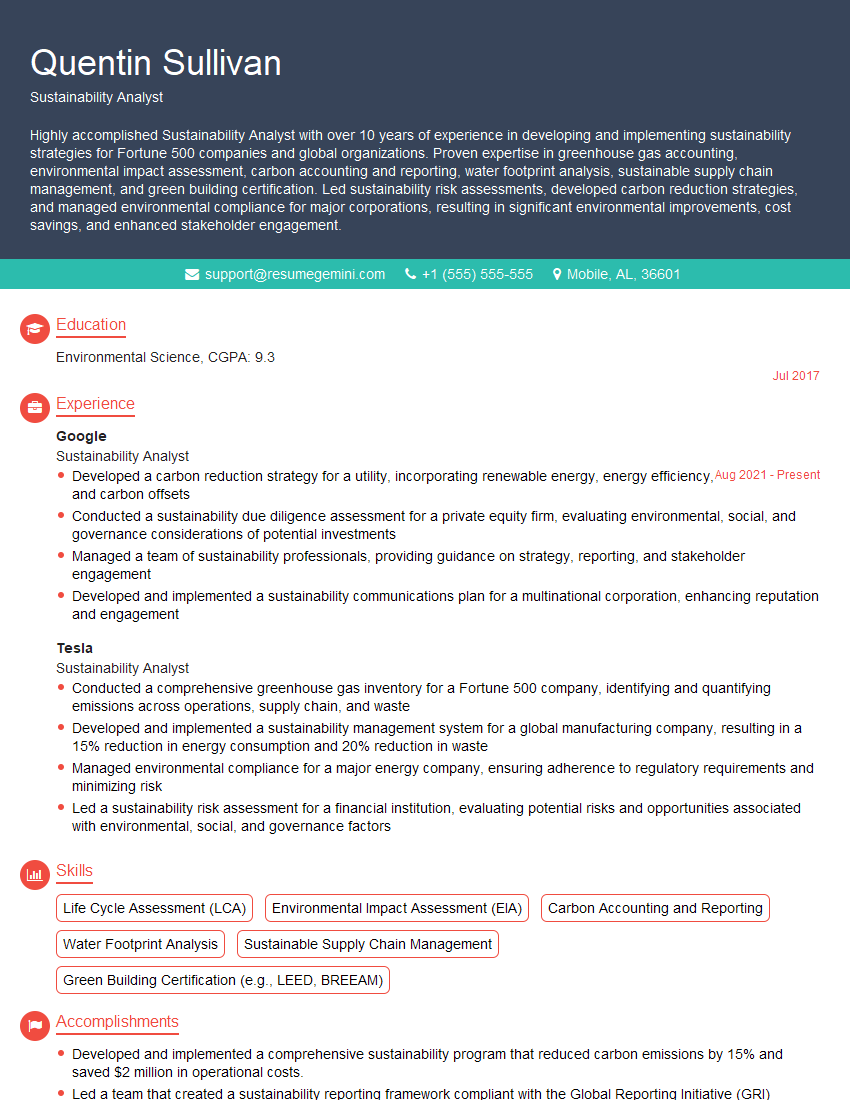
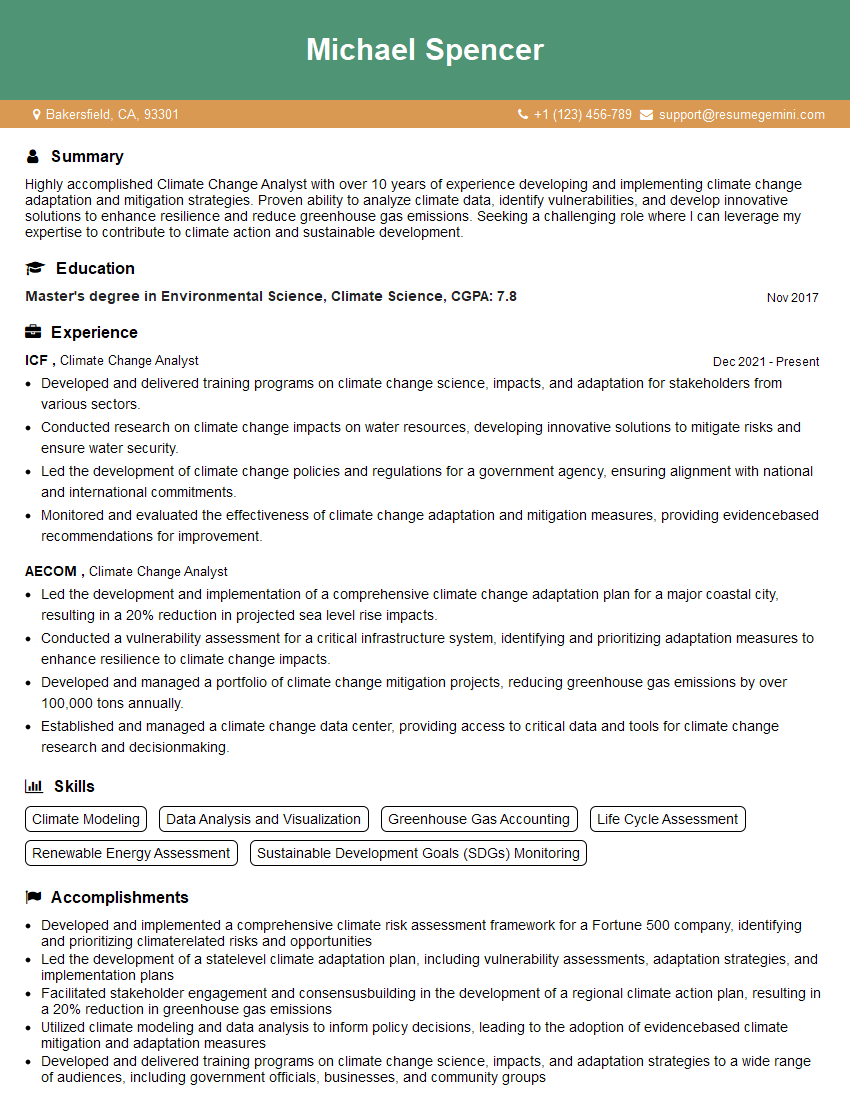
Mastering Greenhouse Gas Emissions Monitoring opens doors to exciting and impactful careers in environmental consulting, sustainability management, and research. To significantly enhance your job prospects, focus on crafting an ATS-friendly resume that effectively showcases your skills and experience. ResumeGemini is a trusted resource to help you build a professional and compelling resume that grabs the attention of recruiters. Examples of resumes tailored to Greenhouse Gas Emissions Monitoring are available to help you create a winning application.



Explore more articles
Users Rating of Our Blogs
Share Your Experience
We value your feedback! Please rate our content and share your thoughts (optional).
What Readers Say About Our Blog
To the interviewgemini.com Webmaster.
Very helpful and content specific questions to help prepare me for my interview!
Thank you
To the interviewgemini.com Webmaster.
This was kind of a unique content I found around the specialized skills. Very helpful questions and good detailed answers.
Very Helpful blog, thank you Interviewgemini team.