Cracking a skill-specific interview, like one for Grinding and Finishing of Tombstones, requires understanding the nuances of the role. In this blog, we present the questions you’re most likely to encounter, along with insights into how to answer them effectively. Let’s ensure you’re ready to make a strong impression.
Questions Asked in Grinding and Finishing of Tombstones Interview
Q 1. What types of stones are commonly used in tombstones, and how do their properties affect grinding and finishing techniques?
Tombstones are crafted from a variety of stones, each possessing unique properties influencing the grinding and finishing techniques. Common choices include granite, marble, limestone, and sandstone. Granite, known for its hardness and durability, requires aggressive grinding and polishing using diamond tooling. Its inherent strength allows for intricate detailing but demands robust equipment. Marble, softer and more susceptible to scratching, needs gentler techniques and finer abrasives to achieve a smooth, polished finish. Limestone, being relatively porous and softer, is more easily shaped but requires careful handling to prevent damage. Sandstone, with its varying hardness and potential for fracturing, necessitates a more nuanced approach, often involving hand finishing in sensitive areas. The choice of stone dictates the entire process, from initial shaping to final polishing, ensuring the desired aesthetic and longevity.
- Granite: Requires diamond tooling and aggressive grinding.
- Marble: Needs gentler techniques and finer abrasives.
- Limestone: Requires careful handling to prevent damage.
- Sandstone: May necessitate hand finishing in certain areas.
Q 2. Explain the different grinding stages involved in finishing a tombstone.
Grinding a tombstone involves several progressive stages, each using increasingly finer abrasives to achieve a smooth surface. It’s like sanding wood – you start rough and get progressively finer. The process typically begins with rough grinding using coarse diamond tools to remove excess material and level the surface. This is followed by medium grinding, using slightly finer diamond pads to further refine the surface and remove any remaining imperfections. Fine grinding with even finer abrasives follows, leading to a smoother, more uniform surface. Finally, polishing stages use increasingly fine polishing compounds to achieve a high-gloss sheen, depending on the desired finish.
- Rough Grinding: Coarse diamond tools, removes excess material.
- Medium Grinding: Finer diamond pads, refines the surface.
- Fine Grinding: Very fine abrasives, achieves smoothness.
- Polishing: Polishing compounds, creates high gloss.
Q 3. What safety precautions are essential when operating grinding and polishing equipment?
Safety is paramount in tombstone grinding and polishing. These machines operate at high speeds with abrasive materials; any lapse in safety can result in serious injury. Essential precautions include wearing appropriate personal protective equipment (PPE), such as safety glasses, dust masks (especially with silica-containing stones), hearing protection, and gloves to prevent cuts and abrasions. The workspace should be well-ventilated to mitigate dust inhalation. Machines must be properly maintained and operated according to manufacturer instructions. Regular inspection of equipment for wear and tear is crucial, and safety guards should always be in place and functioning correctly. Furthermore, proper training and adherence to safety protocols are non-negotiable.
Q 4. Describe your experience with various abrasive materials used in stone finishing.
My experience spans a wide range of abrasive materials. Diamond tooling, in various grits from coarse to fine, is essential for granite and other hard stones. Silicon carbide and aluminum oxide abrasives are used for softer stones like marble and limestone. The choice depends on the stone type and desired finish. I’ve also worked with specialized polishing compounds containing cerium oxide or tin oxide for achieving a mirror-like polish. Each material has unique properties; for instance, diamond offers superior hardness and cutting ability, while silicon carbide provides a good balance of cutting and finishing capabilities. Understanding these nuances is key to choosing the correct abrasive for optimal results and to avoid damaging the stone.
Q 5. How do you ensure the uniform polishing of a tombstone surface?
Uniform polishing is achieved through meticulous technique and consistent machine operation. This involves systematic passes across the surface, ensuring even pressure and coverage. Regular inspection during the process is critical to identify and address any inconsistencies immediately. Using polishing pads with consistent density and wear is crucial. Additionally, ensuring the tombstone is securely mounted and the machine is calibrated correctly prevents unevenness. Think of it like painting a wall – multiple thin, even coats yield a far better result than one thick, uneven coat. It’s a combination of equipment, material, and precise technique.
Q 6. What are the common defects encountered during the grinding and finishing process, and how do you address them?
Common defects include scratches, pitting, staining, and uneven polishing. Scratches are often caused by improper abrasive selection or technique; pitting can result from inherent flaws in the stone or aggressive grinding. Staining can occur from exposure to contaminants during the process. Uneven polishing stems from inconsistent pressure or machine operation. Addressing these issues requires a multi-pronged approach. Scratches can be removed through finer grinding and polishing. Pitting is often impossible to completely remove, but can be minimized. Staining might require specialized cleaning agents. Uneven polishing needs re-polishing with careful attention to pressure and technique. Prevention is always better than cure – meticulous work and proper equipment maintenance minimizes these problems.
Q 7. Explain the process of removing scratches and blemishes from a tombstone surface.
Removing scratches and blemishes involves a systematic progression through finer and finer abrasives. Start by identifying the depth and nature of the defect. Shallow scratches might be removed with a fine diamond pad or polishing compound. Deeper scratches might require progressively finer grits of abrasives until the scratch is imperceptible. For blemishes that are more significant, it may require re-grinding and re-polishing, potentially employing specialized techniques or products depending on the stone and the nature of the blemish. Think of it as a gradual refinement, progressively erasing the imperfections. Patience and a systematic approach are key to a successful outcome.
Q 8. How do you achieve a high-gloss finish on a granite tombstone?
Achieving a high-gloss finish on a granite tombstone is a multi-step process requiring precision and the right tools. It starts with rough grinding to remove any imperfections or saw marks, followed by progressively finer grinding stages. Each stage uses a finer grit diamond abrasive to smooth the surface. Finally, we use polishing compounds to achieve that mirror-like shine. Think of it like sanding wood – you start with coarse sandpaper and gradually move to finer grits until you reach the desired smoothness. For granite, the process involves diamond polishing pads, starting with a coarse grit (e.g., 50 grit) and working our way up to a very fine grit (e.g., 3000 grit) or even using a polishing compound applied with specialized buffing equipment. The final step often involves a specialized granite polishing compound applied with a high-speed polisher to create that deep, reflective gloss.
For example, on a recent project featuring a black granite tombstone with a simple design, we started with a 50-grit diamond pad to remove significant imperfections, then moved progressively through 100, 200, 400, 800, 1500, and 3000 grit pads. This was followed by several passes with a high-quality granite polishing compound using a high-speed machine to achieve the desired high-gloss finish. The entire process ensures a uniform and lasting shine.
Q 9. What is the significance of maintaining consistent pressure and speed during grinding?
Maintaining consistent pressure and speed during grinding is crucial for achieving a uniform finish and preventing damage to the tombstone. Inconsistent pressure can lead to uneven grinding, leaving some areas rougher than others. This is akin to sanding a piece of wood unevenly – you’ll have patches that are smooth and others that are still rough. Similarly, inconsistent speed can cause overheating of the stone, which can create cracks or discoloration. With granite, overheating can lead to stress fracturing, compromising the integrity of the stone. A consistent, even application of force ensures a uniform surface that’s ready for the next stage of polishing. We use specialized tools to monitor and maintain consistent pressure, including calibrated grinding pads and pressure gauges incorporated in some of our machines. Speed control on the polishing equipment is equally critical for maintaining a uniform finish and preventing damage.
Q 10. Describe your experience with different types of polishing compounds and their applications.
My experience encompasses a wide range of polishing compounds, each suited for different stages of the process and stone types. Diamond polishing pads, with varying grits, are fundamental. These are essentially diamond particles embedded in a resin pad, offering varying degrees of abrasiveness. We also use specialized granite polishing compounds, often containing cerium oxide or other fine abrasives. These compounds are applied after the diamond polishing stages and achieve the final luster. The choice of compound depends on the type of stone (granite, marble, etc.), the desired finish (matte, satin, high-gloss), and the previous grinding stages. For instance, a coarse granite polishing compound might be used after initial grinding stages to quickly smooth the surface, followed by a fine-grit compound for the final high-gloss finish. The selection is very much a matter of judgment and experience based on the stone, desired finish, and condition after each stage.
Q 11. How do you handle intricate carvings and details during the finishing process?
Handling intricate carvings and details during finishing requires extreme care and precision. We utilize a combination of techniques to ensure the details are not damaged during the grinding and polishing process. Hand tools, such as smaller polishing pads and specialized abrasive tools, are often necessary to access and finish intricate areas. For extremely delicate carvings, we might use lower speeds and lighter pressure to avoid removing detail. In some instances, protective coatings might be used on the surrounding stone to prevent accidental abrasion of the intricate parts. It’s like sculpting – you want to use your tools carefully and precisely to maintain the details and bring out the desired depth of the carving.
For example, on a tombstone with elaborate floral carvings, we used a combination of small, hand-held polishing pads and meticulously applied polishing compounds to preserve the delicate petals and leaves. The process was slower, but it ensured the integrity of the artistic work.
Q 12. Explain your experience with different types of polishing machines.
My experience includes working with a variety of polishing machines, ranging from smaller, hand-held units for detailed work to large, automated systems for larger tombstones with simple designs. Hand-held machines offer greater control and precision, especially for intricate carvings. Larger automated systems increase efficiency and consistency on simpler designs, allowing for a smoother, faster process on larger surfaces. Each machine has its own set of features, such as variable speed controls, pressure adjustments, and different pad attachment systems. We also use specialized machines with water-cooling systems to manage heat build-up during polishing and prevent the risk of damaging the stone from overheating. Selection of the machine is always tailored to the design complexity and overall size of the tombstone.
Q 13. How do you determine the appropriate level of polishing for a specific tombstone design?
Determining the appropriate level of polishing depends entirely on the design and the client’s preferences. A simple, elegant design might only require a satin finish, while a more ornate piece might benefit from a high-gloss polish to highlight the details. The type of stone also plays a role. Some stones, like certain types of granite, lend themselves better to high-gloss finishes than others. We always discuss the desired finish with the client, offering guidance based on our expertise and the specific characteristics of the chosen stone. We often present examples of different finishes achieved on similar stone types to help clients visualize the end result and guide their selection.
Q 14. How do you ensure the longevity of the finished tombstone?
Ensuring the longevity of a finished tombstone involves several key steps. First, using high-quality materials throughout the entire process is crucial. We always use premium polishing compounds and diamond pads designed for long-lasting durability. Second, proper sealing is vital. A high-quality sealant protects the stone from the elements, preventing water damage and discoloration. This is particularly important in areas with harsh weather conditions. Finally, regular maintenance, though minimal, can help preserve the finish. A simple cleaning with mild soap and water is usually sufficient. Avoiding harsh chemicals and abrasive cleaners will further extend the life and beauty of the finished product. A well-maintained tombstone can stand the test of time, preserving the memory it represents for generations to come.
Q 15. What is your experience with edge finishing techniques?
Edge finishing is crucial for achieving a polished and aesthetically pleasing tombstone. It involves techniques to create smooth, even, and visually appealing edges, preventing chipping and enhancing durability. My experience encompasses a wide range of techniques, including:
- Polishing: Using progressively finer diamond pads or polishing compounds to achieve a high-gloss sheen. This is commonly used for marble and granite tombstones.
- Honing: Creating a matte or satin finish, ideal for stones like slate where a less reflective surface is desired. This involves using progressively finer abrasive stones.
- Beveling: Creating a sloped edge, which reduces sharpness and adds a sophisticated touch. This is frequently used to soften the look of granite edges.
- Ogee: A more intricate edge profile with curves, adding a classic and elegant touch. This requires specialized tooling and precision.
- Bullnose: A rounded edge profile providing a softened and safer finish, often seen on headstones with child’s engravings.
I’ve successfully applied these techniques to hundreds of tombstones, adapting my approach based on the stone type, desired finish, and specific design requirements. For example, I recently completed a project involving a large granite monument where creating a perfectly smooth ogee edge was critical to maintaining the overall aesthetic appeal. It took meticulous work and precise control, but the final result was stunning.
Career Expert Tips:
- Ace those interviews! Prepare effectively by reviewing the Top 50 Most Common Interview Questions on ResumeGemini.
- Navigate your job search with confidence! Explore a wide range of Career Tips on ResumeGemini. Learn about common challenges and recommendations to overcome them.
- Craft the perfect resume! Master the Art of Resume Writing with ResumeGemini’s guide. Showcase your unique qualifications and achievements effectively.
- Don’t miss out on holiday savings! Build your dream resume with ResumeGemini’s ATS optimized templates.
Q 16. Describe your experience with the restoration of damaged tombstones.
Restoring damaged tombstones requires a blend of artistic skill and technical expertise. My approach is always conservative, aiming to preserve as much of the original stone as possible. I typically start with a thorough assessment of the damage, which helps determine the best restoration strategy. This includes:
- Cleaning: Gently removing dirt, grime, and biological growth using appropriate cleaning agents and tools. This can often involve specialized cleaning techniques to avoid further damage.
- Repairing Cracks and Chips: Filling cracks and chips with specialized stone epoxy resin that closely matches the stone’s color. Precise application and careful blending are crucial for an invisible repair.
- Rebuilding Missing Sections: In cases of significant damage, I might need to rebuild missing sections using matching stone or casting materials. This requires advanced sculpting and matching skills to ensure the repair is seamless.
- Repolishing: Once repairs are complete, I repolish the affected area to ensure it blends seamlessly with the surrounding surface. This may involve the use of diamond pads or other polishing techniques.
One memorable restoration involved a severely cracked marble tombstone. Using a combination of epoxy repair, careful polishing, and a protective sealant, I was able to restore the stone to its former glory, preserving a valuable piece of family history.
Q 17. How do you handle different stone types such as marble, granite and slate?
Each stone type presents unique challenges and requires a tailored approach to grinding and finishing. My experience encompasses working with:
- Marble: Relatively soft and porous, marble requires careful handling to avoid scratching or staining. I use finer grits during polishing and apply protective sealants to enhance durability and prevent staining.
- Granite: Hard and durable, granite requires aggressive grinding and polishing techniques. The process involves using diamond tools of various grits to achieve the desired finish. Special attention is needed to avoid overheating the stone which can cause cracking.
- Slate: A harder stone with a natural, often matte finish. Honing techniques are frequently used to enhance the stone’s natural texture. Excessive polishing can diminish the stone’s natural beauty.
Understanding the specific properties of each stone is paramount to successful finishing. I always adjust my techniques and tool selection to ensure optimal results and avoid causing damage. Choosing the wrong tools or techniques with granite, for example, can lead to significant cracking.
Q 18. What are your methods for quality control during the finishing process?
Quality control is an integral part of my workflow. I employ a multi-stage approach throughout the finishing process:
- Regular Inspection: I visually inspect the tombstone at every stage of the process, checking for imperfections, scratches, or inconsistencies.
- Precision Measurement: I utilize precise measuring tools to ensure accurate dimensions and consistent edge profiles.
- Testing: I test the finished surface for durability and water resistance using specialized testing equipment and techniques.
- Documentation: I keep meticulous records of the process, including the types of tools and materials used, and the time spent at each stage.
This comprehensive approach allows me to identify and correct any issues early on, preventing defects and ensuring the final product meets the highest standards. Even small imperfections can be very noticeable on a polished tombstone.
Q 19. How do you ensure consistency in color and finish across multiple tombstones?
Maintaining color and finish consistency across multiple tombstones requires careful attention to detail and standardized procedures. My methods include:
- Using Consistent Materials: Utilizing the same type and batch of stone, polishing compounds, and sealants to minimize variations.
- Calibrated Equipment: Regularly calibrating my grinding and polishing equipment to ensure consistent performance.
- Controlled Environment: Maintaining consistent temperature and humidity during the finishing process to prevent inconsistencies.
- Standard Operating Procedures (SOPs): Following standardized procedures for each step of the process, ensuring uniformity.
For large projects involving multiple tombstones, I create detailed templates and process sheets to guarantee uniformity across the entire set. This attention to detail is crucial to delivering a professional and aesthetically pleasing final product.
Q 20. Describe your experience with working with different types of tooling and equipment.
My experience spans a wide range of tooling and equipment, including:
- Grinding Machines: Various types of grinding machines, including bridge saws, which are vital for shaping and pre-finishing the stone.
- Polishing Machines: Automatic and manual polishing machines using diamond pads of varying grits.
- Hand Tools: Specialized hand tools for detailed work, including chisels, scrapers, and polishing pads for intricate carvings or hard-to-reach areas.
- Protective Equipment: Safety equipment like respirators, safety glasses, and gloves is critical for handling abrasive materials and preventing injuries.
I am proficient in using both traditional and modern equipment, adapting my approach based on the project requirements. For example, some complex carvings require intricate hand tooling, while large, flat surfaces are best finished with automated polishing machines. The ability to expertly use both types of tools is crucial for flexibility and efficiency.
Q 21. What are the industry standards and best practices for tombstone finishing?
Industry standards and best practices for tombstone finishing prioritize quality, durability, and safety. These include:
- Adherence to Safety Regulations: Strict adherence to workplace safety regulations, including proper use of personal protective equipment (PPE).
- Use of Quality Materials: Employing high-quality stone, polishing compounds, and sealants to ensure durability and longevity.
- Precision and Accuracy: Maintaining precise dimensions and consistent finishes to meet aesthetic and functional requirements.
- Environmental Considerations: Utilizing environmentally friendly materials and practices to minimize environmental impact.
- Client Communication: Maintaining clear and consistent communication with clients throughout the process to ensure satisfaction.
Staying updated on the latest industry trends and technologies ensures I can provide the best possible service, continually refining my techniques to achieve the highest standards. Following these best practices not only ensures quality work but also promotes a safe and sustainable work environment.
Q 22. How do you comply with health and safety regulations during stone finishing operations?
Health and safety are paramount in tombstone finishing. My approach is multifaceted and begins with adhering to all OSHA (Occupational Safety and Health Administration) regulations, including proper use of Personal Protective Equipment (PPE). This includes respirators to mitigate silica dust inhalation from grinding operations, safety glasses to protect my eyes from flying debris, and hearing protection to reduce noise-induced hearing loss from the machinery. Furthermore, I meticulously maintain a clean and organized workspace to prevent accidents. This includes proper disposal of stone dust and other hazardous materials, regularly inspecting equipment for any signs of damage or wear, and ensuring adequate ventilation to minimize dust accumulation. For example, I always ensure the dust collection systems on our grinders are functioning correctly and regularly check the filters. Finally, regular safety training and adherence to company safety protocols are crucial components of my approach.
Q 23. Describe your experience with working under pressure to meet deadlines.
Meeting deadlines in this industry is critical, especially with the sensitive nature of the work. I’ve handled numerous high-pressure situations, often involving multiple projects with tight deadlines. For instance, we once had a large order of headstones for a national cemetery that needed to be completed within a very short timeframe. My strategy involved detailed planning, prioritizing tasks based on urgency and complexity, and effective communication with the team to ensure everyone was aware of the timeline and their individual responsibilities. We also implemented a system to track progress meticulously, which allowed for early identification and resolution of potential bottlenecks. Through efficient teamwork and prioritization, we successfully completed the order on time and to the client’s satisfaction.
Q 24. What is your approach to troubleshooting equipment malfunctions?
Troubleshooting equipment malfunctions requires a systematic approach. I begin by identifying the specific problem: Is the machine making unusual noises? Is it not functioning at all? Is there a power issue? Once the problem is defined, I check the obvious – power supply, belts, and any loose connections. If the issue persists, I consult the equipment manuals for troubleshooting guides. If the manual doesn’t provide a solution, I utilize my experience to investigate further. This may involve checking individual components, testing circuits, and even disassembling parts (if I’m comfortable and it’s safe to do so). If the problem is beyond my ability to fix, I immediately notify the appropriate maintenance personnel. For example, if a grinder’s motor overheats frequently, I might check the motor’s cooling system or look for signs of overloading.
Q 25. How do you maintain your tools and equipment?
Maintaining tools and equipment is essential for both safety and efficiency. My routine includes daily cleaning of all tools and equipment, removing dust and debris. I regularly inspect for wear and tear, ensuring that cutting tools are sharp and functioning optimally. I also lubricate moving parts as needed, following manufacturer recommendations. Major maintenance tasks, such as belt replacements or motor servicing, are performed according to a scheduled maintenance plan. Sharp tools and well-maintained equipment not only lead to a safer working environment, but also produce higher-quality work with greater efficiency; dull tools lead to more effort and potential damage to the stone.
Q 26. Describe your experience with working from blueprints or designs.
I’m proficient in reading and interpreting blueprints and design specifications. My experience includes working from a wide range of design styles, from simple lettering to intricate carvings. I’ve used CAD (Computer-Aided Design) drawings as well as traditional hand-drawn blueprints. My approach involves carefully examining the design for details, including dimensions, fonts, and any specific instructions. I then transfer this information to the stone, ensuring precise execution and adherence to the client’s vision. Accuracy is critical in this aspect of the work; even a small error can significantly impact the final product. I always double-check my measurements and make sure the design is perfectly aligned before beginning the finishing process.
Q 27. How do you manage your workload and prioritize tasks?
Workload management is crucial in a demanding environment. I use a combination of techniques to prioritize tasks, such as creating daily and weekly schedules. I prioritize urgent and important tasks using tools like Eisenhower Matrix (urgent/important), ensuring timely completion of critical projects. I also break down complex tasks into smaller, manageable steps to improve efficiency and reduce stress. Furthermore, I utilize project management software to track progress and allocate resources effectively. Regular communication with supervisors allows for adjustments to the schedule based on unexpected changes or delays. This systematic approach ensures that even under heavy workload, deadlines are met and quality is maintained.
Q 28. What are your salary expectations for this role?
My salary expectations for this role are commensurate with my experience and skills in tombstone grinding and finishing, considering the market rate for similar positions in this region. I am open to discussing a competitive compensation package that reflects my contributions to the company.
Key Topics to Learn for Grinding and Finishing of Tombstones Interview
- Stone Selection and Preparation: Understanding different stone types (granite, marble, etc.), their properties, and appropriate preparation techniques before grinding and polishing.
- Grinding Techniques: Mastering various grinding methods, including hand grinding, automated grinding, and the use of different abrasives and tools for achieving desired surface textures.
- Polishing Techniques: Understanding the process of polishing tombstones to achieve a high-gloss finish, including the selection of polishing compounds and techniques for removing scratches and imperfections.
- Safety Procedures: Knowledge of all relevant safety regulations and practices for operating machinery and handling materials, including personal protective equipment (PPE) use and hazard identification.
- Quality Control: Implementing quality control measures throughout the grinding and finishing process to ensure consistent results and meet customer expectations. This includes identifying and correcting defects.
- Equipment Maintenance: Understanding the routine maintenance and troubleshooting of grinding and polishing equipment to ensure optimal performance and longevity.
- Finishing Techniques: Exploring various finishing options beyond polishing, such as etching, carving, and applying sealants to protect the tombstone’s finish.
- Problem-Solving: Developing practical problem-solving skills to address issues such as uneven grinding, surface imperfections, and equipment malfunctions efficiently and effectively.
- Production Processes: Familiarity with the overall production workflow, including the stages preceding and succeeding the grinding and finishing stages.
Next Steps
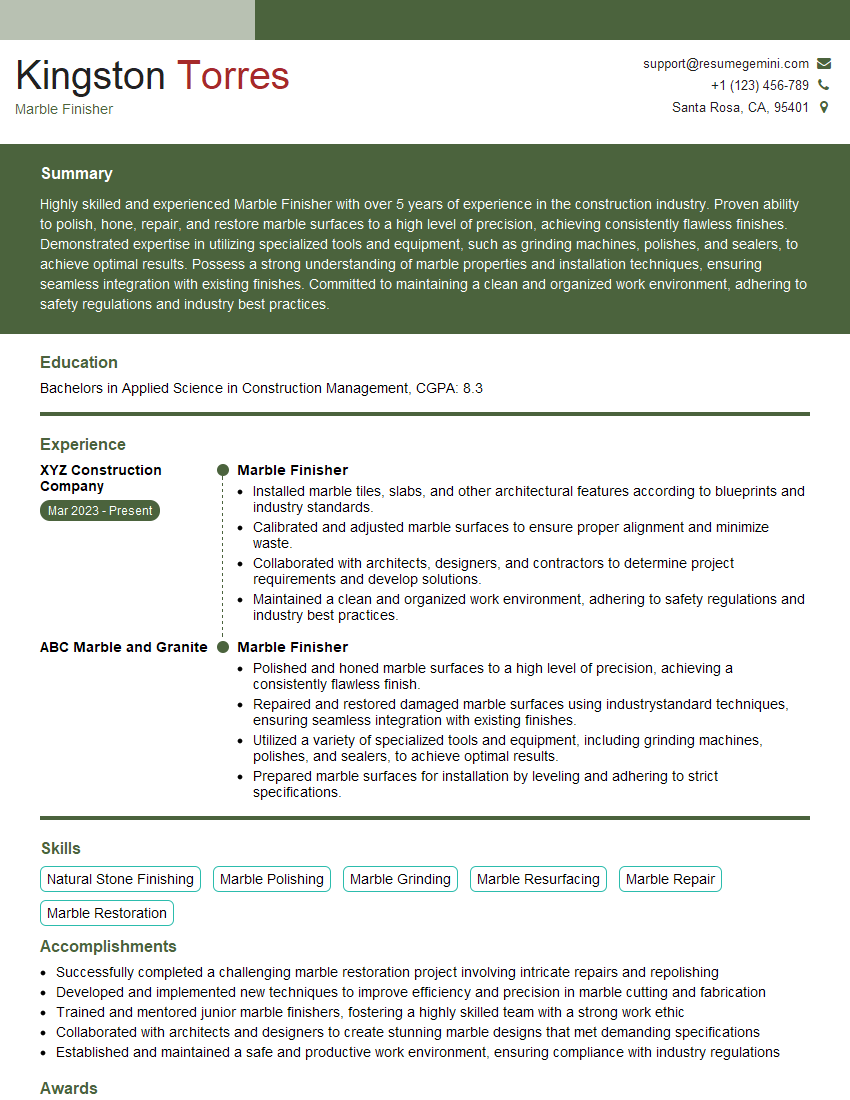
Mastering the art of grinding and finishing tombstones opens doors to a fulfilling career in a specialized and skilled trade. Your expertise in this craft is highly valued, and continuous learning will ensure your growth within the industry. To significantly improve your job prospects, creating a strong, ATS-friendly resume is crucial. ResumeGemini is a trusted resource that can help you build a professional and impactful resume tailored to highlight your skills and experience. Examples of resumes specifically designed for candidates in Grinding and Finishing of Tombstones are available to guide you. Take the next step and craft a resume that showcases your unique capabilities and secures you the interview you deserve.
Explore more articles
Users Rating of Our Blogs
Share Your Experience
We value your feedback! Please rate our content and share your thoughts (optional).
What Readers Say About Our Blog
To the interviewgemini.com Webmaster.
Very helpful and content specific questions to help prepare me for my interview!
Thank you
To the interviewgemini.com Webmaster.
This was kind of a unique content I found around the specialized skills. Very helpful questions and good detailed answers.
Very Helpful blog, thank you Interviewgemini team.