Every successful interview starts with knowing what to expect. In this blog, we’ll take you through the top Imagery Intelligence Analysis interview questions, breaking them down with expert tips to help you deliver impactful answers. Step into your next interview fully prepared and ready to succeed.
Questions Asked in Imagery Intelligence Analysis Interview
Q 1. Explain the difference between panchromatic and multispectral imagery.
The key difference between panchromatic and multispectral imagery lies in how they capture light. Panchromatic imagery records light across the entire visible spectrum (and sometimes near-infrared) as a single grayscale band. Think of it like a black and white photograph – it shows variations in brightness but not specific colors. Multispectral imagery, on the other hand, captures light in multiple, distinct wavelength bands. These bands are usually separated into different colors (e.g., red, green, blue, near-infrared), allowing for the analysis of specific spectral signatures. This is similar to looking at an object through several different colored filters simultaneously; each filter reveals different aspects of the object’s composition and properties.
For example, healthy vegetation reflects strongly in the near-infrared band, a characteristic that multispectral imagery can easily detect and highlight. This allows for detailed vegetation analysis, something not possible with simple panchromatic imagery. Panchromatic imagery excels in high spatial resolution and sharpness; it’s perfect for identifying small objects. Multispectral excels in detailed analysis of material composition and change detection.
Q 2. Describe the process of image exploitation, from acquisition to analysis.
Image exploitation is a multi-stage process that begins with image acquisition. This involves selecting appropriate sensors (satellite, aircraft, drone), setting parameters (resolution, wavelength ranges), and capturing the imagery. Next comes preprocessing, where the raw imagery is cleaned up. This often includes geometric correction (removing distortions), atmospheric correction (removing haze), and radiometric calibration (standardizing brightness levels).
Image analysis follows. This involves applying various techniques like visual interpretation (human analysis), image classification (automated categorization of pixels), change detection (identifying changes over time), and object recognition (identifying specific features). The analysis draws upon various tools and techniques to interpret features and extract meaningful information. For example, we might use spectral signature analysis to identify different types of vegetation or apply feature extraction algorithms to automate the identification of vehicles or buildings. The final stage is reporting and dissemination, where the findings are documented and shared with relevant stakeholders, often in the form of intelligence reports, maps, or presentations.
For instance, in a scenario involving monitoring deforestation in the Amazon rainforest, the process would involve acquiring satellite imagery with multispectral sensors like Landsat, pre-processing to correct for atmospheric effects and geometric distortions, then analyzing the imagery to identify areas of recent deforestation based on changes in vegetation indices.
Q 3. What are the limitations of using satellite imagery for intelligence gathering?
Satellite imagery, while a powerful tool, has limitations. Firstly, cloud cover can severely obstruct views, making analysis difficult or impossible. Secondly, resolution limitations prevent the identification of very small objects or fine details. The spatial resolution of the imagery dictates the smallest discernible feature. Thirdly, temporal limitations mean that imagery might not be available when needed, particularly in regions with low revisit rates. Fourthly, sensor limitations restrict the kinds of information obtainable. Specific types of sensors might lack sensitivity to certain wavelengths, preventing the analysis of specific characteristics. Lastly, access and cost can be significant barriers. High-resolution imagery from advanced satellites can be very expensive.
For example, trying to identify specific individuals in a crowd using satellite imagery would be impossible due to resolution limitations. Similarly, attempting to monitor a remote location with frequent cloud cover would prove challenging.
Q 4. How do you assess the quality and reliability of imagery sources?
Assessing imagery quality and reliability requires a multi-faceted approach. First, we must consider the source of the imagery. Is it from a reputable satellite with known accuracy and reliability? What are the sensor’s capabilities? Next, we examine metadata, which provides information such as acquisition date, time, altitude, sensor type, and processing details. Inconsistencies or missing information can raise red flags. Third, the image itself is assessed for various factors. Is the image sharp and clear, or is it blurry or noisy? Are there distortions or artifacts present? Fourth, ground truth is essential; we compare the imagery to known data (e.g., maps, ground surveys) to verify its accuracy. Finally, the context of the imagery must be considered. Was the imagery acquired under optimal conditions? Does it reflect the reality on the ground?
For instance, if we’re analyzing imagery of a military installation, we might compare its features to known architectural plans or previous imagery to ensure the integrity of the current image. A discrepancy could indicate significant changes or manipulation.
Q 5. Explain different types of image distortions and how to correct them.
Image distortions arise from various factors during the image acquisition and processing stages. Geometric distortions include displacement of features due to sensor movement, Earth’s curvature, and atmospheric effects. Radiometric distortions involve errors in brightness and color values. Common geometric distortions include: scale distortion (changes in scale across the image), relief displacement (objects at higher elevations appearing displaced), and perspective distortion (objects appearing foreshortened or elongated depending on viewing angle). Radiometric distortions can stem from sensor imperfections or atmospheric scattering.
Corrections typically involve using ground control points (GCPs), which are points with known coordinates in both the image and a reference map. Sophisticated software employs mathematical models (e.g., polynomial transformations, orthorectification) to transform the distorted image into a geometrically corrected one. Radiometric correction involves techniques like histogram equalization to improve brightness uniformity and atmospheric correction to remove haze.
For example, in orthorectification, GCPs help align the image to a reference map, effectively removing relief displacement and creating a map-like representation. This process is critical for accurate measurements and analysis.
Q 6. How do you identify and interpret different types of terrain features in imagery?
Identifying and interpreting terrain features relies on understanding various visual cues. Shape, size, texture, pattern, shadow, and tone are key elements. For instance, rivers appear as linear features with winding patterns and differing tonal signatures reflecting water depth and reflectivity. Mountains exhibit a characteristic conical or ridge-like shape with significant shadows depending on the sun’s angle. Forests appear as textured areas with a characteristic mottled pattern and darker tone compared to open fields. Roads are characterized by their linear shape, regular width, and smooth texture. Urban areas appear as areas of high density with geometric shapes and patterns.
Experience and knowledge of geographic context are vital. Familiarizing oneself with local geography and understanding the region’s geology and vegetation types enhances the accuracy of interpretation. In addition, understanding the interplay between light and shadow helps to deduce the three-dimensional structure of landforms. For instance, the length and direction of shadows provide clues about the height and orientation of features.
For example, observing a dark, linear feature in an image, especially one following a natural drainage pattern, might lead one to interpret it as a river. The presence of meandering characteristics and surrounding vegetation would further support this interpretation.
Q 7. Describe your experience with image processing software (e.g., ENVI, ArcGIS).
I have extensive experience with both ENVI and ArcGIS, having used them for various projects throughout my career. In ENVI, I’ve performed extensive image processing tasks including atmospheric correction, orthorectification, pan-sharpening, and various types of image classification, such as supervised and unsupervised techniques. I’ve used ENVI’s capabilities to analyze multispectral and hyperspectral imagery to extract spectral signatures and conduct change detection analysis. The software’s powerful tools allow for detailed feature extraction, providing valuable insights from imagery data.
ArcGIS has been instrumental in integrating imagery data with geographic information systems (GIS) data. I’ve utilized ArcGIS to create maps showing the spatial distribution of features identified in satellite or aerial imagery, conducting spatial analysis and creating thematic maps. For example, I’ve used ArcGIS to combine high-resolution satellite imagery with vector data of roads and buildings to create comprehensive, visually rich maps. This integrated approach allowed for a detailed understanding of geographic relationships, supporting various intelligence assessments.
My proficiency in both ENVI and ArcGIS provides a powerful toolkit for imagery analysis, enabling me to tackle complex projects and extract valuable intelligence from various sources.
Q 8. How do you integrate imagery intelligence with other intelligence disciplines?
Imagery Intelligence (IMINT) doesn’t exist in a vacuum; it’s most powerful when integrated with other intelligence disciplines. Think of it as a puzzle where IMINT provides the visual pieces, but other forms of intelligence give context and meaning.
- HUMINT (Human Intelligence): On-the-ground reports from informants can corroborate or challenge observations from satellite imagery. For instance, satellite imagery might show a new building under construction; HUMINT could reveal its intended purpose – a weapons factory or a school.
- SIGINT (Signals Intelligence): Communication intercepts might reveal the activity at a location identified in IMINT. If IMINT shows increased vehicle traffic at a specific location, SIGINT might capture radio chatter related to military movements.
- OSINT (Open-Source Intelligence): News reports, social media posts, and publicly available documents can contextualize the imagery. IMINT might reveal a large gathering; OSINT could identify the event as a political rally or a protest.
- MASINT (Measurement and Signature Intelligence): This can provide additional data to confirm or clarify what is observed in the imagery. For example, if IMINT depicts a potential missile site, MASINT might analyze electromagnetic emissions to confirm its functionality.
Effective integration often involves collaborative analysis, where analysts from different disciplines work together, sharing data and insights to build a comprehensive understanding.
Q 9. Explain your understanding of different image formats (e.g., GeoTIFF, JPEG2000).
Different image formats cater to specific needs in terms of compression, resolution, and metadata. Choosing the right format is crucial for efficient storage, transmission, and analysis.
- GeoTIFF: This is a widely used format that stores geospatial information directly within the image file. This means the image is already georeferenced, meaning its location on the Earth is known, saving a significant step in the processing pipeline. It supports various compression techniques, offering a balance between file size and image quality. It’s great for maps and images requiring precise geographic coordinates.
- JPEG2000: This format offers superior compression compared to traditional JPEG, allowing for smaller file sizes while preserving high image quality. It’s particularly useful for handling very high-resolution imagery, like those from satellites, where file sizes can be enormous. It’s also wavelet-based, making it efficient for progressive display, meaning you can see a low-resolution preview quickly, then gradually increase the quality as it downloads.
Other formats like NITF (National Imagery Transmission Format) are also used, especially in military and intelligence settings, due to their ability to store extensive metadata and accommodate various image types.
Q 10. How do you identify and analyze man-made structures and infrastructure in imagery?
Identifying and analyzing man-made structures and infrastructure in imagery involves a multi-step process that combines visual interpretation with advanced techniques.
- Visual Interpretation: Experienced analysts initially examine the imagery visually, looking for patterns, shapes, and sizes that indicate man-made features. This often involves using tools to enhance contrast and sharpness.
- Feature Extraction: Software tools can be used to automatically extract features like lines, points, and polygons that represent buildings, roads, or other structures. Algorithms can identify features based on their spectral signatures or geometric properties.
- Measurement and Analysis: Once features are identified, analysts measure their dimensions, calculate areas, and assess their condition. This might involve comparing them to known building standards or detecting signs of damage or modification.
- Contextual Analysis: The analysis needs to consider the surrounding environment. Is a structure near a military base? Is it located in a heavily populated area? This contextual information provides critical clues.
For example, identifying a specific type of radar installation would require expertise in recognizing its characteristic shape, size, and antenna configuration. Then, analyzing its location relative to other strategic assets and comparing it to open-source data might reveal its purpose.
Q 11. Describe your experience with different types of sensors (e.g., optical, radar, hyperspectral).
Different sensors provide unique perspectives and capabilities. Understanding their strengths and limitations is vital for effective IMINT analysis.
- Optical Sensors: These are like high-resolution cameras in space. They capture visible and near-infrared light, providing detailed color imagery. Their resolution is typically high, but they are limited by weather conditions (clouds) and can’t see through objects.
- Radar Sensors (SAR): Synthetic Aperture Radar uses radio waves, making them capable of seeing through clouds and darkness. They provide information on the shape and texture of objects, but the images are typically greyscale and can be affected by speckle noise.
- Hyperspectral Sensors: These collect images across a vast number of narrow spectral bands, revealing subtle differences in material composition. This allows us to identify materials based on their unique spectral ‘fingerprint,’ such as differentiating between different types of vegetation or identifying specific minerals.
Each sensor type offers distinct advantages. For example, optical imagery is excellent for identifying fine details in urban environments during daylight hours; SAR is crucial for monitoring activities in areas with frequent cloud cover; and hyperspectral imaging can support mineral exploration or crop health assessment.
Q 12. How do you perform change detection analysis using imagery?
Change detection is the process of identifying differences between two or more images of the same area taken at different times. This is a powerful tool for monitoring changes over time.
- Image Registration: This crucial first step involves aligning images acquired at different times to ensure they are accurately overlaid. Errors in registration can lead to false change detections.
- Difference Imaging: Simple difference imaging involves subtracting the pixel values of one image from another. Areas with significant differences will stand out.
- Image Ratioing: This technique divides the pixel values of two images, revealing changes in the relative reflectance of features. It’s particularly useful in detecting subtle changes.
- Classification-Based Methods: Advanced techniques classify pixels in each image and compare the classifications to identify changes. These methods can be more accurate but are computationally more intensive.
A common application is monitoring deforestation. By comparing images from different years, we can identify areas where forest cover has been lost, and possibly determine the rate of deforestation and its causes.
Q 13. Explain your understanding of geometric correction and orthorectification.
Geometric correction and orthorectification are essential preprocessing steps for improving the accuracy and usability of imagery. They address distortions caused by sensor geometry, terrain relief, and Earth curvature.
- Geometric Correction: This involves transforming an image to match a known map projection or coordinate system. This correction removes some distortions, but doesn’t fully account for terrain effects. Think of it as roughly aligning a slightly skewed photograph.
- Orthorectification: This is a more advanced process that removes the effects of terrain relief. It creates an image where all points are in their correct geographic location, as if the image were taken from directly above the ground. This is more computationally intensive but is essential for accurate measurements and spatial analysis. Imagine transforming that skewed photo into a perfectly flat, accurate map representation.
Both processes are typically done using ground control points (GCPs) – identifiable points that have known coordinates in a real-world coordinate system. These points allow the software to accurately calculate the transformations needed to correct the image geometry.
Q 14. How do you handle classified imagery and maintain security protocols?
Handling classified imagery requires strict adherence to security protocols to protect sensitive information. This involves both technical and procedural measures.
- Secure Storage: Classified imagery is stored in secure facilities with access control systems that limit access based on security clearances. This could involve physical security measures like vaults as well as digital security like encryption and access logs.
- Data Encryption: Imagery is often encrypted both in transit and at rest to prevent unauthorized access. Strong encryption algorithms are used to protect data even if intercepted.
- Access Control: Only individuals with the appropriate security clearances and a need-to-know can access the imagery. Access logs track who accesses what data and when.
- Data Handling Procedures: Strict procedures are in place to govern how the imagery is handled, including printing, copying, and dissemination. This often includes regular audits and security training.
- Watermarking and Redaction: Watermarks might be embedded to identify the source and security level of the image. Redaction tools can conceal sensitive information before dissemination.
Breaches in security protocols can have serious consequences, so maintaining a rigorous security posture is paramount. I have extensive experience working with classified data and understand the sensitivity involved. My training and background ensures I follow all relevant security protocols.
Q 15. Describe your experience with creating intelligence products based on imagery analysis.
My experience in creating intelligence products from imagery analysis spans over a decade, encompassing diverse projects from military operations to environmental monitoring. I’ve consistently followed a structured approach, beginning with defining the intelligence requirement, selecting appropriate imagery (satellite, aerial, UAV), and then conducting rigorous analysis. This analysis often involves change detection, object recognition, and measurement extraction using specialized software.
For example, in one project involving assessing infrastructure damage after a natural disaster, I utilized high-resolution satellite imagery to map the extent of damage to roads, buildings, and critical infrastructure. I then created detailed reports and geospatial products that aided in resource allocation and disaster relief efforts. Another project focused on tracking maritime vessels involved advanced techniques like automated target recognition (ATR) and vessel signature analysis.
The final intelligence products vary depending on the client’s needs and can include maps, charts, detailed reports, 3D models, and even interactive dashboards for real-time monitoring. Throughout the entire process, maintaining a high level of accuracy and contextual awareness is paramount.
Career Expert Tips:
- Ace those interviews! Prepare effectively by reviewing the Top 50 Most Common Interview Questions on ResumeGemini.
- Navigate your job search with confidence! Explore a wide range of Career Tips on ResumeGemini. Learn about common challenges and recommendations to overcome them.
- Craft the perfect resume! Master the Art of Resume Writing with ResumeGemini’s guide. Showcase your unique qualifications and achievements effectively.
- Don’t miss out on holiday savings! Build your dream resume with ResumeGemini’s ATS optimized templates.
Q 16. How do you assess the potential biases present in imagery analysis?
Assessing potential biases in imagery analysis is crucial for producing objective and reliable intelligence. Bias can creep in at various stages, from the acquisition of the imagery itself to the interpretation of the data. For instance, the sensor used to collect the imagery might have inherent limitations, resulting in systematic errors. The time of day, weather conditions, and even the analyst’s preconceived notions can introduce biases.
To mitigate these biases, I employ a multi-faceted approach. This includes using multiple sources of imagery to cross-reference findings, employing rigorous quality control procedures, ensuring diverse teams are involved in the analysis, and meticulously documenting all assumptions and methodologies. Applying a structured analytical technique like the analysis of competing hypotheses (ACH) helps to actively challenge any pre-existing assumptions.
For example, if analyzing images related to a potential military buildup, I would actively seek out contradictory evidence to challenge the initial interpretation and prevent confirmation bias. This rigorous approach ensures the integrity of the intelligence product and reduces the risk of misinterpretations.
Q 17. Explain your proficiency in using geographic information systems (GIS).
My GIS proficiency is extensive, encompassing the use of various software packages such as ArcGIS, QGIS, and ERDAS Imagine. I’m adept at georeferencing imagery, creating thematic maps, performing spatial analysis (such as proximity analysis and overlay analysis), and integrating various geospatial data sources. My skills extend beyond basic mapping to include advanced techniques like 3D modeling and terrain analysis.
I’ve used GIS extensively in various projects to support imagery analysis, for instance, to determine the location of specific features within an image using coordinate systems and projections, creating detailed maps showing the distribution of specific objects (e.g., vehicles, buildings) identified in imagery, and integrating imagery data with other spatial data (e.g., elevation models, road networks) to gain a richer understanding of the context. I am also skilled in utilizing various coordinate systems and projections, ensuring the accuracy and consistency of spatial data throughout the analysis process.
Essentially, GIS forms the backbone of my imagery analysis workflow, enabling me to transform raw imagery data into actionable intelligence.
Q 18. How do you validate and verify the accuracy of your imagery analysis?
Validating and verifying the accuracy of imagery analysis is paramount. I employ a rigorous process that incorporates several key steps. First, I cross-reference my findings with multiple sources of information, including other imagery, open-source intelligence (OSINT), and human intelligence (HUMINT) reports. This helps to corroborate the findings and identify potential discrepancies.
Second, I utilize ground truth data, whenever available, to validate my interpretations. Ground truth refers to confirmed information obtained from reliable sources on the ground. If ground truth data is limited or unavailable, I resort to using secondary evidence and reasonable inferences. Finally, I employ rigorous quality control checks throughout the entire process, meticulously documenting all methodologies and assumptions.
For example, when analyzing imagery of a suspected military base, I would compare my assessment of the number and types of vehicles present with publicly available information on the base’s inventory. I would also look for corroborating evidence from news reports or social media. This multi-layered approach significantly enhances the reliability and accuracy of my analysis.
Q 19. Describe your experience with different types of image interpretation techniques (e.g., photo interpretation keys).
My experience with image interpretation techniques is extensive, ranging from basic photo interpretation keys to advanced techniques like change detection and object-based image analysis (OBIA). I’m familiar with various interpretation keys designed for specific applications, such as those used for identifying military equipment, infrastructure types, or agricultural practices.
For example, I have used photo interpretation keys to identify different types of military vehicles based on their shape, size, and unique features. The process often involves comparing visual characteristics in the imagery to established reference materials, ensuring consistent and accurate identification. OBIA, on the other hand, allows for automated feature extraction and classification, significantly increasing efficiency and accuracy in large datasets.
My understanding of these techniques allows me to adapt my approach based on the specific imagery and intelligence requirement, ensuring the most effective and efficient analysis.
Q 20. How do you prioritize and manage multiple competing intelligence requirements?
Prioritizing and managing multiple, competing intelligence requirements necessitates a structured approach. I typically utilize a prioritization matrix, considering factors such as urgency, importance, available resources, and the potential impact of the intelligence. This matrix helps to rank the requirements objectively and allocate resources accordingly.
Furthermore, I employ effective time management techniques, including breaking down complex tasks into smaller, more manageable components and utilizing project management tools to track progress and deadlines. Communication with stakeholders is crucial, ensuring everyone is aware of the priorities and potential delays. Regular updates and progress reports are essential to maintaining transparency and managing expectations.
For instance, if faced with multiple requests—one urgent but less important, and another less urgent but more significant—the matrix would guide me to focus on the crucial elements of the high-impact task while also dedicating appropriate resources to address the immediate need of the urgent task. Flexibility and adaptability are key to handling shifting priorities effectively.
Q 21. How do you communicate your findings effectively to both technical and non-technical audiences?
Effective communication is critical in intelligence analysis. My approach focuses on tailoring the communication style to the audience. When communicating with technical audiences, I use precise terminology and detailed explanations, including technical specifications and data visualizations. However, when interacting with non-technical audiences, I avoid jargon, simplify complex concepts using analogies and visual aids, and focus on conveying the key findings and implications.
I employ diverse methods to communicate my findings: detailed written reports, concise presentations with visual aids, interactive dashboards, and briefings tailored to specific audiences. For example, a technical report might include detailed maps, charts, and data tables, while a briefing for senior leadership would focus on the key conclusions and their strategic implications. Clear, concise, and accurate communication ensures that the intelligence findings are understood and acted upon.
The use of clear visual aids, such as maps, charts, and graphs, alongside well-structured narrative reports, is essential for communicating complex data effectively to both technical and non-technical audiences.
Q 22. Explain your experience using measurement tools within imagery analysis software.
My experience with measurement tools in imagery analysis software is extensive. I’m proficient in using tools within various platforms like ArcGIS Pro, ENVI, and commercial software packages to perform precise measurements on imagery. This includes determining distances, areas, and even volumes using various techniques.
For example, I routinely use the distance measurement tool to calculate the length of a runway at an airport from high-resolution satellite imagery. This involves selecting two points on the runway, and the software automatically calculates the distance, often offering the result in multiple units (meters, feet, kilometers, etc.). Similarly, polygon tools allow for accurate area calculations of buildings, agricultural fields, or even deforestation zones, vital for change detection analysis. For more complex 3D measurements, I utilize digital elevation models (DEMs) integrated with the imagery to calculate volumes, for instance, the volume of a landslide or the capacity of a reservoir.
Beyond basic measurements, I’m adept at using tools that leverage image metadata, such as ground sampling distance (GSD) calculation to verify measurement accuracy and scale. Understanding GSD is crucial, as it directly impacts the precision of any measurement taken from the image. In situations with oblique imagery, I employ advanced geometric correction and rectification techniques to ensure accurate measurements before performing any analysis.
Q 23. How do you handle uncertainty and ambiguity in imagery interpretation?
Uncertainty and ambiguity are inherent in imagery interpretation. I address this through a multi-faceted approach. Firstly, I meticulously document all assumptions and limitations, emphasizing areas where the interpretation might be less certain. This transparency is vital for conveying the confidence level associated with my conclusions.
Secondly, I leverage multiple sources of information. Combining imagery with other intelligence sources—such as open-source reports, human intelligence, or signals intelligence—helps validate findings and reduce ambiguity. For instance, if imagery shows a suspicious structure, I might cross-reference it with news articles or social media posts to gain additional context and corroborating evidence.
Thirdly, I employ contextual knowledge. Understanding the geographical area, cultural nuances, and potential activities significantly aids interpretation. For example, knowing the typical size and layout of agricultural fields in a specific region allows me to differentiate a normal farming practice from a potential illicit activity, like illegal crop cultivation. Finally, I employ a rigorous process of hypothesis generation and testing, continually refining my interpretation as I gather more information. This iterative process helps reduce ambiguity and leads to more robust conclusions.
Q 24. Describe your familiarity with different map projections and coordinate systems.
My understanding of map projections and coordinate systems is fundamental to my work. I’m familiar with a wide range of projections, including UTM (Universal Transverse Mercator), geographic coordinates (latitude and longitude), and various projected coordinate systems tailored to specific regions. Each projection has strengths and weaknesses depending on the application.
For example, UTM is well-suited for large-scale mapping across relatively small latitudinal extents, minimizing distortion, while geographic coordinates are essential when working with global datasets. Understanding the implications of different projections is crucial for accurate measurements and geospatial analysis. I routinely convert between coordinate systems using software tools to ensure compatibility between various datasets.
Misunderstanding map projections can lead to significant errors. For instance, using a projection unsuitable for a large area could result in inaccurate distance or area measurements. My proficiency in this area guarantees that my analyses are accurate and reliable, considering the specific characteristics of each projection and its applicability to the data being analyzed.
Q 25. Explain your experience with data fusion techniques involving imagery data.
Data fusion is a crucial aspect of modern imagery intelligence analysis. I have extensive experience integrating imagery data with other data sources to enhance analysis and derive more comprehensive conclusions. This often involves combining multiple types of imagery, such as combining high-resolution satellite imagery with aerial photography, or integrating multispectral imagery with LiDAR data.
For example, I’ve integrated thermal imagery with visible light imagery to identify camouflaged military equipment, where temperature differences highlight the equipment’s presence. Similarly, I have fused radar imagery with optical imagery to overcome limitations imposed by cloud cover or adverse weather conditions. These techniques often utilize specialized software capable of registering and aligning datasets from different sources, allowing for a comparative analysis.
Furthermore, I’m familiar with various data fusion algorithms and techniques, ranging from simple overlay analysis to more sophisticated methods like Bayesian fusion. The choice of technique depends on the specific data types and the goals of the analysis. My experience allows me to select the most appropriate approach for optimal results, maximizing the value of the combined datasets.
Q 26. How do you identify and mitigate risks associated with imagery analysis?
Risk mitigation in imagery analysis is paramount. I address risks through a structured approach, starting with careful planning and defining the scope of the analysis. This includes identifying potential limitations of the data, such as resolution, cloud cover, or image artifacts. I then develop a plan to address these limitations during the analysis phase.
A crucial aspect is ensuring data integrity and provenance. I meticulously document the origin, processing steps, and any potential alterations made to the imagery to maintain transparency and traceability. This is essential for maintaining the credibility of the analysis and avoiding errors arising from unintentional data corruption or manipulation.
Another key consideration is operational security (OPSEC). I carefully manage access control to sensitive imagery and analysis products, adhering to strict security protocols and guidelines to prevent unauthorized access and mitigate the risk of data breaches or compromise. Regular review of security protocols, awareness of current threats, and secure data handling practices are integral parts of my workflow.
Q 27. Describe your experience with using open-source imagery sources.
My experience with open-source imagery sources is significant. I regularly utilize platforms like Google Earth, Bing Maps, and various open-source satellite imagery archives to gather publicly available imagery data. These sources can provide valuable context, preliminary information, and often serve as a cost-effective alternative to commercial or classified imagery.
For example, I have used Google Earth’s historical imagery to track the development of infrastructure projects over time, assessing changes in building construction or road expansion. Similarly, open-source satellite imagery platforms have been used to monitor environmental changes, such as deforestation or glacial retreat. However, I’m mindful of the limitations of open-source data, such as lower resolution compared to commercial or government sources, frequent cloud cover, and potential inconsistencies in image quality or timeliness.
When using open-source data, I always carefully assess the metadata, quality, and potential biases associated with the information. This critical evaluation ensures responsible and accurate use of the freely available data, integrating it effectively within the broader context of the analysis, often as a first step to identify areas of further investigation using more specialized datasets.
Q 28. How do you stay up-to-date with the latest advancements in imagery intelligence technology?
Staying current with advancements in imagery intelligence technology is crucial for maintaining professional competency. I actively engage in continuous professional development through several methods.
I regularly attend industry conferences and workshops, participate in webinars, and actively engage in online professional communities. These engagements expose me to the latest research, algorithms, and software tools within the field. I also subscribe to relevant professional journals and publications to remain aware of cutting-edge developments and new research findings.
Beyond formal learning, I engage in self-directed learning, often experimenting with new software and techniques on sample datasets. This hands-on approach helps solidify my understanding of new tools and technologies, ensuring I can effectively apply these advancements to real-world analysis tasks. This approach enhances my adaptability to evolving technologies and ensures my analytical skills remain at the forefront of the industry.
Key Topics to Learn for Imagery Intelligence Analysis Interview
- Image Exploitation Fundamentals: Understanding the image formation process, sensor types (e.g., satellite, aerial, UAV), and their limitations. Practical application: Analyzing image resolution and determining the level of detail achievable for specific tasks.
- Photogrammetry and Geospatial Analysis: Utilizing techniques to extract 3D measurements and create maps from imagery. Practical application: Determining the height of a structure or the distance between objects in an image.
- Change Detection and Feature Extraction: Identifying differences between images taken at different times and extracting relevant features (e.g., buildings, vehicles, vegetation). Practical application: Monitoring construction activity or identifying changes in land use over time.
- Image Interpretation and Analysis Techniques: Applying knowledge of visual cues, pattern recognition, and context to draw meaningful conclusions from imagery. Practical application: Identifying potential threats or anomalies in a given area based on visual evidence.
- Geopolitical and Cultural Context: Understanding the geopolitical landscape and cultural nuances of the area depicted in the imagery. Practical application: Interpreting the significance of observed activities within their broader context.
- Report Writing and Presentation Skills: Clearly and concisely communicating findings and analysis to a diverse audience. Practical application: Structuring reports to highlight key findings and support conclusions with visual evidence.
- Software and Tools: Familiarity with common Geographic Information Systems (GIS) software and image processing tools. Practical application: Demonstrating proficiency in using software to analyze and manipulate imagery data.
Next Steps
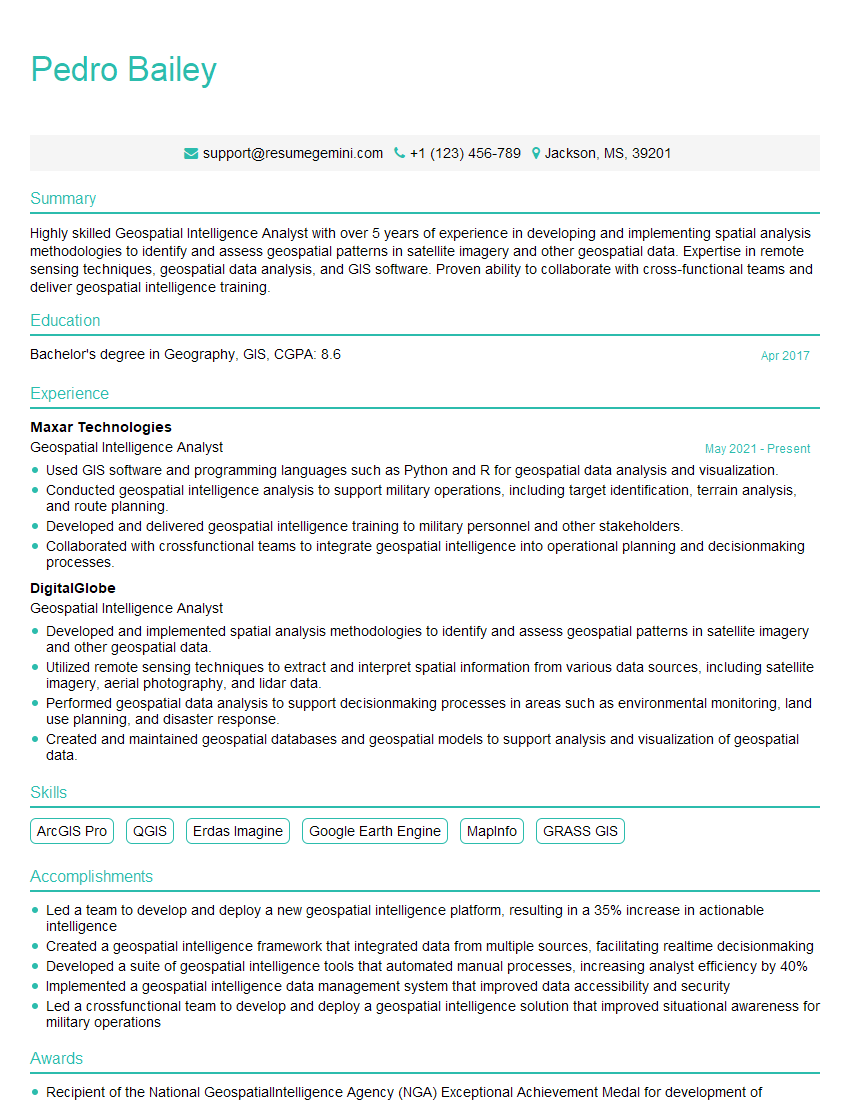
Mastering Imagery Intelligence Analysis opens doors to a rewarding career with significant growth potential in national security, defense, and commercial sectors. To maximize your job prospects, invest time in crafting a compelling, ATS-friendly resume that showcases your skills and experience effectively. ResumeGemini is a trusted resource to help you build a professional resume that stands out. They provide examples of resumes tailored to Imagery Intelligence Analysis, ensuring your application reflects your capabilities accurately and helps you secure your desired role.
Explore more articles
Users Rating of Our Blogs
Share Your Experience
We value your feedback! Please rate our content and share your thoughts (optional).
What Readers Say About Our Blog
To the interviewgemini.com Webmaster.
Very helpful and content specific questions to help prepare me for my interview!
Thank you
To the interviewgemini.com Webmaster.
This was kind of a unique content I found around the specialized skills. Very helpful questions and good detailed answers.
Very Helpful blog, thank you Interviewgemini team.