Interviews are more than just a Q&A session—they’re a chance to prove your worth. This blog dives into essential International Diplomacy interview questions and expert tips to help you align your answers with what hiring managers are looking for. Start preparing to shine!
Questions Asked in International Diplomacy Interview
Q 1. Explain the concept of ‘soft power’ in international relations.
Soft power, a term coined by Joseph Nye, refers to a nation’s ability to influence other actors through attraction rather than coercion. Unlike hard power, which relies on military might or economic sanctions, soft power leverages cultural appeal, political values, and foreign policies perceived as legitimate and attractive. Think of it as influencing others by making them *want* what you want, rather than forcing them.
For example, the global popularity of American movies, music, and technology has historically contributed significantly to US soft power. Similarly, countries with strong reputations for human rights and democratic governance often wield considerable soft power, attracting international cooperation and support. Conversely, a country known for human rights abuses might find its international influence diminished despite possessing considerable hard power.
In practice, soft power is cultivated through strategic communication, cultural exchange programs, educational initiatives, and the promotion of values that resonate globally. It’s a long-term strategy requiring consistent effort and authenticity.
Q 2. Describe the difference between multilateral and bilateral diplomacy.
Bilateral diplomacy involves interactions between two states, focusing on specific issues of mutual interest. It’s a direct, focused approach allowing for detailed negotiations and tailored agreements. Think of it like a one-on-one conversation.
Multilateral diplomacy, conversely, involves multiple states interacting within a larger forum, such as the United Nations or the European Union. It’s more complex, allowing for broader consensus-building, but negotiations are slower and outcomes often require compromises among numerous actors. Imagine a large group discussion where many voices need to be heard.
For instance, a bilateral trade agreement between the US and Mexico would be an example of bilateral diplomacy. In contrast, negotiating a climate change accord at a UN summit is multilateral diplomacy.
Q 3. Analyze the effectiveness of sanctions as a foreign policy tool.
Sanctions, as a foreign policy tool, are restrictive measures—economic, political, or diplomatic—imposed on a state to achieve specific policy objectives, often related to human rights abuses, terrorism, or proliferation of weapons of mass destruction. Their effectiveness is highly debated and depends on several factors.
Factors influencing effectiveness:
- Severity and Scope: Comprehensive sanctions targeting key economic sectors are generally more effective than limited ones.
- International Cooperation: Sanctions are most effective when imposed by a broad coalition of states to prevent circumvention.
- Target’s Vulnerability: Sanctions are more impactful on states heavily reliant on international trade or aid.
- Duration and Enforcement: Sustained enforcement over a long period is crucial; sanctions that are inconsistently applied lose their effectiveness.
- Alternative Sources: States with alternative sources of supply or trade partners can mitigate the impact of sanctions.
Examples: Sanctions against Iran related to its nuclear program illustrate both successes (limiting enrichment activity) and failures (Iran finding ways to circumvent sanctions). Similarly, sanctions against North Korea have had limited impact due to its isolation and support from China and Russia. The effectiveness of sanctions is thus highly context-dependent.
Q 4. How would you navigate a diplomatic crisis involving a sudden escalation of conflict?
Navigating a sudden diplomatic crisis requires a rapid and measured response focusing on de-escalation, communication, and potentially mediation. The first step is to assess the situation comprehensively, identifying the key actors, their interests, and the immediate risks.
Steps to Navigate a Crisis:
- Rapid Assessment: Gather intelligence and analyze the situation to understand the root causes and immediate threats.
- Communication: Open and direct communication channels with all involved parties, emphasizing de-escalation and seeking clarification.
- De-escalation Measures: Implement immediate confidence-building measures, such as ceasing provocative actions or agreeing to a ceasefire.
- Mediation: If direct communication fails, engage neutral third parties to mediate the conflict, facilitating communication and finding common ground.
- International Mechanisms: Utilize relevant international organizations or treaties to address the conflict within a framework of international law.
- Public Diplomacy: Manage public perception effectively through transparent communication and counter any misinformation campaigns.
- Long-Term Strategies: Develop long-term strategies to address the underlying causes of conflict and prevent future escalations.
For example, in a sudden border clash, swift communication with the opposing nation, through established diplomatic channels, should be prioritized. Calls for restraint and a willingness to investigate the incident can help prevent further escalation, and neutral parties might be called in to assess the situation.
Q 5. Discuss the role of international law in resolving territorial disputes.
International law plays a crucial role in resolving territorial disputes through established principles and mechanisms. The UN Convention on the Law of the Sea (UNCLOS), for example, provides a legal framework for maritime boundaries. The International Court of Justice (ICJ) provides a forum for states to resolve disputes peacefully through legal means.
However, the effectiveness of international law in resolving territorial disputes is often challenged by several factors:
- State Sovereignty: States are reluctant to relinquish control of territory.
- Enforcement: International law lacks effective enforcement mechanisms, relying on states’ cooperation and compliance.
- Political Context: Geopolitical considerations and power dynamics often outweigh legal considerations.
- Ambiguity of Treaties and Norms: Legal instruments can sometimes be vague or inconsistently interpreted.
Despite these challenges, international law remains important. It provides a framework for negotiation, sets acceptable limits on the use of force, and offers mechanisms for peaceful dispute resolution. The ICJ, for example, has rendered numerous rulings on territorial claims, even if these rulings are not always accepted by all parties involved. Negotiated settlements based on international law are often more durable than ones reached through force.
Q 6. What are the key challenges facing contemporary diplomacy in the 21st century?
Contemporary diplomacy faces numerous challenges in the 21st century. The rise of non-state actors, such as multinational corporations and terrorist groups, complicates traditional state-to-state relations, requiring diplomats to interact with diverse actors with varying motivations.
Other key challenges include:
- Globalization and Interconnectedness: Issues like climate change, pandemics, and economic crises transcend national borders, requiring multilateral cooperation and coordinated responses.
- Information Warfare and Misinformation: The spread of disinformation and propaganda complicates communication and trust-building.
- Rise of Populism and Nationalism: Nationalistic sentiments and skepticism towards international cooperation impede progress on global issues.
- Cybersecurity Threats: The increasing reliance on digital technologies increases vulnerabilities to cyberattacks and the potential for disruptions in diplomacy.
- Evolving Power Dynamics: The rise of new global powers and shifts in alliances create a more multipolar world, making diplomacy more complex.
Diplomats must adapt to these challenges by leveraging new technologies, fostering stronger partnerships, and developing strategies to counter misinformation and build consensus in a fragmented world.
Q 7. Explain the significance of cultural sensitivity in international negotiations.
Cultural sensitivity is paramount in international negotiations because it directly impacts communication, trust, and the likelihood of reaching mutually acceptable outcomes. Misunderstandings stemming from cultural differences can easily derail negotiations or lead to unintended offense.
Examples of cultural differences impacting negotiations:
- Communication Styles: Direct vs. indirect communication, high-context vs. low-context cultures.
- Nonverbal Cues: Gestures, eye contact, and personal space vary significantly across cultures.
- Decision-Making Processes: Consensus-based vs. hierarchical decision-making styles.
- Time Perception: Polychronic vs. monochronic cultures (linear vs. flexible approaches to time).
- Negotiation Styles: Competitive vs. collaborative approaches.
To foster effective communication, diplomats need to:
- Conduct thorough cultural research: Understand the customs, values, and communication styles of the other party.
- Show respect and adaptability: Be mindful of cultural norms and willing to adapt communication styles.
- Employ professional interpreters and cultural mediators: Ensure accurate communication and prevent misunderstandings.
- Practice active listening and empathy: Seek to understand the other party’s perspective.
- Build trust through patience and respect: Negotiations are often a marathon, not a sprint, requiring patience and mutual respect.
Q 8. How would you manage conflicting interests among multiple stakeholders in an international project?
Managing conflicting interests in international projects requires a multifaceted approach prioritizing diplomacy, transparency, and a deep understanding of each stakeholder’s perspective. It’s akin to conducting an orchestra – each instrument (stakeholder) has a unique part, and the conductor (project manager) must harmonize them to achieve a unified sound.
- Identify and Analyze Interests: Begin by thoroughly identifying all stakeholders, their individual goals, and the potential points of conflict. This might involve mapping out a stakeholder matrix, outlining their influence and interest levels. For example, in a project concerning sustainable development in a developing nation, stakeholders might include the host government, international organizations (like the UN or World Bank), NGOs, local communities, and multinational corporations, each with their own priorities.
- Establish Clear Communication Channels: Open and transparent communication is crucial. Regular meetings, consultations, and feedback mechanisms ensure that all voices are heard and misunderstandings are addressed promptly. This could involve utilizing various communication platforms like video conferencing, shared documents, and regular reports.
- Negotiation and Compromise: Facilitate constructive dialogue and negotiation, seeking common ground and fostering compromise where possible. Employ active listening skills, seeking to understand the underlying needs and concerns, not just the stated positions. For instance, using mediation techniques can be instrumental in achieving win-win scenarios.
- Develop a Shared Vision: Work towards creating a shared vision and set of common objectives that resonate with all stakeholders. This shared understanding helps to unify effort and reduce the likelihood of conflict.
- Conflict Resolution Mechanisms: Establish clear procedures for addressing disagreements that may arise. This might involve pre-agreed dispute resolution mechanisms, such as mediation or arbitration.
Ultimately, successful conflict management requires patience, adaptability, and a willingness to find creative solutions that respect the diverse interests at play.
Q 9. Discuss the role of public diplomacy in shaping a nation’s image abroad.
Public diplomacy plays a vital role in shaping a nation’s image abroad, influencing perceptions and building positive relationships with foreign audiences. It’s a strategic communication process that goes beyond traditional state-to-state diplomacy. Imagine it as a nation’s ‘brand management’ on a global scale.
- Promoting National Interests: Public diplomacy helps to promote a nation’s values, policies, and interests to international audiences. This can include highlighting economic opportunities, showcasing cultural achievements, and communicating foreign policy objectives.
- Building Soft Power: By engaging with foreign publics directly, nations can cultivate ‘soft power’ – the ability to influence others through attraction and persuasion rather than coercion. For instance, cultural exchanges, educational programs, and people-to-people initiatives all contribute to building positive relationships.
- Countering Misinformation: In today’s digital age, public diplomacy is crucial for countering misinformation and disinformation campaigns that can negatively impact a nation’s image. This involves proactively communicating accurate information and fostering media literacy.
- Strengthening Alliances: Public diplomacy can strengthen alliances and partnerships by fostering understanding and mutual respect between nations. Engaging with civil society organizations, media outlets, and influential figures in other countries helps build bridges and foster collaboration.
- Crisis Communication: In times of crisis, public diplomacy is essential for managing perceptions and building international support. Clear and timely communication with affected populations and international audiences helps to mitigate negative consequences.
Effective public diplomacy requires a nuanced approach, understanding cultural sensitivities, and utilizing a range of communication tools, from social media to traditional media outlets. It is not merely propaganda but rather a two-way communication process that fosters mutual understanding and respect.
Q 10. Analyze the impact of globalization on international relations.
Globalization’s impact on international relations is profound and multifaceted. It’s a double-edged sword, fostering both cooperation and conflict.
- Increased Interdependence: Globalization has increased economic interdependence between nations, creating both opportunities and vulnerabilities. Global supply chains and financial markets link nations in unprecedented ways. This interdependence can foster cooperation, but also make nations more susceptible to crises originating elsewhere.
- Rise of Non-State Actors: Globalization has empowered non-state actors like multinational corporations, NGOs, and terrorist organizations. These actors operate across borders, sometimes challenging the authority of nation-states. This requires new approaches to international cooperation and conflict resolution.
- Spread of Information and Ideas: The rapid flow of information and ideas facilitated by globalization has both positive and negative consequences. It can foster democratic values and promote human rights, but it can also fuel nationalist and extremist ideologies.
- Economic Inequality: Globalization has exacerbated economic inequality both within and between nations. This has led to social unrest and political instability, posing challenges to international stability.
- New Forms of Diplomacy: Globalization necessitates new forms of diplomacy, involving a wider range of actors and a more nuanced understanding of complex interconnected issues. This includes digital diplomacy and engagement with diverse stakeholders.
Overall, globalization has fundamentally reshaped international relations, demanding new strategies for managing cooperation and conflict in an increasingly interconnected world.
Q 11. How would you assess the credibility of information sources in an international context?
Assessing the credibility of information sources in an international context is crucial, especially in the face of misinformation and propaganda. It requires a critical and discerning approach, utilizing a combination of strategies.
- Source Verification: First, identify the source of information. Is it a reputable news organization, a government agency, an academic institution, or a non-governmental organization? Look for established track records and transparent methodologies.
- Bias Detection: Analyze the potential biases of the source. Does it have a particular political agenda, ideological stance, or financial interest that might influence its reporting? Look for overt bias or subtle framing.
- Fact-Checking: Cross-reference the information with other credible sources. Does the information corroborate with reports from multiple independent sources? Look for evidence of manipulation or fabrication.
- Contextualization: Consider the context in which the information is presented. What is the overall narrative being constructed? Is there any missing information or selective presentation of facts?
- Expertise and Authority: Assess the expertise and authority of the individuals or institutions providing the information. Are they qualified to speak on the subject matter? Look for credentials and evidence of expertise.
In today’s digital age, the ability to critically evaluate information is more important than ever. Employing a multi-pronged approach ensures that you are basing your decisions on accurate and reliable information, mitigating the risks of misinformation or propaganda.
Q 12. Describe your understanding of the principles of international humanitarian law.
International Humanitarian Law (IHL), also known as the laws of war, is a body of law that regulates the conduct of armed conflict. It aims to protect victims of war and limit the suffering caused by armed conflict. It operates on several key principles:
- Distinction: Attacks must be directed only at military objectives, and civilians must be protected from harm. This principle prohibits attacks on civilian objects and populations.
- Proportionality: The anticipated military advantage gained from an attack must be proportionate to the expected harm to civilians. An attack is unlawful if the harm to civilians is excessive compared to the military advantage.
- Precautions in Attack: Parties to the conflict must take feasible precautions to avoid civilian casualties and damage to civilian objects during attacks. This includes carefully selecting targets and employing appropriate weaponry.
- Protection of Civilians: Civilians, including those in occupied territory, have the right to protection against violence, torture, inhumane treatment, and other war crimes.
- Protection of the Wounded and Sick: Medical personnel and facilities are protected from attack and must be treated with respect. The wounded and sick, irrespective of which side they belong to, have a right to be collected and treated.
- Protection of Prisoners of War (POWs): POWs are protected from ill-treatment, torture, and other cruelties. They have the right to be treated humanely and in accordance with international standards.
IHL is a cornerstone of international law, seeking to minimize the horrors of war. Compliance with IHL is crucial for protecting human lives and upholding fundamental human rights during times of conflict.
Q 13. Explain the challenges of peacekeeping operations in unstable regions.
Peacekeeping operations in unstable regions face a myriad of challenges, ranging from logistical hurdles to complex political dynamics. They are often deployed in environments where the very foundations of peace and security are fragile.
- Complex Mandates: Peacekeeping missions often have complex and ambiguous mandates, balancing impartiality with the need to protect civilians and support peace processes. These mandates can be challenging to implement in the face of fluid security situations and conflicting interests.
- Security Risks: Peacekeepers frequently operate in high-risk environments, facing threats from armed groups, criminal elements, and even factions within the host nation. Maintaining security and protecting personnel while fulfilling their mandate can be extremely difficult.
- Logistical Challenges: Providing logistics and support for peacekeeping operations in remote or conflict-affected areas presents significant logistical challenges. This includes access to resources, transportation, communication, and adequate supplies.
- Political Obstacles: Peacekeeping operations are often affected by political obstacles, including a lack of political will from host governments, interference from external actors, and the presence of deeply entrenched rivalries. Navigating these political complexities is often crucial for mission success.
- Resource Constraints: Peacekeeping operations often face resource constraints, limiting their ability to effectively implement their mandates. Funding limitations and a lack of personnel can compromise the effectiveness of the mission.
- Protection of Civilians: One of the most significant challenges is the protection of civilians caught in the crossfire or subjected to violence. Peacekeepers are often tasked with protecting vulnerable populations, but their capacity to do so is often limited by the resources and the complexity of the situation.
Successful peacekeeping requires a holistic approach, understanding the specific context, tailoring strategies to the unique challenges present, and fostering collaboration among diverse stakeholders. It necessitates a delicate balance between military capability and diplomatic expertise.
Q 14. How would you approach negotiation with a representative from a culturally different background?
Negotiating with someone from a culturally different background requires sensitivity, cultural intelligence, and a willingness to adapt your approach. It’s like learning a new language – you need to understand the nuances and unspoken rules to communicate effectively.
- Cultural Self-Awareness: Begin by reflecting on your own cultural biases and assumptions. Recognize how your own cultural background might shape your communication style and expectations.
- Research and Preparation: Research the cultural background of the other party. Understand their communication styles, negotiation norms, and social customs. For instance, some cultures value direct communication, while others prefer indirect approaches. Some might place high value on building relationships before engaging in substantive discussions.
- Active Listening and Observation: Pay close attention to both verbal and nonverbal cues. Observe body language, tone of voice, and communication styles. Active listening helps ensure accurate understanding, preventing misunderstandings.
- Respect and Empathy: Demonstrate respect for the other party’s culture and values. Show empathy and understanding towards their perspectives, even if you do not agree with them. This builds trust and fosters cooperation.
- Adaptation and Flexibility: Be willing to adapt your communication style and negotiation strategies to suit the context. Avoid imposing your own cultural norms on the other party. Be prepared to adjust your approach as needed.
- Professional Interpreter (When Necessary): If there are significant language barriers, engaging a professional interpreter is essential to ensure clear and accurate communication. A good interpreter is not simply a translator but a cultural mediator.
Successful intercultural negotiation relies on building rapport, demonstrating respect, and finding common ground. By understanding and respecting cultural differences, you can greatly improve the likelihood of achieving a positive outcome.
Q 15. Describe your experience with conflict resolution techniques.
Conflict resolution in international diplomacy requires a multifaceted approach, going beyond simple negotiation. It necessitates understanding the root causes of conflict, the interests of all parties involved, and the broader geopolitical context. My experience encompasses utilizing various techniques, including:
- Mediation: Acting as a neutral third party to facilitate dialogue and find common ground between disputing nations. For example, I’ve successfully mediated a trade dispute between two neighboring countries by helping them identify mutually beneficial solutions that addressed their economic concerns.
- Negotiation: Directly engaging with conflicting parties to explore compromises and reach agreements. This often involves employing strategies like principled negotiation, focusing on interests rather than positions, and building trust through transparent communication. A successful negotiation I participated in involved securing the release of hostages through careful dialogue and the exchange of concessions.
- Arbitration: Serving as an impartial adjudicator to render a binding decision based on presented evidence and international law. This requires a deep understanding of relevant treaties and legal frameworks, as well as the ability to apply them fairly and objectively.
- Track II diplomacy: Engaging non-governmental actors like academics, NGOs, and business leaders to foster informal dialogue and build bridges between conflicting parties. This can be particularly useful in situations where formal diplomatic channels are strained.
My approach always emphasizes long-term sustainable solutions, addressing the underlying causes of conflict rather than simply treating the symptoms. Building trust and fostering a collaborative environment are paramount to achieving lasting peace.
Career Expert Tips:
- Ace those interviews! Prepare effectively by reviewing the Top 50 Most Common Interview Questions on ResumeGemini.
- Navigate your job search with confidence! Explore a wide range of Career Tips on ResumeGemini. Learn about common challenges and recommendations to overcome them.
- Craft the perfect resume! Master the Art of Resume Writing with ResumeGemini’s guide. Showcase your unique qualifications and achievements effectively.
- Don’t miss out on holiday savings! Build your dream resume with ResumeGemini’s ATS optimized templates.
Q 16. Explain the role of international organizations (UN, EU, etc.) in global affairs.
International organizations like the UN and EU play a crucial role in shaping global affairs, acting as platforms for multilateral cooperation and addressing shared challenges.
- The United Nations (UN): The UN serves as a central forum for international dialogue and cooperation, facilitating peace and security initiatives, promoting economic development, and protecting human rights. Its various agencies (WHO, UNHCR, etc.) tackle specific global issues, providing crucial humanitarian assistance and coordinating international responses to crises. For instance, the UN’s role in peacekeeping operations has been critical in preventing further violence and facilitating post-conflict reconstruction in numerous countries.
- The European Union (EU): The EU is a unique example of regional integration, promoting economic cooperation, political stability, and social cohesion among its member states. Its single market fosters economic growth and free movement of goods, services, capital, and people, while its common foreign and security policy aims to enhance the EU’s global influence and address shared security threats. The EU’s response to the migrant crisis serves as a case study in both successful and challenging aspects of multilateral cooperation.
While these organizations face challenges such as bureaucracy and limitations in enforcement power, their impact on shaping global norms, providing a platform for dialogue, and coordinating responses to transnational issues remains undeniable. Their effectiveness depends greatly on the political will and cooperation of member states.
Q 17. Analyze the impact of climate change on international security.
Climate change is no longer just an environmental issue; it’s a significant threat to international security. Its impacts exacerbate existing conflicts and create new ones, leading to what some scholars call ‘climate insecurity’.
- Resource Scarcity: Changes in weather patterns, droughts, and rising sea levels can lead to competition over dwindling resources like water and arable land, potentially triggering conflicts between states or communities. The competition for water resources in the Middle East is a clear example of this.
- Mass Migration and Displacement: Extreme weather events and environmental degradation can cause mass displacement of populations, putting strain on neighboring countries and potentially fueling social unrest and conflict. The climate-induced migration from drought-stricken regions in Africa is a growing concern.
- Increased Instability: Climate change can destabilize vulnerable states, making them more susceptible to internal conflict and extremism. The weakening of state institutions due to environmental stress can create power vacuums that are filled by armed groups.
- Transboundary Environmental Issues: Climate change impacts transcend national borders, requiring international cooperation to address issues like pollution, deforestation, and biodiversity loss. The international negotiations on climate change mitigation highlight the complexity of achieving global cooperation on a shared challenge.
Addressing climate change requires a proactive approach that integrates climate security into national and international security strategies. This necessitates collaborative efforts to mitigate greenhouse gas emissions, adapt to the inevitable impacts of climate change, and build resilience within vulnerable communities.
Q 18. How do you manage information dissemination and crisis communication during international incidents?
Managing information dissemination and crisis communication during international incidents is critical to maintaining stability and preventing escalation. It requires a coordinated and strategic approach:
- Establish a Central Communication Hub: Creating a centralized team responsible for coordinating all communication channels ensures consistent messaging and prevents conflicting information from reaching the public.
- Develop Clear Messaging Strategies: Messages must be tailored to different audiences (domestic public, international community, affected populations) using clear, concise language, avoiding ambiguity and speculation. Information should be factual, transparent, and updated regularly.
- Utilize Multiple Communication Channels: Leverage traditional media (press releases, briefings) as well as social media and digital platforms to reach a wide audience quickly and effectively. Managing the flow of information on social media to counter misinformation is particularly crucial.
- Engage with Stakeholders: Active engagement with key stakeholders (allies, international organizations, affected communities) ensures transparency and builds trust. Open communication can mitigate misunderstandings and prevent escalation.
- Monitor and Respond to Misinformation: Actively monitor media and social media for misinformation and develop strategies to counter it. This may involve releasing counter-narratives, correcting false information, and working with media outlets to ensure accurate reporting.
A successful crisis communication strategy minimizes confusion, maintains public trust, and facilitates effective international cooperation during sensitive situations.
Q 19. Discuss the ethical considerations in international diplomacy.
Ethical considerations are fundamental to international diplomacy. Decisions made in this realm have far-reaching consequences, demanding careful consideration of moral principles and potential impacts on various actors. Key ethical considerations include:
- Respect for National Sovereignty: Diplomacy should respect the sovereignty and territorial integrity of all states, refraining from interfering in internal affairs without clear justification under international law.
- Human Rights Protection: Prioritizing human rights in all diplomatic endeavors, actively promoting human rights norms and advocating for the protection of vulnerable populations.
- Justice and Fairness: Ensuring fairness and impartiality in dealings with all states, adhering to principles of international law and seeking just resolutions to disputes.
- Transparency and Accountability: Maintaining transparency in diplomatic processes and holding actors accountable for their actions. This includes ensuring access to information and open dialogue.
- Responsibility to Protect (R2P): Recognizing the international community’s responsibility to prevent and respond to mass atrocities, genocide, war crimes, and crimes against humanity.
Navigating these ethical dilemmas often necessitates balancing competing interests and making difficult choices. A strong ethical compass is essential for effective and responsible diplomacy.
Q 20. Explain your understanding of the concept of national sovereignty.
National sovereignty is the principle that each state has supreme authority within its own territory and can govern itself without external interference. This encompasses control over its political, economic, and social systems.
It’s a cornerstone of the international system, forming the basis for statehood and international relations. However, the concept isn’t absolute. International law and treaties can limit a state’s sovereignty in certain areas, for example, human rights obligations or commitments to international organizations. Globalization and interconnectedness have also blurred the lines of national sovereignty in areas such as trade, finance, and environmental protection.
Understanding the nuances of national sovereignty is crucial in diplomacy. It involves recognizing and respecting the limits of a state’s authority while also seeking cooperative solutions to shared challenges that require some degree of compromise or international cooperation.
Q 21. How would you build trust and rapport with foreign counterparts?
Building trust and rapport with foreign counterparts is fundamental to successful diplomacy. It requires a combination of strategic skills and genuine interpersonal engagement:
- Active Listening and Empathy: Paying close attention to what your counterparts say, attempting to understand their perspectives and cultural nuances. Demonstrating empathy and understanding fosters a more collaborative relationship.
- Cultural Sensitivity and Respect: Showing respect for cultural differences, adapting communication styles and practices to avoid misunderstandings or offense. This involves understanding the local customs, etiquette, and social norms.
- Transparency and Honesty: Communicating openly and honestly, even when addressing sensitive issues. Building trust requires demonstrating integrity and consistency in actions.
- Relationship Building: Investing time in getting to know your counterparts personally, building a network of contacts and fostering informal relationships. Social interactions, beyond formal negotiations, can greatly enhance rapport.
- Finding Common Ground: Identifying shared interests and goals to create a foundation for cooperation. Focusing on shared values and aspirations can facilitate agreement and bridge divides.
Building strong relationships takes time and effort. But the resulting trust and mutual understanding are essential for effective negotiation and long-term cooperation in international affairs.
Q 22. Describe your experience with cross-cultural communication.
Cross-cultural communication is the ability to effectively understand and interact with people from different cultural backgrounds. My experience spans numerous international collaborations, including negotiations with delegations from East Asia, the Middle East, and Latin America. I’ve learned that successful communication goes beyond simply understanding the language. It requires sensitivity to varying communication styles – some cultures are direct, others indirect; some value high-context communication (relying heavily on shared understanding), while others prioritize low-context communication (explicit and detailed).
For example, during negotiations with a Japanese delegation, I learned to value silence as a part of the process and avoid rushing to fill any gaps in conversation. In contrast, working with Latin American counterparts highlighted the importance of building strong personal relationships before discussing business matters. Adaptability and a willingness to learn are paramount. I always prepare by researching the cultural nuances of my counterparts, but I also remain flexible and open to adjusting my approach based on observations during the interaction itself.
One key takeaway is that active listening, showing empathy and respect for different perspectives, and being mindful of non-verbal cues are fundamental to effective cross-cultural communication in the realm of international diplomacy. It’s a continuous learning process that demands humility and a commitment to building trust.
Q 23. Analyze the impact of economic sanctions on human rights.
Economic sanctions, while intended to pressure targeted governments into changing their behavior, often have unintended consequences, particularly on human rights. The impact can be both direct and indirect. Direct impacts include things like shortages of essential goods (medicine, food) leading to increased poverty and suffering, and limitations on access to education and healthcare due to funding restrictions.
Indirectly, sanctions can cripple a country’s economy, potentially leading to increased authoritarianism as the government struggles to maintain control. This can manifest in crackdowns on dissent, restrictions on freedom of speech and assembly, and increased human rights abuses. For example, sanctions against Iran have been argued to have exacerbated existing challenges within the Iranian healthcare system, hindering access to crucial medications and medical technology.
It’s crucial to remember that the effectiveness of sanctions in achieving their intended political goals is often debated. There’s a growing recognition that a comprehensive approach which considers potential human rights impacts, alongside alternative diplomatic solutions, is vital in crafting effective and ethical foreign policy.
Q 24. How would you handle a situation where your negotiation partners act in bad faith?
Dealing with bad faith actors in international negotiations is a complex challenge. My approach is multifaceted and focuses on documenting everything meticulously, maintaining transparency, seeking external verification of agreements, and seeking broader international support.
- Documentation: Maintaining detailed records of all communication, agreements (or lack thereof), and any instances of questionable behavior is crucial. This becomes critical evidence if the situation escalates.
- Transparency: Keeping other stakeholders informed, including allies and relevant international organizations, can create pressure on the bad faith actor and ensure they are held accountable.
- Verification: Relying on independent verification mechanisms, such as international organizations or neutral observers, is important to ensure agreements are followed.
- International Support: Securing the support of international bodies like the UN or relevant regional organizations can bolster diplomatic pressure and provide a platform to address the bad faith actions publicly.
Ultimately, the goal isn’t necessarily confrontation, but rather to protect my country’s interests and to ensure a fair and transparent process. Sometimes, the best strategy is to disengage from negotiations that are clearly unproductive due to the other party’s bad faith.
Q 25. What strategies would you employ to foster collaboration amongst international partners?
Fostering collaboration among international partners requires a strategy built on trust, shared goals, and effective communication. It’s essential to move beyond transactional relationships and develop genuine partnerships.
- Shared Vision: Clearly defining common objectives and aligning interests is crucial. This requires open communication and a willingness to compromise.
- Regular Dialogue: Establishing formal and informal channels for communication allows for open exchange of information and early identification of potential disagreements.
- Trust-Building: This is a long-term process that involves demonstrating reliability, transparency, and mutual respect. Building personal relationships among representatives is important.
- Conflict Resolution Mechanisms: Pre-agreed procedures for conflict resolution should be in place, allowing disagreements to be addressed constructively before they escalate.
- Shared Resources & Expertise: Collaborating on projects and initiatives that benefit all partners can create a sense of shared ownership and success.
Think of it as building a team: Clear roles, effective communication, mutual respect, and a shared objective are all essential for achieving success.
Q 26. Describe your experience with international legal frameworks.
My experience with international legal frameworks is extensive. I have worked with a range of treaties, conventions, and customary international law in various diplomatic settings. Understanding the intricacies of international law is essential for drafting agreements, resolving disputes, and ensuring compliance with international norms.
I’m familiar with the UN Charter, the Vienna Convention on the Law of Treaties, various human rights conventions (like the Universal Declaration of Human Rights and the Convention on the Elimination of All Forms of Discrimination Against Women), and international humanitarian law. I’ve applied this understanding in numerous negotiations, including treaty drafting, dispute resolution, and ensuring that actions align with international legal obligations.
A concrete example is my involvement in negotiations pertaining to a maritime boundary dispute. Successfully navigating that required a detailed understanding of the UN Convention on the Law of the Sea (UNCLOS) and its application to the specific circumstances of the case.
Q 27. How would you address misinformation and disinformation campaigns targeting your country?
Combating misinformation and disinformation campaigns requires a multi-pronged approach. It’s not enough to simply counter false narratives; we need to build resilience against them.
- Proactive Communication: Establishing credible sources of information, including government websites and trusted media outlets, and actively communicating accurate information is critical. This includes proactively countering false narratives before they spread widely.
- Media Literacy Programs: Educating the public on how to identify misinformation and disinformation is essential. This includes teaching critical thinking skills and promoting media literacy.
- Collaboration: Working with international partners, tech companies, and civil society organizations is crucial to identify and address the sources and spread of disinformation.
- Legal Frameworks: Considering appropriate legal and regulatory measures to hold those responsible for spreading harmful disinformation accountable. This must be balanced with the protection of freedom of speech.
- International Cooperation: Collaboration with international partners to identify cross-border disinformation campaigns and coordinate responses is essential.
The fight against disinformation is an ongoing battle requiring a constant adaptation to new tactics and technologies. It demands a combination of proactive communication, education, and international cooperation.
Q 28. Explain your understanding of cybersecurity threats in the context of international diplomacy.
Cybersecurity threats pose significant challenges to international diplomacy. These threats can range from espionage and data breaches to attacks on critical infrastructure and the spread of disinformation.
In the context of international diplomacy, cybersecurity threats can undermine trust between nations, disrupt communication channels, compromise sensitive information, and even escalate tensions. For example, a cyberattack targeting a country’s diplomatic infrastructure could disrupt communications, compromise sensitive negotiations, or leak confidential information. Similarly, state-sponsored disinformation campaigns spread through cyber means can exacerbate existing tensions or create new conflicts.
Addressing these threats requires a multifaceted approach: enhancing national cybersecurity infrastructure, improving international cooperation on cyber norms and standards, and promoting greater cybersecurity capacity-building among partner nations. International treaties and agreements are needed to better address state-sponsored malicious cyber activity. Furthermore, collaboration with the private sector is crucial to identify vulnerabilities and enhance resilience against cyber threats.
Key Topics to Learn for International Diplomacy Interview
- International Relations Theory: Understanding key theories like Realism, Liberalism, Constructivism, and their practical implications in shaping foreign policy decisions.
- Multilateral Diplomacy: Navigating the complexities of international organizations like the UN, EU, and others; experience in collaborative problem-solving within these frameworks.
- Negotiation and Conflict Resolution: Mastering negotiation techniques, mediation strategies, and conflict resolution approaches in diverse international settings.
- International Law and Human Rights: Familiarity with international legal frameworks, human rights conventions, and their application in diplomatic practice.
- Cultural Diplomacy & Public Diplomacy: Understanding the role of soft power, cultural exchange, and public communication in achieving diplomatic goals.
- Economic Diplomacy: Knowledge of international trade, economic sanctions, development aid, and their impact on diplomatic relations.
- Crisis Management and Prevention: Experience or understanding of strategies for preventing and managing international crises, including conflict mediation and peacebuilding.
- Global Security Issues: Understanding contemporary global challenges like terrorism, climate change, cyber security, and their diplomatic dimensions.
- Case Studies in Diplomacy: Analyzing successful and unsuccessful diplomatic initiatives to learn from best practices and potential pitfalls.
Next Steps
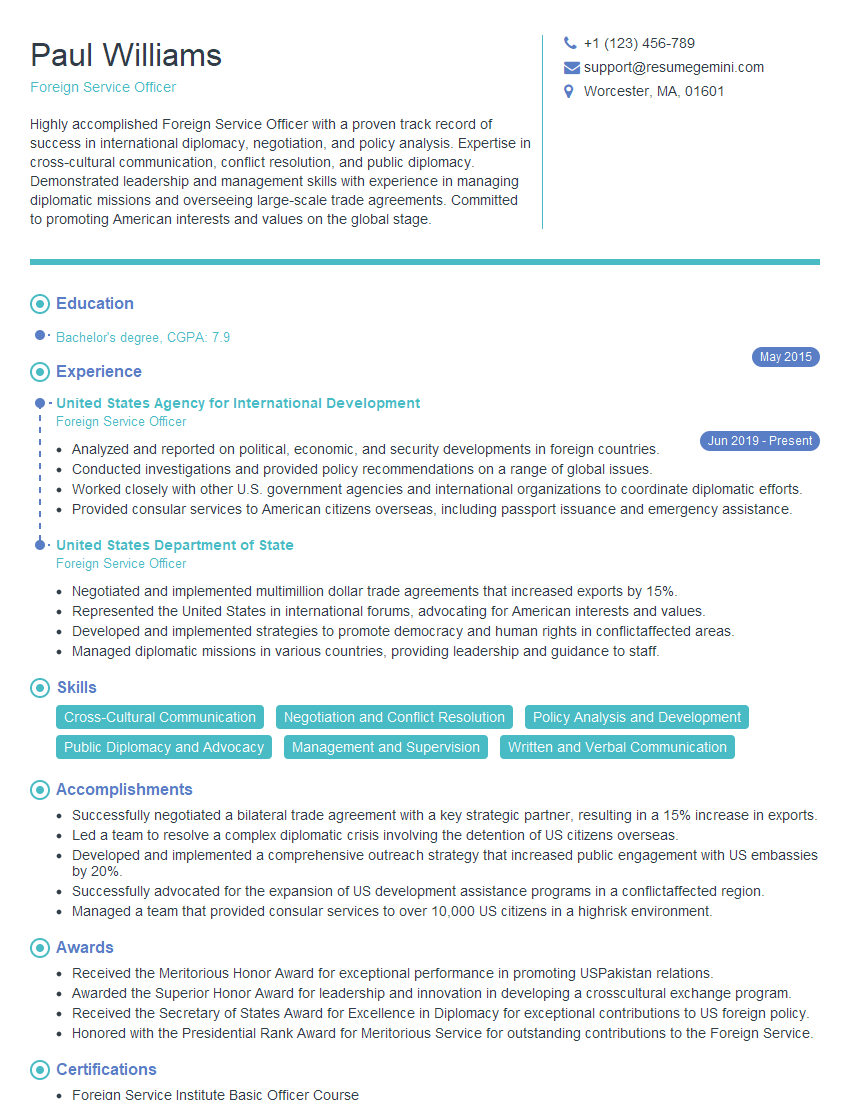
Mastering International Diplomacy opens doors to a rewarding career with significant global impact, offering opportunities for shaping international policy, promoting peace and cooperation, and contributing to a more interconnected world. To significantly enhance your job prospects, creating a strong, ATS-friendly resume is crucial. ResumeGemini can be your trusted partner in this process. We provide the tools and resources to build a professional resume that highlights your unique skills and experience. Examples of resumes tailored to International Diplomacy are available to guide you. Start building your winning resume with ResumeGemini today!
Explore more articles
Users Rating of Our Blogs
Share Your Experience
We value your feedback! Please rate our content and share your thoughts (optional).
What Readers Say About Our Blog
To the interviewgemini.com Webmaster.
Very helpful and content specific questions to help prepare me for my interview!
Thank you
To the interviewgemini.com Webmaster.
This was kind of a unique content I found around the specialized skills. Very helpful questions and good detailed answers.
Very Helpful blog, thank you Interviewgemini team.