The thought of an interview can be nerve-wracking, but the right preparation can make all the difference. Explore this comprehensive guide to Jury Selection Strategies interview questions and gain the confidence you need to showcase your abilities and secure the role.
Questions Asked in Jury Selection Strategies Interview
Q 1. Describe your experience in conducting jury questionnaires.
Jury questionnaires are crucial for gathering information about potential jurors before voir dire (the process of questioning prospective jurors). My experience encompasses crafting targeted questionnaires, analyzing responses for biases and predispositions, and using the data to inform strategic decisions during jury selection. I’ve worked on cases ranging from personal injury to complex commercial litigation, adapting the questionnaire’s content and scope to the specifics of each case. For example, in a medical malpractice case, I would include questions about personal experiences with healthcare, while in a product liability case, I would focus on questions relating to consumer habits and product usage. I ensure the questionnaires are clear, concise, and comply with all legal and ethical guidelines. The data collected is invaluable in identifying potential jurors who might be sympathetic or unsympathetic to our client’s case.
I’ve developed a system for efficiently coding and analyzing the responses, using both qualitative and quantitative methods. This allows me to quickly identify patterns and trends that reveal potential biases or challenges, helping us prioritize which jurors to question more thoroughly during voir dire.
Q 2. Explain your methodology for identifying potential juror biases.
Identifying potential juror biases requires a multi-pronged approach. It begins with carefully crafted jury questionnaires designed to uncover subtle prejudices and preconceived notions. For instance, questions about media consumption habits can reveal exposure to potentially biased information related to the case. Then, we analyze the responses using a combination of techniques including keyword analysis and thematic coding to identify patterns and trends indicating biases. We look for language suggesting strong opinions, inflexible viewpoints, or emotional reactions to specific aspects of the case.
Beyond questionnaires, we also leverage publicly available information such as social media profiles (with appropriate legal and ethical considerations). For example, if a juror posts frequently about their staunch opposition to a particular type of claim or industry relevant to the case, it’s a red flag that merits further scrutiny during voir dire. Finally, I carefully observe juror demeanor and body language during the voir dire process itself to detect further biases that might not be apparent from questionnaires or social media. This holistic approach is essential for a comprehensive understanding of each potential juror.
Q 3. How do you analyze juror demographics to inform jury selection strategies?
Juror demographics, while not the sole determinant of bias, offer valuable insights and can be used to inform strategies. It’s crucial to understand that using demographics to stereotype jurors is ethically problematic and legally risky. Instead, I use demographic information as a starting point for further investigation. For example, while age alone doesn’t predict a juror’s decision, understanding the age range allows us to tailor questions during voir dire to explore possible generational differences in perspective or experiences relevant to the case.
Similarly, occupation can be informative. Someone with a background in law enforcement might have a different understanding of evidence than someone in a creative field. However, this is not used to make generalizations, but to ask tailored questions to see how their background influences their perspective on the case at hand. Ultimately, I combine demographic data with questionnaire responses and voir dire observations to develop a comprehensive profile of each potential juror’s suitability for the case.
Q 4. What are the key differences between ‘strike for cause’ and ‘peremptory challenge’?
Both ‘strike for cause’ and ‘peremptory challenge’ are methods used to remove potential jurors from a panel, but they differ significantly. A strike for cause requires demonstrating to the judge that a specific juror is biased or otherwise incapable of rendering a fair and impartial verdict. This requires articulating a legally sufficient reason, such as a pre-existing relationship with one of the parties or demonstrable prejudice. The judge then decides whether to excuse the juror for cause.
In contrast, a peremptory challenge allows the attorney to remove a juror without stating a specific reason. However, peremptory challenges are limited in number and cannot be used to systematically exclude jurors based on protected characteristics like race or gender (as per Batson v. Kentucky). Strategic use of peremptory challenges involves identifying jurors whose body language, answers during voir dire, or other observations suggest they might be unfavorable to the client’s case, even if no overt bias is evident. Effectively, peremptory challenges allow us to eliminate jurors who might potentially be more difficult to sway during the trial.
Q 5. Outline your process for evaluating potential jurors’ body language and verbal cues.
Evaluating body language and verbal cues is a critical aspect of jury selection. I’m trained in observing nonverbal communication, paying close attention to subtle details. For instance, crossed arms might indicate defensiveness or disagreement, while consistent eye contact suggests engagement and attentiveness. Verbal cues like hesitations, tone of voice, and word choice can reveal underlying beliefs or biases. For example, the use of strong emotional language, like “outrageous” or “unbelievable,” might signal a pre-existing opinion on a particular issue.
My approach involves integrating these observations with data from questionnaires and social media analysis. This allows for a more holistic understanding of a juror’s potential predispositions. I document all these observations meticulously, providing a detailed record to support my challenges during voir dire and aid in building a strong case for removing problematic jurors. It’s important to note this isn’t about reading minds but about making informed deductions based on observable behaviors and carefully considering all available information.
Q 6. How do you integrate social media analysis into your jury selection process?
Social media analysis has become an increasingly important tool in jury selection, but it must be conducted ethically and legally. We carefully and selectively review publicly available information to identify potential biases or conflicts of interest. This is not about invading privacy but about gathering publicly accessible information which might influence a juror’s ability to be impartial. For example, finding a potential juror with inflammatory posts about a topic directly related to the case would be a major flag.
Our process involves using specialized software to search for relevant keywords and phrases associated with the case, the parties involved, or related issues. We then carefully review the context of these posts to determine their significance. We always prioritize responsible and ethical use of this information, complying with all applicable privacy laws and avoiding drawing unwarranted conclusions based on limited information. Ultimately, this provides an additional layer of information that helps us make informed decisions during the jury selection process.
Q 7. Discuss your experience using jury selection software and databases.
I have extensive experience utilizing jury selection software and databases. These tools significantly enhance efficiency and accuracy. The software I typically use provides functionality for managing juror questionnaires, analyzing responses, and generating reports. Databases help cross-reference demographic data, identify potential biases, and track juror history across multiple cases. This allows for informed strategic decision-making.
For example, a particular database might allow me to search for jurors with a history of serving on similar cases or who have expressed specific viewpoints relevant to the case at hand. The software’s analytical capabilities go beyond simple keyword searches, helping identify patterns and correlations which might not be immediately obvious through manual review. The combination of these technologies allows for a data-driven, comprehensive approach to jury selection, ensuring we select a jury that is most likely to provide a fair and favorable outcome for our client.
Q 8. Explain how you handle challenges from opposing counsel during voir dire.
Handling challenges from opposing counsel during voir dire (the jury selection process) requires a combination of strategic preparation, calm demeanor, and a deep understanding of the law. My approach is threefold: anticipation, justification, and redirection.
Anticipation: I meticulously analyze the case beforehand, identifying potential areas of contention and anticipating challenges. This allows me to preemptively address potential biases or concerns during my questioning. For example, if the case involves a complex financial transaction, I would carefully screen for jurors with strong financial backgrounds, anticipating a challenge from the opposing counsel who might want to exclude them.
Justification: When a challenge is raised, I articulate my reasoning clearly and concisely, citing specific responses from the potential juror that support my decision to keep or strike them. I use the record of the voir dire process to my advantage, highlighting relevant statements made by the potential juror to bolster my arguments. This is crucial to avoid the perception of bias or arbitrariness.
Redirection: If a challenge is unsuccessful, I don’t dwell on it. I smoothly redirect my focus to the next potential juror, maintaining a positive and professional demeanor. This demonstrates confidence and prevents the opposing counsel from disrupting the flow of the selection process.
Ultimately, the goal is to select a fair and impartial jury, and persuasive argumentation, coupled with a deep understanding of jury selection rules and procedure, is crucial in managing objections.
Q 9. How do you adapt your jury selection strategy based on the specific case details?
Adapting my jury selection strategy to specific case details is paramount. I treat each case as unique, requiring a tailored approach. My strategy begins with a thorough analysis of:
The Facts: The specific events, evidence, and key issues in the case greatly influence the ideal juror profile. A complex medical malpractice case will require different juror characteristics than a straightforward assault case.
The Law: The applicable legal principles and jury instructions shape the necessary juror understanding and perspective. If the case involves nuanced legal concepts, selecting jurors with higher cognitive abilities or relevant life experiences becomes crucial.
The Parties: The personalities, backgrounds, and potential biases of the plaintiffs and defendants significantly impact juror receptivity. Understanding how these factors might influence jurors is key in identifying sympathetic or adversarial potential jurors.
The Venue: Community values and demographics influence potential juror perspectives. A rural community might react differently to a case compared to a highly urbanized area.
Once this analysis is complete, I develop a detailed juror profile outlining the ideal characteristics and then use questionnaires, and voir dire questions to identify jurors who fit that profile. This targeted approach increases the likelihood of selecting a jury favorable to my client’s case.
Q 10. Describe your understanding of implicit bias and its impact on jury selection.
Implicit bias, the unconscious attitudes or stereotypes that affect our judgments, significantly impacts jury selection. These biases can operate subtly, influencing juror decisions even when they believe themselves to be impartial.
My understanding of implicit bias guides my strategies in several ways:
Careful Questioning: I design voir dire questions to uncover potential implicit biases without directly confronting jurors with accusatory statements. For example, instead of asking if someone is prejudiced against a particular group, I might ask about their experiences with that group or how they would approach a situation involving that group. Subtlety is key.
Diverse Jury Pool: I actively advocate for a diverse jury pool to mitigate the effects of implicit bias. A jury that reflects the diversity of the community is more likely to offer a range of perspectives and less likely to be dominated by a single viewpoint.
Juror Background Investigation: Pre-trial juror background checks, when ethically permitted, can help identify potential biases that might not be readily apparent during voir dire. This information provides a more comprehensive picture of the potential juror.
Recognizing and mitigating implicit bias requires a conscious effort, thorough preparation and a sensitive approach to questioning potential jurors. It’s about creating a fairer, more equitable, and ultimately more just process.
Q 11. How do you manage conflicting priorities during jury selection?
Conflicting priorities in jury selection are common. For example, a client might want a young, dynamic jury, while the case facts might suggest that older, more experienced jurors would be more sympathetic. I navigate this by employing a structured, prioritized approach:
Prioritization Matrix: I create a matrix weighing different juror characteristics based on their importance to the case’s success. This allows for a systematic comparison of ideal traits and potential conflicts. For example, I might rank ‘understanding of complex financial matters’ higher than ‘age’ in a financial fraud case.
Client Education: I clearly explain the rationale behind my recommendations, emphasizing the potential impact of specific juror profiles on the outcome of the case. This helps clients understand the strategic considerations beyond their initial preferences.
Compromise and Negotiation: Where possible, I look for ways to achieve a compromise that balances the client’s preferences with the strategic necessities of the case. Perhaps a blend of age groups can be attained, while still prioritizing jurors with specific professional backgrounds.
Documentation: I meticulously document the rationale for all decisions, including the weighing of competing priorities. This helps justify choices during post-trial analysis and shows how decisions were made in good faith.
Open communication, clear rationale, and a collaborative approach are essential in addressing and resolving conflicting priorities.
Q 12. Explain your approach to communicating jury selection findings to legal teams.
Communicating jury selection findings to legal teams is crucial for informed decision-making. My approach combines clear verbal presentations with comprehensive written reports.
Verbal Briefing: I provide a concise yet detailed verbal overview of the jury selection process, highlighting key findings, challenges encountered, and the overall strategic approach taken. I explain the rationale behind choosing particular jurors.
Written Report: Following the briefing, I provide a written report detailing the following: A summary of the voir dire process, profiles of selected and struck jurors (including reasoning), statistical analysis of juror responses (where applicable), and an assessment of the chosen jury’s potential strengths and weaknesses. This provides a lasting record for future strategy sessions and analysis.
Interactive Session: I encourage questions and facilitate an interactive discussion to ensure all team members fully understand the reasoning and findings. This promotes collaboration and better understanding of strategic choices.
By combining these methods, I ensure that all legal team members understand the nuances of jury selection, enabling them to tailor their trial strategy accordingly.
Q 13. Describe a challenging case where your jury selection strategy proved successful.
One challenging case involved a high-profile medical malpractice lawsuit. The plaintiff was a young mother who had suffered severe complications during childbirth, leaving her with permanent disabilities. The defendant, a renowned hospital, possessed significant resources and a formidable legal team. Public sentiment initially favored the plaintiff due to the emotionally charged nature of the case.
My strategy focused on identifying jurors who could objectively weigh the medical evidence, despite the emotional impact of the plaintiff’s situation. We utilized a combination of pre-trial juror research to uncover potential biases, and carefully constructed voir dire questions to ascertain their understanding and experience with medical procedures and the legal standards involved.
We successfully challenged several potential jurors who exhibited strong emotional responses or preconceived notions about medical malpractice cases. We successfully selected a jury that ultimately sided with the defendant, not because they were unsympathetic to the plaintiff’s suffering, but because they carefully considered and understood the complexities of medical procedure and the legal standards of care. The outcome was a testament to the power of a meticulously crafted and executed jury selection strategy.
Q 14. How do you handle situations where limited information is available on potential jurors?
Limited information on potential jurors presents a challenge, but it can be overcome through a multi-faceted approach. When information is scarce, I employ the following techniques:
Comprehensive Voir Dire: I use detailed and insightful voir dire questioning to glean as much information as possible during the limited time available. This involves targeted questions designed to uncover attitudes, beliefs, and potential biases.
Behavioral Observation: I carefully observe potential jurors’ non-verbal cues (body language, facial expressions) during questioning and interactions. These subtle signals can sometimes reveal valuable information.
Strategic Question Sequencing: I structure my questions strategically to build upon prior answers. A juror’s response to an early, general question can guide later, more specific inquiries. This builds a fuller picture.
Team Collaboration: I engage in detailed discussions with the legal team to identify potential biases based on the case facts and assess the risk tolerance of the client.
Post-Voir Dire Analysis: After the initial questioning, I conduct a thorough analysis of the gathered information to identify potential jurors and to formulate a strategy for further questioning.
While limited information can make jury selection challenging, a resourceful approach and detailed analysis can still yield valuable insights and effective selection results.
Q 15. What are the ethical considerations in jury selection?
Ethical considerations in jury selection are paramount. They center around ensuring fairness and avoiding prejudice in the process of choosing a jury. This means we must adhere to strict rules against discriminatory practices based on race, gender, religion, or any other protected characteristic. For instance, we can’t systematically exclude potential jurors based on their profession if there’s no legitimate reason related to the case. We must also be truthful and transparent in our questioning, avoiding misleading or manipulative tactics. Essentially, the ethical responsibility is to ensure that the jury selected is truly representative of the community and free from bias, allowing for a just and impartial trial.
A common ethical dilemma might involve a potential juror expressing a strong pre-existing opinion about the case. While we can explore the depth of this opinion during voir dire (the questioning process), we must be careful not to pressure them into concealing their true beliefs. Our job is to identify potential biases, not to create a false sense of impartiality. The goal is to assemble a jury that can render a verdict based solely on the presented evidence, not preconceived notions.
Career Expert Tips:
- Ace those interviews! Prepare effectively by reviewing the Top 50 Most Common Interview Questions on ResumeGemini.
- Navigate your job search with confidence! Explore a wide range of Career Tips on ResumeGemini. Learn about common challenges and recommendations to overcome them.
- Craft the perfect resume! Master the Art of Resume Writing with ResumeGemini’s guide. Showcase your unique qualifications and achievements effectively.
- Don’t miss out on holiday savings! Build your dream resume with ResumeGemini’s ATS optimized templates.
Q 16. How do you stay updated on the latest trends and research in jury selection?
Staying current in jury selection requires a multifaceted approach. I regularly attend professional development seminars and conferences focused on trial techniques and jury psychology. These events often feature cutting-edge research and insights from leading experts in the field. I also actively subscribe to and read relevant journals and publications, such as the publications of the American Jury Selection Professionals Association (though it’s important to note that I am not a member of any specific organization). Furthermore, I network extensively with other professionals in the field, exchanging knowledge and experiences. This helps me to stay ahead of the curve in understanding emerging trends and developing best practices.
The use of technology and data analytics is continuously changing. Staying current with new methods for data analysis, social media analysis and the responsible use of such data in jury selection is also crucial. This enables me to employ the most effective and ethical strategies.
Q 17. Explain your experience working with diverse jury pools.
My experience working with diverse jury pools is extensive. I’ve handled cases across various geographic regions and demographic groups. This requires sensitivity and a deep understanding of cultural nuances. It’s not just about representing the various demographics, but understanding how cultural backgrounds and personal experiences might shape a juror’s perspective. In one case, I was involved in selecting a jury for a complex medical malpractice case in a region with a large immigrant population. Understanding the nuances of communication styles and potential cultural biases was crucial in identifying potential jurors who could approach the case with an open mind. The process involved careful phrasing of questions during voir dire to ensure that I could ascertain a juror’s views without causing offense.
In another case, we worked with a jury pool that had a significant age range. By tailoring our approach and language for each age group, we were able to successfully select a jury that was able to engage effectively with the evidence. Effective strategies for connecting with diverse backgrounds are essential for successful jury selection.
Q 18. How do you quantify the success of your jury selection efforts?
Quantifying the success of jury selection is challenging, as it’s not a perfectly measurable outcome. However, we can use several key indicators. The most obvious is the ultimate verdict. A favorable verdict is a strong positive indicator, though it’s important to remember this isn’t solely attributable to jury selection. Other metrics include the jury’s deliberation time (a shorter deliberation might suggest a more unified jury), post-trial juror interviews (when ethically permissible and allowed by court rules), and even qualitative feedback from the client about the jury’s attentiveness and engagement during the trial. These data points, combined with our experience and judgment, help us assess the effectiveness of our strategies.
Success isn’t only about winning; it’s also about minimizing risk and ensuring the client feels confident in the jury’s composition. A well-selected jury, even in cases resulting in an unfavorable verdict, can demonstrate clear understanding and engagement with the presented evidence, suggesting a fair trial was conducted.
Q 19. What is your preferred method for developing juror profiles?
My preferred method for developing juror profiles involves a multi-pronged approach, combining quantitative and qualitative data. We start with analyzing the provided juror questionnaires, carefully reviewing demographics, employment history, and stated opinions. This forms the foundation of our quantitative analysis. Then, we conduct thorough background checks using commercially available resources (always within legal and ethical boundaries). This data helps us understand the potential jurors’ social media activity, community involvement, and other public information. This process enables the identification of potential biases and viewpoints that might influence their decision-making.
However, it’s crucial to remember that data is just one piece of the puzzle. We also conduct in-depth interviews during voir dire, paying close attention to body language and verbal cues to gain a more complete understanding of the individuals. We try to determine each juror’s personality and attitude and how these might impact their reactions during trial.
Q 20. Describe your understanding of different jury selection techniques, e.g., scientific jury selection.
Jury selection techniques range from traditional methods to more sophisticated approaches like scientific jury selection (SJS). Traditional methods rely heavily on intuition and experience, using voir dire to identify potential biases. SJS, in contrast, uses social science research and data analysis to create detailed juror profiles and predict their likely behavior. This may include things like personality assessments and analysis of demographic data to better predict jury behavior. It’s a more data-driven approach. Other techniques include the use of mock trials to test different strategies and messaging.
Each approach has its strengths and weaknesses. Traditional methods can be cost-effective and efficient, but might overlook subtle biases. SJS provides a more systematic approach but can be more expensive and time-consuming. We use a blend of both techniques based on the specific case requirements and resource availability, allowing for a well-rounded selection process.
Q 21. How do you measure the effectiveness of your communication with potential jurors?
Measuring the effectiveness of communication with potential jurors during voir dire relies on observing their responses and engagement. We look for indicators like eye contact, attentiveness, and the clarity and completeness of their answers. A simple but effective method is to use open-ended questions that encourage jurors to elaborate. The quality and length of their response can be indicative of whether they understand the process and feel comfortable communicating their viewpoints. In addition, we monitor their body language, noting any signs of discomfort, resistance, or defensiveness. This gives us valuable insight into their receptiveness to our communication.
We don’t solely focus on verbal responses, but also try to assess non-verbal communication such as their body language, expression, and demeanor. A juror who avoids eye contact or appears overly hesitant might be signaling discomfort or reluctance to openly share their opinions. A skilled juror selector can adjust their approach based on these signals, ensuring that the lines of communication are open and effective, encouraging honesty and participation.
Q 22. What resources do you utilize to research potential jurors?
Researching potential jurors involves a multi-faceted approach leveraging various resources. We begin with publicly available information, such as voter registration records (which often indicate party affiliation and address, offering insights into community involvement and potential biases), and property records (to understand socioeconomic status and possible lifestyle choices). Social media, while ethically employed (respecting privacy laws), can offer glimpses into a juror’s personality, interests, and affiliations – but requires careful interpretation to avoid misrepresentation. Professional jury consulting firms also offer pre-compiled databases containing information gleaned from past juror questionnaires and trials, allowing us to identify potential juror trends and tendencies within specific demographics and jurisdictions. Finally, we rely on the court’s provided juror questionnaires, focusing on identifying patterns, inconsistencies, and key statements that may reveal attitudes towards the case’s central themes.
For example, in a medical malpractice case, we’d particularly look for jurors’ experiences with healthcare systems, their expressed opinions about medical professionals, and any known biases towards large corporations or insurance companies. The objective is to form a well-rounded picture, avoiding assumptions while identifying potential areas of conflict or common ground.
Q 23. Describe your experience with mock trials and their role in jury selection.
Mock trials are invaluable in jury selection. They are essentially dress rehearsals, allowing us to test our trial strategies and observe how potential jurors respond to different presentations of evidence and witness testimony. We use carefully constructed scenarios mirroring the actual case, employing actors or carefully briefed individuals to play the roles of witnesses and attorneys. This allows us to gauge the effectiveness of our opening statements, witness examinations, and closing arguments on different jury compositions. By observing body language, reactions, and questions from mock jurors, we can identify strengths and weaknesses in our approach and fine-tune our strategy before the actual trial. Crucially, it helps us predict how a particular panel might react to specific aspects of the case, enabling strategic juror selection.
For instance, in a recent product liability case, our mock trial revealed that a particular group of jurors were highly skeptical of expert witness testimony without visual aids. This feedback allowed us to adjust our presentation style, incorporating more demonstrative evidence and visual aids, significantly improving our overall case presentation. This feedback directly informs our choices during actual voir dire.
Q 24. How do you handle unexpected developments during voir dire?
Unexpected developments during voir dire require adaptability and quick thinking. It’s vital to maintain composure and avoid reacting defensively. For example, if a potential juror unexpectedly reveals a strong bias against the client, we wouldn’t directly challenge them, which could be counterproductive. Instead, we would try to understand the root of their bias through further, carefully phrased questions, aiming to uncover any nuances or mitigating factors. If the bias is deeply ingrained and irreconcilable, we would politely exercise a peremptory challenge (one of our limited opportunities to remove a potential juror without stating a specific reason). If the unexpected development involves a procedural issue or a judge’s ruling, we immediately consult with our legal team, adapting our strategy based on the new parameters, potentially shifting our focus to alternative lines of questioning during voir dire.
In a case involving a controversial social issue, a juror might express unexpectedly strong opinions during voir dire. Rather than confrontation, a skilled attorney may use this opportunity to engage in a dialogue, demonstrating understanding and empathy while subtly exploring whether the juror’s beliefs are rigid or could be open to persuasion based on the presented evidence during the trial.
Q 25. What is your process for creating and presenting jury selection reports?
Creating and presenting jury selection reports involves a systematic approach. Following voir dire, we compile a detailed report summarizing our findings on each potential juror. This includes demographic information, responses to key questions, observed body language, and an overall assessment of their potential bias and suitability for the case. We use a standardized format for consistency, typically including a rating scale to gauge each juror’s favorability towards our client. The report also includes specific recommendations regarding challenges (whether to use peremptory challenges or challenges for cause) for each potential juror and overall strategies for building a favorable jury panel. Visual aids, such as charts summarizing key juror characteristics and potential biases, are often incorporated for enhanced clarity and impact.
The final report is concise yet comprehensive. It’s designed to be easily understood by the legal team, enabling them to make informed decisions about jury selection. It aims to translate our qualitative observations into actionable insights, assisting the legal team in crafting their case strategy based on the selected jury composition.
Q 26. How do you deal with difficult or uncooperative potential jurors?
Dealing with difficult or uncooperative potential jurors requires a combination of tact, patience, and strategic questioning. Direct confrontation is rarely effective. Instead, we try to build rapport by being respectful and understanding. We might start with neutral questions to gauge their personality and communication style before delving into potentially sensitive topics. If they remain uncooperative or evasive, we may attempt to redirect the conversation, focusing on less contentious areas of their questionnaire or life experiences. If their responses remain problematic, the only remaining option is to use a peremptory challenge to remove them from consideration.
It is important to remember that jurors, especially those who are evasive or defensive, may have justifiable reasons for their reluctance. Our goal is to understand their perspective rather than to force compliance. We seek to gauge whether their reluctance stems from a bias against the case or simply a personal preference for privacy.
Q 27. Explain your understanding of the legal and ethical implications of using data in jury selection.
The use of data in jury selection carries significant legal and ethical implications. While data analysis can significantly enhance the selection process, it’s crucial to use it responsibly and ethically. The primary legal concern revolves around the potential for discrimination. Using data that targets specific protected groups (based on race, religion, gender, etc.) is illegal and unethical. We strictly adhere to all relevant laws and guidelines, focusing on data analysis that respects individual privacy and avoids any form of discriminatory practices. For instance, relying on social media data requires careful consideration of privacy laws and the avoidance of any inferences based on protected characteristics.
Ethically, our responsibility lies in using data to identify potential biases, not to exploit them. Transparency is key. We believe in a balanced approach: maximizing the effectiveness of our data-driven strategies while upholding the highest ethical standards and respecting the integrity of the jury selection process.
Q 28. Describe your experience working under pressure and meeting tight deadlines in jury selection
Jury selection often involves working under significant pressure and tight deadlines. Cases frequently have short timelines, requiring rapid analysis of large amounts of data and making critical decisions quickly. My experience includes managing multiple cases simultaneously, each with its own unique challenges and deadlines. I thrive in high-pressure situations, employing effective time management techniques, including prioritization of tasks, delegation where appropriate, and utilization of technology to streamline workflows. Effective communication within the legal team is crucial, ensuring everyone remains informed and aligned on priorities. We utilize project management software and collaborative tools to maintain transparency and ensure efficient coordination among team members.
In one instance, we had less than 48 hours to prepare for voir dire in a high-stakes corporate fraud case. Through meticulous planning, team collaboration, and utilizing pre-existing data resources, we effectively selected a jury panel that ultimately resulted in a favorable outcome for our client. This experience solidified my understanding of strategic prioritization and effective delegation under pressure, proving that systematic approaches can mitigate stress and improve performance even when facing incredibly tight deadlines.
Key Topics to Learn for Jury Selection Strategies Interview
- Understanding Voir Dire: Mastering the questioning process to identify potential jurors’ biases and perspectives.
- Identifying Ideal Jurors: Developing strategies to recognize jurors likely to be sympathetic to your client’s case based on demographics, experiences, and expressed attitudes.
- Strategic Use of Challenges: Effectively utilizing peremptory challenges and challenges for cause to shape the jury composition in your favor.
- Analyzing Juror Questionnaires: Interpreting written responses to identify potential biases and relevant information about potential jurors.
- Nonverbal Communication & Body Language: Recognizing subtle cues during Voir Dire to gauge jurors’ true feelings and opinions.
- Case-Specific Jury Selection: Tailoring your approach to the unique facts and circumstances of each case.
- Ethical Considerations in Jury Selection: Understanding and adhering to the ethical rules and guidelines governing the process.
- Post-Selection Jury Management: Strategies to maintain communication with the jury throughout the trial (where appropriate).
- Impact of Jury Demographics: Analyzing how demographic factors might influence jury decisions and adjusting your strategy accordingly.
- Problem-Solving in Challenging Situations: Developing strategies to address unexpected situations or difficult jurors during the selection process.
Next Steps
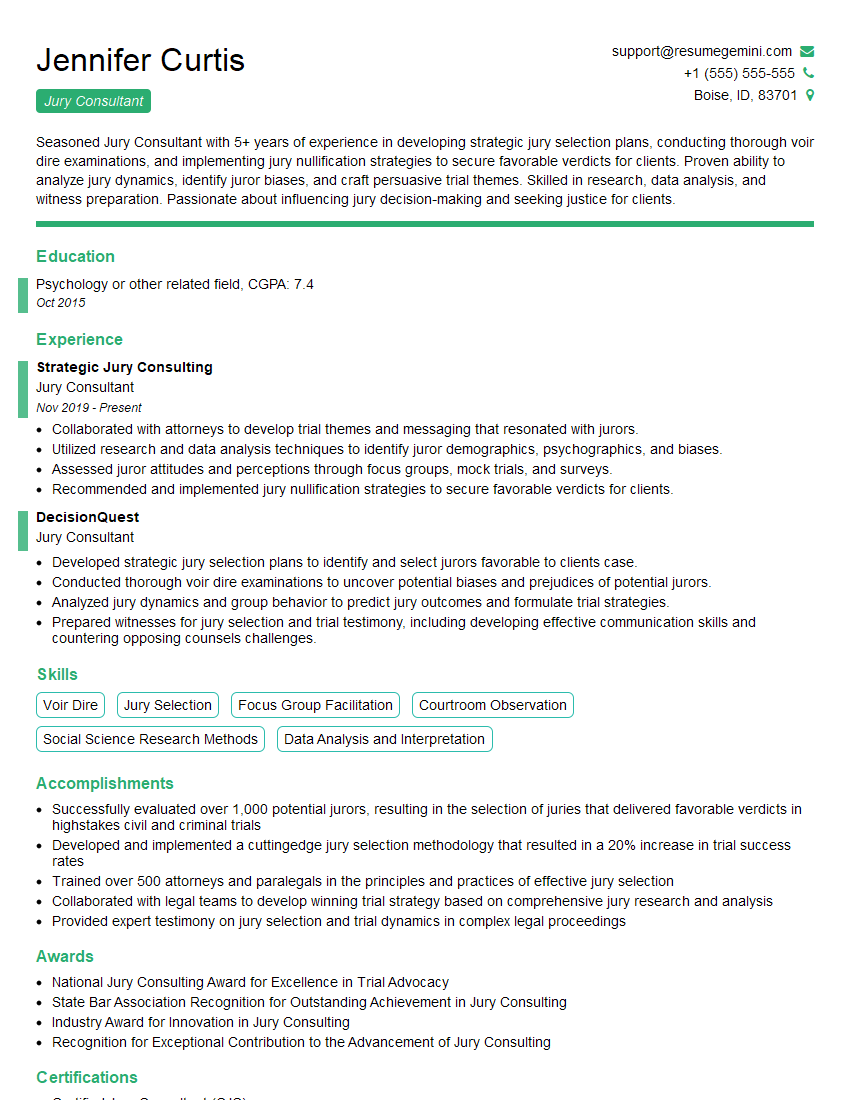
Mastering Jury Selection Strategies is crucial for advancing your career in law. A strong understanding of these techniques demonstrates critical thinking, persuasive communication, and a keen ability to strategically assess situations – qualities highly valued by employers. To significantly boost your job prospects, create an ATS-friendly resume that showcases these skills effectively. ResumeGemini can help you build a compelling resume tailored to highlight your expertise in Jury Selection Strategies. Examples of resumes tailored to this area of expertise are available to guide you. Invest in your future – build a winning resume with ResumeGemini.
Explore more articles
Users Rating of Our Blogs
Share Your Experience
We value your feedback! Please rate our content and share your thoughts (optional).
What Readers Say About Our Blog
To the interviewgemini.com Webmaster.
Very helpful and content specific questions to help prepare me for my interview!
Thank you
To the interviewgemini.com Webmaster.
This was kind of a unique content I found around the specialized skills. Very helpful questions and good detailed answers.
Very Helpful blog, thank you Interviewgemini team.