The right preparation can turn an interview into an opportunity to showcase your expertise. This guide to Knowledge of Plumbing and HVAC Systems interview questions is your ultimate resource, providing key insights and tips to help you ace your responses and stand out as a top candidate.
Questions Asked in Knowledge of Plumbing and HVAC Systems Interview
Q 1. Explain the difference between a heat pump and a furnace.
The key difference between a heat pump and a furnace lies in how they heat your home. A furnace burns fuel (natural gas, propane, or oil) to generate heat, which is then distributed through ductwork. Think of it like a big, controlled bonfire in your basement. It’s simple and effective but less energy-efficient. A heat pump, on the other hand, acts more like a refrigerator in reverse. It absorbs heat from the outside air (even in cold weather) and transfers it inside, using electricity. While they might not work as well in extremely cold climates, they are far more energy-efficient than furnaces because they move heat rather than generate it.
Consider this: if you live in a mild climate with average winter temperatures, a heat pump would likely save you money on your energy bills. However, in areas with extremely cold winters, a furnace might be a more reliable choice, although supplemental electric resistance heating might be necessary in the heat pump.
Q 2. Describe the function of a condensate pump.
A condensate pump is a small, but crucial, component found in high-efficiency furnaces and air conditioners, particularly those with condensing units. These units produce condensate (water vapor that condenses due to the cooling process). The condensate pump’s job is to remove this water from the unit and safely pump it to a drain line. Without it, the condensate could overflow, causing water damage and potentially creating a breeding ground for mold.
Imagine it like this: your air conditioner is like a cold glass on a humid day. The moisture in the air condenses on the cold coils, and this needs to be removed to keep things working smoothly. The condensate pump is the system’s little plumber, quietly ensuring that the water gets disposed of properly.
Q 3. What are the common causes of a low-water pressure issue?
Low water pressure is a common plumbing problem with several potential causes. The most frequent culprits include:
- Clogged pipes: Mineral deposits or debris can restrict water flow. This is especially common in older homes with corroded pipes.
- Faulty pressure regulator: This device maintains consistent water pressure; if it malfunctions, pressure can drop.
- Leaks: Leaks anywhere in the system—from a dripping faucet to a hidden underground pipe break—reduce available water pressure.
- Low water main pressure: Sometimes the problem originates from the municipal water supply itself. This is usually noticeable across a wider area.
- Air in the lines: Air pockets can obstruct water flow and cause fluctuating pressure.
Identifying the source requires systematic investigation. You might need to check your water meter for leaks, look for obvious signs of leaks throughout the house, and even contact your local water utility to check main pressure.
Q 4. How do you troubleshoot a clogged drain?
Troubleshooting a clogged drain involves a methodical approach. First, try the simplest methods:
- Boiling water: Pour a kettle of boiling water down the drain to melt grease and soap buildup.
- Plunger: Use a sturdy plunger to create suction and dislodge the clog.
- Baking soda and vinegar: Pour a cup of baking soda followed by a cup of vinegar down the drain; the fizzing reaction can help break down organic clogs. Let it sit for 30 minutes then flush with hot water.
If these don’t work, you may need more aggressive tools:
- Drain snake/auger: This flexible tool can reach and break up clogs further down the pipe.
- Chemical drain cleaner (use cautiously): Chemical drain cleaners can be effective but can damage pipes if used frequently or incorrectly. Always follow the manufacturer’s instructions.
If the clog persists, it’s best to call a professional plumber, especially if you suspect a blockage beyond the reach of home remedies.
Q 5. Explain the different types of water heaters and their pros/cons.
Several types of water heaters exist, each with its own set of advantages and disadvantages:
- Tank water heaters: These store hot water in a tank. They are generally less expensive upfront but can be less efficient due to standby heat loss (the tank continuously losing heat even when not in use).
- Tankless water heaters (on-demand): These heat water only when needed. They are more energy-efficient, offer endless hot water, and have a smaller footprint. However, the upfront cost is higher, and they may not be suitable for homes with very high hot water demands.
- Heat pump water heaters: These use electricity and a refrigeration cycle to heat water, making them highly energy-efficient. They are a good choice for eco-conscious homeowners, but they have a higher initial cost and perform best in warmer climates.
- Solar water heaters: These use solar energy to heat water. They are environmentally friendly but require significant upfront investment and may not provide enough hot water on cloudy days or in colder climates.
Choosing the right water heater depends on your budget, energy needs, climate, and environmental concerns. A professional consultation can help you assess your specific requirements.
Q 6. What are the safety precautions when working with refrigerants?
Working with refrigerants requires strict adherence to safety procedures because many refrigerants are harmful or even deadly if inhaled or exposed to skin. Here are some key precautions:
- Proper ventilation: Always work in a well-ventilated area to prevent the buildup of refrigerant fumes. This is essential, as exposure can lead to various health issues.
- Personal protective equipment (PPE): Wear safety glasses, gloves, and appropriate respiratory protection, such as a respirator equipped with the correct filters.
- Refrigerant recovery and recycling: Never vent refrigerant into the atmosphere; it must be recovered and recycled in compliance with EPA regulations. Improper handling is both illegal and detrimental to the environment.
- Proper handling and disposal: Follow manufacturer’s instructions for handling and disposal of refrigerant cylinders and components.
- Training and certification: Before working with refrigerants, receive proper training and certification to ensure safe handling practices. Many states require specific licensing for HVAC technicians dealing with refrigerants.
Ignoring these precautions can lead to serious health consequences, environmental damage, and legal penalties.
Q 7. How do you identify and repair a leaky faucet?
Identifying and repairing a leaky faucet depends on the type of faucet. Here’s a general approach:
- Identify the source of the leak: Determine whether the leak is from the spout, handles, or base of the faucet. Carefully inspect each component.
- Turn off the water supply: Locate the shut-off valves under the sink and turn off both the hot and cold water supplies.
- Remove the faucet handle(s): Usually, there’s a small screw under a decorative cap that needs to be removed to access the handle. This will vary depending on the specific faucet design.
- Inspect the internal components: Once the handle is removed, you can see the internal parts, like O-rings, cartridges, or washers. These often wear out, causing leaks.
- Replace worn components: Replace any worn or damaged O-rings, washers, or cartridges with new ones of the same type and size. Carefully follow the manufacturer’s instructions or consult a diagram if available.
- Reassemble the faucet: Put everything back together, making sure that the parts are properly seated and tightened.
- Turn the water back on and test: Turn on the water and check for leaks. If the leak persists, you might need to repeat the process or consult a plumber.
If you are uncomfortable working with plumbing, calling a professional is always the safest option.
Q 8. Explain the principle of operation of a split-system air conditioner.
A split-system air conditioner works on the principle of refrigeration. It uses a refrigerant to transfer heat from the inside of a building to the outside. The system is ‘split’ because it has two main components: an indoor unit (evaporator) and an outdoor unit (condenser), connected by refrigerant lines.
Here’s how it works:
- Refrigerant in the indoor unit (evaporator): The refrigerant absorbs heat from the indoor air, evaporating and becoming a cool gas.
- Refrigerant lines: This cool gas travels through copper tubing (refrigerant lines) to the outdoor unit.
- Compressor in the outdoor unit (condenser): The compressor compresses the refrigerant gas, raising its pressure and temperature.
- Condenser coil in the outdoor unit: The hot, high-pressure refrigerant gas passes through the condenser coil, releasing heat to the outside air and condensing back into a liquid.
- Expansion valve: The liquid refrigerant then flows through an expansion valve, which reduces its pressure and temperature, preparing it to absorb more heat from the indoor air, restarting the cycle.
Think of it like a refrigerator, but reversed. The refrigerator removes heat from inside to keep food cold; the air conditioner moves heat from inside the building to the outside to keep the building cool.
Q 9. What are the different types of pipes used in plumbing systems?
Plumbing systems utilize various pipe materials, each suited to specific applications and pressures. The choice depends on factors like cost, durability, corrosion resistance, and the fluid being transported.
- Copper: Widely used for its durability, corrosion resistance, and ability to withstand high pressure. Ideal for hot and cold water lines.
- PVC (Polyvinyl Chloride): A cost-effective, lightweight plastic pipe suitable for cold water lines and drainage systems. It’s not ideal for high-temperature applications.
- CPVC (Chlorinated Polyvinyl Chloride): A stronger and more heat-resistant version of PVC, suitable for hot and cold water lines.
- PEX (Cross-linked Polyethylene): A flexible plastic pipe gaining popularity due to its ease of installation and resistance to freezing. Used for both hot and cold water lines.
- Cast Iron: Historically common for drainage and sewer lines, known for its strength but susceptible to corrosion. Less commonly used now due to its weight and cost.
- Galvanized Steel: Once popular but now less common due to corrosion concerns. Often found in older buildings.
For example, in a new residential build, you might see PEX used for the interior water lines because of its flexibility and ease of installation, while copper might be used for sections that experience higher pressures, such as the main water line.
Q 10. Describe the process of sizing an HVAC system for a building.
Sizing an HVAC system involves calculating the heating and cooling loads for a building to ensure optimal comfort and energy efficiency. It’s a critical step to avoid oversizing or undersizing the system, both of which can lead to problems.
The process involves several steps:
- Calculating the building’s heat load: This accounts for factors like climate, building materials, window size and type, insulation levels, and occupancy. Software tools and manual calculation methods exist for this.
- Calculating the building’s cooling load: This considers similar factors as the heat load, along with internal heat gains from appliances and people.
- Selecting the appropriate equipment: Once the loads are determined, an HVAC system (furnace, air conditioner, heat pump, etc.) with a capacity that matches the calculated loads is chosen. An oversized system will cycle on and off frequently, reducing efficiency and comfort. An undersized system will struggle to maintain the desired temperature.
- Ductwork design: The ductwork (air distribution system) must be appropriately sized to deliver the heated or cooled air efficiently throughout the building. Improper duct sizing can negate the benefits of a well-sized HVAC system.
- Load calculations should account for future changes such as additional insulation or changes in occupancy.
Professional engineers typically handle complex HVAC system sizing, employing specialized software to account for all variables involved.
Q 11. How do you identify and repair a gas leak?
Identifying and repairing a gas leak requires caution and adherence to safety procedures. Never attempt gas leak repair without proper training and certification. If you suspect a leak, evacuate the area immediately and call a qualified gas professional.
Identification:
- Smell: Natural gas has a distinct odor (mercaptan) added for safety. If you detect a rotten egg smell, suspect a leak.
- Hissing sound: A hissing sound near gas appliances or pipes can indicate a leak.
- Bubbles in soapy water: Apply soapy water to suspected leak points. Bubbles will form if gas is escaping.
Repair: Gas leak repair should only be undertaken by a certified professional. They will locate the leak using specialized equipment, shut off the gas supply, repair the leak, and test for leaks before restoring service.
Example: If you detect a gas leak near your stove, immediately turn off the gas supply at the meter or valve, evacuate the premises, and contact your gas company or a qualified gas technician.
Q 12. Explain the function of a pressure relief valve in a water heater.
The pressure relief valve (PRV) in a water heater is a crucial safety device designed to prevent dangerous pressure buildup inside the tank. Water expands as it heats, increasing pressure. If this pressure exceeds a safe limit, the PRV opens, releasing hot water and relieving the excess pressure.
Function: The PRV is a spring-loaded valve that remains closed under normal operating pressure. When the pressure inside the tank rises above the preset limit (usually around 150 psi), the spring is overcome, and the valve opens, allowing water to escape. This prevents the tank from rupturing, which could cause serious damage and injury.
Regular testing: It’s vital to test the PRV annually to ensure it’s functioning correctly. A simple way to do this is to gently lift the lever on the valve. If water doesn’t flow, the valve may be malfunctioning and requires professional attention.
Q 13. What are the common causes of a frozen pipe?
Frozen pipes occur when water inside the pipe freezes and expands, causing the pipe to crack or burst. This is most likely to happen during periods of extreme cold.
Common causes:
- Exposure to cold temperatures: Pipes located in uninsulated areas, such as exterior walls, attics, or crawl spaces, are particularly vulnerable.
- Lack of insulation: Inadequate insulation around pipes reduces their ability to resist freezing temperatures.
- Low water flow: Pipes with very little water flow are more susceptible to freezing because the water remains stationary, allowing it to freeze more easily.
- Leaks or drips: Even small leaks can freeze and further restrict the flow of water, increasing the risk of a larger freeze.
Example: Pipes running along an outside wall of a house without adequate insulation are highly susceptible to freezing during winter. Proper insulation and potentially heat tape can mitigate this risk.
Q 14. How do you test for air leaks in an HVAC system?
Testing for air leaks in an HVAC system is important for ensuring efficient operation and preventing energy waste. Air leaks can reduce airflow, decrease heating and cooling efficiency, and increase energy consumption.
Methods for detecting air leaks:
- Visual inspection: Check ductwork connections, seams, and registers for visible gaps or cracks.
- Smoke test: Introduce smoke into the ductwork to visualize air leakage. Smoke will escape through any leaks.
- Pressure testing: Use a pressure gauge to measure the pressure within the ductwork. A significant pressure drop over time indicates air leakage.
- Manometer testing: Use a manometer to measure the pressure difference across ductwork sections.
Repair: Once leaks are identified, they need to be sealed using appropriate materials, such as mastic sealant, metal tape, or insulation. The choice of material depends on the type of ductwork and the location of the leak.
Example: A pressure test revealing a significant drop in pressure in the supply ductwork may indicate multiple leaks requiring the repair of ductwork joints and sealing of gaps in the system.
Q 15. What are the different types of toilets and their flushing mechanisms?
Toilets come in various types, primarily differentiated by their flushing mechanisms. The most common are gravity-fed toilets, pressure-assisted toilets, and dual-flush toilets.
- Gravity-fed toilets: These rely on gravity to move water from the tank into the bowl. Water flows from the tank into the bowl, creating enough force to flush waste. They’re simple, reliable, and generally less expensive.
- Pressure-assisted toilets: These use compressed air to forcefully flush waste. A pressurized air chamber is part of the tank, and when flushed, this air forces water into the bowl with significantly more power, resulting in a more powerful flush, ideal for removing waste effectively. However, they are often more complex and expensive to repair.
- Dual-flush toilets: These offer a choice between a full flush and a half flush, conserving water. Two buttons or levers allow for different amounts of water to be used, depending on the waste volume. They’re environmentally friendly and can save on water bills over time.
Imagine a simple water slide (gravity-fed), a powerful water jet (pressure-assisted), or a water faucet with two settings (dual-flush) – each representing the different mechanisms and their strengths.
Career Expert Tips:
- Ace those interviews! Prepare effectively by reviewing the Top 50 Most Common Interview Questions on ResumeGemini.
- Navigate your job search with confidence! Explore a wide range of Career Tips on ResumeGemini. Learn about common challenges and recommendations to overcome them.
- Craft the perfect resume! Master the Art of Resume Writing with ResumeGemini’s guide. Showcase your unique qualifications and achievements effectively.
- Don’t miss out on holiday savings! Build your dream resume with ResumeGemini’s ATS optimized templates.
Q 16. Explain the principles of air balancing in HVAC systems.
Air balancing in HVAC systems ensures that the proper amount of air flows through each supply register in a building. It’s crucial for maintaining consistent temperatures and preventing some zones from being too hot or cold while others are improperly heated or cooled. Imbalance leads to discomfort and energy inefficiency.
The principle is based on adjusting dampers within the ductwork to equalize airflow. This involves measuring the airflow at each register using an anemometer and then adjusting dampers – either manually or using motorized dampers and control systems – to bring all measurements within an acceptable range. This process often involves careful calculation and consideration of ductwork design and system capacity.
For example, a poorly balanced system might have one room significantly warmer than another, even with the same thermostat setting. Air balancing ensures fair distribution, optimizing energy efficiency and occupant comfort.
Q 17. How do you troubleshoot a malfunctioning thermostat?
Troubleshooting a malfunctioning thermostat begins with a systematic approach. First, check the power supply – make sure the thermostat is receiving power. Then:
- Check the wiring: Loose wires or incorrect wiring can cause malfunctions. Inspect the wiring connections carefully and ensure they’re secure.
- Test the batteries (if applicable): Many thermostats use batteries for their display and operation. Replace them if necessary. Sometimes, the thermostat’s power could be low.
- Check the calibration: Compare the thermostat’s reading to a reliable thermometer in the same location. If there’s a significant difference, the thermostat may need recalibration or replacement.
- Verify the system’s mode: Ensure the system is set to the correct mode (heating or cooling).
- Inspect the furnace or AC unit: The thermostat itself might not be the problem. If the unit is not running, this indicates a system issue, requiring HVAC technician attention.
In a recent case, a customer’s thermostat showed a constant low temperature, despite a properly functioning furnace. The issue turned out to be a simple loose wire; tightening it immediately solved the problem.
Q 18. What are the common causes of low refrigerant in an HVAC system?
Low refrigerant in an HVAC system can stem from several causes:
- Leaks: The most common cause. Leaks can occur in various components, such as the condenser coils, evaporator coils, or even connections. These leaks might be microscopic and hard to detect.
- Improper installation: Incorrect installation can lead to leaks or inefficient refrigerant flow.
- Component failure: A faulty compressor, expansion valve, or other components can cause refrigerant loss.
- System aging: Over time, seals and components can wear out, increasing the likelihood of leaks.
Detecting low refrigerant requires specialized equipment, such as refrigerant leak detectors. Addressing the leak, whether through repair or component replacement, is crucial to restoring optimal system performance. A proper vacuum and recharge is necessary after a leak repair. Ignoring low refrigerant can damage the compressor and reduce system efficiency.
Q 19. Explain the difference between PVC and CPVC pipes.
PVC (Polyvinyl Chloride) and CPVC (Chlorinated Polyvinyl Chloride) are both types of plastic pipes commonly used in plumbing, but they have key differences:
- Temperature resistance: CPVC is designed for higher temperatures than PVC. PVC is suitable for cold water and some low-temperature applications, while CPVC can handle hot water and higher pressure. CPVC’s higher chlorine content provides superior heat resistance.
- Strength and durability: Both are relatively strong, but CPVC is generally considered more impact-resistant and durable, especially at higher temperatures. Think of CPVC as a more robust, high-temperature version of PVC.
- Cost: CPVC pipes are generally more expensive than PVC pipes.
- Applications: PVC is frequently used for drainage and wastewater systems. CPVC is often preferred for hot and cold water distribution systems in homes and buildings.
In short: Choose PVC for cold water applications or drainage where cost is a major factor; opt for CPVC for hot water distribution or applications needing higher temperature and pressure resistance.
Q 20. How do you determine the appropriate size of a water pipe?
Determining the appropriate size of a water pipe depends on several factors, including the flow rate required, the pressure of the water supply, and the length of the pipe run. It’s crucial to ensure sufficient flow rate while preventing excessive pressure drops.
Pipe sizing is typically done using engineering calculations and industry standards. There are various formulas and charts available, often found in plumbing codes or engineering handbooks, which consider factors such as friction losses within the pipe. Software tools can also help with complex calculations. Incorrect sizing can lead to insufficient water pressure or increased energy consumption for pumps.
For example, a small-diameter pipe for a high-flow application (like supplying multiple bathrooms) might result in low water pressure. Conversely, an oversized pipe might lead to unnecessary material costs and inefficient energy use if the water pressure and flow requirements are lower.
Q 21. What are the safety regulations for working with natural gas?
Safety regulations for working with natural gas are stringent and vital to prevent accidents. These regulations vary by location but generally include:
- Proper ventilation: Ensure adequate ventilation to prevent gas buildup, which can lead to explosions or asphyxiation.
- Leak detection: Use appropriate leak detection tools and techniques regularly to identify and address leaks promptly.
- Personal protective equipment (PPE): Always wear appropriate PPE, including safety glasses, gloves, and respirators, when handling natural gas.
- Lockout/Tagout procedures: Follow lockout/tagout procedures before performing any maintenance or repairs to ensure the gas supply is shut off and isolated.
- Emergency response plan: Have a well-defined emergency response plan in place to deal with gas leaks or other emergencies.
- Licenses and certifications: Many jurisdictions require proper licenses and certifications for individuals working with natural gas.
Ignoring these regulations can lead to severe consequences, from property damage to serious injury or even death. Always prioritize safety and follow all local codes and regulations.
Q 22. Explain the function of a expansion tank in a plumbing system.
An expansion tank is a crucial component in a closed-loop plumbing system, particularly those with water heaters. Its primary function is to accommodate the expansion of water as it heats up. Water, like most substances, increases in volume when heated. Without an expansion tank, this expansion could cause dangerously high pressure within the system, potentially leading to pipe bursts or other serious damage.
Imagine a sealed container of water. As you heat it, the water expands and pushes against the container’s walls. The expansion tank acts as a buffer, absorbing this excess volume. It’s typically filled with air (or a pre-charged inert gas) that compresses as the water expands, maintaining a relatively stable pressure within the system. This prevents damaging pressure spikes and safeguards the integrity of your plumbing.
For example, a common scenario is a domestic hot water system. When the water heater heats the water, the expansion tank absorbs the extra volume, preventing a pressure buildup that could damage pipes and fixtures. Without it, you’d likely see pressure relief valves constantly activating, releasing water and wasting energy.
Q 23. How do you interpret a pressure gauge on an HVAC system?
An HVAC system’s pressure gauge provides critical information about the refrigerant’s pressure, a key indicator of the system’s health and efficiency. Typically, there are two gauges: one for the low-pressure side (suction) and one for the high-pressure side (discharge). These gauges usually display pressure in pounds per square inch (psi).
On the low-pressure side, you’re looking for a reading within the manufacturer’s specified range. Readings that are too low could indicate a refrigerant leak, a faulty compressor, or a problem with the metering device. Conversely, excessively high readings suggest possible restrictions in the system, such as a clogged filter or condenser coil.
The high-pressure side gauge shows the pressure after the refrigerant has been compressed by the compressor. High readings could point to a restricted discharge line, a failing compressor, or an overcharged system. Low readings might suggest insufficient refrigerant or a problem with the compressor’s ability to build pressure.
Interpreting these gauges requires understanding the specific operating pressures for your particular HVAC system model. These specifications are typically found in the system’s documentation. Always consult these specifications before drawing conclusions based on gauge readings. Improper interpretation could lead to incorrect diagnoses and costly repairs.
Q 24. What are the common causes of a running toilet?
A running toilet is a frustratingly common plumbing problem, often stemming from a few key issues. The most frequent culprits are a faulty fill valve or flapper.
- Faulty Fill Valve: This valve controls the water supply to the toilet tank. If it’s malfunctioning, it might continuously supply water, causing the toilet to run. This could be due to a worn-out valve, a faulty float mechanism, or a problem with the valve’s internal components.
- Worn Flapper: The flapper is a rubber seal at the bottom of the tank that seals the opening to the bowl. If this flapper is cracked, warped, or otherwise damaged, water will continuously leak from the tank into the bowl.
- Chain Issues: The chain connecting the handle to the flapper can sometimes get tangled or adjusted incorrectly, preventing the flapper from sealing properly.
- Cracked Tank: In more serious cases, a hairline crack in the tank itself could be the source of the leak.
Diagnosing the problem often involves a simple visual inspection. Check for obvious signs of leaks around the fill valve and flapper. Listen carefully to pinpoint the source of the running water. Repair often involves replacing the faulty component; it’s generally a straightforward process that can often be handled by a homeowner with basic plumbing skills. If you’re unsure, it’s always better to call a professional plumber.
Q 25. Explain the difference between single-stage and multi-stage heating systems.
The difference between single-stage and multi-stage heating systems lies in how they modulate the heat output. A single-stage system operates at only one heat output level; it’s either fully on or fully off. Think of it like a light switch – you can only turn it on or off, no dimming.
Conversely, a multi-stage system (typically two-stage or three-stage) offers variable heat output. It can operate at lower capacities for milder weather, only ramping up to full power when necessary. This is like a dimmer switch on a light – you can adjust the brightness smoothly.
The benefits of multi-stage systems are improved comfort and energy efficiency. They provide more consistent temperatures, reducing the large temperature swings often experienced with single-stage systems. By modulating their output, they are more responsive to temperature changes, consuming less energy overall than a constantly cycling single-stage system.
For instance, on a mild day, a two-stage system might only use its low-stage heating, maintaining a comfortable temperature more efficiently than a single-stage system constantly cycling on and off. Only when a larger heating demand is present will it switch to its high-stage. This nuanced control is a major advantage in terms of energy efficiency and occupant comfort.
Q 26. How do you diagnose and repair a leaking water pipe?
Diagnosing and repairing a leaking water pipe requires a systematic approach. First, locate the leak precisely. Listen for dripping or hissing sounds, look for visible water stains or damp spots, and check the pipe’s connections for any signs of leakage. You’ll likely need to turn off the water supply to the affected area to prevent further water damage.
Once you have located the leak, assess the severity. A small leak might be repairable with a patch or sealant, whereas a larger leak will usually require a section of pipe to be replaced. For minor leaks, you might be able to use pipe sealant or a repair clamp depending on the pipe material and the size of the leak. Always follow the manufacturer’s instructions for these products.
For larger leaks, or if you are dealing with corroded pipe sections, the damaged section needs to be cut out and replaced. This requires appropriate pipe-cutting tools and the ability to properly connect the new pipe section using appropriate fittings and techniques. Remember to always use the correct pipe and fittings for the water pressure within your system.
After making the repair, carefully test for leaks by turning the water back on and observing the repaired section. If the leak persists, call a licensed plumber; a persistent leak can cause further water damage and structural issues.
Q 27. What are the different types of HVAC system controls?
HVAC systems utilize various control methods to regulate their operation, ranging from simple manual switches to sophisticated programmable thermostats.
- Thermostats: These are the most common controls, allowing users to set desired temperatures. They range from basic mechanical thermostats to sophisticated smart thermostats with advanced features like programmable schedules, remote control, and energy-saving capabilities. Smart thermostats can learn usage patterns and optimize energy consumption.
- Timers: These controls allow for automated system operation based on a preset schedule, helpful in situations where the HVAC system needs to turn on or off at specific times, regardless of the temperature.
- Humidistats: Used in conjunction with humidifiers or dehumidifiers, these controls maintain a set level of humidity within a space, improving comfort and preventing issues like mold growth.
- Zone Controls: For larger buildings, zone controls allow for independent temperature regulation in different areas or zones, optimizing energy use and comfort in specific areas.
- Building Management Systems (BMS): In large commercial or industrial settings, BMS integrates and monitors various building systems, including HVAC, enabling centralized control and monitoring of energy consumption and performance.
The choice of control system depends on the scale and complexity of the HVAC system and the user’s needs. Simple systems might use basic thermostats, while larger or more sophisticated systems might benefit from advanced controls like BMS.
Q 28. Explain the importance of regular HVAC maintenance.
Regular HVAC maintenance is crucial for several reasons: increased efficiency, improved comfort, enhanced indoor air quality, extended system lifespan, and reduced energy costs. Neglecting regular maintenance can lead to costly repairs down the line.
During maintenance, a technician will inspect and clean various components, such as the air filter, blower motor, condenser coils, and evaporator coils. They will also check refrigerant levels, inspect electrical connections, lubricate moving parts, and test system functionality. This ensures the system is running at peak efficiency and identifies potential issues before they become major problems.
For example, a clogged air filter restricts airflow, forcing the system to work harder and potentially overheating. Regular filter changes prevent this problem. Similarly, dirty condenser coils reduce the system’s ability to dissipate heat, decreasing efficiency and potentially shortening the lifespan of the compressor. Regular cleaning maintains the system’s cooling capacity and prevents breakdowns.
In essence, regular maintenance is an investment that pays off in terms of lower energy bills, improved indoor comfort, and a longer-lasting, more reliable HVAC system. It’s comparable to getting regular check-ups for your health – preventative care prevents more serious, costly problems down the road.
Key Topics to Learn for Knowledge of Plumbing and HVAC Systems Interview
- Plumbing Systems: Understanding pipe sizing, materials (copper, PVC, PEX), pressure calculations, drainage systems, fixture installation, and troubleshooting common plumbing issues.
- HVAC Fundamentals: Comprehending the principles of thermodynamics as applied to heating, ventilation, and air conditioning systems. This includes understanding heat transfer, refrigeration cycles, and airflow dynamics.
- Refrigeration Systems: Knowledge of different refrigerant types, compressor operation, expansion valves, and troubleshooting common refrigeration problems (e.g., leaks, low refrigerant charge).
- Air Conditioning Systems: Understanding split systems, heat pumps, ductwork design, and the operation of various components like evaporators, condensers, and blowers. Familiarize yourself with different types of air filters and their maintenance.
- Heating Systems: Knowledge of furnaces (gas, electric), boilers, heat exchangers, and their associated safety and maintenance procedures. Understanding different types of thermostats and their functionality.
- Troubleshooting and Diagnostics: Developing skills in identifying and resolving common problems in both plumbing and HVAC systems. This involves using diagnostic tools and interpreting system readings.
- Safety Procedures: Demonstrating a thorough understanding of safety regulations and best practices related to working with plumbing and HVAC systems, including proper handling of refrigerants and working at heights.
- Building Codes and Regulations: Familiarity with relevant building codes and regulations related to plumbing and HVAC installations. This is crucial for ensuring compliance and safe operation.
- Practical Applications: Be prepared to discuss real-world scenarios where you’ve applied your knowledge to solve problems or complete projects. Think about examples that showcase your problem-solving skills and technical expertise.
Next Steps
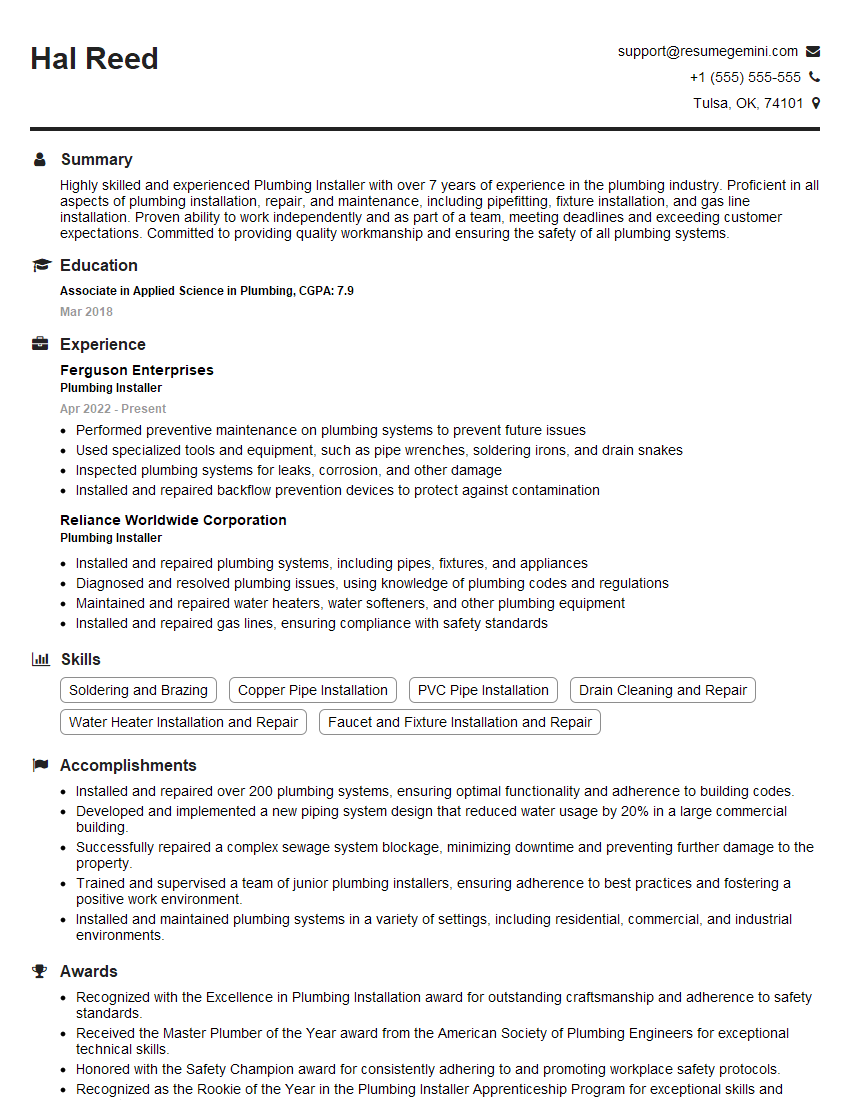
Mastering Knowledge of Plumbing and HVAC Systems is crucial for career advancement in this in-demand field. A strong understanding of these systems will open doors to more challenging and rewarding roles with higher earning potential. To maximize your job prospects, create an ATS-friendly resume that highlights your skills and experience effectively. ResumeGemini is a trusted resource that can help you build a professional and impactful resume tailored to the specific requirements of plumbing and HVAC jobs. Examples of resumes tailored to Knowledge of Plumbing and HVAC Systems are available to guide you through the process. Invest time in crafting a compelling resume – it’s your first impression on potential employers!
Explore more articles
Users Rating of Our Blogs
Share Your Experience
We value your feedback! Please rate our content and share your thoughts (optional).
What Readers Say About Our Blog
To the interviewgemini.com Webmaster.
Very helpful and content specific questions to help prepare me for my interview!
Thank you
To the interviewgemini.com Webmaster.
This was kind of a unique content I found around the specialized skills. Very helpful questions and good detailed answers.
Very Helpful blog, thank you Interviewgemini team.