Unlock your full potential by mastering the most common Discography interview questions. This blog offers a deep dive into the critical topics, ensuring you’re not only prepared to answer but to excel. With these insights, you’ll approach your interview with clarity and confidence.
Questions Asked in Discography Interview
Q 1. Explain the importance of accurate metadata in a discography.
Accurate metadata is the backbone of any reliable discography. Think of it as the detailed index for a vast library of music. Without it, finding specific recordings, verifying releases, or managing rights becomes nearly impossible. Accurate metadata includes, but isn’t limited to, the artist name, album title, release date, track titles, ISRCs (International Standard Recording Codes), labels, catalog numbers, and various other identifiers. In essence, it allows for efficient searching, organization, and management of a music catalog, crucial for both commercial and archival purposes. For example, an inaccurate release date could lead to misreporting of chart positions or incorrect licensing agreements. An incomplete track listing would make it difficult to accurately represent a release. Consistent and accurate metadata ensures a smooth and efficient workflow for all stakeholders involved in the music industry, from musicians and producers to distributors and archivists.
Q 2. Describe your experience with digital audio workstations (DAWs).
My experience with Digital Audio Workstations (DAWs) spans over 15 years, encompassing various industry-standard software like Pro Tools, Logic Pro X, and Ableton Live. I’m proficient in all aspects of DAW usage, from basic audio editing and mixing to advanced mastering techniques and session management. I’ve utilized DAWs extensively in creating and editing master recordings used for discographies. This involves ensuring the highest possible audio fidelity. For instance, in one project involving a remastering campaign, I used Pro Tools to meticulously clean up and restore old recordings, often involving noise reduction, equalization, and dynamic processing. My experience also includes using DAWs for preparing audio files in various formats suitable for digital distribution and archival purposes, often incorporating metadata tagging directly within the DAW. Beyond purely technical proficiency, I deeply understand the workflow implications and artistic considerations involved in using DAWs to prepare recordings for discographical entries.
Q 3. How do you ensure the accuracy and completeness of a discography?
Ensuring accuracy and completeness in a discography requires a multi-faceted approach. It begins with meticulous research, often involving cross-referencing multiple sources. This includes official release announcements, record label catalogs, online databases like Discogs, and even contacting the artists or their representatives directly. I meticulously verify information, comparing different sources to resolve inconsistencies. A consistent methodology is crucial. I usually create a structured database – often using a spreadsheet or a dedicated database management system – to record all information. This database allows for efficient data management and error detection. Moreover, I actively seek feedback from colleagues and experts in the field to validate findings and catch potential oversights. Finally, a continuous review and update process is paramount to keep the discography current and accurate. Regular checks for new releases or corrections in existing data are essential. Think of it as a living document that constantly evolves.
Q 4. What are the common challenges in maintaining a large music catalog?
Managing a large music catalog presents several significant challenges. One major issue is maintaining data consistency across different sources and formats. Inconsistencies in naming conventions, release dates, and artist names can create significant problems. Another challenge is handling versioning and variations. Reissues, remixes, and different editions of the same album can easily lead to confusion unless meticulously documented. Furthermore, keeping track of rights and licensing information across a large catalog is complex and demands an organized system. Dealing with obsolete formats and technological advancements is another significant factor. Finally, ensuring that the metadata is up-to-date and readily accessible for efficient retrieval is a crucial but often challenging task. An efficient database and a well-defined workflow are crucial for effectively navigating these challenges.
Q 5. Explain your experience with music rights management systems.
My experience with music rights management systems (MRMS) involves working with various platforms, including both proprietary systems and open-source solutions. I understand how to input and manage metadata related to copyright ownership, licensing agreements, and royalty distribution. My work focuses on ensuring the accuracy and completeness of rights information within the discography. This often involves coordinating with rights holders to clarify ownership and permissions. A key aspect of my work with MRMS is recognizing the complexities in managing rights for different territories and formats. For example, ensuring that the correct information is in place for digital streaming, physical releases, and synchronization licensing in each territory requires meticulous attention to detail and a deep understanding of international copyright laws. This contributes significantly to the overall accuracy and reliability of the discography.
Q 6. How do you handle discrepancies or inconsistencies in existing discography data?
Handling discrepancies or inconsistencies requires a systematic approach. First, I identify the source of the inconsistency. This may involve cross-checking different databases and sources. Once the source is identified, I attempt to resolve the discrepancy through further research, often involving contacting record labels or artists’ representatives. For example, if there are conflicting release dates, I might seek original press releases or production records to resolve the issue. If the discrepancy cannot be definitively resolved, I document both conflicting entries, noting the sources and explaining the reason for the uncertainty. Transparency and clear documentation are critical in such situations. This allows anyone accessing the discography to understand the limitations and potential areas of uncertainty within the data. A clear explanation of the known discrepancies prevents misinterpretations and ensures the user is aware of the unresolved challenges.
Q 7. Describe your experience with different audio file formats and their applications.
My experience with audio file formats encompasses a wide range, from lossless formats like WAV and FLAC to lossy formats such as MP3 and AAC. I understand the trade-offs between file size and audio quality inherent in each format. WAV and FLAC are generally preferred for archival purposes due to their lossless compression. MP3 and AAC are commonly used for online streaming and distribution because of their smaller file sizes. I’m familiar with the metadata embedding capabilities of different formats, ensuring that the metadata remains intact throughout the process of archiving, editing, or distribution. Beyond these common formats, I also have experience with more niche formats used in specific situations, such as DSD (Direct Stream Digital) for high-resolution audio and AIFF (Audio Interchange File Format) in various professional workflows. My work involves selecting the most appropriate format for each application, carefully considering factors like storage space, audio quality requirements, and intended use. Understanding these nuances is crucial for optimal management and preservation of audio recordings.
Q 8. What strategies do you use for organizing and searching a large music collection?
Organizing a large music collection requires a systematic approach. Think of it like curating a museum – you need a clear structure to easily find and appreciate each piece. My strategy involves a multi-layered system combining file organization, metadata tagging, and database management.
Hierarchical File Structure: I use a folder structure based on artist, album, and year. For example:
/Artist/Album (Year)/Track.mp3. This allows for quick visual browsing and intuitive navigation. Variations might include genre or subgenre classifications for further refinement.Metadata Tagging: Consistent and accurate metadata is crucial. I meticulously tag each file with ID3 tags (Title, Artist, Album, Year, Track Number, Genre, etc.). Accurate tagging ensures smooth integration with music players and library management software.
Database Management: For extremely large collections, a dedicated music database program like MusicBrainz Picard becomes essential. It allows for batch tagging, duplicate detection, and powerful search functionalities.
By combining these methods, I can quickly locate any track using various criteria – artist, album, genre, or even specific keywords in the track title.
Q 9. How familiar are you with different music metadata standards (e.g., ID3, MusicBrainz)?
I’m very familiar with various music metadata standards. ID3 and MusicBrainz are fundamental. ID3 tags are embedded directly within the audio files themselves, providing a relatively simple and accessible way to store information. They come in different versions (v1, v2), each with its own intricacies and capabilities. I utilize both ID3v2 and ID3v1 tags when necessary for broader compatibility with different software.
MusicBrainz is a collaborative, open-source music database that goes beyond simple tagging. It uses a structured schema to provide more detailed information, allowing cross-referencing and building rich contextual data. Its tagging format is powerful because it ensures standardization across different databases and applications.
Understanding these standards is key to interoperability; ensuring consistency across different players and management tools. The ability to work seamlessly with various metadata standards is essential for effectively managing a large collection and ensuring data integrity.
Q 10. Describe your workflow for adding new releases to an existing discography.
Adding new releases follows a structured workflow emphasizing accuracy and consistency.
Acquisition: I obtain the release (digital download, physical media). I always verify the source for authenticity.
File Conversion (if necessary): If the music is not already in a suitable format (e.g., FLAC, MP3), I convert it using tools like ffmpeg, ensuring quality is maintained.
Metadata Tagging: I meticulously tag each file using a combination of manual entry and automated tools like MusicBrainz Picard. Picard leverages MusicBrainz’s database to accurately tag files, saving time and ensuring consistency.
File Organization: I place the tagged files into my pre-established file structure (Artist/Album/Year).
Database Update: For my larger database, I use tools to update the database with information about the newly added release and links to the digital files.
Quality Control: I perform a final check of all metadata and file organization to ensure accuracy and consistency.
This systematic approach minimizes errors and helps maintain the integrity of my discography over time. Consistency is key – building a reliable system to make the task repeatable and efficient is vital.
Q 11. How do you handle copyright and licensing issues related to music releases?
Copyright and licensing are paramount considerations. I strictly adhere to copyright laws and licensing agreements. I only acquire music legally, through authorized channels like official music stores or streaming services for digital downloads, and reputable retailers for physical media.
For any project involving the public use of music, I meticulously check licenses to ensure proper attribution and payment of royalties. This includes verifying the rights associated with any use of sampled material. Understanding Creative Commons licensing is also important to avoid unintentional copyright infringement. Ignoring these aspects can lead to serious legal repercussions.
Q 12. How do you prioritize tasks and manage deadlines in a fast-paced music production environment?
In a fast-paced environment, prioritization and deadline management are crucial. I employ a combination of techniques:
Task Prioritization: I use a project management methodology, often a Kanban board, to visually organize tasks by priority and status. Tasks are prioritized based on urgency and impact. Urgent and impactful tasks are addressed first.
Time Blocking: I allocate specific time slots for particular tasks, improving focus and productivity. This avoids task-switching and maintains momentum.
Regular Review and Adjustment: I regularly review my progress, adjust plans as needed, and communicate any potential delays proactively. Flexibility and adaptability are key.
By using these methods, I can manage multiple projects and meet deadlines effectively even under pressure. Clear communication is also vital – letting stakeholders know of any potential roadblocks proactively ensures a smoother process.
Q 13. Explain your experience with music database software or applications.
My experience with music database software is extensive. I’ve used MusicBrainz Picard extensively for tagging and managing large collections, and I’m also proficient in using database management systems (DBMS) such as MySQL or PostgreSQL for more complex data management needs, especially if dealing with metadata beyond simple tags (e.g., linking releases to artists’ biographies or associated news articles).
I’ve also worked with various music library applications like foobar2000 with its advanced tagging capabilities, and specialized cataloging software designed for large-scale discography management. My experience spans both client-side applications and working directly with backend database structures.
Q 14. What is your experience with data validation and quality control in a discography context?
Data validation and quality control are essential for maintaining the accuracy and integrity of any discography. My approach involves several layers of verification:
Automated Checks: I use software tools to check for inconsistencies such as duplicate entries, missing data, or incorrect formatting in metadata fields.
Manual Review: A manual review of a sample of the data is crucial. This involves spot checking metadata for accuracy and completeness, paying close attention to details like dates, track listings, and artist names. This step catches errors that automated tools might miss.
Cross-Referencing: I cross-reference data against trusted external sources like MusicBrainz or Discogs to verify the accuracy of my data.
Data Cleaning: Identified errors are addressed through data cleaning processes, including updating incorrect information, filling in missing data, and standardizing formats.
This multi-layered approach ensures a high level of data quality, crucial for the reliability and usefulness of the discography. In essence, accuracy and consistency are paramount, so I approach this aspect very methodically.
Q 15. How do you maintain the integrity and consistency of a discography over time?
Maintaining a discography’s integrity and consistency over time is crucial for accurate representation of an artist’s work and for effective rights management. Think of it like maintaining a meticulously organized library – each entry needs to be accurate and reflect the current state of information.
This involves a multi-pronged approach:
- Data Standardization: Employing consistent formats for date representation (e.g., YYYY-MM-DD), track titles, artist names, and record labels. Using a controlled vocabulary or ontology for genres ensures consistency across all entries.
- Regular Audits: Periodically reviewing the entire discography for inconsistencies. This might involve comparing data against official sources like record labels’ websites, online music databases (like Discogs), or even physical copies of album releases.
- Version Control (discussed further in the next answer): Tracking changes made to the discography over time to easily revert to previous versions if necessary, and to understand the evolution of the data itself.
- Automated Checks: Implementing scripts or software to identify potential errors, such as duplicate entries, conflicting information, or missing data fields, proactively catching issues before they become widespread problems.
- Data Validation: Using predefined rules (e.g., checking for valid date formats, verifying the existence of record labels) to ensure the accuracy of new data entries.
For example, if a reissue of an album is released, the original release information needs to be preserved, while a new entry for the reissue should clearly distinguish the two versions, noting changes in tracklist or mastering.
Career Expert Tips:
- Ace those interviews! Prepare effectively by reviewing the Top 50 Most Common Interview Questions on ResumeGemini.
- Navigate your job search with confidence! Explore a wide range of Career Tips on ResumeGemini. Learn about common challenges and recommendations to overcome them.
- Craft the perfect resume! Master the Art of Resume Writing with ResumeGemini’s guide. Showcase your unique qualifications and achievements effectively.
- Don’t miss out on holiday savings! Build your dream resume with ResumeGemini’s ATS optimized templates.
Q 16. Describe your experience with version control systems for music files or metadata.
Version control is paramount in managing a discography. It’s like having a detailed history of every edit, allowing you to undo mistakes or see how the discography has evolved. I’ve extensively used Git, a widely adopted version control system, for this purpose. Each commit (a saved version of the discography data) includes a descriptive message explaining the changes made.
While I’ve primarily used Git for metadata management (like in a structured database or CSV files), the same principles apply to music files themselves. A Git Large File Storage (LFS) extension handles large audio files efficiently. This allows us to track changes not only in the metadata (album title, artist, tracklist) but also in the audio files themselves, for example, when remasters are released.
Consider this example: Let’s say we initially had incorrect release dates for a few albums. Using Git, I can easily revert back to a previous version with the correct information, while still preserving the history of the correction for future reference. This is critical for maintaining data accuracy and accountability.
git checkout This command would revert the repository to a specific past version identified by its unique hash.
Q 17. How do you identify and resolve errors or inconsistencies in discography information?
Identifying and resolving errors is an iterative process that requires a combination of automated checks and manual review. Think of it as a detective investigation, carefully examining clues to solve the mystery of inconsistent information.
- Automated Data Cleansing: Using scripts to identify inconsistencies such as missing or contradictory data, duplicate entries, or incorrect formats. For example, a script could check for albums with missing release dates or track listings.
- Cross-referencing with External Sources: Validating information against reliable sources like official websites, music databases, or library catalogs to ensure accuracy. This helps resolve discrepancies and confirm the authenticity of the data.
- Manual Review and Correction: Carefully reviewing flagged inconsistencies and making corrections. This often requires deep knowledge of the artist’s work and the music industry.
- Community Feedback (if applicable): For publicly accessible discographies, allowing users to report errors or provide updates through a feedback mechanism, ensuring community involvement in the maintenance process.
For example, I once discovered that two entries for the same album had slightly different track titles due to minor spelling variations. Cross-referencing the information with the album’s liner notes helped resolve the discrepancy.
Q 18. How would you approach updating a legacy discography to a modern digital format?
Updating a legacy discography to a modern digital format requires a structured and systematic approach. Imagine converting an old vinyl record collection’s catalog to a searchable digital database.
- Data Extraction: Carefully extract data from the legacy format (e.g., handwritten notes, spreadsheets, databases). This often involves manual data entry and cleaning if the source is not digitally accessible.
- Data Cleaning and Standardization: Clean the extracted data to ensure consistency and accuracy. This involves standardizing formats, resolving inconsistencies, and handling missing information.
- Database Design: Create a relational database (like MySQL or PostgreSQL) or use a structured file format (like CSV or JSON) to organize the information efficiently. A well-designed database makes it easy to query and retrieve information.
- Data Migration: Migrate the cleaned data into the new digital format. This process should be carefully tested to ensure data integrity and accuracy.
- Data Validation: Implement automated checks to ensure data consistency and accuracy in the new format.
For example, I once migrated a discography from a handwritten notebook to a MySQL database. This involved painstakingly entering the data, standardizing formats, and creating a schema (database structure) to effectively organize the information.
Q 19. What are your skills in data analysis and reporting related to music data?
My skills in data analysis and reporting related to music data involve using tools and techniques to extract insights from large datasets. This is essential for understanding trends, identifying patterns, and generating informative reports.
- Data Mining and Extraction: I use SQL and scripting languages (like Python) to extract, clean, and transform raw music data from various sources.
- Statistical Analysis: Applying descriptive and inferential statistics to analyze trends in music releases, sales data, or listening habits.
- Data Visualization: Using tools like Tableau or Python libraries (Matplotlib, Seaborn) to create charts, graphs, and dashboards to visualize data patterns and insights.
- Report Generation: Generating reports summarizing key findings and presenting them in an easy-to-understand manner for stakeholders.
For example, I’ve used data analysis to identify the most successful genres of music released by an artist in a particular region and used this information to inform marketing strategies.
Q 20. How do you collaborate with other teams (e.g., marketing, legal) on discography projects?
Collaboration is vital in discography projects. Effective communication and a shared understanding of goals are crucial for success. Think of it as a symphony – each section (marketing, legal, discography team) plays a part in creating a harmonious whole.
- Regular Meetings: Holding regular meetings with all involved teams to discuss progress, address issues, and ensure everyone is aligned on goals.
- Shared Communication Platforms: Using tools like Slack or Microsoft Teams to facilitate quick communication and information sharing.
- Version Control Collaboration: Using a collaborative version control system (like Git) for the discography ensures transparency and helps avoid conflicts.
- Clear Roles and Responsibilities: Defining the roles and responsibilities of each team to avoid confusion and duplication of efforts.
- Feedback Mechanisms: Establishing clear channels for providing and receiving feedback to ensure the project stays on track.
For example, when working on a new album release, I collaborate with the marketing team to ensure the discography information is accurately reflected in promotional materials, and with the legal team to ensure compliance with copyright and licensing regulations.
Q 21. Describe your experience with different music distribution platforms and their requirements.
My experience spans various music distribution platforms, each with its own unique requirements and technical specifications. Each platform is like a unique storefront, each with specific requirements for product display.
- Digital Service Providers (DSPs): I’m familiar with the requirements of major DSPs like Spotify, Apple Music, Amazon Music, and others. This includes metadata specifications (e.g., ISRC codes, genre classifications) and delivery formats (e.g., WAV, MP3).
- Physical Distribution: I’m aware of the specifications for physical media like CDs and vinyl records, including artwork requirements and mastering specifications.
- Metadata Standards: I have a deep understanding of various metadata standards like ID3 tags, and their implications for proper display and searchability on different platforms.
- API Integration: I’ve worked with APIs (Application Programming Interfaces) offered by some platforms for automated upload and metadata management.
For example, preparing a release for Spotify requires meticulous attention to detail regarding metadata formatting to ensure the track appears correctly in searches, playlists, and user libraries. Similarly, physical releases often require precise specifications for artwork dimensions and print quality.
Q 22. How familiar are you with music industry best practices for discography management?
My familiarity with music industry best practices for discography management is extensive. It goes beyond simply listing releases; it encompasses a deep understanding of metadata standards (like ISRCs, UPCs, and ISWCs), accurate data entry, consistent formatting, version control, and the importance of maintaining a robust and easily searchable database. This includes knowledge of legal considerations, rights management, and the workflow necessary for efficient collaboration between artists, labels, distributors, and other stakeholders.
Best practices also involve regular audits to ensure data integrity and accuracy. Think of it like meticulously cataloging a vast library – not just by title but by author, publisher, edition, and even minor variations. This level of detail is crucial for royalty calculations, reporting, and overall transparency throughout the music value chain.
Q 23. What are the key considerations for maintaining a secure and accessible music archive?
Maintaining a secure and accessible music archive requires a multi-faceted approach. Security hinges on robust access control, preventing unauthorized access or modification of the data. This involves using strong passwords, encryption (both at rest and in transit), regular backups to prevent data loss, and version control to track changes and revert to previous states if necessary. Think of it like Fort Knox for your music – multiple layers of protection to keep it safe.
Accessibility, on the other hand, focuses on ease of retrieval and usability. This necessitates a well-structured database, efficient search functionality, metadata tagging adhering to industry standards, and a user-friendly interface. A clear organizational system—by artist, album, year, genre, etc.—is paramount for quick and easy data access. Regular data cleaning and de-duplication are also essential for maintaining accessibility.
Q 24. How do you handle requests for information or data from various stakeholders?
Handling data requests from various stakeholders requires a systematic and organized approach. I establish clear communication channels to understand the specific request, its purpose, and the required format. This could involve providing simple release information to a journalist, detailed sales data to a label executive, or complex metadata sets for a digital distributor. Prioritization is key, especially with conflicting deadlines or urgent requests.
Data is typically provided via secure methods such as encrypted email, FTP transfers, or through a dedicated data portal with appropriate access controls. I always ensure the data shared aligns with the individual’s permissions and adheres to any relevant confidentiality agreements. Clear documentation and version control are crucial to maintain transparency and accountability.
Q 25. Explain your experience with different discography software applications.
My experience encompasses several discography software applications, including specialized database solutions like MusicBrainz Picard and Musicbrainz, as well as more general-purpose database management systems (DBMS) like MySQL. I’ve also worked with proprietary systems developed in-house by record labels. Each application has its strengths and weaknesses. For example, MusicBrainz Picard excels at metadata tagging and batch processing, while a DBMS offers greater flexibility and scalability for large datasets. The choice of application depends heavily on the specific needs and scale of the project. My experience allows me to select the most appropriate tool for the job and efficiently manage the data within it.
Q 26. How do you stay up-to-date with changes and advancements in music technology and standards?
Staying current in music technology and standards is a continuous process. I actively participate in industry forums and conferences to learn about new trends and best practices. I regularly follow relevant publications, blogs, and online resources, such as those published by organizations like the IFPI and RIAA. This ensures I am up-to-date on emerging technologies, updated metadata standards, and changes in digital distribution workflows. It’s akin to a mechanic constantly updating their knowledge of car technology—without it, you fall behind.
Q 27. Describe a situation where you had to solve a complex problem related to discography management.
In one instance, I encountered a complex problem involving discrepancies in royalty payouts stemming from inconsistencies in the discography database. This involved multiple releases spanning various formats (physical and digital) and involving several sub-publishers. The problem was compounded by a lack of clear and consistent metadata across different data sources. My solution involved a multi-step process: First, a thorough audit of the database to identify and isolate inconsistencies. Next, I developed a system for standardizing metadata across all sources. Finally, I implemented a robust version control system to prevent similar problems in the future. This resolved the payout discrepancies, ensuring fair compensation to all involved parties.
Q 28. How do you prioritize accuracy and efficiency when working with large datasets of music information?
Prioritizing accuracy and efficiency with large music datasets requires a blend of automated processes and meticulous manual checks. Automation tools, such as scripts for data cleaning and validation, greatly improve efficiency. Think of it like using a powerful vacuum cleaner to quickly clean a large space. However, manual verification is crucial for catching nuanced errors that automation might miss. This is like carefully inspecting a painting after cleaning it to ensure no damage was done. Data validation rules, regular audits, and the use of checksums help ensure data integrity. A well-defined workflow that integrates both automation and manual review ensures both speed and accuracy. The goal is to find the optimal balance between speed and thoroughness.
Key Topics to Learn for Discography Interview
- Mastering Metadata: Understanding and applying ID3 tags, metadata schemas (like MusicBrainz Picard), and their importance in organizing and searching music files. Practical application includes demonstrating proficiency in tagging tools and ensuring data consistency across a large library.
- Digital Audio Formats: Deep understanding of various audio formats (WAV, AIFF, MP3, FLAC, etc.), their compression techniques, audio quality trade-offs, and suitability for different applications. Practical application involves explaining the advantages and disadvantages of different formats in specific scenarios.
- Audio Restoration and Editing: Familiarity with audio editing software and techniques for noise reduction, click/pop removal, and other restoration processes. Practical application could involve describing a workflow for cleaning up a damaged audio track.
- Digital Asset Management (DAM) Systems: Knowledge of different DAM systems used in discography management, including their features for cataloging, searching, and version control. Practical application involves discussing experience with specific systems or explaining the benefits of using a DAM system.
- Copyright and Licensing: Understanding copyright law as it relates to music, licensing agreements, and the ethical considerations involved in handling copyrighted material. Practical application involves demonstrating awareness of best practices and potential legal issues.
- Database Management: Proficiency in using databases (SQL or NoSQL) to manage large amounts of discography data efficiently. Practical application involves discussing experience designing or querying databases for music-related information.
Next Steps
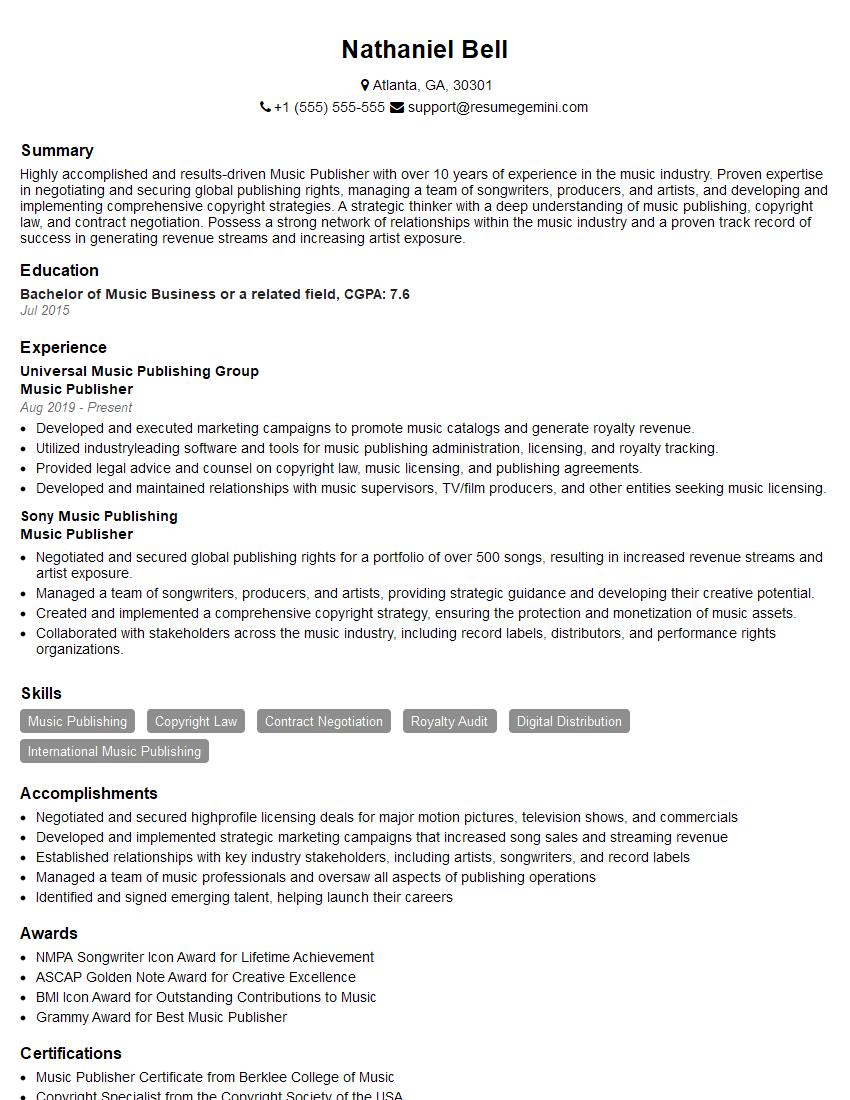
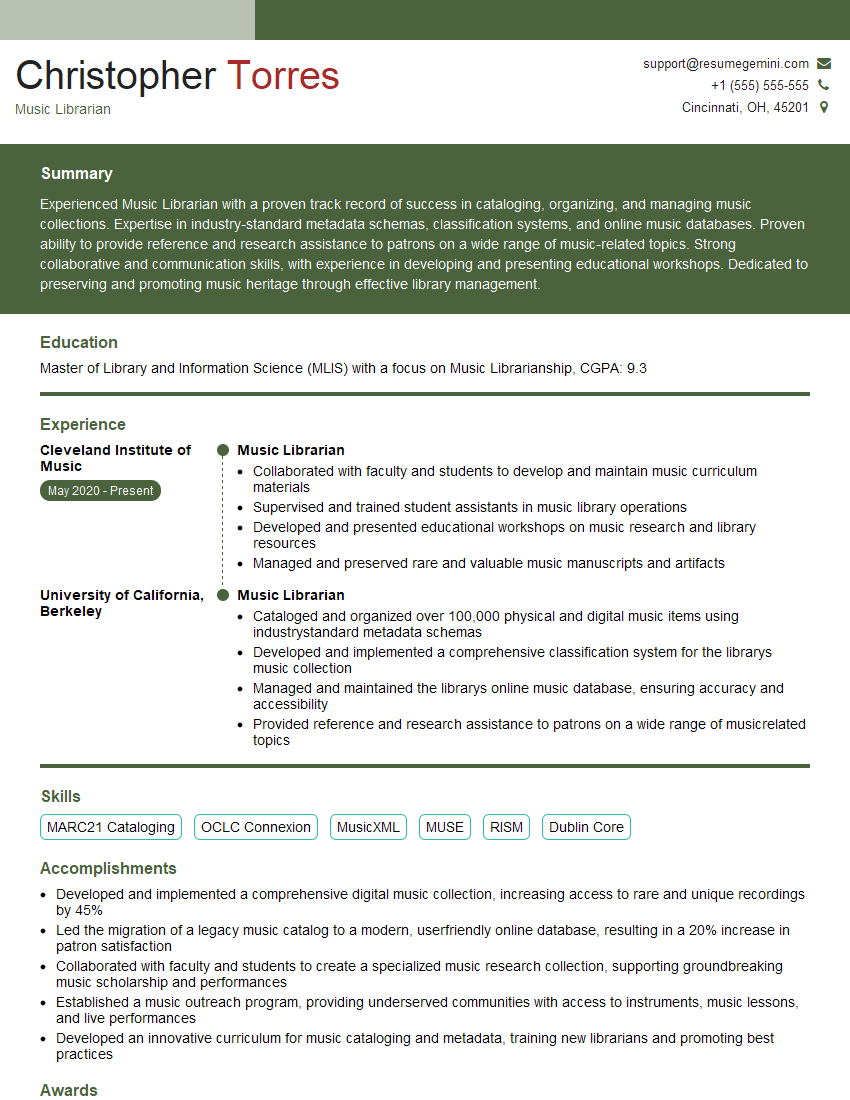
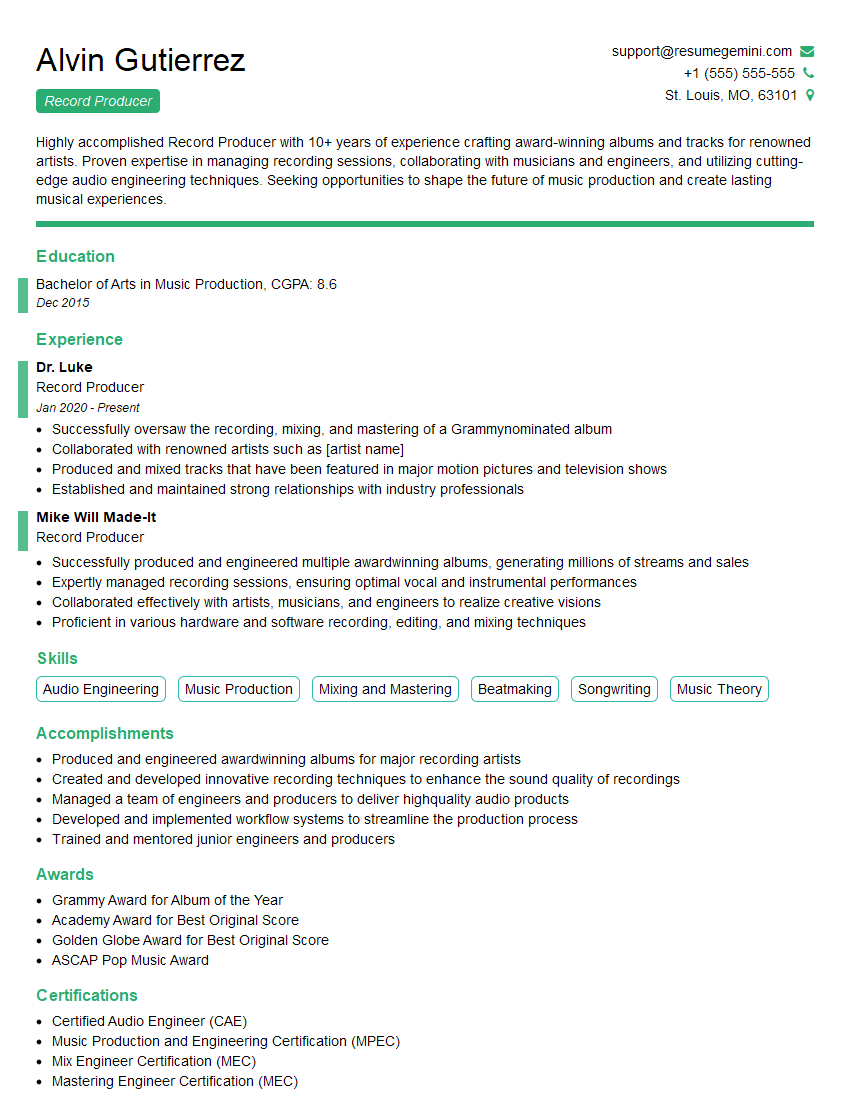
A strong foundation in Discography opens doors to exciting careers in music production, curation, archiving, and research. Mastering these skills not only enhances your technical capabilities but also demonstrates a deep understanding and passion for the art form. To significantly boost your job prospects, create an ATS-friendly resume that highlights your relevant skills and experience effectively. ResumeGemini is a trusted resource that can help you build a professional and impactful resume, ensuring your application gets noticed. Examples of resumes tailored to Discography roles are provided to guide you.
Explore more articles
Users Rating of Our Blogs
Share Your Experience
We value your feedback! Please rate our content and share your thoughts (optional).
What Readers Say About Our Blog
To the interviewgemini.com Webmaster.
Very helpful and content specific questions to help prepare me for my interview!
Thank you
To the interviewgemini.com Webmaster.
This was kind of a unique content I found around the specialized skills. Very helpful questions and good detailed answers.
Very Helpful blog, thank you Interviewgemini team.