Interviews are opportunities to demonstrate your expertise, and this guide is here to help you shine. Explore the essential Landfill Gas Collection System Maintenance interview questions that employers frequently ask, paired with strategies for crafting responses that set you apart from the competition.
Questions Asked in Landfill Gas Collection System Maintenance Interview
Q 1. Explain the function of a landfill gas collection system.
A landfill gas (LFG) collection system’s primary function is to capture methane and other gases generated by decomposing organic waste within a landfill. These gases are potent greenhouse gases, and their uncontrolled release contributes significantly to climate change. The system prevents this by channeling the gases through a network of wells, pipes, and other infrastructure to a processing point, typically a flare or energy recovery system. This prevents air pollution and allows for the beneficial use of the captured gas.
Think of it like this: a landfill is a giant, slowly decomposing compost pile. Just as a compost heap produces gases, so does a landfill. The LFG collection system is the ventilation system for this massive ‘compost pile,’ ensuring these gases are safely managed rather than escaping into the atmosphere.
Q 2. Describe different types of landfill gas extraction wells.
Landfill gas extraction wells come in various designs, each suited to specific landfill conditions and gas extraction needs. Some common types include:
- Vertical Wells: These are the most common type, drilled vertically into the landfill waste. They’re relatively simple to install and maintain, and are effective in areas with relatively uniform waste.
- Horizontal Wells: These are drilled horizontally into the waste, allowing for greater gas collection area per well. They’re particularly useful in areas with highly variable waste composition or where gas migration is unpredictable.
- Auger Wells: These wells are installed using an auger drill, creating a smaller diameter well. They’re often used in shallower areas or for supplemental gas extraction.
- Screened Wells: These wells use a perforated screen to allow gas to enter while preventing the infiltration of solid waste. They can help to extend the life of a well.
The choice of well type depends on factors like landfill geometry, waste characteristics, gas pressure, and budget constraints. A skilled engineer will consider all of these aspects when designing a system.
Q 3. What are the common causes of leaks in a landfill gas collection system?
Leaks in an LFG collection system are a major concern, as they negate the system’s effectiveness and can pose environmental and safety hazards. Common causes include:
- Damaged Pipes and Fittings: Corrosion, settling of the landfill, or physical damage from equipment can compromise the integrity of the piping system.
- Poor Well Construction: Improper well sealing or installation can lead to gas bypassing the collection system.
- Settlement and Subsidence: The landfill’s settling can create gaps and fissures in the cover and waste, allowing gas to escape.
- Improper Cover Material: A poorly designed or maintained landfill cover can allow gas to penetrate and escape into the atmosphere.
- Corrosion of Well Components: The corrosive nature of landfill gas can damage well casings and other components over time.
Regular inspections and preventative maintenance are crucial for minimizing the risk of leaks.
Q 4. How do you detect and locate leaks in a landfill gas collection system?
Leak detection in an LFG collection system requires a multi-pronged approach. Methods include:
- Visual Inspections: Regular visual checks of the system for any visible signs of damage or gas release are essential. This includes checking pipes, wells, and other system components for cracks, corrosion, or other damage.
- Pressure Testing: Sections of the pipeline can be isolated and pressurized to detect leaks. A drop in pressure indicates a leak.
- Gas Detectors: Portable gas detectors can be used to scan the landfill surface and identify areas with elevated methane concentrations.
- Tracer Gas Techniques: Introducing a tracer gas into the system allows for precise localization of leaks. Specialized equipment can then detect the tracer gas and pinpoint the leak’s location.
- Infrared Thermography: Infrared cameras can detect temperature differences caused by escaping gas, helping to identify leak points.
A combination of these methods is typically used to ensure comprehensive leak detection.
Q 5. What are the safety precautions for working on a landfill gas collection system?
Safety is paramount when working on an LFG collection system. Methane is highly flammable and explosive, and other gases present can be toxic. Crucial safety precautions include:
- Proper Personal Protective Equipment (PPE): This includes gas detection equipment, respirators, flame-resistant clothing, and safety footwear.
- Confined Space Entry Procedures: If entering wells or confined spaces within the system, strict confined space entry protocols must be followed.
- Lockout/Tagout Procedures: Before any maintenance or repair work, all power and gas flow to the affected section must be safely isolated and locked out.
- Emergency Response Plan: A detailed emergency response plan should be in place, with trained personnel ready to respond to any incidents.
- Regular Monitoring: Continuous monitoring of gas levels in the air is essential to ensure worker safety.
Thorough training and adherence to safety regulations are critical for preventing accidents.
Q 6. Describe the process of maintaining and repairing a landfill gas extraction well.
Maintaining and repairing an LFG extraction well involves a systematic approach:
- Assessment: The well’s condition is assessed to determine the extent of damage and the necessary repairs.
- Isolation: The well is isolated from the rest of the system to prevent gas flow.
- Repair/Replacement: Depending on the damage, repairs may involve patching leaks, replacing damaged components (like the well casing or screen), or even replacing the entire well.
- Testing: After repairs, the well is thoroughly tested for leaks and proper functionality.
- Reintegration: Once the well passes testing, it’s reintegrated into the collection system.
Specialized equipment, such as drilling rigs and wellhead repair tools, might be required. The specific procedures will vary depending on the well’s design and the nature of the repairs needed.
Q 7. What are the different types of landfill gas flare systems?
Landfill gas flare systems are designed to safely combust LFG, preventing its release into the atmosphere. Different types exist, primarily categorized by their design and emission control features:
- Elevated Flares: These are tall, elevated structures that disperse combustion products high into the atmosphere, minimizing ground-level air pollution. They are commonly used for high flow rate scenarios.
- Ground Flares: These flares are located at ground level and generally have a more limited capacity compared to elevated flares.
- Closed Flare Systems: These systems include features to reduce the release of unburnt gases and other pollutants. For example, they may incorporate a thermal oxidizer to help achieve more complete combustion. They are environmentally friendlier but more expensive.
The selection of a flare system depends on factors like gas flow rate, environmental regulations, and budget. Proper maintenance and operation are crucial to ensure safe and efficient LFG combustion.
Q 8. Explain how to troubleshoot a malfunctioning gas flare system.
Troubleshooting a malfunctioning gas flare system involves a systematic approach. First, ensure safety by confirming the flare is actually malfunctioning and isolating the system if necessary to prevent potential hazards like fire or gas leaks. This often involves checking for visible flames or pilot lights, and measuring gas flow rate at various points in the system.
Next, we’ll check the obvious: Is the gas supply itself failing? Check the pressure at the flare’s inlet. Low pressure could indicate a blockage in the piping, a problem with the gas extraction system upstream, or a malfunctioning blower. Inspect the piping for any blockages, corrosion, or damage.
Examine the flare itself. Is the pilot light out? Is the igniter working properly? Many flares have a pilot light that needs to be relit, often requiring specialized equipment and safety precautions. If the igniter is electronic, check its power supply and wiring. If it’s a thermal igniter, inspect for damage or blockages.
Finally, consider environmental factors. Strong winds can sometimes extinguish a flare or prevent proper ignition. Documentation and previous maintenance records are invaluable in this process, pointing to potential recurring issues or identifying components needing regular replacement.
Q 9. How do you monitor the composition of landfill gas?
Monitoring landfill gas composition is crucial for safety and environmental compliance. We primarily use Gas Chromatographs (GCs) for this purpose. These devices analyze the gas sample, separating its components (primarily methane (CH4), carbon dioxide (CO2), and other trace gases) and quantifying their concentrations.
The GC data provides essential information about the gas’s heating value (important for energy recovery) and its potential for greenhouse gas emissions. Continuous monitoring systems often transmit data in real-time to a central control system, providing immediate alerts if concentrations deviate from established parameters. Regular calibration of GCs is essential for accurate measurements. Portable GCs allow for on-site, quick checks, particularly useful in emergency situations or during initial site assessments.
Beyond GCs, other sensors can continuously monitor methane concentrations, providing an early warning system for potential leaks or shifts in gas generation. Data loggers are often used to store information from sensors and GCs, creating a historical record for analysis and compliance reporting.
Q 10. What are the environmental regulations concerning landfill gas emissions?
Environmental regulations concerning landfill gas emissions vary by location but generally aim to minimize greenhouse gas emissions and protect air quality. These regulations frequently dictate allowable emission limits for methane and other pollutants, often expressed as a mass emission rate or concentration. They may also specify monitoring and reporting requirements, including the frequency of gas composition analysis and the submission of data to regulatory agencies.
Permitting requirements are typically involved. Landfill operators must obtain permits demonstrating that their landfill gas management system complies with the established standards. Non-compliance can lead to penalties, including fines and mandatory system upgrades. Regulations also frequently address the design and maintenance of landfill gas collection systems, requiring regular inspections and specific construction standards to ensure the systems’ efficacy in capturing and managing landfill gases. The specific regulations will differ based on regional and national legislation, as well as the size and type of the landfill.
Q 11. Describe the different methods for controlling and mitigating landfill gas emissions.
Several methods control and mitigate landfill gas emissions. The most common is a well-designed and properly maintained landfill gas collection system, which captures the gas and diverts it away from the atmosphere. This captured gas can then be used for energy generation (e.g., electricity production) or processed to reduce its greenhouse gas potential.
Flare systems burn the collected gas, converting methane into carbon dioxide, a less potent greenhouse gas. While this reduces the greenhouse gas impact compared to releasing methane directly into the atmosphere, it is not ideal, as it still generates CO2. Gas-to-energy systems offer a more sustainable approach, utilizing the methane to generate electricity or heat, effectively recovering energy while minimizing emissions.
Biogas upgrading techniques can further improve environmental performance by purifying the landfill gas, enriching the methane content, and creating a higher-quality fuel source for use in vehicles or other applications. Finally, proactive landfill design and waste management practices significantly influence the amount of gas produced in the first place. Proper waste compaction and layering reduce the formation of landfill gas.
Q 12. How often should a landfill gas collection system be inspected?
The frequency of landfill gas collection system inspections depends on several factors, including the size and complexity of the system, local regulations, and the historical performance of the system. However, a general guideline is to conduct regular inspections at least monthly, checking for leaks, blockages, and ensuring proper system functionality. More frequent inspections may be necessary in areas with high gas production or if problems are identified.
These inspections should include visual checks of all system components, including wellheads, pipelines, and collection pipes, looking for signs of damage, corrosion, or leaks. Regular pressure readings at different points in the system can indicate potential blockages or leaks. Additionally, instrument readings from gas monitoring equipment should be reviewed to verify consistent gas composition and flow. A comprehensive inspection should also include checking the functionality of all safety devices, such as pressure relief valves and flare systems. Detailed records of all inspections should be maintained.
Q 13. What is the role of vacuum pressure in a landfill gas collection system?
Vacuum pressure plays a vital role in a landfill gas collection system by creating a pressure differential that draws the gas from the landfill towards the extraction points. The system is typically designed to maintain a slightly negative pressure (a vacuum) within the collection network. This negative pressure encourages landfill gas to move from the waste mass towards the extraction wells and collection pipes, minimizing the amount of gas that escapes into the atmosphere.
Maintaining optimal vacuum pressure is critical for efficient gas collection. Too low a vacuum may result in insufficient gas capture, whereas too high a vacuum could potentially damage the system’s components or lead to gas leaks. Pressure sensors at various points in the system help monitor vacuum levels, providing data for efficient system operation. Regular monitoring and adjustments ensure that the system operates within the designated pressure range.
Q 14. Explain the importance of regular maintenance on a landfill gas collection system.
Regular maintenance on a landfill gas collection system is paramount for several reasons: safety, environmental compliance, and economic efficiency. Without regular maintenance, the system’s efficiency decreases, leading to increased landfill gas emissions and potential environmental damage.
Regular maintenance involves tasks such as leak detection and repair, pipeline cleaning, inspection and replacement of system components (valves, pumps, etc.), and calibration of monitoring instruments. This prevents major malfunctions and ensures the system operates at peak efficiency. Preventative maintenance is significantly more cost-effective than repairing major failures. Regular maintenance extends the lifespan of the system’s components, saving on replacement costs and minimizing downtime. It also helps ensure compliance with environmental regulations, avoiding potential fines or legal issues. Maintaining a safe operating environment for workers is also crucial; leaks can pose significant hazards. In short, a proactive maintenance program is essential for a safe, reliable, and environmentally responsible landfill gas management system.
Q 15. What are the potential consequences of neglecting landfill gas system maintenance?
Neglecting landfill gas (LFG) system maintenance can have severe consequences, ranging from environmental hazards to significant financial repercussions. Think of it like ignoring a leaky roof – a small problem can quickly escalate into a major disaster.
- Environmental damage: LFG is primarily methane, a potent greenhouse gas. Leaks contribute to climate change. Uncontrolled LFG releases can also contaminate groundwater and soil, harming ecosystems and potentially impacting human health.
- Safety hazards: LFG is flammable and explosive. A poorly maintained system increases the risk of explosions, fires, and worker injuries. Think of it like a gas leak in your home – highly dangerous!
- Financial losses: LFG can be captured and used as an energy source (e.g., generating electricity). A malfunctioning system reduces or eliminates this revenue stream. Repairs, remediation, and potential fines due to environmental violations add substantial costs.
- Regulatory non-compliance: Most jurisdictions have strict regulations for LFG management. Failure to meet these standards can result in hefty penalties and legal action.
In short, proactive maintenance is crucial for environmental protection, worker safety, and economic viability.
Career Expert Tips:
- Ace those interviews! Prepare effectively by reviewing the Top 50 Most Common Interview Questions on ResumeGemini.
- Navigate your job search with confidence! Explore a wide range of Career Tips on ResumeGemini. Learn about common challenges and recommendations to overcome them.
- Craft the perfect resume! Master the Art of Resume Writing with ResumeGemini’s guide. Showcase your unique qualifications and achievements effectively.
- Don’t miss out on holiday savings! Build your dream resume with ResumeGemini’s ATS optimized templates.
Q 16. Describe different types of landfill gas collection system piping.
Landfill gas collection systems employ various piping materials, each with its strengths and weaknesses. The choice depends on factors such as gas composition, soil conditions, and budget.
- High-density polyethylene (HDPE): This is a common choice due to its durability, flexibility, and resistance to corrosion. It’s often used for smaller diameter pipes and in areas with challenging ground conditions.
- Polyvinyl chloride (PVC): PVC pipes are less expensive than HDPE but can be brittle and more susceptible to damage. They are typically used in less demanding applications.
- Ductile iron: This material offers high strength and resistance to pressure. It’s suitable for larger diameter pipes and high-pressure applications, but it is more expensive and susceptible to corrosion.
- Steel: Steel pipes, though strong, are prone to corrosion unless appropriately coated and protected. They might be used in specific sections of the system, but are less common than the other options due to maintenance challenges.
Often, a combination of materials might be employed within a single system to optimize cost and performance.
Q 17. What are the common issues with landfill gas piping and how are they addressed?
Several issues can arise with LFG piping. Regular inspections and proactive maintenance are key to identifying and addressing these problems before they escalate.
- Leaks: Leaks can be caused by damage, deterioration, or improper installation. Detection methods include pressure testing, visual inspection, and gas detection equipment. Repairs involve excavating the affected section and replacing or repairing the damaged pipe.
- Blockages: Blockages are often caused by the accumulation of debris, liquids, or condensate. Cleaning methods range from high-pressure water jets to specialized tools for removing obstructions. Properly designed systems with condensate management are crucial to prevent this.
- Corrosion: Corrosion is a significant concern, particularly with metallic pipes. Regular inspections, protective coatings, and cathodic protection are used to mitigate corrosion. If corrosion is extensive, pipe sections might need replacement.
- Settlement and displacement: Landfill settlement can strain and damage pipes. Regular monitoring, proper pipe support systems, and flexible pipe materials help minimize these issues.
Addressing these issues promptly prevents environmental damage, safety hazards, and costly repairs down the line.
Q 18. How do you ensure the system complies with all safety standards?
Ensuring safety compliance is paramount in LFG system operation. This involves adherence to local, regional, and national regulations, as well as industry best practices.
- Regular inspections and testing: This includes pressure testing, leak detection, and gas monitoring to ensure system integrity and identify potential hazards.
- Proper ventilation and gas detection systems: These are crucial to prevent the build-up of flammable gases and alert personnel to dangerous levels.
- Worker training and safety protocols: Personnel need proper training on safe operating procedures, emergency response, and the use of personal protective equipment (PPE).
- Emergency response plans: Detailed plans should outline procedures for handling leaks, fires, or other emergencies.
- Compliance with relevant codes and standards: This ensures that the system meets all regulatory requirements and industry best practices, often involving regular audits and inspections by regulatory bodies.
Safety should always be the top priority in LFG system management. A robust safety program is essential for protecting workers and the environment.
Q 19. What are the different types of monitoring equipment used in landfill gas systems?
A variety of monitoring equipment is used to track LFG system performance and ensure safety.
- Gas chromatographs: These precisely measure the composition of LFG, determining the methane, carbon dioxide, and other components’ concentrations. This data is crucial for optimizing energy recovery and assessing environmental impact.
- Pressure transducers: These sensors continuously monitor pressure within the collection system, providing early warnings of leaks or blockages.
- Flow meters: These devices measure the volume of LFG being extracted from the landfill. This data is essential for evaluating system effectiveness and energy production.
- Flammable gas detectors: These provide continuous monitoring for flammable gas concentrations in the vicinity of the system and in confined spaces, ensuring the safety of workers.
- Oxygen sensors: These are particularly important in confined spaces to prevent oxygen depletion and asphyxiation risks.
The specific equipment used depends on the size and complexity of the system, as well as regulatory requirements.
Q 20. Explain how to interpret data from landfill gas monitoring equipment.
Interpreting data from LFG monitoring equipment requires understanding the system’s normal operating parameters and recognizing deviations that indicate potential problems.
- Pressure readings: Consistent pressure drops might indicate a leak, while sudden pressure increases could suggest a blockage. The baseline pressure needs to be established for each system and significant deviations investigated.
- Flow rate data: Decreasing flow rates can indicate a decrease in gas generation or a system blockage. Increases could potentially point to increased gas production or a leak in the system.
- Gas composition analysis: Variations in methane concentration can indicate changes in the landfill’s decomposition processes. Monitoring specific components aids in optimizing gas utilization and assessing environmental impact.
Data analysis often involves comparing real-time readings to historical data and established thresholds. Significant deviations warrant immediate investigation and corrective action.
Software packages and data logging systems are used to store, analyze, and visualize the data, allowing for efficient monitoring and timely intervention.
Q 21. How do you perform routine maintenance tasks such as cleaning and inspection?
Routine maintenance is crucial for ensuring the long-term performance and safety of an LFG system.
- Cleaning: This involves removing debris, liquids, and condensate from collection pipes and wells. Methods include using high-pressure water jets or specialized cleaning tools. Regular cleaning prevents blockages and maximizes gas flow.
- Inspections: Visual inspections of pipes, wells, and other components help identify corrosion, damage, or other potential problems. This includes checking for leaks and signs of degradation.
- Pressure testing: This is a critical component of maintenance, ensuring the system’s integrity and identifying potential leaks. Regular pressure tests help assess the system’s ability to handle gas flows safely.
- Calibration of monitoring equipment: Regular calibration of sensors and instruments ensures accurate data collection and reliable system monitoring.
- Documentation: All maintenance activities must be meticulously documented, including date, time, type of work performed, and any issues identified.
A well-defined maintenance schedule, customized for the specific system, is crucial for ensuring its long-term reliability and preventing costly repairs.
Q 22. What is your experience with troubleshooting complex system malfunctions?
Troubleshooting complex landfill gas system malfunctions requires a systematic approach. I start by thoroughly assessing the system’s performance data, looking for anomalies in gas flow rates, pressure differentials, and biogas composition. This often involves analyzing data from SCADA (Supervisory Control and Data Acquisition) systems and other monitoring equipment. I then use diagnostic tools, such as pressure gauges, gas analyzers, and thermal cameras to pinpoint the exact location and nature of the problem. This might range from a simple blockage in a pipeline to a more serious issue such as a compressor failure or a leak in a well. Once the problem is identified, I develop a tailored solution considering safety, efficiency, and cost-effectiveness. This might include repairing or replacing damaged components, adjusting system parameters, or implementing preventive maintenance procedures to avoid recurrence. For example, I once resolved a significant drop in gas flow by identifying a partially collapsed liner in a collection pipe using a combination of pressure readings and CCTV inspection. The repair involved carefully excavating the affected section, replacing the damaged liner, and ensuring proper backfilling to restore system integrity.
Q 23. Describe your experience with different types of gas compressors and blowers.
My experience encompasses various gas compressor and blower technologies commonly used in landfill gas systems. I’m proficient with reciprocating compressors, which are known for their high-pressure capabilities, and centrifugal compressors, which are favored for their high gas flow rates. I also have experience with rotary lobe blowers, suitable for lower-pressure applications, and regenerative blowers, known for energy efficiency at moderate pressures. The choice of compressor or blower depends on factors such as the desired gas flow rate, pressure requirements, gas composition, and the overall system design. For instance, in a smaller landfill with lower gas production, a rotary lobe blower might be sufficient, while a large landfill generating significant gas volumes would require more powerful centrifugal compressors. In my experience, routine maintenance, including regular lubrication, seal checks, and performance monitoring, is crucial to ensure their long-term reliability and prevent unexpected breakdowns.
Q 24. Explain your understanding of landfill gas energy recovery systems.
Landfill gas energy recovery systems transform landfill gas, primarily composed of methane and carbon dioxide, into usable energy. This typically involves several key stages. First, the gas is extracted from the landfill via a network of wells and pipelines. Then, it undergoes treatment to remove contaminants such as siloxanes, which can damage engines, and moisture which can reduce efficiency. The cleaned gas is then combusted in an engine, usually a reciprocating internal combustion engine or a gas turbine, generating electricity. This electricity can then be fed into the power grid or used to power on-site operations. Alternatively, the landfill gas can be used directly as fuel for heating purposes. The entire system requires careful monitoring and control to optimize energy production and ensure safe operation. I have firsthand experience overseeing the operation and maintenance of such systems, ensuring optimal efficiency and environmental compliance. For example, I’ve worked on projects optimizing the gas cleaning processes resulting in significant increases in energy generation and reductions in harmful emissions.
Q 25. Describe your experience with different types of landfill gas treatment technologies.
I’m familiar with various landfill gas treatment technologies designed to remove contaminants before the gas is used for energy recovery or flared. These technologies include thermal oxidation, which uses high temperatures to combust pollutants; biological treatment using microorganisms to break down contaminants; and adsorption, which employs specialized materials to absorb contaminants. Additionally, I have experience with membrane separation technologies, capable of selectively separating methane from carbon dioxide, increasing the methane concentration and improving energy efficiency. The selection of the most suitable technology depends on several factors, including the composition of the landfill gas, the desired level of treatment, and cost considerations. For instance, a landfill with high siloxane concentrations would require a more robust treatment system, potentially incorporating thermal oxidation or adsorption, while a landfill with lower concentrations might only need biological treatment or a membrane separation system. I’ve implemented and maintained several of these systems, optimizing their performance to maximize efficiency and meet stringent environmental regulations.
Q 26. How do you handle emergency situations involving landfill gas leaks?
Handling landfill gas leaks requires immediate action to mitigate safety risks and environmental hazards. My response protocol begins with activating the emergency response plan, notifying relevant authorities, and evacuating personnel from the affected area. I then use portable gas detectors to accurately locate and assess the extent of the leak. This is followed by implementing immediate containment measures, which could involve temporarily shutting down sections of the gas collection system or deploying temporary barriers to control gas dispersion. Once the leak is contained, I undertake repair work, replacing damaged components and conducting thorough system inspections to identify the root cause of the leak and prevent future incidents. Proper documentation and reporting of the incident are crucial for analysis, learning, and compliance. In one instance, I successfully managed a significant leak by quickly isolating the affected section of the pipeline, deploying emergency flares to burn off the escaping gas, and subsequently repairing the damaged pipe under strict safety protocols. This minimized environmental impact and prevented a potentially hazardous situation.
Q 27. What are your skills in using specialized software or tools for managing landfill gas systems?
My skills encompass a variety of specialized software and tools for managing landfill gas systems. I am proficient in using SCADA systems for real-time monitoring of system parameters such as gas flow rates, pressures, and biogas composition. This allows for proactive identification of potential issues and optimized system performance. I also utilize specialized software packages for data analysis and reporting, enabling detailed performance evaluations and the generation of compliance reports. Furthermore, I’m skilled in operating and maintaining gas analyzers, flow meters, and other specialized equipment used for diagnostic purposes and system calibration. Familiarity with GIS (Geographic Information Systems) software is essential for managing the spatial aspects of the landfill gas collection network. Understanding and utilizing these tools effectively contributes significantly to efficient system management, proactive maintenance, and regulatory compliance.
Q 28. Describe a challenging problem you solved in a similar role, emphasizing your technical skills and problem-solving approach.
In a previous role, I faced a challenging situation where a significant reduction in gas flow occurred across several wells in a large landfill. Initial investigations revealed no obvious physical blockages. Using the SCADA system, I identified a correlation between decreased gas flow and periods of heavy rainfall. My hypothesis was that the increased groundwater levels were affecting the gas flow within the subsurface waste. To verify this, I initiated a series of tests using pressure sensors installed in the wells, measuring the changes in pressure relative to the water table. These tests confirmed the influence of groundwater on gas extraction. My solution involved implementing a well-head pressure adjustment system to compensate for fluctuations in the water table, coupled with a comprehensive review of well locations and design specifications. Implementing these changes resulted in a significant restoration of gas flow, optimizing energy production and preventing economic losses. This experience highlighted the importance of data analysis, systematic investigation, and creative problem-solving within the complex dynamics of a landfill gas collection system.
Key Topics to Learn for Landfill Gas Collection System Maintenance Interview
- System Design & Components: Understanding the various components of a landfill gas collection system, including well placement, piping networks, headers, and flare/recovery systems. This includes knowledge of different materials used and their limitations.
- Gas Extraction & Treatment: Familiarize yourself with the principles of vacuum pressure maintenance, gas flow monitoring, and the different methods employed for treating landfill gas before its utilization or disposal (e.g., flaring, energy recovery).
- Troubleshooting & Repair: Learn to identify common issues such as leaks, blockages, and equipment malfunctions. Understand diagnostic techniques, preventative maintenance procedures, and repair strategies for various system components.
- Safety Procedures & Regulations: Master the safety protocols associated with working in and around landfill gas collection systems, including personal protective equipment (PPE), gas detection, and emergency response procedures. Be aware of relevant environmental regulations and permitting requirements.
- Data Analysis & Reporting: Understand how to collect, interpret, and report data related to gas flow rates, pressure differentials, and system performance. Familiarity with data logging systems and reporting software is advantageous.
- Predictive Maintenance & Optimization: Explore strategies for preventative maintenance, leveraging data analysis to predict potential issues and optimize system performance for maximum efficiency and reduced downtime.
- Environmental Impact & Sustainability: Understand the environmental benefits of effective landfill gas management, including methane reduction and its contribution to combating climate change.
Next Steps
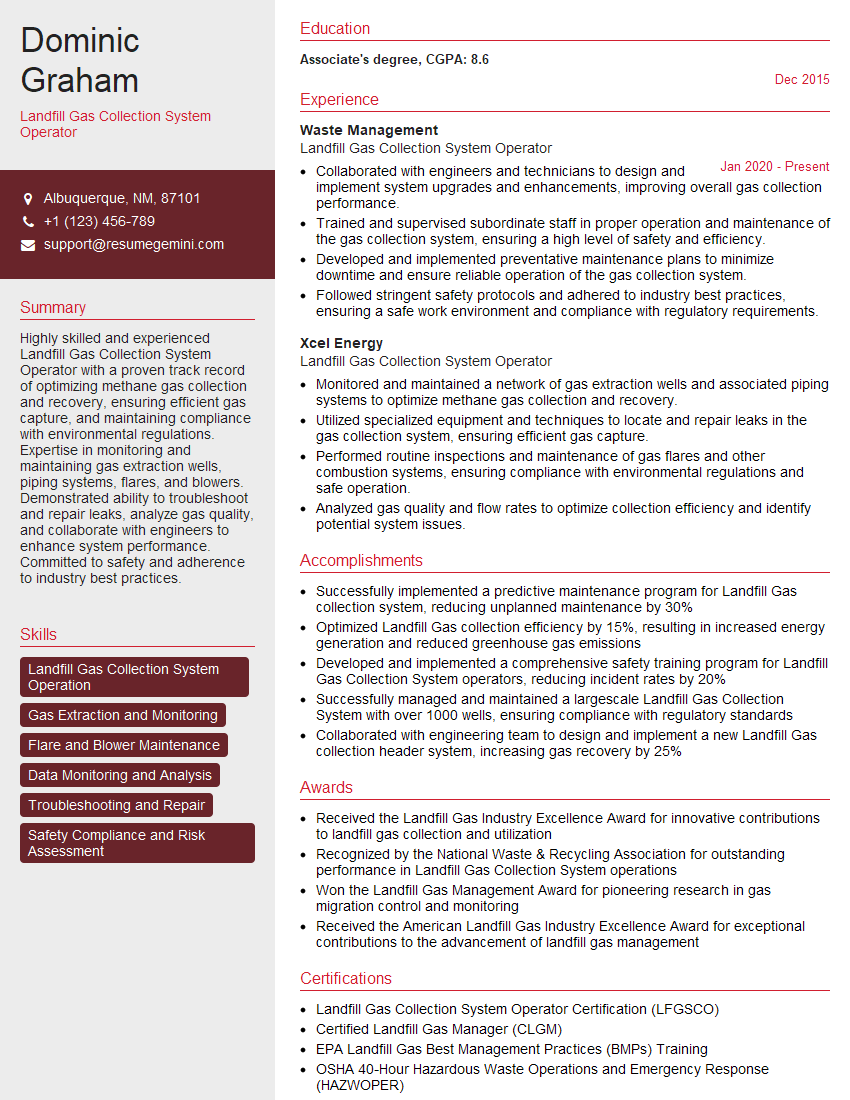
Mastering Landfill Gas Collection System Maintenance opens doors to a rewarding career with excellent growth potential in a vital sector focused on environmental sustainability. A strong resume is crucial for showcasing your skills and experience to potential employers. Creating an ATS-friendly resume is essential for navigating Applicant Tracking Systems and increasing your chances of landing an interview. ResumeGemini is a trusted resource to help you build a professional and impactful resume that highlights your expertise. Examples of resumes tailored to Landfill Gas Collection System Maintenance are available to help guide you through the process.
Explore more articles
Users Rating of Our Blogs
Share Your Experience
We value your feedback! Please rate our content and share your thoughts (optional).
What Readers Say About Our Blog
To the interviewgemini.com Webmaster.
Very helpful and content specific questions to help prepare me for my interview!
Thank you
To the interviewgemini.com Webmaster.
This was kind of a unique content I found around the specialized skills. Very helpful questions and good detailed answers.
Very Helpful blog, thank you Interviewgemini team.