The right preparation can turn an interview into an opportunity to showcase your expertise. This guide to Transit Network Design interview questions is your ultimate resource, providing key insights and tips to help you ace your responses and stand out as a top candidate.
Questions Asked in Transit Network Design Interview
Q 1. Explain the difference between a transit network and a transportation network.
A transportation network encompasses all modes of movement, including personal vehicles, transit, cycling, and walking. Think of it as the complete picture of how people and goods move within a region. A transit network, on the other hand, is a subset of this, focusing specifically on the public transportation systems – buses, trains, light rail, subways, etc. It’s like zooming in on a specific part of the transportation network to examine its efficiency and effectiveness.
For example, a city’s transportation network might include highways, local roads, bike lanes, and the city’s bus system. The transit network would only encompass that city’s bus system, along with any other public transportation options it might have like a subway or light rail.
Q 2. Describe your experience with various transit network modeling software (e.g., TransCAD, VISUM, Aimsun).
I have extensive experience with various transit network modeling software packages. My expertise includes TransCAD, which I’ve used extensively for network analysis, assignment modeling, and geographic information system (GIS) integration. I’ve leveraged its powerful optimization tools for designing efficient bus routes and evaluating the impact of new transit infrastructure. I’m also proficient in VISUM, particularly its microsimulation capabilities, for simulating passenger behavior and predicting demand under various scenarios. This has been crucial in assessing the effectiveness of different transit strategies. Finally, my work with Aimsun has focused on its strengths in microscopic traffic simulation, allowing for a detailed understanding of how transit interacts with other traffic flows, especially important in congested urban areas. In each case, I’ve employed these tools to create realistic models, conduct sensitivity analyses, and offer data-driven recommendations.
Q 3. How do you incorporate accessibility considerations into transit network design?
Accessibility is paramount in transit network design. We can’t just focus on speed and efficiency; we must ensure the system serves everyone. I incorporate accessibility considerations in several ways:
- Analyzing travel times and distances for various demographic groups, factoring in walking distances to stations and potential transfers.
- Designing routes and schedules that cater to the specific needs of the elderly and disabled, including frequent service, accessible vehicles, and clear wayfinding.
- Considering the location of key destinations like hospitals, schools, and employment centers, ensuring convenient access for all.
- Utilizing GIS data to overlay transit network information with social and demographic data, identifying areas with limited accessibility and prioritizing improvements.
For example, in a recent project, we used GIS analysis to identify areas with high concentrations of elderly residents who lacked convenient access to healthcare facilities. Based on this analysis, we proposed route modifications to increase service frequency and improve connectivity to these critical destinations.
Q 4. What are the key performance indicators (KPIs) you use to evaluate transit network efficiency?
Several KPIs are crucial in evaluating transit network efficiency. These include:
- Headway (frequency): How often services run. Lower headways indicate greater frequency and convenience.
- Speed and travel time: Average travel speeds and the total time needed to complete a journey.
- Ridership: The number of passengers using the system. Higher ridership indicates greater utilization and success.
- Level of service (LOS): A measure that combines various factors like crowding, waiting time, and walking distance.
- Cost-effectiveness: Comparing the operating costs with the ridership and benefits achieved. This often involves calculating things like cost per passenger-mile.
- Accessibility measures: This might include the percentage of stops with accessibility features or the average walking distance to a station for various demographics.
By tracking these metrics and analyzing trends, we can identify areas for improvement and optimize the network for maximum efficiency.
Q 5. Explain the concept of transit-oriented development (TOD) and its impact on network design.
Transit-oriented development (TOD) is a land use planning approach where high-density, mixed-use development is concentrated around transit stations. This creates vibrant, walkable communities and reduces reliance on cars. Its impact on network design is significant:
- Increased ridership: TOD generates higher demand for transit services due to the proximity of housing, jobs, and amenities.
- Optimized network design: Network planning considers the increased demand around transit stations, leading to more efficient route planning and service frequencies.
- Reduced congestion: By encouraging walking and transit use, TOD helps reduce traffic congestion on roads.
- Sustainable development: TOD promotes environmentally friendly development patterns by decreasing the need for car travel.
Think of a successful TOD project as a self-reinforcing cycle: better transit attracts development, which in turn increases transit ridership and justifies further investment in the transit network.
Q 6. How do you balance the needs of different user groups (e.g., commuters, elderly, disabled) in network planning?
Balancing the needs of diverse user groups requires a multi-faceted approach. I use several strategies:
- Data-driven analysis: Utilizing data on ridership patterns, demographic characteristics, and accessibility needs to understand the specific requirements of different user groups.
- Stakeholder engagement: Actively involving representatives from various communities, including the elderly, disabled, and commuters, in the planning process to gather feedback and ensure their needs are incorporated.
- Universal design principles: Applying principles of universal design, creating a system that is usable and accessible to everyone, regardless of age, ability, or background.
- Prioritizing accessibility features: Ensuring that stations, vehicles, and information systems meet accessibility standards.
- Flexible service design: Designing services and schedules that meet the diverse needs of different user groups, such as peak-hour service for commuters and off-peak service for other user groups.
For example, in one project, we integrated feedback from wheelchair users into station design, resulting in improved accessibility and significantly improved user experience.
Q 7. Describe your experience with different transit modes (bus, rail, light rail, etc.) and their integration.
My experience spans various transit modes and their integration. I’ve worked on projects involving:
- Bus systems: Designing efficient bus routes and schedules, optimizing stop locations, and implementing intelligent transportation systems (ITS) for real-time monitoring and control.
- Rail systems: Planning rail networks, considering factors such as track capacity, station spacing, and rolling stock requirements.
- Light rail systems: Integrating light rail with bus networks to provide a seamless and comprehensive transit system.
- Modal integration: Designing integrated fare systems, creating convenient transfers between different modes, and developing comprehensive journey planning tools.
Successful integration requires careful consideration of factors such as schedule coordination, fare structures, and physical connectivity between different modes. For instance, in one project, we implemented a unified ticketing system that allowed passengers to seamlessly transfer between bus and light rail, increasing ridership and improving the overall user experience.
Q 8. How do you address equity concerns in transit network design?
Addressing equity in transit network design means ensuring that the system serves all members of the community fairly, regardless of income, race, ethnicity, disability, or other factors. This goes beyond simply providing service; it requires actively mitigating historical and systemic inequities embedded in transportation systems.
- Accessibility Analysis: We conduct thorough accessibility assessments, using tools and methodologies to evaluate access for people with disabilities, considering factors like proximity to transit stops, the presence of ramps and elevators, and clear wayfinding information.
- Equity-Based Metrics: We utilize metrics that go beyond simple ridership numbers. This includes calculating travel times for different demographics across various neighborhoods, evaluating access to opportunities (jobs, education, healthcare), and assessing the distribution of transit service based on population density and socio-economic indicators.
- Community Engagement: Meaningful engagement with under-served communities is paramount. This involves holding public forums, conducting targeted surveys, and actively incorporating community feedback into the design process to understand their needs and perspectives directly.
- Prioritizing underserved areas: We strategize to allocate resources strategically, potentially prioritizing underserved areas for service improvements like increased frequency or new routes. This might involve a cost-benefit analysis that weights equity considerations higher than in traditional analyses.
For example, in a previous project, we identified a transit desert in a low-income neighborhood. By collaborating with the community and incorporating their feedback, we were able to design a new bus route that significantly improved access to employment opportunities and reduced travel times.
Q 9. Explain your understanding of different transit network topologies (e.g., grid, radial, hybrid).
Transit network topologies describe the overall structure and arrangement of routes. Different topologies offer unique advantages and disadvantages depending on the city’s geography and population distribution.
- Radial Network: This structure features routes radiating outwards from a central point, like spokes on a wheel. This is common in older cities with a dense downtown core, like many European capitals. It’s efficient for moving people to and from the center but can lead to congestion at the central hub and limited connectivity between outer areas.
- Grid Network: This topology uses a grid pattern of intersecting routes, providing excellent connectivity across the entire network. It’s highly adaptable to changing demands and offers flexibility in routing. Manhattan, New York, exemplifies a grid system, though it is often more complicated than a simple grid in practice.
- Hybrid Network: Most modern cities employ a hybrid approach, combining elements of radial and grid networks to optimize efficiency and connectivity. This involves having radial lines connecting to a more grid-like structure in suburban areas, improving overall access and flexibility. Many rapidly growing cities are developing such a hybrid strategy, trying to get the benefits of both worlds.
The choice of topology depends on several factors, including population density, geographic constraints, and projected ridership patterns. A thorough analysis is crucial to determine the most effective structure for a specific city or region.
Q 10. How do you incorporate data from various sources (e.g., GPS, smart cards, surveys) into network analysis?
Data integration is fundamental to effective transit network analysis. We utilize various data sources to gain a comprehensive understanding of passenger behavior, network performance, and overall system efficiency.
- GPS Data from Vehicles: Provides real-time information on vehicle location, speed, and adherence to schedules. This helps identify delays, optimize routes, and improve service reliability. We can use this data for things like analyzing dwell times at stops or identifying sections of the network with chronic congestion.
- Smart Card Data: Passenger smart card data provides insights into ridership patterns, including origin-destination information, peak travel times, and popular routes. This is valuable for demand forecasting and route optimization. We use this to identify underserved routes and potentially adjust frequencies or add additional buses.
- Surveys and Public Feedback: Surveys help gauge passenger satisfaction, uncover unmet needs, and understand accessibility challenges. Public feedback can illuminate issues or desires that might not be reflected in other data sources. For example, a survey might reveal a lack of adequate shelter at certain bus stops.
These diverse data sources are integrated using advanced analytical techniques, including GIS mapping and statistical modeling, to create a complete picture of the transit system’s performance and passenger behavior. Data visualization tools are crucial for identifying trends and patterns, aiding decision-making.
Q 11. Describe your experience with demand forecasting techniques for transit systems.
Demand forecasting is critical for planning and allocating resources effectively. Accurate forecasts ensure adequate capacity, minimize overcrowding, and optimize service levels. We use a variety of techniques, ranging from simple statistical methods to sophisticated agent-based modeling.
- Regression Analysis: A statistical technique that establishes relationships between ridership and factors like population density, income levels, and employment opportunities. This helps predict future ridership based on projected changes in these factors.
- Time Series Analysis: This examines historical ridership data to identify trends and seasonal variations, allowing for more accurate short-term predictions. We might use ARIMA or other time-series models to predict future ridership.
- Agent-Based Modeling (ABM): A complex simulation approach that models the individual behaviors of passengers, incorporating diverse factors like travel choices, modal split, and network conditions. This provides a detailed representation of network interactions and facilitates ‘what-if’ scenario analysis for different planning options. This is particularly useful when planning major infrastructure projects.
The choice of technique depends on the available data, the desired level of detail, and the planning horizon. For instance, simple regression might suffice for long-term strategic planning, while ABM is often better for detailed short-term operational decisions.
Q 12. How do you account for uncertainty and risk in transit network planning?
Uncertainty and risk are inherent in transit network planning. Factors like economic fluctuations, technological advancements, and unforeseen events can significantly impact project success. We utilize various strategies to account for these uncertainties.
- Scenario Planning: We develop multiple scenarios based on different assumptions about future conditions. This might include scenarios reflecting high or low economic growth, changes in fuel prices, or shifts in demographic trends. Each scenario is analyzed and a range of possible outcomes is determined.
- Sensitivity Analysis: This involves systematically changing input parameters (e.g., ridership projections, construction costs) to assess their impact on key performance indicators (KPIs), such as cost-effectiveness and environmental impact. This helps to identify the most critical uncertainties.
- Risk Assessment: We identify and evaluate potential risks, assigning probabilities and consequences to each. This allows for proactive mitigation strategies to be put in place.
- Robust Optimization Techniques: Mathematical methods that help design systems that perform well under a range of conditions, accounting for various uncertainties.
By incorporating these strategies, we can make more informed decisions, reduce potential negative impacts, and build more resilient transit systems.
Q 13. Explain your experience with cost-benefit analysis of transit projects.
Cost-benefit analysis (CBA) is a crucial tool for evaluating the economic feasibility of transit projects. It compares the total costs (construction, operation, maintenance) with the total benefits (reduced travel times, improved accessibility, economic impacts) over the project’s lifespan.
We utilize a structured approach to CBA, including:
- Identifying and quantifying costs: This includes direct costs (construction, equipment, personnel) and indirect costs (environmental impacts, disruptions to traffic). We use discounted cash flow techniques to convert future costs into present values.
- Identifying and quantifying benefits: We consider both tangible benefits (reduced travel time, increased productivity) and intangible benefits (improved air quality, enhanced social equity). These are often more difficult to quantify and require careful consideration of valuation techniques.
- Calculating Net Present Value (NPV): The NPV sums the discounted present value of benefits minus the discounted present value of costs. A positive NPV suggests that the project is economically viable.
- Conducting Sensitivity Analysis: This tests the robustness of the NPV to changes in key assumptions, such as ridership projections and discount rates.
CBA is not simply about numbers; it’s about making sound judgments informed by data and professional expertise. We carefully consider the assumptions and limitations of the analysis, ensuring transparency and robust decision-making.
Q 14. Describe your familiarity with environmental impact assessments related to transit systems.
Environmental impact assessments (EIAs) are essential for evaluating the potential environmental consequences of transit projects. This is a critical component of sustainable transit planning.
Our EIA process typically includes:
- Identifying potential impacts: This considers impacts on air and water quality, noise pollution, greenhouse gas emissions, habitat loss, and visual impacts. We use modeling tools to predict these impacts accurately.
- Assessing the significance of impacts: This involves evaluating the magnitude and duration of the impacts, considering their potential effects on human health and the environment. We may use standardized methodologies and environmental impact matrices to assist.
- Developing mitigation measures: This involves designing strategies to reduce or eliminate negative environmental impacts. Examples include using low-emission vehicles, incorporating green infrastructure, and minimizing habitat disruption. Our mitigation strategy should be consistent with overall sustainability goals.
- Monitoring and evaluating mitigation effectiveness: Post-project monitoring is essential to track environmental performance and ensure that mitigation measures are effective. We collect data and analyze it to determine the extent to which the project’s environmental impacts are aligned with predictions and mitigation measures are successful.
EIA helps ensure that transit projects are environmentally sound and contribute to a more sustainable future. It is often a crucial component in obtaining permits and approvals for transit projects.
Q 15. How do you use GIS tools in transit network design and analysis?
Geographic Information Systems (GIS) tools are indispensable in transit network design and analysis. They allow us to visualize, analyze, and manage geographically referenced data, providing a crucial foundation for informed decision-making. Imagine trying to plan a bus route without a map – a nightmare! GIS provides that map and so much more.
Data Integration: GIS integrates various datasets like road networks, population density, land use, points of interest (POIs like schools and hospitals), and even real-time traffic data. This comprehensive view helps identify optimal route locations, potential bottlenecks, and areas with high ridership demand.
Network Modeling: We use GIS to build and analyze network models, simulating the flow of passengers and vehicles. This helps evaluate different scenarios, such as adding new routes or changing frequencies, and predicting their impact on overall system performance.
Spatial Analysis: GIS performs spatial analysis – calculating distances, finding nearest neighbors, and identifying service gaps. For example, we can determine the optimal locations for new bus stops to minimize travel time for passengers while ensuring adequate coverage.
Visualization and Communication: GIS produces visually compelling maps and reports that are easily understandable by stakeholders. This helps in communicating complex analyses to non-technical audiences, facilitating informed decision-making and public engagement.
For instance, in a recent project, we used ArcGIS to model the impact of a proposed light rail line on traffic congestion and travel times. The visual representation of predicted changes helped secure funding for the project.
Career Expert Tips:
- Ace those interviews! Prepare effectively by reviewing the Top 50 Most Common Interview Questions on ResumeGemini.
- Navigate your job search with confidence! Explore a wide range of Career Tips on ResumeGemini. Learn about common challenges and recommendations to overcome them.
- Craft the perfect resume! Master the Art of Resume Writing with ResumeGemini’s guide. Showcase your unique qualifications and achievements effectively.
- Don’t miss out on holiday savings! Build your dream resume with ResumeGemini’s ATS optimized templates.
Q 16. Explain your approach to optimizing bus routes or train schedules.
Optimizing bus routes and train schedules is a complex optimization problem, typically tackled using a combination of techniques. My approach involves a multi-step process:
Data Collection and Preparation: Gathering data on passenger demand (origin-destination matrices), travel times, vehicle capacity, operating costs, and infrastructure constraints is crucial. This data is often cleaned and processed using scripting languages like Python.
Route Optimization: We use algorithms like genetic algorithms or simulated annealing to find routes that minimize travel time, distance, or cost while meeting service requirements. These algorithms consider factors like traffic patterns, speed limits, and passenger demand at various times of the day.
Schedule Optimization: This involves adjusting headways (the time between successive vehicles) to match demand. This might mean deploying more frequent services during peak hours and less frequent ones during off-peak periods. Mathematical programming techniques are often used for schedule optimization.
Simulation and Validation: Before implementation, we simulate the optimized routes and schedules to evaluate their performance under various conditions. This might involve using simulation software that considers real-world factors like passenger loading and unloading times.
For example, in a recent project for a bus system, we used a genetic algorithm to optimize routes and reduce overall travel time by 15% while maintaining acceptable service coverage. The optimization took into account peak hour congestion and passenger distribution across different neighborhoods.
Q 17. How do you manage conflicts between different stakeholders in transit network projects?
Managing stakeholder conflicts is a critical aspect of transit network projects. Different stakeholders (residents, businesses, environmental groups, government agencies) have varying priorities and concerns. My approach emphasizes collaborative engagement and transparent communication:
Stakeholder Identification and Analysis: Identifying all relevant stakeholders and understanding their interests and potential conflicts is the first step. This involves community meetings, surveys, and discussions with representatives from different groups.
Early and Frequent Communication: Keeping stakeholders informed throughout the project lifecycle is crucial to building trust and addressing concerns early on. Regular updates, workshops, and feedback sessions can help maintain open communication channels.
Conflict Resolution Techniques: When conflicts arise, I employ various conflict resolution techniques, such as mediation, negotiation, and compromise. The goal is to find solutions that address the concerns of as many stakeholders as possible.
Multi-Criteria Decision Analysis (MCDA): MCDA can be used to evaluate different options considering various stakeholder preferences and criteria. This allows for a transparent and objective way to compare alternatives and make informed decisions.
For example, in a project involving a proposed new bus rapid transit (BRT) corridor, we faced opposition from residents concerned about noise and traffic disruptions. Through a series of community meetings and negotiations, we were able to incorporate mitigation measures like noise barriers and traffic calming techniques, ultimately achieving a consensus.
Q 18. Describe your experience with scenario planning and sensitivity analysis in transit network design.
Scenario planning and sensitivity analysis are essential for robust transit network design. They help us understand the uncertainty inherent in forecasting and planning and prepare for potential disruptions.
Scenario Planning: We develop various future scenarios based on different assumptions about factors like population growth, economic development, and technological advancements. For example, we might create scenarios reflecting high growth, moderate growth, and no growth in ridership.
Sensitivity Analysis: This involves assessing the impact of changes in key input parameters on the outcome. For instance, we might vary travel times, operating costs, or passenger demand to understand how these variations affect the performance of the proposed network. This helps identify critical parameters that require careful monitoring and management.
In a recent light rail project, we created three scenarios: a high ridership scenario, a moderate ridership scenario, and a low ridership scenario. The sensitivity analysis showed that the project was financially viable even under the low ridership scenario, increasing investor confidence.
Q 19. How do you evaluate the effectiveness of different transit network strategies?
Evaluating the effectiveness of different transit network strategies involves using a range of quantitative and qualitative metrics. These metrics need to capture various aspects of system performance.
Ridership: Measuring passenger volume provides a direct indicator of the network’s success in attracting users. This can be broken down by route, time of day, and demographic.
Travel Time and Speed: These metrics assess the efficiency of the network in moving passengers from origin to destination. Reduced travel times enhance user satisfaction.
Accessibility: The network’s ability to reach diverse populations and serve underserved areas is a key aspect of its effectiveness.
Cost-Effectiveness: Evaluating the operating costs, capital investments, and subsidy requirements helps assess the financial viability and sustainability of the network.
Environmental Impact: Measuring greenhouse gas emissions and air quality improvements can quantify the environmental benefits of the transit network.
Customer Satisfaction: Surveys and feedback mechanisms provide valuable insights into user perceptions and satisfaction with the service.
A balanced scorecard approach, considering both quantitative and qualitative factors, is often used to provide a comprehensive evaluation.
Q 20. What are the challenges in integrating different transit modes into a unified network?
Integrating different transit modes (buses, trains, subways, ride-sharing, etc.) into a unified network presents several challenges:
Data Integration and Interoperability: Different modes often use different data systems and technologies, making data exchange and integration difficult. This needs standardized data formats and APIs.
Fare Integration and Ticketing: Developing a seamless fare payment system that works across all modes can be challenging. This often requires investment in smart card technology or mobile ticketing solutions.
Transfer Optimization: Minimizing transfer times and improving the transfer experience between different modes is crucial for enhancing user satisfaction. This requires careful coordination of schedules and route planning.
Network Management and Control: Managing a complex, multi-modal network requires advanced control systems that can coordinate the operation of different modes and respond to real-time events.
For example, integrating a light rail system with a bus network requires careful coordination of schedules to ensure convenient transfers. This might involve using real-time data to adjust bus schedules based on train arrival times.
Q 21. How do you ensure the sustainability of a transit network design?
Ensuring the sustainability of a transit network design requires considering environmental, economic, and social factors. This requires a holistic and long-term perspective.
Environmental Sustainability: Reducing greenhouse gas emissions, promoting the use of renewable energy sources for vehicles and infrastructure, and minimizing land consumption are key environmental considerations.
Economic Sustainability: The network should be financially viable in the long run, generating sufficient revenue to cover operating costs and maintain infrastructure. This might involve optimizing routes, adjusting fares, and seeking public funding.
Social Sustainability: The network should enhance social equity and accessibility, connecting communities and providing access to jobs, education, and healthcare. This requires careful consideration of demographic data and service requirements.
Resilience to Disruptions: The network’s ability to withstand and recover from unexpected events like natural disasters or terrorism is a crucial aspect of sustainability.
For example, using electric buses, optimizing energy consumption in transit stations, and implementing robust backup plans for emergencies contribute to a sustainable transit system design.
Q 22. Explain your approach to evaluating the impact of new technologies (e.g., autonomous vehicles) on transit networks.
Evaluating the impact of new technologies like autonomous vehicles (AVs) on transit networks requires a multi-faceted approach. It’s not simply about replacing existing buses with self-driving ones; it’s about understanding how AVs fundamentally alter the system’s dynamics.
- Demand Forecasting: We need to model how AVs might change travel patterns. Will people shift from private vehicles to shared autonomous services? Will this increase or decrease overall demand on public transit?
- Network Optimization: AVs could lead to on-demand services, requiring dynamic routing and scheduling algorithms that differ drastically from fixed-route bus systems. We’d use simulation software to explore different scenarios and optimize the network accordingly. For instance, we might explore microtransit zones served by smaller AV fleets supplementing existing bus routes.
- Infrastructure Adaptation: AVs might need specific infrastructure, like dedicated lanes or charging stations. We need to assess the costs and benefits of such infrastructure investments and integrate them into the overall network design.
- Safety and Reliability: Ensuring the safety and reliability of AVs within a transit network is crucial. This involves analyzing potential failure modes, developing contingency plans, and integrating AV operations with existing transit management systems.
- Economic and Social Impacts: The impact extends beyond the network itself. We must consider the effects on employment (drivers), accessibility (for people with disabilities), and the overall economic efficiency of the transportation system.
For example, in a recent project, we used agent-based modeling to simulate the impact of introducing a fleet of autonomous shuttles in a suburban area. The model allowed us to test different scenarios, such as varying levels of AV penetration and different pricing strategies, to determine the optimal integration strategy for the existing bus network.
Q 23. Describe your experience with public participation and engagement in transit planning.
Public participation is paramount in successful transit planning. Ignoring the needs and perspectives of the community can lead to projects that fail to meet their objectives or even face significant opposition.
- Community Forums and Workshops: I’ve organized numerous community forums and workshops where residents can voice their opinions, concerns, and suggestions. This helps us understand the real-world needs and priorities of potential riders.
- Online Surveys and Feedback Mechanisms: Using online platforms allows for broader participation and more efficient data collection. This provides an additional method for engagement, especially for those who find it difficult to attend in-person events.
- Stakeholder Collaboration: Effective transit planning involves working with a variety of stakeholders, including local businesses, community organizations, disability advocacy groups, and other government agencies. I prioritize open communication and collaborative decision-making to ensure everyone’s perspectives are considered.
- Data Visualization and Accessible Communication: Presenting complex transit information in an understandable and visually engaging way is crucial for effective participation. This includes using maps, charts, and infographics to communicate proposed changes and their potential impact.
For instance, in one project, we faced strong opposition to a proposed bus route change. By actively engaging with affected residents through a series of community meetings and online surveys, we were able to address their concerns, modify the proposal, and ultimately gain their support.
Q 24. How do you ensure the resilience of a transit network to unexpected events (e.g., natural disasters)?
Building resilience into a transit network requires proactive planning and robust contingency measures. It’s about anticipating potential disruptions and designing the system to withstand them.
- Redundancy and Diversification: Multiple routes and modes of transportation minimize the impact of disruptions. If one route is blocked, alternative routes should be readily available.
- Robust Infrastructure: Designing infrastructure to withstand extreme weather events (e.g., using elevated tracks to avoid flooding) is essential. This requires careful consideration of local geological and climatic conditions.
- Emergency Response Plans: Well-defined plans for dealing with emergencies, including natural disasters, accidents, and security threats, are crucial. This includes having backup communication systems and procedures for evacuating passengers and staff.
- Real-time Monitoring and Control Systems: Sophisticated monitoring systems allow for early detection of problems and rapid responses. This includes integrated traffic management systems that can reroute services around incidents.
- Geographic Information System (GIS) Integration: Using GIS to visualize the network and overlay it with hazard maps helps identify vulnerable areas and prioritize mitigation efforts.
For example, in designing a coastal transit network, we integrated elevation data into our GIS to identify areas vulnerable to storm surges. This allowed us to plan for alternative routes and elevated stations, making the system more resilient to flooding.
Q 25. What are your preferred methods for communicating complex transit network information to stakeholders?
Communicating complex transit network information effectively requires a multi-pronged approach tailored to the audience.
- Visualizations: Maps, charts, and interactive dashboards are powerful tools for conveying information quickly and intuitively. These visuals need to be clear, concise, and easy to understand, even for people unfamiliar with transit systems.
- Plain Language: Avoid technical jargon. Explain concepts in simple, easy-to-understand terms. Use analogies and relatable examples to make the information more accessible.
- Multiple Channels: Use a variety of channels to reach stakeholders, including websites, social media, community meetings, and printed materials. This ensures that information reaches a wider audience.
- Interactive Tools: Interactive maps and trip planners allow stakeholders to explore the network and understand the impact of proposed changes in a personalized way.
- Feedback Mechanisms: Provide opportunities for stakeholders to ask questions and provide feedback. This demonstrates transparency and helps build trust.
For example, when explaining a proposed network restructuring, we used a series of interactive maps that allowed users to see the impact of the changes on their specific commutes. This interactive approach increased engagement and helped us gather valuable feedback.
Q 26. Describe a situation where you had to make a trade-off between different design goals in a transit project.
In one project, we had to balance the competing goals of minimizing travel times and maximizing accessibility. The proposed light rail line would significantly reduce travel times between the city center and a suburban area. However, the optimal route passed through a low-income neighborhood that lacked adequate accessibility features.
The trade-off involved choosing between a route that provided faster travel times but potentially displaced some residents and caused accessibility issues, and a less efficient route that better served the existing community. We used multi-criteria decision analysis (MCDA) to weigh these competing factors, considering factors like travel time savings, construction costs, environmental impact, and social equity. Ultimately, we opted for a slightly less efficient route that incorporated improved accessibility features in the low-income neighborhood, recognizing that social equity was a crucial aspect of a successful transit project.
Q 27. How do you stay updated with the latest trends and innovations in transit network design?
Staying current in transit network design requires continuous learning and engagement with the field’s evolving landscape.
- Professional Organizations: Active membership in organizations like the Institute of Transportation Engineers (ITE) and the Transportation Research Board (TRB) provides access to conferences, publications, and networking opportunities.
- Academic Journals and Publications: Regularly reading leading academic journals and industry publications allows me to stay abreast of the latest research and innovations.
- Conferences and Workshops: Attending industry conferences and workshops allows for direct interaction with leading experts and exposure to cutting-edge technologies and design methodologies.
- Online Resources and Webinars: Online platforms offer a wealth of information, including webinars, tutorials, and online courses, providing continuing professional development.
- Collaboration and Networking: Engaging with colleagues and experts through professional networks and collaborations fosters the exchange of knowledge and innovative ideas.
I actively participate in these avenues to ensure I am always up to date on the latest advancements in areas like data-driven decision-making, smart mobility solutions, and the integration of emerging technologies into transit networks.
Key Topics to Learn for Transit Network Design Interview
- Network Topology and Routing: Understanding different network structures (e.g., radial, grid, hybrid) and their impact on efficiency and accessibility. Practical application: Analyzing existing transit networks and proposing improvements based on optimal routing algorithms.
- Demand Forecasting and Modeling: Utilizing data analysis and forecasting techniques to predict future ridership and inform network planning decisions. Practical application: Developing models to project future demand for various transit modes under different scenarios.
- Transit Scheduling and Optimization: Mastering techniques for creating efficient and reliable transit schedules, considering factors like headways, dwell times, and vehicle capacity. Practical application: Designing and optimizing schedules to minimize delays and maximize passenger throughput.
- GIS and Geographic Data Analysis: Proficiency in using GIS software to analyze spatial data, visualize networks, and conduct geographic analysis. Practical application: Integrating geographic information with ridership data to identify service gaps and optimize route placement.
- Accessibility and Equity Considerations: Understanding the principles of equitable transit service delivery and incorporating accessibility features into network design. Practical application: Designing networks that serve diverse populations and address the needs of passengers with disabilities.
- Multimodal Integration: Designing networks that seamlessly integrate different modes of transportation (e.g., bus, rail, bike share) to provide comprehensive travel options. Practical application: Developing strategies to improve first/last mile connectivity and encourage multimodal journeys.
- Performance Measurement and Evaluation: Understanding key performance indicators (KPIs) used to assess the effectiveness of transit networks, such as on-time performance, ridership levels, and cost-effectiveness. Practical application: Developing metrics and frameworks for evaluating the success of network improvements.
Next Steps
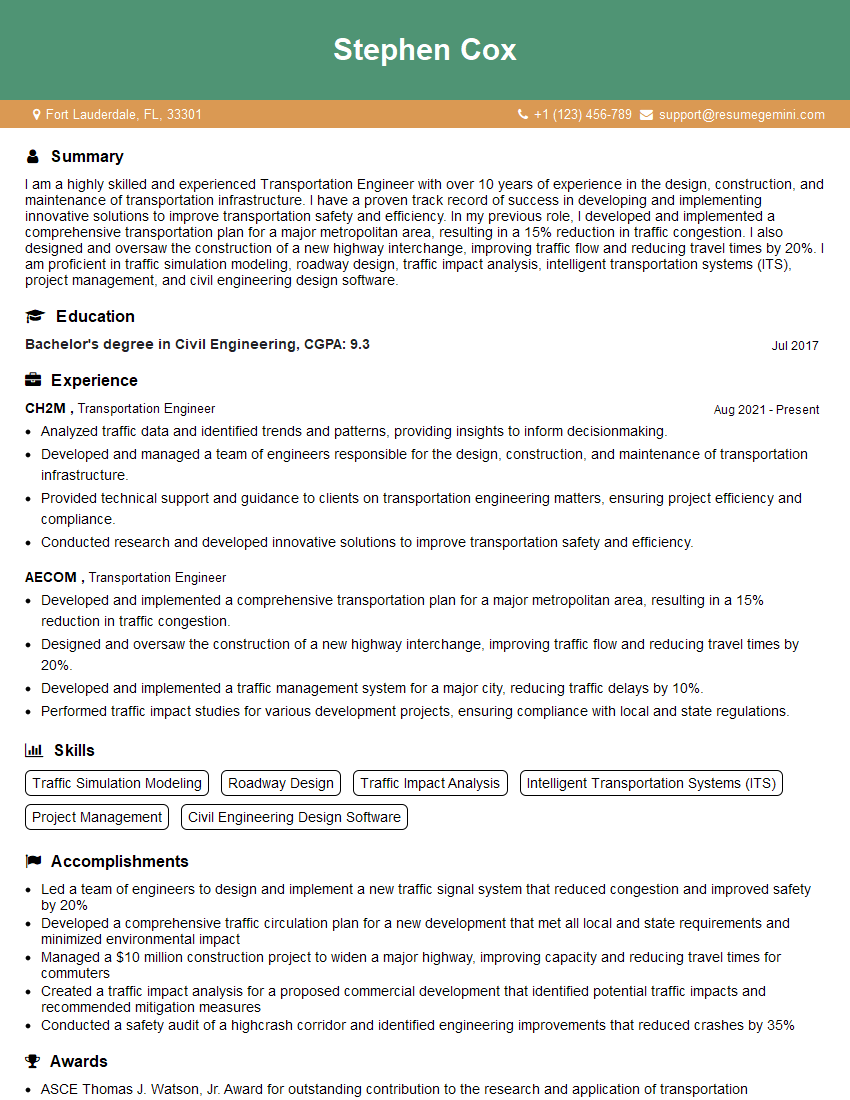
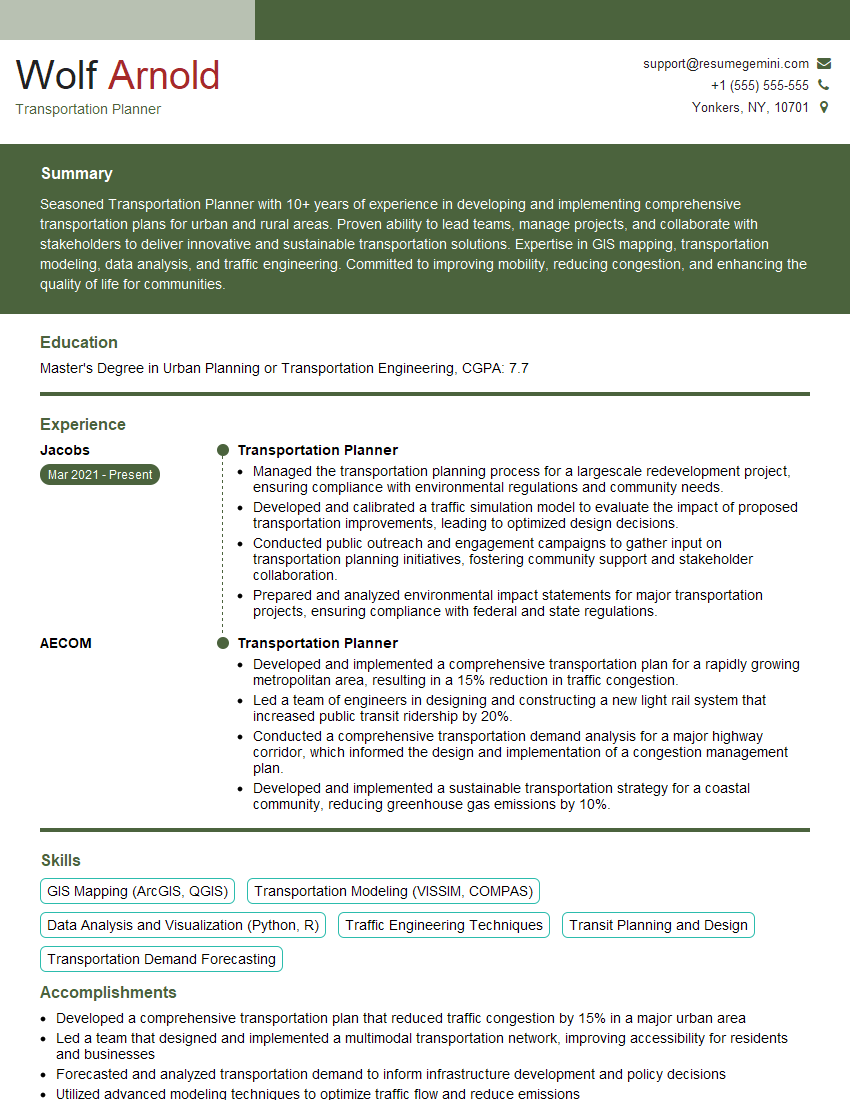
Mastering Transit Network Design is crucial for a rewarding and impactful career in transportation planning and engineering. It opens doors to exciting projects and leadership opportunities, allowing you to shape the future of urban mobility. To significantly boost your job prospects, creating an ATS-friendly resume is essential. This ensures your qualifications are effectively communicated to hiring managers and Applicant Tracking Systems. We strongly recommend leveraging ResumeGemini as a trusted resource for building a professional and compelling resume. ResumeGemini offers expert guidance and provides examples of resumes tailored to Transit Network Design to help you present yourself effectively. Take the next step towards your dream career today!
Explore more articles
Users Rating of Our Blogs
Share Your Experience
We value your feedback! Please rate our content and share your thoughts (optional).
What Readers Say About Our Blog
To the interviewgemini.com Webmaster.
Very helpful and content specific questions to help prepare me for my interview!
Thank you
To the interviewgemini.com Webmaster.
This was kind of a unique content I found around the specialized skills. Very helpful questions and good detailed answers.
Very Helpful blog, thank you Interviewgemini team.