Interviews are more than just a Q&A session—they’re a chance to prove your worth. This blog dives into essential Landfill Gas Data Analysis and Reporting interview questions and expert tips to help you align your answers with what hiring managers are looking for. Start preparing to shine!
Questions Asked in Landfill Gas Data Analysis and Reporting Interview
Q 1. Explain the composition of typical landfill gas.
Landfill gas (LFG) is primarily composed of methane (CH4) and carbon dioxide (CO2), along with trace amounts of other gases. The exact composition varies depending on factors like the age of the landfill, waste composition, and environmental conditions. A typical LFG composition might look like this:
- Methane (CH4): 45-60%
- Carbon Dioxide (CO2): 40-55%
- Nitrogen (N2): 1-5%
- Oxygen (O2): Trace amounts (ideally very low)
- Other trace gases: Hydrogen sulfide (H2S), siloxanes, volatile organic compounds (VOCs)
The high methane content is of significant concern due to its potent greenhouse gas effect, making LFG capture and utilization crucial for environmental protection. The presence of other trace gases like H2S necessitates gas cleaning before utilization for energy production to prevent equipment corrosion and protect the environment.
Q 2. Describe different methods for landfill gas monitoring.
Landfill gas monitoring employs various methods to assess gas composition, flow rates, and pressure. These methods are essential for efficient operation, safety, and environmental compliance.
- Fixed-point monitoring: This involves installing sensors at strategic locations within the landfill to continuously measure gas parameters like CH4, CO2, and pressure. Data is usually logged and transmitted remotely for analysis.
- Mobile monitoring: Portable gas detectors are used for spot checks and surveys across the landfill to identify potential leaks or gas hotspots. This is particularly useful for investigating unusual readings from fixed sensors.
- Wellhead monitoring: This focuses on measuring gas pressure and flow rates at the wellheads – where gas extraction pipes emerge from the landfill. This data is vital in assessing extraction system efficiency.
- Gas chromatography (GC): GC is a laboratory technique providing precise quantification of various LFG components, including trace gases. This detailed analysis is often carried out regularly for quality control and regulatory compliance.
- Remote sensing: Emerging technologies such as satellite-based remote sensing can offer large-scale monitoring of methane emissions from landfills, offering a valuable overview, especially across wide geographical areas.
The choice of methods depends on budget, site-specific factors, and the level of detail required.
Q 3. How do you calculate landfill gas production rates?
Calculating landfill gas production rates requires careful consideration of multiple factors. A common approach is to measure gas extraction rates from the collection system and adjust for extraction efficiency. The formula often looks like this:
Production Rate = Extraction Rate / Extraction EfficiencyWhere:
- Extraction Rate is typically measured in standard cubic meters per day (Sm3/day) or other suitable units and represents the amount of gas extracted from the landfill’s collection system.
- Extraction Efficiency represents the percentage of generated gas that is successfully captured and extracted. This is often determined by comparing the amount of gas extracted to an estimated gas generation potential based on waste characteristics and site-specific factors. This efficiency can vary considerably, often between 60-90% depending on the quality and coverage of the gas collection network.
Determining extraction efficiency can be challenging. Sophisticated models are employed often incorporating waste quantity, composition, and decomposition rates to estimate total gas production. Isotopic analysis of landfill gas can also aid in quantifying production rates by determining the proportion of biogenic versus thermogenic methane.
Q 4. What are the key challenges in accurately measuring landfill gas emissions?
Accurately measuring landfill gas emissions poses significant challenges:
- Heterogeneous waste composition: The variable composition of waste within a landfill leads to uneven gas generation rates and distribution, making it difficult to get a representative sample.
- Leakage: Leaks in the collection system can lead to significant underestimation of actual gas generation and release of potent greenhouse gases into the atmosphere.
- Spatiotemporal variability: Gas production and emission rates change over time and location, requiring frequent and spatially distributed measurements.
- Instrumentation limitations: Sensors can be affected by various environmental factors (temperature, humidity), leading to inaccurate readings. Calibration and maintenance are therefore paramount.
- Access limitations: Accessing all parts of the landfill for measurement can be difficult and dangerous due to terrain and the nature of the waste itself. This particularly impacts the accuracy of surveying for leaks.
Overcoming these challenges involves a combination of advanced monitoring techniques, regular system maintenance, and robust data analysis to account for variability and uncertainties.
Q 5. Explain the importance of landfill gas collection and control systems.
Landfill gas collection and control systems are critical for environmental protection and public safety. They play a crucial role in:
- Reducing greenhouse gas emissions: Capturing methane prevents its release into the atmosphere, mitigating its contribution to climate change. Methane is considerably more potent as a greenhouse gas than carbon dioxide.
- Minimizing air pollution: Collecting and treating LFG helps remove harmful pollutants like H2S and VOCs from escaping and impacting surrounding communities.
- Preventing explosions and fires: Proper gas management mitigates the risk of explosions from accumulated methane in the landfill or surrounding areas. A build-up of methane can be extremely hazardous.
- Enabling beneficial use: Collected gas can be used as a renewable energy source, reducing reliance on fossil fuels.
Efficient collection systems need careful design considering the landfill’s topography, waste characteristics, and projected gas generation. Regular monitoring and maintenance are crucial for long-term effectiveness. A well-designed and maintained system minimizes emissions and provides opportunities for sustainable energy generation.
Q 6. Describe different technologies used for landfill gas utilization.
Several technologies are used for landfill gas utilization, mainly focused on energy generation or beneficial use.
- Energy generation:
- Electricity generation: LFG is used to fuel engines (internal combustion engines or gas turbines) which drive generators to produce electricity.
- Combined heat and power (CHP): Systems that simultaneously generate electricity and heat from LFG, improving overall energy efficiency.
- Fuel cells: These use electrochemical reactions to convert LFG into electricity with high efficiency and lower emissions.
- Other beneficial uses:
- Gas flaring: A less desirable option where LFG is burned, reducing methane but still releasing CO2. It is often used as a temporary or emergency measure.
- Thermal applications: LFG is sometimes used to provide heat for industrial processes or building heating.
- Biogas upgrading: Through processes like CO2 removal and other purification steps, LFG can be enhanced to natural gas quality for direct injection into existing pipelines.
The optimal technology depends on factors like LFG composition, volume, proximity to infrastructure, and economic considerations.
Q 7. How do you interpret landfill gas data to assess site performance?
Interpreting landfill gas data is crucial for assessing site performance and identifying areas for improvement. Analysis focuses on several key parameters:
- Gas composition: Trends in CH4, CO2, and other components reveal information about the waste degradation processes and the overall health of the landfill.
- Gas production rate: Monitoring changes in gas production rates allows for tracking the progress of decomposition and adjustments in extraction system operations.
- Extraction efficiency: Consistent monitoring provides insights into the effectiveness of the gas collection network. A decline suggests leaks or the need for system upgrades.
- Pressure monitoring: Changes in landfill gas pressure can indicate potential issues such as plugging of extraction wells or excessive gas generation.
- Correlation with waste characteristics: Data analysis can help correlate gas composition and production rates with the waste characteristics and composition, providing valuable input for landfill design and operation optimization.
By combining data from various monitoring points and analyzing trends, landfill operators can assess system performance, detect potential problems, and optimize operations for efficient gas management and emission control. Effective data analysis can be crucial for regulatory compliance and environmental responsibility.
Q 8. What are the regulatory requirements for landfill gas management in your region?
Landfill gas management regulations vary significantly by region, but generally aim to minimize environmental impact and protect public health. In my region, these regulations typically encompass several key areas:
- Gas Collection and Control Systems: Regulations mandate the design, installation, and operation of effective gas collection systems, specifying minimum collection rates and leak detection protocols. For example, there are often requirements for specific well spacing and design based on landfill size and waste composition.
- Emission Monitoring and Reporting: Regular monitoring of landfill gas composition (methane, carbon dioxide, etc.) and flow rates is mandated. This data is then reported to the relevant environmental agency, often with specific frequency and reporting formats. Penalties for non-compliance are substantial.
- Flare and Energy Recovery Systems: Regulations often encourage or require the use of flares to combust landfill gas, preventing its release into the atmosphere. Increasingly, regulations incentivize energy recovery projects, such as using landfill gas to generate electricity. Specific emission limits for flares and efficiency standards for energy recovery systems are often detailed.
- Permitting and Inspections: Landfill gas management activities are subject to a rigorous permitting process, with regular inspections by environmental authorities to ensure compliance. These inspections can involve reviews of monitoring data, system maintenance records, and on-site assessments.
Specific details regarding permitted emission levels, monitoring frequencies, and reporting requirements are documented in the regional environmental regulations. Staying up-to-date on these regulations is critical for responsible landfill management.
Q 9. Explain different statistical methods used for analyzing landfill gas data.
Analyzing landfill gas data involves a range of statistical methods, depending on the specific objectives. Here are some commonly used approaches:
- Descriptive Statistics: These provide a summary of the data, such as mean, median, standard deviation, and range of gas flow rates and concentrations. This gives a clear picture of typical behavior and variability.
- Time Series Analysis: This is crucial for understanding trends and patterns in gas production over time. Methods like moving averages can smooth out short-term fluctuations to reveal underlying trends. Decomposition techniques help separate seasonal, trend, and random components of the data. We can use this to predict future gas generation.
- Regression Analysis: This helps establish relationships between landfill gas production and other variables, such as waste quantity, age, or environmental factors (rainfall, temperature). Linear regression is frequently employed, but more complex models may be needed for non-linear relationships. For example, we can model the relationship between landfill age and methane production.
- Correlation Analysis: This assesses the strength and direction of relationships between different gas components (methane, carbon dioxide) or between gas production and other factors. This helps identify potential causes of changes in gas composition.
- Statistical Process Control (SPC): Control charts (e.g., Shewhart, CUSUM) are used to monitor gas production parameters over time, identifying potential anomalies or deviations from expected ranges, indicating possible system malfunctions or changes in waste composition.
The choice of statistical method depends on the research question and the nature of the data. Often, a combination of methods is used to obtain a comprehensive understanding.
Q 10. How do you identify and troubleshoot issues in landfill gas systems?
Troubleshooting landfill gas systems requires a systematic approach, combining data analysis with on-site inspections. Here’s a typical workflow:
- Data Review: Start by carefully examining gas flow and composition data. Significant deviations from expected patterns, such as sudden drops in flow or changes in methane concentration, often indicate a problem.
- System Inspection: Visually inspect the collection system, including wells, headers, and pipelines, looking for leaks, blockages, or damage. This may involve using specialized equipment, such as thermal cameras or gas detectors.
- Well Pressure Testing: Measure the pressure within individual wells to identify potential blockages or restrictions in the collection system.
- Leak Detection: Employ leak detection techniques (e.g., acoustic leak detection, tracer gas analysis) to pinpoint and repair leaks in the system. This is crucial to minimize methane emissions.
- Waste Characterization: In some cases, changes in waste composition (e.g., increased proportion of inert materials) may impact gas production. Waste characterization can help identify the root cause.
- Data Reconciliation: After addressing the issue, carefully monitor the system to verify the effectiveness of repairs or adjustments, and ensure the system is functioning as expected.
For instance, a sudden drop in gas flow might point to a blockage in a pipeline, which could be confirmed by visual inspection and well pressure testing. Regular maintenance, preventative measures and prompt attention to anomalies are vital to ensure optimal system performance and environmental compliance.
Q 11. Describe your experience with different types of landfill gas monitoring equipment.
My experience encompasses a range of landfill gas monitoring equipment, from basic instruments to sophisticated automated systems:
- Gas Chromatographs (GCs): GCs are used for precise measurement of gas composition, providing detailed information on methane, carbon dioxide, and other components. I’ve used both portable and laboratory-based GCs, each with its advantages and limitations in terms of speed and accuracy.
- Flame Ionization Detectors (FIDs): FIDs are commonly used for continuous monitoring of methane concentration, providing real-time data on gas flow. These are often part of automated monitoring systems, providing ongoing data for operational decision-making.
- Thermal Mass Flow Meters: These instruments accurately measure the volume of gas flowing through a pipeline, helping to track the total gas production from the landfill. Different flow meter technologies are available to handle different ranges and pressures.
- Pressure Sensors and Transducers: Pressure sensors are crucial for monitoring pressure within the landfill gas collection system, helping to identify blockages or other problems. The accuracy and range of these sensors are key considerations.
- Data Loggers and SCADA Systems: Data loggers and supervisory control and data acquisition (SCADA) systems are used to collect, store, and manage data from multiple sensors and instruments, providing a comprehensive overview of landfill gas production and system performance.
Selecting the appropriate equipment depends on factors like budget, required accuracy, desired level of automation, and the specific characteristics of the landfill.
Q 12. How do you ensure the accuracy and reliability of landfill gas data?
Ensuring the accuracy and reliability of landfill gas data is paramount. Several strategies are employed:
- Calibration and Maintenance: Regular calibration of all monitoring equipment according to manufacturer’s specifications is crucial. This ensures that the data collected is accurate and traceable. Proper maintenance of equipment, including regular cleaning and servicing, is also important.
- Quality Control Procedures: Implementing quality control (QC) procedures, such as regular blank and spike analyses, helps identify and correct potential errors or biases in the data. This provides confidence in the data quality.
- Data Validation: Data validation techniques are employed to identify and remove outliers or erroneous data points. This ensures that only reliable data is used for analysis and reporting.
- Redundancy and Cross-Checking: Using redundant sensors or multiple analytical methods helps verify the accuracy of data. If possible, cross-checking data from different monitoring points can help identify potential inconsistencies.
- Data Logging and Archiving: Using reliable data logging systems with secure data archiving ensures that data is preserved and readily accessible for analysis and reporting. Proper data management practices are essential for compliance with regulatory requirements.
A robust quality assurance/quality control (QA/QC) program is critical to ensure data integrity and confidence in any analysis or reporting.
Q 13. Explain your experience with data visualization techniques for landfill gas data.
Effective data visualization is key to communicating landfill gas data effectively. I utilize several techniques:
- Time Series Plots: These clearly display trends in gas flow and composition over time, allowing for easy identification of patterns and anomalies. I often use color-coding to highlight different gas components or periods of interest.
- Bar Charts and Histograms: These are useful for comparing gas production across different wells, time periods, or landfill sections. I use this to show the distribution of gas composition.
- Scatter Plots: These show the relationship between different variables, such as gas flow and pressure, or gas production and environmental factors. I might add regression lines to illustrate trends.
- Geographic Information Systems (GIS) Mapping: GIS maps can visually represent gas well locations, flow rates, and other parameters spatially, facilitating identification of potential problem areas within the landfill.
- Interactive Dashboards: Dashboards allow for dynamic exploration of data through interactive charts and maps, letting users filter and analyze data in real time. This can be very powerful for both internal teams and stakeholders.
Choosing appropriate visualizations depends on the audience and the specific message being communicated. Well-designed visualizations enhance understanding and facilitate informed decision-making.
Q 14. How do you communicate complex landfill gas data to non-technical audiences?
Communicating complex landfill gas data to non-technical audiences requires a clear and concise approach. I employ these strategies:
- Plain Language: Avoid technical jargon. Explain concepts using simple, everyday language and relatable analogies. For instance, instead of “methane emission rate,” I might say “the amount of methane escaping into the air.”
- Visualizations: Employ clear and visually appealing charts and graphs, minimizing complex details. Focus on key takeaways and avoid overwhelming the audience with too much data.
- Analogies and Metaphors: Use relatable analogies to illustrate complex concepts. For example, I might compare landfill gas flow to the flow of water through a pipe system.
- Storytelling: Frame the data within a compelling narrative, highlighting key findings and their implications. This makes the information more engaging and memorable.
- Interactive Demonstrations: In some cases, interactive demonstrations or simulations can help illustrate key concepts and make the data more accessible.
- Summary Reports: Provide concise summary reports that focus on key findings and recommendations, leaving out unnecessary technical details.
Remember, effective communication is about conveying the essential information clearly and efficiently, ensuring the audience understands the significance of the data and any recommended actions.
Q 15. Describe your experience with developing reports and presentations on landfill gas data.
Developing reports and presentations on landfill gas (LFG) data requires a multifaceted approach combining technical expertise with clear communication. My experience involves collecting, analyzing, and interpreting LFG data from various sources, including monitoring wells, flare systems, and energy generation facilities. I then synthesize this data into compelling narratives, tailored to the specific audience. This might involve creating visually appealing charts and graphs showcasing LFG production rates, methane concentrations, and energy recovery efficiency. For example, I once created a presentation for a local council demonstrating how upgrading their LFG collection system would reduce methane emissions and generate significant renewable energy, resulting in substantial cost savings and environmental benefits. My reports typically include executive summaries, detailed data analysis sections, and clear conclusions with actionable recommendations. I’ve presented to various stakeholders, including engineers, environmental regulators, and investors, adapting my communication style to each audience to ensure maximum impact and understanding.
Career Expert Tips:
- Ace those interviews! Prepare effectively by reviewing the Top 50 Most Common Interview Questions on ResumeGemini.
- Navigate your job search with confidence! Explore a wide range of Career Tips on ResumeGemini. Learn about common challenges and recommendations to overcome them.
- Craft the perfect resume! Master the Art of Resume Writing with ResumeGemini’s guide. Showcase your unique qualifications and achievements effectively.
- Don’t miss out on holiday savings! Build your dream resume with ResumeGemini’s ATS optimized templates.
Q 16. What software and tools do you use for landfill gas data analysis?
My LFG data analysis relies on a suite of software and tools. I’m proficient in statistical packages like R and Python, using libraries such as pandas and statsmodels for data manipulation, statistical analysis, and predictive modeling. I utilize Geographic Information Systems (GIS) software, such as ArcGIS, to visualize spatial data, map LFG well locations, and model gas migration patterns. Specialized software for LFG modeling, like those based on finite element or finite difference methods, is also critical for simulating gas generation and flow within the landfill. I also use spreadsheet software like Excel for initial data cleaning and basic visualizations. For data management and collaboration, I leverage cloud-based platforms that provide robust data storage, version control, and sharing capabilities. Finally, presentation software, like PowerPoint or similar tools, is essential for creating effective reports and presentations for a variety of audiences.
Q 17. Explain your experience with modelling landfill gas generation and migration.
Modeling LFG generation and migration is crucial for predicting future gas production, optimizing energy recovery, and mitigating environmental risks. My experience encompasses using both empirical and mechanistic models. Empirical models, often based on historical data, are useful for short-term predictions. However, mechanistic models, such as those incorporating factors like waste composition, degradation rates, and site-specific hydrogeological conditions, provide more comprehensive understanding and are better suited for long-term planning. I’ve used various modeling approaches, including simplified models for quick assessments and complex numerical simulations for detailed analyses. For example, I once used a 3D numerical model to simulate gas migration in a large landfill, which helped optimize the placement of extraction wells to maximize gas recovery and minimize potential environmental impacts such as ground deformation and off-site migration. Calibration and validation of models using real-world data are essential steps in ensuring accuracy and reliability.
Q 18. Describe your experience with environmental impact assessments related to landfill gas.
Environmental impact assessments (EIAs) related to LFG are crucial to evaluate the potential effects of landfill operations on surrounding environments. My involvement in EIAs includes assessing the quantity and composition of LFG emissions, predicting the atmospheric dispersion of pollutants, and evaluating the potential impacts on air and water quality, local flora and fauna. This involves using specialized atmospheric dispersion models to predict concentrations of LFG components in the surrounding area. I’ve also been involved in evaluating the potential for groundwater contamination by leachate and LFG. A recent EIA I participated in involved evaluating the potential impacts of a proposed expansion of a landfill on local air quality, using advanced modeling techniques to demonstrate that the project would meet regulatory requirements. These assessments are critical for securing necessary permits and for ensuring environmentally responsible landfill management.
Q 19. How do you evaluate the effectiveness of landfill gas mitigation strategies?
Evaluating the effectiveness of LFG mitigation strategies requires a systematic approach. I start by establishing clear performance indicators, such as reductions in methane emissions, improvements in energy recovery efficiency, and decreases in LFG concentration in monitoring wells. Then I collect baseline data before implementing the mitigation strategy and compare it with post-implementation data. Statistical analysis, such as t-tests or ANOVA, is used to determine if the observed changes are statistically significant. I also consider various factors that might influence the effectiveness, such as changes in waste composition or climatic conditions. For example, in evaluating the effectiveness of a new gas collection system, I’d compare the LFG capture rate before and after its installation, also assessing factors such as gas pressure changes and any leaks. A combination of quantitative data analysis and qualitative observations help deliver a comprehensive assessment of the strategy’s success.
Q 20. What are the key factors affecting landfill gas generation?
Several key factors influence LFG generation. The primary factor is the waste composition: the type and quantity of organic waste directly impact the amount of biogas produced. Waste age is another key factor; decomposition rates decrease over time. Moisture content within the landfill influences microbial activity, as does the temperature; higher temperatures generally accelerate decomposition. Solid waste density and the availability of electron acceptors (like oxygen and sulfate) also play a crucial role in the type and rate of decomposition. The presence of inhibitors, such as heavy metals, can hinder microbial activity. Finally, the pH level and nutrient availability within the waste mass influence microbial communities and their metabolism. Understanding the interplay of these factors is essential for accurately predicting LFG generation rates and optimizing LFG management strategies.
Q 21. Explain your understanding of lifecycle greenhouse gas emissions from landfills.
Understanding the lifecycle greenhouse gas (GHG) emissions from landfills is crucial for comprehensive environmental assessments. This goes beyond just measuring LFG emissions and considers the entire lifecycle, from waste generation and transportation to disposal and post-closure. Waste transportation itself contributes to GHG emissions. During the landfill’s operational phase, LFG emissions (primarily methane, a potent GHG) are a major concern. However, effective LFG capture and energy recovery can significantly reduce these emissions and potentially generate renewable energy. After closure, the landfill continues to emit GHGs for many years due to continued decomposition. Therefore, a complete lifecycle assessment needs to account for all sources and sinks of GHG emissions over the entire lifespan of the landfill to accurately quantify the total environmental impact. This allows for a proper comparison of different waste management strategies and informs decisions on landfill design, operation, and post-closure management practices.
Q 22. How do you incorporate uncertainty and variability in landfill gas estimations?
Incorporating uncertainty and variability is crucial for reliable landfill gas estimations. We can’t perfectly predict gas generation; it’s affected by waste composition, decomposition rates (which vary with temperature and moisture), and even seasonal changes. This uncertainty isn’t a weakness; it’s an inherent part of the system we need to acknowledge.
We address this through several methods:
- Statistical Modeling: We utilize probabilistic models, like Monte Carlo simulations, to run thousands of scenarios based on ranges of input parameters (e.g., waste density, methane generation potential). This generates a probability distribution of potential gas yields, not just a single point estimate. This distribution shows the range of plausible outcomes and their likelihoods.
- Sensitivity Analysis: We identify which input parameters have the most significant impact on the final gas estimations. This allows us to focus resources on getting better data for those critical factors, reducing overall uncertainty.
- Data Quality Assessment: Rigorous data quality checks are essential. This includes identifying outliers, checking for measurement errors, and applying appropriate data cleaning techniques. For example, we might smooth out erratic spikes in gas flow data which could be caused by sensor malfunction.
- Uncertainty Propagation: We account for uncertainties at each step of the estimation process, propagating them through the calculations. This provides a more realistic representation of the total uncertainty in our final estimates. This method acknowledges that small uncertainties in input can accumulate and lead to larger uncertainties in the output.
For example, in a recent project, a Monte Carlo simulation revealed a 95% confidence interval for annual methane generation between 15,000 and 25,000 cubic meters, highlighting the inherent variability and helping stakeholders make informed decisions based on a range of possibilities, rather than a single, potentially inaccurate prediction.
Q 23. Describe your experience with designing and implementing landfill gas collection systems.
Designing and implementing landfill gas collection systems requires a comprehensive understanding of site-specific conditions and regulatory requirements. My experience encompasses all phases, from initial site assessment and design to construction oversight and commissioning.
I’ve worked on various projects, ranging from small municipal landfills to large industrial waste sites. The design process typically involves:
- Site Characterization: This includes geotechnical investigations to understand the landfill’s geology, waste composition analysis to estimate gas generation potential, and a thorough assessment of existing infrastructure.
- System Design: This entails selecting appropriate collection technologies (e.g., horizontal wells, vertical wells, or a combination), designing the pipeline network for efficient gas transport, and specifying the necessary gas processing and handling equipment.
- Construction Management: Overseeing the installation of the collection system, ensuring adherence to design specifications and safety regulations.
- Commissioning and Testing: Thoroughly testing the system’s functionality, leak detection, and performance against design criteria. This may involve using specialized leak detection equipment like infrared cameras or gas chromatographs.
- Ongoing Monitoring and Optimization: Regularly monitoring system performance, identifying potential issues, and optimizing operation to maximize gas capture and minimize emissions. We often collect data on factors like gas pressure, flow rate and composition to make informed decisions regarding system optimization.
In one project, we successfully implemented a hybrid system combining horizontal and vertical wells to address varying waste characteristics and maximize gas extraction from a challenging landfill site with heterogeneous waste.
Q 24. What are the potential environmental and health risks associated with landfill gas?
Landfill gas poses significant environmental and health risks if not properly managed. The primary components of concern are methane (CH4) and carbon dioxide (CO2), along with trace amounts of other volatile organic compounds (VOCs) and potentially harmful substances.
- Greenhouse Gas Emissions: Methane is a potent greenhouse gas, contributing significantly to climate change. Uncontrolled release of landfill gas directly increases global warming potential.
- Air Pollution: Landfill gas can cause local air pollution, leading to respiratory problems, headaches, and other health issues. VOCs present in landfill gas can also contribute to smog formation.
- Groundwater Contamination: Landfill gas can migrate into groundwater, contaminating drinking water sources with methane and other potentially hazardous substances. This is especially serious if there’s insufficient liner in the landfill.
- Explosions and Fires: Methane is highly flammable, creating a risk of explosions and fires, particularly if it accumulates in confined spaces. We need proper ventilation and safety measures around landfills.
- Soil Contamination: The leachate (liquid that percolates through the waste) can be contaminated by landfill gas and migrate into the surrounding soil.
Effective management strategies, such as gas collection and energy recovery systems, are essential to mitigate these risks.
Q 25. How do you address data gaps or inconsistencies in landfill gas data sets?
Data gaps and inconsistencies are common in landfill gas datasets. Several techniques help us address these challenges:
- Data Interpolation and Extrapolation: We use statistical methods to estimate missing data points based on available data. Simple linear interpolation might be used for short gaps, while more complex time series models may be needed for longer or more complex patterns. We need to carefully consider the appropriateness of the method in relation to the data’s characteristics.
- Outlier Detection and Treatment: Outliers can be detected using statistical methods like box plots or z-score calculations. We may remove outliers if they represent measurement errors. If it is possible that the outlier represents a real, though unusual event we might need to investigate the reason.
- Data Imputation: For missing data, we might use imputation techniques, replacing missing values with estimated ones based on similar data points or using predictive models. It is important to document this.
- Quality Control Checks: Implementing robust quality control measures during data collection and analysis helps minimize data errors and inconsistencies. Regular calibration of measurement equipment is essential.
- Data Reconciliation: We reconcile different data sources to identify and resolve discrepancies. For example, comparing gas flow data from different sensors at the same location.
For example, if a sensor malfunctions, we might use data from nearby sensors combined with historical data and interpolation to estimate the missing values while flagging the gap and the applied method in our reports.
Q 26. Describe your experience with working with stakeholders on landfill gas projects.
Effective stakeholder engagement is paramount in landfill gas projects. These projects often involve multiple parties with diverse interests, including landfill operators, regulatory agencies, community representatives, and energy companies.
My approach focuses on:
- Transparent Communication: Clearly communicating project goals, methods, and results to all stakeholders, using accessible language and visual aids.
- Collaborative Decision-Making: Actively involving stakeholders in the decision-making process, considering their concerns and integrating their input into project plans. This might involve stakeholder meetings, surveys or workshops.
- Regular Reporting: Providing regular updates on project progress, including data summaries and performance indicators, to maintain transparency and accountability. Interactive dashboards can be very helpful here.
- Conflict Resolution: Addressing conflicts and disagreements proactively, facilitating open dialogue and finding mutually acceptable solutions. Mediation skills can be essential.
- Building Trust: Establishing trust by demonstrating competence, integrity, and a commitment to stakeholder needs.
In a recent project, I facilitated a series of workshops with local residents, addressing their concerns about potential environmental impacts and ensuring the project aligned with their priorities. This resulted in enhanced community support and a smoother project implementation.
Q 27. How do you stay up-to-date with the latest advancements in landfill gas technology and regulations?
Staying current with advancements in landfill gas technology and regulations requires a multifaceted approach.
- Professional Organizations: Active membership in relevant professional organizations (e.g., the Air & Waste Management Association) provides access to conferences, publications, and networking opportunities.
- Industry Publications and Journals: Regularly reading industry publications and peer-reviewed journals helps stay informed about emerging technologies and best practices. These often include case studies and research findings.
- Conferences and Workshops: Attending industry conferences and workshops facilitates learning from experts and exchanging knowledge with peers. This offers a chance to discover new tools and techniques.
- Regulatory Updates: Monitoring updates to environmental regulations and standards ensures compliance and informs project planning. Government websites and regulatory agency announcements are crucial resources.
- Online Resources: Utilizing online resources, such as industry databases and websites, provides access to a wealth of information, including technical guidance documents, case studies, and news articles.
I also participate in webinars and online courses to deepen my understanding of specific aspects of landfill gas management. A continuous learning approach ensures I remain at the forefront of this rapidly evolving field.
Key Topics to Learn for Landfill Gas Data Analysis and Reporting Interview
- Data Collection and Preprocessing: Understanding different methods of collecting landfill gas data (e.g., sensors, manual readings), data cleaning techniques, handling missing data, and ensuring data quality for accurate analysis.
- Gas Composition Analysis: Interpreting the composition of landfill gas (methane, carbon dioxide, other trace gases), understanding the implications of varying compositions for energy production and environmental impact. Practical application: analyzing data to optimize biogas upgrading processes.
- Statistical Analysis and Modeling: Applying statistical methods (e.g., regression analysis, time series analysis) to identify trends, predict future gas production, and assess the performance of landfill gas management systems. Problem-solving approach: using statistical models to forecast gas production for efficient energy planning.
- Data Visualization and Reporting: Creating clear and informative visualizations (charts, graphs) to effectively communicate findings to stakeholders. Practical application: developing compelling reports for regulatory compliance or internal decision-making.
- Environmental Regulations and Compliance: Understanding relevant environmental regulations and reporting requirements related to landfill gas emissions and management. Practical application: ensuring data analysis supports compliance with environmental standards.
- Energy Production and Optimization: Analyzing data to optimize energy generation from landfill gas, including considerations for efficiency, cost-effectiveness, and environmental sustainability. Problem-solving approach: identifying bottlenecks in the energy production process through data analysis.
- Advanced Analytical Techniques: Exploring advanced techniques like machine learning for predictive modeling and anomaly detection in landfill gas data (optional, depending on the seniority of the role).
Next Steps
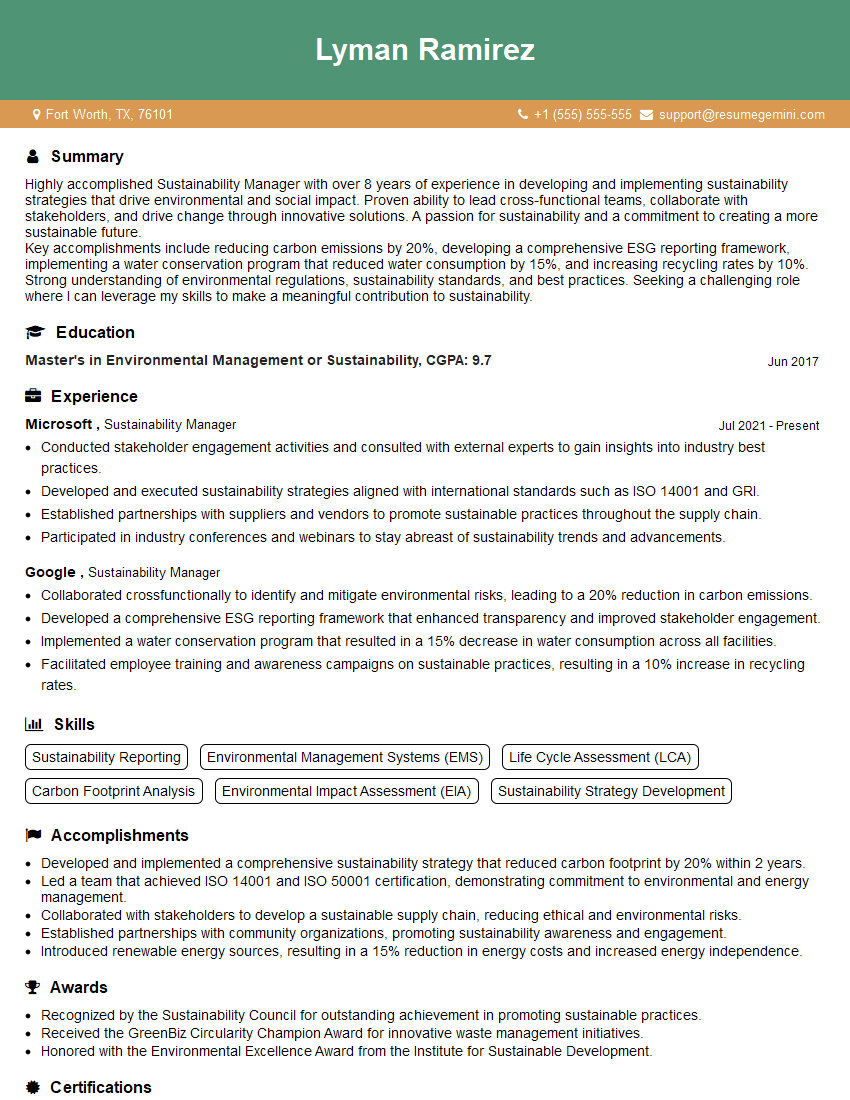
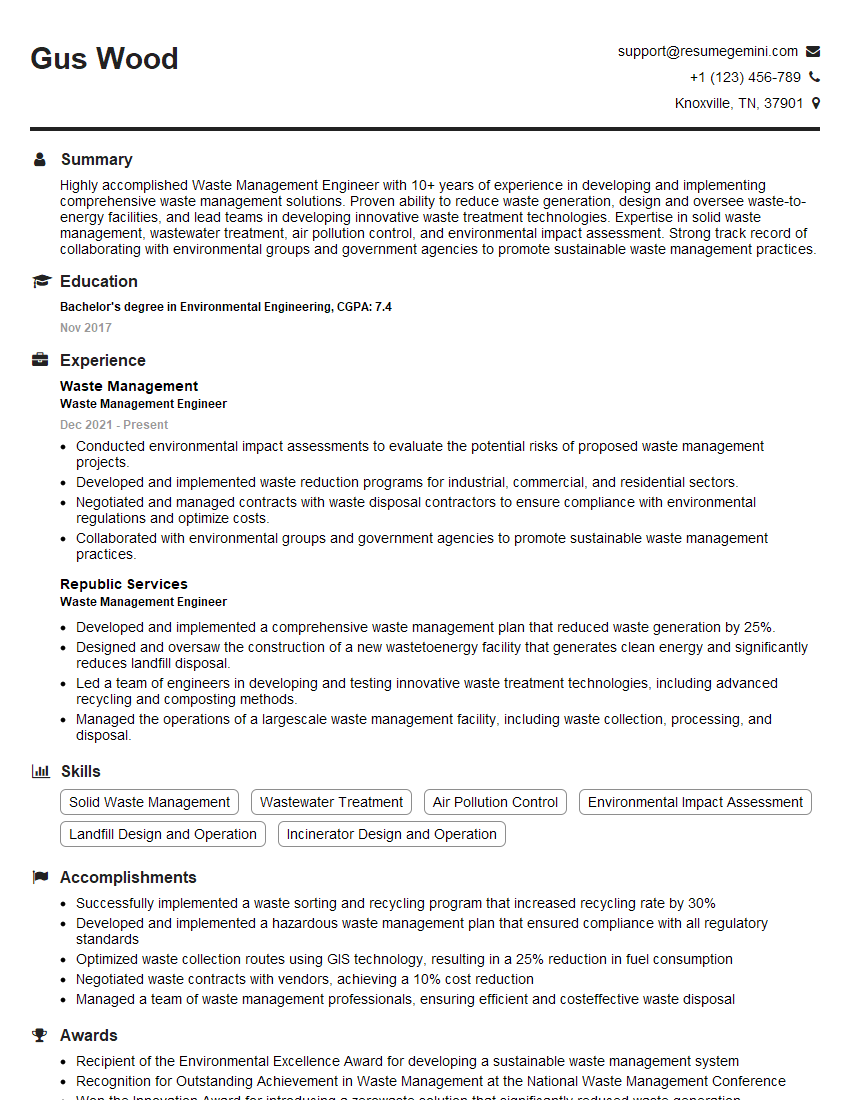
Mastering Landfill Gas Data Analysis and Reporting is crucial for a successful and rewarding career in environmental engineering and renewable energy. A strong understanding of these techniques opens doors to exciting opportunities for professional growth and impact. To significantly enhance your job prospects, focus on creating an ATS-friendly resume that effectively showcases your skills and experience. ResumeGemini is a trusted resource to help you build a compelling and professional resume. Examples of resumes tailored specifically to Landfill Gas Data Analysis and Reporting are available to guide you through this process.

Explore more articles
Users Rating of Our Blogs
Share Your Experience
We value your feedback! Please rate our content and share your thoughts (optional).
What Readers Say About Our Blog
To the interviewgemini.com Webmaster.
Very helpful and content specific questions to help prepare me for my interview!
Thank you
To the interviewgemini.com Webmaster.
This was kind of a unique content I found around the specialized skills. Very helpful questions and good detailed answers.
Very Helpful blog, thank you Interviewgemini team.