The thought of an interview can be nerve-wracking, but the right preparation can make all the difference. Explore this comprehensive guide to Locating and Marking Utilities interview questions and gain the confidence you need to showcase your abilities and secure the role.
Questions Asked in Locating and Marking Utilities Interview
Q 1. Explain the process of locating underground utilities.
Locating underground utilities is a crucial process that involves systematically identifying the precise location of buried infrastructure, such as gas lines, electrical cables, water pipes, and communication conduits, before any excavation work begins. This prevents accidental damage, potential injuries, service disruptions, and costly repairs. The process typically begins with a thorough review of available records, including utility plans and maps. This is followed by on-site investigation using various locating technologies.
Think of it like searching for buried treasure, but instead of gold, we’re looking for essential services. We need to be extremely precise to avoid damaging these vital utilities.
Q 2. Describe different utility locating methods (e.g., ground penetrating radar, electromagnetic locating).
Several methods exist for locating underground utilities, each with its strengths and limitations.
- Ground Penetrating Radar (GPR): GPR uses high-frequency radio waves to create images of the subsurface. It’s particularly useful for identifying the depth and location of utilities, even those not metallic. Think of it as a sophisticated underground ‘X-ray’ machine. It can visualize various materials and detect anomalies.
- Electromagnetic Locating (EML): EML detects metallic utilities by inducing a current in the utility line and measuring the resulting electromagnetic field. This method is effective for locating metallic pipes and cables. This is like using a metal detector, but specifically designed to target utility lines.
- Traditional Methods (e.g., probing, calling 811): Before utilizing advanced technologies like GPR or EML, it is essential to first contact the local One-Call center (like 811 in the US) and follow their procedures. This allows utility companies to mark the approximate locations of their lines. Physical probing is sometimes used to verify marked locations, although it requires extra caution to avoid damage.
Q 3. What are the common types of underground utilities you encounter?
The types of underground utilities encountered vary depending on the location and the age of the infrastructure. Common examples include:
- Electric Power Lines: High-voltage and low-voltage cables supplying electricity to homes and businesses.
- Gas Lines: Natural gas pipelines transporting fuel for heating and cooking.
- Water Lines: Pipes supplying potable water to buildings.
- Sewer Lines: Pipes carrying wastewater to treatment facilities.
- Communication Lines: Cables carrying telephone, internet, and cable television signals.
- Fiber Optic Cables: High-bandwidth cables for data communication.
Identifying and distinguishing between these is critical to avoid damage and ensure safety.
Q 4. How do you identify and mark different types of utilities?
Different utilities are identified and marked using a standardized color-coding system, often following regional or national guidelines. For example, in the US, a common color-coding system is used:
- Red: Electric power lines
- Yellow: Gas lines
- Orange: Communication lines (telephone, cable TV, etc.)
- Blue: Potable water lines
- Purple: Reclaimed water or irrigation lines
- Pink: Temporary survey markers
These markers are placed along the approximate path of the utility, typically using paint or flags. The depth of the utility is often also noted. This ensures that excavators know precisely where to avoid digging.
Q 5. What safety procedures do you follow when locating utilities?
Safety is paramount in utility locating. Procedures include:
- Following all applicable regulations and safety guidelines: This includes adhering to local and national standards.
- Utilizing proper personal protective equipment (PPE): This may include safety glasses, gloves, high-visibility clothing, and hard hats.
- Employing safe excavation practices: Hand digging around suspected utility lines is preferred to minimize the risk of damage.
- Maintaining awareness of surroundings: Be mindful of potential hazards and traffic.
- Communicating effectively with other workers: Clear communication prevents misunderstandings and accidents.
- Regular training and updates: Staying current with best practices and technologies is essential.
An accident can have catastrophic consequences; carefulness is always the best policy.
Q 6. How do you handle conflicts between utility lines?
Conflicts between utility lines are common, especially in densely populated areas. When this happens, the location of all conflicting utilities must be precisely determined. Stakeholders – such as utility companies and excavation contractors – need to cooperate to find a solution. Solutions can involve:
- Adjusting excavation plans: Modifying the excavation plan to avoid conflict areas.
- Protective measures: Implementing measures such as shielding or rerouting to protect conflicting utilities.
- Coordination with utility companies: Working with utility companies to temporarily shut off services or relocate utilities if necessary.
- Detailed documentation: Keeping precise records of the conflict, resolutions, and all involved parties.
These situations demand careful planning and collaboration to ensure a safe and effective outcome.
Q 7. What is the importance of accurate utility locating?
Accurate utility locating is critical for preventing damage to underground infrastructure, which can lead to:
- Service disruptions: Damage to utilities can cause power outages, water shortages, or gas leaks, disrupting services for individuals and communities.
- Financial losses: Repairs can be expensive, and lawsuits resulting from damage can lead to significant financial burdens.
- Environmental damage: Leaks or spills from damaged utilities can pollute soil and water resources.
- Injuries and fatalities: Accidents involving damaged utilities can result in serious injuries or even death.
In essence, accurate locating saves lives, money, and protects the environment. It is the bedrock of safe excavation practices.
Q 8. Describe your experience with using a ticket system for utility locating.
Ticket systems are the backbone of efficient utility locating. They’re essentially digital records of every locate request, tracking it from initial submission to final verification. My experience involves using various systems, from simple databases to sophisticated web-based platforms that integrate with GPS mapping and communication tools. I’m proficient in using these systems to log requests, update statuses (e.g., scheduled, in progress, complete), record location data, attach photos and sketches of markings, and document any challenges encountered. For example, one system I used allowed for real-time updates to field crews, significantly improving collaboration and reducing the risk of missed information. Efficient ticket management ensures that every locate request is handled promptly and accurately, mitigating potential damage to underground utilities.
A well-managed ticket system also aids in tracking key performance indicators (KPIs) such as response times, accuracy rates, and overall efficiency. This helps identify areas for improvement and maintain a high standard of service.
Q 9. Explain the concept of ‘positive response’ in utility locating.
A ‘positive response’ in utility locating means confirmation of a utility’s presence in the area of concern. This doesn’t necessarily mean that the utility is precisely located, but it indicates that a specific utility exists within a certain area and needs to be considered during excavation. Imagine you’re searching for a buried gas line. A positive response might be a utility representative confirming the gas line runs somewhere within a 2-meter radius of a marked point. This differs from a ‘negative response’ where the utility confirms the absence of their lines in that area. The level of detail in the positive response will vary depending on the utility and the tools used. For instance, some utilities might provide precise GPS coordinates, while others might provide only a general area.
Q 10. How do you deal with unclear or inaccurate utility markings?
Dealing with unclear or inaccurate utility markings requires a methodical approach that prioritizes safety. The first step is to carefully examine the markings, noting any ambiguities. If there is a conflict between markings (e.g., two utilities marked in the same spot), I would immediately contact the conflicting utilities for clarification. If a marking is unclear, I would use my experience and knowledge of typical utility placement to estimate the most probable location, taking photos and making detailed notes. It’s crucial to maintain open communication with the excavator and the utilities, keeping everyone informed of any uncertainties and agreed upon solutions. In some cases, I would need to conduct further investigation using additional locating equipment like electromagnetic locators or ground penetrating radar to confirm the location of underground utilities.
Documentation is key. I meticulously record all uncertainties, actions taken, and communication with utilities. This ensures traceability and helps prevent similar issues in the future.
Q 11. How do you handle emergency utility locating situations?
Emergency utility locating situations demand immediate action and clear communication. These situations often involve urgent repairs or situations that could lead to immediate harm. My priority is to coordinate with the utility companies and emergency personnel to quickly identify and mark the location of all utilities in the affected area. This may involve utilizing advanced locating techniques and equipment in a timely fashion to get the necessary information to those who need it quickly and efficiently. Clear and concise communication with all parties is vital to ensure everyone understands the situation and the location of the utilities before any excavation or repair work commences. After confirming utility location information, I’ll ensure that this information is immediately passed onto the team involved in the emergency response.
Q 12. What is your experience with different types of locating equipment?
My experience encompasses a wide range of locating equipment, including:
- Electromagnetic locators: These are essential for tracing buried metallic utilities. I’m skilled in operating various models, understanding their limitations and selecting the appropriate device for different scenarios.
- Ground penetrating radar (GPR): GPR provides high-resolution images of subsurface structures, allowing me to locate both metallic and non-metallic utilities. I’m proficient in interpreting GPR scans and differentiating between various utility types.
- Vacuum excavators: Although not strictly locating equipment, I’m familiar with their use for safe excavation near marked utilities, minimizing the risk of accidental damage.
- GPS and mapping software: Integrating GPS data with utility records allows for accurate mapping and efficient on-site locating. I’m proficient in using different mapping software.
I understand the strengths and weaknesses of each technology, and I choose the appropriate tool based on the specific situation, the type of utilities suspected, and the ground conditions.
Q 13. Explain the role of the ‘call before you dig’ system.
The ‘Call Before You Dig’ (or ‘811’ in the US) system is a nationwide network designed to prevent damage to underground utilities during excavation. Before any digging project, individuals and contractors are required to contact their local one-call center and provide details of the planned excavation. This triggers a process where participating utility companies are notified and send locators to mark the approximate location of their underground facilities. This system is crucial for public safety and preventing costly repairs. Think of it as a traffic system for underground infrastructure; it ensures that excavators know exactly where utilities are located, minimizing the risk of accidental damage. Failure to use the ‘Call Before You Dig’ system can result in fines and potentially hazardous situations.
Q 14. How do you ensure the accuracy of your utility markings?
Ensuring the accuracy of utility markings is paramount. My approach is multi-faceted and includes:
- Thorough investigation: Employing various locating techniques appropriate to the site conditions and the type of utility.
- Clear and precise markings: Using standardized markings, readily understood by all parties. I always ensure markings are visible, permanent, and accurately reflect the location.
- Detailed record-keeping: Creating comprehensive reports with sketches, photos, and notes documenting the locating process and any challenges encountered. This allows for traceability and transparency.
- Cross-checking: Verifying the location of utilities using multiple methods and comparing results to ensure consistency.
- Ongoing training and certifications: Staying up-to-date with the latest industry best practices and technologies.
Maintaining this level of diligence ensures the safety of workers and protects underground utilities from damage.
Q 15. What are the potential consequences of inaccurate utility locating?
Inaccurate utility locating carries significant risks, potentially leading to serious consequences. The most severe outcome is damage to underground utilities, resulting in service disruptions, costly repairs, injuries, and even fatalities. Think of it like this: imagine digging a trench for a new building without knowing where the gas line runs – the results could be catastrophic.
- Service Disruptions: Damaged lines can interrupt gas, electricity, water, or communication services, affecting homes, businesses, and critical infrastructure.
- Financial Losses: Repairing damaged utilities is incredibly expensive, often leading to significant project delays and cost overruns for contractors and municipalities.
- Environmental Damage: Leaks from damaged pipelines can contaminate soil and water sources, causing environmental harm and requiring extensive cleanup efforts.
- Injury or Fatality: Contact with live electrical lines or gas leaks during excavation can result in severe injuries or even death for workers and the public.
- Legal Liability: Companies and individuals responsible for inaccurate locating can face legal action, leading to substantial fines and legal fees.
Career Expert Tips:
- Ace those interviews! Prepare effectively by reviewing the Top 50 Most Common Interview Questions on ResumeGemini.
- Navigate your job search with confidence! Explore a wide range of Career Tips on ResumeGemini. Learn about common challenges and recommendations to overcome them.
- Craft the perfect resume! Master the Art of Resume Writing with ResumeGemini’s guide. Showcase your unique qualifications and achievements effectively.
- Don’t miss out on holiday savings! Build your dream resume with ResumeGemini’s ATS optimized templates.
Q 16. How do you interpret utility plans and drawings?
Interpreting utility plans and drawings requires a keen eye for detail and a solid understanding of utility symbology. These plans, often provided by utility companies, show the location, type, and size of underground utilities. They aren’t always perfectly accurate, so on-site verification is critical.
My approach involves:
- Identifying the Legend: First, I meticulously examine the plan’s legend to understand the symbols used to represent different utilities (e.g., gas lines are typically represented by a specific color and symbol).
- Analyzing Dimensions and Coordinates: I pay close attention to the dimensions and coordinates provided to accurately pinpoint the utility’s location. I cross-reference different drawings if available for a more holistic view.
- Understanding Scale: Understanding the scale of the plan is crucial to accurately translating the information onto the ground. Incorrect scaling can lead to significant errors in locating.
- Considering Potential Discrepancies: Utility plans aren’t always perfectly up-to-date. I’m aware of the possibility of discrepancies between the plan and the actual field conditions, so I always perform a thorough field verification. This involves using advanced equipment like ground penetrating radar (GPR) to ensure accuracy.
Q 17. Describe your experience working with different stakeholders (e.g., contractors, engineers).
Effective collaboration with various stakeholders is paramount in utility locating. I’ve worked extensively with contractors, engineers, and utility representatives to ensure safe and efficient excavation projects.
- Contractors: I clearly communicate the located utility markings to excavation crews, providing concise instructions on safe digging practices around utilities. This often involves on-site briefings and demonstrations to highlight potential hazards.
- Engineers: I collaborate with engineers to review utility plans and address any ambiguities or discrepancies before excavation begins. This ensures the plans align with the on-site realities, preventing errors during the project.
- Utility Representatives: I work closely with utility companies to confirm the accuracy of the provided plans, especially when discrepancies arise during field verification. This may involve contacting the utility’s damage prevention team for clarification or additional information.
My communication style emphasizes clarity, precision, and active listening. Building trust and rapport with all parties is essential to resolving any conflicts and ensuring the project progresses smoothly.
Q 18. How do you maintain your locating equipment?
Maintaining locating equipment is critical for accurate and reliable results. Regular maintenance is a cornerstone of safe and efficient operations. My routine includes:
- Daily Checks: Before each use, I inspect the equipment for any damage or malfunctions. This includes checking battery levels, signal strength, and the overall functionality of the equipment.
- Calibration: Regular calibration is essential for accurate readings. This typically involves comparing the readings from the locating equipment to known points or calibration standards.
- Cleaning: Cleaning the equipment after each use prevents the buildup of dirt and debris that can interfere with its operation.
- Storage: I store the equipment in a secure, dry, and protected environment to prevent damage and extend its lifespan. This typically involves using protective cases and storing the equipment away from extreme temperatures.
- Preventative Maintenance: I follow the manufacturer’s recommended maintenance schedule for each piece of equipment. This might involve sending the equipment for professional servicing or replacing certain components based on wear and tear.
Q 19. What are the legal and regulatory requirements related to utility locating?
Legal and regulatory requirements related to utility locating vary by jurisdiction, but they all emphasize safety and damage prevention. In many regions, the practice is governed by ‘One-Call’ or ‘811’ systems, which require excavators to notify utility companies before beginning any excavation work.
- One-Call Notification: Excavators must provide advance notice of their excavation plans to the designated ‘One-Call’ center. This triggers the process of locating underground utilities.
- Markout Standards: Utility companies must follow standardized marking procedures to clearly identify the location of their underground facilities. These markings typically involve different colored paint or flags.
- Safe Digging Practices: Excavators are legally required to follow safe digging practices, maintaining a safe distance from marked utilities and using hand digging techniques near utility markings.
- Penalties for Non-Compliance: Failure to comply with these regulations can result in substantial fines and legal repercussions for both excavators and utility companies.
Staying updated on the specific regulations in each area I operate within is vital to ensuring compliance and preventing legal issues. I regularly review updates to state and local codes.
Q 20. How do you communicate effectively with excavation crews?
Clear and concise communication with excavation crews is crucial for safety. I approach this by emphasizing visual aids, clear language, and active listening.
- On-Site Briefing: I conduct a thorough on-site briefing, explaining the location of marked utilities and any potential hazards. I use visual aids, like maps and diagrams, to enhance understanding.
- Clear and Concise Instructions: I use simple, unambiguous language to relay instructions and avoid technical jargon. I ensure that everyone understands the plan before excavation begins.
- Active Listening and Feedback: I encourage questions and feedback from the crew to ensure that everyone understands and agrees with the plan. This ensures that there is no room for misinterpretation or misunderstanding.
- Ongoing Communication: I remain on-site during excavation to address any questions or concerns that may arise during the process. I continuously monitor the excavation work to ensure safe practices.
Building trust and rapport with the excavation crew is essential to ensuring a collaborative and safe working environment.
Q 21. Describe a time you had to deal with a difficult or challenging utility locating situation.
During a large-scale road construction project, we encountered unexpected underground utilities that weren’t documented on the original plans. This was a significant challenge because the undocumented utilities were located directly in the planned trench path.
My response involved:
- Immediate Stop Work: I immediately instructed the excavation crew to cease operations in the affected area to prevent accidental damage.
- Detailed Verification: Using ground-penetrating radar (GPR), I conducted a thorough scan of the area to identify the nature and precise location of the undocumented utilities.
- Coordination with Utility Companies: I contacted the appropriate utility companies to confirm the existence and details of the utilities. This was crucial for determining their exact location, type, and any specific handling requirements.
- Replanning: Collaborating with the project engineers, we devised an alternative trench path that safely avoided the undocumented utilities while minimally impacting the project timeline and budget.
This situation highlighted the importance of thorough field verification and close collaboration with utility companies and engineering teams. The successful resolution avoided potential service interruptions, significant cost overruns, and safety hazards.
Q 22. What is your experience with GIS technology in utility locating?
GIS, or Geographic Information System, technology is indispensable in modern utility locating. It allows us to visualize underground infrastructure data, such as the location of gas lines, water mains, and fiber optic cables, on a digital map. My experience encompasses using various GIS software packages to interpret existing utility data, plan efficient locating routes, and accurately mark the location of utilities identified during field work. For example, I’ve used ArcGIS to analyze data from multiple sources – utility company databases, previous locate tickets, and even aerial imagery – to create a comprehensive subsurface utility map before commencing a dig site investigation. This significantly reduces the risk of accidental damage by giving a detailed, spatially accurate representation of what lies beneath the surface.
I’m also proficient in using GPS devices integrated with GIS to accurately record the location of identified utilities during fieldwork. This ensures that the marked locations are precisely georeferenced and can be easily accessed and shared with other stakeholders. The precision and efficiency provided by GIS are crucial for safe and effective utility locating.
Q 23. How do you ensure the safety of yourself and others during utility locating?
Safety is paramount in utility locating. My approach is multifaceted and adheres strictly to all relevant safety regulations. Before beginning any project, I conduct a thorough site assessment to identify potential hazards beyond the underground utilities, including traffic conditions, environmental factors, and any existing excavations. I always wear high-visibility clothing, safety glasses, and appropriate personal protective equipment (PPE), such as gloves and hard hats.
Communication is key. I always notify relevant parties, such as construction crews and the utility companies themselves, of my location and activities. When working near traffic, I employ traffic control measures to ensure the safety of both myself and motorists. I also undergo regular safety training to stay updated on the latest safety procedures and best practices. For example, I’ve participated in training sessions focused on safe digging practices around high-voltage power lines, emphasizing the critical importance of maintaining a safe distance and following proper lockout/tagout procedures.
Finally, I follow the ‘Call Before You Dig’ principle religiously, coordinating with the One-Call center before any excavation takes place to verify the location of underground utilities and ensure that all necessary precautions are taken.
Q 24. What are the best practices for documenting utility locations?
Accurate and comprehensive documentation is essential for liability reasons and to aid future projects. My documentation process includes detailed field notes, precise measurements, sketches, and photographs. I use standardized forms to record the type of utility, its depth, its location relative to reference points (such as property lines or existing structures), and any other relevant information. High-resolution photographs are vital; they provide visual confirmation of the located utility and its surroundings.
Digital documentation plays a crucial role. I often use GIS software to create maps and integrate my field data into a digital record. This creates a searchable and easily shareable archive. For example, I might use GPS coordinates to pinpoint the exact location of each marked utility on the map, alongside details of the material, depth, and any observations made during the locating process. The digital record helps ensure consistency, accuracy, and long-term accessibility of the information.
Q 25. What is your understanding of different utility line materials and their properties?
Understanding utility line materials and their properties is crucial for safe and accurate locating. Different materials exhibit different electromagnetic and physical properties, influencing the locating methods used. For instance:
- Copper: Highly conductive, easily detected by electromagnetic locators.
- Steel: Also highly conductive, identifiable through magnetic detection.
- PVC (Polyvinyl Chloride): Non-conductive, requiring more advanced techniques such as ground penetrating radar (GPR) for accurate location.
- Concrete: Can interfere with signal detection, requiring careful interpretation of locators’ readings.
- Fiber Optic Cable: Difficult to locate directly with traditional methods often requires knowledge of cable routes and use of specialized equipment
This knowledge influences my choice of equipment and techniques; understanding that plastic pipes might require GPR while metal pipes can be more easily detected using traditional electromagnetic locators.
Q 26. How do you stay up-to-date with changes in utility locating technology and regulations?
The field of utility locating is constantly evolving with new technologies and regulations. I actively participate in professional development activities, including attending industry conferences and workshops, to keep abreast of these changes. I am a member of relevant professional organizations, which provide access to the latest research, best practices, and regulatory updates. Online courses and webinars are also valuable resources.
Furthermore, I regularly review updated safety regulations and industry standards to ensure compliance in my work practices. Staying current isn’t just about technological advances; it’s about ensuring that my methods align with the most up-to-date safety standards and legal requirements.
Q 27. Describe your experience with different soil types and their effect on utility locating.
Soil type significantly impacts utility locating. Different soil compositions affect the transmission of electromagnetic signals used in many locating methods. Clay soils, for instance, are highly conductive and can distort or dampen signals, making locating more challenging. Rocky or gravelly soils can also interfere with signal penetration, affecting the accuracy of locators. Sandy soils are generally easier to work with, offering better signal penetration.
My experience involves adapting my techniques based on the anticipated soil conditions. If I anticipate challenging soil conditions like clay or rock, I may utilize supplementary methods such as ground penetrating radar (GPR) or hand digging to verify the location of utilities. Understanding the soil profile is a critical step in planning a locating project and selecting the most effective techniques.
Q 28. How do you prioritize different utility lines when multiple conflicts arise?
Prioritizing utility lines when conflicts arise is governed by several factors, including the type of utility, its size, and the potential consequences of damage. Generally, the order of priority is established by local regulations and industry best practices, often referred to as a ‘hierarchy of utilities.’ High-pressure gas lines, for example, usually have top priority due to their high risk of causing explosions. Power lines, due to the risk of electrocution, also receive high priority. Water and sewer lines are typically next, while communication lines have a lower priority.
In practice, I meticulously examine the conflict area, assess the potential risks associated with damaging each utility, and apply the established hierarchy. If there is ambiguity, I consult with the relevant utility companies to resolve any disputes and confirm the correct prioritization before commencing any excavation.
Key Topics to Learn for Locating and Marking Utilities Interview
- Understanding Utility Types: Learn to identify and differentiate various underground utilities (e.g., gas, electric, water, fiber optic) and their typical locations and depths.
- Locating Technologies: Familiarize yourself with different locating methods and technologies, including electromagnetic locating, ground penetrating radar (GPR), and hand-held detection equipment. Understand their limitations and applications.
- Safety Procedures and Regulations: Master the critical safety procedures and regulations associated with utility locating, including OSHA standards and best practices for working near energized lines.
- Data Interpretation and Mapping: Develop your ability to interpret locating data, create accurate maps, and effectively communicate findings using various methods (e.g., CAD software, field sketches).
- Damage Prevention and Communication: Understand the role of locating in preventing damage to underground utilities and the importance of clear and concise communication with excavators and other stakeholders.
- Legal and Regulatory Compliance: Gain knowledge of relevant laws, regulations, and industry standards related to utility locating and marking in your area.
- Problem-Solving and Troubleshooting: Practice identifying and solving common challenges encountered during the utility locating process, such as difficult terrain, conflicting signals, or inaccurate information.
- Technological Advancements: Stay updated on the latest advancements in utility locating technologies and their impact on efficiency and accuracy.
Next Steps
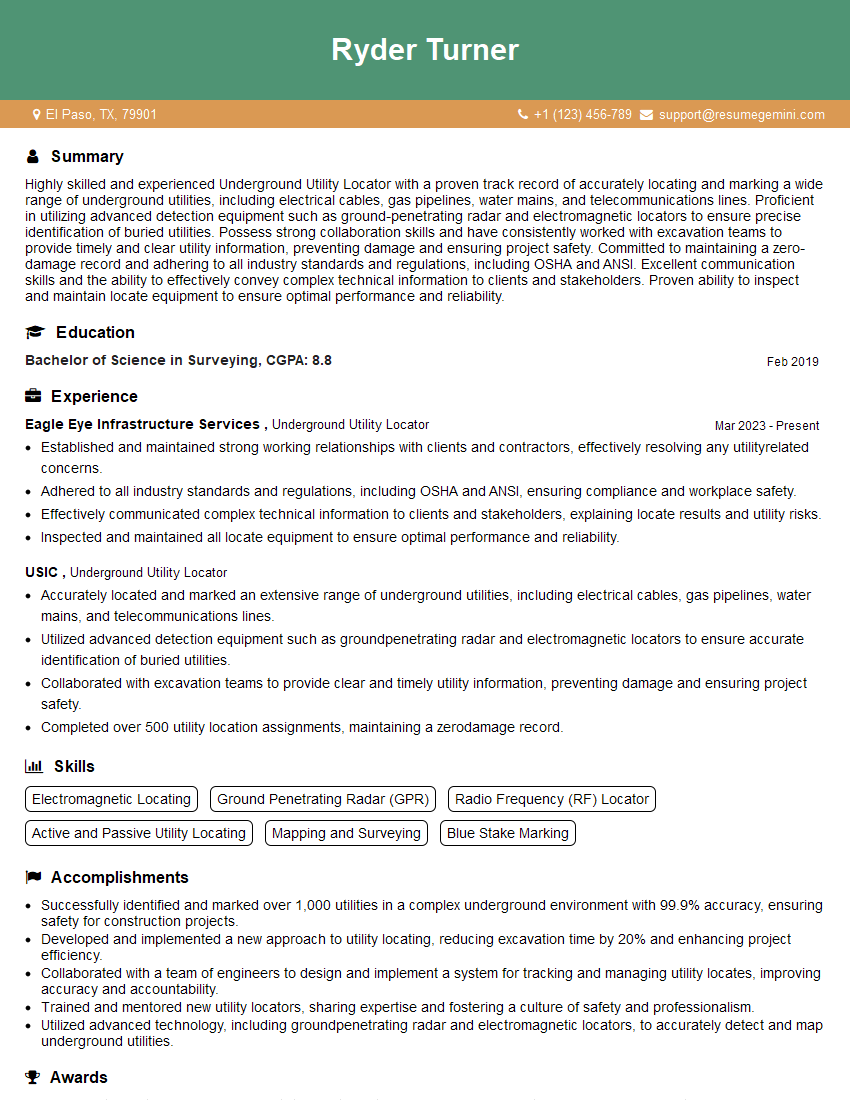
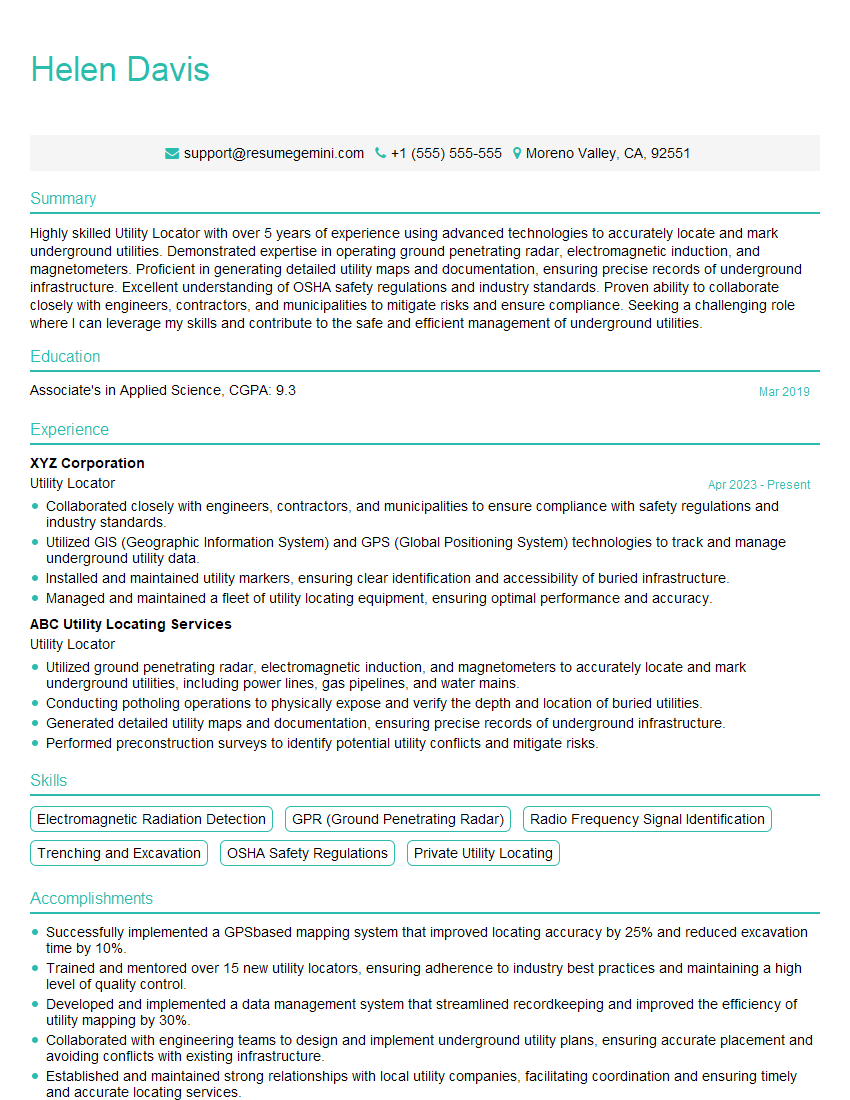
Mastering Locating and Marking Utilities opens doors to a rewarding career with significant growth potential in a vital infrastructure sector. A strong resume is key to landing your dream role. To increase your chances of getting noticed by Applicant Tracking Systems (ATS), focus on creating a well-structured, keyword-rich resume that highlights your skills and experience. ResumeGemini is a trusted resource that can help you build a professional and effective resume. They provide examples of resumes tailored to the Locating and Marking Utilities field, giving you a head start in your job search.
Explore more articles
Users Rating of Our Blogs
Share Your Experience
We value your feedback! Please rate our content and share your thoughts (optional).
What Readers Say About Our Blog
To the interviewgemini.com Webmaster.
Very helpful and content specific questions to help prepare me for my interview!
Thank you
To the interviewgemini.com Webmaster.
This was kind of a unique content I found around the specialized skills. Very helpful questions and good detailed answers.
Very Helpful blog, thank you Interviewgemini team.