Cracking a skill-specific interview, like one for Masonry Blueprint Interpretation, requires understanding the nuances of the role. In this blog, we present the questions you’re most likely to encounter, along with insights into how to answer them effectively. Let’s ensure you’re ready to make a strong impression.
Questions Asked in Masonry Blueprint Interpretation Interview
Q 1. Explain the different types of masonry unit symbols found on blueprints.
Masonry blueprints employ various symbols to represent different masonry units. Think of them as a shorthand language for construction professionals. Understanding these symbols is crucial for accurate interpretation and construction. Common symbols include:
- Brick: Often represented by a simple rectangular block, sometimes with a pattern indicating the brick’s orientation (e.g., running bond, common bond). The size might be indicated, but standard brick sizes are often assumed.
- Concrete Block (CMU): Usually depicted as a larger rectangular block, often hollow, with dimensions specified. Different symbols might indicate variations in block type (e.g., solid, lightweight).
- Stone: Represented by irregular shapes, often with annotations indicating the type of stone (e.g., granite, limestone) and its dimensions. The level of detail depends on the project and the design’s complexity.
- Other Masonry Units: Symbols can also represent specialized masonry units like glass blocks, clay tiles, or precast concrete units. These are usually clearly labeled.
For instance, a small rectangle might represent a standard brick, while a larger rectangle with internal lines could represent a hollow concrete block. Always refer to the blueprint’s legend or key for precise definitions of the symbols used in a specific project. This prevents costly mistakes later on.
Q 2. How do you identify the scale of a masonry blueprint?
The scale of a masonry blueprint is crucial for accurate measurements and material estimations. It’s typically indicated in a title block or legend, often expressed as a ratio (e.g., 1:50, 1/4″ = 1′). This means 1 unit on the drawing represents 50 units in reality, or 1/4 inch on the drawing equals 1 foot in real life.
For example, a scale of 1:50 indicates that 1 centimeter on the drawing represents 50 centimeters in the actual structure. It’s vital to check this scale because misinterpreting the scale can lead to significant errors in ordering materials and constructing the building.
Finding the scale is usually straightforward; it is usually prominently displayed within the title block, a rectangular box containing essential project information. If it is not immediately visible, carefully examine the drawing for a legend that specifies the scale.
Q 3. Describe the process of calculating the quantity of bricks needed from a blueprint.
Calculating brick quantities involves a methodical approach. Think of it like solving a 3D puzzle, where you need to account for every brick.
- Determine the wall area: Measure the length and height of each wall section from the blueprint. Subtract areas for openings (doors, windows). Remember to consider the scale!
- Calculate the area of a single brick: Use the standard size or the size specified on the drawings. (Typical dimensions are 8″ x 2.25″ x 3.75″ or 200 mm x 65 mm x 100 mm for common bricks)
- Determine brick quantity per square unit: Account for mortar joints, typically 3/8″ (10mm) thick. This adds to the overall wall dimensions before calculation. A simple way to estimate this is to divide the wall area by the area of a single brick, adding a percentage to account for waste (typically 5-10%, depending on the complexity of the project)
- Calculate total quantity: Multiply the brick quantity per square unit by the total wall area.
For example: If a wall is 10ft x 8ft and a brick is 8” x 2.25”, and accounting for waste, a precise calculation is required, and considering the additional area of mortar joints.
Q 4. How do you interpret masonry wall details, including dimensions, materials, and reinforcement?
Masonry wall details are crucial; they provide a detailed view of the wall’s construction. Imagine slicing through the wall to see its internal structure.
Dimensions: The blueprint will clearly show the overall wall thickness, height, and length. Individual components, such as brick courses or concrete blocks, will also have their dimensions specified.
Materials: The blueprint usually indicates the type of masonry unit (brick, block, stone), mortar type, and any reinforcement details (rebar, steel mesh).
Reinforcement: Reinforcement is shown using symbols for rebar (usually denoted by lines and diameters) or steel mesh. Its placement is indicated within the wall section, often tied to structural requirements or for stability, particularly in seismic zones. The spacing is usually given, as well.
For example, a wall detail might show a 12-inch-thick brick wall reinforced with #4 rebar at 16-inch centers vertically, filled with type N mortar.
Q 5. Explain how you would identify different types of mortar from a blueprint.
Mortar types are often specified using their designation (e.g., Type M, S, N, O). These letters correspond to mortar types based on compressive strength. This information is typically found in the specifications or notes section of the blueprint, sometimes within the wall detail itself. Type M is the strongest, while Type O is the weakest. Sometimes a written specification might be necessary to clarify this.
The chosen mortar will depend on the type of masonry unit used, the intended load-bearing capacity of the wall, and the project’s overall requirements. For instance, a stronger Type M might be used for load-bearing walls, while a weaker Type N might be suitable for non-load-bearing partitions. Understanding these designations is important for selecting the right mortar for the job.
Q 6. How do you interpret foundation plans related to masonry construction?
Foundation plans show the base of the structure, crucial for masonry construction as it provides support. Key details within the foundation plans related to masonry include:
- Footing type and dimensions: This indicates the depth, width, and type of footing (spread footing, strip footing, etc.) needed to support the masonry walls.
- Foundation wall dimensions and materials: This specifies the material (concrete, block) and dimensions of the foundation walls that the masonry walls will rest on.
- Waterproofing details: The plan often illustrates waterproofing measures such as damp proofing or membranes used to protect the foundation and prevent water damage. This is crucial for the longevity of the masonry structure.
- Anchor bolt placement: For connecting the foundation to the masonry walls above, anchor bolts are critical, and their positions are usually detailed within the foundation plans.
Understanding these aspects of the foundation is essential for ensuring a stable and durable structure. A poorly designed foundation can compromise the entire building, so this part of the blueprint should be thoroughly reviewed.
Q 7. What are the common abbreviations and symbols used in masonry blueprints?
Masonry blueprints employ various abbreviations and symbols to save space and enhance clarity. Some common ones include:
- CMU: Concrete Masonry Unit
- BR: Brick
- STD: Standard
- TYP: Typical (repeated element)
- Ø: Diameter (for rebar sizes)
- #4, #5, etc.: Rebar sizes
- c-c: Center-to-center spacing
- W.P.: Waterproofing
- Type M, S, N, O: Mortar types
A thorough understanding of these common abbreviations and symbols ensures accurate interpretation of the drawings, preventing costly errors during construction. Always refer to a legend if you encounter unfamiliar symbols or abbreviations. The blueprint’s legend acts as a glossary for the project. Consistent use and understanding of these is vital.
Q 8. How do you calculate the volume of concrete required for a masonry foundation?
Calculating the concrete volume for a masonry foundation involves a few key steps. First, you need to determine the precise dimensions of the foundation footing from the blueprint. This typically includes the length, width, and depth of the footing. Next, calculate the volume using the formula: Volume = Length x Width x Depth. Remember to convert all measurements to a consistent unit (e.g., feet or meters) before performing the calculation. For example, a footing measuring 10ft x 4ft x 1ft would have a volume of 40 cubic feet. Finally, you’ll need to account for any additional concrete needed for the foundation walls or piers, which are also clearly shown on the blueprint. These calculations often involve breaking down complex shapes into simpler geometrical shapes whose volumes can be easily determined and added together. Always add a percentage (typically 5-10%) for waste and unforeseen circumstances to the final calculated volume.
Example: Let’s say a blueprint shows a foundation with a footing (10ft x 4ft x 1ft) and a wall (10ft x 1ft x 3ft). The footing volume is 40 cubic feet, and the wall volume is 30 cubic feet. Adding these together and factoring in a 10% waste, we get a total concrete requirement of approximately (40 + 30) * 1.10 = 77 cubic feet.
Q 9. Explain the importance of understanding tolerances in masonry blueprint interpretation.
Understanding tolerances in masonry blueprints is crucial for successful construction. Tolerances specify the acceptable range of variation from the specified dimensions. Ignoring tolerances can lead to misaligned walls, improperly sized openings, and other structural issues. Blueprints typically indicate tolerances using symbols or notations. For instance, a dimension might be shown as “10ft ± 1/4in”, meaning the actual dimension can vary by 1/4 inch in either direction. These tolerances account for the inherent variability in material dimensions and construction processes. As a mason, understanding these tolerances helps me make informed decisions about material selection, cutting, and laying. For example, slight variations in brick size must be accommodated to prevent issues such as uneven mortar joints or compromised structural integrity. Carefully checking and understanding the specified tolerances is an essential part of blueprint interpretation and guarantees the project’s overall quality and accuracy.
Q 10. How would you interpret lintel and beam details in a masonry drawing?
Lintel and beam details in masonry drawings are vital for understanding structural support over openings like doors and windows. The drawings usually specify the type of lintel or beam (e.g., steel, reinforced concrete, or masonry), its dimensions, and its location within the wall. They also show how the lintel or beam is supported by the masonry structure and the specific anchoring methods. Interpreting these details requires understanding structural engineering principles and recognizing standard symbols and notations. For example, a cross-section detail might show the lintel’s dimensions, the thickness of the masonry above it, and the type of supporting bearing. Missing or unclear details could cause issues such as insufficient support, leading to structural weakness and compromise. Proper interpretation ensures that the chosen lintel or beam meets the structural needs and has adequate support, ensuring building integrity and longevity.
Q 11. Describe the process of interpreting details related to cavity walls in masonry construction.
Interpreting cavity wall details involves understanding the components and their arrangement. A cavity wall consists of two wythes (layers) of masonry separated by a cavity, usually filled with insulation. The blueprint will show the thickness of each wythe, the width of the cavity, and the type of insulation used (e.g., fiberglass, mineral wool). Details will show how the two wythes are tied together using wall ties to maintain stability and prevent collapse. Understanding these details is crucial to select the correct materials, ensure proper insulation and structural integrity, and meet building codes. A detail section might show the arrangement of the ties, the location of any damp-proof course, and how the wall is anchored to the foundation. Incorrect interpretation could result in a structurally deficient wall, leading to moisture issues or even collapse. Paying close attention to detail specifications is essential for optimal performance.
Q 12. How do you identify different types of masonry bonds from a blueprint?
Identifying masonry bonds from a blueprint depends on recognizing the pattern of bricks. The blueprint will either show a detailed section or use a simple notation to indicate the type of bond (e.g., running bond, common bond, English bond, Flemish bond, etc.). Each bond has a distinct pattern, which is indicated through the layout of bricks in the elevation or section view. A running bond uses a single course of bricks laid end to end, while a common bond has alternating headers and stretchers. English bond uses alternating courses of headers and stretchers, and a Flemish bond uses alternating headers and stretchers in each course. Understanding these patterns is critical for ordering the correct number of bricks and for maintaining the aesthetic and structural integrity of the wall. Misinterpretation could lead to incorrect material ordering and a less structurally sound or visually appealing wall.
Q 13. Explain how you identify and interpret details for brick veneer construction.
Brick veneer construction involves a single wythe of brick attached to a structural backing, usually wood framing or concrete block. The blueprint will show the thickness of the brick veneer, the type of backing, and the details of the attachment system (e.g., metal ties). It will include details of the flashing and weep holes needed for water drainage to prevent moisture issues. Understanding these details is vital for ensuring the structural integrity of the system and preventing moisture damage. The blueprint will show how the veneer is tied to the backing, the location and type of flashing and weep holes, and the specific dimensions. Missing or unclear details could lead to insufficient anchoring, moisture intrusion, and potential structural failure. Thorough understanding ensures correct material selection and construction for a durable, visually appealing finish.
Q 14. How do you use a blueprint to determine the required number of labor hours for a masonry project?
Estimating labor hours for a masonry project from a blueprint requires careful analysis of several factors. First, you need to calculate the total area of the masonry work, such as walls, foundations, and other elements. Then you need to determine the complexity of the project – this includes the type of bond, the presence of openings (doors, windows), and any intricate detailing. Experienced masons use historical data (labor hours per square foot) for similar projects and adjust based on the complexity. The number of masons and helpers required should also be considered. Complex projects like those with intricate bonds or numerous openings will require more labor hours per square foot than simple projects with a running bond. In addition to masonry work itself, consider labor hours for tasks like material handling, scaffolding, and cleanup. Finally, a safety factor, perhaps 10-15%, should be added to account for unforeseen delays. A detailed breakdown of the tasks and estimated labor hours per task, based on the blueprint and project complexity, is crucial for accurate budgeting and scheduling.
Q 15. How do you determine the quantities of materials required from a set of masonry blueprints?
Determining material quantities from masonry blueprints involves a systematic approach combining careful measurement and calculation. First, I meticulously review the plans to identify all masonry elements – walls, piers, columns, etc. – noting their dimensions (length, height, width, and thickness). Then, I calculate the volume of each element. For example, a wall’s volume is its length multiplied by its height multiplied by its thickness. I always use the same units throughout the calculation (e.g., meters or feet).
Next, I account for openings like doors and windows, subtracting their volumes from the total volume of the wall sections. This ensures I’m not overestimating the required materials. Finally, I factor in waste – typically 5-10%, depending on the brick size, shape, and the complexity of the design – to account for breakage and cutting losses. This adjusted total volume is then converted into the number of units required – bricks, blocks, or stones – using the known dimensions of the selected masonry unit. I always double-check my calculations and cross-reference them against the bill of quantities (if provided) to ensure accuracy.
For example, consider a 10ft long, 8ft high, and 1ft thick wall. The volume is 80 cubic feet. If we subtract a 3ft x 4ft door opening (12 cubic feet), we get 68 cubic feet. Accounting for a 10% waste factor, we have approximately 75 cubic feet of brickwork. Knowing that a standard brick has a volume of approximately 0.6 cubic feet, this translates to about 125 bricks needed.
Career Expert Tips:
- Ace those interviews! Prepare effectively by reviewing the Top 50 Most Common Interview Questions on ResumeGemini.
- Navigate your job search with confidence! Explore a wide range of Career Tips on ResumeGemini. Learn about common challenges and recommendations to overcome them.
- Craft the perfect resume! Master the Art of Resume Writing with ResumeGemini’s guide. Showcase your unique qualifications and achievements effectively.
- Don’t miss out on holiday savings! Build your dream resume with ResumeGemini’s ATS optimized templates.
Q 16. Explain how to identify and interpret waterproofing details in a masonry blueprint.
Waterproofing details are crucial for masonry structures’ longevity. I look for symbols, notes, and sections detailing waterproof membranes, coatings, or dampproofing courses. These are often indicated by specific symbols on the drawings, such as a wavy line representing a membrane. The blueprints will specify the type of waterproofing material (e.g., liquid applied membrane, sheet membrane), its location (e.g., behind the cladding, within the cavity wall), and its thickness. I carefully examine sections showing the placement of these materials relative to other construction components like brickwork, insulation, and flashing. Details like flashing termination points and overlaps should be meticulously checked to ensure a continuous waterproof barrier.
For instance, a detail might show a liquid-applied waterproofing membrane applied to the exterior face of a foundation wall, followed by a layer of insulation and a brick veneer. Another detail might depict a cavity wall with a waterproof membrane placed between the inner and outer leaves of the wall.
Q 17. Describe your method for verifying the accuracy of dimensions and details on a masonry blueprint.
Verifying the accuracy of dimensions and details is paramount. My approach is multi-faceted. First, I perform a thorough dimensional check, ensuring consistency across different views (plans, sections, elevations) and verifying that dimensions add up correctly. Inconsistent dimensions are a red flag, indicating potential errors. I use mathematical checks to verify the geometry – right angles, parallel lines, and circle radii. For complex geometry, I may use CAD software to model the structure and verify its dimensions.
Next, I cross-check all the specifications against the project’s standards and building codes. Details like brick size, mortar joint thickness, and reinforcement placement must conform to relevant regulations. Finally, I look for any discrepancies or contradictions within the blueprint itself. I highlight these inconsistencies and resolve them by consulting with the architect or engineer to get clarifications before proceeding with construction.
For example, if a wall’s length is given as 10m on one plan and 10.5m on another, this discrepancy needs immediate attention and clarification.
Q 18. How do you interpret details related to flashing and weep holes in masonry construction?
Flashing and weep holes are vital for preventing water ingress. Flashing, typically a sheet metal component, diverts water away from vulnerable areas like window openings, parapets, and intersections of different materials. On the blueprint, I look for symbols representing flashing – often a hatched or shaded area – along with its material specification (e.g., copper, galvanized steel). The drawings must clearly show the flashing’s position, its extension above and below the masonry, and its connection to other elements. Improper flashing can lead to serious water damage.
Weep holes, small openings in the mortar joints, allow water that penetrates the wall to escape. Blueprints will typically show their location, spacing, and size. I verify that their placement ensures drainage and prevents water from being trapped behind the masonry. The location of weep holes must be carefully checked to prevent visual interference and also ensure proper drainage.
For example, a detail might show flashing installed at the base of a parapet wall to direct water away from the top of the wall, while weep holes are shown at regular intervals in the mortar joints below to allow any accumulated water to drain.
Q 19. How would you identify and interpret special details for fire-rated masonry walls?
Fire-rated masonry walls require specific details to ensure their integrity during a fire. The blueprints will specify the required fire rating (e.g., 2-hour, 4-hour) which dictates the wall’s construction and materials. This often involves the use of special fire-rated blocks or bricks, specific mortar types, and potentially embedded steel reinforcement. I examine the drawings for details regarding the wall’s thickness, the arrangement of any reinforcing steel (location, size, spacing), and the type of fire-resistant sealant used at penetrations like pipes and conduits.
The plans must also clearly indicate fire-stopping measures at openings and junctions with other building components. Any deviations from the standard construction method would be specifically detailed in the plans, ensuring the required fire-resistance rating is maintained.
For example, a 4-hour fire-rated wall might require a much thicker wall section than a non-rated wall, specified types of fire-rated blocks, and carefully positioned steel reinforcement to prevent structural collapse during a fire.
Q 20. Explain how you use masonry blueprints to assess potential construction challenges.
Masonry blueprints help anticipate construction challenges by revealing potential problems proactively. I carefully analyze the drawings for complex geometries, tight tolerances, and the integration of different materials. For example, intricate detailing with many small elements can lead to increased installation time and potential errors. Similarly, conflicts between different trades or systems are easily spotted. The interaction of masonry with other systems – windows, doors, roofing – needs careful examination for any potential conflicts or difficulties.
I also assess accessibility for construction, considering the size and layout of the site, and the movement of materials and equipment. The selection of masonry units is another critical factor: the availability, size, and weight of the chosen blocks or bricks may influence the construction process and the equipment required. I also consider potential weather-related challenges, such as working in extreme temperatures or during inclement weather.
For instance, a complex curved wall might present difficulties in achieving accurate bricklaying, whereas a congested site could impede the flow of materials and increase the overall construction time.
Q 21. Describe your approach to resolving discrepancies or ambiguities found in masonry blueprints.
Discrepancies or ambiguities in masonry blueprints are addressed systematically. My first step is to carefully review the entire set of drawings, searching for conflicting information or missing details. I might use a systematic checklist to ensure all aspects are considered. I then attempt to resolve minor inconsistencies through logical deduction. I might refer to relevant codes, standards, or manufacturer’s specifications to clarify ambiguous details. For example, if the type of mortar is not specified, I’d consult building codes for appropriate recommendations.
If internal resolution isn’t possible, I contact the architect or engineer responsible for the drawings. I document my findings, including the location, nature of the discrepancy, and my proposed resolution. I discuss the issue with the architect, comparing my interpretations with theirs, and mutually resolving the inconsistencies. All changes and clarifications are then documented and approved before construction commences.
Open communication and collaboration are key in navigating and resolving inconsistencies, ensuring all parties are on the same page before starting construction. I maintain detailed records of any changes or clarifications made to the original blueprints.
Q 22. How do you incorporate details from various drawings (e.g., architectural, structural, etc.) into your understanding of the masonry plan?
Interpreting a masonry plan requires a holistic approach, integrating information from various sources. It’s not just about the masonry drawings themselves; it’s about understanding how the masonry interacts with the overall building design. I start by reviewing the architectural drawings to understand the building’s layout, the location of walls, openings (doors and windows), and the overall aesthetic design. These drawings provide the context for the masonry, indicating where walls are placed and what finishes are needed. Then, I carefully study the structural drawings to understand the engineering aspects—the loads the masonry will bear, the type of foundation, the reinforcement details (if any), and the connection points to other structural elements like beams and columns. Finally, I meticulously analyze the specific masonry details, which usually includes elevation drawings, section details, and schedules that specify brick type, mortar type, and construction methods.
For instance, the architectural drawings might show a decorative brick feature on a façade. The structural drawings will indicate the load requirements on that wall section and whether it needs additional reinforcement. The masonry details will specify the exact brick type, bonding pattern, and any special construction techniques needed to achieve the desired aesthetic and structural integrity.
- Architectural Drawings: Overall building layout, wall locations, openings.
- Structural Drawings: Loads, foundation details, reinforcement, connections.
- Masonry Drawings: Brick type, mortar type, bonding pattern, construction methods.
Q 23. What software or tools are you familiar with for reviewing and interpreting masonry blueprints?
My proficiency extends to a range of software and tools commonly utilized in the architectural, engineering, and construction (AEC) industry. I’m highly experienced with Autodesk AutoCAD, widely used for creating and manipulating 2D drawings. I can confidently navigate and interpret information from both digital and hardcopy blueprints in AutoCAD. My skills also include proficiency in Revit, which offers the advantages of 3D modeling and BIM (Building Information Modeling). Revit allows for a more comprehensive visualization of the masonry elements within the entire building model, leading to better coordination and fewer clashes. Additionally, I’m comfortable using PDF viewers like Adobe Acrobat Pro to annotate and review digital blueprints and manage revision control. I also utilize project management software such as Bluebeam Revu for collaboration and markup during the design and construction phases.
Q 24. How do you handle revisions or updates to masonry blueprints during the construction process?
Handling revisions and updates during construction is a critical aspect of my role. I typically receive these updates in the form of revised drawings, marked-up PDFs, or change orders. My process involves systematically comparing the new versions with the existing ones. I carefully scrutinize each alteration, noting its implications for the masonry work. This might involve changes to dimensions, materials, or construction techniques. I then ensure all relevant parties—foremen, masons, and the project architect—are informed about the revisions. We hold discussions to determine the best way to incorporate the changes while adhering to the project schedule and budget. Clear communication is paramount to prevent costly mistakes or delays. Any changes are meticulously documented, ensuring a clear audit trail of the modifications throughout the project’s lifecycle.
For example, if a revised drawing indicates a change in the location of a window opening, I would ensure the masons adjust their work accordingly, avoiding the need to tear down already constructed sections. This necessitates precise communication and coordination to ensure smooth integration of updates without compromising the overall project quality.
Q 25. Explain your experience using digital blueprints (PDFs, BIM models) for masonry projects.
My experience with digital blueprints is extensive, and I find them significantly more efficient than traditional paper-based drawings. PDFs provide readily accessible copies for all stakeholders, making collaboration and review simpler. I often use annotation tools in PDF viewers to highlight important details, mark up potential conflicts, or communicate instructions directly on the digital blueprints. BIM models, like those created in Revit, provide a 3D representation of the project, allowing for better visualization and detection of clashes between different building elements before construction begins. This proactive approach minimizes costly rework during construction. Moreover, the ability to quantify materials directly from the BIM model is a great benefit for accurate cost estimation and material ordering.
For instance, using a BIM model helped me identify a clash between a ductwork system and a bearing wall in a previous project. This clash was easily detected and corrected in the digital model before the wall was even constructed, saving considerable time and money.
Q 26. Describe a situation where you had to interpret a complex or ambiguous detail on a masonry blueprint.
On a recent project, we encountered an ambiguous detail regarding the flashing system around a parapet wall. The drawings showed a general arrangement, but the exact details of the flashing overlap, termination points, and integration with the masonry were unclear. This posed a risk of water penetration, causing damage to the building over time. To resolve this ambiguity, I reviewed relevant building codes and industry best practices for parapet wall flashing. I also consulted with the project architect and structural engineer, holding several meetings to discuss possible solutions and to ensure a unified understanding of the requirements. Ultimately, we adopted a solution that complied with the relevant codes and provided a robust and reliable water barrier. This solution involved adding a more detailed section detail that clarified the flashing details and ensured watertight construction.
This experience highlighted the importance of clear communication and thorough analysis when faced with vague or incomplete details. Relying solely on the drawings without considering practical applications and regulatory requirements can be a costly mistake.
Q 27. How do you ensure compliance with building codes and regulations when interpreting masonry blueprints?
Compliance with building codes and regulations is paramount. I incorporate this aspect throughout my review and interpretation process. First, I identify the relevant codes for the project’s location and building type, ensuring the drawings conform to the applicable standards. This involves referencing documents like the International Building Code (IBC), local building codes, and any relevant standards for masonry construction (e.g., standards from the American Society for Testing and Materials (ASTM)). I check for compliance with requirements related to materials (brick strength, mortar mix design), construction methods (bonding patterns, reinforcement), and fire safety aspects. I compare the design to these codes during the review process to flag any inconsistencies or potential violations. Moreover, I collaborate with the project engineers and architects to resolve any discrepancies and ensure the final design meets all regulatory requirements. Any deviations from the code need to be formally documented, justified, and approved.
For instance, ensuring the proper thickness of a masonry wall to meet the fire rating requirements is crucial. I will carefully verify this against the local building code requirements to ensure the wall meets the specified fire resistance rating.
Key Topics to Learn for Masonry Blueprint Interpretation Interview
- Understanding Blueprint Scales and Dimensions: Mastering the ability to accurately interpret scale drawings and translate them into real-world measurements for material estimation and layout.
- Identifying Masonry Units and Materials: Recognizing symbols and notations representing various brick types, stone, concrete blocks, and mortar specifications on blueprints.
- Interpreting Wall Sections and Elevations: Accurately reading and understanding drawings depicting wall construction details, including bonding patterns, reinforcement, and flashing.
- Comprehending Foundation and Footing Details: Analyzing blueprint information related to foundation types, dimensions, and reinforcement requirements for stable masonry structures.
- Analyzing Detail Drawings and Specifications: Interpreting detailed drawings of specific masonry components, such as arches, columns, or fireplaces, and understanding associated specifications.
- Practical Application: Material Calculations: Applying blueprint information to calculate the quantities of materials needed for a project, optimizing costs and minimizing waste.
- Problem-Solving: Identifying Potential Issues: Developing the ability to identify potential construction challenges or conflicts based on blueprint interpretation, such as inconsistencies or omissions.
- Working Drawings and As-Built Drawings: Understanding the differences and applications of working drawings used during construction versus as-built drawings documenting the completed project.
- Safety Regulations and Compliance: Interpreting blueprint information related to safety regulations and ensuring compliance with building codes and standards.
- Advanced Concepts: Complex Masonry Systems: For more senior roles, understanding complex systems like veneer walls, cavity walls, and reinforced masonry structures.
Next Steps
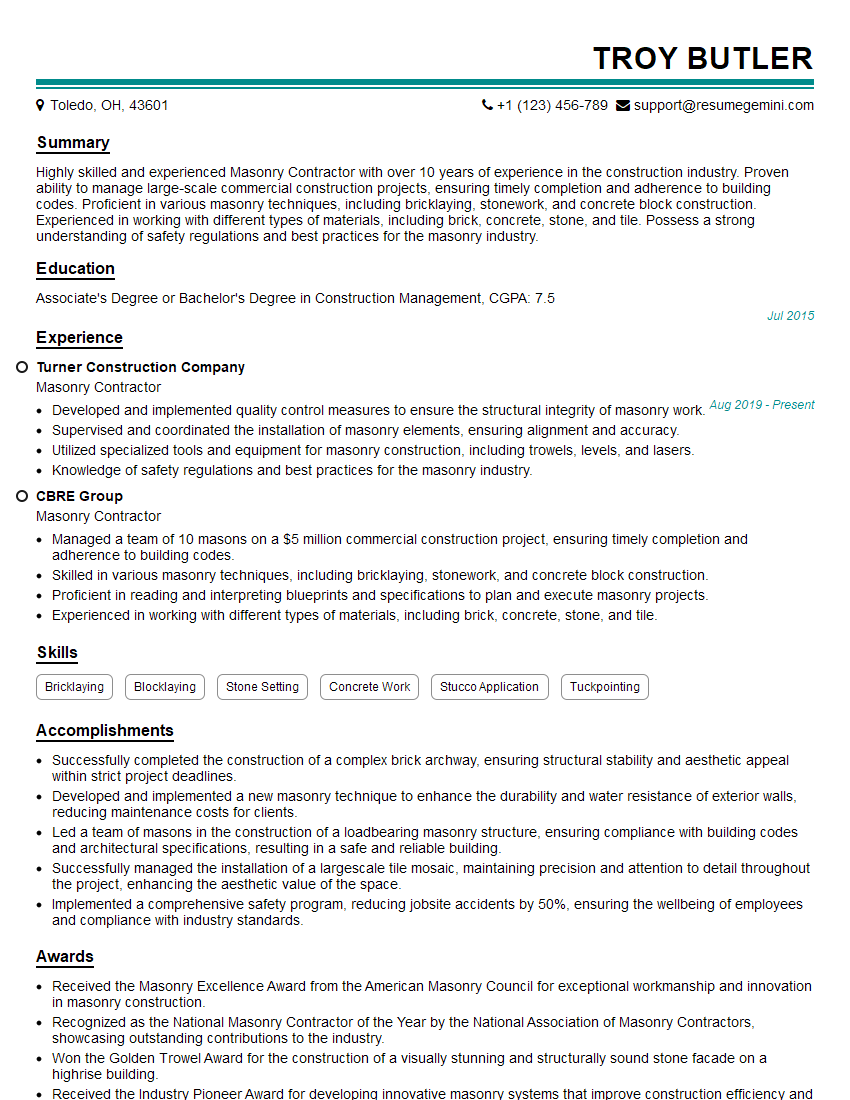
Mastering Masonry Blueprint Interpretation is crucial for career advancement in the construction industry. A strong understanding of blueprints demonstrates essential skills and allows for efficient project management and execution. To increase your job prospects, create an ATS-friendly resume that highlights your abilities. ResumeGemini is a trusted resource that can help you build a professional and effective resume. Examples of resumes tailored to Masonry Blueprint Interpretation are available to guide you. Invest time in crafting a compelling resume; it’s your first impression with potential employers.
Explore more articles
Users Rating of Our Blogs
Share Your Experience
We value your feedback! Please rate our content and share your thoughts (optional).
What Readers Say About Our Blog
To the interviewgemini.com Webmaster.
Very helpful and content specific questions to help prepare me for my interview!
Thank you
To the interviewgemini.com Webmaster.
This was kind of a unique content I found around the specialized skills. Very helpful questions and good detailed answers.
Very Helpful blog, thank you Interviewgemini team.