Interviews are more than just a Q&A session—they’re a chance to prove your worth. This blog dives into essential Masonry layout and planning interview questions and expert tips to help you align your answers with what hiring managers are looking for. Start preparing to shine!
Questions Asked in Masonry layout and planning Interview
Q 1. Explain the process of transferring building lines and levels to the masonry layout.
Transferring building lines and levels is the foundational step in masonry construction, ensuring the entire structure aligns perfectly with the architectural plans. It’s like drawing a precise blueprint onto the ground before you start building. We begin by establishing a benchmark – a known elevation point – usually tied to a surveyed datum. From this, we use string lines and levels to project the building’s overall dimensions and elevations onto the site. This involves:
Setting out control points: Using the architect’s plans and site survey data, we establish key points, such as corners and critical alignment points, using precise measurements and surveying instruments.
Transferring levels: We utilize levels (automatic or hand levels) to transfer the design elevations to the site, ensuring the foundation and subsequent courses are at the correct height. This might involve setting out batter boards – temporary wooden structures that hold string lines indicating the precise foundation level.
Establishing building lines: From the control points, we accurately establish building lines using strings and batter boards. These lines represent the outer faces of the walls. We use measuring tapes and other precision tools to ensure accuracy, frequently checking and double-checking measurements.
Marking out openings: Door and window openings are precisely marked on the building lines to ensure they’re positioned correctly. This often involves careful calculations and double-checking to avoid mistakes.
For example, on a recent project involving a large retaining wall, we used a total station to establish the precise alignment and elevation of the base course, guaranteeing the wall’s stability and aesthetic appeal.
Q 2. How do you account for expansion and contraction in masonry layout?
Expansion and contraction joints are crucial in masonry layout to prevent cracking due to temperature fluctuations and moisture changes. Think of it like allowing your walls to ‘breathe.’ Materials like brick and stone expand in warmer weather and contract in colder weather. Ignoring this can lead to significant structural problems. To account for this:
Control joints: These are vertical or horizontal gaps built into the masonry. They’re usually filled with a flexible sealant that allows movement without stressing the structure. The spacing depends on the material, climate, and wall height, following industry best practices and building codes.
Expansion joints: These are larger gaps, often used between different sections of a building or where the structure meets other elements. They’re designed to accommodate greater movement. They are often designed to be filled with a material to allow them to move without allowing water ingress.
Material selection: Choosing appropriate materials with good thermal properties and low moisture absorption is important. This minimizes the expansion and contraction effects.
For instance, in a long, exposed wall, we’d incorporate control joints every 8-10 feet, depending on the material and local climate, to minimize cracking. In a situation where a masonry wall meets a concrete structure, we’d implement a generous expansion joint to allow for independent movement.
Q 3. Describe your experience with different types of masonry bonds.
My experience encompasses a wide range of masonry bonds, each with its own structural and aesthetic characteristics. A bond is essentially the pattern in which bricks or blocks are laid. Here are a few examples:
Running Bond: The simplest, with bricks laid in continuous horizontal rows. It’s efficient but less strong than other bonds.
Common Bond: Alternating headers (bricks laid with their ends showing) and stretchers (bricks laid with their sides showing), forming a strong and visually appealing pattern. This is a very common choice.
English Bond: An alternating pattern of full headers and stretchers with a layer of stretchers between each header course. This creates a very stable and robust wall.
Flemish Bond: Alternating headers and stretchers in each course, creating a more complex and visually interesting pattern. It’s aesthetically pleasing but is more time-consuming to lay.
Stack Bond: Bricks stacked vertically, creating a sleek, modern look but offering less structural strength. It’s often used for aesthetic appeal and requires reinforcing elements.
The choice of bond depends on the structural requirements, aesthetic preferences, and project budget. In a project that required both strength and a visually striking effect, I opted for an English bond, while in a contemporary building, we chose a stack bond with reinforced concrete to compensate for the lower inherent strength.
Q 4. What are the key considerations when laying out complex curved masonry walls?
Laying out curved masonry walls requires a different approach than straight walls. Accuracy is paramount to avoid unevenness or structural issues. The process often involves:
Creating a template: We often create a full-scale template using plywood or other suitable materials to accurately represent the curve. This allows us to lay out and check the dimensions prior to setting bricks.
Using radial lines: We establish a center point and radiate lines outwards to determine the brick placement for each course. Each brick is carefully cut and positioned to conform to the curve.
Employing specialized tools: This might involve using radial arms to ensure consistent curvature or specialized brick cutting tools to ensure a precise fit. The use of a string line can also be essential to maintain a smooth curve.
Careful brick selection: Brick size variations need to be considered to maintain consistency along the curve. Careful sorting and selection may be necessary.
For example, constructing a curved retaining wall demanded meticulous planning. We used a full-scale plywood template to guide the laying out of each course, ensuring the smooth curve and structural integrity of the wall.
Q 5. How do you ensure accurate measurements and tolerances during masonry layout?
Accuracy is crucial in masonry layout. Even small errors can accumulate and lead to significant issues later. To ensure accurate measurements and tolerances, we employ several methods:
Precise measuring tools: We use high-quality measuring tapes, levels, squares, and plumb bobs to ensure precision in all measurements. Regular calibration of these instruments is critical.
Double-checking measurements: All measurements are double-checked, often by different team members, to minimize errors. This is a cornerstone of our quality control.
Establishing benchmarks: Using fixed points as reference points for measurements ensures consistent accuracy throughout the process.
Using templates and guides: Templates and guides help maintain consistency, especially in complex shapes or patterns.
Adherence to tolerances: We strictly adhere to specified tolerances, ensuring all work falls within the acceptable range of error.
In one project involving intricate brick detailing, we used laser levels to ensure that the verticality and horizontality of each course were within the specified tolerance.
Q 6. Explain your experience using laser levels and total stations for masonry layout.
Laser levels and total stations are invaluable tools in modern masonry layout. They provide unparalleled accuracy and efficiency. My experience includes extensively using both:
Laser levels: These are fantastic for establishing accurate levels and alignments over long distances. They are used to set out elevations and maintain consistent heights across multiple courses. We use them for both horizontal and vertical alignment checks.
Total stations: These sophisticated surveying instruments measure distances, angles, and elevations with extreme precision. They are particularly useful in complex projects or large-scale masonry work, where they allow for precise positioning of control points and accurate layout of complex geometries, even on uneven terrain. They’re also invaluable for as-built surveys to document the final construction.
On a recent project involving a multi-story building, the total station’s ability to accurately measure distances and angles across long spans was crucial in ensuring the perfect alignment of the masonry walls.
Q 7. Describe your methods for dealing with site obstructions during masonry layout.
Dealing with site obstructions is a common challenge in masonry layout. Our approach involves strategic planning and adaptation:
Pre-planning and site survey: A thorough site survey identifies potential obstructions early on. We plan the layout to minimize conflicts wherever possible.
Alternative referencing points: If direct line of sight is blocked, we use alternative reference points to transfer measurements accurately. This often involves triangulation techniques.
Creative solutions: We’re adept at developing creative solutions to overcome obstructions. This might involve using shorter measuring instruments, adjusting the layout, or employing techniques like offsetting measurements.
Utilizing advanced technology: Laser levels and total stations are particularly helpful in situations where direct measurements are difficult due to obstacles. Their ability to bypass physical obstructions is a great advantage.
For example, when a large tree obstructed our line of sight, we used a total station to measure distances and angles to establish accurate reference points, ensuring the wall’s alignment was unaffected by the tree’s presence.
Q 8. How do you handle discrepancies between the drawings and the actual site conditions?
Discrepancies between drawings and site conditions are unfortunately common in construction. My approach is systematic and prioritizes accurate execution. First, I meticulously document all discrepancies using photographs and detailed notes. This forms the basis for a thorough comparison against the original plans. Then, I consult with the architect and engineers to determine the best course of action. Sometimes, minor adjustments can be made on-site, while major discrepancies require formal change orders. For instance, if the drawings show a perfectly level foundation but the site is sloped, we’d need to discuss the impact on the project cost and timeline, potentially revising the foundation design to accommodate the existing slope. Ultimately, I advocate for clear communication and collaborative problem-solving to ensure the final product aligns with the project goals, even when initial conditions vary from the design.
Q 9. Explain your experience with different types of masonry units (brick, block, stone).
My experience encompasses a wide range of masonry units. I’m proficient in working with brick, both standard and specialty shapes and sizes, considering their structural properties, aesthetic qualities, and thermal performance. With concrete block, I understand the importance of selecting units with appropriate compressive strength and size for specific applications. This includes considering factors like hollow core versus solid units for insulation needs. Finally, my experience with stone masonry involves understanding the diverse characteristics of various stones – their durability, workability, and aesthetic appeal. For example, I’ve worked with projects using granite for its strength and lasting beauty, and limestone for a softer, more rustic look. In each case, the selection and placement of units are guided by the project’s architectural vision and structural requirements.
Q 10. How do you determine the required number of masonry units for a project?
Determining the required number of masonry units involves meticulous takeoff from the architectural and structural drawings. I start by calculating the total area of each wall section. Then, I account for openings such as doors and windows, deducting their area from the total wall area. Next, I account for the dimensions of the specific masonry unit to be used (e.g., a standard brick’s size) to calculate the number of units needed per square foot or square meter. Waste factor is crucial and I typically add 5-10%, depending on the complexity of the project and the type of masonry unit. For example, intricate designs or significant cuts necessitate a larger waste factor. Finally, I always add a buffer for potential damage or breakage during handling and transportation.
For instance, if a wall section is 100 sq ft and requires 7 bricks per sq ft, a basic calculation would yield 700 bricks. However, a 10% waste factor would increase this to 770 bricks.
Q 11. What are your methods for managing material waste during masonry construction?
Minimizing material waste is a key priority in masonry construction, both for cost-effectiveness and environmental responsibility. My strategy is multifaceted. Firstly, precise planning and accurate material takeoffs are essential. Secondly, I carefully plan cuts to minimize waste. For instance, I may use offcuts in less visible locations or for different applications where possible. Thirdly, I utilize proper material handling techniques to prevent breakage. Fourthly, I maintain open communication with the suppliers and subcontractors to return any unused materials. For example, if we’ve overestimated the quantity of bricks, I coordinate with the supplier for return or credit. Lastly, I encourage the use of efficient cutting methods, and where possible, explore options such as sourcing reclaimed materials to reduce environmental impact.
Q 12. Describe your experience with creating detailed masonry shop drawings.
Creating detailed masonry shop drawings is a critical part of my process. These drawings provide a precise representation of the masonry components, including dimensions, material specifications, and details of connections. My shop drawings typically include elevation views, section details, and large-scale drawings of critical areas, especially those with complex features such as arches or intricate patterns. I use clear labeling and annotations to avoid ambiguities. They also incorporate information regarding anchor bolts, flashing, and other embedded elements. Creating these drawings requires thorough understanding of the project’s architectural and structural designs and working closely with other disciplines to ensure coordination. The goal is to provide a comprehensive guide for the masons to execute the work accurately and efficiently, minimizing rework and potential errors.
Q 13. How do you ensure the proper placement of lintels, sills, and other masonry components?
Proper placement of lintels, sills, and other masonry components is crucial for structural integrity and water management. My approach involves careful review of the structural drawings to determine the exact location and dimensions of these elements. I ensure that lintels are adequately supported to carry the weight of the masonry above. Sills are carefully placed to ensure proper drainage and prevent water ingress. I use precise leveling and alignment tools during installation to maintain the overall accuracy and quality of the masonry work. In addition, we use proper anchoring methods to secure these elements to the surrounding masonry to prevent movement or displacement. Regular inspections and quality control checks during the construction process help ensure these components are placed correctly and function as intended.
Q 14. Explain your understanding of different mortar types and their applications.
Understanding mortar types and their applications is fundamental to successful masonry construction. Mortar is more than just ‘glue’; its properties significantly influence the strength, durability, and aesthetic qualities of the finished structure. I’m familiar with various types, including Type N (general purpose), Type S (medium-strength), and Type M (high-strength). Type N is commonly used for interior and non-load-bearing walls, while Type S is often preferred for exterior walls and load-bearing structures. Type M is reserved for high-strength applications. The choice also depends on the masonry unit used and the climate conditions. For instance, in areas with freeze-thaw cycles, a mortar with higher water resistance is crucial. My experience allows me to select the appropriate mortar type, ensuring optimal performance, longevity, and appropriate aesthetic results. I am also familiar with the need for proper mixing and application techniques to maximize the bond between the masonry units and ensure even distribution and prevent voids.
Q 15. How do you ensure the structural integrity of a masonry structure during construction?
Ensuring the structural integrity of a masonry structure is paramount and involves meticulous planning and execution at every stage. It begins with the design phase, verifying the foundation’s capacity to support the load, and considering factors such as soil conditions, seismic activity, and wind loads. During construction, we meticulously follow approved plans, ensuring proper bonding patterns (like running bond, common bond, English bond, etc.) are used to distribute loads effectively. This means paying close attention to the placement of each brick, ensuring proper mortar joints of consistent thickness and proper curing time. We regularly check for plumbness and levelness using levels and plumb bobs to prevent any deviations that could compromise stability. Regular inspections and quality control checks throughout the process are essential. For instance, we might perform load tests on specific sections, especially in high-rise buildings, to verify the structure’s ability to withstand anticipated loads. Finally, we always comply with building codes and regulations, seeking necessary approvals and permits to guarantee the safety and stability of the final structure. Ignoring these steps can lead to catastrophic failures such as cracking, leaning, or even collapse.
Career Expert Tips:
- Ace those interviews! Prepare effectively by reviewing the Top 50 Most Common Interview Questions on ResumeGemini.
- Navigate your job search with confidence! Explore a wide range of Career Tips on ResumeGemini. Learn about common challenges and recommendations to overcome them.
- Craft the perfect resume! Master the Art of Resume Writing with ResumeGemini’s guide. Showcase your unique qualifications and achievements effectively.
- Don’t miss out on holiday savings! Build your dream resume with ResumeGemini’s ATS optimized templates.
Q 16. What are your strategies for coordinating with other trades during masonry construction?
Coordination with other trades is crucial for a smooth and efficient masonry construction process. We establish a clear communication plan from the outset, often using daily coordination meetings to discuss upcoming tasks and potential conflicts. For example, before the masons begin work on a wall, we need to ensure that the electricians have completed their wiring and the plumbers have finished their pipe runs within the walls. This might involve scheduling meetings with the respective trade supervisors, creating a shared schedule, or utilizing a project management software. We often utilize prefabrication techniques for certain components, like pre-assembled window and door frames, to minimize on-site clashes. This proactive approach prevents delays and rework, saving time and money while enhancing the overall project quality. Clear communication and a collaborative spirit are essential for successful coordination.
Q 17. Explain your experience with using CAD software for masonry layout and design.
I’m proficient in several CAD software packages, including AutoCAD and Revit. I use these tools extensively for masonry layout and design, creating detailed drawings of walls, arches, columns, and other masonry elements. For example, I use CAD to accurately create detailed shop drawings that illustrate precise brick placement, dimensions, and material specifications for the masons. I also use CAD to generate quantities of materials required, which helps in accurate budgeting and procurement. Furthermore, I’m capable of generating 3D models for complex structures, allowing us to visualize the finished product and identify potential design flaws or construction challenges before they arise. One project involved a complex curved wall, and using CAD allowed me to accurately calculate the brick sizes and angles needed for seamless construction. The digital nature of the designs ensures precise and easily-reproducible plans.
Q 18. Describe your experience with building information modeling (BIM) in masonry projects.
My experience with Building Information Modeling (BIM) in masonry projects has been transformative. BIM allows for a collaborative and integrated approach to design and construction. I have used BIM software like Revit to create detailed 3D models of masonry structures, incorporating data on materials, quantities, and even structural analysis. This allows for early detection of clashes between different building systems (MEP, structural, architectural), ensuring a smooth workflow and minimizing costly rework. For example, in a recent high-rise project, BIM helped us identify and resolve potential conflicts between the masonry walls and the HVAC ductwork, saving significant time and resources. The ability to generate accurate quantities from the BIM model also enhances cost estimation and procurement processes, reducing waste and improving efficiency. BIM allows for easier coordination and improved communication across disciplines and facilitates more informed decision-making throughout the project lifecycle.
Q 19. How do you troubleshoot common problems encountered during masonry layout?
Troubleshooting masonry layout issues requires a systematic approach. Common problems include inconsistent mortar joints, inaccurate dimensions, and incorrect brick placement. My strategy begins with a thorough review of the plans and the as-built conditions. If discrepancies are found, I investigate the root cause. This might involve checking the levelness and plumbness of the existing work, verifying the accuracy of the brick sizes and mortar mix, and examining the construction sequence. For instance, if a wall is out of plumb, I might use laser levels and plumb bobs to identify the point of deviation and work backward to correct the problem. If the issue stems from inaccurate measurements in the initial layout, we make corrections and adjust accordingly. Clear communication with the construction team is vital in this process, ensuring everyone understands the solutions and how to implement them correctly. Documentation of the problem and the solution is crucial for future reference and prevents recurrence.
Q 20. Explain your experience with quality control procedures for masonry construction.
Quality control is a non-negotiable aspect of masonry construction. Our procedures involve regular inspections at various stages of the project. We adhere to strict guidelines on material selection, ensuring the bricks and mortar meet the required specifications. We continuously monitor the work for adherence to approved plans, checking for plumbness, levelness, and proper bonding patterns. We use tools like levels, plumb bobs, and measuring tapes to ensure accuracy. Sample bricks and mortar are tested to verify their quality and strength. Documentation of all inspections and test results is maintained, allowing us to track progress and identify any potential issues early on. Non-conforming work is immediately addressed, and corrective actions are taken to maintain the quality standards. This diligent approach minimizes defects, ensures the structural integrity of the building, and ensures the project meets the required specifications.
Q 21. How do you communicate effectively with construction workers regarding masonry layout?
Effective communication with construction workers is vital for successful masonry layout. I ensure clear and concise instructions, using simple language and avoiding technical jargon whenever possible. I supplement verbal instructions with visual aids such as detailed plans, diagrams, and photographs. Regular on-site meetings allow for clarification and addressing any questions or concerns the masons may have. Open communication fosters a collaborative environment where workers feel comfortable asking questions and providing feedback. Demonstrating proper techniques and providing practical examples helps in understanding the layout and construction procedures. Feedback from the team is welcomed and incorporated to improve efficiency and minimize errors. Building a trusting and respectful relationship with the crew contributes significantly to successful project execution.
Q 22. Describe your experience with working from blueprints and specifications.
Working from blueprints and specifications is fundamental to successful masonry. It’s like following a detailed recipe to build a structure. I meticulously review all aspects of the drawings, from foundation plans to wall elevations and details. This includes checking dimensions, material specifications (e.g., brick type, mortar mix), and identifying any potential conflicts or ambiguities. I’m proficient in interpreting architectural, structural, and MEP (Mechanical, Electrical, Plumbing) drawings to ensure the masonry work integrates seamlessly with other building systems. For example, I’ve worked on projects where the blueprints indicated a complex curved wall requiring precise calculations and specialized tooling to achieve the desired radius. My experience extends to coordinating with other trades, such as steel erectors or plumbers, to ensure that openings and embedments are accurately placed. I regularly use software like AutoCAD to verify dimensions and create detailed layout plans for the construction team.
Q 23. What are your methods for managing time and resources during masonry layout?
Effective time and resource management in masonry layout involves a multi-pronged approach. First, I meticulously plan the sequence of operations, prioritizing tasks that must be completed before others. This often entails creating a detailed schedule, breaking down large tasks into smaller, manageable units. For instance, on a large commercial project, I would start by laying out the foundation walls, followed by the perimeter walls, and then the interior partitions. Second, resource allocation is crucial. This involves accurately estimating the required materials (bricks, mortar, blocks), labor hours, and equipment. I leverage historical data from previous projects and utilize estimating software to predict material needs and labor costs accurately. Third, I maintain open communication with the team, ensuring everyone understands the schedule and their responsibilities. Regular progress meetings and on-site adjustments are key to addressing any unforeseen delays or challenges. Finally, I constantly monitor progress against the schedule, making necessary adjustments to optimize efficiency and ensure timely completion.
Q 24. How do you address safety concerns during masonry layout and construction?
Safety is paramount in masonry work. My approach to safety starts with pre-planning. This involves conducting thorough site assessments to identify potential hazards, such as uneven ground, overhead obstructions, or proximity to electrical lines. I then develop a detailed safety plan that includes specific measures to mitigate identified risks. This might include providing and enforcing the use of personal protective equipment (PPE) like hard hats, safety glasses, and work gloves. Proper scaffolding and shoring techniques are strictly adhered to for elevated work. Regular safety meetings with the team reinforce safe practices and address any concerns. I also ensure compliance with all relevant OSHA (Occupational Safety and Health Administration) regulations and company safety policies. For example, I’ve implemented systems for managing material handling, particularly when dealing with heavy blocks and bricks, to prevent back injuries. Finally, I create a culture of safety awareness where everyone feels empowered to report potential hazards and stop work if necessary.
Q 25. Describe your experience with different types of foundation preparation for masonry walls.
Foundation preparation is critical for the stability and longevity of masonry structures. My experience encompasses various types of foundations, including poured concrete footings and foundations, spread footings, and pier and beam foundations. Before commencing any masonry work, I meticulously inspect the prepared foundation to ensure it meets the specifications outlined in the blueprints. This includes verifying the dimensions, levelness, and structural integrity of the foundation. I’ve worked with different soil types and have experience addressing challenging soil conditions, such as expansive clay or soft ground, often requiring specialized foundation techniques like reinforced footings or deep pilings. For example, I once worked on a project with highly unstable soil, requiring us to install deep helical piles to ensure the foundation’s stability before commencing the masonry work. Accurate leveling and proper compaction of the foundation are also vital steps, as they directly impact the stability and alignment of the masonry walls.
Q 26. Explain your understanding of the importance of proper drainage around masonry structures.
Proper drainage around masonry structures is crucial to prevent moisture damage and ensure longevity. Moisture intrusion can lead to various issues, including efflorescence (salt deposits on the surface), freeze-thaw damage, and structural problems. My approach involves implementing several strategies to manage water runoff. This includes ensuring that the ground slopes away from the foundation walls to divert water. I often use drainage materials like gravel or perforated pipe to facilitate water flow. We also utilize weep holes in the foundation walls to allow trapped moisture to escape. Proper flashing and sealant around windows and doors prevent water from entering the structure. In some cases, we use a waterproofing membrane or coating on the foundation walls for added protection against moisture. I’ve found that a thorough understanding of local climate conditions is essential, as rainfall amounts and frost lines directly influence drainage design. The ultimate goal is to maintain a dry environment around the structure, extending its lifespan and preserving its structural integrity.
Q 27. How do you ensure the compliance of your masonry work with building codes and regulations?
Compliance with building codes and regulations is paramount. I understand the importance of adhering to local, state, and national standards for masonry construction. Before starting any project, I thoroughly review the applicable codes and regulations, which can vary depending on location and building type. I work closely with inspectors throughout the construction process to ensure that our work meets all requirements. This includes submitting necessary documentation, such as shop drawings and material certifications. We utilize appropriate materials and construction techniques that comply with code requirements. For instance, I meticulously check that the mortar mix has the appropriate strength and water-cement ratio. We use proper anchoring and reinforcement techniques to ensure the stability of the walls, especially in high-wind or seismic zones. My experience also includes understanding the requirements for fire-resistant masonry, including the proper selection of materials and construction details. I make sure that the final inspection passes without any code violations.
Q 28. Describe your experience with managing a team of masons during a large-scale project.
Managing a team of masons during a large-scale project requires strong leadership, communication, and organizational skills. I foster a positive and collaborative work environment where every team member feels valued and respected. Clear and consistent communication is key, ensuring everyone understands their roles, responsibilities, and the project’s overall goals. I often employ a combination of daily briefings, visual aids (like layout plans and progress charts), and one-on-one discussions to ensure that everyone is on the same page. Delegation is important—assigning tasks based on individuals’ skills and experience. I also prioritize on-the-job training and mentoring to develop the skills of my team members. During a large high-rise project, I managed a team of 20 masons, coordinating their efforts to maintain productivity and meet deadlines. Conflict resolution and problem-solving are also part of my responsibilities, ensuring that any issues are addressed promptly and effectively. Regular progress monitoring and feedback sessions keep the project on track and allow us to make necessary adjustments along the way.
Key Topics to Learn for Masonry Layout and Planning Interview
- Material Selection and Properties: Understanding the strengths and weaknesses of various masonry materials (brick, block, stone) and their suitability for different projects. This includes considerations of compressive strength, water absorption, and freeze-thaw resistance.
- Mortar Selection and Application: Knowing the different types of mortar and their appropriate uses based on project requirements. Practical application includes understanding proper mixing ratios, application techniques, and achieving strong, durable joints.
- Bond Patterns and Construction Techniques: Familiarity with various bond patterns (running bond, common bond, English bond, etc.) and their structural implications. Understanding the practical application of these patterns in different wall types and configurations.
- Reinforced Masonry: Knowledge of incorporating reinforcement into masonry structures to enhance strength and ductility. This includes understanding different reinforcement methods and their effectiveness in resisting various loads.
- Design Considerations: Understanding the principles of structural design as applied to masonry structures. This includes load calculations, stability analysis, and considerations for seismic activity and wind loads.
- Construction Sequencing and Planning: Practical application of planning a masonry project, including sequencing of tasks, material handling, and quality control measures to ensure efficiency and safety.
- Building Codes and Regulations: Familiarity with relevant building codes and regulations pertaining to masonry construction, ensuring compliance and safe practices.
- Troubleshooting and Problem Solving: Ability to identify and resolve common problems encountered during masonry construction, such as efflorescence, cracking, and mortar failures.
- Estimating and Cost Control: Understanding material quantities, labor costs, and overall project budgeting for masonry work.
- Sustainability and Green Building Practices: Awareness of sustainable materials and practices in masonry construction, including energy efficiency and waste reduction.
Next Steps
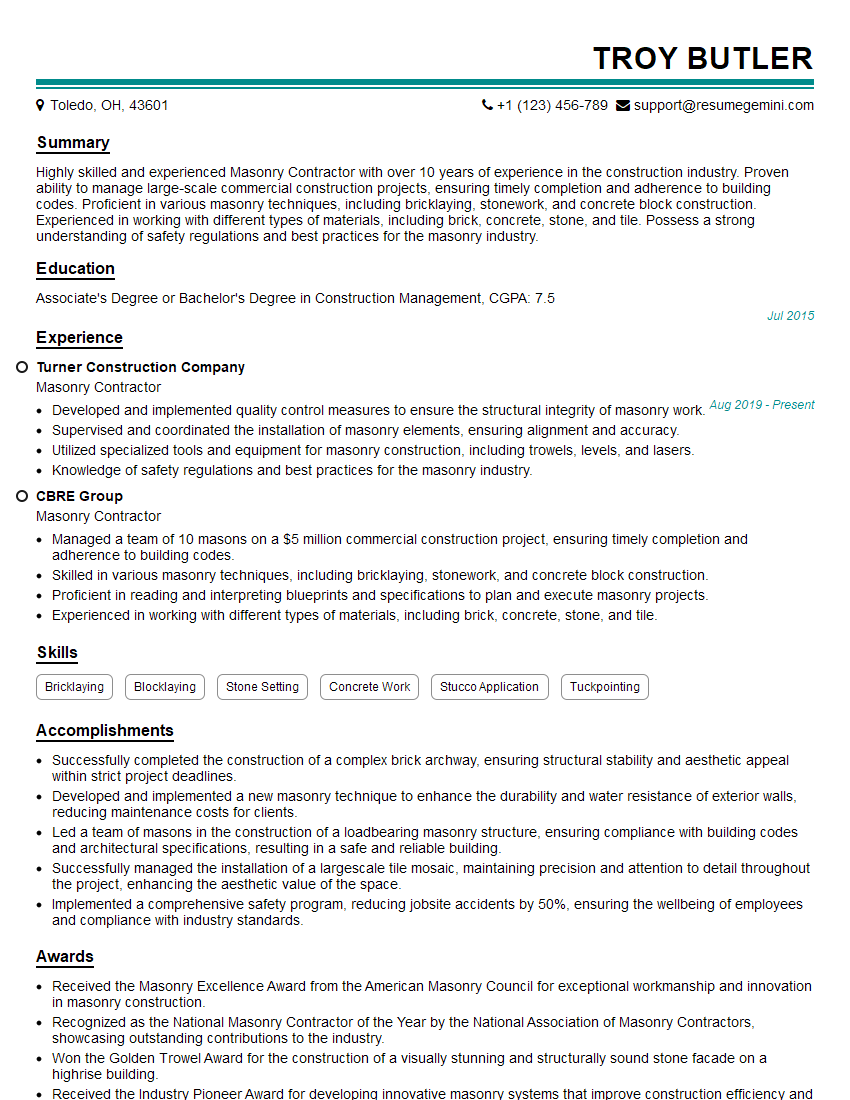
Mastering masonry layout and planning is crucial for career advancement in the construction industry, opening doors to higher-paying roles and greater responsibility. A strong resume is your key to unlocking these opportunities. Creating an ATS-friendly resume is essential for getting noticed by potential employers. ResumeGemini can significantly enhance your resume-building experience, helping you craft a professional document that highlights your skills and experience effectively. Examples of resumes tailored to Masonry layout and planning are available to help you get started. Invest the time in crafting a compelling resume – it’s an investment in your future.
Explore more articles
Users Rating of Our Blogs
Share Your Experience
We value your feedback! Please rate our content and share your thoughts (optional).
What Readers Say About Our Blog
To the interviewgemini.com Webmaster.
Very helpful and content specific questions to help prepare me for my interview!
Thank you
To the interviewgemini.com Webmaster.
This was kind of a unique content I found around the specialized skills. Very helpful questions and good detailed answers.
Very Helpful blog, thank you Interviewgemini team.