Feeling uncertain about what to expect in your upcoming interview? We’ve got you covered! This blog highlights the most important Matched Filtering interview questions and provides actionable advice to help you stand out as the ideal candidate. Let’s pave the way for your success.
Questions Asked in Matched Filtering Interview
Q 1. Explain the principle of matched filtering.
Matched filtering is a powerful signal processing technique used to detect the presence of a known signal within noisy data. Imagine you’re trying to find a specific song on a noisy radio – the matched filter acts like a finely tuned receiver, maximizing the signal’s strength while minimizing the interference from the background noise. It achieves this by correlating the incoming signal with a replica (the ‘matched filter’) of the expected signal. The higher the correlation, the greater the likelihood that the desired signal is present.
Q 2. Derive the output of a matched filter for a known signal.
Let’s derive the output of a matched filter. Assume we have a known signal s(t) and a received signal r(t) = s(t) + n(t), where n(t) represents additive noise. The matched filter’s impulse response, h(t), is simply the time-reversed and conjugated version of the known signal: h(t) = s*(T-t), where T is a suitable time constant and * denotes complex conjugation (important for complex signals). The output y(t) of the matched filter is the convolution of the received signal and the impulse response: y(t) = r(t) * h(t) = ∫r(τ)h(t-τ)dτ. Substituting r(t) and h(t), we get the output which at time t=T is: y(T) = ∫[s(τ) + n(τ)]s*(T-τ)dτ = ∫s(τ)s*(T-τ)dτ + ∫n(τ)s*(T-τ)dτ. The first term represents the signal component, which is maximized when the signal is present. The second term is the noise component. If s(t) is a real-valued signal, the first integral represents the autocorrelation of the signal which is maximized at t=T if the signal matches completely.
Q 3. What is the significance of the matched filter theorem?
The matched filter theorem states that the matched filter is the optimal linear filter for maximizing the signal-to-noise ratio (SNR) in the presence of additive white Gaussian noise (AWGN). In simpler terms, it’s the best way to detect a known signal in noisy conditions using linear processing. This is crucial because it provides a benchmark for filter performance and guides the design of optimal detection systems. Any other linear filter will yield a lower SNR for the same signal and noise conditions.
Q 4. How does the SNR improve using matched filtering?
Matched filtering improves the SNR by concentrating the signal’s energy into a single point in time. The signal component of the output is maximized at the time instant when the signal is perfectly aligned with its matched filter. Conversely, the noise component tends to be spread out. This difference in energy concentration significantly boosts the SNR. The improvement is directly proportional to the energy of the signal. A stronger signal yields a greater SNR improvement.
Q 5. Describe the relationship between correlation and matched filtering.
Correlation and matched filtering are intimately related; in fact, matched filtering *is* a correlation process. The output of a matched filter is essentially the cross-correlation between the received signal and the time-reversed, conjugated version of the known signal. The peak of this correlation function indicates the presence and timing of the known signal. The higher the correlation value, the stronger the evidence for the signal’s presence. Matched filtering can be viewed as a specialized type of correlation designed for optimal detection in noise.
Q 6. What are the limitations of matched filtering?
While incredibly powerful, matched filtering has limitations.
- Sensitivity to signal variations: If the received signal differs from the expected signal (e.g., due to Doppler shift, multipath propagation, or other distortions), the performance degrades significantly. The filter is specifically tuned to a known signal shape.
- Computational complexity: For long signals, computing the correlation can be computationally expensive, demanding significant processing power.
- Assumption of AWGN: The matched filter theorem assumes additive white Gaussian noise. In the presence of other noise types (e.g., impulsive noise), its optimality is no longer guaranteed.
- Requires prior knowledge of the signal: It needs a complete replica of the signal to be detected.
Q 7. How does noise affect the performance of a matched filter?
Noise directly affects the performance of a matched filter by reducing the SNR of the output. While the matched filter maximizes the SNR compared to other linear filters, it cannot eliminate the noise completely. The noise component in the filter output can obscure the signal peak, making detection challenging. The impact of noise depends on its power relative to the signal power and its statistical properties. High noise levels can lead to false detections or missed detections, compromising the reliability of the system. Techniques like averaging multiple observations or using more sophisticated signal processing algorithms can help mitigate the adverse effects of noise.
Q 8. Explain how to design a matched filter for a given signal.
Designing a matched filter involves creating a filter whose impulse response is the time-reversed and complex conjugate of the signal you’re trying to detect. Think of it like creating a perfect ‘mirror image’ of your target signal. This ensures maximal correlation when the target signal appears in the received signal, leading to optimal signal detection in the presence of noise.
Here’s a step-by-step process:
- Obtain the target signal: This is the signal you’re aiming to detect within a noisy environment. Let’s call it s(t).
- Time-reverse the signal: Flip the signal along the time axis. This creates s(-t).
- Take the complex conjugate: If your signal is complex-valued (e.g., in communication systems involving complex modulation), take the complex conjugate of the time-reversed signal. This means replacing each complex number a + bj with its conjugate a – bj. If your signal is real-valued, this step is simply skipped.
- Use the resulting signal as the impulse response: The resulting signal, s*(-t) (where the asterisk denotes the complex conjugate), now serves as the impulse response of your matched filter. You can then implement this filter either digitally (using convolution) or analogously (using circuit design).
Example: Let’s say your target signal is a simple rectangular pulse. Time-reversing it gives another rectangular pulse. Taking the complex conjugate (if it’s real) doesn’t change it. The matched filter would then be a filter with an impulse response that is identical to the original pulse.
Q 9. How do you choose the appropriate filter length for a matched filter?
Choosing the appropriate filter length for a matched filter is crucial. A filter that’s too short will miss important signal features and reduce detection performance. Conversely, a filter that’s too long increases computational complexity and sensitivity to noise.
The ideal filter length is generally equal to the duration of the signal you’re trying to detect. However, practical considerations might necessitate adjustments.
- Signal duration: The most straightforward approach is to make the filter length equal to the duration of your target signal. This maximizes the correlation peak.
- Noise characteristics: The signal-to-noise ratio (SNR) significantly impacts the choice. Higher noise levels might require slightly longer filters to achieve robust detection, but excessively long filters will amplify noise more than signal.
- Computational constraints: Real-time applications often have limitations on processing power. Balancing filter length with computational feasibility is often necessary.
Often, a trial-and-error approach, combined with simulations and analysis of the resulting detection performance (e.g., using metrics like probability of detection and false alarm rate), is used to fine-tune the filter length. It is important to remember there is no one-size-fits-all answer. Experimentation and careful consideration of the signal and noise characteristics are essential.
Q 10. What is the impact of signal distortion on matched filter performance?
Signal distortion significantly degrades the performance of a matched filter. The matched filter is optimally designed for a specific signal shape. Any deviation from that ideal shape reduces the correlation peak, leading to weaker detection or false negatives.
The impact depends on the nature of the distortion:
- Linear distortion: This includes effects like amplitude attenuation or phase shifts across different frequencies. Linear distortion can be partially mitigated through equalization techniques before matched filtering.
- Non-linear distortion: This involves more complex distortions that affect the signal shape in a non-linear manner (e.g., clipping, saturation). These distortions are far more challenging to compensate for and severely impair matched filter performance.
- Multipath propagation: In wireless communication or radar, signals can arrive at the receiver via multiple paths, leading to signal spreading and interference. This degrades the correlation peak and makes detection difficult. Techniques like Rake receivers, which combine the signals from different paths, can help mitigate this.
In essence, the more the received signal deviates from the expected signal used to design the matched filter, the lower the correlation peak will be, thus lowering detection reliability.
Q 11. How do you implement a matched filter in a digital signal processing system?
Implementing a matched filter in a digital signal processing (DSP) system involves convolving the received signal with the time-reversed complex conjugate of the target signal. This is typically done using fast Fourier transforms (FFTs) for computational efficiency.
Here’s a common approach:
- Obtain the digital signal: The received signal is sampled and digitized.
- Generate the filter impulse response: As discussed earlier, time-reverse and complex conjugate the target signal.
- Compute FFTs: Compute the FFT of both the received signal and the filter impulse response.
- Multiply in the frequency domain: Multiply the two FFTs element-wise. This is equivalent to convolution in the time domain.
- Compute Inverse FFT: Compute the inverse FFT of the product from step 4. This yields the output of the matched filter.
- Threshold detection: The output will have a peak at the time instant when the target signal is present. Compare this peak to a threshold to decide if the target signal is present or not.
Example (Conceptual Python Code):
import numpy as np
from scipy.fft import fft, ifft

# Received signal
received_signal = np.array([1, 2, 3, 2, 1])

# Target signal
target_signal = np.array([1, 2, 3, 2, 1])

# Time-reverse and complex conjugate (in this case, just time-reversal for a real signal)
filter_impulse_response = target_signal[::-1]

# FFTs
received_fft = fft(received_signal)
filter_fft = fft(filter_impulse_response)

# Multiply in frequency domain
output_fft = received_fft * filter_fft

# Inverse FFT
matched_filter_output = ifft(output_fft)

print(matched_filter_output)
This is a simplified example. Real-world implementations would involve more sophisticated noise handling, windowing techniques, and potentially adaptive filtering.
Q 12. Compare and contrast matched filtering with other filtering techniques.
Matched filtering is a powerful technique, but it’s not universally applicable. Let’s compare it to other filtering methods:
| Feature | Matched Filter | Other Filters (e.g., FIR, IIR) |
|---|---|---|
| Design Goal | Maximize SNR for a specific signal | Meet various frequency response specifications (low-pass, high-pass, band-pass, etc.) |
| Optimality | Optimal for signal detection in noise (given knowledge of the signal) | Not specifically optimized for signal detection; design depends on desired frequency response. |
| Flexibility | Less flexible; requires knowledge of the target signal. | More flexible; can be designed to meet various needs. |
| Computational Cost | Can be computationally intensive, especially for long signals. | Computational cost varies depending on filter order and implementation. |
In short: Matched filters are excellent for detecting known signals in noisy environments. They achieve optimal SNR improvement for the specific target signal. However, they lack the flexibility of other filters and require prior knowledge of the signal to be detected.
Q 13. Describe the application of matched filtering in radar systems.
Matched filtering is a cornerstone of modern radar systems. Its ability to enhance weak signals buried in noise makes it invaluable for detecting targets at long ranges or in cluttered environments.
In radar, the transmitted signal is known, and the receiver uses a matched filter designed for this specific signal. When a target reflects the signal back to the radar, the matched filter outputs a strong peak, indicating the presence and range of the target. The timing of the peak determines the target’s range, and the amplitude of the peak provides information about the target’s strength (reflectivity).
Example: A radar might transmit a pulse signal. The receiver then uses a matched filter designed for this pulse to detect the reflected pulses from aircraft or other objects. The matched filter improves the signal-to-noise ratio, enabling detection of even faint reflections. This allows radar systems to reliably detect small targets at long distances.
Q 14. How is matched filtering used in communication systems?
Matched filtering plays a crucial role in communication systems, particularly in situations where signals are weak and noisy. It improves the signal-to-noise ratio, enabling reliable signal detection and demodulation.
In digital communication, the transmitted signal is typically a sequence of known symbols (e.g., binary 0s and 1s modulated onto a carrier wave). The receiver employs a matched filter for each symbol to detect the transmitted data. This filtering process extracts the signal of interest from the background noise, enhancing the signal quality before further processing (e.g., decoding).
Example: In a wireless communication system, the receiver utilizes matched filters to detect the incoming modulated signals. Each matched filter is designed for a specific modulated symbol. The output of these filters helps determine which symbols were transmitted, enabling reliable data recovery. The choice of modulation scheme and the design of the matched filters are crucial aspects to optimize the system’s performance under noisy conditions.
Q 15. Explain the use of matched filters in biomedical signal processing.
Matched filtering is a powerful technique used to detect known signals embedded in noisy environments. In biomedical signal processing, this translates to identifying specific waveforms, like electrocardiogram (ECG) QRS complexes or evoked potentials, within the complex background noise of biological signals. Imagine trying to hear a specific bird call in a bustling forest – the matched filter is like having a ‘template’ of that bird call, allowing you to isolate it from all the other sounds.
For example, in ECG analysis, a matched filter designed using a typical QRS complex waveform can be used to detect the presence and timing of heartbeats, even in the presence of muscle artifact or other interference. This accurate detection is crucial for diagnostic purposes. Similarly, in electroencephalography (EEG), matched filters can help identify specific event-related potentials (ERPs) triggered by sensory stimuli, providing valuable insights into brain activity.
The process involves correlating the incoming signal with a template (the matched filter), which is a time-reversed and complex conjugate of the known signal. The output is a correlation function, and peaks in this function indicate the presence of the target signal at those time points. The higher the peak, the stronger the match and the higher the signal-to-noise ratio (SNR) achieved.
Career Expert Tips:
- Ace those interviews! Prepare effectively by reviewing the Top 50 Most Common Interview Questions on ResumeGemini.
- Navigate your job search with confidence! Explore a wide range of Career Tips on ResumeGemini. Learn about common challenges and recommendations to overcome them.
- Craft the perfect resume! Master the Art of Resume Writing with ResumeGemini’s guide. Showcase your unique qualifications and achievements effectively.
- Don’t miss out on holiday savings! Build your dream resume with ResumeGemini’s ATS optimized templates.
Q 16. Discuss the challenges in implementing matched filtering in real-time systems.
Implementing matched filtering in real-time systems presents several challenges. The primary difficulty stems from the computational cost. Matched filtering involves a convolution operation between the input signal and the filter, a computationally intensive process, especially for long signals or complex filters. Real-time applications require low latency, meaning processing must occur fast enough to keep up with the incoming data stream.
Another challenge lies in the need for accurate knowledge of the signal characteristics. Matched filters are optimized for a specific signal template. Any mismatch between the template and the actual signal in the real-world data (e.g., due to variations in signal amplitude or morphology) degrades the filter’s performance. Furthermore, variations in the noise characteristics can also affect filter efficiency.
Finally, real-time systems often operate under constrained resources, such as limited memory and processing power. Optimizing the algorithm to fit these constraints while maintaining the desired level of performance is critical.
Q 17. How do you handle multipath effects when using matched filtering?
Multipath effects, where the signal travels through multiple paths before reaching the receiver, create multiple delayed and attenuated copies of the original signal. This causes signal distortion and smearing, leading to reduced detection accuracy of the matched filter.
Several techniques can mitigate multipath effects. One approach is to incorporate a channel model into the matched filter design. This model accounts for the delays and attenuations introduced by the different paths. This requires accurate estimation of the channel impulse response, which can be challenging in practice.
Another strategy involves using adaptive filtering techniques. Adaptive filters can learn and adjust to the changing channel conditions, minimizing the impact of multipath distortion. Techniques like least mean squares (LMS) or recursive least squares (RLS) algorithms are commonly employed.
Finally, employing diversity reception methods, such as using multiple antennas, can also help reduce the effect of multipath by providing multiple independent signal copies to the receiver, and combining them smartly (e.g., using maximal ratio combining).
Q 18. What are the computational complexities associated with matched filtering?
The computational complexity of matched filtering is directly related to the length of the filter and the input signal. A direct implementation using convolution requires O(MN) computations, where M is the length of the filter and N is the length of the input signal. This can be quite computationally expensive, especially for long signals.
For example, processing a 1-second ECG signal sampled at 1 kHz with a 100-sample matched filter requires 100,000 multiplications and additions. While manageable for some systems, this complexity can become prohibitive for real-time applications involving longer signals or higher sampling rates.
The computational load can be reduced using techniques like Fast Fourier Transform (FFT)-based convolution. FFT-based convolution transforms the convolution operation into the frequency domain, where it can be computed more efficiently using element-wise multiplication, reducing the complexity to O(K log K), where K is approximately the length of the signal plus filter (K ≈ M+N). This significant reduction makes real-time implementations more feasible.
Q 19. How can you optimize the implementation of a matched filter for speed?
Optimizing matched filter implementation for speed involves several strategies. As mentioned earlier, using FFT-based convolution is a significant improvement over direct convolution.
Further optimizations can be achieved by using reduced-complexity algorithms. These algorithms trade off some performance (like a slightly lower SNR) for decreased computational cost. Examples include using pruned filters, where less significant filter coefficients are discarded, or low-complexity approximations of the correlation operation.
Hardware acceleration can also significantly boost performance. Implementing the matched filter on specialized hardware like digital signal processors (DSPs) or field-programmable gate arrays (FPGAs) can significantly speed up the computation. Parallel processing techniques can also be applied to process different parts of the signal concurrently.
Finally, careful code optimization techniques, such as loop unrolling and vectorization, can improve the efficiency of the software implementation.
Q 20. Explain the concept of a frequency-domain matched filter.
A frequency-domain matched filter operates by performing correlation in the frequency domain instead of the time domain. This leverages the convolution theorem, which states that convolution in the time domain is equivalent to multiplication in the frequency domain.
The implementation involves taking the Fast Fourier Transform (FFT) of both the input signal and the filter. The FFT of the filter is then complex conjugated, and the resulting spectra are multiplied. Inverse FFT is then applied to obtain the correlation in the time domain. This method is particularly advantageous because FFT-based convolution significantly reduces the computational complexity, as discussed previously.
Consider the following example using Python and NumPy (Note: Actual implementation may involve handling complex numbers explicitly):
import numpy as np
signal = np.random.rand(1024)
filter = np.random.rand(128)
signal_fft = np.fft.fft(signal)
filter_fft = np.fft.fft(filter)
correlation_fft = signal_fft * np.conj(filter_fft)
correlation = np.fft.ifft(correlation_fft)
Q 21. How do you adapt a matched filter for signals with unknown parameters?
Adapting a matched filter for signals with unknown parameters requires employing adaptive filtering techniques. These techniques adjust the filter’s parameters in real-time based on the incoming signal. The filter essentially learns the characteristics of the signal as it is observed.
Several adaptive filtering algorithms are available, including the least mean squares (LMS) algorithm and the recursive least squares (RLS) algorithm. LMS is computationally simpler, but RLS converges faster and provides better performance in some scenarios. The choice depends on the specific application’s computational constraints and performance requirements.
In essence, these algorithms iteratively update the filter coefficients to minimize the error between the filter’s output and the desired signal. This process gradually refines the filter’s ability to match the characteristics of the unknown signal, even when those characteristics change over time.
For example, if the amplitude or timing of a specific signal feature varies, an adaptive matched filter will adjust its parameters accordingly, maintaining detection accuracy despite this variation. The adaptive nature allows for robust detection in dynamic environments.
Q 22. Describe the effect of sampling rate on matched filter performance.
The sampling rate directly influences the performance of a matched filter. Think of it like this: you’re trying to find a specific needle (your signal) in a haystack (noise). A higher sampling rate provides more data points, giving you a finer-grained picture of the haystack. This allows for more accurate detection of the needle, even if it’s partially obscured. Conversely, a lower sampling rate results in fewer data points, potentially causing you to miss the needle entirely or misidentify something else as the needle.
Specifically, insufficient sampling can lead to aliasing, where high-frequency components in the signal are misinterpreted as lower frequencies. This can significantly degrade the matched filter’s ability to distinguish your signal from noise. The Nyquist-Shannon sampling theorem provides the theoretical minimum sampling rate to avoid aliasing: twice the highest frequency component present in your signal. However, in practice, oversampling is often beneficial to improve the accuracy and robustness of the matched filter, especially in the presence of noise.
For example, imagine trying to detect a faint radio signal. A higher sampling rate will capture more nuances of the signal, allowing the matched filter to better distinguish it from background noise and interference. Using too low a sampling rate might cause you to miss the signal altogether or misinterpret it due to aliasing.
Q 23. How do you evaluate the performance of a matched filter?
Evaluating a matched filter’s performance involves comparing its output to the actual presence or absence of the target signal. This is typically done using metrics like signal-to-noise ratio (SNR), probability of detection (Pd), and probability of false alarm (Pfa). We usually use simulated or real-world data containing the target signal embedded in noise. We run the matched filter on the data, analyze the output, and compute the performance metrics.
In a practical setting, you might create a dataset with known signal occurrences. You then pass the data through your matched filter and measure how many times it correctly identifies the signal (Pd) and how many times it incorrectly flags noise as the signal (Pfa). A good matched filter will have high Pd and low Pfa. You can also compare the filter’s output SNR to the input SNR – a high output SNR indicates effective noise reduction.
Q 24. What metrics are used to assess the effectiveness of a matched filter?
Several key metrics assess a matched filter’s effectiveness. The most prominent are:
- Signal-to-Noise Ratio (SNR): Measures the ratio of signal power to noise power. A higher SNR indicates better signal clarity after filtering.
- Probability of Detection (Pd): The probability that the matched filter correctly identifies the presence of the target signal when it’s actually present.
- Probability of False Alarm (Pfa): The probability that the matched filter incorrectly identifies the presence of the target signal when it’s actually absent (detecting noise as a signal).
- Receiver Operating Characteristic (ROC) Curve: Plots Pd versus Pfa at various threshold settings, providing a comprehensive visualization of the filter’s performance across different operating points.
These metrics allow us to quantitatively compare different matched filter designs or parameter settings, ultimately guiding the selection of the optimal filter for a given application.
Q 25. Discuss the use of matched filtering in image processing.
Matched filtering finds significant application in image processing, primarily for template matching and object detection. Imagine you have a large image and you want to find a specific object (like a face) within it. The object’s image serves as the template. The matched filter correlates the template with every possible position in the larger image. High correlation values indicate the presence of the object.
In practical terms, the template is treated as the desired signal, and the image is the received signal (which contains noise and other objects). The matched filter’s output is a correlation map, showing the similarity between the template and different image regions. Peaks in this map indicate potential locations of the object. This technique is very effective in tasks like medical image analysis (locating tumors), satellite imagery analysis (identifying specific features), and automated visual inspection.
Example: Consider a template of a specific type of cell. A matched filter can be used to automatically scan a microscopic image and pinpoint all instances of that cell.Q 26. How does the choice of waveform impact matched filter performance?
The choice of waveform significantly impacts matched filter performance. The filter is designed to be optimally matched to a specific signal; therefore, the closer the actual received signal is to the assumed waveform used in designing the filter, the better the performance. Any deviation between the assumed and actual waveform results in a loss of performance. This is known as the ‘mismatch loss’.
For example, if your assumed signal is a perfect sine wave, but the received signal has slight variations in frequency or amplitude, or includes other distortions, the matched filter’s performance will degrade. Consider the impact of channel distortion. If the channel distorts the signal in a known way, you can pre-compensate for that distortion in the design of the matched filter, thus mitigating the mismatch loss. The optimal choice of waveform often involves a trade-off between signal energy, bandwidth, and robustness to various types of noise and distortions.
Q 27. Explain the concept of adaptive matched filtering.
Adaptive matched filtering enhances the robustness of traditional matched filtering by adjusting its characteristics to account for uncertainties in the received signal or the channel. Instead of relying on a fixed template, adaptive matched filters dynamically update their parameters based on the incoming data. This approach is particularly valuable in situations with time-varying noise, unknown channel characteristics, or signals with fluctuating properties.
One common implementation involves estimating the noise characteristics from the received data and then adjusting the filter to optimize its performance in the presence of that specific noise. This might include techniques like noise power estimation or blind source separation. Another approach is using feedback from the filter’s output to iteratively improve its accuracy and adaptation to changing conditions. Adaptive filters allow you to track a signal even if its characteristics (amplitude, frequency, etc.) are changing over time.
Q 28. What are some common errors to avoid when designing a matched filter?
Several common errors can hinder matched filter design and performance:
- Inadequate Signal Modeling: Poorly characterizing the target signal, failing to account for realistic signal variations, and neglecting important signal characteristics can lead to significant mismatch loss.
- Ignoring Noise Characteristics: Failure to properly model and incorporate noise statistics into the filter design will lead to suboptimal performance.
- Incorrect Sampling Rate: As discussed earlier, an inappropriately chosen sampling rate can cause aliasing and dramatically reduce performance.
- Improper Threshold Selection: Choosing an inappropriate threshold for detecting signal presence will affect Pd and Pfa, potentially leading to excessive false alarms or missed detections.
- Oversimplifying the Channel: Neglecting or improperly modeling channel effects (like distortion or fading) reduces the filter’s effectiveness in real-world scenarios.
Careful consideration of these aspects during the design phase is crucial to achieve optimal matched filter performance.
Key Topics to Learn for Matched Filtering Interview
- Signal Representation & Correlation: Understanding different signal representations (time-domain, frequency-domain) and their impact on matched filter design. Grasping the concept of correlation and its role in signal detection.
- Filter Design & Optimization: Explore various matched filter design techniques, including those based on known signal shapes. Learn how to optimize filter parameters for specific applications, considering factors like noise and signal-to-noise ratio (SNR).
- Noise and its Effects: Analyze the impact of different noise types (e.g., additive white Gaussian noise) on matched filter performance. Understand how to model and mitigate the effects of noise in signal detection.
- Practical Applications: Explore real-world applications of matched filtering, such as radar systems, communication systems, and medical imaging. Be prepared to discuss specific examples and their challenges.
- Performance Metrics: Familiarize yourself with key performance metrics used to evaluate matched filters, such as probability of detection, probability of false alarm, and receiver operating characteristic (ROC) curves.
- Limitations and Alternatives: Understand the limitations of matched filtering and be aware of alternative signal processing techniques used when matched filtering is not optimal. This demonstrates a broader understanding of the field.
- Implementation & Algorithms: Be prepared to discuss different algorithmic approaches to implementing matched filtering, including their computational complexity and trade-offs.
Next Steps
Mastering matched filtering opens doors to exciting career opportunities in diverse fields demanding advanced signal processing expertise. To maximize your job prospects, creating a strong, ATS-friendly resume is crucial. ResumeGemini is a valuable resource for building professional, impactful resumes that highlight your skills effectively. We offer examples of resumes tailored to Matched Filtering to help you showcase your qualifications to potential employers. Invest time in crafting a compelling resume – it’s your first impression!

Data Analyst Resume Sample

Data Scientist Resume Sample

Research Scientist Resume Sample

Telecommunications Engineer Resume Sample

Aerospace Engineer Resume Sample

Communications Engineer Resume Sample

Microwave Engineer Resume Sample

Control Systems Engineer Resume Sample

Robotics Engineer Resume Sample
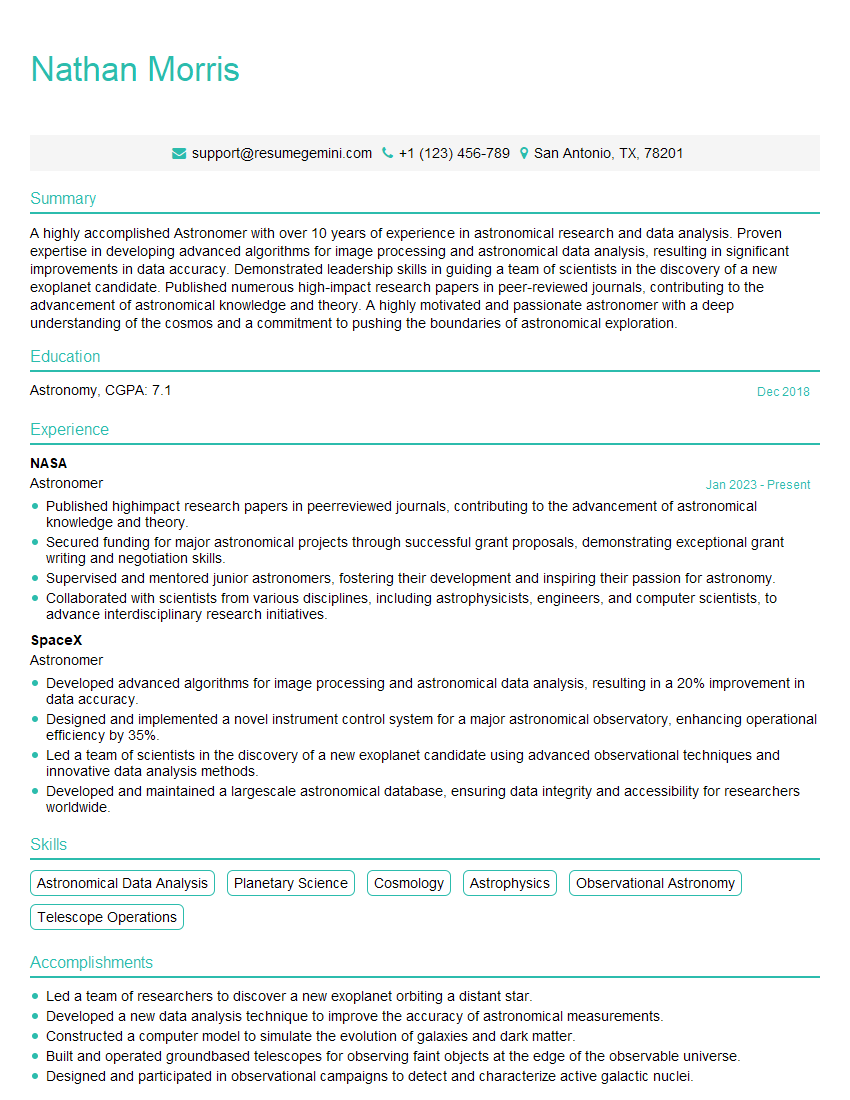
Astronomer Resume Sample
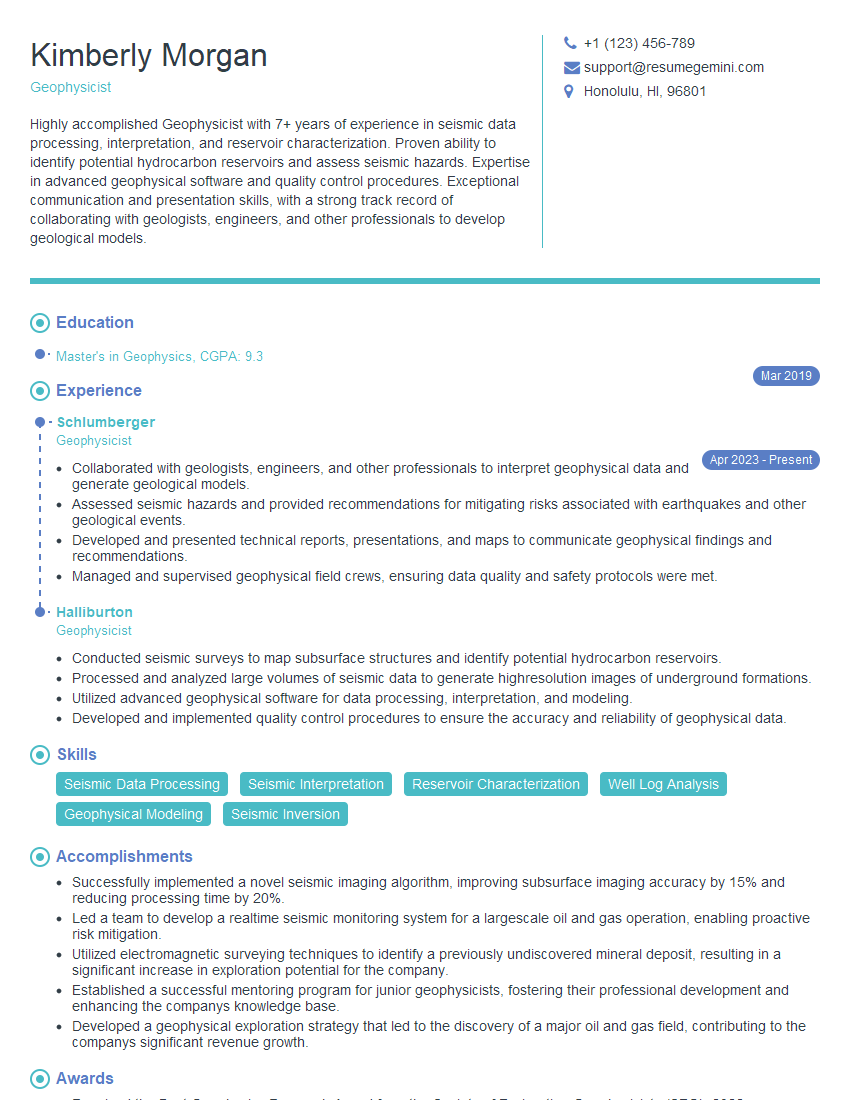
Geophysicist Resume Sample
Explore more articles
Users Rating of Our Blogs
Share Your Experience
We value your feedback! Please rate our content and share your thoughts (optional).
What Readers Say About Our Blog
To the interviewgemini.com Webmaster.
Very helpful and content specific questions to help prepare me for my interview!
Thank you
To the interviewgemini.com Webmaster.
This was kind of a unique content I found around the specialized skills. Very helpful questions and good detailed answers.
Very Helpful blog, thank you Interviewgemini team.