Cracking a skill-specific interview, like one for Medical Illustration, requires understanding the nuances of the role. In this blog, we present the questions you’re most likely to encounter, along with insights into how to answer them effectively. Let’s ensure you’re ready to make a strong impression.
Questions Asked in Medical Illustration Interview
Q 1. Describe your experience with different illustration software (e.g., Adobe Creative Suite, Cinema 4D, Blender).
My experience with illustration software is extensive, encompassing the Adobe Creative Suite (Photoshop, Illustrator, InDesign), Cinema 4D, and Blender. Adobe Creative Suite forms the backbone of my workflow; Photoshop is invaluable for photorealistic rendering and image manipulation, Illustrator for precise vector-based drawings, especially for diagrams and schematics, and InDesign for layout and publication-ready files. Cinema 4D allows me to create complex 3D models, particularly useful for anatomical structures and surgical procedures. I utilize Blender, a free and open-source option, for similar 3D modeling tasks when appropriate, and find its community support invaluable for problem-solving. I’m proficient in using each program’s features to achieve different artistic and technical goals, tailoring my software choice to the specifics of each project.
For example, a project illustrating the intricate vascular system of the heart would benefit from Cinema 4D’s 3D capabilities to accurately represent the spatial relationships. In contrast, creating a simplified diagram of the digestive system would be more efficiently executed in Illustrator.
Q 2. Explain your process for creating a medical illustration from concept to final product.
My process for creating a medical illustration is iterative and collaborative. It begins with a thorough understanding of the project’s goals. This involves detailed discussions with the client (often medical professionals) to determine the specific anatomical features to be highlighted, the target audience, and the desired style.
- Concept and Research: I start by gathering relevant information, often consulting medical literature and anatomical atlases. Sketching is crucial at this stage, exploring various compositional approaches.
- Drafting and Refinement: I create initial drafts using the appropriate software, incorporating feedback from the client to ensure anatomical accuracy and clarity.
- 3D Modeling (if necessary): For complex structures, I create 3D models, experimenting with lighting and rendering to achieve the desired visual effect. This ensures depth and realism.
- Color and Texture: The application of color and texture is crucial for conveying anatomical information effectively and aesthetically. Subtle color gradients, for instance, can highlight specific muscle layers.
- Final Rendering and Review: Once satisfied, I export the illustration in the required format (usually high-resolution images for print or web) and submit it to the client for final approval. This process usually involves several rounds of revision.
For instance, when illustrating a surgical procedure, I might build a 3D model of the surgical site to accurately depict the instrument placement and anatomical structures involved.
Q 3. How do you ensure anatomical accuracy in your illustrations?
Anatomical accuracy is paramount in medical illustration. I employ a multi-pronged approach to ensure this accuracy. First and foremost, I rigorously research the subject matter, referencing authoritative sources. My illustrations are never based solely on memory or guesswork.
Secondly, I utilize a meticulous process during creation. I break down complex anatomical structures into their individual components, ensuring correct spatial relationships and relative sizes. When working in 3D, precise measurements and anatomical references are essential. Finally, I always seek peer review from colleagues or medical professionals, encouraging constructive criticism and helping to identify any inaccuracies.
Q 4. What resources do you utilize to verify anatomical accuracy (e.g., anatomical atlases, medical textbooks)?
To ensure accuracy, I utilize a broad range of resources. These include peer-reviewed medical journals, anatomical atlases (like Gray’s Anatomy), textbooks, and online databases such as medical image repositories. I also consult with medical professionals directly, when possible, to verify the accuracy of my illustrations and address any questions I may have.
For example, while working on an illustration of a specific surgical technique, I would consult surgical textbooks and potentially contact a surgeon experienced in that technique for clarification or input.
Q 5. Describe your experience with different illustration styles (e.g., realistic, schematic, cross-sectional).
I’m experienced with a variety of illustration styles, each suitable for different purposes. Realistic styles aim for photographic accuracy, suitable for presentations requiring detailed anatomical fidelity. Schematic styles prioritize clarity and simplicity, often using symbols and simplified shapes, ideal for educational materials targeting a broader audience. Cross-sectional illustrations provide insight into the internal structures, useful for showcasing layered anatomy.
For instance, a realistic illustration might be used in a surgical textbook, while a schematic representation might be best suited for a patient education pamphlet.
Q 6. How do you adapt your illustration style to meet the specific needs of a project?
Adapting my style to meet project needs is essential. I always begin by considering the target audience and the purpose of the illustration. A complex illustration for specialists would differ significantly from one intended for the general public. I may adjust factors such as level of detail, color palette, and overall aesthetic. For example, a simple line drawing might suffice for a quick visual aid, while a fully rendered 3D model might be necessary to illustrate a complex surgical procedure.
Client feedback plays a critical role. I actively solicit feedback throughout the process to ensure the final product meets their specific requirements and expectations. This collaborative approach helps me tailor the style precisely to the project’s needs.
Q 7. Explain your experience working with medical professionals (e.g., surgeons, physicians, researchers).
Collaborating with medical professionals is integral to my work. I have worked extensively with surgeons, physicians, researchers, and medical educators on various projects. This collaborative process involves regular communication, feedback sessions, and review meetings. Their expertise ensures the anatomical accuracy, clarity, and clinical relevance of my work.
For example, when illustrating a new surgical technique, I would work closely with the surgeon to ensure that my illustration precisely reflects the procedure, including the instruments, steps, and key anatomical landmarks.
Open communication and a willingness to understand their perspective are crucial. These relationships not only ensure accuracy but also lead to innovative and impactful illustrations that effectively communicate complex medical information.
Q 8. How do you handle feedback from medical professionals on your illustrations?
Feedback from medical professionals is crucial for ensuring accuracy and clarity in medical illustrations. I approach feedback collaboratively, viewing it as an opportunity for improvement rather than criticism. My process involves:
- Active Listening: I carefully listen to the feedback, asking clarifying questions to ensure I fully understand their concerns.
- Detailed Review: I meticulously review the illustration alongside the feedback, identifying specific areas needing revision.
- Iterative Revisions: I create revised versions, incorporating the suggested changes. I often provide multiple iterations, allowing the medical professional to see the evolution of the changes.
- Open Communication: I maintain open communication throughout the revision process, providing updates and seeking further clarification if needed.
- Documentation: I keep detailed records of all feedback received and the revisions made, demonstrating a commitment to quality and accountability.
For example, in a recent project illustrating a complex surgical procedure, a surgeon pointed out an anatomical inaccuracy in the positioning of a specific artery. I revised the illustration, incorporating their feedback and providing a detailed explanation of the correction. This collaborative process ensured the final illustration was both accurate and easily understood.
Q 9. Describe your experience with various illustration techniques (e.g., digital painting, 3D modeling, traditional media).
My experience spans a wide range of illustration techniques, each offering unique advantages for different applications in medical illustration.
- Digital Painting: I’m proficient in software like Adobe Photoshop and Procreate, using them to create detailed, anatomically accurate illustrations for textbooks, journals, and websites. Digital painting offers flexibility in revisions and allows for intricate details.
- 3D Modeling: I utilize software such as Blender and ZBrush to create realistic 3D models, particularly useful for complex anatomical structures or surgical procedures. This approach allows for dynamic visualization from multiple angles and can generate accurate representations of movement.
- Traditional Media: My background includes traditional techniques like pen and ink, watercolor, and graphite. These are valuable for creating a specific artistic style or when a hand-drawn feel is desired, such as for artistic medical renderings.
For instance, I might use 3D modeling to create a rotatable model of the human heart for a cardiology website, while employing digital painting to create highly detailed anatomical illustrations for a medical textbook. The choice of technique depends greatly on the project requirements and desired aesthetic.
Q 10. How do you manage multiple projects simultaneously and meet deadlines?
Managing multiple projects and deadlines effectively requires meticulous organization and time management skills. My approach centers around:
- Project Prioritization: I prioritize projects based on deadlines and urgency, ensuring the most time-sensitive projects receive the necessary attention.
- Detailed Project Planning: I use project management tools (like Trello or Asana) to create detailed timelines, outlining tasks, milestones, and deadlines for each project.
- Time Blocking: I allocate specific time blocks for each project, minimizing distractions and maintaining focus.
- Regular Check-ins: I schedule regular check-ins with clients to discuss progress, address any concerns, and ensure the project remains on track.
- Delegation (where applicable): If a project allows, I strategically delegate tasks to other team members to enhance efficiency.
Think of it like conducting an orchestra: Each musician (project) needs a designated time and place to play their part. My project management strategy ensures a harmonious blend of all the projects, resulting in timely and successful delivery.
Q 11. Explain your familiarity with different image formats and their applications in medical communication.
Understanding image formats is critical in medical illustration, as each format impacts image quality, file size, and compatibility with different platforms.
- TIFF (Tagged Image File Format): Excellent for high-resolution images with minimal compression, ideal for print publications (textbooks, journals) where image quality is paramount.
- JPEG (Joint Photographic Experts Group): Offers good compression, reducing file size, suitable for web use and online publications where file size matters but not at the cost of drastic quality loss.
- PNG (Portable Network Graphics): Supports lossless compression, maintaining image quality, useful for illustrations with sharp lines and text, suitable for both print and web.
- AI (Adobe Illustrator): Vector-based format, allowing scalability without loss of quality. Ideal for illustrations that need to be resized frequently (e.g., logos, diagrams for presentations). It’s a key tool for creating scalable vector graphics (SVGs).
- EPS (Encapsulated PostScript): Another vector format, often used for print publications that require high-resolution images.
For example, I would use TIFF for an illustration in a medical textbook due to its high resolution and lossless compression. For a website, JPEG might be a more appropriate choice due to its smaller file size, balanced against a slightly lower image quality. The context of the usage is paramount in selecting the right format.
Q 12. Describe your experience creating illustrations for different publications (e.g., textbooks, journals, websites).
I have extensive experience creating illustrations for a variety of publications, tailoring my style and approach to the specific needs of each medium.
- Textbooks: I create detailed, anatomically accurate illustrations often accompanied by clear labels and concise captions to support the text. Emphasis is on clarity and comprehensive visual information.
- Journals: Illustrations often focus on specific research findings or procedures. Precision and accuracy are crucial, adhering to the journal’s style guidelines.
- Websites: Illustrations need to be visually appealing and easily digestible, often using smaller file sizes for optimal web performance. Interactive elements, such as animations or 3D models, are sometimes incorporated.
For instance, I created a series of detailed anatomical illustrations for a medical textbook on the human nervous system, ensuring the illustrations accurately depicted the complex network of nerves and related structures. For a medical journal article on a new surgical technique, I created a series of step-by-step illustrations, allowing readers to follow the procedure clearly and safely.
Q 13. How do you ensure your illustrations are accessible to a diverse audience?
Ensuring accessibility for a diverse audience is a fundamental aspect of my work. This involves:
- Colorblind-Friendly Palettes: I use color palettes that are easily distinguishable by individuals with various forms of color blindness, employing contrasting colors and incorporating text labels for clarity.
- Alternative Text (Alt Text): For digital illustrations, I always provide detailed alternative text descriptions so screen readers can convey the image information to visually impaired users.
- Simplified Visual Language: I use clear, concise visuals, avoiding overly complex compositions that could be difficult for some viewers to interpret.
- Cultural Sensitivity: I take into account cultural differences and sensitivities when choosing imagery and depictions of people in my illustrations, ensuring inclusivity.
- Multilingual Support: Where appropriate, I work to incorporate multiple languages to reach a global audience.
For example, in an illustration of a diverse group of people, I would pay careful attention to the representation of various ethnicities and genders, reflecting the diversity of the intended audience.
Q 14. How do you maintain the confidentiality of sensitive medical information?
Maintaining the confidentiality of sensitive medical information is paramount. My approach involves:
- Data Security Protocols: I utilize secure storage methods for all patient data and medical images, utilizing password-protected files and encrypted storage solutions.
- Strict Compliance with Regulations: I strictly adhere to HIPAA (Health Insurance Portability and Accountability Act) and other relevant regulations concerning the handling of protected health information (PHI).
- Data Minimization: I only use the minimum necessary amount of patient data required to create the illustration, avoiding unnecessary information.
- Informed Consent: I ensure that appropriate informed consent is obtained before using any patient data or medical images for illustrative purposes.
- Secure File Transfer: I utilize secure file transfer protocols (e.g., encrypted email) to transfer sensitive data between myself and clients.
Consider it like safeguarding a valuable secret: Multiple layers of protection are implemented to ensure data remains confidential and secure. This ensures that trust is maintained and ethical standards are upheld.
Q 15. Describe your understanding of copyright and intellectual property related to medical illustrations.
Copyright and intellectual property are crucial in medical illustration. Essentially, copyright protects the original artwork, granting the creator exclusive rights to reproduce, distribute, display, and create derivative works. This means that any image I create is legally mine unless I explicitly transfer those rights to a client through a contract. Intellectual property encompasses a broader scope, including not only the artwork itself but also any underlying concepts, designs, and processes involved in its creation. For instance, if I develop a novel way to illustrate a specific anatomical structure, that method could be considered intellectual property. In practice, I always clearly define copyright ownership in contracts with clients and ensure that usage is licensed appropriately, avoiding any infringement. This includes specifying the permissible uses, territories, and duration of the license. Failure to do so can lead to legal disputes and financial penalties.
For example, if a pharmaceutical company uses my illustration in their marketing materials without a proper license, they are infringing on my copyright. Similarly, if I create an illustration based on a client’s confidential data, I need to respect their intellectual property rights and ensure the appropriate non-disclosure agreements are in place.
Career Expert Tips:
- Ace those interviews! Prepare effectively by reviewing the Top 50 Most Common Interview Questions on ResumeGemini.
- Navigate your job search with confidence! Explore a wide range of Career Tips on ResumeGemini. Learn about common challenges and recommendations to overcome them.
- Craft the perfect resume! Master the Art of Resume Writing with ResumeGemini’s guide. Showcase your unique qualifications and achievements effectively.
- Don’t miss out on holiday savings! Build your dream resume with ResumeGemini’s ATS optimized templates.
Q 16. How do you stay updated on current trends and technologies in medical illustration?
Staying current in medical illustration requires a multi-pronged approach. I regularly attend conferences and workshops, such as those hosted by the Association of Medical Illustrators (AMI), to network with other professionals and learn about the latest software, techniques, and trends. Many leading institutions also host relevant webinars and online courses that cover everything from advanced software tutorials to ethical considerations in medical communication. I also actively participate in online communities, forums, and social media groups dedicated to medical illustration, engaging in discussions and sharing knowledge with colleagues. Keeping up with advancements in medical research is also essential. This often involves browsing scientific journals, attending medical lectures, or collaborating directly with medical professionals to stay informed on new discoveries and their visual representations.
For example, I recently participated in a workshop focusing on using virtual and augmented reality technologies for medical visualization, greatly enhancing my skills in creating interactive 3D models. I also subscribed to several relevant journals and online newsletters to keep abreast of breakthroughs in medical technology and their implications for medical illustration.
Q 17. What is your experience with creating animations or interactive medical visualizations?
I have extensive experience creating medical animations and interactive visualizations using various software packages, including Adobe After Effects, Cinema 4D, and Unity. My work ranges from short animated explainers for patient education to complex interactive 3D models for surgical planning. For example, I recently collaborated with a surgical team to create a 3D interactive model of the heart, which allowed surgeons to plan a complex procedure pre-operatively. The model enabled them to view the heart from various angles, zoom in on specific structures, and even simulate the surgical intervention. This resulted in a more precise and less invasive operation. In another project, I developed a series of short animated videos explaining the causes and progression of a specific disease for patient education. This required careful consideration of pacing, visual storytelling, and the use of clear and concise language. Each project requires a nuanced approach that prioritizes clarity and engagement while adhering to the highest medical accuracy.
Q 18. How would you approach illustrating a complex surgical procedure?
Illustrating a complex surgical procedure demands a systematic approach. First, I would collaborate closely with the surgeon to understand the procedure step-by-step. This would involve reviewing surgical videos, attending surgical demonstrations if possible, and asking specific questions about anatomical landmarks, instrument usage, and key decision points. I’d then create a detailed storyboard breaking down the procedure into sequential steps. This helps visualize the narrative flow of the illustration and allows for revisions before detailed rendering. The illustrations themselves might use a combination of techniques, such as cutaway diagrams to show internal structures and realistic rendering to depict the surgical instruments and tissues. A crucial aspect is maintaining anatomical accuracy and clarity. This might involve using anatomical references, collaborating with medical professionals for verification, and clearly labeling all essential structures and steps.
For example, when illustrating a minimally invasive laparoscopic procedure, I would use diagrams showing the surgical instruments entering the body through small incisions, alongside views that illustrate the internal perspective during the operation. This multi-faceted approach provides a comprehensive visual narrative of the surgical procedure.
Q 19. Explain your approach to color theory and its application in medical illustrations.
Color theory is fundamental to effective medical illustration. My approach involves using color strategically to enhance clarity and understanding. For instance, I might use warm colors (reds, oranges, yellows) to highlight areas of inflammation or bleeding, while cooler colors (blues, greens) might represent healthy tissue or oxygenated blood. This is not arbitrary; it leverages the psychological associations viewers have with different colors. I also consider color contrast to ensure readability, particularly when labeling structures or highlighting key features. Using a limited palette can improve clarity, while an excess of colors can be distracting. In the case of anatomical diagrams, maintaining consistency in color coding for specific structures across various illustrations is crucial to avoid viewer confusion. For example, consistently using a specific shade of red for arteries across all illustrations helps viewers quickly identify them.
Furthermore, I need to be mindful of color blindness. I often use colorblind-friendly palettes and incorporate additional visual cues, such as different line weights or textures, to ensure that the illustrations are accessible to everyone.
Q 20. How do you handle complex anatomical structures or difficult-to-visualize concepts?
Illustrating complex anatomical structures or difficult-to-visualize concepts often requires creative problem-solving. I frequently use layered diagrams, cutaways, and cross-sections to reveal hidden structures and clarify spatial relationships. Animations can be invaluable, allowing for a dynamic representation of complex processes that are impossible to capture statically. For instance, showing the flow of blood through the heart is much easier with animation than a static image. 3D modeling can also be extremely useful, allowing for rotation and manipulation of complex structures to understand their relationships from various angles. When dealing with abstract or microscopic concepts, I use analogies and visual metaphors to make them more accessible to the viewer. For example, I might illustrate the concept of cellular receptors using lock-and-key analogy, making a complex biochemical interaction easier to understand.
In all cases, thorough research and consultation with experts remain essential to ensure anatomical and conceptual accuracy.
Q 21. What is your process for ensuring the clarity and effectiveness of your illustrations?
Ensuring the clarity and effectiveness of my illustrations is an iterative process. It starts with a thorough understanding of the target audience and the desired message. I then create multiple drafts, refining the design based on feedback from clients and medical professionals. This often involves testing the illustrations with the target audience to see how effectively they understand the information. Simplicity is key—I avoid unnecessary details or clutter, focusing instead on the essential information. Clear labels, consistent color schemes, and well-defined anatomical structures are crucial. Using appropriate visual hierarchy (size, placement, and emphasis) ensures that the most important information is easily identifiable. Finally, I always ensure that the final illustrations meet the highest standards of medical accuracy and are consistent with current scientific understanding. This could involve peer review by medical professionals before finalizing the work.
For example, when illustrating a complex cellular process, I might initially create a highly detailed rendering. However, after feedback from medical reviewers and user testing, I might simplify the illustration to show only the essential elements, making it more accessible and easier to understand. Regular revisions and feedback loops are vital to refining illustrations for optimal clarity and effectiveness.
Q 22. How do you balance artistic creativity with scientific accuracy in your work?
Balancing artistic creativity and scientific accuracy is the cornerstone of effective medical illustration. It’s like creating a beautiful, informative map – the artwork needs to be engaging, but the geographical details (scientific facts) must be flawlessly accurate. I achieve this balance through a rigorous process:
- Thorough Research: Before even picking up a pen or stylus, I delve deeply into the relevant scientific literature, consulting with subject matter experts to ensure a complete understanding of the anatomy, physiology, or pathology being depicted. For example, when illustrating a complex surgical procedure, I’d review surgical videos and texts to confirm the accuracy of every step.
- Iterative Refinement: My initial sketches are often rough, focusing on anatomical correctness. Subsequent iterations incorporate artistic elements, improving the visual appeal without compromising accuracy. I might use color palettes to highlight specific structures or use perspective to enhance three-dimensionality, but always keeping the scientific integrity intact.
- Peer Review and Expert Consultation: I actively seek feedback from other medical illustrators and subject matter experts throughout the creation process. Their scrutiny guarantees that the final artwork is not only aesthetically pleasing but also scientifically sound.
This meticulous approach ensures that the illustrations are both beautiful and reliable, serving their purpose of communicating complex medical information effectively.
Q 23. Describe your understanding of visual communication principles and their application in medical illustration.
Visual communication principles are fundamental to medical illustration. My understanding encompasses:
- Clarity and Simplicity: Complex anatomical structures or procedures need to be broken down into easily digestible visual components. I utilize clear lines, strategic labeling, and a minimalist approach to avoid overwhelming the viewer.
- Visual Hierarchy: Using size, color, and placement, I guide the viewer’s eye to the most important information first. For instance, in a diagram of the heart, the major vessels would be emphasized to draw attention to their function.
- Color Theory: Color is a powerful tool. I use it strategically to highlight key structures, differentiate tissues, and improve visual appeal while maintaining scientific accuracy. Specific colors might represent blood flow, nerve pathways, or disease states.
- Layout and Composition: The organization and arrangement of elements greatly impact understanding. I strive for a logical flow, ensuring that related information is grouped together in a visually cohesive manner. For example, in a series of illustrations showing a surgical procedure, the steps are naturally sequenced.
By mastering these principles, I create medical illustrations that are not only accurate but also highly effective in conveying their intended message.
Q 24. How do you incorporate client feedback effectively into your design process?
Incorporating client feedback is crucial for a successful project. My process involves:
- Regular Communication: Open and frequent communication is key. I schedule regular check-ins with clients to discuss progress, address concerns, and incorporate their feedback.
- Active Listening: I listen carefully to client needs and translate their feedback into actionable steps. Sometimes this involves clarifying their vision, and sometimes it’s adapting to new requirements.
- Iterative Design: Client feedback informs each iteration of the illustration. This allows for adjustments and refinements based on their input. I might provide multiple versions reflecting different feedback options for them to review.
- Documentation: I meticulously document all feedback and revisions to track progress and ensure transparency.
This collaborative approach ensures that the final product meets and exceeds client expectations, creating a win-win scenario. For example, a client might initially request a particular color scheme, but after seeing a prototype, they might suggest a more impactful alternative. This collaboration leads to better outcomes.
Q 25. What is your experience with pre-production planning and client meetings?
Pre-production planning and client meetings are essential for project success. My experience involves:
- Project Scoping: Before any design work begins, I have detailed discussions with the client to understand their needs, objectives, target audience, and budget. This clarifies the scope of the project and prevents misunderstandings later.
- Timeline and Budget: I create a realistic project timeline and budget, outlining milestones and deliverables. This transparency keeps the client informed and minimizes surprises.
- Content Gathering: I work collaboratively with clients to gather all necessary information, including reference materials, data, and specifications.
- Style Guide Development: In some instances, we develop style guides that establish consistent branding and visual identity for a series of illustrations.
These initial steps lay a solid foundation for a smooth and productive workflow. For instance, a well-defined scope of a project prevents unexpected costs and delays. This proactive approach keeps projects on track and within budget.
Q 26. Explain your understanding of different types of medical illustration projects (e.g., anatomical charts, surgical diagrams, patient education materials).
Medical illustration encompasses a vast range of projects, each requiring a different approach. My experience includes:
- Anatomical Charts: These detailed diagrams accurately represent the structure and relationships of body parts. Creating these requires meticulous attention to detail and a deep understanding of anatomy. For example, a chart showing the nervous system would require precise rendering of nerves, ganglia, and brain structures.
- Surgical Diagrams: These illustrations detail surgical procedures step-by-step, guiding surgeons and trainees. They require a strong understanding of surgical techniques and anatomical planes. For example, a diagram of a heart bypass surgery would clearly show the placement of grafts and incisions.
- Patient Education Materials: These illustrations simplify complex medical information for patients, making it easier to understand. I focus on clarity, simplicity, and visual appeal while ensuring accuracy. For example, I might use simple icons and friendly language to explain the process of a specific therapy.
- Medical Animations: I am also experienced in creating medical animations to further enhance understanding and engagement. This could range from simulations of physiological processes to demonstrations of disease progression.
My adaptability allows me to tackle diverse projects effectively, tailoring my approach to the specific needs of each assignment.
Q 27. Describe your familiarity with different presentation formats for medical illustrations (e.g., print, digital, web).
Medical illustrations can take many forms, and I’m proficient in various presentation formats:
- Print: I create high-resolution illustrations for print publications like textbooks, journals, and posters, ensuring optimal quality for reproduction. This often involves selecting the appropriate resolution and file formats.
- Digital: I generate illustrations for digital platforms such as presentations, websites, and interactive learning modules. This might involve using vector graphics for scalability and resolution independence.
- Web: Illustrations for websites require optimization for different screen sizes and resolutions, often utilizing web-friendly file formats and incorporating interactive elements.
- Interactive Media: This includes creating animations, simulations, and virtual reality experiences. My skills in this area provide new avenues for educating and communicating with broader audiences.
Understanding the nuances of each format ensures the illustrations are presented effectively, regardless of the medium. For example, a print publication might require a different color profile than a web application.
Q 28. How do you handle unexpected challenges or changes in a project timeline?
Unexpected challenges are inevitable in any project. My approach to handling them involves:
- Proactive Problem-Solving: I anticipate potential challenges during the planning phase, developing contingency plans to mitigate risks. For example, I always have backup plans and alternative solutions readily available.
- Open Communication: I immediately communicate any unexpected issues to the client, transparently explaining the situation and potential solutions.
- Flexibility and Adaptability: I adjust my workflow and strategies to accommodate unexpected changes, prioritizing the most critical tasks. I might re-prioritize tasks or seek external help to meet the deadline.
- Resourcefulness: I leverage my network of experts and colleagues to overcome technical or scientific obstacles. For example, I might consult a specialist in a specific area of anatomy if needed.
This proactive and adaptable approach minimizes disruption and ensures that even unforeseen obstacles don’t derail the project’s success. For example, if a client suddenly requests a significant change, I’d discuss the impact on the timeline and budget, and work collaboratively to find a mutually acceptable solution.
Key Topics to Learn for Your Medical Illustration Interview
- Anatomy and Physiology: Deep understanding of human anatomy, physiological processes, and pathology is fundamental. Prepare to discuss how this knowledge informs your illustration choices.
- Medical Imaging Techniques: Familiarity with various imaging modalities (X-ray, CT, MRI, ultrasound) and their interpretation is crucial. Be ready to explain how you translate these images into illustrations.
- Illustration Software and Techniques: Demonstrate proficiency in industry-standard software (e.g., Adobe Creative Suite). Be prepared to discuss your preferred techniques and workflow for different illustration types.
- Scientific Communication and Visualization: Explain your understanding of effectively conveying complex medical information visually. Discuss your approach to simplifying complex data for diverse audiences.
- Medical Terminology and Nomenclature: Accurate use of medical terminology is paramount. Be prepared to discuss your strategy for ensuring accuracy and consistency in your work.
- Ethical Considerations in Medical Illustration: Discuss your awareness of ethical guidelines and best practices related to patient confidentiality and image manipulation.
- Portfolio Development and Presentation: Be ready to discuss your portfolio, highlighting your artistic skills, technical expertise, and problem-solving abilities. Explain your design choices and creative process.
- Collaboration and Teamwork: Medical illustration often involves collaboration. Discuss your experience working in teams and your communication style.
- Project Management and Time Management: Discuss your ability to manage multiple projects effectively, meet deadlines, and prioritize tasks.
Next Steps
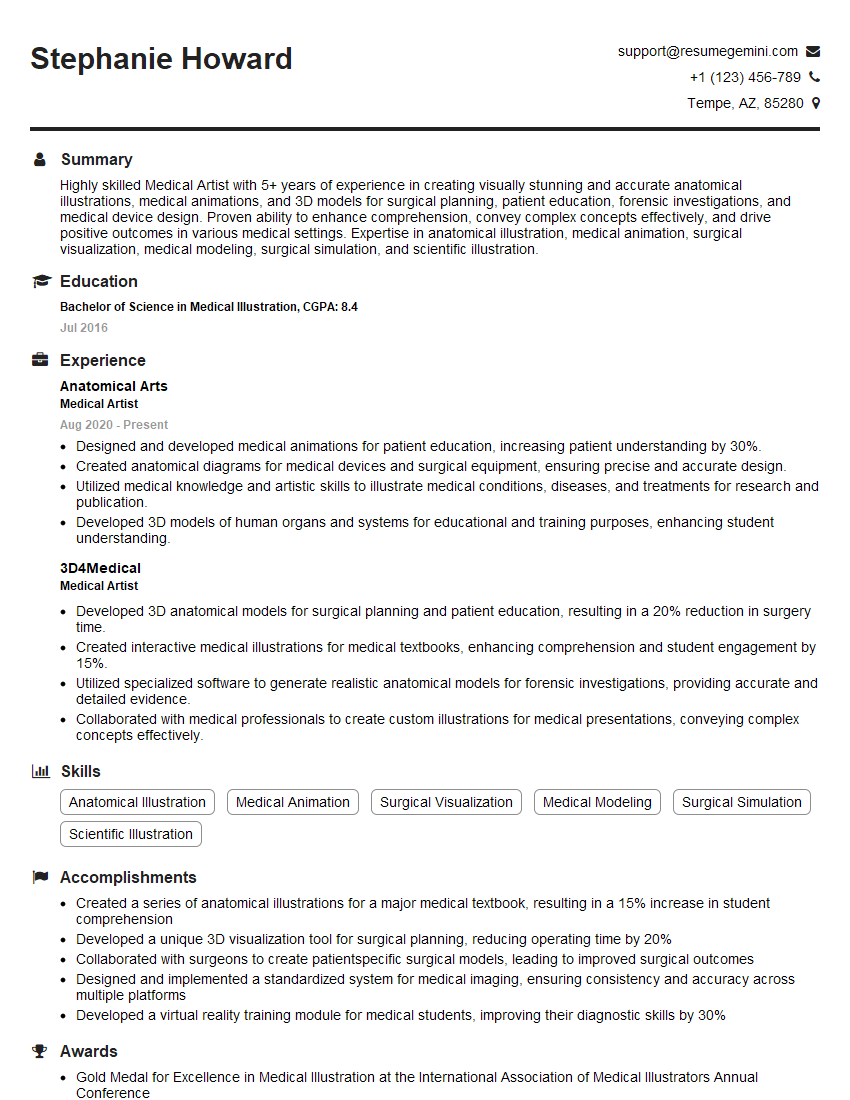
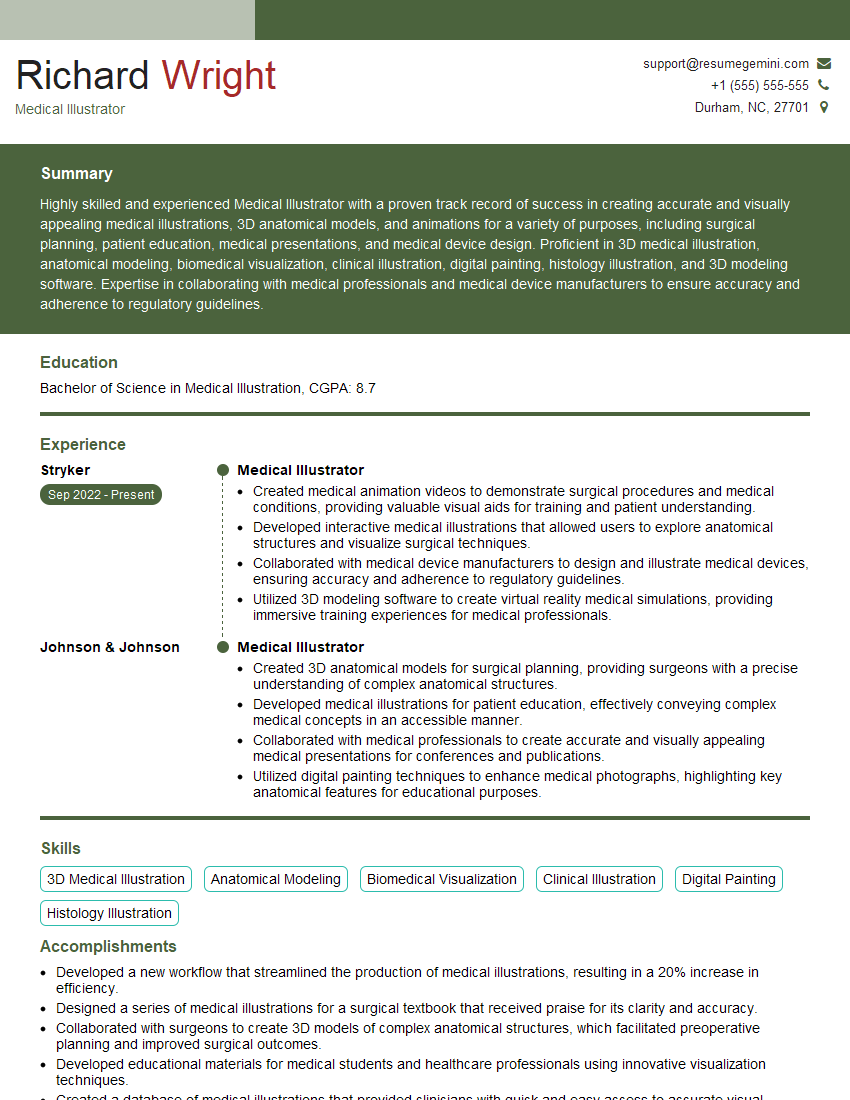
Mastering medical illustration opens doors to a rewarding career in healthcare, education, and publishing. To maximize your job prospects, crafting a strong, ATS-friendly resume is essential. ResumeGemini is a trusted resource that can help you build a professional resume that showcases your skills and experience effectively. Examples of resumes tailored specifically for Medical Illustration professionals are available to guide you. Invest the time to create a compelling resume – it’s your first impression and a key to unlocking your career goals.
Explore more articles
Users Rating of Our Blogs
Share Your Experience
We value your feedback! Please rate our content and share your thoughts (optional).
What Readers Say About Our Blog
To the interviewgemini.com Webmaster.
Very helpful and content specific questions to help prepare me for my interview!
Thank you
To the interviewgemini.com Webmaster.
This was kind of a unique content I found around the specialized skills. Very helpful questions and good detailed answers.
Very Helpful blog, thank you Interviewgemini team.