Are you ready to stand out in your next interview? Understanding and preparing for Milling Equipment Operation interview questions is a game-changer. In this blog, we’ve compiled key questions and expert advice to help you showcase your skills with confidence and precision. Let’s get started on your journey to acing the interview.
Questions Asked in Milling Equipment Operation Interview
Q 1. Describe your experience with different types of milling machines (e.g., vertical, horizontal, CNC).
My experience encompasses a wide range of milling machines, from traditional vertical and horizontal models to sophisticated CNC (Computer Numerical Control) machines. With vertical milling machines, I’m proficient in operations like face milling, slot milling, and drilling, commonly used for creating flat surfaces and precise features. Horizontal milling machines, which are ideal for larger workpieces and heavy-duty operations, have allowed me to tackle more complex projects, focusing on applications like end milling and profile milling. My CNC milling experience significantly extends my capabilities. I’m adept at programming and operating these machines, utilizing their precision and automation to achieve intricate designs and high-volume production runs. I’ve worked extensively with various CNC controls, including Fanuc and Siemens, and I’m comfortable with different machining centers—3-axis, 4-axis, and even some 5-axis machines for complex geometries. For example, in a recent project, I used a 3-axis CNC mill to manufacture a batch of custom-designed aluminum parts with incredibly tight tolerances. This involved careful programming and precise setup to ensure consistency across the entire production run.
Q 2. Explain the process of setting up a milling machine for a specific job.
Setting up a milling machine for a specific job is a meticulous process that requires attention to detail and safety. It begins with a thorough review of the job specifications, including the material to be machined, the desired dimensions and tolerances, and the chosen cutting tools. Next, I securely mount the workpiece on the machine’s table or fixture, ensuring it’s properly aligned and clamped to prevent movement during operation. The correct cutting tools are then selected and installed in the spindle, taking into account the material’s hardness and the desired cut. Following this, the machine’s parameters are carefully set, including spindle speed (RPM), feed rate (in/min or mm/min), depth of cut, and the number of passes. For CNC machines, this involves inputting the G-code program that dictates the toolpath. A test run is crucial to identify any potential issues such as incorrect toolpath or insufficient clamping force. Finally, I check the machine for any signs of wear or damage before commencing the main machining operation. Imagine machining a complex mold cavity—proper setup minimizes the risk of errors and ensures the final product matches the design specifications.
Q 3. How do you ensure the accuracy and precision of milled parts?
Accuracy and precision in milling are paramount. Several steps ensure this. First, regular machine maintenance and calibration are essential. This includes checking the machine’s alignment, spindle runout, and the accuracy of its measuring systems. Second, proper tool selection is crucial; using sharp, well-maintained cutters minimizes inaccuracies caused by dull tools. Third, the use of appropriate clamping and fixturing techniques prevents workpiece movement during machining. For CNC milling, the accuracy of the G-code program is paramount. Simulation software helps verify the toolpath before machining, preventing potential collisions and ensuring the desired geometry. Finally, post-machining inspection using precise measuring tools like calipers, micrometers, and CMMs (Coordinate Measuring Machines) verifies that the milled parts meet the required tolerances. For instance, when producing precision components for aerospace applications, the tolerance might be measured in micrometers, and every step must be precise to meet these demanding standards.
Q 4. What are the common causes of milling machine malfunctions, and how do you troubleshoot them?
Milling machine malfunctions can stem from various sources. Common issues include:
- Tool breakage: Caused by excessive cutting forces, improper tool selection, or collisions.
- Spindle problems: Bearing wear, improper lubrication, or motor failure can lead to vibrations or stalling.
- Coolant system issues: Insufficient coolant can cause overheating, while blockages reduce cooling efficiency.
- Control system errors: Faulty sensors, programming errors, or electrical issues can disrupt operation.
- Workpiece instability: Poor clamping or incorrect workpiece setup can cause vibrations and inaccuracies.
Q 5. Describe your experience with different milling cutters and their applications.
My experience covers a wide range of milling cutters, each suited to specific applications:
- End Mills: Used for a variety of operations, including face milling, slotting, and pocketing. Different geometries exist, like ball-nose and square end mills, for various surface finishes.
- Face Mills: Ideal for machining flat surfaces efficiently, often on larger workpieces.
- Slot Mills: Specifically designed for creating slots and keyways.
- Forming Tools: Used to create complex shapes and profiles.
- Drill Bits: While not strictly milling cutters, they are commonly used in conjunction with milling operations.
Q 6. How do you select the appropriate cutting speed and feed rate for a given material and operation?
Selecting appropriate cutting speed (CS) and feed rate (FR) is crucial for efficient and productive milling. These parameters depend on the material being machined, the type of cutter used, and the desired surface finish. CS is typically expressed in revolutions per minute (RPM) and represents the rotational speed of the cutter. FR refers to the speed at which the cutter moves across the workpiece, usually expressed in inches or millimeters per minute (IPM or MMPM). Higher CS and FR generally result in faster machining times, but excessive values can lead to tool breakage, poor surface finish, or excessive heat generation. Machining handbooks and manufacturer’s recommendations provide guidelines. For example, harder materials, such as hardened steel, require lower CS and FR to prevent tool wear and damage. Softer materials, like aluminum, allow for higher CS and FR. Experienced machinists also factor in other factors such as the depth of cut and the number of passes to arrive at optimal settings. A well-chosen combination ensures an efficient cutting process, good surface quality, and long tool life. I frequently use online calculators and references to confirm my selections, especially when dealing with unfamiliar materials or complex geometries.
Q 7. Explain your understanding of G-code programming for CNC milling machines.
G-code is the language of CNC machines. It’s a set of alphanumeric commands that define the toolpath and other machine parameters. My understanding of G-code is thorough, encompassing the various G-codes and M-codes used for controlling the machine’s movements, spindle speed, coolant, and other functionalities. I’m proficient in writing and interpreting G-code programs, using CAM (Computer-Aided Manufacturing) software to generate the code from CAD (Computer-Aided Design) models. For instance, the G00 X10 Y20 command would move the tool rapidly to the coordinates X=10 and Y=20. G01 X10 Y20 F5 would move the tool linearly to the same coordinates at a feed rate of 5 units/minute. M03 S1000 would turn on the spindle at 1000 RPM. I can also troubleshoot and modify existing G-code programs, adjusting parameters to optimize the machining process or correct errors. Besides, I understand various G-code dialects used by different CNC control systems. My expertise extends to generating code for multi-axis machining, incorporating advanced programming techniques for creating complex shapes and surface features.
Q 8. How do you ensure the safety of yourself and others while operating milling equipment?
Safety is paramount when operating milling equipment. My approach is multifaceted, prioritizing preventative measures and adhering strictly to safety protocols. This begins with a thorough pre-operation inspection of the machine, checking for loose parts, proper functioning of safety guards, and ensuring all emergency stops are accessible and responsive. I always wear appropriate Personal Protective Equipment (PPE), including safety glasses, hearing protection, and cut-resistant gloves. Before starting any operation, I clear the work area of any obstructions and ensure that all machine guards are in place and functioning correctly. During operation, I maintain a safe distance from moving parts and never reach into the machine while it’s running. I also ensure that the workpiece is securely clamped to prevent unexpected movement. Regularly, I conduct self-audits to check for potential hazards and improve safety practices. For instance, I’ve implemented a system of visual checks before starting any new job – think of it as a pre-flight checklist for a pilot – to identify potential hazards proactively. Training others on these practices and emphasizing the importance of reporting any safety concerns is also a critical aspect of my role.
Q 9. What are the different types of milling operations (e.g., face milling, end milling, slot milling)?
Milling operations encompass a wide range of techniques, each designed for specific applications.
- Face Milling: This involves using a cutter with multiple teeth to machine a flat surface parallel to the axis of rotation. Think of it like planing a surface smooth. It’s highly efficient for creating flat surfaces on large workpieces.
- End Milling: This uses a cutter with cutting edges on its ends and sides, allowing for both axial and radial cuts. It’s highly versatile and commonly used for creating slots, pockets, and contours. Imagine carving a detailed shape from a block of material.
- Slot Milling: This method employs a narrow cutter to produce slots or grooves in a workpiece. Similar to end milling but specifically tailored for narrow cuts, like creating keyways or grooves for seals.
- Peripheral Milling: This involves using the periphery or the outer edge of a cutter to remove material from a workpiece. Useful for creating intricate shapes.
Selecting the correct milling operation depends heavily on the desired geometry, material properties, and available tooling.
Q 10. Describe your experience with various workholding methods (e.g., vises, fixtures, chucks).
My experience with workholding methods is extensive. I’m proficient in using various techniques to secure workpieces effectively and safely.
- Vise: Vises are great for simple clamping. I use them frequently for smaller parts requiring secure holding. I ensure they are properly tightened to prevent workpiece slippage, and use soft jaws when necessary to prevent marring the workpiece.
- Fixtures: For more complex parts or high-precision milling, I rely on custom fixtures. These provide repeatable and accurate positioning, crucial for mass production. I’ve designed and implemented fixtures for intricate components, ensuring alignment and minimizing error.
- Chucks: For cylindrical parts, chucks are essential. I use three-jaw and four-jaw chucks, selecting the appropriate type based on the workpiece’s shape and material. Accurate chucking is crucial to prevent runout and ensure consistent cuts. I frequently use a dial indicator to verify the concentricity of the workpiece before beginning the milling operation.
The selection of the workholding method is critical for both part quality and operator safety. Improper clamping can lead to accidents and inaccurate machining.
Q 11. How do you inspect milled parts for quality and conformance to specifications?
Inspecting milled parts involves a multi-step process to ensure they meet specifications. I start with a visual inspection, checking for obvious defects like burrs, scratches, or chipping. Then, I use precision measuring tools like micrometers, calipers, and dial indicators to verify dimensions and tolerances. I also use a surface roughness tester to assess the surface finish. If blueprints or CAD models are available, I meticulously compare the actual dimensions with the specifications to ensure conformity. For complex geometries, I might use coordinate measuring machines (CMMs) to perform a thorough dimensional inspection. Documentation is essential; I meticulously record all inspection results, noting any deviations from specifications. This detailed record-keeping aids in quality control and facilitates continuous improvement in the milling process.
Q 12. Explain your understanding of different types of cutting fluids and their applications.
Cutting fluids, also known as coolants, play a vital role in milling operations. They serve several important functions, including cooling the cutting tool, lubricating the cutting zone, and flushing away chips. Different cutting fluids are suited to different materials and applications.
- Water-based coolants: These are generally environmentally friendly and cost-effective, suitable for most materials. They effectively cool and flush away chips but may not provide optimal lubrication for some applications.
- Oil-based coolants: These provide excellent lubrication and cooling, especially when machining tough materials or performing high-speed operations. However, they present disposal challenges and can be less environmentally friendly.
- Synthetic coolants: These offer a balance between performance and environmental impact. They typically offer good lubrication and cooling properties while minimizing environmental concerns.
Selecting the appropriate coolant depends heavily on the material being machined, the type of operation, and the desired surface finish. I always consult material data sheets and consider the environmental implications when making my selection.
Q 13. How do you maintain and lubricate milling machines to ensure optimal performance?
Maintaining a milling machine is essential for optimal performance and longevity. Regular maintenance involves several key steps. First, I always follow the manufacturer’s recommendations for lubrication points. This usually involves applying the correct type and quantity of grease or oil to bearings, ways, and other moving parts. Second, I regularly inspect the machine for wear and tear. This includes checking for excessive play in the bearings, signs of rust or corrosion, and damage to the machine’s components. Third, I keep the machine clean, removing chips and debris regularly to prevent clogging and damage. I’ll also inspect and change coolant regularly, preventing contamination. For instance, I’ve implemented a weekly maintenance checklist that includes cleaning, lubrication, and inspection of critical components. Preventing problems is much more efficient than fixing them; this routine maintenance significantly extends the machine’s life and minimizes downtime.
Q 14. Describe your experience with using various measuring tools (e.g., micrometers, calipers, dial indicators).
Precise measurement is fundamental to milling. I’m highly proficient with various measuring tools and techniques.
- Micrometers: I use micrometers for highly precise measurements of small dimensions. Their accuracy is crucial for verifying tolerances in precision parts.
- Calipers: Calipers are used for measuring both inside and outside dimensions. They’re faster than micrometers for many applications, providing an essential balance between speed and precision.
- Dial Indicators: Dial indicators are critical for checking runout, alignment, and surface flatness. I use them regularly to ensure workpieces are correctly mounted and that milling operations produce accurate results.
Choosing the right tool for the job depends on the required accuracy and the size and shape of the part. Mastering these tools is essential for achieving consistent, high-quality results in milling operations. For example, when setting up a fixture, I might use calipers to measure the distance between locating pins, and a dial indicator to check the parallelism of the surface.
Q 15. How do you handle tool wear and breakage during milling operations?
Tool wear and breakage are inevitable in milling, but proactive measures significantly minimize downtime and ensure part quality. We monitor tool wear through regular visual inspection, checking for chipping, cracking, and excessive wear on cutting edges. For precise monitoring, we often use tool life monitoring systems integrated into the CNC machine which track the cutting force and vibration. These systems can predict tool failure and alert us before catastrophic breakage occurs.
Strategies for handling wear include using appropriate cutting parameters (speed, feed, depth of cut) specific to the material and tool geometry, ensuring proper tool clamping, and using cutting fluids to lubricate and cool the tool. When breakage does happen, a swift response is crucial. This involves stopping the machine immediately, assessing the damage, removing the broken tool safely (using appropriate extraction tools), and replacing it with a sharp, correctly indexed tool. Regular tool presetting and calibration is key to prevent unexpected issues.
For example, during a high-volume production run of aluminum parts, we noticed slightly increased cutting forces being reported by the tool life monitoring system. This early warning allowed us to change tools proactively before a catastrophic failure, preventing a costly machine downtime and scrap parts. We then investigated the cause and adjusted our cutting parameters slightly to extend the tool life in the next run.
Career Expert Tips:
- Ace those interviews! Prepare effectively by reviewing the Top 50 Most Common Interview Questions on ResumeGemini.
- Navigate your job search with confidence! Explore a wide range of Career Tips on ResumeGemini. Learn about common challenges and recommendations to overcome them.
- Craft the perfect resume! Master the Art of Resume Writing with ResumeGemini’s guide. Showcase your unique qualifications and achievements effectively.
- Don’t miss out on holiday savings! Build your dream resume with ResumeGemini’s ATS optimized templates.
Q 16. Describe your experience with different materials commonly milled (e.g., steel, aluminum, plastics).
My experience encompasses a wide range of materials commonly milled, including steels (various grades, from mild steel to hardened tool steels), aluminum alloys (various tempers and compositions), and plastics (both thermoplastics and thermosets). Each material presents unique challenges and requires tailored approaches.
- Steel: Demands robust tooling, careful selection of cutting parameters to prevent tool wear and surface defects. Hardened steels necessitate higher cutting speeds and specialized tooling.
- Aluminum: Easier to machine than steel, but prone to built-up edge formation if not using the proper cutting fluids. Appropriate cutting speeds are crucial to achieve desired surface finish.
- Plastics: Require lower cutting speeds and feeds to prevent melting or tearing. Tooling selection is critical as the incorrect tool can easily damage the plastic workpiece. Selecting tools that minimize heat generation is key.
For instance, when milling a high-strength steel component, I would opt for carbide tooling with a high rake angle and utilize a coolant system to manage the heat generated during the cutting process. Conversely, milling a soft plastic would require tools with sharper cutting edges, a lower cutting speed, and potentially, no coolant to avoid melting. The key is adapting your technique to the material’s properties.
Q 17. How do you interpret engineering drawings and specifications for milling operations?
Interpreting engineering drawings and specifications is fundamental to successful milling. I start by meticulously reviewing the drawing to understand the part’s geometry, dimensions, tolerances, surface finish requirements, and material specifications. This includes identifying key features, such as holes, slots, pockets, and curves, and noting their precise locations and sizes.
I then cross-reference the drawing with the provided specifications, which may include detailed information about surface finish (Ra, Rz values), dimensional tolerances (e.g., +/- 0.01mm), and other important details like the required material grade and heat treatment. Any ambiguities or inconsistencies are clarified with the engineering team before proceeding. The information from the drawing is then translated into a CNC program, and I carefully check the G-code to ensure it accurately represents the design. The process also includes verifying the machining fixtures and tooling required to meet the specified tolerances and surface finish.
For example, a drawing might specify a surface finish of Ra 0.8µm. I will need to ensure that I use the appropriate machining strategy and tooling to achieve this level of smoothness. Likewise, if a drawing specifies a tight tolerance on a critical dimension, I will verify my chosen milling process and post-processing will provide the required accuracy.
Q 18. Explain your understanding of tolerance and surface finish requirements in milling.
Tolerance and surface finish are critical quality parameters in milling. Tolerance refers to the permissible variation in a dimension or feature of a part. Surface finish describes the texture of the machined surface, usually indicated by parameters like Ra (average roughness) and Rz (maximum height of profile).
Understanding these requirements is crucial for selecting appropriate machining strategies and tooling. Tight tolerances require greater precision and may necessitate multiple machining operations, possibly involving different tooling and more sophisticated process parameters (such as smaller depth of cut). Similarly, achieving a very fine surface finish often involves using sharper cutting tools, higher surface speeds, and optimized feed rates, along with potential finishing operations.
For example, a tolerance of +/- 0.005mm on a critical shaft diameter demands a high-precision milling process, perhaps employing a finishing cut with a small diameter end mill. If a mirror-like surface finish is required (low Ra value), this might involve multiple passes with fine-grained tooling and possibly additional finishing procedures like polishing. The cost of achieving such high precision and surface finish needs to be factored into the project planning phase.
Q 19. How do you troubleshoot problems related to chatter and vibration during milling?
Chatter and vibration are common problems in milling, often resulting in poor surface finish, dimensional inaccuracies, and tool wear. Troubleshooting involves systematically investigating several potential causes.
- Tooling: A dull or damaged tool is a primary suspect. Replace or resharpen the tool and adjust cutting parameters.
- Cutting Parameters: Incorrect speed, feed, or depth of cut can induce chatter. Experiment with different combinations to find optimal parameters.
- Workpiece Clamping: Inadequate clamping can cause workpiece deflection and vibration. Ensure the workpiece is securely clamped, using appropriate fixtures.
- Machine Stiffness: A poorly maintained or less rigid machine can amplify vibrations. Check for any loose components or structural problems.
- Cutting Fluid: Using the incorrect cutting fluid or insufficient fluid application can exacerbate chatter. Ensure proper selection and application of the cutting fluid.
Addressing chatter may involve several steps such as: reducing the depth of cut, lowering the feed rate, optimizing the cutting speed, changing the tool geometry, adjusting the machine settings, using improved clamping techniques, or introducing vibration damping techniques. In severe cases, more significant intervention may be necessary, for instance, investigating and resolving any structural issues or instability within the milling machine itself.
I once encountered persistent chatter while milling a long, slender component. By carefully analyzing the setup, I discovered that the workpiece deflection caused by the insufficient support was the main culprit. Implementing a better support system effectively eliminated the vibration. A methodical approach to troubleshooting is essential to pinpoint the cause.
Q 20. Describe your experience with using Computer Numerical Control (CNC) milling machines.
I have extensive experience operating and programming CNC milling machines, including various makes and models. My skills encompass all aspects, from creating and editing CNC programs (G-code) using CAM software to setting up and operating the machines, monitoring the machining process, and conducting post-process inspections.
I’m proficient in using various CAM software packages (e.g., Mastercam, Fusion 360) to generate efficient and accurate G-code. I understand the importance of optimizing toolpaths to minimize machining time, maximize tool life, and achieve the desired surface finish and tolerances. I’m also experienced in using machine simulators to predict and prevent potential collisions before running the actual program on the machine. This pre-emptive approach is crucial in preventing machine damage and improving productivity.
One project involved creating a complex part with intricate features using 5-axis CNC milling. I developed the CNC program using CAM software, considering tool access and collision avoidance. The result was a high-precision part that met all the specified requirements, a testament to the importance of skillful CNC programming and machine operation.
Q 21. What are the advantages and disadvantages of using different milling techniques?
Various milling techniques exist, each with its advantages and disadvantages. The choice depends on factors like part geometry, material properties, required surface finish, and available resources.
- Face Milling: Efficient for planar surfaces, but can generate significant cutting forces. Advantage: high material removal rate; Disadvantage: requires rigid machine and strong clamping.
- End Milling: Versatile for various shapes and features, offering good surface finish. Advantage: flexibility; Disadvantage: lower material removal rate compared to face milling.
- Peripheral Milling: Uses the cylindrical surface of a cutter, suitable for slotting and profiling. Advantage: creates clean cuts; Disadvantage: requires careful selection of cutter diameter.
- High-Speed Milling (HSM): Utilizes small tools and high spindle speeds for efficient material removal and fine surface finish. Advantage: superior surface finish; Disadvantage: requires specialized tooling and machine capabilities.
For example, face milling is ideal for creating large flat surfaces, while end milling provides the flexibility to machine complex shapes. HSM is preferred for parts requiring a high-quality surface finish. The selection of the appropriate technique is critical to optimizing efficiency and quality.
Q 22. How do you ensure the proper alignment and balance of milling machine components?
Ensuring proper alignment and balance in milling machine components is crucial for accuracy, efficiency, and preventing damage. Think of it like balancing a bicycle – if it’s not balanced, it’s hard to control and prone to falling. We achieve this through a multi-step process.
- Visual Inspection: A thorough visual check for any visible misalignment of the spindle, table, and other components. I look for things like worn bearings, loose fasteners, or bent parts.
- Alignment Tools: I use precision tools like dial indicators and alignment lasers to measure the accuracy of various components relative to each other. For example, I would check for spindle runout (how much the spindle deviates from a perfectly straight line during rotation). A dial indicator precisely measures this deviation, while a laser alignment system provides a visual confirmation and ensures the spindle is perfectly perpendicular to the table.
- Calibration: After any adjustments, we recalibrate the machine using standardized test blocks and procedures to verify that all movements are within the specified tolerances. This ensures the accuracy of the milling process.
- Balancing: Rotating components, like the spindle and its tooling, need balancing. Imbalanced components can cause vibrations, leading to inaccurate cuts, premature wear, and potential damage. We use specialized balancing equipment to measure and correct imbalances.
For example, once I discovered a slight misalignment in a CNC milling machine’s X-axis during a routine check. Using a laser alignment system, I identified the source as a loose coupling. Tightening it resolved the issue, preventing potential damage to the machine and ensuring the accuracy of future projects.
Q 23. How do you maintain and calibrate milling machine tooling?
Maintaining and calibrating milling machine tooling is essential for consistent quality and safety. Dull or damaged tooling can lead to inaccurate cuts, increased wear on the machine, and even accidents. My process includes:
- Regular Inspection: Before each use, I visually inspect the tooling for chips, cracks, or wear. I check for proper clamping and tightness to prevent accidents.
- Sharpening and Reconditioning: Depending on the type of tooling (e.g., end mills, drills), I either sharpen them using appropriate grinding machines or send them to a specialized tool reconditioning service for more complex repairs.
- Calibration: Precision tooling often requires calibration to ensure accuracy. This is done using precision measuring equipment and standardized procedures. For example, the length and diameter of end mills are regularly checked.
- Proper Storage: Tooling should be stored properly to prevent damage and corrosion. This involves using designated storage systems and appropriate lubricants or protective coatings.
For instance, I once noticed slight inconsistencies in hole diameters during a production run. After a thorough check, I found one of the drill bits was slightly worn. Replacing it immediately restored consistency and prevented further defects, saving material and production time.
Q 24. Describe your process for creating and optimizing CNC programs for complex milling operations.
Creating and optimizing CNC programs for complex milling operations involves a structured approach. Think of it as writing a precise recipe for the machine to follow.
- CAD/CAM Software: I use CAD (Computer-Aided Design) software to create the 3D model of the part and CAM (Computer-Aided Manufacturing) software to translate that model into the CNC program (G-code). This involves selecting appropriate cutting tools, feed rates, and depths of cut.
- Simulation: Before running the program on the actual machine, I simulate it in the CAM software. This allows me to identify potential collisions or problems in the toolpaths, saving time and material.
- Optimization: I optimize the program for efficiency and productivity by adjusting parameters such as feed rates and spindle speed. The goal is to find the best balance between speed and surface finish. This involves considering the material properties and the desired tolerances.
- Testing and Refinement: After simulation, I test the program on a sample piece of material. I monitor the process, checking for any unexpected behavior. Based on the results, I make adjustments to the program for optimal performance.
For example, I recently created a program for milling a complex aerospace component with intricate features. Through simulation, I identified a potential collision that was easily corrected in the program. This avoided a potentially costly mistake during production. I also experimented with different cutting strategies to optimize machining time while maintaining the required surface quality. The final program reduced machining time by 15% compared to the initial draft.
Q 25. How do you address safety concerns related to the use of hazardous materials in milling operations?
Safety is paramount in milling operations, especially when dealing with hazardous materials such as certain coolants, lubricants, or materials being machined (e.g., toxic metals). My approach focuses on prevention and control.
- Material Safety Data Sheets (MSDS): I always review the MSDS for any hazardous materials involved to understand the potential risks and required safety precautions.
- Personal Protective Equipment (PPE): I ensure that appropriate PPE is used consistently, including safety glasses, hearing protection, respiratory protection (where necessary), and gloves.
- Proper Ventilation: Adequate ventilation is crucial to remove airborne particles and fumes from hazardous materials. I make sure the ventilation system is functioning correctly and that local exhaust ventilation is used at the point of generation of the hazardous substance.
- Spill Containment: I ensure that proper spill containment measures are in place to prevent the spread of hazardous materials in the event of a spill.
- Emergency Procedures: I am familiar with and regularly review the emergency procedures for handling accidents and spills, including the location of safety equipment and emergency contacts.
In one instance, we were machining a part made of a material that produced toxic fumes. I ensured that we had a properly functioning local exhaust ventilation system and that everyone wore respirators rated for those specific fumes. Regular monitoring of air quality ensured that the operation was performed safely.
Q 26. What are some best practices for optimizing milling processes for efficiency and productivity?
Optimizing milling processes for efficiency and productivity requires a holistic approach focusing on various aspects.
- Tool Selection: Selecting the right tooling for the job is crucial. This includes considering factors like tool material, geometry, and size. The right tool can significantly reduce machining time and improve surface finish.
- Cutting Parameters: Optimizing cutting parameters, such as feed rate, spindle speed, and depth of cut, is essential for achieving the desired balance between machining time and surface finish. This requires understanding the capabilities of both the machine and the tooling.
- Workholding: Secure workholding is critical for preventing vibrations and ensuring accurate machining. Using appropriate fixtures and clamping methods is crucial for minimizing errors and maximizing productivity.
- Machine Maintenance: Regular maintenance and calibration of the milling machine are essential for maintaining accuracy and minimizing downtime. A well-maintained machine operates more efficiently.
- Process Monitoring: Monitoring the milling process during operation, observing factors like vibration, cutting forces, and tool wear, helps in early detection of problems and allows for timely intervention. Real-time monitoring can drastically improve production efficiency and quality.
For example, by simply optimizing the cutting parameters and tool selection on a particular project, we reduced the machining time by 20% without compromising on surface quality. This led to a significant increase in our output. Improved workholding further minimized part defects due to vibrations.
Q 27. Explain your experience with preventative maintenance on milling equipment.
Preventative maintenance is the cornerstone of reliable milling equipment operation. It’s akin to regular check-ups for your car – preventing small problems from becoming major breakdowns. My approach focuses on a structured and scheduled maintenance program.
- Scheduled Maintenance: I follow a predefined schedule for regular inspections and maintenance tasks, which varies depending on the machine’s usage and type. These tasks include lubrication, cleaning, and checking for wear and tear.
- Lubrication: Regular lubrication of moving parts is crucial to reduce friction and wear. I use appropriate lubricants and follow the manufacturer’s recommendations.
- Cleaning: Keeping the machine clean is important to prevent the build-up of chips and debris, which can damage components and affect accuracy.
- Inspection of Key Components: I regularly inspect key components, such as the spindle bearings, ways, and coolant system, for wear or damage. This helps identify potential problems early.
- Documentation: I meticulously document all maintenance activities and any findings, using a computerized maintenance management system (CMMS). This helps track maintenance history and predict potential failures.
For instance, I established a preventative maintenance program that included weekly lubrication of the machine’s ways and monthly inspection of the spindle bearings. This program significantly reduced unexpected downtime and prolonged the lifespan of the equipment. The cost savings from preventing major repairs far outweighed the cost of preventative maintenance.
Q 28. Describe a situation where you had to solve a complex milling problem. What was your approach?
I once faced a challenging situation where we were experiencing significant chatter (unwanted vibrations) during the milling of a titanium alloy part, leading to poor surface finish and dimensional inaccuracies. My approach was systematic and data-driven.
- Problem Definition: I clearly defined the problem: excessive chatter during titanium machining, resulting in poor surface finish and inaccurate dimensions.
- Data Collection: I collected data on the existing machining parameters (spindle speed, feed rate, depth of cut), tool condition, and workholding setup.
- Root Cause Analysis: I analyzed the data, suspecting a combination of factors including improper cutting parameters and insufficient rigidity in the setup. The high stiffness of the titanium alloy exacerbated the problem.
- Solution Implementation: I implemented the following changes: (a) reduced the feed rate significantly, (b) increased the spindle speed, (c) used a more rigid tool holder and (d) employed a different workholding setup that provided greater clamping force. I also used a high-pressure coolant system to improve chip removal and lubrication.
- Verification and Optimization: I gradually tweaked parameters based on real-time monitoring to find the optimal balance between material removal rate and surface finish. This iterative process led to a significant reduction in chatter.
Through this systematic approach, which included careful observation, data analysis, and iterative refinement, we effectively resolved the chatter issue, leading to successful production of the titanium part to the required specifications. This experience highlighted the importance of understanding the interactions of various factors in the milling process and the need for a systematic problem-solving approach.
Key Topics to Learn for Milling Equipment Operation Interview
- Milling Machine Types and Capabilities: Understand the differences between various milling machines (e.g., vertical, horizontal, CNC) and their specific applications. Be prepared to discuss their strengths and limitations.
- Safe Operating Procedures: Demonstrate a thorough understanding of safety protocols, including lockout/tagout procedures, machine guarding, and personal protective equipment (PPE) requirements.
- Cutting Tools and Selection: Explain the principles of selecting appropriate cutting tools (mills, end mills, drills) based on material properties, desired finish, and machining parameters.
- Machining Processes and Parameters: Discuss feed rates, spindle speeds, depth of cut, and their impact on surface finish, tool life, and overall machining efficiency. Be ready to explain how you determine these parameters.
- Setup and Programming (for CNC): If applicable to the position, demonstrate knowledge of CNC milling machine setup, programming (G-code or CAM software), and troubleshooting common programming errors.
- Troubleshooting and Maintenance: Discuss common milling machine problems (e.g., tool breakage, chatter, inaccurate cuts) and describe your approach to diagnosing and resolving these issues. Explain routine maintenance procedures.
- Quality Control and Inspection: Explain how you ensure the quality of machined parts, including inspection methods and the use of measuring tools (calipers, micrometers).
- Material Science Basics: Possessing a foundational understanding of different materials and their machinability will greatly enhance your responses.
Next Steps
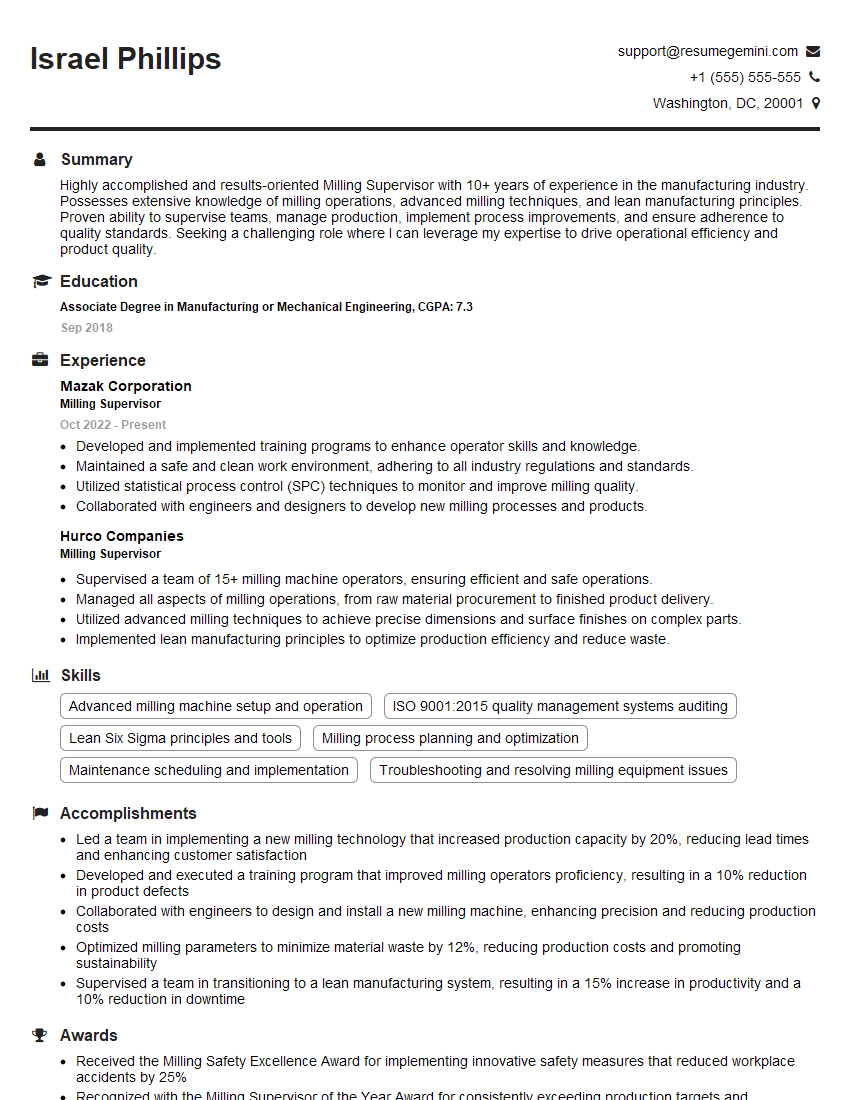
Mastering Milling Equipment Operation is crucial for advancing your career in manufacturing and related fields. It opens doors to higher-paying roles with increased responsibility and opportunities for specialized training. To maximize your job prospects, create an ATS-friendly resume that highlights your skills and experience effectively. ResumeGemini is a trusted resource to help you build a professional resume that stands out. They provide examples of resumes tailored to Milling Equipment Operation to guide you through the process. Invest the time to craft a compelling resume – it’s your first impression with potential employers.

Explore more articles
Users Rating of Our Blogs
Share Your Experience
We value your feedback! Please rate our content and share your thoughts (optional).
What Readers Say About Our Blog
To the interviewgemini.com Webmaster.
Very helpful and content specific questions to help prepare me for my interview!
Thank you
To the interviewgemini.com Webmaster.
This was kind of a unique content I found around the specialized skills. Very helpful questions and good detailed answers.
Very Helpful blog, thank you Interviewgemini team.