Are you ready to stand out in your next interview? Understanding and preparing for Motors and Controls interview questions is a game-changer. In this blog, we’ve compiled key questions and expert advice to help you showcase your skills with confidence and precision. Let’s get started on your journey to acing the interview.
Questions Asked in Motors and Controls Interview
Q 1. Explain the difference between AC and DC motors.
The primary difference between AC and DC motors lies in the type of current they use: alternating current (AC) or direct current (DC). This fundamental difference leads to variations in their construction, operation, and applications.
AC Motors: These motors operate on alternating current, where the direction and magnitude of the current periodically reverse. They are generally more robust, require less maintenance, and are often preferred in industrial applications due to the ease of power transmission via transformers. Common types include induction motors (most prevalent) and synchronous motors.
DC Motors: These motors operate on direct current, where the current flows in one direction. They offer precise speed control and high starting torque, making them suitable for applications requiring accurate speed regulation, like robotics or electric vehicles. However, they are often more complex and expensive than AC motors and require more maintenance.
Analogy: Think of a water pump. An AC motor is like a pump constantly reversing its direction slightly, but still moving water consistently. A DC motor is like a pump with a constant and easily controlled flow.
Q 2. Describe the working principle of a three-phase induction motor.
A three-phase induction motor operates on the principle of electromagnetic induction. It doesn’t require any external electrical connections to the rotor (the rotating part), unlike DC motors which need brushes and commutators.
The stator (stationary part) houses three windings, each displaced by 120 electrical degrees. When a three-phase AC power supply is fed to these windings, a rotating magnetic field is created. This rotating field interacts with the rotor’s conductors (typically squirrel-cage bars), inducing currents within them. The interaction between the rotating magnetic field and the induced currents in the rotor produces a torque, causing the rotor to rotate.
Simplified Explanation: Imagine three magnets spinning around a central point. This spinning magnetic field pulls the rotor along with it. The faster the magnetic field spins, the faster the motor rotates.
Slip: The rotor never quite catches up to the speed of the rotating magnetic field; there’s always a small difference called ‘slip’. This slip is necessary for the induction of currents in the rotor.
Q 3. What are the different types of motor starters?
Motor starters are essential for controlling the starting current and protecting the motor from damage. Several types exist, each suited to specific motor sizes and applications:
- Across-the-line starters: These are simple, inexpensive starters that directly connect the motor to the power supply. Suitable for smaller motors where high inrush current is manageable.
- Reduced-voltage starters: These limit the starting current by reducing the voltage applied to the motor. Types include autotransformer starters and wye-delta starters.
- Star-delta starters: A type of reduced-voltage starter that changes the winding connections during the starting sequence to reduce the voltage applied.
- Solid-state starters: These use power electronic devices (like thyristors or transistors) to control the motor voltage and current smoothly. They offer precise control and protection features.
- Variable Frequency Drives (VFDs): These are more advanced starters offering the most precise speed control and protection. (Detailed in the next answer).
Q 4. Explain the function of a Variable Frequency Drive (VFD).
A Variable Frequency Drive (VFD) is an electronic device that controls the speed of an AC motor by adjusting the frequency and voltage of the power supplied to it. This offers precise speed control and several advantages over other methods.
Function: A VFD rectifies the incoming AC power to DC, then inverts it back into AC, but at a variable frequency. By changing the frequency, the speed of the rotating magnetic field in the motor changes, thus controlling the motor’s speed. The voltage is also adjusted to maintain the motor’s torque capability at different speeds.
Benefits: VFDs offer smooth acceleration and deceleration, energy savings (by reducing energy consumption at lower speeds), precise speed control, and enhanced motor protection.
Example: In a conveyor belt system, a VFD allows the belt speed to be adjusted precisely based on the production demand, optimizing efficiency and reducing energy waste. A fixed-speed motor would require mechanical methods to change the speed, which are less efficient and precise.
Q 5. How do you select the appropriate motor for a specific application?
Selecting the right motor involves careful consideration of several factors:
- Load requirements: Determine the torque and horsepower needed to drive the load. This includes starting torque, running torque, and any peak loads.
- Speed requirements: Specify the desired operating speed and whether constant or variable speed is needed.
- Operating environment: Consider factors like temperature, humidity, and the presence of corrosive substances.
- Power supply: Determine the available voltage and phase (single-phase or three-phase).
- Duty cycle: The percentage of time the motor operates at full load. This impacts the motor’s thermal capacity.
- Budget and maintenance considerations: Evaluate the initial cost, operating cost, and anticipated maintenance needs.
Example: For a small fan, a single-phase AC induction motor might suffice. For a large industrial pump, a three-phase induction motor with a VFD for variable speed control might be more suitable. A robot arm would likely use a DC motor for precise control.
Q 6. What are the common methods for motor speed control?
Several methods exist for controlling the speed of motors. The best choice depends on the motor type and application:
- Variable Frequency Drives (VFDs): The most common and versatile method for controlling AC motor speeds. Provides smooth, precise control.
- Pole changing: This method changes the number of poles in the motor, resulting in different speeds. It’s only applicable to certain types of AC motors and offers a limited number of speed settings.
- Field weakening (DC motors): Reduces the magnetic field strength in DC motors, allowing higher speeds but at the expense of torque.
- Mechanical methods: Gears, pulleys, and belts can be used to change the speed, but this is often less efficient and less precise than electronic methods.
Q 7. Describe different types of motor protection devices.
Motor protection devices prevent damage to the motor due to overload, overheating, or other faults. Common devices include:
- Overload relays: These protect against excessive current draw, typically caused by overloading or mechanical jams.
- Thermal overload protectors: These are built into some motors and shut them down if they overheat.
- Circuit breakers: These provide overcurrent protection, shutting down the power in case of short circuits or faults.
- Fuses: Similar to circuit breakers, but are one-time use devices that need replacing after they blow.
- Motor protection relays: Sophisticated devices that monitor various motor parameters (current, voltage, temperature, speed) and provide comprehensive protection.
Example: A motor driving a pump might have an overload relay to prevent damage if the pump becomes blocked. A large industrial motor might use a motor protection relay which monitors numerous parameters and initiates a shutdown if any unsafe condition occurs.
Q 8. Explain the concept of motor torque and its significance.
Motor torque is the rotational force a motor produces. Imagine trying to open a tight jar – the force you apply to twist the lid is analogous to torque. In motors, it’s measured in Newton-meters (Nm) or pound-feet (lb-ft). Torque is crucial because it determines a motor’s ability to accelerate a load, overcome resistance, and maintain speed under varying conditions. A higher torque rating means the motor can handle heavier loads or faster acceleration.
For example, a small motor might have enough torque to turn a small fan, but it wouldn’t be sufficient to power a conveyor belt carrying heavy boxes. The selection of a motor for a specific application is heavily dependent on the required torque at various speeds – a critical consideration in motor design and application engineering.
Q 9. What are the advantages and disadvantages of using servo motors?
Servo motors offer precise control and positioning, making them ideal for applications requiring accurate movement.
- Advantages: High accuracy, excellent responsiveness, precise positioning, good speed control, relatively compact size for their power output.
- Disadvantages: Higher cost than standard motors, more complex control systems are often needed (requiring more expertise in setup and maintenance), can be susceptible to noise and vibration if not properly implemented, and require careful tuning of the control loop for optimal performance.
Think of a robotic arm assembling a car – the smooth, precise movements are often achieved using servo motors. Conversely, a standard fan motor doesn’t need precise positioning and will operate satisfactorily without complex controls.
Q 10. What are the different types of encoders used in motor control systems?
Encoders provide feedback on the motor’s position and speed, essential for closed-loop control. There are several types:
- Incremental Encoders: Produce pulses for each increment of movement, providing relative position information. They require a known starting point to determine absolute position.
- Absolute Encoders: Provide an absolute position reading regardless of the starting point. They use a unique code for each position.
- Optical Encoders: Use light sources and sensors to detect movement. They are common in many applications due to their precision and relatively low cost.
- Magnetic Encoders: Use magnetic fields and sensors to detect rotation. They are more robust to environmental factors like dirt and oil compared to optical encoders.
Choosing the right encoder depends on the application’s accuracy, resolution, and environmental considerations. For instance, a high-precision robotic arm might use an absolute optical encoder, while a simpler application like a conveyor belt might utilize an incremental magnetic encoder.
Q 11. Explain the role of a PLC in a motor control system.
A Programmable Logic Controller (PLC) is the brain of many motor control systems. It receives input signals from sensors (like limit switches, proximity sensors, and encoders), processes them according to a programmed logic, and sends output signals to control the motor’s speed, direction, and braking. It acts as a central processing unit, orchestrating the entire control process.
Imagine a manufacturing line – a PLC manages the timing and sequence of operations, coordinating multiple motors for tasks like conveying, positioning, and processing. It ensures safe and efficient operation by monitoring various parameters and taking corrective actions based on pre-defined logic.
Q 12. Describe the different programming languages used for PLCs.
PLCs use various programming languages, each with its strengths and weaknesses:
- Ladder Logic (LD): Uses a graphical representation of relay logic, easily understood by electricians and technicians familiar with electrical schematics.
- Structured Text (ST): A high-level text-based language similar to Pascal or C, offering more complex programming capabilities.
- Function Block Diagram (FBD): Uses graphical blocks representing functions, suitable for complex systems.
- Sequential Function Chart (SFC): Represents the control logic as a sequence of steps, ideal for processes with sequential operations.
- Instruction List (IL): A low-level mnemonic-based language, similar to assembly language, providing precise control but requiring more programming expertise.
The choice of language often depends on the programmer’s experience and the complexity of the control system. For simple systems, Ladder Logic is often preferred, while complex systems might benefit from Structured Text or Function Block Diagrams.
Q 13. What is a SCADA system and how does it interact with motor controls?
Supervisory Control and Data Acquisition (SCADA) systems provide a high-level view and control of industrial processes. They collect data from various sources, including PLCs controlling motor systems, and present it to operators through human-machine interfaces (HMIs). SCADA systems allow operators to monitor the entire system, making adjustments, and troubleshooting issues remotely.
Think of a large power plant or water treatment facility – SCADA systems provide a central control room where operators can oversee all aspects of the system, including the numerous motors involved in various processes. They can monitor motor performance, react to alarms, and make changes to setpoints, all from a centralized location.
Q 14. Explain the concept of PID control and its application in motor control.
Proportional-Integral-Derivative (PID) control is a widely used feedback control algorithm for regulating motor speed, position, or other variables. It uses three terms to adjust the control output:
- Proportional (P): Corrects the error proportionally to its magnitude. A larger error leads to a larger correction.
- Integral (I): Corrects the accumulated error over time, eliminating steady-state error.
- Derivative (D): Predicts the future error based on the rate of change of the error, reducing overshoot and oscillation.
The PID controller constantly compares the desired value (setpoint) with the actual value (feedback from the encoder), and adjusts the motor control signal (e.g., voltage or current) accordingly. Proper tuning of the P, I, and D gains is crucial to achieve optimal performance – avoiding overshoot, oscillations, and slow response times. PID control is ubiquitous in motor control applications, ranging from simple position control to advanced robotics.
Q 15. What are the different types of feedback mechanisms used in motor control?
Feedback mechanisms in motor control systems are crucial for precise speed, position, and torque regulation. They essentially allow the system to ‘sense’ the motor’s actual performance and compare it to the desired performance, enabling corrective actions. Common types include:
- Open-loop control: This simplest form relies on pre-programmed settings without real-time feedback. Think of a simple fan speed switch – you choose a speed, and the motor runs at that approximate speed without any continuous monitoring of its actual speed. It’s less accurate but simpler and cheaper.
- Closed-loop control (feedback control): This sophisticated approach utilizes sensors to measure the actual motor output (speed, position, or torque) and compares it to a setpoint (desired value). The difference (error) is then used to adjust the motor’s input signal, achieving precise control. This is akin to a cruise control system in a car, continuously adjusting the throttle to maintain a set speed.
- Position feedback: Sensors like encoders (optical or magnetic) or resolvers provide precise information about the motor’s angular position. This is essential for applications requiring precise positioning, like robotics or CNC machining.
- Speed feedback: Tachometers (analog or digital) measure the rotational speed of the motor shaft. This is crucial for speed control applications, such as conveyor belts or pumps, ensuring consistent output.
- Torque feedback: Strain gauges or torque sensors measure the torque produced by the motor. This is vital in applications needing precise torque control, like robotic arms or automated assembly lines.
The choice of feedback mechanism depends on the specific application’s requirements regarding accuracy, cost, and complexity.
Career Expert Tips:
- Ace those interviews! Prepare effectively by reviewing the Top 50 Most Common Interview Questions on ResumeGemini.
- Navigate your job search with confidence! Explore a wide range of Career Tips on ResumeGemini. Learn about common challenges and recommendations to overcome them.
- Craft the perfect resume! Master the Art of Resume Writing with ResumeGemini’s guide. Showcase your unique qualifications and achievements effectively.
- Don’t miss out on holiday savings! Build your dream resume with ResumeGemini’s ATS optimized templates.
Q 16. Describe your experience with troubleshooting motor control systems.
My experience in troubleshooting motor control systems spans various industrial settings, encompassing everything from simple single-phase motors to complex multi-axis servo systems. I approach troubleshooting systematically using a structured methodology:
- Gather information: Start by understanding the problem – what exactly is malfunctioning? When did it start? Are there any error messages? This often involves interviewing operators and reviewing operational logs.
- Visual inspection: Check for obvious issues like loose connections, damaged wiring, or physical obstructions. Overheating is often a visual clue that warrants further investigation.
- Systematic testing: I use multimeters, oscilloscopes, and other diagnostic tools to measure voltages, currents, and signals at various points in the system. This helps pinpoint the faulty component or the stage of the control circuit causing the issue. For example, I might check the input power, the motor’s winding resistance, the output of the driver circuit, and the feedback signal from the sensors.
- Software diagnostics: Many modern motor control systems have embedded diagnostics capabilities, allowing for identification of faults through software tools or displays. Accessing this data can be essential for resolving complex problems.
- Component replacement: Once the faulty component is identified, it needs to be carefully replaced, ensuring compatibility and correct installation. This might involve replacing a faulty motor, sensor, driver circuit, or even a PCB.
For example, I once resolved a production line slowdown caused by a faulty encoder on a servo motor. By systematically testing signals and comparing them to specifications, I pinpointed the failing encoder, leading to a quick resolution and minimal production downtime. Another time I debugged a system where intermittent motor stalls were attributed to a faulty power supply.
Q 17. How do you ensure the safety of personnel working with motor control systems?
Safety is paramount when working with motor control systems. My approach emphasizes a multi-layered strategy:
- Lockout/Tagout (LOTO) procedures: Before any maintenance or repair, strict LOTO procedures are followed to isolate power sources and prevent accidental energization. This is a fundamental safety practice that minimizes the risk of electrical shock.
- Proper grounding and earthing: Ensuring proper grounding prevents electrical hazards and reduces the risk of shock. All equipment and systems should be properly grounded according to safety standards.
- Safety interlocks and emergency stops: Implementing safety interlocks prevents operation under unsafe conditions, while emergency stops allow for immediate power disconnection in case of an emergency. Regular testing of these safety features is vital.
- Protective equipment: Workers should always use appropriate Personal Protective Equipment (PPE), such as insulated gloves, safety glasses, and hearing protection, depending on the specific task. This reduces the risk of electrical shock, eye injury, or hearing damage.
- Training and competency: All personnel working with motor control systems should receive adequate training on safe working procedures, hazard awareness, and emergency response. This includes knowledge of LOTO procedures, electrical safety, and the specific hazards associated with the equipment they operate.
- Regular inspections and maintenance: Routine inspections and preventative maintenance can help identify potential hazards before they cause accidents. This includes checking wiring, connections, and safety devices regularly.
Safety is not just a checklist; it’s a mindset and a culture that must be ingrained in every aspect of the operation.
Q 18. Explain your understanding of motor efficiency and power factor.
Motor efficiency refers to how effectively a motor converts electrical energy into mechanical work. A higher efficiency means less energy is wasted as heat, resulting in energy savings and reduced operating costs. It’s typically expressed as a percentage.
Power factor, on the other hand, represents the ratio of real power (used for actual work) to apparent power (total power drawn from the supply). A low power factor indicates a significant portion of the apparent power is reactive power, which does not contribute to the actual work but still stresses the electrical system, leading to higher energy bills and potential equipment damage. It’s also expressed as a percentage or a decimal between 0 and 1.
Relationship: While not directly related, both efficiency and power factor are important considerations for optimizing motor operation and reducing energy consumption. Improved motor design and power factor correction techniques can improve both parameters significantly. For instance, a high-efficiency motor with a high power factor (close to 1) will have the lowest energy losses.
Example: A motor with 90% efficiency and a 0.9 power factor will be more energy-efficient than a motor with 80% efficiency and 0.8 power factor, even if the latter draws less apparent power.
Q 19. What are the common causes of motor overheating?
Motor overheating is a common problem with potentially severe consequences, including motor failure and safety hazards. Common causes include:
- Overload: The motor is subjected to a load exceeding its rated capacity. This might be due to mechanical problems, process changes or incorrect sizing of the motor for the application.
- Blocked ventilation: Restricted airflow prevents heat dissipation, causing the motor to overheat. This can happen due to dust accumulation, improper installation, or obstructions in the cooling system.
- Winding faults: Internal shorts or open circuits in the motor windings generate excess heat and can lead to rapid overheating.
- Bearing failure: Worn or damaged bearings increase friction, leading to increased heat generation. This is often accompanied by unusual noises from the motor.
- Incorrect voltage supply: Applying an incorrect voltage to the motor can cause overheating, as the motor might draw excessive current or operate outside its designed parameters.
- High ambient temperature: Operating the motor in an excessively hot environment can exacerbate heat build-up and lead to overheating.
Regular motor inspections and proper maintenance, including cleaning and lubrication, can significantly reduce the risk of overheating.
Q 20. How do you diagnose and resolve motor control system malfunctions?
Diagnosing and resolving motor control system malfunctions requires a systematic and logical approach. My approach often follows these steps:
- Identify the symptom: Clearly define the problem. Is the motor not starting? Running too slowly? Overheating? Accurate observation is vital.
- Check the obvious: Look for loose connections, tripped breakers, blown fuses, or any signs of physical damage.
- Use diagnostic tools: Employ multimeters, oscilloscopes, and other relevant tools to measure voltages, currents, and signals at different points in the system. Compare measured values to specifications.
- Examine the control logic: If using a Programmable Logic Controller (PLC) or other programmable device, review the control program for errors or unexpected behavior. Simulation or offline debugging can help.
- Inspect sensors and feedback devices: Check sensors for proper operation and ensure feedback signals are within acceptable ranges. Faulty sensors can lead to incorrect control actions.
- Check the motor itself: Measure the motor’s winding resistance and insulation resistance to identify potential internal faults.
- Isolate the problem: By systematically checking each component and circuit, pinpoint the source of the malfunction.
- Repair or replace: Once the fault is identified, repair or replace the faulty component. Ensure correct installation and secure connections.
- Test and verify: After repair, thoroughly test the system to ensure it is operating correctly and safely.
Thorough documentation at each step is crucial, aiding both the current troubleshooting process and future maintenance.
Q 21. Describe your experience with different motor communication protocols (e.g., Modbus, Profibus).
My experience with motor communication protocols includes Modbus, Profibus, and others like Ethernet/IP, CANopen, and Profinet. Each protocol has its strengths and weaknesses, making them suitable for different applications:
- Modbus: A widely used, simple, and robust serial communication protocol. It’s relatively easy to implement and offers good interoperability between different vendor’s equipment. I’ve used it extensively in various industrial automation projects, including controlling multiple motors in a conveyor system.
- Profibus: A fieldbus system offering high speed and deterministic communication, suitable for applications requiring precise synchronization and real-time control. I’ve used Profibus in applications requiring precise motor control in high-speed automated systems.
- Ethernet/IP: An industrial Ethernet protocol offering high bandwidth and flexibility. It’s well-suited for complex systems with many devices and requires robust network infrastructure.
- CANopen: A protocol often used in robotics and motion control, providing real-time communication capabilities and offering a standardized approach for sensor and actuator integration.
- Profinet: Another industrial Ethernet protocol offering high speed, deterministic communication, and advanced features like integrated safety functions. I’ve utilized Profinet in applications where high data throughput and real-time precision are necessary.
My experience includes configuring these protocols, troubleshooting communication issues, and integrating them with various PLCs and HMIs. Understanding the specifics of each protocol is crucial for seamless integration and efficient operation of motor control systems.
Q 22. Explain the concept of regenerative braking in motor control.
Regenerative braking is a technique used in motor control systems to recover kinetic energy during deceleration and convert it back into electrical energy. Instead of dissipating the energy as heat (like in friction braking), regenerative braking essentially reverses the motor’s operation, turning it into a generator. This generated electricity can then be fed back into the power supply, reducing energy consumption and improving overall system efficiency.
Imagine a hybrid car slowing down. Instead of relying solely on friction brakes, the electric motor acts as a generator, slowing the car while simultaneously charging the battery. This is a perfect example of regenerative braking.
The process typically involves switching the motor’s power electronics to allow the motor to operate in the ‘generating’ mode. This requires careful control of the motor’s speed and current to ensure stability and prevent damage to the power electronics and the power supply.
- Advantages: Increased efficiency, reduced energy waste, extended lifespan of friction brakes.
- Disadvantages: More complex control system, may not be suitable for all motor types or applications.
Q 23. What is the importance of proper grounding in motor control systems?
Proper grounding in motor control systems is paramount for safety, performance, and reliability. It provides a low-impedance path for fault currents to flow to the earth, preventing dangerous voltage buildup on the equipment and protecting personnel. Without proper grounding, stray currents can lead to equipment malfunction, electrical shock, and even fire.
Imagine a scenario where a motor winding experiences insulation failure. If the system is not properly grounded, this fault current could find its way to other parts of the system, causing damage or posing a serious safety hazard. A proper ground provides a safe path for this fault current to flow to earth, tripping the protective devices and minimizing the risk of injury or equipment damage.
Grounding also improves the performance of the motor control system by minimizing noise and interference. Grounding reduces the impact of electromagnetic interference (EMI) and radio frequency interference (RFI), improving the accuracy of signal transmission and preventing false signals which could lead to malfunctions.
Q 24. Describe your experience with motor control system design and implementation.
Throughout my career, I’ve been extensively involved in the design and implementation of various motor control systems. One project involved designing a high-precision control system for a robotic arm in a manufacturing setting. This required careful selection of motor type (brushless DC motors for their high precision and efficiency), development of a custom control algorithm using PID (Proportional-Integral-Derivative) control to achieve precise positioning and speed control, and rigorous testing to ensure robustness and reliability. The system successfully improved production efficiency and accuracy.
Another significant experience involved implementing a variable frequency drive (VFD) system for a large industrial fan. This required careful consideration of power factor correction, harmonic filtering, and motor protection strategies to ensure efficient and reliable operation while minimizing electrical noise and environmental impact. Here, I focused on optimizing energy consumption by using advanced control strategies and energy-efficient motor designs.
I have also worked on projects involving stepper motors for precise positioning applications in medical devices and servo motors for high-speed applications in automation lines. My approach always emphasizes a structured design process, thorough testing and validation, and a focus on achieving optimal system performance and reliability.
Q 25. How do you handle motor vibration and noise issues?
Motor vibration and noise are common issues in motor control systems, often stemming from mechanical imbalances, bearing wear, resonance frequencies, or improper installation. Addressing these issues requires a systematic approach.
Firstly, I’d start with a thorough diagnostic process to identify the root cause. This may involve vibration analysis using sensors and spectrum analyzers to pinpoint the frequency and amplitude of vibrations and identify any problematic resonances.
Solutions can range from simple adjustments (like proper alignment and balancing of rotating components) to more complex interventions such as:
- Replacing worn bearings.
- Modifying the motor mounting system to dampen vibrations.
- Adding vibration isolators.
- Adjusting the motor control parameters to mitigate resonance frequencies.
- Implementing active noise cancellation techniques.
In many cases, addressing the mechanical aspects effectively solves the noise problem as well. Careful attention to detail during installation and maintenance is crucial in preventing these issues from arising in the first place.
Q 26. Explain your understanding of harmonic distortion in motor drive systems.
Harmonic distortion in motor drive systems refers to the presence of unwanted frequency components in the motor current and voltage waveforms. These harmonics are multiples of the fundamental frequency (typically 50 or 60 Hz) and are primarily generated by the non-linear switching behavior of power electronic converters used in motor drives. High levels of harmonic distortion can lead to increased losses, overheating, interference with other equipment, and reduced motor lifespan.
The consequences of harmonic distortion can be significant:
- Increased losses: Harmonics cause additional heating in the motor windings, leading to reduced efficiency and a shorter lifespan.
- Equipment malfunction: Harmonics can cause interference with other sensitive equipment connected to the same power system.
- Power quality issues: High harmonic distortion can affect the overall power quality, impacting other loads in the system.
Mitigation strategies involve using techniques such as harmonic filters, active power filters, and optimized pulse width modulation (PWM) strategies to reduce the generation and propagation of harmonics.
Q 27. What are the latest trends and technologies in motor control systems?
The field of motor control systems is constantly evolving. Some of the latest trends and technologies include:
- Increased use of power electronics: Advances in power semiconductor devices are enabling higher efficiency and more compact motor drives.
- Advanced control algorithms: Model predictive control (MPC) and artificial intelligence (AI) based control algorithms are improving motor performance, efficiency, and robustness.
- Sensorless control: Reducing reliance on sensors for motor control through the use of advanced estimation techniques is gaining popularity for cost reduction and improved reliability.
- Integration of renewable energy sources: Motor control systems are increasingly being integrated with renewable energy sources like solar and wind power.
- Digitalization and IoT: Motor control systems are becoming more connected and data-driven, enabling remote monitoring, predictive maintenance, and enhanced operational efficiency.
- Focus on energy efficiency: There’s a growing emphasis on designing motor control systems that minimize energy consumption and environmental impact.
Q 28. Describe your experience working with different types of industrial motors (e.g., stepper motors, brushless DC motors).
I have extensive experience working with a variety of industrial motors, including:
- Stepper Motors: I’ve used stepper motors in precision positioning applications, such as robotics and 3D printing. My experience includes designing control algorithms for precise step control and microstepping to minimize position errors and vibrations.
- Brushless DC (BLDC) Motors: These motors are highly efficient and are frequently used in applications requiring high speed and accuracy. I’ve worked with sensor-based and sensorless control techniques for BLDC motors in applications such as electric vehicles and industrial automation.
- Induction Motors: I’m proficient in designing and implementing control systems for induction motors using variable frequency drives (VFDs), focusing on energy efficiency, torque control and thermal management.
- Servo Motors: I’ve worked with servo motors in high-performance applications such as robotic manipulators and machine tools, implementing advanced control strategies for high-precision motion control.
My experience covers both design and implementation aspects, including motor selection, controller design, software development, and system integration. I’m adept at selecting the optimal motor type based on application-specific requirements and developing efficient control systems to meet performance specifications.
Key Topics to Learn for Motors and Controls Interview
- DC Motors: Understand the principles of operation, characteristics (torque-speed curves), and applications in various industries. Consider the differences between brushed and brushless DC motors.
- AC Motors (Induction & Synchronous): Learn the operating principles, including the role of stator and rotor, and the differences between various types (e.g., squirrel-cage vs. wound-rotor induction motors). Discuss speed control methods and applications.
- Motor Control Techniques: Explore various control strategies such as V/f control, vector control, and closed-loop control systems. Understand the role of sensors (e.g., encoders, resolvers) and their integration into control systems.
- Power Electronics: Familiarize yourself with power semiconductor devices (IGBTs, MOSFETs) and their use in motor drive circuits. Understand concepts like PWM (Pulse Width Modulation) and its importance in motor speed control.
- Control Systems Theory: Review fundamental concepts like feedback control, transfer functions, stability analysis, and PID control. Understand how these concepts apply to motor control systems.
- Troubleshooting and Diagnostics: Be prepared to discuss common motor and control system faults and troubleshooting techniques. This includes understanding diagnostic tools and methods.
- Safety and Standards: Demonstrate awareness of relevant safety regulations and standards related to motor control systems and electrical safety practices.
- Practical Applications: Prepare examples from your experience or studies showcasing how Motors and Controls are used in robotics, automation, automotive, or other relevant fields.
Next Steps
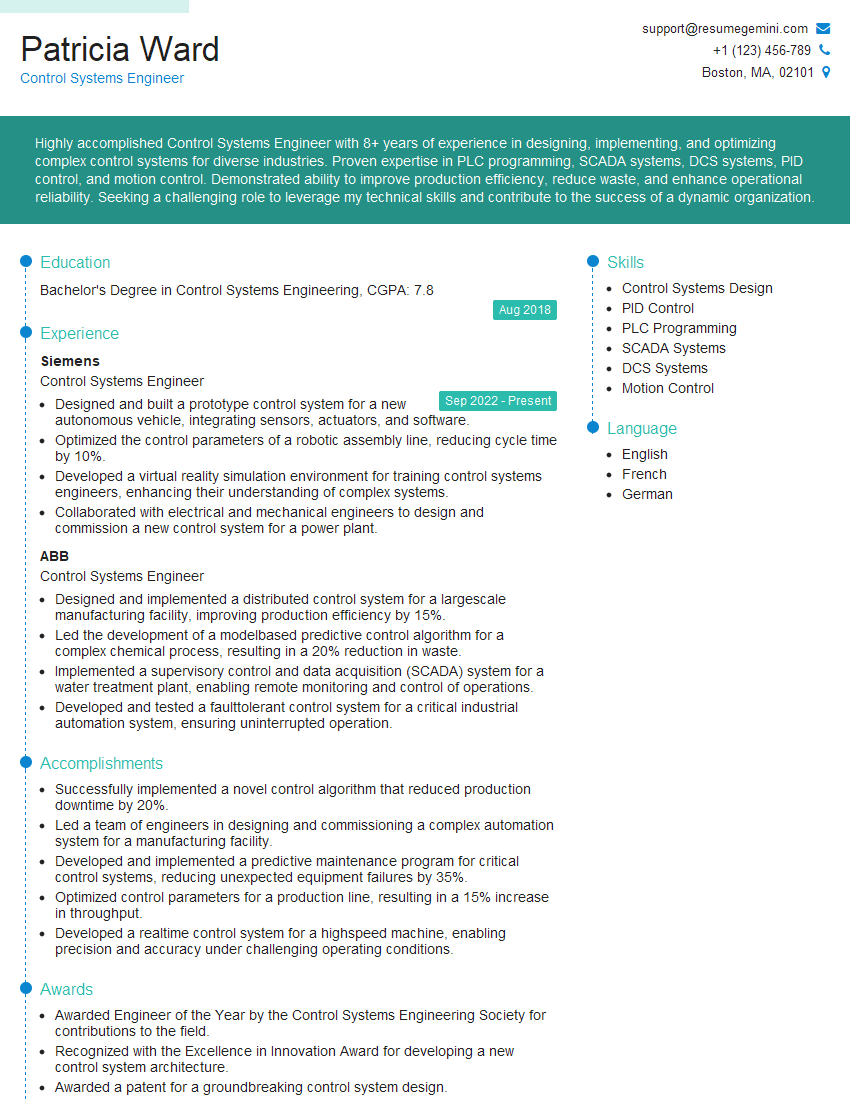
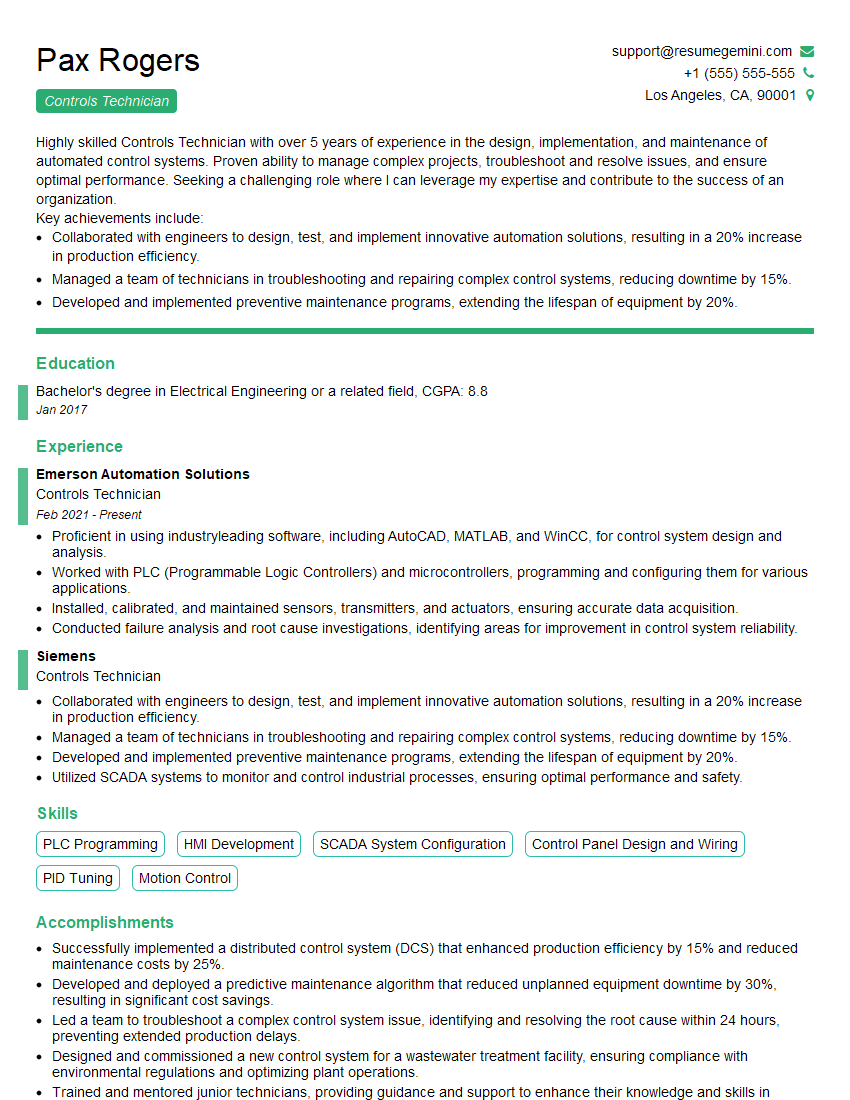
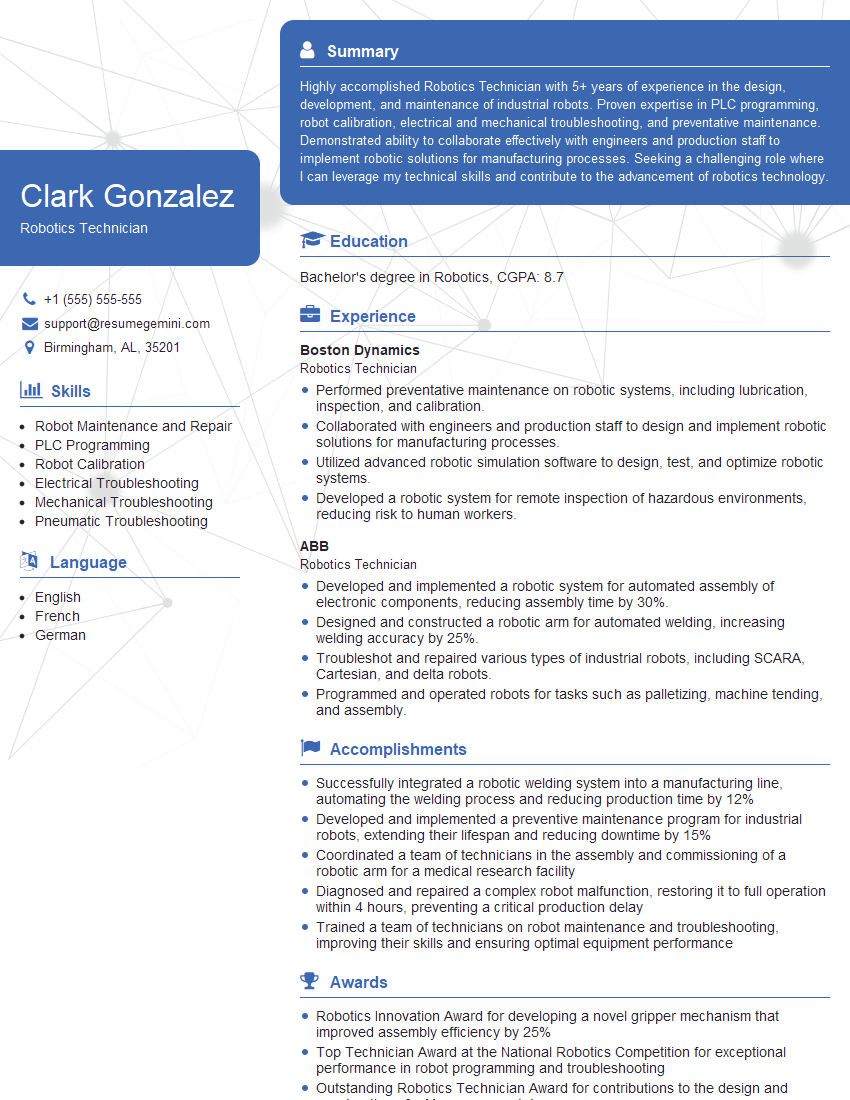
Mastering Motors and Controls opens doors to exciting and rewarding careers in diverse sectors. A strong understanding of these principles is highly sought after, significantly boosting your job prospects. To maximize your chances, creating an ATS-friendly resume is crucial. ResumeGemini is a trusted resource to help you build a professional and impactful resume that highlights your skills and experience effectively. Examples of resumes tailored to the Motors and Controls field are available to guide you, ensuring your application stands out.


Explore more articles
Users Rating of Our Blogs
Share Your Experience
We value your feedback! Please rate our content and share your thoughts (optional).
What Readers Say About Our Blog
To the interviewgemini.com Webmaster.
Very helpful and content specific questions to help prepare me for my interview!
Thank you
To the interviewgemini.com Webmaster.
This was kind of a unique content I found around the specialized skills. Very helpful questions and good detailed answers.
Very Helpful blog, thank you Interviewgemini team.