Unlock your full potential by mastering the most common Mounting and Positioning of PV Panels interview questions. This blog offers a deep dive into the critical topics, ensuring you’re not only prepared to answer but to excel. With these insights, you’ll approach your interview with clarity and confidence.
Questions Asked in Mounting and Positioning of PV Panels Interview
Q 1. Explain the different types of PV panel mounting systems.
Photovoltaic (PV) panel mounting systems are crucial for efficient energy generation. They come in various types, each suited for different applications. The primary categories include:
- Roof-mounted systems: These are the most common, attaching panels directly to a building’s roof. Sub-categories include tile-integrated, flush-mounted, and rack-mounted systems, each varying in complexity and aesthetic integration.
- Ground-mounted systems: These systems use structures like poles or frames to elevate panels above ground level. They’re ideal for large-scale solar farms or areas with limited rooftop space, offering flexibility in panel arrangement and optimal sun exposure.
- Carport-mounted systems: These systems combine shading structures with PV panel integration. They’re environmentally friendly and cost-effective, often used in residential settings or parking areas.
- Wall-mounted systems: These mount panels directly onto building walls, typically using brackets and rails. This option works best on south-facing walls with ample sunlight and structural support.
- Floating systems: Primarily used in large-scale installations over water bodies, these systems maximize land usage and minimize environmental impact.
The choice depends on factors like roof type, available space, budget, and aesthetic preferences. For example, a residential installation might choose a rack-mounted roof system for ease of installation and maintenance, while a large utility-scale project will typically use a ground-mounted system for maximum energy output.
Q 2. Describe the process of designing a PV mounting system for a sloped roof.
Designing a PV mounting system for a sloped roof requires careful consideration of several factors. Here’s a step-by-step process:
- Roof Assessment: Begin with a thorough inspection to determine the roof’s structure, material (e.g., asphalt shingles, metal, tile), and load-bearing capacity. Identify potential obstacles like chimneys, vents, or skylights.
- Panel Selection: Choose PV panels that are compatible with the roof’s dimensions and load capacity. Consider panel wattage, dimensions, and weight.
- Racking System Selection: Select a racking system designed for sloped roofs, considering the roof’s pitch angle. Ensure the system is compatible with the chosen panels and roof material. Many manufacturers offer pre-engineered systems, simplifying the process.
- System Design and Layout: Design the PV array’s layout, optimizing for maximum sunlight exposure. Consider shading from nearby structures or trees. Software tools can help visualize the system and calculate energy production.
- Structural Calculations: Perform detailed structural calculations to ensure the system can withstand wind, snow, and seismic loads. This is crucial for safety and compliance with building codes.
- Permitting: Obtain the necessary building permits and comply with all local codes and regulations.
- Installation: Install the racking system securely, following the manufacturer’s instructions. Pay close attention to details such as proper fastening and grounding.
For example, on a steep metal roof, a specialized rail-less system might be preferred for simplicity and efficient installation. On a low-slope asphalt shingle roof, a system with penetrations might be chosen, but with careful consideration given to water tightness.
Q 3. What are the key safety considerations when installing PV panels?
Safety is paramount during PV panel installation. Key considerations include:
- Fall Protection: Working at heights poses significant risks. Proper fall protection equipment, such as harnesses and lifelines, is mandatory. Scaffolding or other elevated work platforms should be used whenever possible.
- Electrical Safety: PV systems operate at high voltages, even when not directly connected to the grid. All work should be performed with the system properly de-energized and locked out/tagged out. Use appropriate personal protective equipment (PPE), including insulated gloves and eye protection.
- Fire Safety: PV modules themselves are relatively fire-resistant but overheating can cause issues. Installers must follow fire codes and ensure proper clearances around panels and other components.
- Handling and Lifting: PV panels are heavy. Use proper lifting techniques, equipment (such as panel lifting suction cups), and assistance to prevent injuries.
- Weather Conditions: Avoid working in inclement weather such as strong winds, rain, or snow. High winds can pose significant hazards during installation.
Failure to adhere to these safety measures can result in serious injury or death. Always prioritize safety and follow established safety protocols.
Q 4. How do you ensure proper grounding and bonding in a PV system?
Proper grounding and bonding are critical for safety and system performance. Grounding protects against electrical shocks and lightning strikes, while bonding ensures that all metal components are at the same electrical potential, minimizing the risk of voltage differences.
Grounding is achieved by connecting the PV system’s metal components (e.g., racking system, array ground wire) to a grounding electrode, typically a ground rod driven into the earth. This creates a low-resistance path for fault currents to flow to the earth, preventing dangerous voltage build-up.
Bonding connects all metal components within the system to ensure they are at the same electrical potential. This is typically achieved using bonding wires or straps. This prevents stray currents from flowing between components and reduces the risk of sparking or arcing.
The specific grounding and bonding methods depend on the system’s design and local codes. It’s crucial to use appropriately sized conductors and ensure all connections are clean and tight. Regular inspections can help identify and rectify any corrosion or loose connections that might compromise the system’s safety and effectiveness. For example, a improperly grounded system could lead to fatal shocks or system malfunction.
Q 5. Explain the importance of proper panel orientation and tilt angle.
Proper panel orientation and tilt angle are essential for maximizing energy production. The optimal orientation is generally south-facing (in the Northern Hemisphere; north-facing in the Southern Hemisphere) to receive the most direct sunlight throughout the day.
The tilt angle should ideally match the local latitude, maximizing the angle of incidence of sunlight on the panels throughout the year. However, adjustments can be made to optimize for specific seasons. A higher tilt angle will favor winter production, while a lower angle favors summer production. The best approach often balances the two.
Deviation from the optimal orientation and tilt angle can significantly reduce energy output. Even a small angle difference can have a noticeable impact over the system’s lifespan. Sophisticated solar modeling software is used by professionals to determine the best optimal angle, considering shading effects from surrounding objects, terrain, and the PV system’s overall design. For example, a 15-degree deviation from the optimal tilt angle might reduce yearly energy production by 5-10%.
Q 6. What are the different types of racking systems available?
Racking systems are the backbone of most PV mounting systems, providing the structure to support the panels. Different types cater to various needs:
- Fixed-tilt racking: The simplest type, where panels are fixed at a constant tilt angle. Suitable for applications where optimal annual performance is prioritized, but seasonal variations are acceptable.
- Adjustable-tilt racking: Allows for changing the tilt angle seasonally to optimize energy production throughout the year. More complex and more expensive but offers better seasonal performance.
- Single-axis tracking: These systems rotate the panels along a single axis (east-west) to follow the sun throughout the day. Increase energy yield significantly but are more expensive and complex.
- Dual-axis tracking: Even more sophisticated, these systems rotate the panels along two axes (both east-west and north-south) for optimal sun tracking. Result in the highest energy production but also most expensive and mechanically complex.
- Rail-less racking: Mounting systems that minimize or eliminate the need for rails, simplifying installation and reducing material usage. These are particularly useful for certain roof types and large-scale deployments.
The choice depends on factors such as budget, desired energy production, and complexity of installation. For instance, a residential installation might choose a fixed-tilt system for its simplicity, while a large commercial project might justify the expense of single or dual-axis trackers for the increased energy yield.
Q 7. How do you account for wind load and snow load in your designs?
Wind and snow loads are significant factors in PV system design, especially in areas prone to extreme weather. Ignoring these loads can lead to system failure, damage, and safety hazards.
Wind Load: The force exerted by wind on the PV array is calculated using engineering standards and local meteorological data. Factors influencing wind load include panel area, height above ground, wind speed, and system geometry. The racking system must be designed to withstand these forces without deformation or failure. This involves using appropriately sized components, ensuring secure fastening, and sometimes incorporating wind bracing.
Snow Load: The weight of accumulated snow on the PV array is another important consideration. Snow load calculations take into account the density of snow, roof pitch, and the projected area of the system. The racking system must be strong enough to support the weight of the snow without collapsing. Design considerations might include sloping the array to shed snow more easily or using reinforced support structures.
Engineers utilize specialized software and established codes (such as ASCE 7 and IBC) to perform these calculations. The results determine the required structural capacity of the racking system, ensuring its resilience to extreme weather events. For example, in high-wind areas, reinforcement may include additional bracing and stronger connections, while areas with heavy snowfall may necessitate a system designed to handle higher loads per square foot.
Q 8. What are the common challenges encountered during PV panel mounting?
Mounting PV panels presents several challenges, broadly categorized into structural, environmental, and logistical issues. Structurally, ensuring the system can withstand wind loads, snow loads (depending on location), and seismic activity is crucial. Improper mounting can lead to panel damage, system failure, or even roof damage. Environmentally, factors like extreme temperatures, UV radiation, and potential corrosion need to be accounted for by selecting appropriate materials and designs. Logistically, accessing the roof safely and efficiently, managing the weight of the panels and mounting hardware, and working within the constraints of the existing building structure can be complex.
- Wind Loads: High winds can exert immense force on panels, potentially dislodging them. Properly engineered mounting systems are critical to resist these forces.
- Snow Loads: In snowy climates, the weight of accumulated snow can be significant. The mounting system must be designed to support this added weight without structural compromise.
- Roof Compatibility: Different roof types (tile, metal, shingle) require specific mounting methods to prevent damage to the roof. Incorrect attachment can lead to leaks or structural weakness.
Q 9. How do you choose the appropriate mounting hardware for different roof types?
Selecting appropriate mounting hardware depends heavily on the roof type and material. The goal is to securely attach the racking system to the roof without causing damage. For example, a tile roof requires careful consideration to avoid puncturing tiles, while a metal roof might utilize clamps or screws that grip the metal sheeting effectively. Always consult manufacturers’ specifications and local building codes.
- Tile Roofs: Often utilize flashing and specialized hooks that sit between or on top of tiles, minimizing roof penetration.
- Metal Roofs: Can utilize clamps that secure directly to the metal panels. These require careful attention to avoid puncturing the panels or compromising the roof’s waterproofing.
- Shingle Roofs: Usually require penetration of the shingles, necessitating careful sealing around the fasteners to prevent leaks.
- Flat Roofs: Typically involve ballast systems (weighted blocks) or penetration mounting depending on the roof membrane.
In all cases, corrosion-resistant materials like stainless steel are preferred to ensure longevity and prevent degradation of the system.
Q 10. What are the building codes and regulations related to PV panel installations?
Building codes and regulations governing PV panel installations vary by location but generally cover structural integrity, safety, fire protection, and electrical requirements. These codes often specify minimum wind and snow load requirements, acceptable mounting methods for different roof types, and electrical connection standards. It’s crucial to obtain the necessary permits and inspections to ensure compliance. Consult your local authorities for specific regulations and any additional requirements related to grid-tie systems and electrical safety.
- National Electrical Code (NEC): Addresses electrical safety aspects of PV systems.
- International Building Code (IBC): Provides guidelines for structural requirements and load calculations.
- Local building codes: These can add stricter requirements based on specific local conditions (e.g., high wind zones, seismic activity).
Q 11. Explain the process of installing PV panels on a flat roof.
Installing PV panels on a flat roof typically involves one of two main methods: ballast mounting or penetration mounting. Ballast mounting uses weighted blocks to hold the racking system in place, avoiding roof penetration. This is preferred when roof penetration is undesirable or prohibited. Penetration mounting involves bolting the racking system directly to the roof structure, requiring careful consideration to ensure waterproofing and structural integrity.
- Assess the roof: Determine the roof’s structural capacity, materials, and any existing obstructions.
- Design the mounting system: Choose between ballast or penetration mounting based on the roof and local codes. Calculate the necessary ballast weight or penetration points.
- Install the racking system: Attach the racking system securely to the roof according to the manufacturer’s instructions. For ballast, evenly distribute the weights. For penetration, use appropriate fasteners and sealants.
- Mount the panels: Secure the PV panels to the racking system, ensuring proper spacing for ventilation and optimal sunlight exposure.
- Connect the wiring: Wire the panels to the inverter and main electrical system following NEC guidelines.
- Inspect the system: Thoroughly inspect the completed installation to ensure stability and safety.
Q 12. How do you ensure the structural integrity of the mounting system?
Ensuring structural integrity is paramount. This requires careful consideration of several factors throughout the installation process. The chosen mounting system must be capable of withstanding the anticipated loads (wind, snow, seismic). Proper anchoring and fastening are essential. Calculations based on local codes and manufacturer’s specifications are needed to determine the necessary strength and stability. Regular inspections can detect any potential issues early on.
- Load Calculations: Accurate calculations of wind and snow loads are critical for selecting the appropriate hardware and mounting system.
- Material Selection: Using high-quality, corrosion-resistant materials ensures longevity and structural integrity.
- Proper Fastening: Using the correct fasteners and ensuring they are installed securely prevents failure due to loosening or corrosion.
- Regular Inspections: Routine inspections can identify any potential issues like loose connections or signs of damage.
Q 13. Describe the procedure for connecting PV panels to inverters.
Connecting PV panels to inverters involves carefully following the manufacturer’s instructions and adhering to safety guidelines. This usually involves DC wiring from the panels to the inverter’s input terminals, and AC wiring from the inverter’s output terminals to the electrical panel. Safety measures such as disconnects, grounding, and overcurrent protection are vital.
- Disconnect switches: Install disconnect switches on both the DC and AC sides for safety during maintenance and emergencies.
- Grounding: Proper grounding of the system protects against electrical shocks and prevents damage from lightning strikes.
- Overcurrent protection: Use circuit breakers or fuses to protect the system from overcurrents that could cause damage or fire.
- Wiring methods: Use appropriate wiring methods and connectors designed for the voltage and current levels involved.
- Combiner boxes: Larger systems often use combiner boxes to consolidate DC wiring from multiple strings of panels.
Always use qualified electricians for wiring connections to ensure safety and code compliance.
Q 14. How do you handle different roof materials (e.g., tile, metal, shingle)?
Handling different roof materials requires adapting the mounting strategy to minimize damage and ensure a secure installation. Each material presents unique challenges and necessitates specific tools and techniques.
- Tile Roofs: Requires careful consideration to avoid puncturing tiles. Often utilizes specialized flashing and hooks that minimize penetration and ensure waterproofing.
- Metal Roofs: Typically utilizes clamps that grip the metal sheeting. Requires careful attention to avoid puncturing the metal or compromising the roof’s waterproofing.
- Shingle Roofs: Usually requires penetrating the shingles with careful sealing around the fasteners to prevent leaks. Using sealant that is compatible with the shingles is crucial.
- Flat Roofs: May involve ballast systems or penetration mounting depending on the roof membrane and building code. Requires careful consideration of the roof’s structural capacity.
Thorough planning and knowledge of different roof types are essential for successful and safe installation. Always follow manufacturers’ guidelines and best practices for specific roof materials.
Q 15. What are the best practices for cable management in PV installations?
Proper cable management in PV installations is crucial for safety, efficiency, and longevity. Think of it like organizing the wiring in your house – a mess can lead to problems, while a neat system ensures everything functions smoothly.
- Secure Routing: Cables should be neatly routed and secured using cable ties, clips, or conduits to prevent sagging, abrasion, and accidental damage. This is especially important in areas exposed to wind or harsh weather.
- Proper Labeling: Clear labeling of all cables is essential for easy identification during maintenance and troubleshooting. We use a color-coding system and labels that specify the circuit and panel they belong to.
- Sufficient Slack: Allowing sufficient slack in the cables is vital to accommodate thermal expansion and contraction. Imagine a tightly strung guitar string – too much tension can cause breakage.
- Grounding and Protection: All cables must be properly grounded to protect against electrical surges and shorts. We always use appropriate grounding conductors and connectors.
- Conduit Use: In high-traffic areas or harsh environments, using conduits to protect cables is highly recommended. This safeguards them from physical damage and environmental factors.
For example, in a recent installation, using properly sized conduits in a livestock area prevented cable damage from farm equipment and grazing animals.
Career Expert Tips:
- Ace those interviews! Prepare effectively by reviewing the Top 50 Most Common Interview Questions on ResumeGemini.
- Navigate your job search with confidence! Explore a wide range of Career Tips on ResumeGemini. Learn about common challenges and recommendations to overcome them.
- Craft the perfect resume! Master the Art of Resume Writing with ResumeGemini’s guide. Showcase your unique qualifications and achievements effectively.
- Don’t miss out on holiday savings! Build your dream resume with ResumeGemini’s ATS optimized templates.
Q 16. How do you prevent corrosion in PV mounting hardware?
Preventing corrosion in PV mounting hardware is paramount for system longevity and performance. Corrosion can lead to structural weakening and electrical failures, essentially crippling your solar array.
- Material Selection: Using corrosion-resistant materials like hot-dipped galvanized steel, stainless steel (316 grade is often preferred), or aluminum alloys is crucial. These materials naturally resist rust and degradation.
- Surface Treatments: Powder coating or other protective coatings provide an additional layer of defense against environmental elements. Think of it as sunscreen for your hardware.
- Proper Installation: Ensure all hardware is properly installed to prevent water ingress. A loose bolt or improperly sealed connection can allow moisture to penetrate, leading to corrosion.
- Regular Inspection: Regular visual inspections should be carried out to identify and address any signs of corrosion early on. Early detection is key!
- Grounding: Effective grounding is important to minimize galvanic corrosion, a type of corrosion that occurs when two dissimilar metals are in contact in the presence of an electrolyte (like moisture).
In one project, we used stainless steel fasteners and a specialized corrosion-inhibiting grease, which completely prevented corrosion even after five years of exposure to harsh coastal conditions.
Q 17. Explain the role of ballast in ground-mounted PV systems.
In ground-mounted PV systems, ballast is used to provide stability and prevent the system from being upturned by strong winds or other external forces. Think of it as an anchor for your solar array.
Ballast can take various forms, including:
- Concrete Blocks: Commonly used, readily available, and relatively inexpensive.
- Steel Weights: More expensive but offer higher weight density, requiring fewer units.
- Specialized Ballast Systems: These systems utilize advanced designs to optimize weight and stability, often incorporating earth anchors.
The amount of ballast required depends on factors like wind load, soil conditions, and the system’s overall weight and design. Accurate calculations and engineering assessments are crucial to determine the right amount to prevent system failure.
For instance, in a recent ground mount installation on a windy hillside, we used a combination of concrete blocks and a specialized ground-screw system for superior stability, easily withstanding hurricane-force winds.
Q 18. What are the common causes of PV panel failures related to mounting?
Common causes of PV panel failures related to mounting are often associated with improper installation, material degradation, or environmental factors.
- Mounting Hardware Failure: Corrosion, improper tightening, or using unsuitable materials can lead to hardware failure, causing panels to loosen, crack, or even fall.
- Structural Instability: Inadequate support, incorrect calculations of wind and snow loads, or using improperly sized racking components can lead to structural instability.
- Shading and Hot Spots: Poorly positioned panels can lead to shading and hot spots, resulting in reduced efficiency and potential damage to the cells.
- Microbial Induced Corrosion (MIC): In humid climates, microbial activity can accelerate corrosion of the mounting hardware, which undermines the structural integrity of the array.
- Mechanical Stress: Impacts from hail, debris, or even expansion/contraction due to temperature changes can stress the mounts and damage the panels.
In a past project, we discovered that improper tightening of mounting bolts had caused micro-fractures in several panels, highlighting the importance of careful installation.
Q 19. How do you troubleshoot common issues related to PV panel mounting?
Troubleshooting PV panel mounting issues often involves a systematic approach combining visual inspection, testing, and potentially re-engineering parts of the system.
- Visual Inspection: Begin with a thorough visual inspection of the entire mounting system, looking for loose bolts, corrosion, cracks, or any signs of damage.
- Check for Structural Integrity: Assess the overall stability of the racking system. Does it feel secure? Are there any signs of bending or movement?
- Test for Electrical Continuity: Check for continuity in grounding wires and electrical connections to rule out electrical issues.
- Examine Panel Condition: Inspect individual panels for cracks, discoloration, or signs of overheating. Use a thermal imaging camera if necessary.
- Review Design Calculations: If significant issues are found, review the initial design calculations and site assessment to verify the appropriateness of the system for the location and environmental conditions.
- Consult Documentation: Refer to the manufacturer’s installation manual and drawings for guidance.
A systematic approach allows for the identification and resolution of problems in a structured way; a recent case involved a seemingly minor loose bolt that led to eventual cracking of the panel. A thorough initial check would have avoided the later, more expensive repair.
Q 20. What software or tools do you use for PV mounting system design?
For PV mounting system design, I utilize several software and tools to ensure accuracy and efficiency. This involves specialized software and also more generic CAD tools.
- PVsyst: A comprehensive software package for simulating and designing PV systems, including detailed mounting system calculations.
- Helioscope: Another powerful simulation tool for analyzing solar irradiance, shading, and overall system performance. This helps optimize panel placement.
- Autodesk AutoCAD: Used for creating detailed drawings and schematics of the mounting system, including structural components and cable routing.
- SketchUp: For visualizing the mounting system in 3D, aiding in design and communication with clients.
- Specialized Engineering Software: For advanced structural analysis and wind load calculations, depending on project complexity.
These tools allow us to accurately model the system’s behavior and ensure its structural integrity and optimal energy production.
Q 21. Describe your experience with different types of PV modules.
My experience encompasses a wide range of PV modules, each with its own characteristics and mounting requirements. Understanding these differences is crucial for safe and effective installation.
- Monocrystalline Silicon Modules: Known for their high efficiency and black appearance; they typically have a more robust construction and are usually easily mounted using standard racking systems.
- Polycrystalline Silicon Modules: Slightly less efficient than monocrystalline but generally more affordable; mounting is similar to monocrystalline.
- Thin-Film Modules: Typically lighter and more flexible than crystalline silicon modules; require specialized mounting systems to ensure proper support and prevent damage.
- Bifacial Modules: These modules collect light from both sides, requiring careful consideration of mounting and placement to maximize light capture. This often involves higher clearance from the ground.
For example, in a recent project using thin-film modules on a curved roof, we designed a custom racking system to accommodate their flexibility and ensure optimal performance and safety.
Q 22. What are the advantages and disadvantages of different mounting systems?
Choosing the right mounting system is crucial for PV panel efficiency and longevity. Several systems exist, each with its own set of pros and cons.
- Roof-mounted systems: These are popular for residential and some commercial applications. Advantages include ease of installation (depending on roof type) and relatively low ground space requirements. Disadvantages can be roof damage potential, higher installation costs for complex roof designs, and potential shading issues. For example, a tile roof requires careful consideration to avoid damaging the tiles during installation.
- Ground-mounted systems: Ideal for large-scale projects or when roof space is limited. Advantages include maximizing sunlight exposure and easier maintenance. Disadvantages involve higher initial costs, significant land requirements, and potential for ground instability or erosion. I’ve worked on a large-scale ground mount system where we used a ballast system to ensure stability in high-wind areas.
- Pole-mounted systems: Used for smaller installations, often in remote locations. These combine aspects of ground and roof mounting. Advantages are their versatility and ability to reach optimal sun angles. Disadvantages include higher material costs compared to some ground mounts and potential for increased shadowing depending on their placement.
- Integrated PV systems (building integrated photovoltaics): These involve integrating the PV panels directly into the building’s structure. Advantages include aesthetic integration, longer life, and potential reduced heating/cooling costs. Disadvantages involve higher upfront costs and often specialized design requirements. I’ve worked on a project where we integrated panels into a building facade, resulting in a cleaner, more modern aesthetic.
The best system depends heavily on site-specific factors such as roof type, land availability, budget, and local regulations.
Q 23. How do you ensure the watertightness of the mounting system?
Watertightness is paramount to prevent system failure and ensure electrical safety. This involves careful attention to detail during every stage of the installation.
- Appropriate Sealants and Gaskets: We use high-quality, UV-resistant sealants and gaskets on all connections, especially around penetrations in roofs and enclosures. Regular inspection for any signs of cracks or deterioration is crucial.
- Proper Cable Management: Cables should be routed carefully to prevent water ingress. We use cable glands and waterproof connectors to maintain the integrity of the electrical connections. Any conduit should also be sealed effectively.
- Grounding and Bonding: This is essential for safety and to reduce the risk of damage from electrical surges. We always comply with relevant codes for proper grounding and bonding. A ground fault circuit interrupter (GFCI) is essential in wet locations.
- Regular Inspection and Maintenance: Post-installation, a thorough inspection is conducted to ensure there’s no visible water leakage. We schedule regular maintenance checks to address potential issues early on.
Imagine a leaky roof—the same principle applies to the PV mounting system. Any compromise in watertightness can lead to damage and downtime.
Q 24. Explain your experience with ground-mounted PV systems.
My experience with ground-mounted PV systems spans numerous large-scale projects. I’ve been involved in every aspect, from initial site assessment and design to installation, commissioning, and ongoing maintenance.
- Site preparation: This involves land clearing, grading, and foundation work. We carefully assess soil conditions to ensure proper anchoring of the mounting structures. In one case, we had to reinforce the foundations with additional concrete due to unexpected soil instability.
- Mounting structure selection: The choice of structure depends on factors like soil conditions, wind loads, and snow loads. We often use galvanized steel structures for their durability and resistance to corrosion. In areas prone to high winds, we’ve employed reinforced structures with additional bracing.
- Panel installation and wiring: We follow precise procedures for panel mounting, ensuring proper spacing for ventilation and optimal sunlight exposure. Careful wiring is vital to prevent short circuits and ensure optimal energy production.
- Grounding and safety: Grounding the entire system is crucial for safety, and this is a key aspect I oversee throughout the process. We use bonding straps and grounding rods to comply with all safety codes.
Ground-mounted systems require meticulous planning and execution to ensure stability and long-term performance.
Q 25. Describe your experience with different types of mounting hardware.
I have extensive experience with various mounting hardware, including:
- Aluminum and Steel Components: Aluminum is lightweight but can be susceptible to corrosion; steel offers superior strength but is heavier. The choice depends on the site conditions and project requirements. I’ve utilized both in various projects, selecting the most appropriate material based on factors like cost, durability, and local conditions.
- Ground Mounts: This includes ground screws, driven piles, and concrete foundations. Each has its own advantages and disadvantages based on soil type and load requirements. For example, in rocky terrain, ground screws can be more challenging to install compared to concrete foundations.
- Roof Mounts: These include rail systems, flashing kits, and clamps specifically designed for different roof types (e.g., tile, shingle, metal). Proper selection is critical to ensure structural integrity and prevent roof damage.
- Fasteners and Bolts: We always use high-quality, corrosion-resistant fasteners to guarantee a secure and durable installation. Careful selection of fasteners is crucial to withstand wind and snow loads.
Choosing the right hardware is as important as the system design itself, as it directly affects the safety and longevity of the PV installation.
Q 26. How do you comply with NEC standards for PV installations?
Compliance with the National Electrical Code (NEC) is non-negotiable for all PV installations. We meticulously follow all relevant articles and guidelines.
- Grounding and Bonding: We ensure the system is properly grounded to prevent electrical shocks and protect against lightning strikes. This includes grounding the array, the racking system, and all associated equipment.
- Overcurrent Protection: Appropriate circuit breakers and fuses are installed to protect the system from overcurrent events. We carefully calculate the size and type of protection devices based on the system’s specifications.
- Wiring Methods: We use appropriate wiring methods, ensuring the cabling is properly secured, protected from damage, and routed to avoid hazards. This often includes conduit protection for exposed cabling.
- Disconnects: Properly sized and easily accessible disconnects are installed to allow safe isolation of the PV array from the grid during maintenance or emergencies. These disconnects need to be clearly marked and easily accessible.
- Rapid Shutdown: For larger systems, we incorporate rapid shutdown systems to meet NEC requirements for firefighter safety.
NEC compliance not only ensures safety but also helps prevent potential liability issues.
Q 27. How do you perform a site assessment before installing PV panels?
A comprehensive site assessment is the foundation for any successful PV installation. We carefully evaluate several factors:
- Shading Analysis: We use specialized software and on-site measurements to determine potential shading from trees, buildings, or other structures. Shading can significantly reduce energy production.
- Sunlight Exposure: The orientation and angle of the panels are crucial for optimal energy generation. We consider the azimuth (compass direction) and tilt angle to maximize sunlight exposure throughout the year.
- Roof Condition (for roof-mounted systems): We assess the structural integrity of the roof to ensure it can support the weight of the PV system. Any repairs or reinforcements might be required before installation.
- Ground Conditions (for ground-mounted systems): Soil analysis is essential to determine the bearing capacity and stability of the ground. We perform soil tests and may need to adjust the foundation design based on the results. This also helps assess any potential erosion risks.
- Electrical System Assessment: We evaluate the existing electrical infrastructure to ensure it can handle the additional load from the PV system. Upgrades might be necessary to accommodate the new system.
A thorough site assessment prevents costly mistakes and ensures the PV system performs optimally.
Q 28. What is your experience with permitting and inspections for PV installations?
Permitting and inspections are integral parts of any PV installation. My experience includes navigating various local and state regulations.
- Permit Application: We prepare and submit comprehensive permit applications including detailed drawings, specifications, and calculations. We work closely with building departments to ensure compliance with all regulations.
- Inspections: We schedule and coordinate all necessary inspections (electrical, structural, and potentially others depending on local requirements). We address any inspector comments promptly to ensure a smooth process.
- Code Compliance: We ensure the installation strictly adheres to all relevant building codes and electrical codes (NEC). This is crucial for obtaining final approval and ensuring safety.
- Documentation: We maintain detailed records of all aspects of the installation, including permits, inspections, and as-built drawings. Proper documentation is vital for future maintenance and troubleshooting.
Understanding and complying with permitting and inspection requirements is a crucial aspect of ensuring a successful and legally compliant PV installation.
Key Topics to Learn for Mounting and Positioning of PV Panels Interview
- PV Panel System Design: Understanding the various components of a PV system (panels, racking, inverters, wiring) and their interaction in relation to optimal mounting and positioning.
- Structural Calculations & Load Analysis: Applying engineering principles to determine appropriate mounting structures based on wind load, snow load, and panel weight. Practical application involves using relevant software or manual calculations.
- Mounting System Selection & Installation: Familiarizing yourself with different mounting systems (roof-mounted, ground-mounted, etc.) and their suitability for varying site conditions. Understanding proper installation procedures and safety protocols.
- Orientation and Azimuth Optimization: Mastering the concepts of optimal panel orientation (tilt and azimuth) to maximize energy production throughout the year. This includes understanding the impact of shading and geographical location.
- Grounding and Electrical Safety: Understanding the critical role of proper grounding and electrical safety measures in the installation of PV panel arrays, ensuring compliance with relevant codes and standards.
- Troubleshooting and Maintenance: Being able to identify and address common issues related to panel mounting and positioning, including loose connections, shading issues, and structural damage. Developing problem-solving skills for real-world scenarios.
- Building Codes and Regulations: Understanding relevant building codes, safety regulations, and permitting processes related to PV panel installations in your region.
- Solar Irradiance and Energy Yield Calculations: Understanding the impact of panel orientation and shading on energy production. Ability to estimate energy yield based on site-specific parameters.
Next Steps
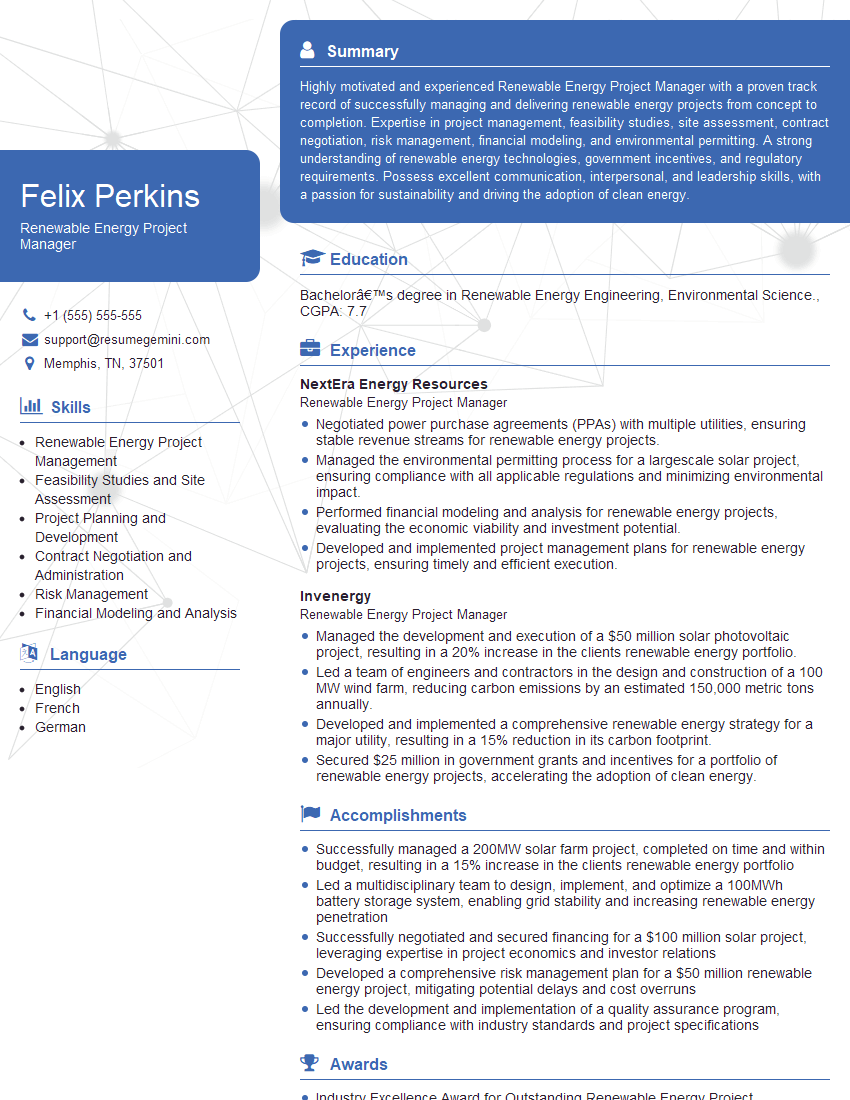
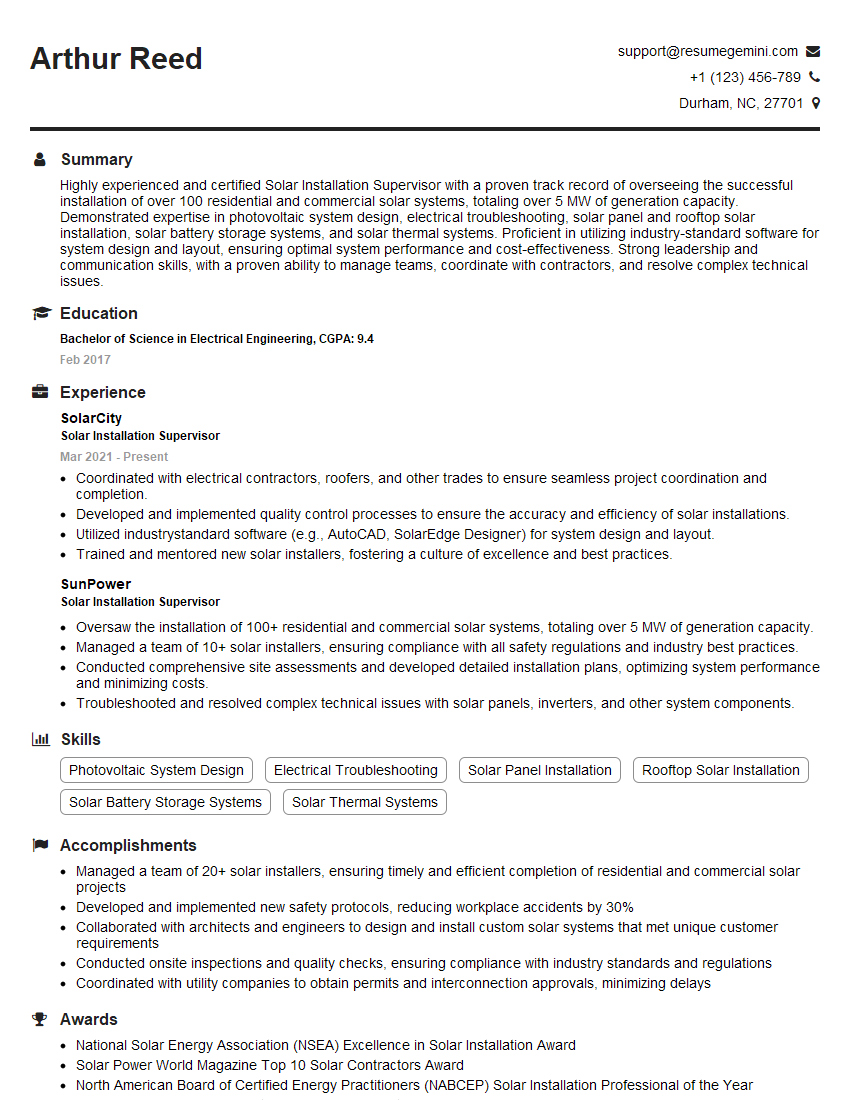
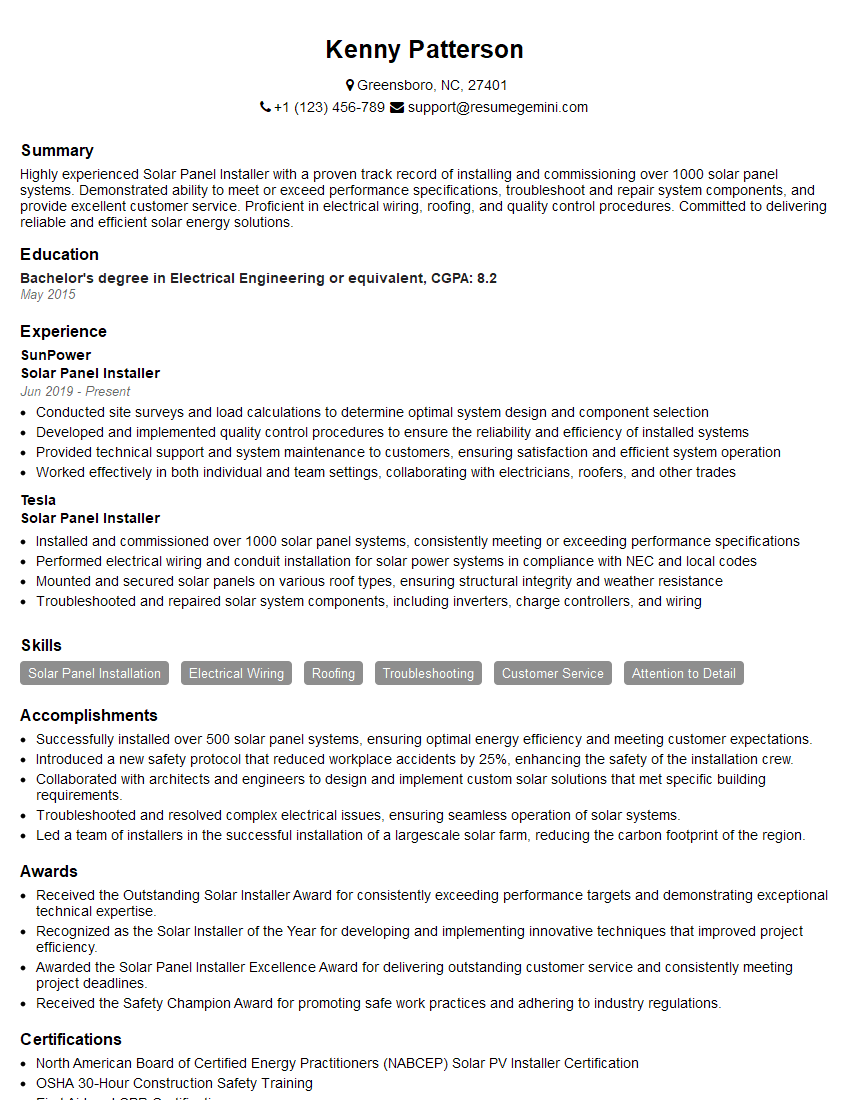
Mastering the mounting and positioning of PV panels is crucial for a successful career in the renewable energy sector. It demonstrates a strong understanding of both theory and practical application, making you a highly valuable asset to any solar installation team. To increase your job prospects, it’s vital to create an ATS-friendly resume that highlights your skills and experience effectively. ResumeGemini is a trusted resource to help you build a professional and compelling resume tailored to the solar industry. We provide examples of resumes specifically designed for candidates specializing in Mounting and Positioning of PV Panels, allowing you to showcase your qualifications in the best possible light. Take the next step towards your dream job today!

Explore more articles
Users Rating of Our Blogs
Share Your Experience
We value your feedback! Please rate our content and share your thoughts (optional).
What Readers Say About Our Blog
To the interviewgemini.com Webmaster.
Very helpful and content specific questions to help prepare me for my interview!
Thank you
To the interviewgemini.com Webmaster.
This was kind of a unique content I found around the specialized skills. Very helpful questions and good detailed answers.
Very Helpful blog, thank you Interviewgemini team.