Are you ready to stand out in your next interview? Understanding and preparing for National Intelligence Estimate (NIE) interview questions is a game-changer. In this blog, we’ve compiled key questions and expert advice to help you showcase your skills with confidence and precision. Let’s get started on your journey to acing the interview.
Questions Asked in National Intelligence Estimate (NIE) Interview
Q 1. Explain the process of developing a National Intelligence Estimate.
Developing a National Intelligence Estimate (NIE) is a rigorous, multi-stage process involving extensive collaboration across the Intelligence Community. Think of it as a massive, highly-vetted research paper, but with far-reaching consequences for national security.
- Topic Selection: The process begins with identifying critical intelligence questions relevant to national security. These are often driven by policy needs, emerging threats, or significant geopolitical shifts.
- Intelligence Collection and Analysis: Analysts from various intelligence agencies – CIA, NSA, DIA, etc. – contribute information. This involves analyzing raw data from human intelligence (HUMINT), signals intelligence (SIGINT), imagery intelligence (IMINT), open-source intelligence (OSINT), and measurement and signature intelligence (MASINT). Think of it like assembling a giant jigsaw puzzle, with each piece representing a different intelligence source.
- Drafting and Review: The National Intelligence Council (NIC) leads the process, coordinating the contributions from different agencies. Multiple drafts are created, each undergoing rigorous internal review and feedback. This ensures a consistent, cohesive product.
- Interagency Coordination and Sign-off: The draft NIE is circulated to relevant agencies and departments for review and comment, resolving disagreements and incorporating alternative perspectives. This step is crucial for achieving consensus and buy-in from stakeholders.
- Final Approval and Dissemination: Once all necessary approvals are obtained, the NIE is finalized and disseminated to senior policymakers. This document provides crucial intelligence that informs crucial decision-making at the highest levels of government.
Q 2. Describe the different types of intelligence used in NIE production.
NIEs leverage a wide array of intelligence disciplines. Imagine each type as a different tool in a detective’s kit, all contributing to the overall picture.
- Human Intelligence (HUMINT): Information gathered from human sources, often spies or informants, providing insights into intentions and capabilities. This could be information gathered from a defector about an enemy’s missile program.
- Signals Intelligence (SIGINT): Intercepted communications, such as phone calls, emails, and radio transmissions, providing insights into plans and activities. This might include intercepted communications revealing a terrorist group’s planned attack.
- Imagery Intelligence (IMINT): Satellite and aerial photographs, videos, and other imagery, providing visual evidence of activities and capabilities. This could be satellite photos revealing the construction of a new military base.
- Open-Source Intelligence (OSINT): Publicly available information from news reports, social media, and academic publications. Think of analyzing social media posts to understand public sentiment towards a particular government policy.
- Measurement and Signature Intelligence (MASINT): Information gathered from technical sensors, such as nuclear detonations or missile launches, providing insights into capabilities and technological advancements. This could include data from sensors detecting a country’s nuclear weapon tests.
Q 3. How does NIE address dissenting opinions and conflicting information?
NIEs explicitly address dissenting opinions and conflicting information through a process of rigorous debate and analysis. It’s not about finding a single ‘correct’ answer, but presenting a range of possibilities with associated levels of confidence.
The process involves:
- Clearly articulating different perspectives: The NIE will highlight different interpretations of the evidence and explicitly mention any disagreements among analysts.
- Providing supporting evidence for each viewpoint: The rationale behind each assessment is clearly explained, allowing readers to understand the basis for different conclusions.
- Assessing the confidence levels: The NIE assigns confidence levels to its judgments, reflecting the degree of certainty or uncertainty associated with each assessment.
- Presenting a central intelligence estimate, alongside alternative scenarios: While a single, most-likely scenario is often presented, the NIE will also explore alternative possibilities, allowing policymakers to consider a broader range of outcomes.
Think of it like a scientific report – showing all the data, even if it contradicts the main conclusion, helps to foster a more robust understanding.
Q 4. What are the key components of a well-written NIE?
A well-written NIE is characterized by:
- Clarity and Conciseness: The language should be clear and easily understandable, even for non-experts, avoiding jargon and overly technical language.
- Objectivity and Impartiality: The analysis should be based on evidence and avoid speculation or bias. Any assumptions made should be clearly stated.
- Comprehensive Analysis: The NIE should consider all relevant information, including dissenting viewpoints, and provide a balanced assessment.
- Logical Structure and Argumentation: The analysis should follow a logical structure, with clear connections between evidence and conclusions. The reasoning process should be transparent.
- Appropriate Caveats and Qualifications: The NIE should acknowledge any limitations of the analysis, such as incomplete data or uncertainties in the assessment.
- Clear Presentation of Confidence Levels: The degree of certainty associated with each judgment should be clearly indicated, helping policymakers to understand the level of risk associated with different options.
Imagine a well-written NIE as a well-structured legal brief – all evidence is presented, even conflicting evidence, with appropriate context and caveats.
Q 5. Discuss the role of the National Intelligence Council (NIC) in the NIE process.
The National Intelligence Council (NIC) plays a central role in the NIE process. They are the orchestrators of the whole process, ensuring a cohesive and high-quality product.
- Leads the NIE Production Process: The NIC manages the entire process, from topic selection to final approval and dissemination.
- Coordinates Interagency Efforts: The NIC coordinates the contributions of various intelligence agencies, ensuring consistency and coherence in the analysis.
- Ensures Objectivity and Impartiality: The NIC strives to ensure that the NIE is objective, impartial, and based on evidence, minimizing bias and ensuring the highest standards of analytic rigor.
- Provides Long-Term Strategic Analysis: The NIC is also responsible for providing long-term strategic assessments, which often inform the selection of topics for NIEs.
Think of the NIC as the conductor of an orchestra, bringing together various instruments (intelligence agencies) to create a harmonious and impactful NIE.
Q 6. How does NIE contribute to national security decision-making?
NIEs directly contribute to national security decision-making by providing policymakers with critical intelligence assessments. This is how they bridge the gap between intelligence analysis and national policy.
- Informs Policy Decisions: NIEs provide critical intelligence that informs national security policy decisions, helping leaders to anticipate threats, evaluate risks, and make informed choices.
- Supports Strategic Planning: They support long-term strategic planning, allowing policymakers to anticipate future trends and prepare for potential challenges.
- Facilitates Interagency Coordination: The NIE process fosters collaboration and coordination across different government agencies, ensuring a shared understanding of intelligence assessments.
- Enhances Situational Awareness: NIEs improve policymakers’ understanding of the global security landscape, enabling more effective and proactive decision-making.
In essence, NIEs serve as a key input into the national security decision-making process, providing the necessary intelligence foundation for sound judgments and effective actions.
Q 7. Explain the importance of rigorous source evaluation in NIE.
Rigorous source evaluation is paramount in NIE production; it’s the foundation upon which the entire analysis rests. It’s like building a house – using faulty materials will lead to a shaky foundation.
The process involves:
- Assessing Source Reliability: Analysts critically evaluate the reliability and credibility of each source, considering factors such as the source’s track record, motivation, and potential biases.
- Verifying Information: Analysts attempt to verify information from multiple independent sources, corroborating findings and reducing the risk of errors or misinformation.
- Assessing Completeness of Information: Analysts consider whether the available information is sufficient to support the conclusions reached, acknowledging any gaps or limitations in the data.
- Considering Potential Biases: Analysts evaluate the potential influence of biases, including cultural, ideological, or political factors, that might affect the reliability of information.
- Documenting Source Evaluation: The process of source evaluation is meticulously documented, providing transparency and accountability.
Without rigorous source evaluation, the NIE risks being based on unreliable or biased information, undermining its credibility and effectiveness.
Q 8. How does NIE incorporate uncertainty and caveats?
National Intelligence Estimates (NIEs) are designed to provide the most accurate assessments possible, but acknowledging uncertainty is crucial for credibility. They do this through several key mechanisms. First, they explicitly state the degree of confidence in their judgments, often using terms like “high confidence,” “moderate confidence,” or “low confidence.” This allows consumers of the intelligence to understand the limitations of the analysis.
Second, NIEs incorporate caveats—statements highlighting potential factors that could affect the assessment’s validity. These caveats could range from acknowledging a lack of sufficient data to highlighting differing expert opinions or potential unforeseen developments. For example, an NIE assessing a potential conflict might include a caveat acknowledging the unpredictable nature of a specific leader’s decision-making. This transparency helps mitigate the risk of overconfidence in the analysis.
Finally, NIEs often present alternative scenarios, outlining different potential outcomes and the likelihood of each. This helps to present a more nuanced picture, avoiding the trap of presenting a single, potentially inaccurate, prediction. By clearly outlining uncertainty and potential challenges, NIEs aim to provide a comprehensive and responsible assessment of the intelligence community’s understanding of a particular issue.
Q 9. Describe the challenges associated with producing timely and accurate NIEs.
Producing timely and accurate NIEs presents significant challenges. The sheer volume and complexity of information that needs to be processed is enormous. Intelligence analysts must sift through vast amounts of data from diverse sources, including human intelligence (HUMINT), signals intelligence (SIGINT), open-source intelligence (OSINT), and more. This data often requires extensive corroboration and validation, adding to the time required.
Another major challenge is the inherently unpredictable nature of global events. NIEs are often assessing complex geopolitical situations, where unexpected developments can quickly render an assessment obsolete. This necessitates constant monitoring and updating of the intelligence picture, requiring flexibility and adaptability from analysts.
Furthermore, achieving consensus among multiple intelligence agencies and experts with varying perspectives can be challenging. Reconciling different interpretations of the same evidence, and ensuring the final product reflects a balanced perspective, requires significant diplomatic skill and careful consideration. Finally, the need to balance timeliness and accuracy is a constant tension. While rapid analysis is often crucial for policymakers, rushing the process can lead to inaccuracies and oversights.
Q 10. How do NIEs interact with other intelligence products?
NIEs serve as a cornerstone of the intelligence community’s products, acting as high-level assessments that inform and synthesize findings from other intelligence products. They don’t operate in isolation; they draw extensively on more granular, specific intelligence reports.
For instance, an NIE on a specific country’s military capabilities might incorporate data from numerous national intelligence reports that analyse individual weapon systems, troop deployments, or military budgets. The NIE provides the synthesis and overarching assessment, placing these individual pieces of intelligence within a broader strategic context. Conversely, NIEs inform the direction and focus of future intelligence collection efforts. If an NIE highlights a critical intelligence gap, that gap will often become the focus of future intelligence collection activities.
Moreover, NIEs often interact with other products, such as President’s Daily Brief (PDB), which summarizes key intelligence findings for the President. NIEs provide a fundamental framework of understanding that informs the PDB, and other intelligence products feeding into the PDB. The relationship is synergistic; lower-level products feed into the NIE, and the NIE, in turn, provides context and strategic direction for further intelligence work.
Q 11. What are some common pitfalls to avoid in NIE writing?
Several pitfalls can undermine the quality and credibility of an NIE. One common mistake is overconfidence—presenting assessments as definitive when the underlying evidence is incomplete or uncertain. Overreliance on a single source of intelligence, without adequate corroboration, is another major pitfall. This can lead to biased or inaccurate conclusions.
Another potential pitfall is groupthink. In an environment where reaching consensus is paramount, differing viewpoints might get suppressed, leading to a homogenized perspective that fails to consider alternative explanations. Similarly, neglecting to incorporate contradictory evidence or dismissing it without adequate justification weakens the objectivity of the NIE. The analysts should always challenge their assumptions and incorporate dissenting views to ensure thoroughness.
Finally, poor clarity and communication can significantly detract from the usefulness of an NIE. The writing should be precise, unambiguous, and avoid unnecessary jargon. The analysis needs to be logically structured and presented in a way that’s easily understood by policymakers with diverse backgrounds. A clear, well-structured argument is crucial for ensuring the message is received accurately and acted upon effectively.
Q 12. Describe the different levels of classification and their implications for NIE.
NIEs are subject to strict classification guidelines, reflecting the sensitivity of the information they contain. Classification levels typically include Top Secret, Secret, and Confidential, with each level imposing restrictions on access and handling of the document. The specific level assigned to an NIE depends on the sensitivity of the information contained within. For instance, an NIE assessing nuclear proliferation would likely be classified as Top Secret, while one assessing economic trends might be classified as Secret or even Confidential.
The implications of classification are significant. Highly classified NIEs are only accessible to individuals with the necessary security clearances. This restriction ensures that sensitive information doesn’t fall into the wrong hands and safeguards national security. However, it also limits the dissemination of information and can impact the speed of decision-making. The classification process requires careful consideration, balancing the need to protect sensitive information with the requirement to provide policymakers with the necessary information for effective decision-making. In practice, different sections of a single NIE may have different classification levels.
Q 13. How does the NIE process ensure objectivity and avoid bias?
Objectivity and avoiding bias are paramount in the NIE process. Several mechanisms are used to ensure this. The most crucial is the rigorous review process. NIEs undergo multiple layers of review by experts within different intelligence agencies, ensuring that diverse perspectives are considered and potential biases are identified and addressed. This process is intended to be adversarial, where reviewers actively seek to challenge the analysis and assumptions of the authors.
Structured analytic techniques are employed to help reduce bias. These techniques, such as the use of key assumptions checklists and scenario planning, help to identify and mitigate potential biases in the analytical process. Moreover, the use of multiple sources of intelligence and careful corroboration helps to prevent over-reliance on any single source which might be inherently biased. Finally, the inclusion of dissenting opinions and alternative perspectives within the NIE ensures transparency and highlights potential uncertainties and challenges to the central assessment.
Q 14. Explain the concept of ‘analytic tradecraft’ within the context of NIE.
Analytic tradecraft refers to the set of skills, methods, and techniques used by intelligence analysts to collect, process, and analyze information to produce accurate and insightful intelligence assessments. In the context of NIEs, analytic tradecraft is central to the entire process.
This involves various aspects, such as:
- Source evaluation: Assessing the credibility and reliability of different intelligence sources.
- Data analysis: Using statistical methods and other tools to identify patterns and trends in large datasets.
- Interpretation: Drawing meaningful conclusions from the available evidence, while acknowledging limitations and uncertainties.
- Scenario planning: Developing alternative scenarios and assessing their likelihood and potential consequences.
- Argumentation: Constructing a clear and logical argument that supports the assessment’s conclusions.
Effective analytic tradecraft ensures that NIEs are based on sound analytical principles, reducing the likelihood of errors and biases. It’s more than just collecting and reporting facts; it’s about weaving together diverse data points to develop a coherent understanding of complex issues and presenting those findings in a clear and persuasive manner that assists policy makers.
Q 15. How has the use of technology impacted NIE production?
Technology has revolutionized NIE production, impacting every stage from data collection to analysis and dissemination. Imagine trying to analyze global satellite imagery without sophisticated software – it would be an insurmountable task. Now, we leverage tools for automated data processing, geospatial intelligence analysis, and predictive modeling to enhance accuracy and efficiency.
For example, machine learning algorithms can sift through vast amounts of social media data to identify emerging trends and gauge public sentiment in a specific region, providing invaluable context for analysts. Advanced data visualization tools allow for the clear representation of complex datasets, facilitating better understanding among policymakers.
However, technological advancements also bring challenges. Data security and the potential for bias in algorithms are critical considerations. We must carefully manage these risks to ensure the integrity of our assessments.
Career Expert Tips:
- Ace those interviews! Prepare effectively by reviewing the Top 50 Most Common Interview Questions on ResumeGemini.
- Navigate your job search with confidence! Explore a wide range of Career Tips on ResumeGemini. Learn about common challenges and recommendations to overcome them.
- Craft the perfect resume! Master the Art of Resume Writing with ResumeGemini’s guide. Showcase your unique qualifications and achievements effectively.
- Don’t miss out on holiday savings! Build your dream resume with ResumeGemini’s ATS optimized templates.
Q 16. Describe the process of reviewing and validating NIEs.
The review and validation process for NIEs is rigorous and multi-layered, designed to ensure accuracy and objectivity. Think of it as a peer-review process on steroids. It begins with internal review within the Intelligence Community (IC) element that produced the NIE, followed by interagency review involving other IC agencies like the CIA, NSA, and DIA. Each agency contributes its expertise, challenging assumptions and refining the analysis.
A crucial step is the National Intelligence Council’s (NIC) review, which brings a broader, integrated perspective. They ensure coherence and consistency across the entire estimate. Finally, the NIE undergoes a rigorous review by the senior policymakers who will use the information – often including the President’s Daily Brief team.
This multi-stage process allows for the identification and correction of potential flaws, leading to a more robust and reliable assessment.
Q 17. What is the role of collaboration in producing a successful NIE?
Collaboration is absolutely fundamental to a successful NIE. It’s not just about pooling data; it’s about integrating diverse perspectives and expertise to create a holistic understanding. Think of it like assembling a complex jigsaw puzzle – each analyst brings a piece of the puzzle, but the final picture emerges only when those pieces are assembled correctly and thoughtfully.
For instance, an expert in economic sanctions might provide crucial insight into the impact of a policy change on a specific country, while a military intelligence expert can assess the potential consequences for regional security. Effectively integrating these different viewpoints ensures a more comprehensive and nuanced assessment, leading to more accurate forecasting.
Regular interagency meetings, collaborative writing sessions, and a shared analytical framework are key to successful collaboration in NIE production.
Q 18. How are NIEs disseminated to policymakers and other stakeholders?
Dissemination of NIEs is carefully controlled and targeted to ensure that the right information reaches the right policymakers at the right time. The process involves several key channels.
Firstly, the NIE is directly delivered to senior policymakers within the executive branch, often presented in briefings. These briefings offer opportunities for direct discussion and clarification. Secondly, the NIE, or key excerpts, may be circulated to relevant committees in Congress, allowing lawmakers to stay informed on critical intelligence matters. Finally, select portions of the NIE, appropriately declassified, might be shared with other government agencies or the public, often through carefully worded press releases or other official communications. It is vital that the dissemination process safeguards sensitive information while ensuring policymakers have access to the insights needed to make informed decisions.
Q 19. What is the significance of the NIE’s ‘bottom line’ assessment?
The ‘bottom line’ assessment of an NIE is its most critical component. It’s the concise, unambiguous statement summarizing the central judgment of the intelligence community on a particular issue. Think of it as the single most important takeaway – the essence of the entire document. It’s not just a summary; it’s a definitive conclusion based on the collected evidence and analysis.
For example, a bottom line might state, “We assess with high confidence that [Country X] will likely deploy nuclear weapons within the next 2 years.” This statement provides policymakers with a clear and concise understanding of the most critical assessment, facilitating rapid decision-making. The clarity and confidence level expressed are crucial for effective action.
Q 20. Explain the importance of considering alternative hypotheses in NIE.
Considering alternative hypotheses is essential in NIE production to prevent groupthink and ensure robust analysis. It encourages analysts to challenge assumptions and explore a range of possible outcomes, rather than focusing solely on a single, favored scenario. Think of it as having Plan A, Plan B, and a contingency Plan C.
For example, while an NIE might assess a high probability of a particular country’s economic collapse, analysts should also consider alternative scenarios, such as a successful economic reform or a sudden surge in commodity prices. Exploring these alternatives allows policymakers to prepare for a wider range of possibilities and make more resilient decisions.
This process reduces the risk of overconfidence in a single narrative and strengthens the overall credibility of the NIE.
Q 21. How does NIE account for geopolitical context and trends?
Geopolitical context and trends are paramount in NIEs. No single event occurs in a vacuum. Understanding the broader political, economic, social, and technological landscape is critical for interpreting events and forecasting future outcomes.
For instance, analyzing a specific military conflict requires considering regional alliances, economic dependencies, historical grievances, and the broader global power dynamics. An analyst needs to consider the potential implications of climate change on resource scarcity and regional stability. Similarly, technological advancements may alter strategic calculations and shift global power balances.
By factoring in these contextual factors, NIEs create a richer, more accurate, and ultimately more useful assessment of the issue at hand, enabling informed decision-making by policymakers.
Q 22. Describe the process of updating and revising an existing NIE.
Updating and revising an existing National Intelligence Estimate (NIE) is a rigorous process driven by new information and changing circumstances. It’s not a simple matter of adding a footnote; it often involves a complete reassessment of the original analysis. The process typically begins with identifying the need for an update. This could stem from a significant geopolitical event, the emergence of contradictory intelligence, or simply the passage of time rendering the original assessment outdated.
Once the need is established, the intelligence community (IC) agencies involved in the original NIE convene. They review the existing intelligence, analyze newly acquired information, and assess its impact on the original conclusions. This often involves intense debate and rigorous scrutiny of various intelligence sources. A formal process is then followed, similar to the original NIE creation process. This can include workshops, expert consultations, and detailed review by senior intelligence officials. The updated NIE then undergoes a thorough review and approval process before being disseminated to policymakers. This iterative process ensures the NIE remains a relevant and accurate reflection of the intelligence community’s understanding.
Imagine a weather forecast: An initial forecast (the original NIE) might predict rain. If new satellite imagery shows the storm system has dissipated (new intelligence), the forecast (NIE) needs updating to reflect the changed circumstances. This updating process might entail a slight revision or, in cases of drastically different information, a complete rewrite.
Q 23. Discuss the ethical considerations involved in producing NIEs.
Ethical considerations are paramount in producing NIEs. The stakes are high; these assessments inform crucial national security decisions. Key ethical concerns include:
- Objectivity and Impartiality: NIEs must present intelligence findings fairly and avoid bias, whether conscious or unconscious. This means presenting all relevant information, including contradictory evidence, and avoiding conclusions that favor a particular policy outcome.
- Accuracy and Integrity: The information presented in NIEs must be accurate and reliable. Intelligence officers are obligated to thoroughly vet sources and information before incorporating them into the assessment. Errors must be corrected promptly and transparently.
- Protection of Sources and Methods: NIEs must protect sensitive sources and methods of intelligence collection. This is essential to maintain the integrity and effectiveness of future intelligence operations. Redaction and careful wording are crucial.
- Transparency and Accountability: While the content of some NIEs remains classified, the process of its creation should be transparent and accountable to ensure oversight and prevent manipulation.
Ethical breaches can lead to serious consequences, ranging from damage to national security to legal repercussions for individuals involved.
Q 24. How does NIE address the issue of information overload?
NIEs address information overload through rigorous analysis and synthesis. The sheer volume of information available to intelligence analysts today is staggering. To overcome this, NIEs employ several key strategies:
- Focus on Key Issues: NIEs are not designed to be comprehensive reports; instead, they focus on a few specific, high-priority intelligence questions. This allows analysts to concentrate their efforts and avoid being overwhelmed by less critical information.
- Structured Analytic Techniques: Techniques like scenario planning, indicator analysis, and key assumptions checking are used to filter information, identify patterns, and assess the likelihood of different outcomes. This helps to avoid being distracted by noise.
- Data Aggregation and Synthesis: Raw data from numerous sources is processed, analyzed, and integrated into a coherent narrative. This allows for the assessment of the broader implications of the information and avoid misleading conclusions drawn from isolated pieces of data.
- Clear and Concise Writing: NIEs are written in a clear and concise style, presenting the key findings and arguments in a manner that is easily digestible for policymakers. Technical jargon is minimized, allowing for rapid comprehension of the intelligence insights.
In essence, NIEs act as filters, distilling vast quantities of information into digestible and actionable intelligence for decision-makers.
Q 25. What is the impact of cognitive biases on NIE production?
Cognitive biases significantly impact NIE production. These are systematic errors in thinking that can skew judgment and lead to inaccurate conclusions. Analysts, like everyone else, are susceptible to these biases. Some common biases that can affect NIEs include:
- Confirmation Bias: The tendency to seek out and interpret information that confirms pre-existing beliefs and disregard contradictory evidence. Analysts may unconsciously favor information that supports their initial hypotheses.
- Anchoring Bias: The tendency to over-rely on the first piece of information received, even if subsequent information suggests otherwise. Initial assessments can unduly influence the final NIE.
- Availability Bias: The tendency to overestimate the likelihood of events that are easily recalled, often due to their vividness or recent occurrence. Highly publicized events might unduly influence assessments, even if statistically improbable.
- Groupthink: The tendency for group members to conform to the opinions of the dominant members, suppressing dissent and leading to a lack of critical evaluation of alternatives. This is especially problematic in group writing environments.
To mitigate the impact of cognitive biases, NIE production employs various techniques such as rigorous peer review, structured analytic techniques, and the use of “red teams” to challenge prevailing assumptions.
Q 26. How does NIE integrate human intelligence with other forms of intelligence?
NIEs integrate human intelligence (HUMINT) with other intelligence disciplines, such as signals intelligence (SIGINT), imagery intelligence (IMINT), and open-source intelligence (OSINT), to create a comprehensive understanding. HUMINT, which involves human sources and covert operations, often provides unique insights into the intentions, capabilities, and vulnerabilities of foreign actors. However, HUMINT is often limited in scope and can be unreliable, requiring corroboration from other sources.
The integration process involves a careful assessment of the strengths and weaknesses of each intelligence discipline. For example, HUMINT might reveal a foreign government’s clandestine weapons program. IMINT might then provide imagery confirming the presence of facilities consistent with that program. SIGINT might intercept communications related to the program’s activities, providing further verification. OSINT, such as news reports or academic papers, could offer contextual information or highlight potential discrepancies.
By combining these sources, the NIE produces a richer and more reliable picture than any single discipline could provide. This fusion of intelligence is crucial to reduce uncertainty and improve the accuracy of assessments.
Q 27. Describe the role of strategic foresight in NIE development.
Strategic foresight plays a critical role in NIE development by helping analysts consider potential future scenarios and their implications. It’s not enough to simply analyze the current situation; NIEs must also project potential future developments and assess their likelihood and impact on national security.
Techniques like scenario planning, which involves constructing plausible future scenarios based on different assumptions, are crucial. This allows analysts to consider a range of potential futures, rather than focusing solely on a single most likely outcome. For example, an NIE might examine the potential impact of climate change on regional stability, considering various scenarios ranging from mild disruptions to widespread conflict. This forward-looking approach enables policymakers to anticipate challenges and develop more effective strategies.
Strategic foresight helps to avoid “surprise” – unexpected events that significantly impact national security. By considering a broad range of potential futures, NIEs help decision-makers prepare for a wider spectrum of possibilities, making their decisions more robust and better informed.
Q 28. How does NIE assess the credibility of foreign intelligence sources?
Assessing the credibility of foreign intelligence sources is a crucial aspect of NIE production. Sources vary greatly in their reliability, and relying on untrustworthy information can have severe consequences. The process involves a multi-faceted approach:
- Source Track Record: Analysts carefully examine a source’s past performance, considering the accuracy of its previous information. A source with a consistent track record of providing reliable information is viewed more favorably than one with a history of inaccuracies.
- Motivation and Bias: Analysts consider the source’s motivations for providing information. Is the source acting out of self-interest, seeking to influence policy, or genuinely seeking to cooperate? Identifying potential biases is crucial for interpreting the information provided.
- Source Corroboration: Analysts rarely rely on a single source. Information is often corroborated with multiple sources and other intelligence disciplines. If multiple independent sources provide consistent information, the credibility of the intelligence increases significantly.
- Method of Acquisition: The method used to obtain the information is also considered. Information obtained through direct observation, such as from a clandestine human source, is typically considered more reliable than information obtained through rumor or hearsay.
This rigorous vetting process helps to ensure that only credible information is included in the NIE, increasing the accuracy and reliability of the assessment.
Key Topics to Learn for National Intelligence Estimate (NIE) Interview
Preparing for a National Intelligence Estimate (NIE) interview requires a multifaceted approach. Success hinges on a deep understanding of both the theoretical framework and practical applications of intelligence analysis within the NIE process. This section outlines key areas to focus your studies.
- The NIE Process: Understand the stages involved in producing an NIE, from the initial tasking to the final dissemination. Consider the roles of various intelligence agencies and the collaborative aspects of the process.
- Intelligence Analysis Techniques: Master various analytical methods, including structured analytical techniques (SATs), competitive analysis, and the use of different analytical frameworks to assess intelligence information.
- Sources and Methods: Familiarize yourself with the diverse range of intelligence sources and methods used in producing NIEs. Analyze the strengths and limitations of each source type and how they contribute to the overall assessment.
- Writing and Communication: Develop strong written communication skills to effectively convey complex information concisely and persuasively, reflecting the standards expected in NIE products.
- Geopolitical Context and Regional Expertise: Demonstrate a strong understanding of current geopolitical issues and regional dynamics relevant to NIE production. This will allow you to demonstrate your ability to apply analysis to real-world scenarios.
- Uncertainty and Risk Assessment: Practice analyzing and articulating uncertainty in intelligence assessments. Master techniques for quantifying and qualifying risk associated with different intelligence scenarios.
- Ethical Considerations in Intelligence Analysis: Be prepared to discuss ethical considerations in intelligence gathering and analysis, emphasizing objectivity, accuracy, and the responsible dissemination of information.
Next Steps
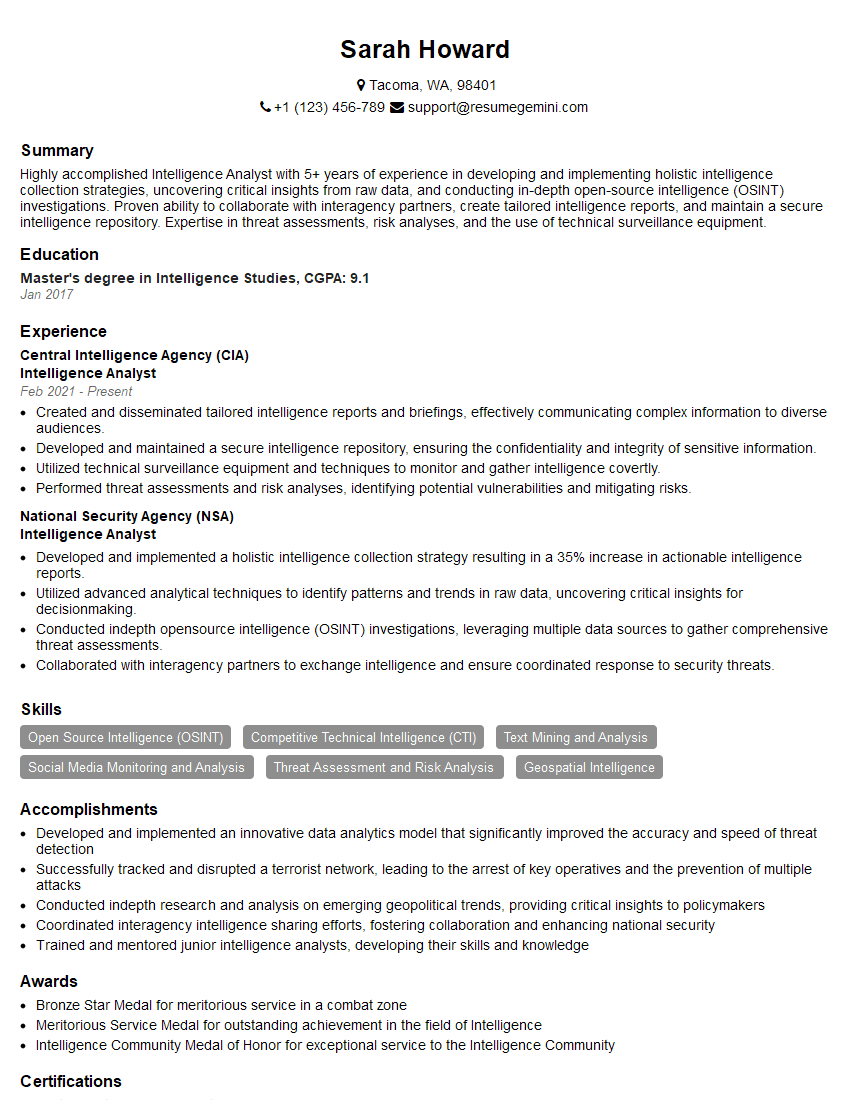
Mastering the intricacies of National Intelligence Estimates significantly enhances your career prospects within the intelligence community and related fields. It showcases your analytical capabilities, critical thinking skills, and understanding of complex geopolitical issues. To further strengthen your application, focus on crafting a compelling and ATS-friendly resume that highlights your relevant skills and experience. We highly recommend using ResumeGemini to build a professional and effective resume tailored to the specific demands of the National Intelligence Estimate field. Examples of resumes optimized for NIE positions are available to help you get started.
Explore more articles
Users Rating of Our Blogs
Share Your Experience
We value your feedback! Please rate our content and share your thoughts (optional).
What Readers Say About Our Blog
To the interviewgemini.com Webmaster.
Very helpful and content specific questions to help prepare me for my interview!
Thank you
To the interviewgemini.com Webmaster.
This was kind of a unique content I found around the specialized skills. Very helpful questions and good detailed answers.
Very Helpful blog, thank you Interviewgemini team.