Feeling uncertain about what to expect in your upcoming interview? We’ve got you covered! This blog highlights the most important Perform basic electrical work interview questions and provides actionable advice to help you stand out as the ideal candidate. Let’s pave the way for your success.
Questions Asked in Perform basic electrical work Interview
Q 1. What are the basic safety precautions when working with electricity?
Safety is paramount when working with electricity. A single mistake can lead to serious injury or even death. Always remember these basic precautions:
- Never work on live circuits: Always disconnect the power source at the breaker box before beginning any work. Think of electricity like water – you wouldn’t try to fix a leaky pipe while the water is still running!
- Use insulated tools: Insulated screwdrivers, pliers, and wire strippers prevent electric shock. Regularly inspect your tools for damage to the insulation.
- Wear appropriate PPE: Personal Protective Equipment (PPE) includes safety glasses to protect your eyes from flying debris, rubber gloves to insulate your hands, and safety shoes to protect your feet from falls or dropped tools.
- Have a second person present: If possible, especially for larger jobs, have a colleague nearby to assist and provide help if necessary. They can also act as a spotter to help prevent accidents.
- Know your limits: Don’t attempt work beyond your skill level. If you’re unsure about anything, consult a qualified electrician.
- Understand your surroundings: Be aware of potential hazards like water, flammable materials, and other electrical sources nearby.
Remember, safety isn’t just a suggestion; it’s a fundamental requirement for anyone working with electricity.
Q 2. Explain the difference between AC and DC current.
AC and DC are the two fundamental types of electrical current. The key difference lies in the direction of electron flow:
- Direct Current (DC): Electrons flow in one direction consistently. Think of a battery; it provides a constant flow of electrons from the positive to the negative terminal. DC is commonly used in portable devices, electronics and some industrial applications.
- Alternating Current (AC): Electrons flow back and forth, periodically changing direction. This is the type of electricity that powers most homes and businesses. The change in direction happens at a specific frequency, typically 50 or 60 Hertz (Hz), representing the number of cycles per second.
Think of a river: DC is like a river flowing consistently downstream, while AC is like a tidal river that flows back and forth with the tides.
Q 3. How do you identify different types of wires?
Wire identification is crucial for safe and efficient electrical work. Several methods exist:
- Color-coding: This is the most common method. In many regions, specific colors are assigned to different wire types (e.g., black for hot, white for neutral, green for ground). Always consult your local electrical code for accurate color designations. The lack of consistent color codes across regions makes this method critical to understand locally.
- Wire markings: Manufacturers often print information directly onto the wire’s insulation, specifying the wire gauge, material, and voltage rating. This information is especially useful when dealing with less common colors.
- Voltage testing: While potentially dangerous if done incorrectly, voltage testing with a non-contact voltage tester or a multimeter can help determine if a wire is carrying voltage.
- Tracing the circuit: If you know the circuit’s layout, you can physically trace the wires to determine their function and destination.
It is extremely important to double-check wire identification before working with any circuit, as misidentification can result in severe electrical shock and equipment damage.
Q 4. What are the common electrical tools used in basic electrical work?
Basic electrical work requires a variety of tools. Here are some common ones:
- Screwdrivers (Phillips and flathead): For removing and installing screws in electrical boxes and devices.
- Wire strippers/cutters: For removing insulation from wires without damaging the conductor.
- Pliers (needle-nose and lineman’s): For gripping and bending wires.
- Voltage tester (non-contact and multimeter): To check for the presence of voltage and test continuity.
- Electrical tape: To insulate wire connections.
- Fish tape/wire snake: To pull wires through walls or conduit.
- Level: Ensure electrical boxes and fixtures are installed correctly.
- Drill (with appropriate bits): For installing electrical boxes.
Always use tools appropriate for the task and ensure they are in good working order.
Q 5. Describe the process of troubleshooting a simple electrical circuit.
Troubleshooting an electrical circuit involves systematically identifying the cause of a malfunction. Here’s a process:
- Safety First: Disconnect power to the circuit at the breaker box.
- Observe and document: Note the symptoms (e.g., no power, flickering lights, blown fuse/breaker). Check for obvious damage to wires, fixtures, or outlets.
- Check the power source: Verify power is available at the breaker panel. Is the breaker tripped? Is the fuse blown?
- Inspect the wiring: Look for loose connections, damaged insulation, or broken wires. Use a multimeter to check for continuity in the wires.
- Test components: If possible, test individual components (e.g., switches, outlets, lights) to isolate the faulty part. For example, swap out a suspect light bulb.
- Trace the circuit: Follow the path of the circuit from the power source to the faulty component.
- Restore Power: After repairs, reconnect the power and test the circuit to verify functionality.
If you can’t find the problem, it’s best to call a qualified electrician.
Q 6. Explain Ohm’s Law and how it applies to electrical circuits.
Ohm’s Law describes the relationship between voltage (V), current (I), and resistance (R) in an electrical circuit. It’s expressed as:
V = I * RWhere:
- V (Voltage): Measured in volts (V), represents the electrical potential difference between two points in a circuit. Think of it as the electrical pressure pushing electrons.
- I (Current): Measured in amperes (A) or amps, represents the rate of electron flow through a circuit. It’s like the amount of water flowing through a pipe.
- R (Resistance): Measured in ohms (Ω), represents the opposition to the flow of current. Think of it as the friction in the pipe resisting the water flow.
This law is fundamental to understanding how electricity flows in a circuit. For example, if you know the voltage and resistance, you can calculate the current. If a circuit draws too much current it may trip the breaker which is a safety feature.
Q 7. How do you test for continuity in a circuit?
Continuity testing verifies the presence of a complete, unbroken path for current flow in a circuit. We use a multimeter to do this.
- Set the multimeter: Select the continuity test setting (usually indicated by a diode symbol or a tone).
- Connect the probes: Touch the multimeter probes to the two points in the circuit you want to test.
- Check for continuity: If there’s a continuous path, the multimeter will beep or display a low resistance value (close to zero ohms). A lack of continuity indicates a break in the circuit, like a broken wire or a faulty component.
Imagine a pipe: continuity testing is like checking if the pipe is completely open and allows water to flow through without any leaks or blockages. This is essential for identifying breaks in wiring or other circuit issues.
Q 8. How do you test for voltage in a circuit?
Testing for voltage involves using a non-contact voltage tester or a multimeter. A non-contact voltage tester is a simple, safe way to quickly check if voltage is present. It lights up or beeps if voltage is detected, indicating a live wire. A multimeter, on the other hand, provides a precise voltage reading. To use a multimeter, select the AC or DC voltage setting (depending on the type of circuit), ensure the probes are properly connected, and carefully touch the probes to the points in the circuit you wish to test. Always prioritize safety and use appropriate personal protective equipment (PPE) like insulated gloves and eye protection.
Example: Before working on a light fixture, I’d use a non-contact tester to quickly check if the wires are energized. If the tester indicates voltage, I’d then use my multimeter to get a precise voltage reading to confirm and troubleshoot.
Q 9. How do you test for current in a circuit?
Measuring current requires a multimeter set to the appropriate amperage range. Unlike voltage measurement, measuring current requires you to break the circuit and insert the multimeter in series with the load. This means you’ll need to disconnect a wire, connect one probe of the multimeter to the disconnected wire and the other probe to the other end of the wire, completing the circuit through the meter. Always start with the highest amperage setting on your multimeter and gradually reduce it until you get a stable reading. Incorrectly selecting the amperage range can damage the meter.
Example: To measure the current draw of a motor, I’d disconnect one of the wires supplying power to the motor, connect my multimeter in series, ensuring it’s set to the appropriate amperage range, and then turn the motor on to get the current reading.
Important Note: Never attempt to measure current by just probing the wires while they’re connected; you risk damaging the meter and potentially causing harm to yourself.
Q 10. What is the purpose of a circuit breaker?
A circuit breaker is an automatic safety device designed to protect an electrical circuit from damage caused by overload or short circuits. If the current flowing through the circuit exceeds the breaker’s rated capacity, it automatically trips, interrupting the flow of electricity. This prevents overheating of wires, potential fires, and damage to appliances. Circuit breakers can be reset by simply flipping the switch back to the ‘on’ position, once the underlying fault is corrected.
Example: If you have too many appliances running on a single circuit, drawing more current than the circuit can handle, the circuit breaker will trip to prevent overheating and potential fire hazards.
Q 11. What is the purpose of a fuse?
A fuse is another safety device that protects a circuit from overcurrent. Like a circuit breaker, it interrupts the flow of electricity if the current exceeds its rated value. However, unlike a circuit breaker, a fuse is a one-time device. Once it blows (melts), it needs to be replaced. Fuses come in various ratings and types, and choosing the correct rating is crucial for the safety of the circuit.
Example: In older homes, fuses are often found in fuse boxes. If a fuse blows, it indicates that there’s an overload or short circuit on that circuit, and the fuse must be replaced with one of the same rating.
Q 12. Explain the difference between a series and parallel circuit.
In a series circuit, the components are connected end-to-end, forming a single path for current to flow. If one component fails, the entire circuit is broken. The voltage across each component is different, but the current is the same throughout the circuit. Think of it like a single lane road – all traffic must go through the same path.
In a parallel circuit, components are connected across each other, creating multiple paths for current to flow. If one component fails, the others continue to function. The voltage is the same across all components, but the current is divided among the paths. This is like a multi-lane highway – traffic can take different routes.
Example: Christmas tree lights are often wired in series; if one bulb burns out, the whole string goes dark. House wiring is typically parallel; if one appliance stops working, the others keep running.
Q 13. How do you calculate the total resistance in a series circuit?
In a series circuit, the total resistance (RT) is simply the sum of the individual resistances (R1, R2, R3…).
RT = R1 + R2 + R3 + ...
Example: If you have three resistors of 10Ω, 20Ω, and 30Ω connected in series, the total resistance is 10Ω + 20Ω + 30Ω = 60Ω.
Q 14. How do you calculate the total resistance in a parallel circuit?
Calculating total resistance (RT) in a parallel circuit is a bit more complex. The reciprocal of the total resistance is equal to the sum of the reciprocals of the individual resistances.
1/RT = 1/R1 + 1/R2 + 1/R3 + ...
After calculating 1/RT, you need to take the reciprocal to find RT.
Example: If you have three resistors of 10Ω, 20Ω, and 30Ω connected in parallel:
1/RT = 1/10Ω + 1/20Ω + 1/30Ω = 0.1 + 0.05 + 0.0333 = 0.1833
RT = 1/0.1833Ω ≈ 5.45Ω
Q 15. How do you identify and replace a faulty switch?
Identifying and replacing a faulty switch involves a few key steps. First, always turn off the power at the breaker box to the circuit controlling the switch. This is crucial for safety! Then, use a non-contact voltage tester to double-check that the power is indeed off. Next, remove the switch plate and the switch itself, usually by loosening screws. Carefully examine the switch for any visible damage, like burnt contacts or loose wiring. If you find damage, replace the switch with one of the same rating (amperage and voltage). When wiring the new switch, carefully match the wires to their corresponding terminals; typically, there will be a black wire (hot), a white wire (neutral), and a ground wire (bare copper or green). Secure the wires, replace the switch, and the plate. Finally, restore power and test the switch.
Example: I once worked on a house where a switch controlling an outdoor light was constantly sparking. After turning off the power and testing, I replaced the switch, and the problem was solved. It turned out the original switch was simply worn out due to repeated use in harsh weather conditions.
Career Expert Tips:
- Ace those interviews! Prepare effectively by reviewing the Top 50 Most Common Interview Questions on ResumeGemini.
- Navigate your job search with confidence! Explore a wide range of Career Tips on ResumeGemini. Learn about common challenges and recommendations to overcome them.
- Craft the perfect resume! Master the Art of Resume Writing with ResumeGemini’s guide. Showcase your unique qualifications and achievements effectively.
- Don’t miss out on holiday savings! Build your dream resume with ResumeGemini’s ATS optimized templates.
Q 16. How do you identify and replace a faulty outlet?
Replacing a faulty outlet is similar to replacing a switch in terms of safety protocols. Always turn off the power at the breaker box first and double-check with a non-contact voltage tester. Remove the outlet cover plate and the outlet itself using a screwdriver. Examine the outlet for any signs of damage, such as scorch marks or loose wires. Pay close attention to the terminals. If the outlet is faulty, replace it with a new one of the same rating (amperage and voltage). Match the wires carefully to their corresponding terminals: typically, a black (hot), a white (neutral), and a ground wire. Tighten the screws securely. Finally, replace the cover plate, restore power, and test the outlet.
Example: In one instance, a client reported an outlet that felt warm to the touch. After safely turning off the power and investigating, I found one of the screws on the hot terminal was loose, resulting in a poor connection and excess heat. This was a simple fix after replacing the outlet with a new one.
Q 17. How do you install a new light fixture?
Installing a new light fixture requires careful attention to safety and proper wiring. Begin by turning off the power at the breaker box and verifying it’s off with a non-contact voltage tester. Remove the old fixture, carefully noting how the wires are connected. For most fixtures, you’ll find a black (hot), a white (neutral), and a ground wire. Follow the instructions provided with the new fixture. Connect the wires to the corresponding terminals on the new fixture. Secure the fixture to the electrical box. This will vary depending on the type of fixture and its mounting bracket. Replace the cover plate, restore power, and test the light fixture.
Example: I recently installed a new ceiling fan with a light kit. The existing wiring was slightly different from the new fixture, so I carefully studied both the wiring diagrams to ensure the correct connections were made, paying close attention to ground wire connectivity.
Q 18. How do you wire a three-way switch?
Three-way switches allow you to control a light from two different locations. Wiring them correctly involves using three wires: a traveler (between the two switches), a hot, and a neutral. Each three-way switch has three terminals: one common and two travelers. The hot wire connects to the common terminal of one switch. The traveler wires connect to the traveler terminals of both switches. The other ends of the traveler wires connect to the traveler terminals of the other switch. The neutral wire connects to the fixture itself. Finally, the hot wire from the light fixture connects to the common terminal of the second switch. Always double-check your work and use a non-contact voltage tester.
Example: This is frequently used in staircases and hallways where switching on and off the lights from two different points is desired. This setup avoids having to walk back to turn off a light.
Q 19. How do you wire a four-way switch?
Four-way switches are used to control a light from three or more locations. They work by using two three-way switches and one or more four-way switches. The four-way switches have four terminals. The traveler wires from the three-way switches pass through the four-way switches, allowing the circuit to be completed when the switches are in certain combinations. Each four-way switch will have two traveler wires entering and two traveler wires exiting, with no direct connection to hot or neutral. Proper wiring requires a good understanding of electrical circuits and careful tracing of wires. Always use a wiring diagram and double-check before restoring power.
Example: I’ve used four-way switches in long corridors to allow control of lighting from various entry points along the hallway. This configuration ensures convenient lighting control for users.
Q 20. What is grounding and why is it important?
Grounding is a critical safety feature in electrical systems. It provides a path for fault currents to flow directly to the earth, preventing electrical shocks and fires. A ground wire connects exposed metal parts of appliances and electrical boxes to the earth. If a short circuit occurs, the fault current flows through the ground wire to the earth rather than through a person who might touch the appliance. This drastically reduces the risk of electrocution.
Importance: Grounding protects people and equipment. Without grounding, even a small fault could lead to a dangerous electrical shock or a fire. It’s a fundamental safety measure in electrical installations.
Q 21. Explain the National Electrical Code (NEC) and its importance.
The National Electrical Code (NEC) is a set of standards for electrical safety that is widely adopted across North America. It provides guidelines for everything from wiring methods to the installation of electrical equipment. The NEC is regularly updated to reflect advances in technology and safety practices. Its goal is to reduce the risk of electrical hazards. Electrical contractors must follow the NEC in all installations, and compliance is often inspected by local authorities. This ensures consistency in electrical safety across various installations, protecting both people and property.
Importance: Compliance with the NEC is crucial for ensuring electrical safety and preventing accidents. Ignoring these codes puts lives and property at risk.
Q 22. Describe different types of electrical wiring (e.g., Romex, BX).
Electrical wiring comes in various types, each suited for different applications. Let’s look at a couple of common examples:
- Romex (NM-B): This is a common type of non-metallic sheathed cable widely used in residential construction. It consists of two or more insulated conductors enclosed within a flexible plastic sheath. The sheath provides protection from abrasion and moisture. Romex is relatively easy to install and is cost-effective, making it popular for interior wiring. You’ll often see it color-coded: black (hot), white (neutral), and bare copper (ground).
- BX (AC Cable): Also known as armored cable, BX is a flexible metal conduit containing insulated conductors. The metal armor provides superior protection against physical damage compared to Romex. BX is often used in areas where there’s a higher risk of damage, such as basements or garages, or where more protection from rodents is required. Installing BX requires more expertise because of the armored casing; special tools may be necessary to make connections.
Other types exist, like UF (underground feeder) cable designed for direct burial, and MC (metal-clad) cable, offering similar protection to BX.
Q 23. How do you interpret electrical schematics?
Reading electrical schematics is fundamental to electrical work. They’re essentially maps of the electrical system, showing how components are interconnected. Think of them as blueprints for electricity.
I start by identifying the key symbols. Each symbol represents a specific component – switches, outlets, lights, circuit breakers, etc. The lines connecting these symbols represent the wiring pathways. I then follow the paths to understand how power flows through the circuit. For example, a simple circuit might show power from a breaker flowing through a switch, then to a light fixture, finally returning to the panel. More complex schematics might include multiple circuits, branch circuits and more intricate arrangements of components. Understanding voltage levels and amperage ratings is also crucial. I carefully review notes and legends provided on the schematic.
I’ve worked on numerous projects where interpreting schematics accurately was critical. For instance, during a recent remodel, I used the schematic to identify a faulty wiring connection in a three-way switch setup, efficiently resolving the power issue.
Q 24. What are the different types of electrical conduit?
Electrical conduit protects wiring from physical damage and the elements. Several types exist:
- Rigid Metal Conduit (RMC): Strong and durable, often used for commercial and industrial applications where superior protection is needed. It’s less flexible than other types.
- Intermediate Metal Conduit (IMC): Lighter and easier to work with than RMC, suitable for many residential and commercial settings.
- Electrical Metallic Tubing (EMT): Lightweight and flexible, widely used in residential construction for its ease of installation. It’s often referred to as ‘thinwall’ conduit.
- Flexible Metal Conduit (FMC): Used for connecting equipment or making flexible connections. It’s often used in situations where some bending and flexibility are needed.
- PVC Conduit: Non-metallic conduit made of rigid polyvinyl chloride. It’s lightweight and corrosion resistant, but less resistant to physical damage than metal conduit. It’s common in residential and commercial applications.
Choosing the right conduit type depends on the application’s requirements, considering factors like environmental conditions, level of protection needed, and ease of installation.
Q 25. Explain the proper way to use a multimeter.
A multimeter is an essential tool for any electrician. It measures voltage, current, and resistance, allowing us to diagnose electrical problems effectively. Before using a multimeter, it’s crucial to understand its functions and safety precautions.
To measure voltage, select the DC or AC voltage setting (depending on the type of current), set the appropriate range (start high and reduce if needed), and carefully connect the probes across the two points where you want to measure the voltage. Make sure the power is ON.
For current measurement, you need to break the circuit and connect the multimeter in series. This means disconnecting a wire, connecting one multimeter lead to the wire, and the other to the component. Always ensure the circuit is turned OFF before measuring current. Choose the appropriate amperage range on the multimeter. This is particularly important to avoid damaging the meter.
To measure resistance, ensure the circuit is OFF. Select the ohms setting and connect the probes across the component. A high resistance reading usually indicates a break in the circuit or a faulty component.
Safety is paramount. Always double-check your settings before taking a measurement. Misusing a multimeter can lead to serious injury or damage to equipment.
Q 26. How do you identify and address common electrical hazards?
Electrical hazards are serious and must be addressed with care. Common hazards include:
- Exposed Wiring: Bare or damaged wires are a significant shock risk. Properly insulating or replacing them is crucial.
- Overloaded Circuits: Drawing too much current than the circuit is rated for can cause overheating, fire, and equipment damage. Using circuit breakers and fuses correctly prevents this.
- Damaged Outlets and Switches: Loose connections, damaged insulation, or improper grounding can cause arcing, sparking and shocks. Replacing faulty components is necessary.
- Water and Electricity: Water is a great conductor of electricity, making it highly dangerous. Never work with electricity near water.
Addressing these hazards involves using appropriate safety equipment (insulated tools, safety glasses), following proper safety procedures (locking out/tagging out), and ensuring all wiring is correctly installed and maintained to code. I always perform a thorough safety inspection before commencing any electrical work.
Q 27. Describe your experience with electrical troubleshooting and repair.
I have extensive experience troubleshooting and repairing a wide range of electrical problems. My approach is systematic and methodical.
I begin by carefully assessing the situation, gathering information about the problem, and visually inspecting the affected area. Next, I’ll use my multimeter to take measurements – voltage, current, and resistance – to pinpoint the fault. For instance, if a light fixture isn’t working, I’d check for voltage at the fixture and at the switch to identify where the break is. If there’s a tripped breaker, I’d investigate the circuit to determine the cause of the overload.
I’ve encountered various challenges, from repairing faulty wiring in older homes to troubleshooting complex commercial systems. One memorable instance involved a malfunctioning three-phase motor in a small factory. By methodically checking each phase and component, I identified a faulty capacitor, resolving the production line stoppage.
I always ensure my repairs are done correctly and safely, adhering to all electrical codes and safety standards. After any repair, I rigorously test to ensure proper operation and safety.
Key Topics to Learn for Perform Basic Electrical Work Interview
- Electrical Safety Regulations and Codes: Understanding and applying relevant safety regulations (e.g., NEC) is paramount. This includes proper use of personal protective equipment (PPE) and lockout/tagout procedures.
- Basic Circuit Principles: Mastering Ohm’s Law, Kirchhoff’s Laws, and series/parallel circuit analysis is crucial for troubleshooting and understanding electrical systems.
- Wiring Methods and Techniques: Practical knowledge of different wiring methods (e.g., Romex, conduit), wire sizing calculations, and proper termination techniques is essential for safe and efficient installations.
- Common Electrical Components: Familiarity with the function and application of various components such as switches, outlets, breakers, fuses, and receptacles is vital.
- Troubleshooting Electrical Problems: Develop your skills in identifying and resolving common electrical issues, including using multimeters for voltage, current, and resistance measurements.
- Electrical Drawings and Schematics: Learn to interpret and understand electrical blueprints and schematics to plan and execute electrical work accurately.
- Tools and Equipment: Demonstrate proficiency in using common electrical tools, such as wire strippers, crimpers, screwdrivers, and multimeters.
Next Steps
Mastering basic electrical work opens doors to numerous career opportunities in construction, maintenance, and industrial settings, offering excellent growth potential and competitive salaries. To maximize your job prospects, create an ATS-friendly resume that highlights your skills and experience effectively. ResumeGemini is a trusted resource that can help you build a professional and impactful resume. We provide examples of resumes tailored to “Perform basic electrical work” to guide you in creating your own compelling application.
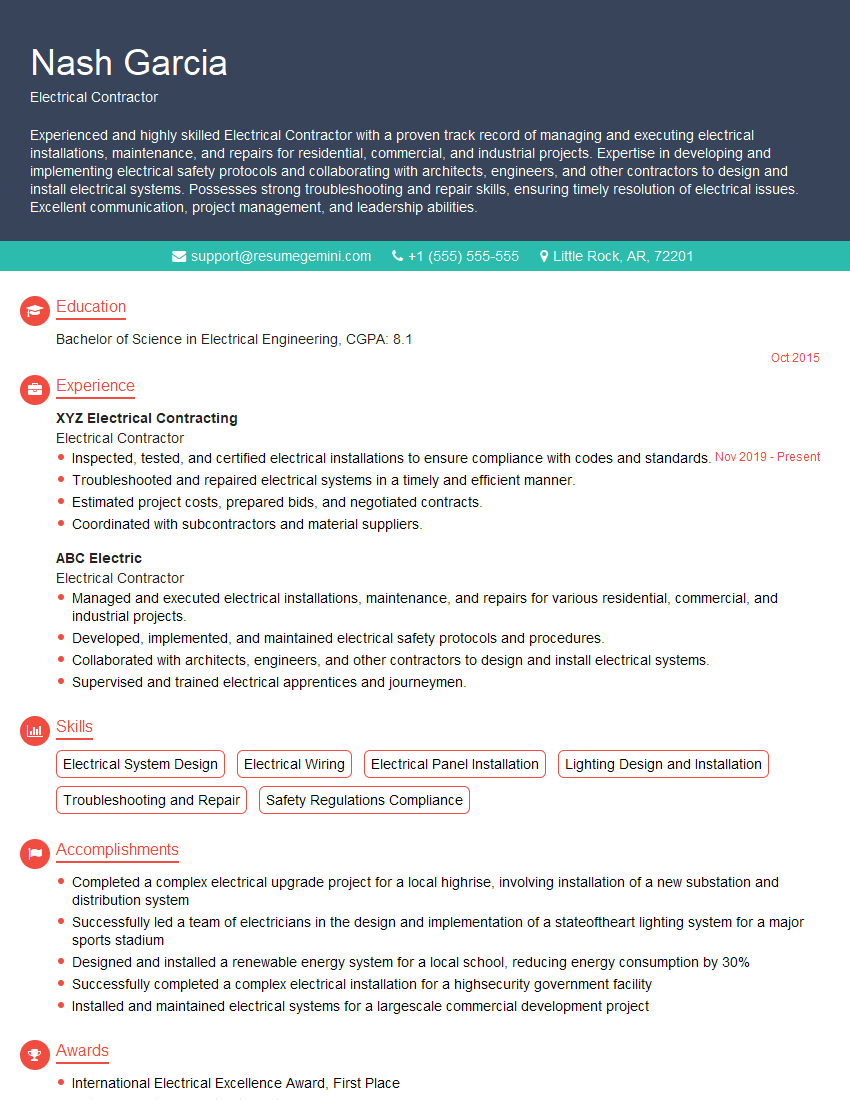
Electrical Contractor Resume Sample
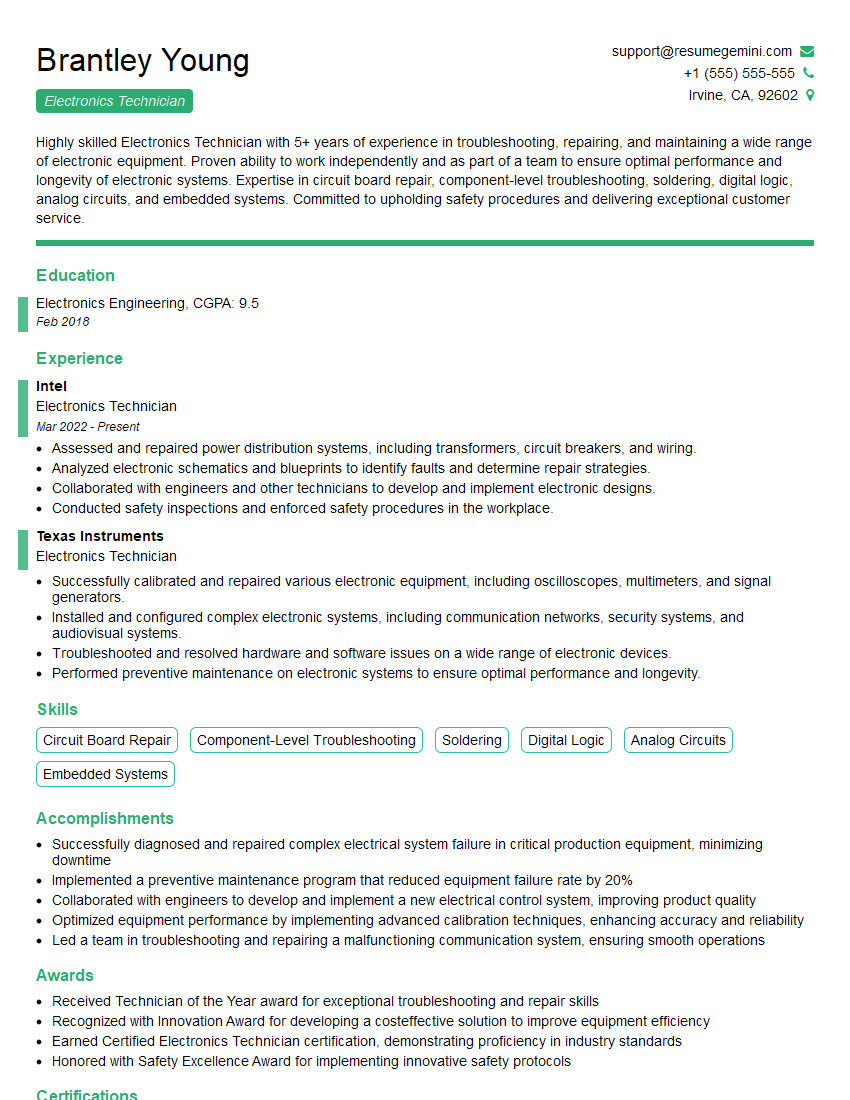
Electronics Technician Resume Sample
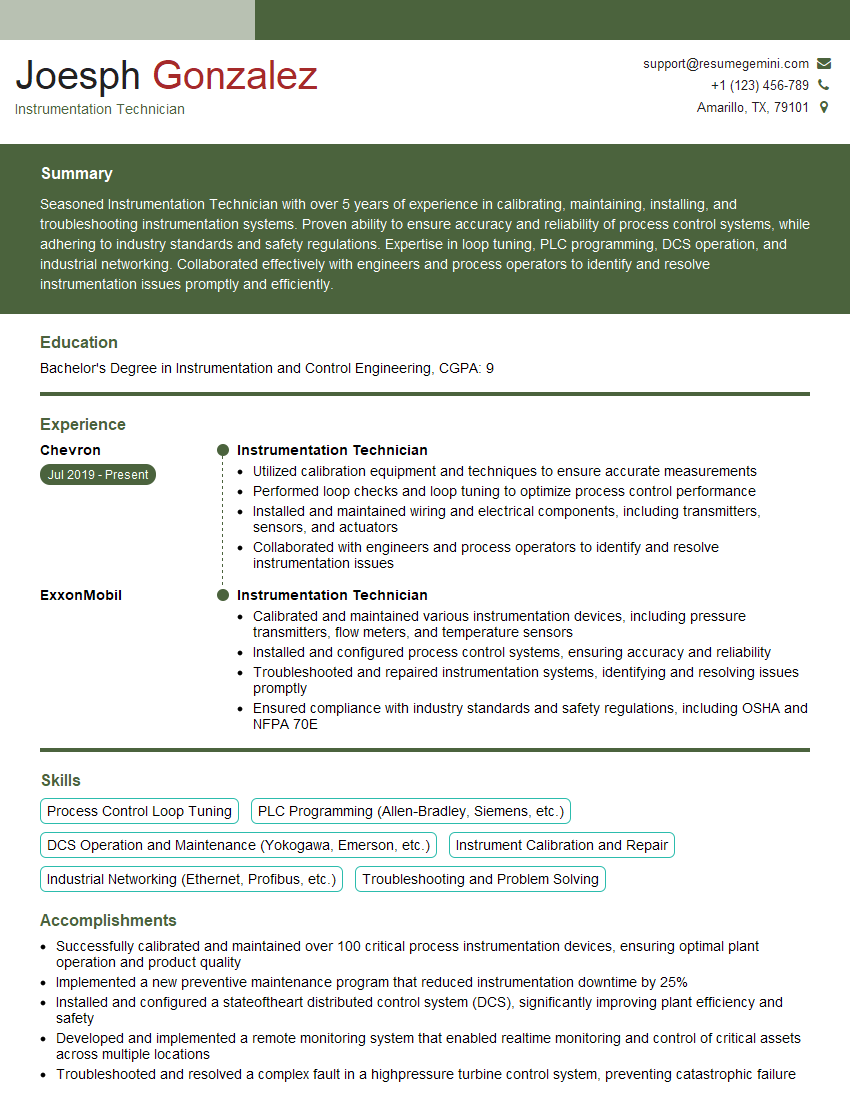
Instrumentation Technician Resume Sample
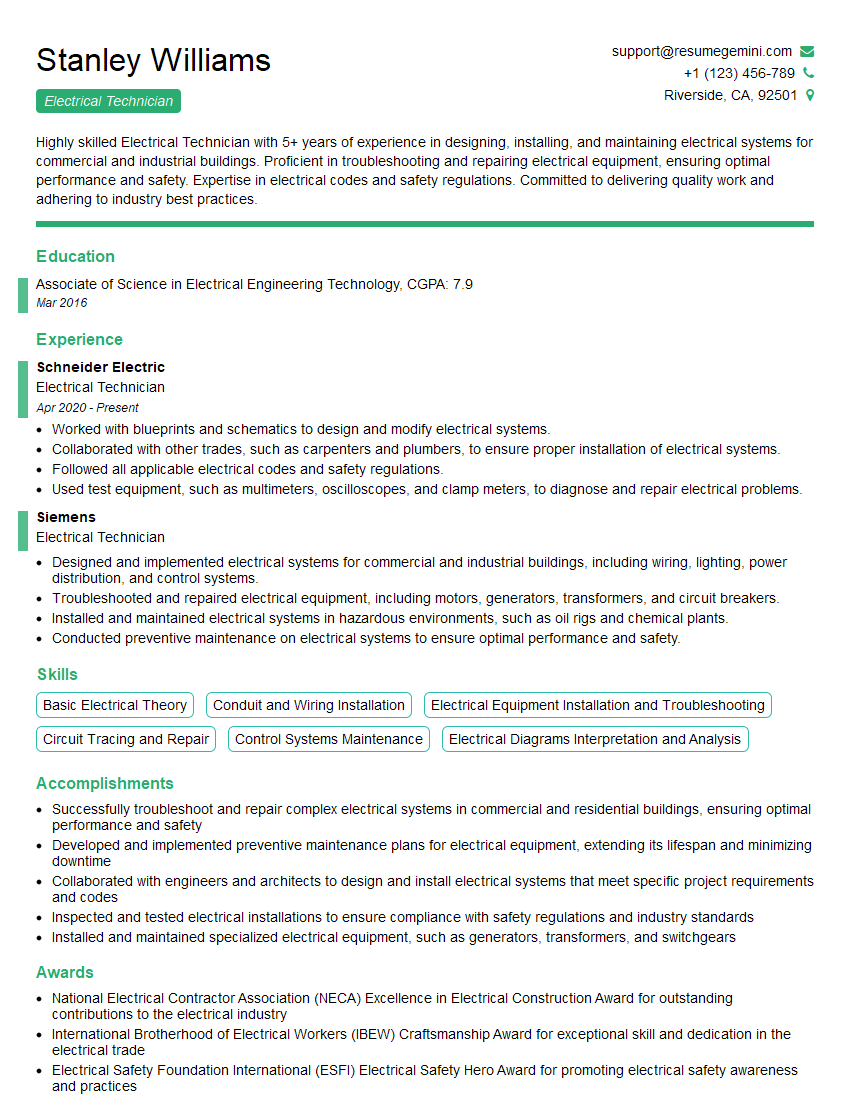
Electrical Technician Resume Sample
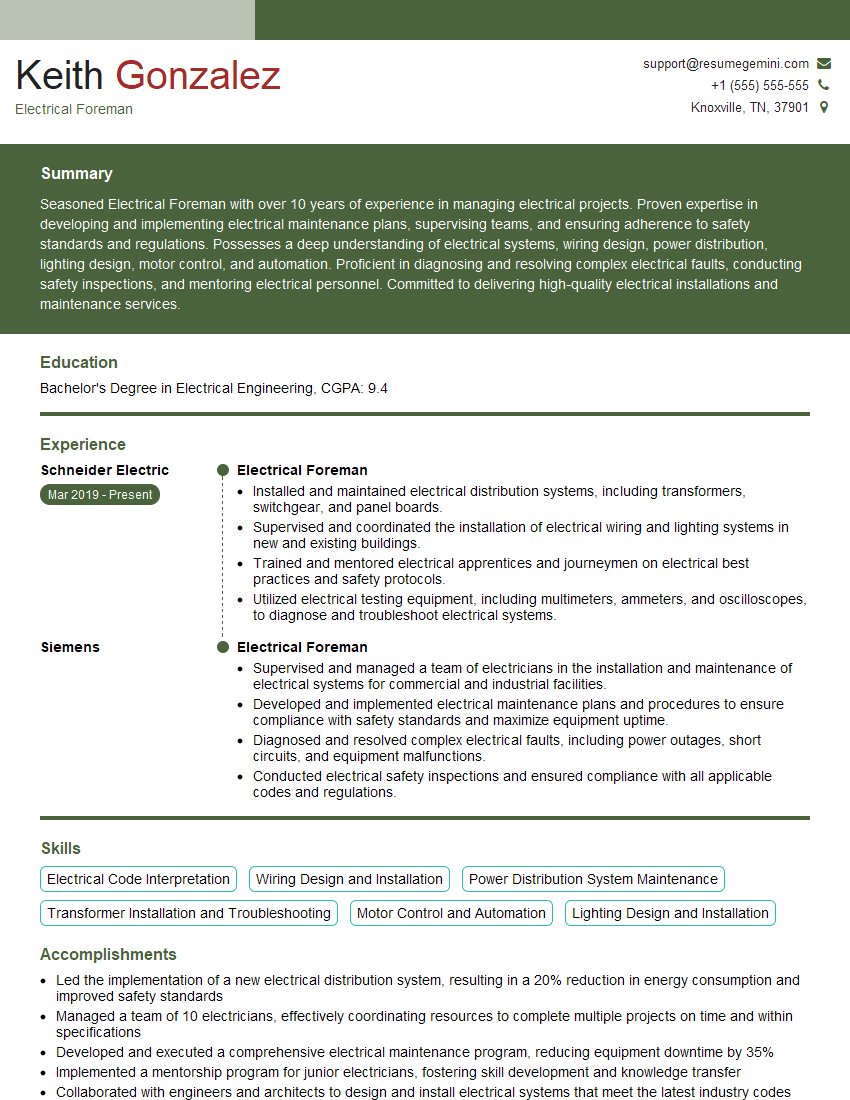
Electrical Foreman Resume Sample
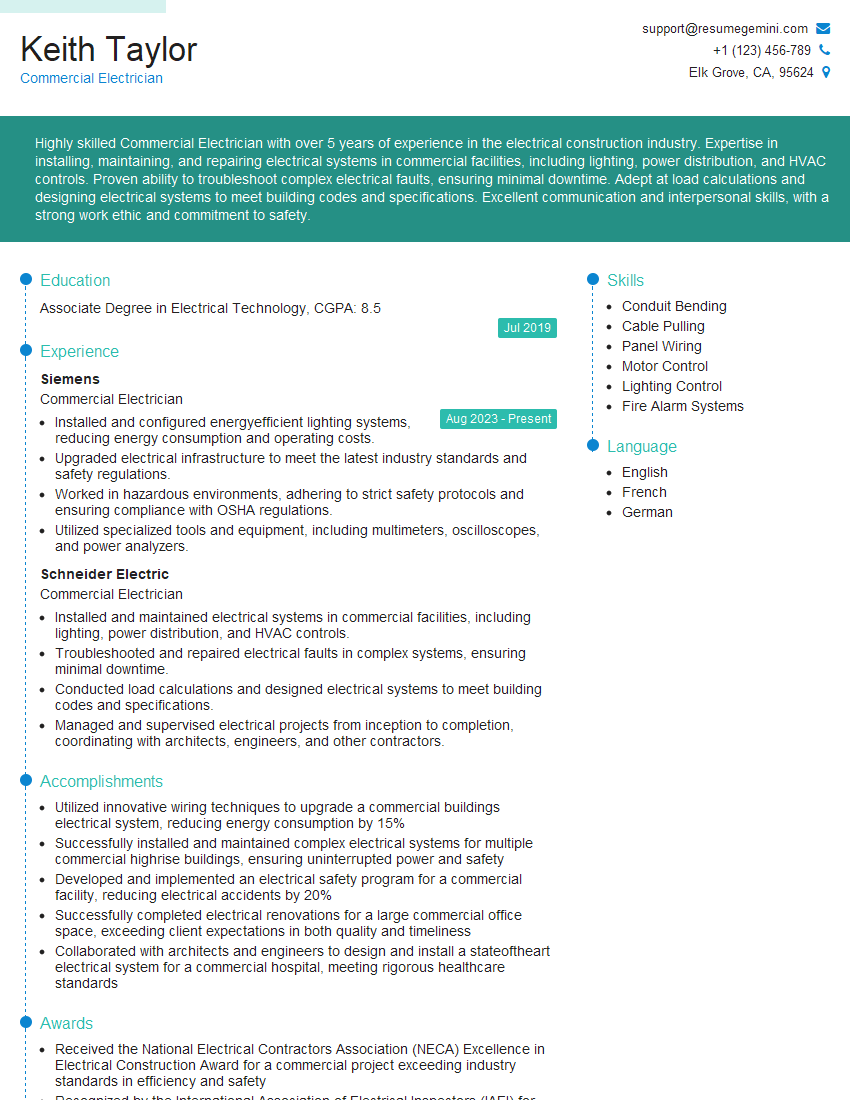
Commercial Electrician Resume Sample
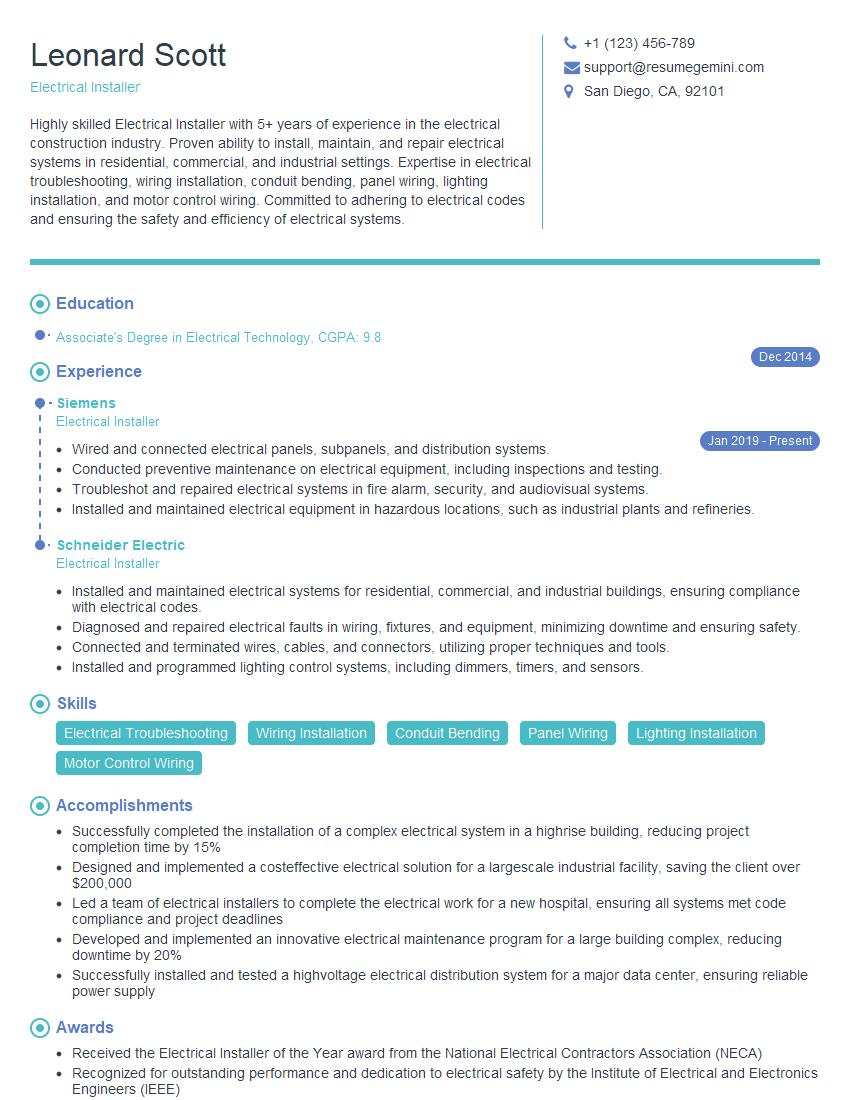
Electrical Installer Resume Sample
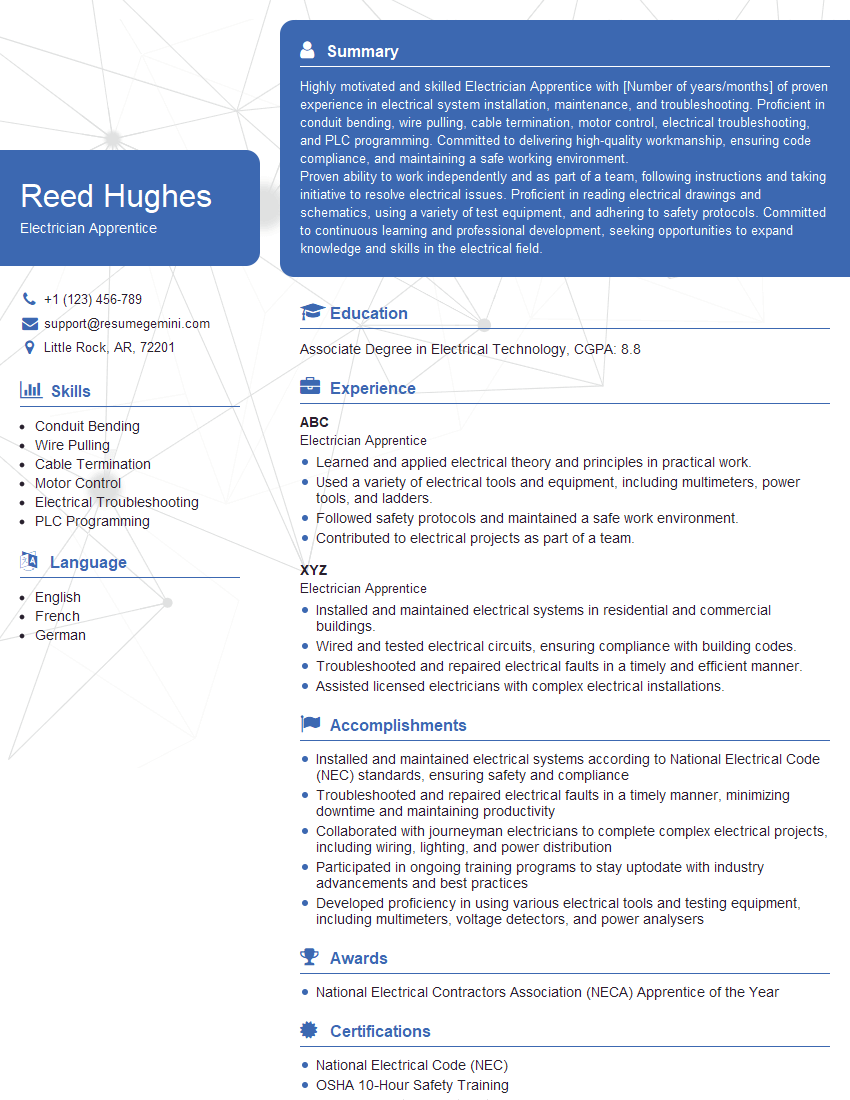
Electrician Apprentice Resume Sample
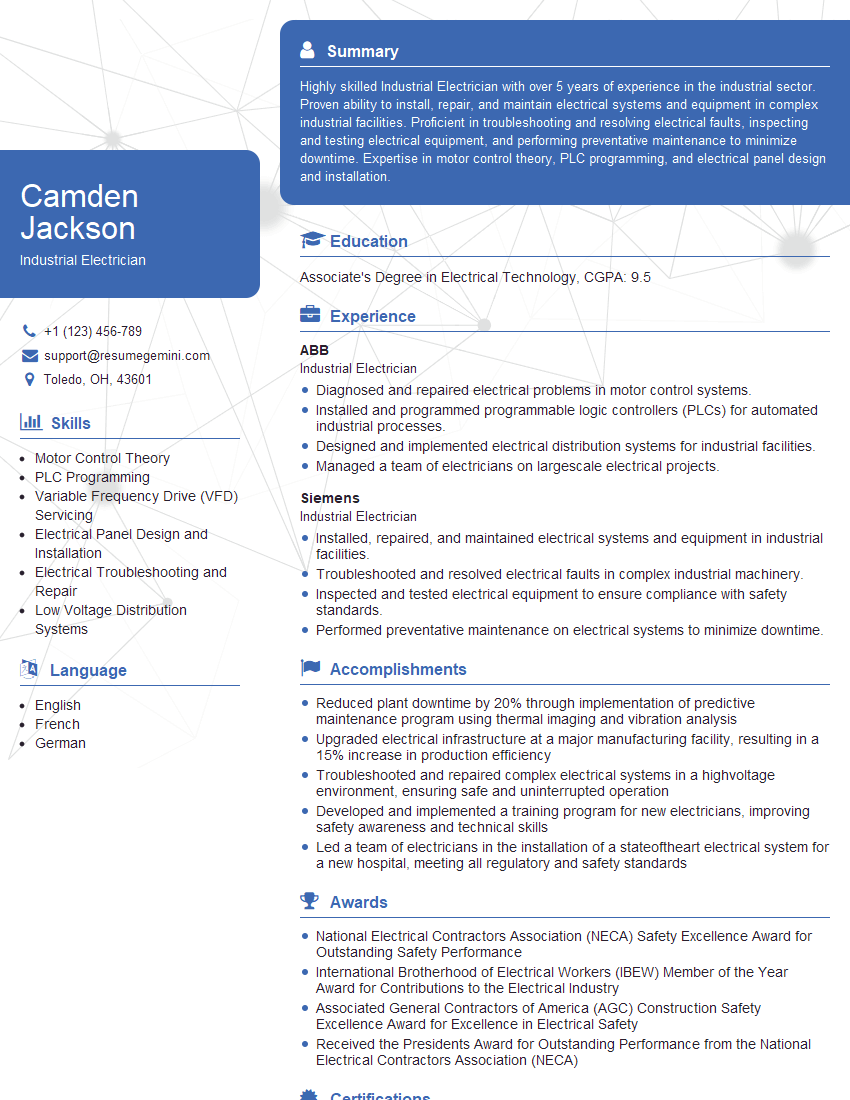
Industrial Electrician Resume Sample
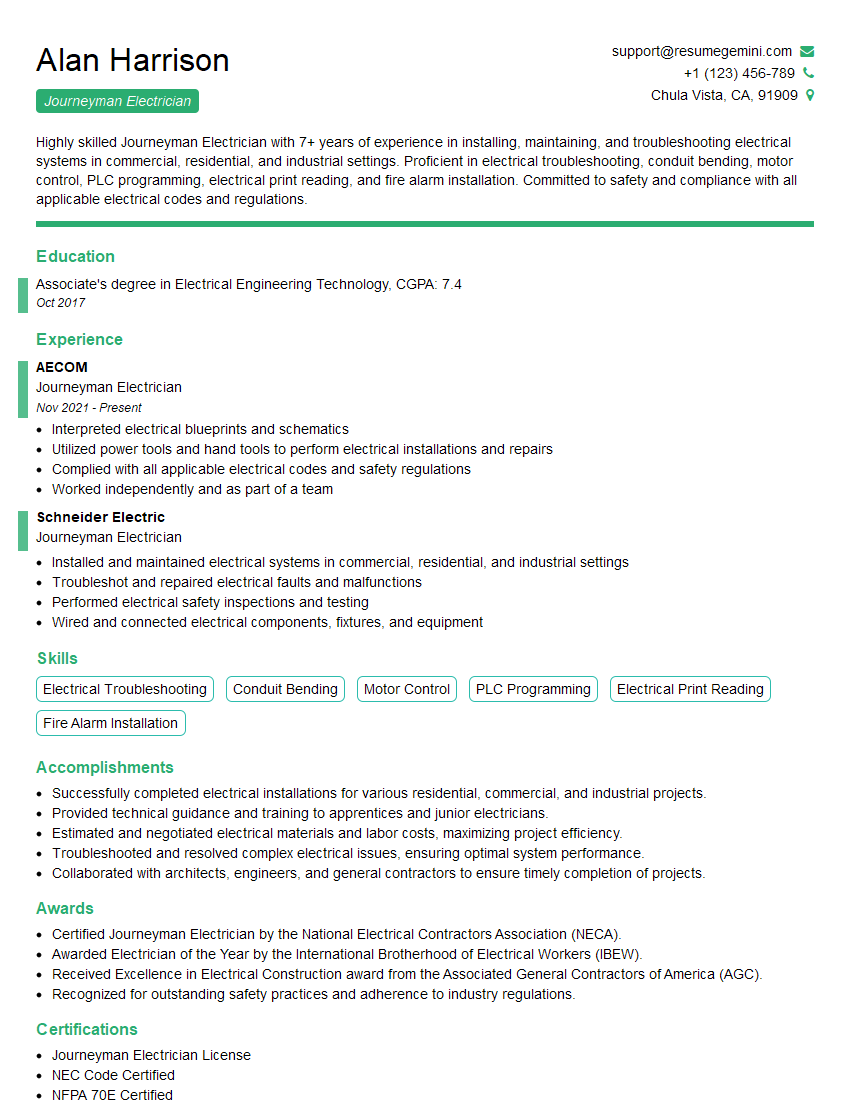
Journeyman Electrician Resume Sample
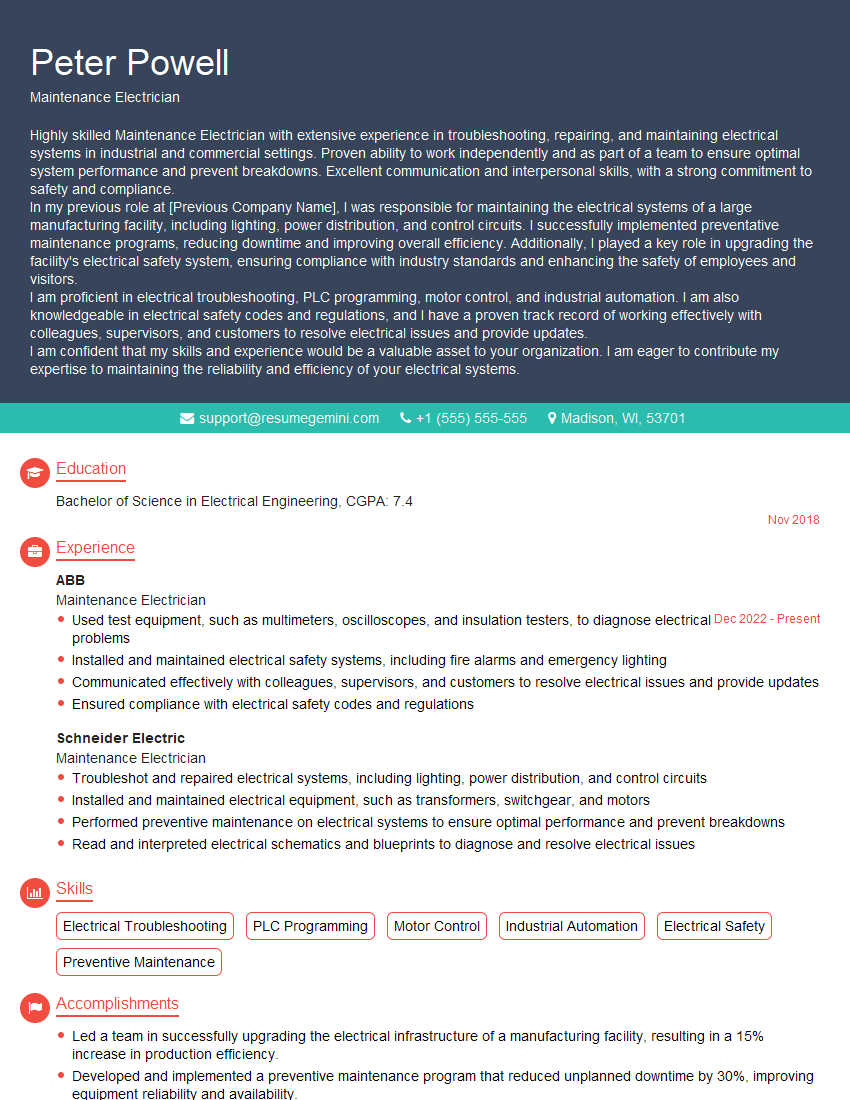
Maintenance Electrician Resume Sample
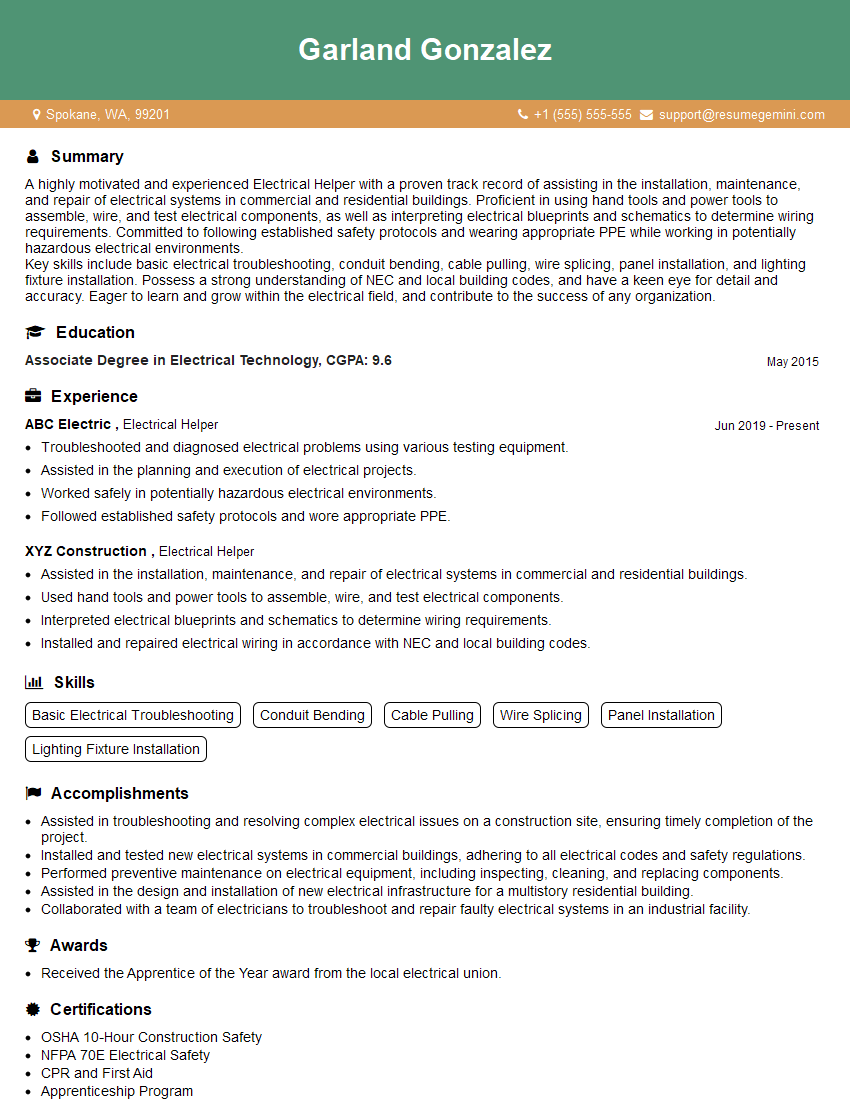
Electrical Helper Resume Sample
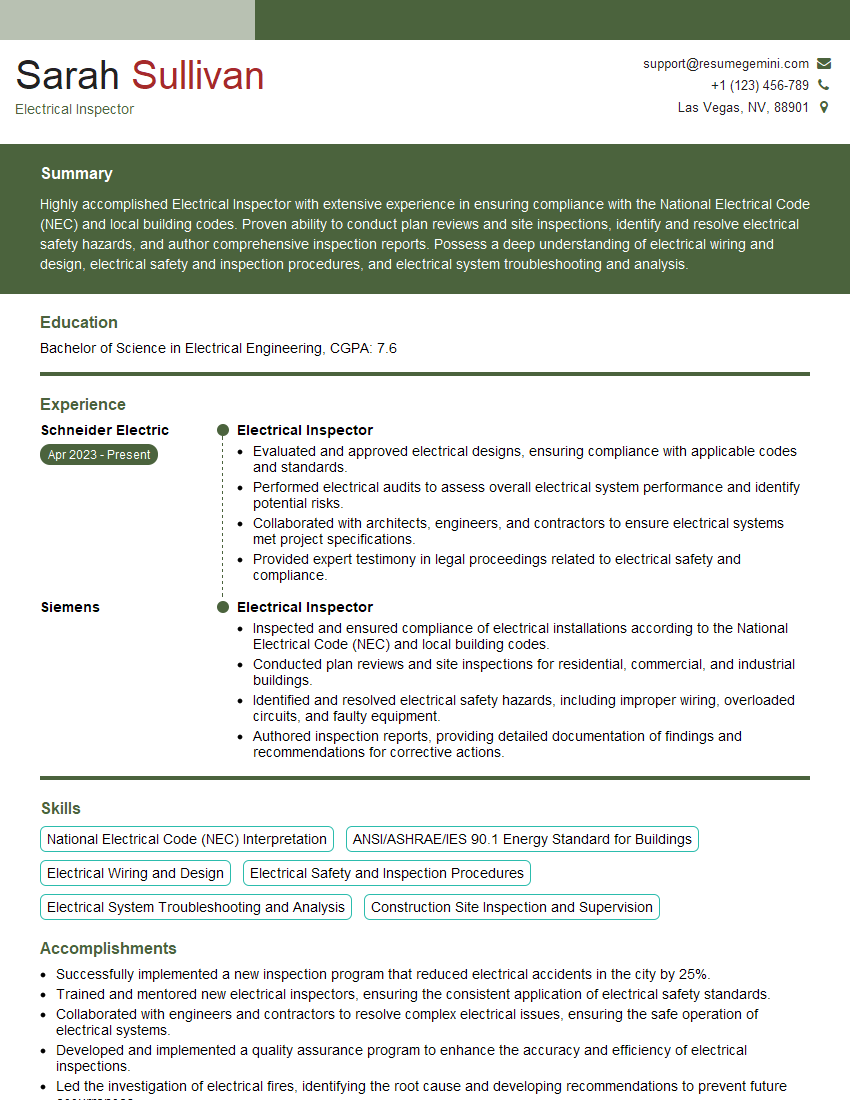
Electrical Inspector Resume Sample
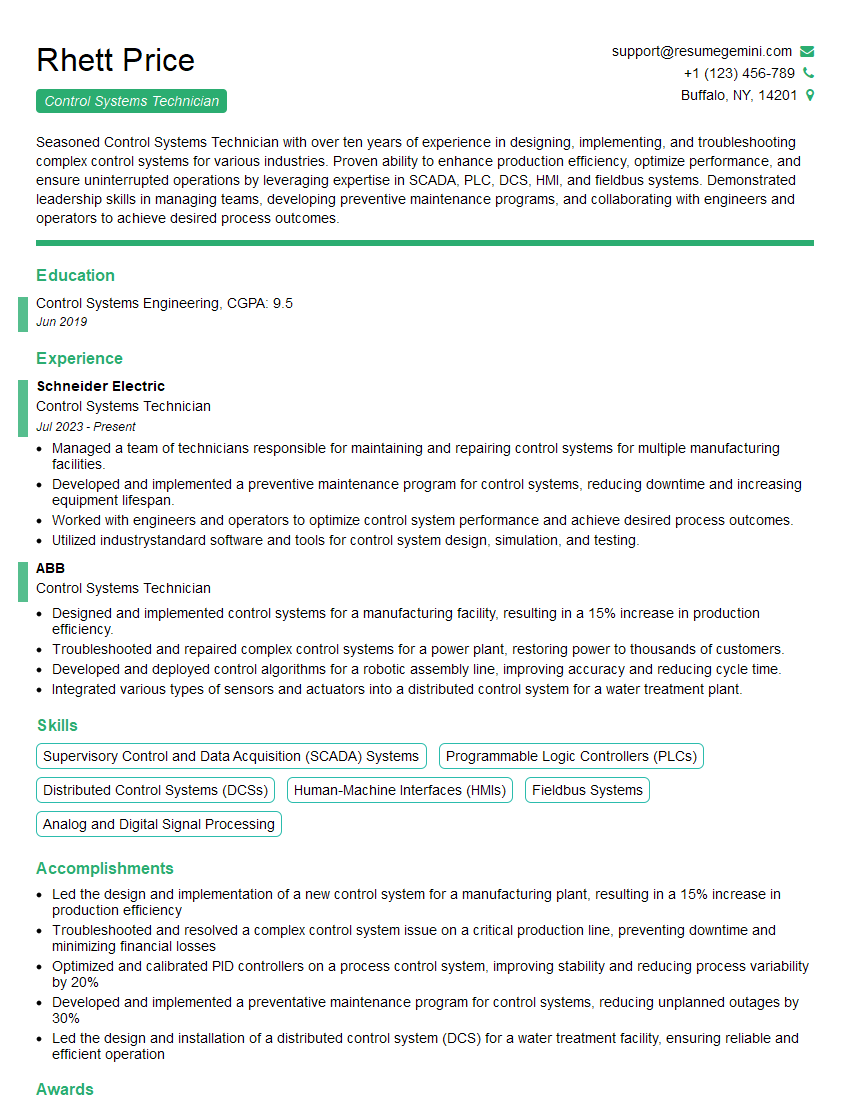
Control Systems Technician Resume Sample
- Electrical Contractor
- Electronics Technician
- Instrumentation Technician
- Electrical Technician
- Electrical Foreman
- Commercial Electrician
- Electrical Installer
- Electrician Apprentice
- Industrial Electrician
- Journeyman Electrician
- Maintenance Electrician
- Electrical Helper
- Electrical Inspector
- Control Systems Technician
Explore more articles
Users Rating of Our Blogs
Share Your Experience
We value your feedback! Please rate our content and share your thoughts (optional).
What Readers Say About Our Blog
To the interviewgemini.com Webmaster.
Very helpful and content specific questions to help prepare me for my interview!
Thank you
To the interviewgemini.com Webmaster.
This was kind of a unique content I found around the specialized skills. Very helpful questions and good detailed answers.
Very Helpful blog, thank you Interviewgemini team.