Preparation is the key to success in any interview. In this post, we’ll explore crucial Pipe Layout and Installation interview questions and equip you with strategies to craft impactful answers. Whether you’re a beginner or a pro, these tips will elevate your preparation.
Questions Asked in Pipe Layout and Installation Interview
Q 1. Explain the difference between isometric drawings and orthographic drawings in piping.
Isometric and orthographic drawings are both crucial in piping design, but they serve different purposes. Think of it like this: orthographic drawings are like a building’s blueprints – they show multiple 2D views (front, side, top) of the piping system, providing precise dimensions and details. Isometric drawings, on the other hand, are a 3D representation of the piping, showing the system as if you’re looking at it from a slightly elevated angle. This allows for a better visualization of the overall layout and spatial relationships between pipes, components, and equipment.
- Orthographic Drawings: Ideal for detailed dimensioning and component specifications. They’re easier to create precise measurements from, crucial for fabrication and material procurement. They are less intuitive for visualizing the overall system flow.
- Isometric Drawings: Offer a clearer overall picture of the piping route and its relationship to other equipment. They’re essential for understanding the flow and avoiding clashes. However, precise measurements are often taken from the supporting orthographic drawings.
For example, an orthographic drawing would show the exact length and diameter of a pipe section, while the isometric drawing would display how that pipe section connects to the larger system and its position relative to valves and other equipment.
Q 2. Describe your experience with pipe support design and selection.
Pipe support design is critical for ensuring the structural integrity and longevity of a piping system. My experience encompasses selecting appropriate support types based on factors such as pipe size, material, operating temperature, pressure, and fluid characteristics. I’ve worked with various support types, including:
- Rigid Supports: These provide fixed points, restricting both movement and rotation. Essential for preventing excessive stress on the piping system in critical areas.
- Flexible Supports: Allow for some movement, accommodating thermal expansion and contraction. Often used in long piping runs or areas with significant temperature variations. Spring hangers are a common example.
- Guides: These restrict movement in one direction, providing directional control. They help keep pipes aligned and prevent unwanted swaying.
Selecting the right supports involves performing calculations to determine the required load capacity for each support and ensuring compliance with industry standards and codes (like ASME B31.1). I’ve used software like CAESAR II for stress analysis to optimize support placement and design. For instance, in a project involving high-pressure steam lines, I employed a combination of rigid and flexible supports to manage both the static load and the significant thermal expansion. Careful placement and design prevented excessive stress on the pipes and valves.
Q 3. How do you calculate pipe sizes for different flow rates and pressures?
Pipe sizing is a crucial aspect of piping design, ensuring efficient flow while maintaining acceptable pressure drop. The process typically involves these steps:
- Determine Flow Rate (Q): This is usually given in gallons per minute (GPM), cubic meters per hour (m³/hr), etc. This is often determined by the process requirements.
- Determine Fluid Properties: Viscosity, density, and temperature are vital parameters affecting flow characteristics.
- Specify Allowable Pressure Drop: This depends on the system’s requirements and the acceptable level of energy loss. Generally, lower pressure drop is preferred for efficiency.
- Select an Appropriate Equation: Equations like the Hazen-Williams or Darcy-Weisbach equations can be used depending on the fluid properties and pipe roughness. These equations relate flow rate, pipe diameter, pressure drop, and fluid properties.
- Iterative Process: Often, an iterative approach is necessary where different pipe diameters are tried until a suitable combination of flow rate and pressure drop is achieved.
Software programs can simplify this calculation. I have experience using specialized programs to calculate pipe sizes and ensure they meet all operational parameters. For example, a project involving high-flow water lines required me to perform multiple iterations with Hazen-Williams equation to determine the optimal pipe diameter that balances both pressure drop and the cost of the piping materials. Larger diameter pipes will reduce pressure drop but increase material costs.
Q 4. What are the common pipe materials and their applications?
Various pipe materials are used depending on the application, each with its strengths and weaknesses:
- Carbon Steel: Commonly used for general-purpose applications due to its strength, availability, and relatively low cost. However, it is susceptible to corrosion in certain environments.
- Stainless Steel: Offers superior corrosion resistance, making it suitable for applications involving corrosive fluids or harsh environments. It’s more expensive than carbon steel.
- Cast Iron: Used in older systems and is usually only suitable for low to medium pressure applications. It is quite brittle.
- Ductile Iron: A superior alternative to cast iron, offering increased strength and ductility.
- PVC (Polyvinyl Chloride): A common choice for potable water and non-corrosive fluids. It’s lightweight and corrosion-resistant but less durable than metal pipes for higher pressure applications.
- CPVC (Chlorinated Polyvinyl Chloride): A more high-temperature and pressure-resistant type of PVC.
The choice of material involves considering factors such as the fluid being transported, operating temperature and pressure, corrosion resistance, and cost. In one project, we chose stainless steel for a chemical processing line because of its superior corrosion resistance to the specific chemicals being handled, although the initial cost was higher than using carbon steel.
Q 5. Explain your understanding of pipe stress analysis.
Pipe stress analysis is a critical process to ensure a piping system’s structural integrity and prevent failures. It involves analyzing the stresses and strains on pipes due to various factors, including:
- Internal Pressure: The pressure of the fluid within the pipe.
- Weight of the Pipe and Contents: The gravitational load on the pipe.
- Thermal Expansion and Contraction: Changes in temperature can cause significant stresses.
- Seismic Loads: Forces exerted during earthquakes.
- Wind Loads: External forces due to wind.
Software like CAESAR II is used to perform these analyses, employing finite element analysis (FEA) techniques. The analysis results indicate stress levels at various points in the piping system, helping engineers determine whether the system will withstand the expected loads and identify areas requiring additional support or modifications. For example, a poorly designed piping system might experience excessive stress near a support, potentially leading to pipe failure. Stress analysis helps identify and prevent such issues before construction, ensuring safe and reliable operation.
Q 6. Describe your experience with different types of pipe joints and fittings.
My experience includes working with a wide variety of pipe joints and fittings, each suited to different applications and pressure classes:
- Welding: Provides a strong and permanent joint, particularly suitable for high-pressure applications. Different welding techniques (e.g., butt weld, fillet weld) are employed depending on the pipe material and design.
- Threaded Joints: Relatively simple to assemble and disassemble but may leak under high pressure if not properly sealed. Suitable for smaller-diameter pipes and lower-pressure applications.
- Flanged Joints: Provide a robust and easily separable connection, commonly used for larger pipes and higher pressures. Gaskets are essential for sealing.
- Compression Fittings: Create a leak-tight seal by compressing a ferrule against the pipe and fitting. Often used for smaller diameter pipes.
- Mechanical Joints: Use clamps, couplings, or other mechanical devices to connect pipes. Convenient for quick assembly and disassembly.
The choice of joint depends on factors like pipe material, diameter, pressure, temperature, and ease of access. In one project, we used flanged joints for large-diameter steam lines due to their robustness and ease of maintenance, while threaded joints were employed for smaller instrumentation lines.
Q 7. How do you ensure proper pipe alignment and slope during installation?
Proper pipe alignment and slope are essential for efficient fluid flow, preventing air pockets, and ensuring proper drainage. Techniques used include:
- Laser Alignment: Precise alignment is achieved using laser levels. This method is particularly useful for long runs and large-diameter pipes.
- Pipe Supports and Guides: Properly designed and installed pipe supports prevent sagging and misalignment, maintaining the desired slope.
- Alignment Tools: Various tools, such as plumb bobs and levels, are used to ensure vertical and horizontal alignment.
- Regular Checks and Adjustments: Throughout the installation process, regular checks are performed to confirm alignment and slope, making adjustments as needed.
- Slope Calculation: The required slope is calculated based on the fluid properties and the desired flow rate. A slight slope is usually sufficient for liquids to ensure drainage and prevent the formation of air pockets, while gases require a different approach.
Inconsistent slope can lead to issues like airlocks in liquid lines or poor drainage, affecting system performance and potentially leading to corrosion or equipment damage. Regular inspections and the use of precision alignment techniques throughout the installation are crucial for long-term operational success.
Q 8. What are the safety precautions you take during pipe installation?
Safety is paramount in pipe installation. My approach involves a multi-layered strategy encompassing pre-installation planning, on-site practices, and post-installation checks. Before starting any work, I ensure a thorough risk assessment is conducted, identifying potential hazards like confined spaces, working at heights, exposure to hazardous materials (like asbestos in older buildings), and the risk of equipment failure. This assessment dictates the necessary Personal Protective Equipment (PPE), which might include hard hats, safety glasses, gloves, steel-toe boots, and fall protection harnesses.
- Lockout/Tagout Procedures: Before working on any pipe system, especially those under pressure, we meticulously follow lockout/tagout procedures to prevent accidental energization or release of hazardous materials. This involves isolating the system, locking out power sources, and tagging the equipment to indicate it’s out of service.
- Confined Space Entry: When working in confined spaces, we adhere to strict protocols, including atmospheric monitoring for oxygen levels, toxic gases, and flammables. A permit-to-work system is always in place, and at least two personnel are involved, one inside and one outside as a standby.
- Excavation Safety: If excavation is needed, we follow OSHA regulations, using shoring, trench boxes, or other appropriate means to prevent cave-ins. We also clearly mark the excavation site and ensure traffic control measures are in place.
- Lifting and Handling: Heavy pipes require the use of appropriate lifting equipment like cranes or hoists, always employing trained personnel and adhering to manufacturer’s guidelines.
- Regular Safety Meetings: Daily toolbox talks reinforce safety procedures and address any emerging concerns on site.
Post-installation, we conduct thorough inspections to ensure proper support, alignment, and the absence of any leaks or other potential hazards.
Q 9. Explain your experience with different types of pipe insulation.
My experience encompasses various pipe insulation materials, each selected based on the application, temperature requirements, and environmental factors. For example:
- Fiberglass Insulation: A cost-effective option suitable for many applications, offering good thermal performance. However, it requires careful handling due to its fibrous nature and potential for skin irritation.
- Calcium Silicate Insulation: Excellent for high-temperature applications and fire protection. Its higher density and strength make it ideal for industrial settings.
- Polyurethane Foam Insulation: Offers excellent thermal performance with a high R-value, making it suitable for applications where space is limited. It’s available in rigid or flexible forms.
- Mineral Wool Insulation: Provides good thermal and acoustic insulation, often used in HVAC systems and other applications requiring sound dampening.
- Aerogel Insulation: A high-performance insulator used for extreme temperatures, offering a very high R-value in a remarkably thin profile. Though expensive, it’s indispensable in specialized applications.
The choice of insulation involves considering factors like the pipe’s diameter, operating temperature, ambient conditions, and the specific project requirements. Proper installation techniques, such as ensuring continuous insulation without gaps, are critical for maximizing its effectiveness. I always carefully review manufacturer specifications and follow best practices for each material.
Q 10. How do you handle pipe routing challenges in confined spaces?
Routing pipes in confined spaces demands creative problem-solving and a thorough understanding of the space’s limitations. My approach involves a combination of techniques:
- 3D Modeling: Before starting the installation, I often utilize 3D modeling software to visualize the pipe routing, accounting for obstructions, access points, and other constraints. This allows for pre-planning and minimizing on-site adjustments.
- Flexible Piping: In tight spaces, flexible piping materials, such as corrugated stainless steel or flexible PTFE tubing (depending on the application) are invaluable, allowing for easier navigation around obstacles.
- Pre-fabricated Assemblies: Where feasible, pre-fabricating pipe sections off-site allows for complex routing to be completed in a controlled environment, simplifying installation within confined spaces.
- Specialized Fittings: Utilizing elbows with smaller bending radii and other specialized fittings designed for tight spaces optimizes the layout.
- Coordination with Other Trades: Close collaboration with other trades working in the confined space is essential to prevent conflicts and ensure safe access for all workers.
A recent project involved installing piping in a cramped server room. By using 3D modeling, we identified the optimal path and pre-fabricated sections, minimizing on-site work and ensuring minimal disruption to the operating equipment.
Q 11. What are the common codes and standards you follow during pipe installation?
Adherence to relevant codes and standards is fundamental to ensuring safe and reliable pipe installations. The specific codes vary by location and application but commonly include:
- ASME B31.1: Power Piping—Covers the design, materials, fabrication, erection, testing, and inspection of power piping systems.
- ASME B31.3: Process Piping—Similar to B31.1, but focuses on process piping systems in chemical, petroleum, and other industries.
- ASME B31.4: Pipeline Transportation Systems for Liquids and Slurries—Covers the design, construction, testing, and operation of pipelines.
- NFPA (National Fire Protection Association) Codes: Several NFPA codes address fire safety aspects of piping systems, including those involving flammable or combustible materials.
- Local Building Codes: Local building codes often dictate specific requirements for pipe installation, including material specifications, support requirements, and inspection procedures.
Staying updated on these codes is critical for ensuring compliance and delivering safe, reliable systems. I regularly attend training courses and utilize industry resources to maintain my knowledge of the latest revisions.
Q 12. Describe your experience with pressure testing and leak detection.
Pressure testing and leak detection are crucial steps in ensuring the integrity of a pipe system. My experience covers various methods:
- Hydrostatic Testing: This involves filling the system with water and pressurizing it to a specified level. Any leaks are identified by observing pressure drops or visible water leaks.
- Pneumatic Testing: This uses compressed air instead of water, which is advantageous for systems that cannot tolerate water or require faster testing. Leak detection often involves using specialized leak detection equipment to identify escaping air.
- Leak Detection Technologies: I’m proficient in using various leak detection technologies, including ultrasonic leak detectors, acoustic emission monitoring, and tracer gas detection. These methods can identify leaks even in inaccessible areas.
After testing, I thoroughly document the results, including pressure readings, test duration, and any identified leaks. Repair procedures and subsequent retesting are meticulously documented.
A particularly challenging project involved pressure testing a complex network of underground piping. Utilizing a combination of hydrostatic testing and acoustic emission monitoring, we effectively pinpointed and repaired several small leaks that would have otherwise resulted in costly problems later on.
Q 13. Explain your experience with different types of pipe hangers and supports.
Proper pipe support is crucial for preventing stress, vibration, and potential failures. My experience includes various types of hangers and supports:
- Rigid Hangers: Provide fixed support, ideal for controlling pipe alignment and preventing excessive movement. These are often used for vertical runs.
- Variable Spring Hangers: Compensate for thermal expansion and contraction, minimizing stress on the pipe. These are essential for long runs of piping where temperature changes can be significant.
- Constant Support Hangers: Maintain a constant support load regardless of pipe displacement. They are often used to support heavy equipment.
- Trapeze Hangers: Provide multiple support points for long sections of piping, improving stability and load distribution.
- Pipe Clamps and Restraints: These provide additional support and help prevent excessive pipe movement, especially in areas of high vibration or seismic activity.
The selection of appropriate hangers and supports involves considering factors such as pipe size, material, operating temperature, and potential environmental loads. Proper installation, including correct spacing and alignment, is essential for maximizing their effectiveness.
Q 14. How do you read and interpret piping and instrumentation diagrams (P&IDs)?
Piping and Instrumentation Diagrams (P&IDs) are essential for understanding the layout and function of a piping system. My approach to reading and interpreting them involves:
- Understanding the Symbols: Familiarity with standard P&ID symbols, representing valves, instruments, equipment, and pipe types is fundamental. Each symbol conveys specific information about the component and its function.
- Tracing the Flow Path: I trace the flow path of fluids through the system, carefully examining the sequence of components and the direction of flow.
- Identifying Equipment and Instruments: I carefully identify the type and purpose of each piece of equipment, including pumps, compressors, heat exchangers, and control valves. The instruments show points of measurement and control.
- Analyzing the Process: I interpret the diagram to understand the overall process and the relationships between different components.
- Checking for Consistency: I verify the consistency of the diagram, ensuring that lines and components are correctly labelled and that there are no conflicts or discrepancies.
Interpreting a P&ID is like reading a map of a complex system. A thorough understanding of the symbols, flow paths, and overall process is essential for successful pipe installation and system maintenance.
Q 15. Describe your experience with pipe fabrication and welding.
My experience in pipe fabrication and welding spans over 15 years, encompassing a wide range of projects from small-scale industrial installations to large-scale infrastructure projects. I’m proficient in various welding techniques, including MIG, TIG, and stick welding, and experienced with different pipe materials like carbon steel, stainless steel, and PVC. For example, on a recent project involving a chemical processing plant, I oversaw the fabrication and welding of a complex network of stainless steel pipes requiring meticulous precision due to the corrosive nature of the chemicals being transported. This involved careful preparation, precise welding techniques to avoid imperfections, and rigorous quality control checks, including radiographic testing (RT) to ensure weld integrity. My expertise extends to blueprint reading, ensuring accurate cutting and fitting of pipe sections before welding, and adhering to all relevant safety regulations.
I’m also familiar with various pipe fitting methods, including socket welding, butt welding, and flanged connections, choosing the optimal method based on the project requirements and pipe diameter. In a past project involving high-pressure pipelines, we employed butt welding for its strength and reliability, followed by non-destructive testing to guarantee a leak-free system.
Career Expert Tips:
- Ace those interviews! Prepare effectively by reviewing the Top 50 Most Common Interview Questions on ResumeGemini.
- Navigate your job search with confidence! Explore a wide range of Career Tips on ResumeGemini. Learn about common challenges and recommendations to overcome them.
- Craft the perfect resume! Master the Art of Resume Writing with ResumeGemini’s guide. Showcase your unique qualifications and achievements effectively.
- Don’t miss out on holiday savings! Build your dream resume with ResumeGemini’s ATS optimized templates.
Q 16. How do you manage pipe installation projects within budget and schedule constraints?
Managing pipe installation projects within budget and schedule constraints requires meticulous planning and execution. I begin by thoroughly reviewing project specifications, blueprints, and material lists to create a detailed work breakdown structure (WBS). This helps in identifying potential bottlenecks and formulating a realistic schedule. Accurate material estimations are crucial; over-ordering leads to wasted resources, while under-ordering can cause delays. I use project management software to track progress, manage resources, and identify any deviations from the plan.
Effective communication with the client and the team is essential. Regular progress reports keep the client informed and allow for timely adjustments. Furthermore, I actively monitor labor costs, material prices, and potential unforeseen challenges, adjusting the schedule and budget as needed. For instance, on a recent project, an unexpected delay in material delivery threatened the deadline. I immediately explored alternative suppliers and adjusted the work schedule to minimize the impact on the overall project timeline, preventing cost overruns.
Q 17. What are the different types of valves used in piping systems and their applications?
Piping systems employ various valve types to control and regulate fluid flow. The choice of valve depends on the application, fluid properties, pressure, and temperature.
- Gate Valves: Used for on/off service, offering minimal resistance when fully open. They’re not ideal for throttling (controlling flow rate).
- Globe Valves: Suitable for throttling, providing precise flow control. However, they have higher pressure drops compared to gate valves.
- Ball Valves: Simple on/off valves offering quick operation. They’re compact and are used in various industrial applications.
- Butterfly Valves: Compact and economical for throttling and on/off applications. They are used for larger pipe diameters.
- Check Valves: Prevent backflow in piping systems. They automatically open and close depending on the flow direction.
- Safety Relief Valves: Designed to protect the system from overpressure by automatically releasing excess fluid.
For example, in a water distribution system, gate valves are often used for isolating sections of the pipeline, while globe valves might be used to control flow to individual buildings. In high-pressure steam systems, safety relief valves are critical safety components.
Q 18. Explain your experience with pipe cutting and threading techniques.
Pipe cutting and threading techniques require precision and adherence to safety protocols. I have experience with various methods:
- Mechanical Cutting: Using pipe cutters for smaller pipes or hacksaws for larger ones. This method ensures clean cuts and is suitable for most pipe materials.
- Power Cutting: Employing abrasive cut-off wheels or chop saws for faster cutting, especially with thicker pipes. Safety precautions, including appropriate personal protective equipment (PPE), are essential.
- Threading: Achieved using either manual or power-driven threading machines. This process requires precision to ensure a tight, leak-free connection. Different die heads are used depending on the pipe size and material.
For instance, when working with high-pressure gas lines, extremely precise threading is crucial to prevent leaks. We use specialized threading machines and lubricate the dies to minimize friction and ensure perfect threads. Regular maintenance and calibration of the threading machines are vital for consistent accuracy.
Q 19. How do you handle changes and revisions during pipe installation?
Handling changes and revisions during pipe installation necessitates adaptability and clear communication. The process begins with a thorough review of the proposed changes, assessing their impact on the overall project scope, schedule, and budget. Any modifications are documented and communicated to the relevant stakeholders, including the client, engineers, and subcontractors.
I then evaluate the technical feasibility of the changes, checking for potential conflicts with existing systems or components. If feasible, I update the project plans, including drawings, material lists, and schedules. Careful planning and execution are essential to minimize disruptions and maintain quality. For instance, on a project where a pump location had to be changed, I revised the piping layout, ensuring proper support and avoiding conflicts with other equipment. This required close collaboration with the engineers and meticulous planning to ensure a smooth transition.
Q 20. Describe your experience with working with different types of pumps and compressors.
My experience includes working with various types of pumps and compressors, understanding their operational principles and integration into piping systems. I’m familiar with centrifugal pumps, positive displacement pumps, reciprocating compressors, and rotary compressors.
Centrifugal pumps are widely used for moving liquids over relatively long distances and are often found in water supply systems. Positive displacement pumps handle viscous liquids and often feature in chemical processing plants. Compressors increase the pressure of gases and are crucial components in pneumatic systems. A recent project involved integrating a new centrifugal pump into an existing water treatment facility. This required careful consideration of pump characteristics, suction and discharge pipe sizes, and ensuring adequate support and vibration isolation to prevent damage and noise.
Q 21. How do you ensure the quality control of pipe installation?
Ensuring quality control in pipe installation involves a multi-faceted approach starting from the initial design phase. This involves verifying design calculations, material specifications, and ensuring compliance with relevant codes and standards. Regular inspections during construction are crucial, confirming that the installation adheres to the design specifications and safety regulations.
Visual inspections check for proper alignment, support, and correct use of fittings. Pressure testing after completion is essential to ensure the system’s integrity and detect leaks. Non-destructive testing techniques such as radiographic testing (RT) or ultrasonic testing (UT) may be employed to verify the quality of welds. Proper documentation and record-keeping are essential throughout the entire process. A comprehensive quality control plan helps minimize errors, reduce rework, and ensure a safe and reliable piping system. In one instance, a regular inspection revealed a potential support issue, which was rectified before it could lead to a more significant problem, highlighting the importance of proactive quality control.
Q 22. Explain your understanding of thermal expansion and contraction in piping systems.
Thermal expansion and contraction in piping systems refers to the change in pipe length due to temperature fluctuations. As the temperature increases, the pipe expands; conversely, it contracts when the temperature decreases. This is a crucial consideration in pipe design and installation because uncontrolled expansion and contraction can lead to stresses on the pipe, fittings, and supporting structures, potentially causing leaks, failures, or damage to connected equipment.
Imagine a long metal rod heated in a fire – it noticeably lengthens. The same principle applies to pipes, although the extent of expansion is influenced by factors like the pipe material (steel expands more than PVC), its length, and the temperature difference. To mitigate these effects, we employ several strategies, including:
- Expansion loops: These strategically placed loops in the pipe allow for movement without imposing significant stress on the system. Think of it as adding flexibility to the pipe.
- Expansion joints: These mechanical devices absorb the expansion and contraction, acting as buffers between pipe sections.
- Anchors and restraints: These strategically positioned components restrict movement in certain areas to prevent excessive strain on the pipe.
- Proper material selection: Choosing materials with low coefficients of thermal expansion can minimize the effect of temperature changes.
Failing to account for thermal expansion can lead to serious consequences, such as pipe ruptures, leaks, and damage to adjacent structures. During a project I worked on, a large industrial pipeline suffered a significant leak due to insufficient expansion loops. Proper planning and accurate calculations are essential to prevent such incidents.
Q 23. How do you coordinate with other trades during pipe installation?
Coordination with other trades is paramount for efficient and safe pipe installation. It’s not simply about laying pipes; it’s about integrating them into a larger, complex system. My approach involves:
- Pre-installation meetings: I actively participate in meetings with electricians, structural steel workers, and other trades to discuss the location of pipes, conduits, and other services. This allows for proactive conflict avoidance.
- Clear communication: I maintain open communication with all relevant parties throughout the project using drawings, models, and regular site updates. Any changes or unforeseen issues are immediately communicated to ensure everyone is on the same page.
- As-built drawings: I meticulously document the final pipe layout, noting any changes or deviations from the original plans. This serves as a reference for future maintenance and repairs.
- Respecting other trades’ workspaces: I’m mindful of other trades’ work areas and schedule my work to minimize disruptions. It’s a matter of respecting professional space and ensuring a cooperative environment.
In one instance, close coordination with the electrical team prevented a potential conflict where our pipe routing was initially too close to their high-voltage cabling. By collaborating early, we adjusted the pipe layout, ensuring both systems remained safe and functional.
Q 24. Describe your experience with pipe cleaning and flushing procedures.
Pipe cleaning and flushing are crucial steps in ensuring the integrity and longevity of piping systems. It removes debris, welding slag, and other contaminants that could compromise the system’s efficiency and cause corrosion or blockages. The procedure typically involves:
- Initial inspection: A thorough visual inspection is carried out to identify potential contamination sources.
- Cleaning: Mechanical cleaning methods (like brushing or using specialized tools) or chemical cleaning (using solvents or acids, under strict safety protocols) are used depending on the pipe’s material and the type of contamination.
- Flushing: After cleaning, the pipes are thoroughly flushed with clean water or other designated fluids to remove remaining debris. The flow rate and duration of flushing are calculated to ensure effective cleaning.
- Sampling and testing: Water samples are collected and analyzed to verify that the cleaning and flushing process was successful and the water meets the required quality standards.
I have extensive experience with these procedures, including instances where we had to address particularly stubborn debris in difficult-to-access sections of a pipeline. In these cases, we employed specialized cleaning tools and techniques to ensure a thorough cleaning while adhering to all safety standards.
Q 25. What software are you proficient in for pipe design and layout (AutoCAD, Revit, etc.)?
I am proficient in AutoCAD, Revit, and Plant 3D. AutoCAD is my go-to for 2D drawings and detailed designs, while Revit allows me to create 3D models for better visualization and coordination with other disciplines. Plant 3D specifically offers features tailored to piping design, including automated component generation and comprehensive material takeoffs. I can also generate isometric drawings and detailed fabrication drawings using these software packages.
For example, in a recent project using Revit, I created a 3D model of the piping system, which allowed me to identify potential clashes with other systems before construction began, saving time and resources. The software’s features enabled accurate quantification of materials needed, reducing procurement costs.
Q 26. Explain your problem-solving approach when faced with unexpected issues during installation.
My problem-solving approach centers around a methodical, step-by-step process. When faced with unexpected issues during installation, I follow these steps:
- Assessment: I carefully assess the situation, identifying the problem’s nature and scope.
- Data gathering: I gather relevant information, including drawings, specifications, and input from colleagues.
- Root cause analysis: I determine the root cause of the problem to prevent recurrence.
- Solution development: I brainstorm and evaluate potential solutions, considering safety, cost, and schedule implications.
- Implementation: I implement the chosen solution, ensuring strict adherence to safety regulations.
- Documentation: I thoroughly document the problem, the solution, and any lessons learned.
For instance, during a project, we encountered an unexpected underground utility that wasn’t marked on the drawings. Instead of panic, I initiated a thorough site survey and coordinated with the utility company to relocate the pipe safely and efficiently. The documentation of this incident ensured that the issue wasn’t repeated on future projects.
Q 27. How do you ensure the proper disposal of hazardous materials during pipe installation?
Proper disposal of hazardous materials is a critical aspect of safe and responsible pipe installation. I always ensure compliance with all relevant local, state, and federal regulations. My approach involves:
- Identification and segregation: I meticulously identify and segregate all hazardous materials, such as solvents, paints, and other chemicals, according to their hazardous waste classification.
- Proper labeling and containment: I use appropriately labeled containers to store hazardous waste, preventing spills and leaks.
- Waste tracking: I maintain detailed records of all hazardous waste generated, including quantities and disposal methods.
- Licensing and permits: I ensure all necessary licenses and permits are in place for the transportation and disposal of hazardous waste.
- Professional disposal: I engage licensed hazardous waste disposal contractors to handle the disposal process, ensuring environmentally sound practices.
We once encountered asbestos during a renovation. Immediate action was taken to halt work, ensure the area was properly contained, and contract a specialized asbestos abatement company for safe removal and disposal.
Q 28. Describe your experience with commissioning and start-up of piping systems.
Commissioning and start-up of piping systems are critical phases that verify the system’s functionality, performance, and safety. My experience encompasses:
- Pre-commissioning activities: This includes reviewing the design documents, inspecting the installed system for completeness and accuracy, and verifying that the system meets the required specifications.
- System flushing and cleaning: As detailed earlier, ensuring the system is free from debris before start-up is crucial for optimal performance.
- Functional testing: This phase involves performing a range of tests to verify the system’s operation, including pressure testing, leak detection, and flow rate verification.
- Performance testing: Once functional testing is complete, we assess the system’s performance against its design specifications.
- Documentation: Throughout the commissioning process, comprehensive documentation of the tests, results, and any deviations from design specifications is essential. This provides a permanent record for future maintenance and reference.
I have been involved in several commissioning projects, including a large-scale water distribution system where we meticulously tested every component to ensure its proper function and adherence to safety standards. Thorough commissioning minimizes the risk of issues down the line and guarantees optimal operational efficiency.
Key Topics to Learn for Pipe Layout and Installation Interview
- Pipe Materials and Properties: Understanding the characteristics of various pipe materials (PVC, CPVC, HDPE, steel, etc.) and their suitability for different applications. This includes knowledge of pressure ratings, temperature limitations, and corrosion resistance.
- Layout Design and Planning: Practical application of blueprints and schematics to determine optimal pipe routing, minimizing bends and ensuring proper slope for gravity flow systems. This also involves understanding code compliance and safety regulations.
- Pipe Joining Methods: Mastering various techniques for joining pipes, including solvent welding, fusion welding, threading, and flange connections. Understanding the strengths and limitations of each method is crucial.
- Installation Techniques and Best Practices: Practical experience with trenching, pipe bedding, backfilling, and testing procedures. This includes adhering to safety protocols and minimizing environmental impact.
- Troubleshooting and Problem Solving: Ability to identify and resolve common issues during installation, such as leaks, clogs, and improper alignment. This requires a strong understanding of hydraulics and fluid dynamics.
- Instrumentation and Measurement: Familiarity with tools and equipment used for pipe layout and installation, including measuring tapes, levels, pipe cutters, and pressure gauges. Understanding the importance of accurate measurements and quality control.
- Code Compliance and Safety Regulations: Knowledge of relevant building codes, safety standards, and industry best practices to ensure safe and compliant installations. This includes understanding permit requirements and inspection procedures.
Next Steps
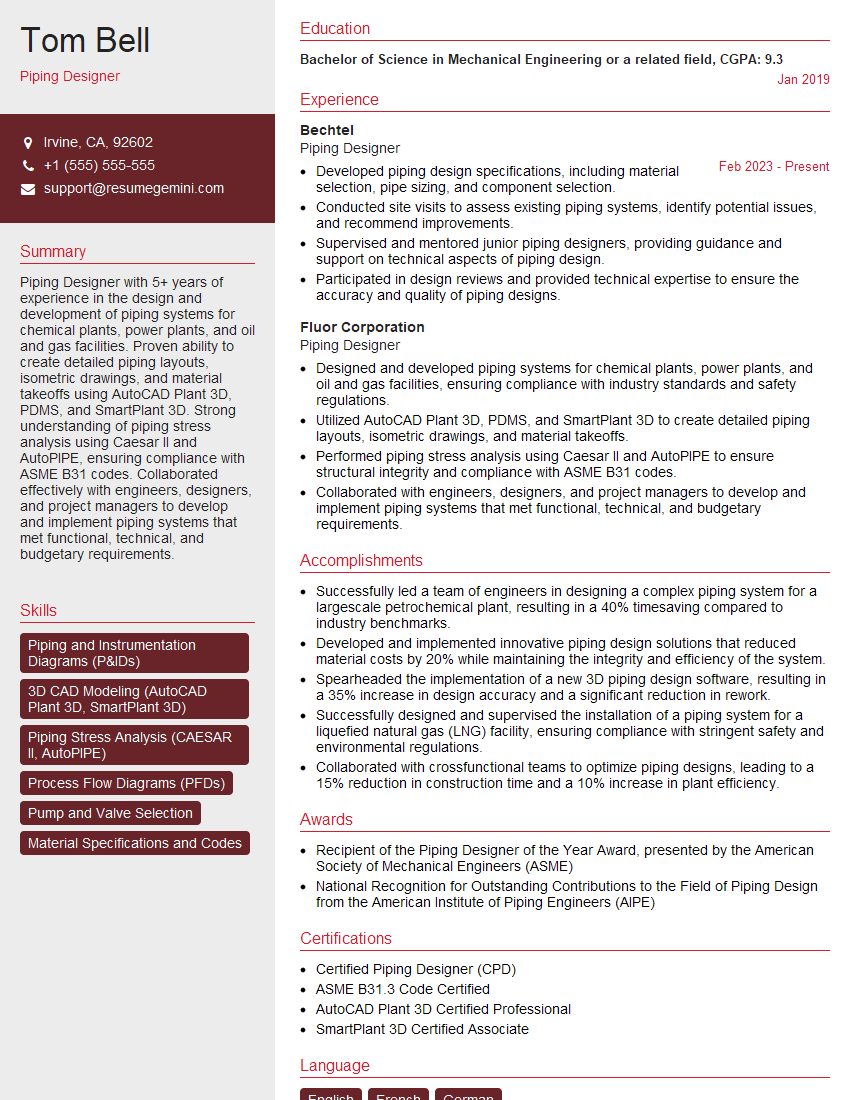
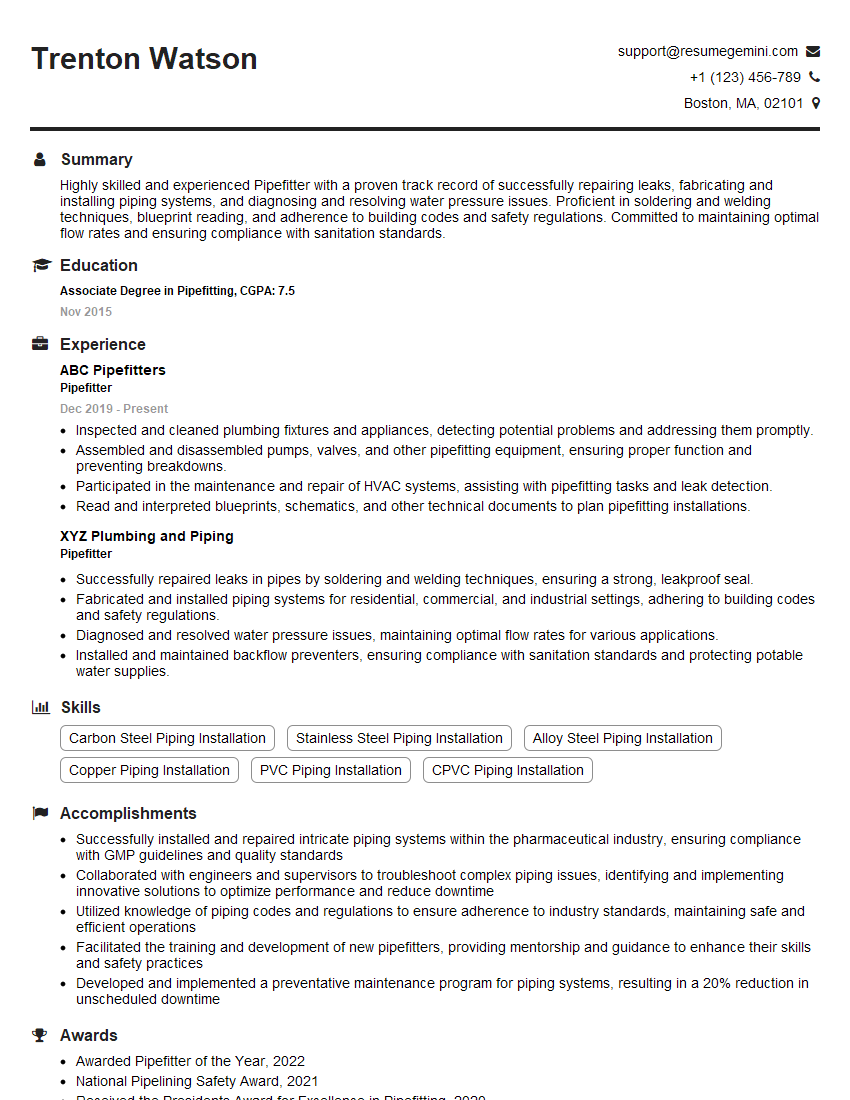
Mastering Pipe Layout and Installation opens doors to rewarding careers in construction, manufacturing, and infrastructure development. Your expertise in this field is highly valued, and continuous learning will further enhance your career prospects. To stand out to potential employers, it’s essential to present your skills effectively. Creating an ATS-friendly resume is crucial for maximizing your job search success. We recommend using ResumeGemini, a trusted resource for building professional resumes that get noticed. Examples of resumes tailored to Pipe Layout and Installation are provided to help guide you.
Explore more articles
Users Rating of Our Blogs
Share Your Experience
We value your feedback! Please rate our content and share your thoughts (optional).
What Readers Say About Our Blog
To the interviewgemini.com Webmaster.
Very helpful and content specific questions to help prepare me for my interview!
Thank you
To the interviewgemini.com Webmaster.
This was kind of a unique content I found around the specialized skills. Very helpful questions and good detailed answers.
Very Helpful blog, thank you Interviewgemini team.