Cracking a skill-specific interview, like one for Program Coordination, requires understanding the nuances of the role. In this blog, we present the questions you’re most likely to encounter, along with insights into how to answer them effectively. Let’s ensure you’re ready to make a strong impression.
Questions Asked in Program Coordination Interview
Q 1. Describe your experience in developing and managing program budgets.
Developing and managing program budgets requires a meticulous approach, starting with a thorough understanding of the project scope and objectives. I begin by collaborating with stakeholders to create a detailed budget breakdown, encompassing all anticipated costs – personnel, materials, software licenses, travel, and contingency funds. This isn’t just a simple list; it’s a dynamic document, regularly reviewed and updated. I utilize budgeting software to track expenses against the allocated budget, generating regular reports to identify potential overruns or underspends. For example, in my previous role at Acme Corp, we were managing a large-scale software implementation project. I created a detailed budget in Excel, categorizing expenses and incorporating a 15% contingency for unforeseen circumstances. This allowed us to successfully manage the project within the allocated budget despite encountering some unexpected challenges during development.
Furthermore, I implement robust tracking mechanisms, often employing project management software to monitor actual versus planned expenses. This allows for proactive adjustments, ensuring the project stays on track financially. Regular budget review meetings with stakeholders provide transparency and facilitate informed decision-making. This iterative process helps us stay ahead of potential financial problems and ensures the project’s financial viability.
Q 2. Explain your process for identifying and mitigating program risks.
Risk management is a critical aspect of program coordination. My process begins with a thorough risk assessment, identifying potential threats to the project’s timeline, budget, and quality. This often involves brainstorming sessions with the project team and key stakeholders. We use a structured approach, categorizing risks by likelihood and impact. I use a risk register to document each identified risk, along with its potential consequences and assigned mitigation strategies. Think of it like a weather forecast for your project; you’re not trying to stop the storms, but you’re preparing for them.
For instance, in a recent project involving multiple third-party vendors, the risk of vendor delays was identified as high. To mitigate this, we established clear service level agreements (SLAs) with each vendor, outlining penalties for non-compliance. We also built in buffer time into the project schedule to account for potential slippages. This proactive approach ensured that any vendor delays didn’t derail the entire program.
Regular risk monitoring is crucial. We continuously assess the risk landscape and adjust mitigation plans as needed. This dynamic approach ensures that the program remains resilient to unexpected challenges.
Q 3. How do you track program progress and report on key performance indicators (KPIs)?
Tracking program progress and reporting on KPIs is achieved through a combination of methods. First, we define clear, measurable, achievable, relevant, and time-bound (SMART) KPIs that align with the program’s overall objectives. These KPIs might include project milestones, budget adherence, resource utilization, and client satisfaction.
Then, I leverage project management software to monitor progress against these KPIs. This software often provides dashboards and reports that visualize progress, identifying potential roadblocks early on. For example, we might use a Gantt chart to visualize the project timeline and identify any task dependencies. Progress reports, generated weekly or bi-weekly, summarize performance against the KPIs, highlighting successes and areas needing attention. These reports are shared with stakeholders, facilitating transparency and enabling timely course corrections.
Finally, regular meetings and presentations offer a collaborative platform to review the data, discuss challenges, and brainstorm solutions. This iterative process ensures that the program stays on track and stakeholders remain informed.
Q 4. What methodologies (e.g., Agile, Waterfall) have you used in program coordination?
My experience encompasses both Agile and Waterfall methodologies, understanding their strengths and weaknesses, and adapting my approach based on the specific project requirements.
Waterfall, with its sequential phases, is well-suited for projects with clearly defined requirements and minimal anticipated changes. I have successfully used this methodology for projects with stable scopes and predictable timelines. On the other hand, Agile’s iterative approach, with its emphasis on flexibility and collaboration, is ideal for projects with evolving requirements or where rapid prototyping and feedback are crucial. I’ve used Scrum and Kanban frameworks within Agile projects, fostering collaborative teamwork and delivering value incrementally.
In reality, many projects benefit from a hybrid approach, combining elements of both methodologies. For example, we might use Waterfall for the initial planning and requirements gathering phases, then transition to Agile for the development and testing stages.
Q 5. Describe a time you had to manage competing priorities within a program.
In one project, we faced competing priorities related to budget constraints and the need to implement a new security feature. The original budget didn’t accommodate the added security enhancements, and delaying the feature posed a significant risk. To resolve this, I facilitated a prioritization workshop involving all stakeholders. We meticulously assessed the risks and benefits associated with each option, using a weighted scoring system to rank competing priorities.
The outcome was a revised budget that incorporated the security feature, achieved by slightly delaying some less critical elements of the project. Transparency and clear communication were paramount throughout the process, and open discussion allowed us to arrive at a mutually agreeable solution. This demonstrated that while sometimes tough choices need to be made, effective prioritization and stakeholder alignment can mitigate the impact of competing priorities.
Q 6. How do you ensure effective communication and collaboration among stakeholders?
Effective communication and collaboration among stakeholders are fundamental to successful program coordination. I employ a multi-faceted approach to ensure open and transparent communication. This starts with establishing clear communication channels – regular meetings, email updates, project management software, and shared documentation.
I also prioritize active listening and seek to understand the perspectives of all stakeholders. Regular status updates, combined with open forums for questions and concerns, keep everyone informed and engaged. In addition, I use visual tools like dashboards and progress reports to communicate complex information effectively. For instance, in a recent large-scale project, we used a dedicated communication platform to facilitate real-time updates and discussions among the team and external stakeholders, promoting a collaborative environment.
Furthermore, I actively foster a culture of trust and mutual respect among team members and stakeholders, recognizing that collaborative efforts are crucial for project success.
Q 7. How do you handle scope creep in a program?
Scope creep, the uncontrolled expansion of a project’s scope, is a common challenge. My approach focuses on proactive prevention and reactive management. Prevention starts with a well-defined scope statement, clearly outlining the deliverables and boundaries of the project. This statement should be approved and signed off by all key stakeholders at the beginning of the project.
During the project lifecycle, change requests are carefully evaluated. A formal change control process is implemented, requiring requests to be documented, assessed for impact on budget, schedule, and quality, and approved by the appropriate authorities before being incorporated into the project. This process provides a structured mechanism to manage change, preventing uncontrolled expansion.
If scope creep does occur despite preventive measures, I work with stakeholders to understand the reasons behind the request, assess its impact, and negotiate a solution that balances the needs of all parties. This might involve adjusting the project schedule, budget, or even re-evaluating the project’s priorities.
Q 8. Explain your experience with program planning and scheduling tools.
Program planning and scheduling are crucial for successful program execution. My experience spans various tools, from traditional Gantt charts to sophisticated project management software like Microsoft Project, Jira, and Asana. I’ve used Gantt charts to visualize project timelines, dependencies, and critical paths, particularly useful for smaller, simpler programs. For larger, more complex programs with multiple teams and intricate dependencies, I’ve leveraged software like Jira and Asana for their robust task management, collaboration, and reporting features. For example, in a recent software implementation project, we used Jira to track individual tasks, assign them to team members, monitor progress, and identify potential bottlenecks. The software’s reporting capabilities allowed us to create detailed progress reports, identify risks, and proactively address potential delays. My proficiency extends to understanding and applying Agile methodologies, using tools like Scrum boards to manage sprints and iterative development cycles. This flexible approach proves invaluable when dealing with evolving requirements.
Q 9. How do you measure the success of a program?
Measuring program success goes beyond simply completing tasks on time and within budget. It involves a holistic assessment against predefined objectives and key results (OKRs). I use a multi-faceted approach. Firstly, I assess whether the program achieved its stated goals. This might involve quantifiable metrics like increased sales, improved customer satisfaction, or reduced operational costs. Secondly, I analyze efficiency indicators such as adherence to the budget, schedule completion, and resource utilization. Thirdly, I evaluate the program’s impact on stakeholders, considering their satisfaction and perceived value. For instance, in a recent organizational change management program, success was measured not just by the successful implementation of new software but also by employee adoption rates, a reduction in help desk tickets related to the new software, and positive feedback from employee surveys. Qualitative data, such as feedback from interviews and surveys, is just as important as quantitative data in understanding the overall effectiveness and impact of a program.
Q 10. Describe your experience in stakeholder management.
Stakeholder management is paramount in program coordination. My experience involves proactively identifying, analyzing, and engaging all stakeholders, from senior management to end-users. I use various techniques, including regular communication meetings, surveys, and one-on-one discussions, to understand their needs, expectations, and concerns. I build strong relationships based on trust and transparency, keeping stakeholders informed about progress, challenges, and potential risks. For example, in a large-scale infrastructure project, I established a regular communication cadence with stakeholders, including weekly email updates and monthly face-to-face meetings to ensure everyone remained aligned and informed throughout the project lifecycle. I documented stakeholder expectations and communication plans to ensure consistent messaging and address their concerns promptly and effectively.
Q 11. How do you manage conflicts between different stakeholders?
Conflicts among stakeholders are inevitable in complex programs. My approach involves a structured process aimed at facilitating constructive dialogue and finding mutually agreeable solutions. I begin by actively listening to each stakeholder to understand their perspectives and the root cause of the conflict. Then, I use a collaborative approach, facilitating meetings where stakeholders can openly discuss their concerns in a safe and respectful environment. Mediation techniques, such as focusing on shared interests and finding common ground, are often employed. If necessary, I will escalate the issue to a higher level of management for resolution. For example, in a project involving multiple departments with competing priorities, I facilitated a series of workshops to identify the key areas of disagreement and collaboratively develop a compromise that met the needs of all stakeholders, although it required some creative scheduling and resource allocation. Documenting the agreements and the resolution process is also key to preventing future conflicts.
Q 12. How do you ensure program compliance with relevant regulations?
Ensuring program compliance is a critical responsibility. This involves understanding and adhering to all relevant regulations, industry standards, and internal policies. I establish a compliance framework from the outset of the project, identifying all applicable regulations and incorporating compliance requirements into the program plan. Regular audits and reviews are conducted to monitor compliance, and any deviations are addressed promptly and effectively. For instance, in a project involving the handling of sensitive personal data, I ensured strict adherence to data privacy regulations such as GDPR and CCPA, implementing robust data security measures and conducting regular data privacy audits. I also developed and implemented a comprehensive compliance training program for all project team members.
Q 13. Describe your experience with program documentation and reporting.
Comprehensive program documentation and reporting are essential for transparency, accountability, and knowledge transfer. My approach involves maintaining detailed records of all program activities, including meeting minutes, decisions made, risks identified, and actions taken. This documentation is used to create regular reports for stakeholders, providing updates on progress, issues, and potential risks. Reporting formats vary depending on the audience and the purpose of the report. For example, I might create a concise executive summary for senior management and more detailed technical reports for the project team. I use a variety of tools, including project management software and document management systems, to ensure that documentation is organized, accessible, and easily searchable. Furthermore, I create a comprehensive project closeout report, which summarizes the project’s achievements, lessons learned, and recommendations for future projects.
Q 14. How do you handle changes in program requirements?
Change is inevitable in project management. My approach to managing changes in program requirements involves a formal change management process. This includes assessing the impact of the change request on the project scope, schedule, and budget. A formal change request form is used to document all changes, which are then reviewed and approved by relevant stakeholders. If approved, the change is incorporated into the project plan, and any necessary adjustments to the schedule, budget, and resources are made. The impact of the change is carefully analyzed, and the stakeholders are informed of the updated project plan. Transparency and communication are key to managing change effectively, keeping stakeholders informed and involved in the decision-making process. For example, a recent project experienced a significant change in customer requirements midway through the development process. By using a formal change request process and transparent communication, we successfully incorporated the changes while minimizing disruption to the project timeline and budget.
Q 15. What is your experience with resource allocation in program management?
Resource allocation in program management is the strategic process of assigning and managing various resources—human, financial, technological, and material—across different projects within a larger program. It’s like being an orchestra conductor, ensuring each instrument (resource) plays its part harmoniously to create a beautiful symphony (successful program). My experience involves developing resource allocation plans, using tools like resource leveling techniques and critical path analysis to optimize resource utilization and minimize conflicts. For instance, in a recent software development program, I identified a bottleneck in testing resources. By reallocating testers across projects based on priority and skillset, I managed to avoid significant delays and stay within budget.
I’ve also used resource allocation matrices and Gantt charts to visualize resource availability and project needs, ensuring transparency and accountability across teams. Effective allocation requires continuous monitoring and adjustment based on actual performance and evolving project needs. I regularly review resource utilization reports to identify potential over-allocation or under-allocation issues and proactively address them before they negatively impact the program’s timeline or budget.
Career Expert Tips:
- Ace those interviews! Prepare effectively by reviewing the Top 50 Most Common Interview Questions on ResumeGemini.
- Navigate your job search with confidence! Explore a wide range of Career Tips on ResumeGemini. Learn about common challenges and recommendations to overcome them.
- Craft the perfect resume! Master the Art of Resume Writing with ResumeGemini’s guide. Showcase your unique qualifications and achievements effectively.
- Don’t miss out on holiday savings! Build your dream resume with ResumeGemini’s ATS optimized templates.
Q 16. Describe your experience with program evaluation and improvement.
Program evaluation and improvement is a continuous cycle of assessing the program’s performance against its objectives, identifying areas for enhancement, and implementing changes to achieve better results. Think of it as regularly checking your car’s engine to ensure it runs smoothly. My approach involves establishing clear key performance indicators (KPIs) aligned with program goals. These KPIs are then tracked using various metrics, such as project completion rates, budget adherence, stakeholder satisfaction, and overall program effectiveness. I employ data analysis techniques to identify trends and potential areas of improvement.
For example, in a previous project focusing on employee training, I discovered through analysis that online modules were less effective than instructor-led training. By incorporating more in-person sessions and adapting the training materials, we saw a significant improvement in employee engagement and knowledge retention. This iterative approach of evaluation and improvement is crucial to maintaining program relevance and achieving optimal outcomes. Regular feedback sessions with stakeholders also play a key role in identifying areas for improvement.
Q 17. How do you utilize project management software in program coordination?
Project management software is indispensable for program coordination. It serves as a central hub for managing tasks, resources, communication, and documentation across multiple projects. I utilize software like Microsoft Project, Jira, or Asana to create and manage program timelines, assign tasks to individuals or teams, track progress, and manage risks. These tools enable real-time collaboration, allowing for easy sharing of information and updates amongst team members.
For example, using Jira’s Kanban boards, we can visualize the workflow of various tasks across projects, identify potential bottlenecks, and adjust the workflow accordingly. Similarly, the reporting features in these tools provide valuable insights into resource utilization, budget tracking, and project completion rates, empowering data-driven decision-making. The use of such platforms ensures transparency and promotes better communication within the program team.
Q 18. Explain your experience with creating and maintaining program timelines.
Creating and maintaining program timelines involves developing a high-level schedule that encompasses all projects within the program, their dependencies, and critical milestones. I typically start by breaking down the program into its constituent projects and defining their objectives, deliverables, and dependencies. This can be illustrated using a Work Breakdown Structure (WBS) and then translated into a visual timeline using tools like Gantt charts or project management software. Critical path analysis is crucial to identify activities that are critical to the program’s success and require careful monitoring.
Maintaining the timeline involves regularly reviewing progress against the plan, adjusting the schedule based on any delays or changes in scope, and communicating these updates to all stakeholders. This may involve risk mitigation strategies, such as identifying potential delays and developing contingency plans. For example, I once used a phased rollout approach for a large program to manage risks associated with releasing all components simultaneously. This flexibility in managing timelines is key to successful program execution.
Q 19. How do you prioritize tasks within a program?
Prioritizing tasks within a program requires a structured approach that considers urgency, importance, and dependencies. I use various prioritization techniques such as MoSCoW method (Must have, Should have, Could have, Won’t have), Eisenhower Matrix (Urgent/Important), and value vs. effort matrix to rank tasks effectively. This ensures that the most critical tasks that directly contribute to program success are tackled first.
For example, using the MoSCoW method, we can clearly identify the essential features of a software program (Must have) and postpone non-essential ones (Could have or Won’t have) to manage scope and deliver a successful minimum viable product. Continuous monitoring and reassessment of priorities are crucial, as project needs and business priorities can evolve over time. This flexible approach ensures the program stays aligned with changing circumstances.
Q 20. Describe your approach to problem-solving in a program coordination context.
My approach to problem-solving in program coordination is systematic and data-driven. I begin by clearly defining the problem, gathering relevant information from various stakeholders, and analyzing the root cause. This often involves root cause analysis tools such as the 5 Whys technique or fishbone diagrams. Once the root cause is identified, I develop potential solutions, evaluating their feasibility and impact, before selecting the most effective approach. This may involve collaborating with cross-functional teams to brainstorm and implement the solution.
For instance, facing a budget overrun in a previous program, I initiated a thorough cost analysis, identified inefficiencies in resource allocation, and proposed a plan for improved resource management and cost optimization. This included renegotiating contracts with vendors and optimizing resource utilization. Regular follow-up and monitoring are vital to ensure the chosen solution is effective and sustainable, preventing similar problems from recurring.
Q 21. How do you monitor and control program costs?
Monitoring and controlling program costs requires a proactive approach that involves establishing a detailed budget, tracking expenses against the budget, and implementing corrective measures when necessary. I use various cost control techniques such as Earned Value Management (EVM) to track progress and forecast future costs, and variance analysis to pinpoint areas of overspending or underspending. Regular budget reviews are crucial to identify potential cost overruns early and to implement corrective actions before they escalate.
For example, I use EVM to regularly compare planned costs with actual costs and the work completed. This helps in identifying potential cost variances and taking timely corrective actions. Transparent and frequent communication with stakeholders about the budget status is crucial for managing expectations and ensuring buy-in. This proactive approach, coupled with robust monitoring mechanisms, is fundamental for keeping the program financially viable and ensuring that resources are effectively utilized.
Q 22. Explain your experience with building and maintaining relationships with vendors.
Building and maintaining strong vendor relationships is crucial for successful program coordination. It’s about more than just procurement; it’s about fostering collaboration and trust. My approach involves several key steps:
- Proactive Communication: I prioritize open and transparent communication throughout the vendor lifecycle. This includes regular check-ins, clear expectations setting during contract negotiations, and timely feedback on performance.
- Relationship Building: I invest time in getting to know key contacts at vendor organizations, understanding their capabilities, and building rapport. This allows for more effective problem-solving and a stronger partnership.
- Performance Management: I establish clear Key Performance Indicators (KPIs) and regularly monitor vendor performance against those metrics. This ensures accountability and allows for timely intervention if issues arise. This also involves documenting performance consistently.
- Conflict Resolution: When disagreements or issues occur, I approach them constructively, focusing on finding mutually beneficial solutions rather than assigning blame. This often involves mediation and collaborative problem-solving.
For example, in a previous role, I managed a complex software implementation project. By proactively communicating project updates and collaborating closely with the vendor, we successfully navigated several unexpected challenges, delivering the project on time and within budget. A key element was our regular joint problem-solving sessions. This open approach avoided small issues escalating to large problems, saving both time and money.
Q 23. Describe a challenging program you managed and how you overcame the challenges.
One particularly challenging program involved the rollout of a new customer relationship management (CRM) system across multiple international offices. The challenge stemmed from a combination of factors: differing regional regulations, varying levels of technical expertise across teams, and a tight deadline.
To overcome these challenges, I employed a phased rollout approach, starting with a pilot program in a single office. This allowed us to identify and resolve potential issues before a full-scale deployment. I also established a robust communication plan, using regular updates, training sessions, and dedicated support channels to keep everyone informed and engaged. Furthermore, I leveraged project management software to track progress, manage risks, and ensure accountability.
A critical aspect was identifying and addressing resistance to change. I organized workshops and training sessions to help staff understand the benefits of the new system and provide them with the necessary skills to use it effectively. This proactive approach mitigated resistance and ensured smoother adoption.
Q 24. How do you ensure data accuracy and integrity in program reporting?
Data accuracy and integrity are paramount in program reporting. I employ several strategies to ensure this:
- Data Validation: I implement rigorous data validation procedures at every stage of data collection and processing. This includes checks for completeness, consistency, and accuracy.
- Source Control: Maintaining clear documentation of data sources and their provenance is critical. This ensures traceability and allows for auditing.
- Version Control: Using version control for data and reports ensures that there is a clear record of changes and that different versions are easily accessible.
- Automated Checks: Where possible, I automate data validation checks using scripting or dedicated data quality tools. This reduces the risk of human error and improves efficiency.
- Regular Audits: Periodic audits of data and reporting processes help identify and address potential inconsistencies or errors. This includes internal reviews and potentially external audits.
For instance, in a previous project, we used automated scripting to cross-reference data from multiple sources. This significantly reduced errors and increased the reliability of our reports.
Q 25. Explain your experience with program closeout procedures.
Program closeout procedures are essential for ensuring a smooth transition and preventing future issues. My experience encompasses:
- Final Reporting: Creating comprehensive final reports that summarize project accomplishments, challenges faced, lessons learned, and a final budget analysis.
- Documentation Archiving: Systematically archiving all relevant project documents, including contracts, correspondence, and reports, in a secure and accessible location. This helps with future reference.
- Financial Closure: Ensuring all financial transactions are reconciled, outstanding invoices are paid, and any remaining funds are returned or transferred appropriately.
- Vendor Closure: Formalizing the end of vendor contracts, settling all outstanding payments, and obtaining necessary documentation, like final performance reports.
- Team Demobilization: Managing the transition of team members to new projects or roles, ensuring a smooth handover and acknowledging contributions.
Proper closure is like tying up loose ends after completing a complex puzzle; it ensures a clean and organized end to the project and supports future knowledge reuse.
Q 26. What is your experience with developing and implementing program communication plans?
Developing and implementing effective communication plans is integral to successful program management. My approach is multifaceted:
- Stakeholder Analysis: I begin by identifying all key stakeholders and understanding their communication preferences and needs. This could involve surveys or one-on-one conversations.
- Channel Selection: I select appropriate communication channels, such as email, meetings, newsletters, project management software, and presentations, to reach different stakeholder groups effectively.
- Message Development: I craft clear, concise, and consistent messages that are tailored to the audience and the purpose of the communication. This ensures accurate information and clear understanding.
- Frequency & Timing: I establish a communication schedule and adhere to it consistently. Regular updates keep stakeholders informed and prevent misunderstandings.
- Feedback Mechanisms: I incorporate feedback mechanisms, such as surveys and feedback forms, to assess the effectiveness of the communication plan and make adjustments as needed.
In a past project, we used a combination of weekly email updates, monthly team meetings, and a dedicated project portal to keep all stakeholders informed. This multi-channel strategy ensured everyone was kept in the loop efficiently.
Q 27. How do you use data analysis to inform program decision-making?
Data analysis is essential for informed decision-making in program management. I use data to:
- Track Progress: I use data to monitor project progress against the planned schedule and budget, identifying potential risks or delays early on.
- Identify Trends: Data analysis helps uncover patterns and trends that can inform strategies for improvement and optimization.
- Evaluate Performance: Data allows for the objective evaluation of program performance against key performance indicators (KPIs), highlighting areas of strength and weakness.
- Resource Allocation: Data-driven insights aid in allocating resources efficiently, maximizing productivity and minimizing waste.
- Risk Management: Analyzing data can help identify and assess potential risks, allowing for proactive mitigation strategies.
For example, by analyzing project task completion data, I was able to identify a bottleneck in the workflow and implement changes that improved efficiency and met the deadline.
Q 28. Describe your experience with training and mentoring junior team members.
I have extensive experience in training and mentoring junior team members. My approach is based on:
- On-the-Job Training: I provide hands-on training and guidance, allowing junior team members to learn by doing and gain practical experience.
- Mentorship: I act as a mentor, providing support and guidance beyond technical training. This often involves career development discussions and helping them navigate workplace challenges.
- Feedback & Coaching: I provide regular feedback, both positive and constructive, to help team members improve their skills and performance. This is ongoing and integrated into daily work.
- Knowledge Sharing: I encourage knowledge sharing among team members through workshops, training sessions, and informal mentoring.
- Delegation & Empowerment: I delegate tasks appropriately, empowering junior team members to take on increasing responsibility and develop their skills.
I find that investing time in training and mentoring not only improves the skills of individual team members, but also boosts team morale and overall project success. I believe in building a culture of learning and development within the team.
Key Topics to Learn for Program Coordination Interview
- Project Management Fundamentals: Understanding project lifecycles, methodologies (Agile, Waterfall), and risk management strategies. Practical application: Describe your experience managing multiple projects simultaneously, highlighting your approach to prioritization and resource allocation.
- Stakeholder Management: Effectively communicating with and managing expectations of various stakeholders (clients, team members, management). Practical application: Provide examples demonstrating your ability to navigate conflicting priorities and build consensus among diverse groups.
- Budgeting and Resource Allocation: Developing and managing program budgets, allocating resources efficiently, and tracking expenses. Practical application: Explain how you’ve monitored budget performance and addressed potential overruns in past projects.
- Communication and Collaboration: Utilizing various communication tools and techniques to foster effective teamwork and information sharing. Practical application: Describe your experience leading or participating in cross-functional teams and ensuring seamless communication flow.
- Problem-Solving and Decision-Making: Identifying and resolving program challenges, making timely and informed decisions under pressure. Practical application: Share an example where you successfully navigated a complex issue or unexpected challenge within a program.
- Program Evaluation and Reporting: Tracking program progress, measuring key performance indicators (KPIs), and preparing insightful reports for stakeholders. Practical application: Discuss your experience creating reports that effectively communicate program performance and identify areas for improvement.
- Technology Proficiency: Familiarity with project management software (e.g., Asana, Trello, Microsoft Project) and other relevant tools. Practical application: Highlight your proficiency in specific software and explain how these tools have aided your program coordination efforts.
Next Steps
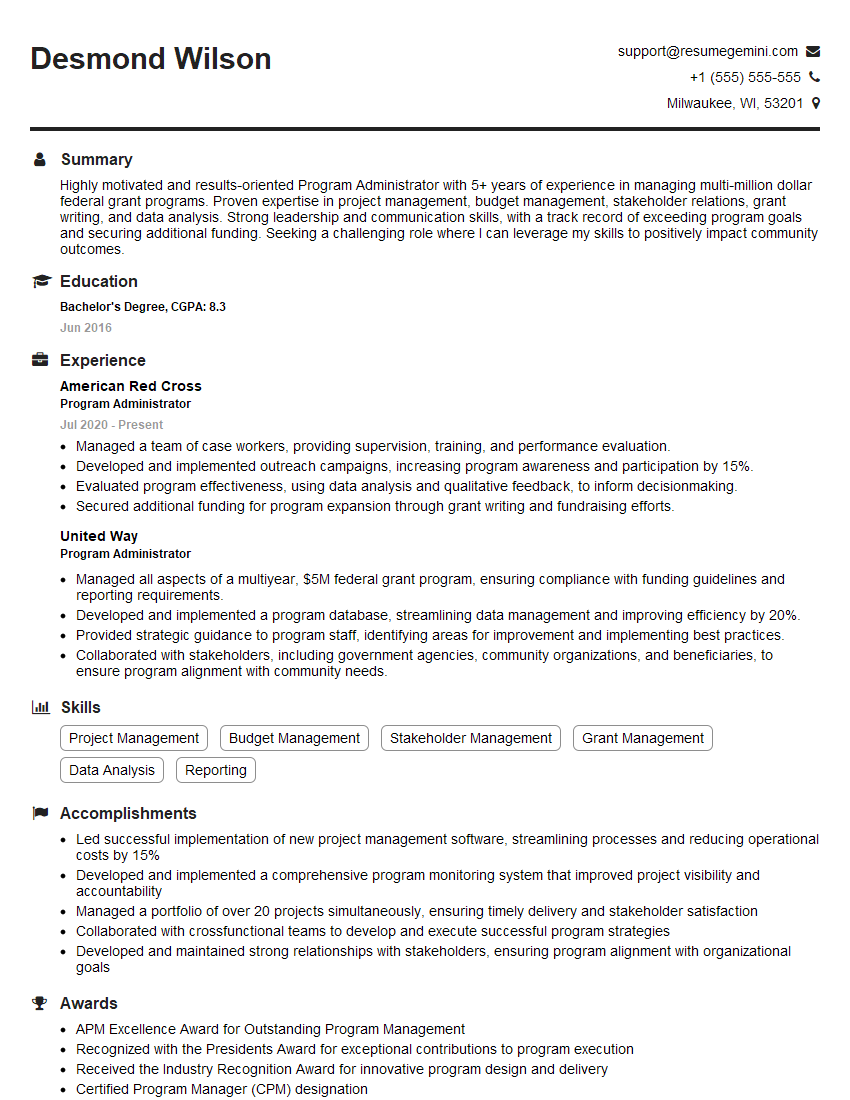
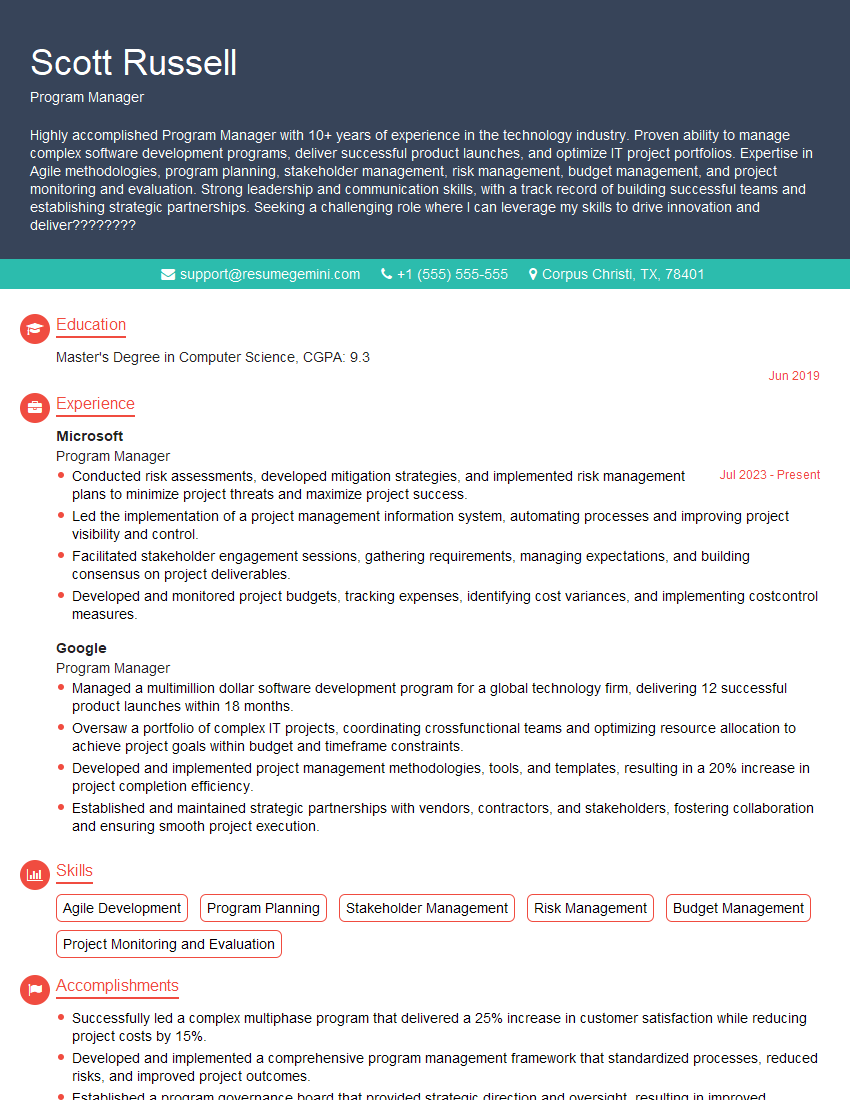
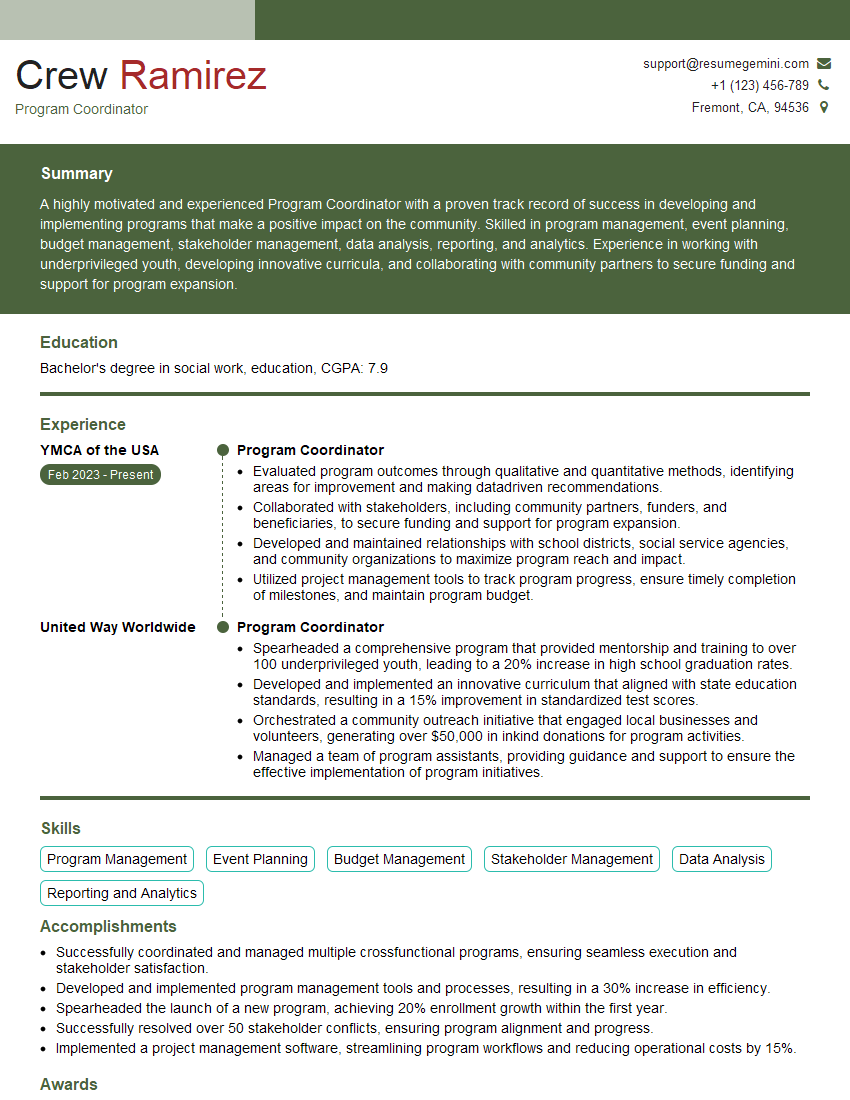
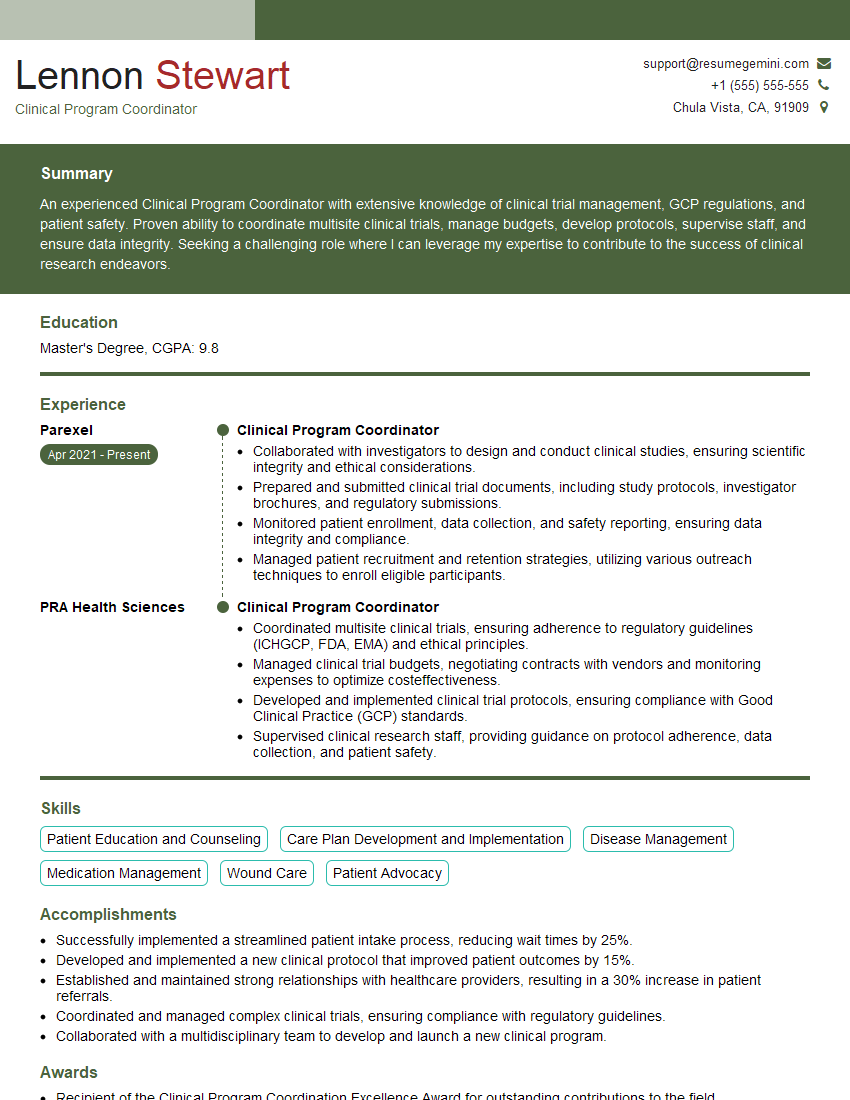
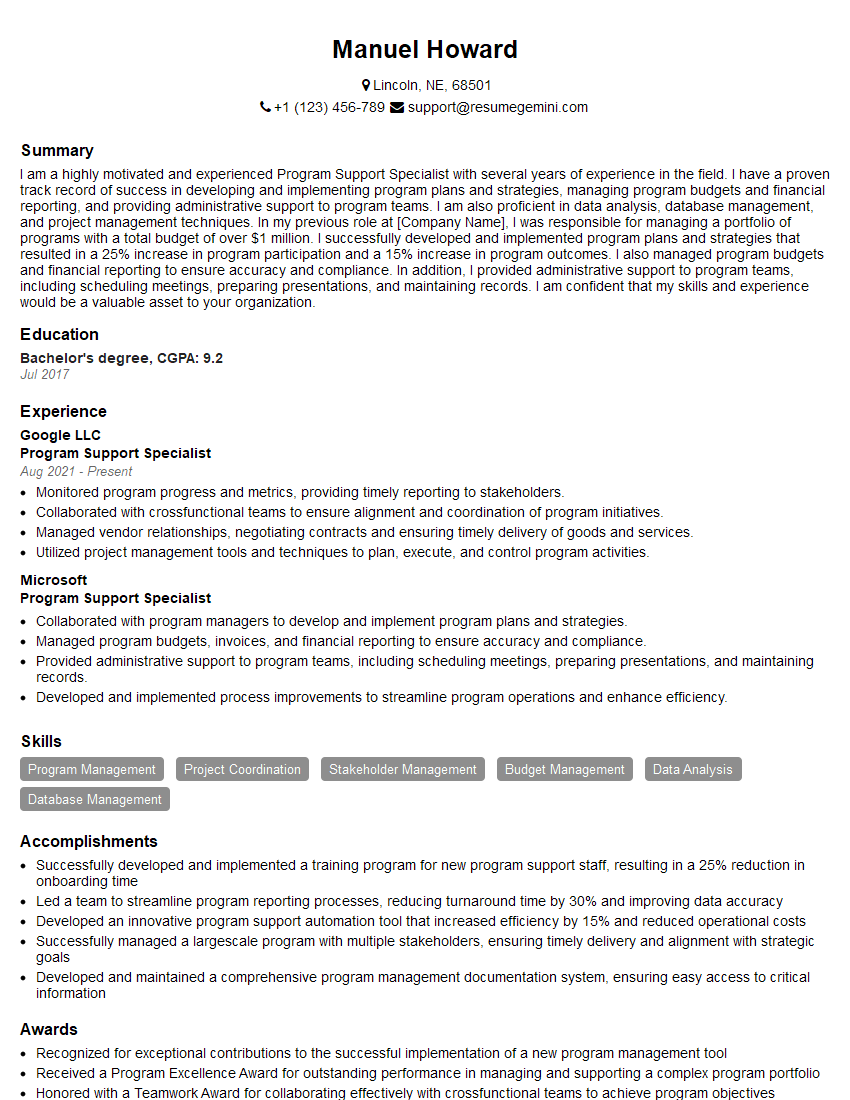
Mastering Program Coordination opens doors to exciting career advancements, offering opportunities for leadership, increased responsibility, and higher earning potential. To significantly boost your job prospects, crafting an ATS-friendly resume is crucial. ResumeGemini is a trusted resource that can help you build a professional and impactful resume designed to get noticed by recruiters. We provide examples of resumes tailored to Program Coordination to guide you. Take advantage of these resources to present your skills and experience in the best possible light and secure your dream role.
Explore more articles
Users Rating of Our Blogs
Share Your Experience
We value your feedback! Please rate our content and share your thoughts (optional).
What Readers Say About Our Blog
To the interviewgemini.com Webmaster.
Very helpful and content specific questions to help prepare me for my interview!
Thank you
To the interviewgemini.com Webmaster.
This was kind of a unique content I found around the specialized skills. Very helpful questions and good detailed answers.
Very Helpful blog, thank you Interviewgemini team.