Interviews are more than just a Q&A session—they’re a chance to prove your worth. This blog dives into essential Restaurant Technology interview questions and expert tips to help you align your answers with what hiring managers are looking for. Start preparing to shine!
Questions Asked in Restaurant Technology Interview
Q 1. Describe your experience with different POS (Point of Sale) systems.
My experience with POS systems spans a wide range, from legacy systems like Micros to modern cloud-based solutions like Toast and Square. I’ve worked with both hardware and software aspects, including setup, configuration, troubleshooting, and staff training. For instance, I implemented a Toast POS system in a high-volume cafe, optimizing its features for table management, order modifications, and inventory tracking. In another project, I migrated a restaurant from a dated Micros system to a cloud-based POS, resulting in a significant improvement in reporting accuracy and operational efficiency. This involved data migration, staff retraining, and close collaboration with the restaurant owners to ensure a seamless transition.
- Micros Simphony: Experienced in its robust functionalities, but acknowledged its limitations in terms of scalability and integration with modern tools.
- Toast POS: Proficient in its user-friendly interface, reporting features, and online ordering capabilities. I particularly appreciate its ability to seamlessly integrate with various third-party applications.
- Square POS: Familiarity with its ease of use and affordability, making it suitable for smaller restaurants or those starting out.
Q 2. Explain your understanding of cloud-based restaurant management systems.
Cloud-based restaurant management systems offer significant advantages over on-premise systems. They eliminate the need for expensive, on-site servers, simplify software updates, and facilitate remote access and management. Think of it like having your restaurant’s central nervous system in the cloud, accessible from anywhere with an internet connection. Popular examples include Toast, Lightspeed, and 7shifts. These systems typically offer a suite of integrated tools, including POS, inventory management, online ordering, employee scheduling, and reporting. A key benefit is real-time data access, enabling quick decision-making based on up-to-the-minute sales figures and inventory levels. For example, if a particular item consistently sells out, a manager can quickly adjust the ordering schedule, minimizing potential lost revenue.
Data security is paramount, and reputable cloud providers invest heavily in robust security measures to protect sensitive restaurant data. However, choosing a provider with a strong security track record and understanding the data security policies is crucial. Regular software updates also ensure that the system is protected against the latest cyber threats.
Q 3. How familiar are you with restaurant industry-specific software integrations?
I possess extensive experience integrating various restaurant-specific software solutions. This involves understanding APIs (Application Programming Interfaces), data mapping, and troubleshooting integration issues. I’ve successfully integrated POS systems with online ordering platforms (like Uber Eats, DoorDash, Grubhub), reservation systems (OpenTable, Resy), accounting software (QuickBooks, Xero), and loyalty programs. A recent project involved integrating a POS with a third-party kitchen display system (KDS), streamlining order routing and improving kitchen efficiency. The integration process usually involves careful planning, testing, and close collaboration with the vendors of different software platforms to ensure seamless data flow and optimal functionality. Without proper integration, data silos emerge, hindering efficient operations and analysis.
Q 4. What are the key performance indicators (KPIs) you would monitor in a restaurant’s technology infrastructure?
The key performance indicators (KPIs) I’d monitor in a restaurant’s technology infrastructure are diverse and depend on the specific goals. However, some critical ones include:
- POS System Uptime: Measures the percentage of time the POS system is operational. Downtime directly impacts sales and customer satisfaction.
- Average Order Value (AOV): Indicates the average amount spent per order, helping to identify potential upselling opportunities.
- Online Ordering Conversion Rate: Tracks the percentage of website visitors who complete an online order. This KPI reveals the effectiveness of the online ordering system.
- Customer Churn Rate: Measures the percentage of customers who stop ordering or visiting. This KPI highlights potential issues with service or other aspects of the business.
- Inventory Turnover Rate: Indicates how quickly inventory is sold. A low rate may suggest overstocking or slow-moving items.
- Employee Engagement (through time tracking and scheduling systems): Effective scheduling reduces labor costs while ensuring sufficient staffing levels.
- Transaction Speed: Monitors the time it takes to complete a transaction. Slow transaction times can lead to longer wait times and customer dissatisfaction.
These KPIs provide valuable insights into the restaurant’s operational efficiency, customer behavior, and overall financial performance. Regular monitoring and analysis allow for proactive adjustments to improve the restaurant’s technology infrastructure and profitability.
Q 5. Describe your experience with data analytics in the restaurant industry.
My experience with data analytics in the restaurant industry involves leveraging data from various sources—POS systems, online ordering platforms, reservation systems, and customer relationship management (CRM) systems—to extract valuable business insights. This includes using tools like SQL, Excel, and data visualization platforms (Tableau, Power BI) to analyze sales trends, customer preferences, menu item popularity, and marketing campaign effectiveness. For instance, I helped a client identify peak hours and slow periods by analyzing POS data, enabling them to optimize staffing levels and reduce labor costs. By examining customer order history, we identified popular meal combinations and created targeted marketing campaigns to increase sales of those items. Data analysis also helps restaurants understand customer demographics, preferences, and buying habits, enabling them to personalize their services and improve customer loyalty.
Q 6. How would you troubleshoot a POS system malfunction during peak hours?
Troubleshooting a POS system malfunction during peak hours requires a systematic and efficient approach. My first step is to assess the nature and scope of the problem. Is it affecting all terminals or just one? Are there any error messages? This initial assessment helps prioritize the solution. I would then follow these steps:
- Immediately switch to offline mode (if possible): This ensures that the restaurant can continue accepting orders, though perhaps with limited functionality. Think of this as activating a backup system.
- Contact the POS provider’s support line: Many providers offer 24/7 support, which is crucial for immediate assistance during peak times.
- Check internet connectivity: A simple internet outage could be the culprit. If this is the issue, coordinate with the internet service provider.
- Restart the POS terminals: A simple reboot can often resolve minor glitches.
- Check for hardware issues: Inspect cables, printers, and other hardware components for any physical damage or loose connections.
- Implement a temporary manual system: As a last resort, a temporary manual order-taking system (e.g., pen and paper) can help maintain service until the POS is back online. This mitigates the negative impact on customer experience.
During troubleshooting, it’s vital to keep customers informed, minimize disruption, and work quickly to restore full functionality. Effective communication and a well-defined troubleshooting process are critical for minimizing downtime during peak hours.
Q 7. What is your experience with online ordering platforms and their integration with POS systems?
I have extensive experience integrating online ordering platforms with POS systems. This integration streamlines order management, reduces manual data entry, and improves efficiency. It’s like having a direct pipeline connecting online orders to the kitchen and accounting systems. I’ve worked with various platforms such as Uber Eats, DoorDash, Grubhub, and also custom-built online ordering systems. The integration process typically involves using APIs to exchange order details between the platforms. Data such as order items, customer information, and payment details is exchanged in real-time, ensuring accuracy and eliminating discrepancies. Proper integration is key to managing online orders efficiently, avoiding errors, and ensuring a smooth experience for both customers and staff. For example, one project involved developing a custom integration that automated order routing to the kitchen display system, improving order fulfillment speed and accuracy.
Q 8. Explain your knowledge of restaurant-specific cybersecurity threats and mitigation strategies.
Restaurant cybersecurity threats are unique because they target sensitive data like customer payment information, employee records, and proprietary recipes. These threats can come in many forms, from malware infections targeting POS systems to phishing attacks targeting employees with access to sensitive information. Data breaches can lead to significant financial losses, reputational damage, and legal repercussions.
Mitigation strategies require a multi-layered approach. This includes regularly updating software on all systems (POS, payment terminals, computers), implementing strong password policies and multi-factor authentication, establishing robust network security with firewalls and intrusion detection systems, and regularly backing up data to secure off-site locations. Employee training is crucial – educating staff about phishing scams, malware, and safe data handling practices is paramount. Regular security audits and penetration testing can proactively identify vulnerabilities before they are exploited. Finally, choosing vendors with strong security reputations and compliant systems is key. For example, regularly patching your POS system to address known vulnerabilities is as important as regularly updating antivirus software on all connected devices.
Q 9. How would you manage a project to implement a new restaurant technology system?
Implementing a new restaurant technology system requires a structured approach. I would use a phased project management methodology, like Agile, to ensure flexibility and iterative progress. The project would begin with a detailed needs assessment, identifying specific requirements and goals. This includes selecting the right technology to match the restaurant’s size, menu, and operational style. Next, a detailed project plan is created, defining tasks, timelines, and resource allocation. This includes defining key performance indicators (KPIs) to measure success.
The implementation phase would involve system setup, data migration, staff training, and testing. Throughout the process, regular communication with all stakeholders (staff, management) is crucial. Post-implementation, we would monitor system performance, address any bugs, and provide ongoing support. For example, introducing a new POS system would require phased rollout across different locations, with thorough staff training and a dedicated support team to address immediate issues. Constant feedback loops would ensure the system is performing as expected and adapting to the needs of the restaurant.
Q 10. Describe your experience with restaurant inventory management systems.
My experience with restaurant inventory management systems includes implementing and managing several different systems, ranging from simple spreadsheets to sophisticated cloud-based solutions. These systems are vital for efficient restaurant operations, helping to reduce food waste, manage costs, and optimize ordering practices. I understand the importance of real-time tracking of ingredients, accurate forecasting based on historical sales data, and integration with POS systems for automated inventory updates. I’ve worked with systems that incorporate features like automated ordering from suppliers based on pre-defined thresholds, minimizing manual ordering and potential stockouts. A good inventory management system allows restaurants to track profitability at the item level, enabling data-driven decisions on menu pricing and ingredient sourcing.
For instance, I helped a client implement a system that integrated their POS data with their inventory, automatically adjusting stock levels based on actual sales. This reduced their food waste by 15% within six months. Another example involved optimizing a smaller restaurant’s inventory using a spreadsheet-based system customized for their needs, demonstrating the effectiveness of simple systems for smaller establishments.
Q 11. How do you ensure data integrity and security in a restaurant’s technology environment?
Data integrity and security are fundamental to a restaurant’s technological environment. This requires a combination of technical and procedural measures. Technically, this includes using secure databases with robust encryption, implementing access control mechanisms to limit who can access what data, and regularly backing up data to prevent data loss. Procedurally, this includes establishing clear data handling policies, providing thorough employee training on data security best practices, and enforcing strong password policies, as well as implementing regular security audits to identify and address vulnerabilities. PCI DSS compliance (for payment card data) is crucial, necessitating specific security measures to protect customer credit card information.
For example, a restaurant using a cloud-based POS system should ensure the vendor adheres to stringent security standards and employs robust data encryption. Implementing regular security awareness training for staff, including simulated phishing attacks to test their awareness, is also essential. A layered approach combining strong technical controls with robust procedures is the most effective way to ensure data integrity and security.
Q 12. What is your experience with different types of restaurant databases (e.g., SQL, NoSQL)?
My experience encompasses both SQL and NoSQL databases in the context of restaurant technology. SQL databases (like MySQL or PostgreSQL) are relational databases, well-suited for structured data like customer information, menu items, and sales transactions. Their strength lies in their ability to handle complex queries and maintain data integrity through relationships between tables. NoSQL databases (like MongoDB or Cassandra) are non-relational and better suited for handling large volumes of unstructured or semi-structured data, such as customer reviews or social media interactions. Choosing the right database depends on the specific application and the nature of the data.
In practice, I’ve used SQL databases to manage a restaurant’s core operational data, including orders, inventory, and customer profiles. For a different client, I leveraged a NoSQL database to store large volumes of customer feedback data for sentiment analysis and trend identification. The choice always depends on the restaurant’s specific requirements. For instance, a small restaurant might use a single SQL database for all data, whereas a large chain might utilize a combination of SQL and NoSQL databases for different purposes.
Q 13. Explain your understanding of restaurant customer relationship management (CRM) systems.
Restaurant CRM systems are crucial for building customer loyalty and improving operational efficiency. These systems help track customer interactions, preferences, and purchase history. This information can be leveraged for targeted marketing campaigns, personalized offers, and improved customer service. Effective CRM systems allow restaurants to segment their customer base, identify high-value customers, and gain valuable insights into customer behavior. They can also help manage loyalty programs, automate marketing communications, and streamline customer feedback collection.
For instance, a CRM system could help identify customers who frequently order the same dish, allowing the restaurant to offer personalized recommendations or discounts. It can also track customer birthdays to send automated birthday messages, building customer relationships and driving repeat business. Integration with other systems, such as the POS and email marketing platforms, is key for maximizing the effectiveness of a restaurant CRM.
Q 14. Describe your experience with mobile apps for restaurants (ordering, loyalty programs, etc.).
I have extensive experience working with mobile apps for restaurants, focusing on online ordering, loyalty programs, and table reservation systems. These apps provide a crucial interface between the restaurant and its customers, boosting convenience and brand engagement. Online ordering apps have become essential for many restaurants, streamlining the ordering process and expanding reach beyond the restaurant’s physical location. Loyalty programs built into mobile apps encourage repeat business and provide valuable data about customer behavior. Table reservation apps simplify the reservation process for customers and help restaurants manage capacity efficiently.
For example, I worked on a project designing and implementing an online ordering app for a local pizza chain, which resulted in a 30% increase in online orders within the first three months of launch. Another project involved developing a loyalty program app for a fine-dining restaurant that increased customer retention by 20%. Developing such apps requires a deep understanding of UX/UI design, mobile development technologies, and seamless integration with the restaurant’s existing POS and CRM systems.
Q 15. How would you handle a situation where a critical technology system fails?
Handling a critical technology system failure in a restaurant requires a swift, methodical approach. Think of it like a well-rehearsed fire drill – you need a plan, and you need to execute it calmly.
My first step would be to identify the root cause of the failure. This involves quickly assessing which system is down (POS, online ordering, payment gateway, etc.) and understanding the extent of the impact. Is it a total outage, or a partial one? Are there error messages providing clues?
Next, I’d activate the restaurant’s pre-defined emergency procedure. This might involve switching to backup systems (if available), notifying staff of the issue and alternative procedures, and contacting the technology vendor for support. For instance, if the POS system crashes, we might have to temporarily revert to manual order taking and payment via cash or card imprints until the issue is resolved. Open communication with customers about the delay is key.
Finally, after the immediate crisis is resolved, a post-incident review is crucial. We need to analyze what went wrong, identify areas for improvement in our systems and protocols, and implement changes to prevent similar situations in the future. This could involve investing in redundant systems, improving our disaster recovery plan, or providing additional staff training. This analysis is crucial for building a resilient and reliable technology infrastructure.
Career Expert Tips:
- Ace those interviews! Prepare effectively by reviewing the Top 50 Most Common Interview Questions on ResumeGemini.
- Navigate your job search with confidence! Explore a wide range of Career Tips on ResumeGemini. Learn about common challenges and recommendations to overcome them.
- Craft the perfect resume! Master the Art of Resume Writing with ResumeGemini’s guide. Showcase your unique qualifications and achievements effectively.
- Don’t miss out on holiday savings! Build your dream resume with ResumeGemini’s ATS optimized templates.
Q 16. What experience do you have with restaurant reporting and analytics dashboards?
My experience with restaurant reporting and analytics dashboards is extensive. I’ve worked with various platforms, from simple spreadsheet-based reports to sophisticated BI (Business Intelligence) tools like Tableau and Power BI. I understand the importance of data-driven decision making in the restaurant industry.
I’ve used dashboards to track key performance indicators (KPIs) such as sales revenue, average order value, customer traffic, popular menu items, and labor costs. For example, I once used a custom-built dashboard to identify that a particular appetizer was consistently underperforming, leading to menu adjustments that increased its sales by 30%.
Beyond simply displaying data, I’m proficient in interpreting trends and insights from these dashboards. This involves identifying areas for improvement, such as optimizing menu pricing, improving staff scheduling, or enhancing customer service based on data-driven insights. I’m also capable of building custom reports and visualizations to answer specific business questions.
For example, I’ve used data visualization to showcase the relationship between peak ordering times and staffing levels, allowing for better scheduling and reduced wait times during rushes. This has a direct impact on customer satisfaction and operational efficiency.
Q 17. How would you optimize a restaurant’s website for online ordering and reservations?
Optimizing a restaurant’s website for online ordering and reservations requires a multi-faceted approach focusing on user experience, search engine optimization (SEO), and mobile responsiveness. Think of it as creating a seamless and inviting digital storefront.
Firstly, the website needs to be user-friendly and intuitive. The online ordering process should be quick, easy, and free from technical glitches. Clear menu displays, high-quality images, and straightforward navigation are essential. Similarly, the reservation system should be simple to use, with clear calendar views and confirmation processes.
Secondly, SEO is paramount. The website needs to be optimized for relevant search terms, such as “best Italian restaurant near me” or “online food delivery [city name]”. This involves optimizing the website content, metadata, and images to improve search engine rankings and drive organic traffic.
Thirdly, mobile responsiveness is crucial in today’s mobile-first world. The website needs to look and function flawlessly on all devices, from smartphones to tablets. A slow-loading or poorly designed mobile website will drive customers away.
Finally, integrating with third-party platforms like Google Maps, Yelp, and OpenTable further improves visibility and convenience. These integrations allow customers to easily find your restaurant, read reviews, and make reservations through familiar channels.
Q 18. Describe your familiarity with different payment processing systems.
I’m familiar with a wide range of payment processing systems, including POS integrated systems, standalone payment terminals, and online payment gateways. Each has its own advantages and disadvantages depending on the restaurant’s size, needs, and budget.
- POS Integrated Systems: These systems, like Square, Toast, or Lightspeed, integrate directly with the restaurant’s point-of-sale system, simplifying transactions and providing real-time sales data. They offer features like EMV (chip card) and contactless payments (Apple Pay, Google Pay).
- Standalone Payment Terminals: These are separate devices used for processing card payments. They are generally less expensive than integrated systems but lack the real-time data integration. Examples include Verifone and Ingenico terminals.
- Online Payment Gateways: These are used for online orders and are often integrated with third-party delivery platforms like Uber Eats and DoorDash. They handle payment authorization and processing securely, often offering a variety of payment options.
My experience includes implementing, troubleshooting, and optimizing various payment systems, ensuring PCI compliance (Payment Card Industry Data Security Standard) to protect sensitive customer data. I’ve also worked on integrating different payment processors into a single system for streamlined operations.
Q 19. How do you stay current with the latest trends in restaurant technology?
Staying current in the rapidly evolving field of restaurant technology requires a proactive approach. I employ several strategies to maintain my knowledge.
- Industry Publications and Blogs: I regularly read industry publications like Restaurant Business Online, Nation’s Restaurant News, and various technology blogs focusing on restaurant tech.
- Conferences and Webinars: Attending industry conferences and webinars allows for networking and exposure to new technologies and best practices. This provides valuable insights from industry experts and allows me to evaluate new technologies firsthand.
- Technology Vendor Websites and Newsletters: I monitor the websites and newsletters of major technology vendors to stay updated on product launches, feature enhancements, and industry trends.
- Professional Networking: I actively engage with other professionals in the restaurant technology field through online communities and professional organizations. This fosters collaboration and knowledge sharing.
By combining these methods, I ensure I’m always up-to-date on the latest innovations and best practices in restaurant technology, allowing me to provide cutting-edge solutions to my clients.
Q 20. What are your experiences with different restaurant technology vendors?
I’ve worked with a variety of restaurant technology vendors, including major players like Toast, Square, Clover, and Lightspeed, as well as smaller, specialized providers. My experience spans different system types, from POS systems and online ordering platforms to inventory management and loyalty programs.
Working with these vendors has given me a comprehensive understanding of their strengths and weaknesses. For example, I’ve found that Toast excels in its comprehensive suite of features, while Square’s ease of use is a significant advantage for smaller businesses. I understand the nuances of each system’s integration capabilities, data security protocols, and customer support services.
My experience extends beyond just using their products. I’ve also worked closely with their technical support teams to resolve issues and implement custom solutions. This collaboration is crucial for optimizing system performance and ensuring a smooth user experience.
Q 21. What are your strengths and weaknesses in restaurant technology?
Strengths: My strengths lie in my analytical skills, problem-solving abilities, and deep understanding of the restaurant industry. I’m adept at identifying technology solutions that address specific business needs, integrating different systems for streamlined operations, and training staff to effectively use new technologies. My experience in data analysis and reporting allows me to provide data-driven insights for strategic decision-making.
Weaknesses: While I’m familiar with a wide array of technologies, continuous learning is essential in this fast-paced industry. Sometimes, emerging technologies require a steeper learning curve than I’d prefer. To mitigate this, I actively seek out training opportunities and leverage my network of peers to quickly gain proficiency with new tools and platforms. My focus remains on continuous improvement and expanding my knowledge base.
Q 22. Explain your experience with restaurant employee scheduling and management software.
My experience with restaurant employee scheduling and management software spans several years and various platforms. I’ve worked with both cloud-based solutions like 7shifts and When I Work, and on-premise systems. My expertise extends beyond simply using these tools; I understand the critical aspects of optimizing schedules for labor cost control, ensuring adequate staffing during peak hours, and managing employee availability and requests. For instance, I implemented 7shifts in a high-volume cafe, reducing labor costs by 15% within three months by optimizing shift coverage based on historical sales data and predicted demand. This involved configuring the system to automatically generate schedules based on pre-defined rules and integrating it with the POS system for real-time sales data analysis.
Furthermore, I’m familiar with the legal compliance requirements related to employee scheduling, particularly concerning break times, overtime regulations, and wage calculations. I can configure these systems to automatically adhere to these regulations, minimizing the risk of legal issues.
- Feature configuration: Customizing scheduling rules, such as minimum/maximum hours per employee, required skills for certain shifts, and automatic overtime calculations.
- Data analysis: Using scheduling data to identify staffing gaps, optimize labor costs, and predict future staffing needs.
- Employee self-service: Implementing and managing employee access to view schedules, request time off, and swap shifts.
Q 23. How do you approach problem-solving when dealing with complex restaurant technology issues?
My approach to problem-solving with complex restaurant technology issues is systematic and data-driven. I follow a structured approach that resembles a troubleshooting tree, starting with the most likely causes and working my way down. Imagine it as detective work; I gather clues (error messages, user reports, system logs), form hypotheses, and then test those hypotheses until I identify the root cause.
- Identify the problem: Clearly define the issue. What isn’t working, and what are the symptoms?
- Gather information: Collect data from various sources (logs, error messages, user feedback, system documentation).
- Formulate hypotheses: Based on the gathered information, generate potential causes for the problem.
- Test hypotheses: Systematically test each hypothesis to rule them out or confirm them.
- Implement solution: Once the root cause is identified, implement the appropriate fix.
- Document and prevent: Document the entire process, including the solution, to aid in future troubleshooting. Also, consider preventative measures to stop the issue from recurring.
For example, when a POS system experienced intermittent crashes, I systematically checked network connectivity, database integrity, software updates, and hardware performance before discovering a memory leak in a specific application. This methodical approach is crucial in a fast-paced restaurant environment where downtime can have significant financial implications.
Q 24. What is your experience with restaurant kitchen display systems (KDS)?
My experience with Kitchen Display Systems (KDS) is extensive. I’ve worked with various KDS platforms, from standalone systems to fully integrated POS solutions. I understand their crucial role in streamlining kitchen operations and improving order accuracy. I’m proficient in configuring KDS to optimize workflow, manage order tickets effectively, and integrate with various POS systems. For instance, in a fast-casual restaurant, I integrated a KDS with their POS to eliminate ticket printing, reduce ticket handling errors, and speed up order fulfillment. This involved configuring the KDS to display orders based on priority, allowing chefs to focus on the most urgent orders first.
Beyond basic configuration, I also understand the importance of KDS features like order modification, ticket grouping, and integration with kitchen management software. Understanding how to properly configure these elements leads to significant efficiency gains.
- Order routing and prioritization: Configuring KDS to prioritize orders based on various criteria (e.g., ticket type, order time).
- Integration with POS and other systems: Ensuring seamless data flow between the KDS, POS, and other kitchen management tools.
- User interface customization: Tailoring the KDS display to suit the specific needs and workflow of the kitchen staff.
Q 25. Describe your understanding of API integrations in a restaurant environment.
API integrations are fundamental to modern restaurant technology. They allow different systems to communicate and exchange data seamlessly. In a restaurant context, this could involve connecting the POS system to online ordering platforms (like Uber Eats or DoorDash), loyalty programs, inventory management systems, and accounting software. I have extensive experience designing, implementing, and troubleshooting these integrations. Understanding RESTful APIs and common data formats like JSON is crucial for this.
For example, I integrated a restaurant’s POS with their online ordering platform using the platform’s provided API. This required careful mapping of data fields to ensure that order details were accurately transferred. I also implemented error handling and logging to track any integration issues. An example of a simple API call might look like this:
{"method": "POST", "endpoint": "/orders", "data": {"customer_id": 123, "items": [{"_id": 456, "quantity": 2}]}}This showcases the ability to create a new order via an API call. The key is understanding the API documentation and how to properly format requests and handle responses.
Q 26. What is your experience with restaurant loyalty programs and their technological components?
My experience with restaurant loyalty programs encompasses both the design and technological implementation. I’ve worked with various loyalty program platforms, from simple point-based systems to more sophisticated programs that use personalized recommendations and targeted marketing. I understand the importance of selecting a platform that can integrate with the POS system to track customer purchases, award points, and manage rewards. I’ve also been involved in designing loyalty programs that align with the restaurant’s brand and customer base. For example, I designed a tier-based loyalty program with increasing benefits for higher tiers. This program included personalized email marketing based on customer purchase history, boosting customer retention and repeat sales.
The technological components include database management for storing customer data, API integrations for communication with the POS and marketing automation tools, and reporting and analytics dashboards to track program performance. The success of a loyalty program depends heavily on how well the technological elements are implemented and integrated.
Q 27. How would you improve the efficiency of a restaurant’s technology infrastructure?
Improving a restaurant’s technology infrastructure requires a holistic approach, focusing on efficiency, scalability, and security. My strategy involves a three-pronged approach:
- Assessment and Optimization: A thorough assessment of the existing infrastructure is crucial. This involves identifying bottlenecks, outdated technologies, and areas for improvement. For example, slow POS systems can lead to long wait times and frustrated customers. Optimizing the system, such as upgrading hardware or streamlining processes, can significantly improve efficiency. We would analyze network speeds, server capacity, and application performance. If we find a lot of reliance on outdated hardware, we can strategize a phased upgrade plan.
- Integration and Automation: Integrating disparate systems (POS, online ordering, inventory, etc.) via APIs will streamline operations and reduce manual data entry. Automating repetitive tasks like payroll processing or inventory ordering will free up staff time and reduce errors. This will also help us generate valuable insights by linking data across different systems.
- Security and Maintenance: Implementing robust security measures is paramount to protect sensitive customer and financial data. This involves regular software updates, network security protocols, and employee training. A proactive maintenance schedule helps prevent unexpected downtime and ensures the smooth operation of all systems. Implementing robust backup and disaster recovery plans is critical. We’ll create a plan to mitigate risks and protect the restaurant from potential disruptions.
By implementing these strategies, restaurants can optimize their technology infrastructure to improve operational efficiency, enhance customer experience, and drive profitability. This requires a balance between immediate improvements and a long-term vision for technological growth.
Key Topics to Learn for Restaurant Technology Interview
- Point of Sale (POS) Systems: Understanding different POS systems (cloud-based, on-premise), their functionalities (order taking, payment processing, inventory management), and integration capabilities with other restaurant technologies.
- Restaurant Management Systems (RMS): Learn about the practical applications of RMS in streamlining operations, including reservation management, table management, staff scheduling, and reporting & analytics. Consider the benefits and drawbacks of different RMS solutions.
- Online Ordering & Delivery Platforms: Explore the integration of third-party delivery services (Uber Eats, DoorDash, etc.) with POS and RMS systems. Understand the implications of commission structures and customer experience optimization within these platforms.
- Data Analytics & Reporting: Focus on how data from POS, RMS, and online ordering platforms can be used to improve efficiency, profitability, and customer satisfaction. Practice interpreting key performance indicators (KPIs) and drawing actionable insights.
- Customer Relationship Management (CRM): Understand how CRM systems can be used to build customer loyalty, personalize marketing efforts, and improve customer service within a restaurant setting.
- Kitchen Display Systems (KDS): Explore the role of KDS in optimizing kitchen workflow, reducing order errors, and improving communication between the front-of-house and back-of-house staff.
- Cybersecurity in the Restaurant Industry: Understand the unique cybersecurity challenges faced by restaurants and the importance of data protection and compliance with relevant regulations.
- Problem-solving and Troubleshooting: Practice identifying and resolving common technical issues related to restaurant technology. Develop your ability to troubleshoot problems effectively and efficiently.
Next Steps
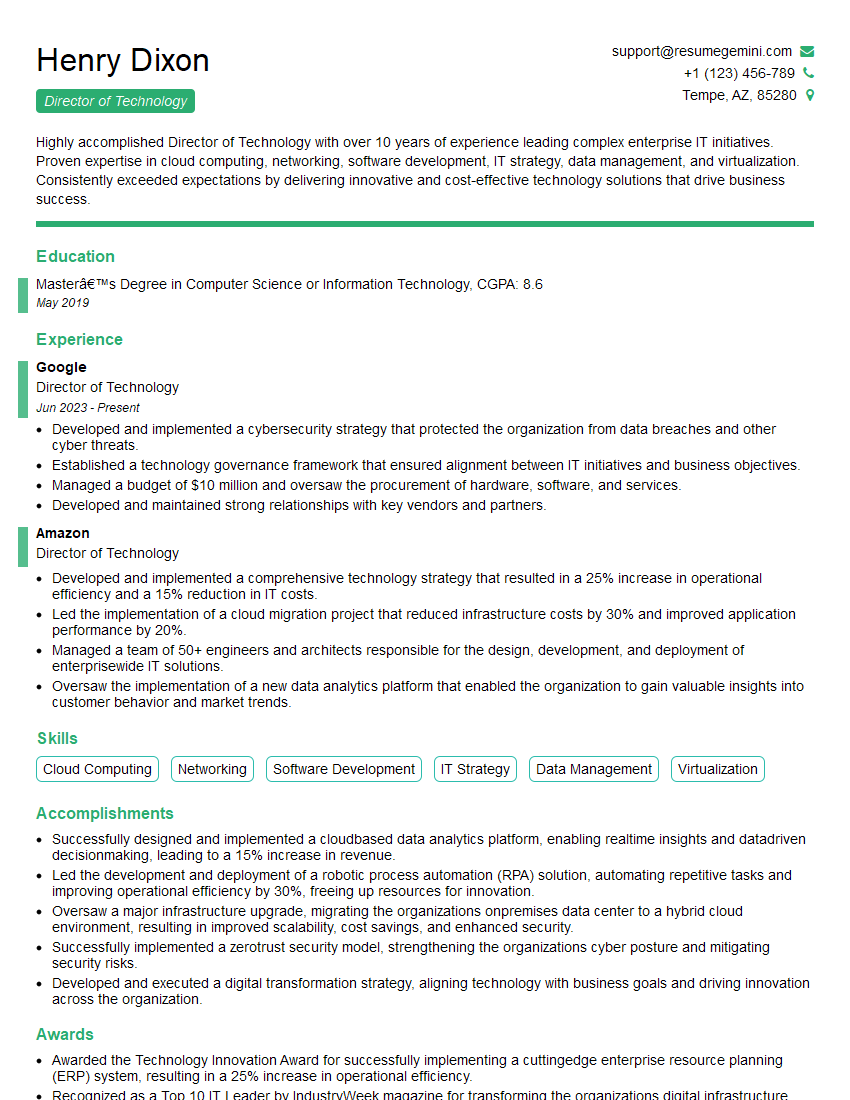
Mastering Restaurant Technology is crucial for career advancement in this rapidly evolving industry. A strong understanding of these systems and their applications will significantly enhance your value to potential employers. To increase your job prospects, focus on creating an ATS-friendly resume that highlights your skills and experience effectively. ResumeGemini is a trusted resource that can help you build a professional and impactful resume. Examples of resumes tailored to Restaurant Technology are provided to guide you.
Explore more articles
Users Rating of Our Blogs
Share Your Experience
We value your feedback! Please rate our content and share your thoughts (optional).
What Readers Say About Our Blog
To the interviewgemini.com Webmaster.
Very helpful and content specific questions to help prepare me for my interview!
Thank you
To the interviewgemini.com Webmaster.
This was kind of a unique content I found around the specialized skills. Very helpful questions and good detailed answers.
Very Helpful blog, thank you Interviewgemini team.